Therapists hear stories. Tons of them.
Everyone has one.
The most significant stories represent the essential narrative of a person’s life. You could have just one story that expresses how you see yourself and your journey through time.
It may not even take the form of a specific tale or recollection. Instead, in a paragraph, you might explain how your life has progressed and who you are.
Perhaps you think you are lucky or unlucky. Maybe you see yourself as a “mover and a shaker.” Do you imagine a handsome and suave (or beautiful and charming) soul as you look in the mirror? Or someone lazy or hardworking or resilient or weak or God-fearing?
But even if there is no yarn attached to the qualities you ascribe to yourself, the character traits you claim are still central to how you see yourself, something you refer to in quiet contemplation.
Nor does the story or characteristic have to be true. It just has to be something that you believe is true.
An example. An old acquaintance thought of himself as a lady’s man, making such politically incorrect comments as this simile: “A woman is like a bus — if you miss this one, there will be another one along in 10 minutes.”
He was clever, energetic, engaging, and outgoing but unremarkable in his level of success and appearance — not particularly tactful either. But when a woman rejected him, he was usually undaunted.
This gentleman even had a theme song of sorts. It was the soaring horn call from the Richard Strauss orchestral tone poem “Don Juan,” representing the bold, dashing title character he believed himself to be. And so, ever on the lookout for attractive women, he did, in fact, have numerous love affairs. Many ended badly, and he was as often rejected as adored.
Another person, no less likable or successful with the opposite sex, might have seen the identical romantic life as disappointing. But our “Don Juan” was rarely chagrined for long and continued to pursue women with vigor.

You might say that our hero had little self-awareness. But, the case can be made that he was more satisfied in living out his romantic life through his chosen vision of himself — through the story he told himself about himself — than if he had defined his role differently.
He could have devised an alternate narrative, including that of the often jilted, luckless lover.
I am not promoting this man’s approach to women or his less-than-realistic view of himself. That’s not the point.
Instead, his view gave him much romance, happiness, and excitement. In other words, he would have said it worked.
Unlike our friend, I have seen people change their stories over a lifetime. For example, from feeling unlucky to feeling lucky, timid to bold, or mistake-prone to capable.
It is worth asking ourselves what stories we tell ourselves about ourselves. Again, they might not stand up to external scrutiny, but they don’t necessarily have to.
We frequently create self-fulfilling prophecies, succeeding or failing because of what we believe will happen or who we believe we are.
The man in question had a lot of romance because he believed many women would find him worth their time. Had he seen himself as a schlemiel, he would have had much less female companionship.
Was his glass half-full or half-empty? That, too, is part of his story, and he certainly looked at life with a hopeful, optimistic gaze and focused on what was best in himself, not his weaknesses.
The person I’ve described had many friends and much pleasure, not only of an amorous variety. He led an active, adventurous life and didn’t hold grudges. Even if his approach to living is not one you would personally choose, do not be too hasty to judge it (especially after I tell you that he is a loving father).
A great man?
No, but then, there aren’t too many of those.
But he found a story that served to achieve fulfillment.
Many of us do worse.
========
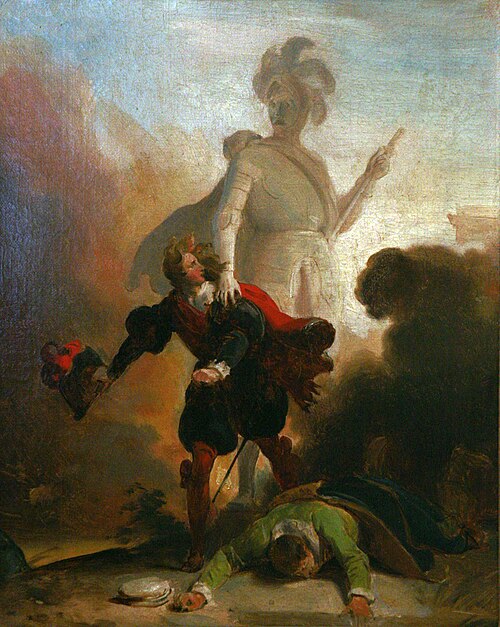
The top image is Don Juan and the Statue of the Commander by Alexandre-Evariste Fragonard, oil on canvas, circa 1830 – 835.
The photo below is Portrait of a Young Boy Looking in a Mirror, by A.M. Rothchild and Co., and provided by pellethepoet. Both of the pictures were sourced from Wikimedia Commons.

I love the vintage image of the little boy, peering both into and away from the mirror. Such a fitting visual to accompany your essay, Dr. Stein and especially this thought, ever true in my mind: …”the character traits you claim are still central to how you see yourself”. Agree, agree – no matter what other input swirls around us. Our thoughts and beliefs do the driving. Thank you!
Thanks, Vicki. I used to think human survival depends on what we don’t see about ourselves as much as what we do see. Unfortunately, the current state of human life suggests that some people can take that way too far! To stay with your “driving” metaphor, we need to be careful when we approach the cliff!
Ohhhh…..yes. I love that point. “Drive safely” indeed! ❤️
Fooling about myself?
All true.
At least it’s what my best friends tell to me, with tenderness and respect.
True?
“The little girl who goes under the trees
only has the weight of her pleat,
a silent song in her throat.
She sings alone
and jumps on the road; because she doesn’t know
she never will have greater gift
than this few alive gold on her shoulders,
than this joy in her throat.
To us who don’t have
other happiness than words,
and not the alighted pleat and not the great
hope which makes great her heart,
if it’s not asking too much, be taken
first life than this only gift.”
Camillo Sbarbaro
(Italian poet. 1932)
I’m not this little girl anymore.
My friends can repeat, with respect, with tenderness, I’m fooling myself.
I’m still this little girl with a pleat and gold in my throat.
But I know too well the price to pay is very high.
You are not alone, Micaela. We are all defended against seeing ourselves and the world as it is. I just saw Les Enfants du Paradise in French with English subtitles. Thank you for recommending it. Multiple heartbreaks while “the Gods” laugh from the upper reaches of the theater called life. I am sorry you are feeling this strongly now. Be sure to treat yourself well.
Caro dottor Stein,
Cannot avoid tears of gratitude and admiration for you humanity in reading you watched “Les enfants du paradis”, and in French, so to enjoy Garance, Baptiste, Frédéric’s real magnificent voices!
Did you fall in love with Arletty?
Did you cry during the first love scene between the two main characters because of Arletty’s deep total freedom and gift of herself and Barrault’s refusal of this grace from God’s?
Exactly what I’m going through from last two desperate months.
They will, years later, make love…to loose themselves again in a huge carnival’s crazy human crowd…
What will be of the little girl with pleat and few gold in her throat?
Like Nathalie, the little girl will find a way to survive, Micaela. For me, the gods of the theater represent the Greek gods of antiquity — a reminder that at times we are the playthings of fate. But we do persist.
An interesting topic, Dr. Stein, especially at a time when I’ve embarked on writing stories about my own life and other women along my life’s journey. I think that the stories we tell ourselves about ourselves are the ones that have the greatest impact in making our way forward after a defeat, failure, setback, blow, or loss. Much like the lady’s man who saw “a woman like a bus.” In other words, there will be other chances/opportunities to achieve whatever remain out of our reach at this moment.
Yes, they help us rebound if the stories have that built into them. If they are self- denigrating stories, then a rebound, persistent effort, or hope for a better result next time are unlikely. Thanks, Rosaliene.
I believe we have our own internal views or narratives of who we are. They may change over time, but be tainted by our lack of self awareness or our being too close to the subject.
Agreed. We know some things no one else knows about us, and others that would bring us to our knees if we recognized them. Thank you, E.A.
That’s is the truth!
Oh, I love this sentence, “It is worth asking ourselves what stories we tell ourselves about ourselves. ” Right -the most important person in the room and we often ignore that.
Love how you illustrated that point and this story so artfully from all sides. Beautiful, Dr. Stein!
Thank you, Wynne. We all walk in a bit of a fog and every so often we see the light. I am still learning too, especially on the days the internal sun comes out!
[…] Dr. Gerald Stein says in his blog, we all have at least one story we tell about ourselves to explain who we are. […]