How Well Are You Living — A Scorecard

Most of us are grateful that the daily newsfeed doesn’t report our personal failures. You don’t get graded, as in school. Nor do your hits and misses become an object of attention as they do for professional athletes.

In my day, all Major League Baseball trading cards included a picture on the front and the player’s career statistics on the back. A slab of bubblegum inside the pack you purchased was a bonus.

Imagine such cards for all of humanity, and ratings of each individual’s life performance updated once a year:

  •      Dating Success    C+
  •      Kindness               B
  •      Work Success       D+
  •      Mood                    C
  •      Parenting              B+
  •      Weight                  A-
  •      Attractiveness       B
  •      Wealth                  C-

Sorry. No bubblegum.

Would you want to know how your fellow humans rate you?

Would you like to be informed of your marks on a challenging test?

An old friend didn’t.

When his SAT (Scholastic Aptitude Test) results arrived in the mail (before the internet), he tore the envelope and its contents into small pieces and threw them away without reading the scores.

I was there.

He was admitted to Northwestern University.

Each person could provide their own categories and ratings, but they wouldn’t align with the rest of the world’s categories and ratings. It’s a necessary thing, isn’t it, that others keep their beliefs about you secret most of the time.

When might you find out such things, assuming you do?

Perhaps when your parents tell you what your teacher said about you. Annual performance reviews at your job insist on communicating whether you fit. When your friend, neighbor, or spouse is angry, you might hear it in their voice.

None of these consists of the full, detailed, and unimpeachable truth.

The validity of the information depends, more or less, on its application to one situation or another, and on the other’s diplomacy, affection, disappointment, and projection of their own problems onto you.

How would you deal with the alleged exactness of a negative report? Not everyone allows themselves to admit the dirtiest bits, the most contemptible indictments.

Beyond that, you might refer to your truth as “my truth.”

Here is a thoughtful comment on the “My Truth” movement from Hungry for Authenticity

By not having a precise definition, the “my truth” movement is being true to itself. Let me explain. The whole concept of “my truth” is that everyone’s truth is relative, as in, it’s personal to them. Therefore, “my truth” is in direct opposition to objective or absolute truth. To have a clear definition would put an objective truth label on the “my truth” movement. This is contrary to what it stands for! If there were a precise definition, it would defeat the whole purpose of “my truth.” The beauty of the “my truth” movement is that it can be whatever you or I want it to be.

Is it possible to combine all the details you receive from outside and inside into perfect autobiographical accuracy?

The completion of such an endeavor, inclusive of the owner’s evolving self-perception as he ages, recasts and refines his being as a person in motion.

An identity can be understood and recognized for a time, but as time goes on, man adapts, experiences more of life, and changes, whether he recognizes the modifications as they happen.

The best that you can do is to recognize some, but not all, of those shifts and revisions.

The truth of what one is can only be approximated. Unless you have been tested in situations that require courage, taking on danger, or enlarged self-sacrifice or generosity, you have not yet explored all your possibilities.

Where does that leave most of humanity? Your friends have their own opinions, but their frankness and honesty are not always on offer.

Your superiors have theirs, but the annual review is based on a single evaluator, possibly including a small number of additional voices, and, as a result, offers a limited perspective.

Your therapist? The professional wants you to feel secure and trust him. He tries to believe in you.

His observations occur only in the office or on a screen. The shrink’s clinical experience, you hope, generates insight.

If you are fortunate, he sees you as you wish to be seen and helps you create a possible future, including a fresh, modified version of yourself.

Your spouse and children? They witness more of you than most, but not necessarily the best of you.

Who are you, then? You might only come closest to fathoming that at the end of your life.

An additional, essential question, while you still have time, is who do you want to be, and how will you recreate yourself? The answers depend, in part, on your honesty about who you are.

Self-awareness grows from the important and wise opinions of those who know you at home, from truthful friends, and from the necessity of finding work and doing it. At your best, you try to acknowledge and remedy the flaws you struggle with and build on your strengths.

And you must be aware that time is short. No one can accomplish everything; not all roads lead where you want them to. As Steve Schmidt wrote yesterday on Substack:

The use of time is highly personal.

Its apportionment is foundational to happiness, and the decisions around with whom to spend it are keystones of life.”

If you are satisfied in the end, your scorecard doesn’t count for much. The record books, full of others’ opinions and ratings of your performances, have been noted.

As to the rest, dispose of them, albeit a little later than my friend’s SAT scores.

Here is Edmund Vance Cook’s entertaining position on all of this and more. A misleading title, but otherwise to the point:


Did you tackle the trouble that came your way

With a resolute heart and cheerful?

Or hide your face from the light of day

With a craven soul and fearful?


Oh, a trouble’s a ton, or a trouble’s an ounce,

Or a trouble is what you make it,

And it isn’t the fact that you’re hurt that counts,

But only how did you take it?


You are beaten to earth?

Well, well, what’s that!

Come up with a smiling face.

It’s nothing against you to fall down flat, But to lie there-that’s disgrace.


The harder you’re thrown, why the higher you bounce

Be proud of your blackened eye!

It isn’t the fact that you’re licked that counts;

It’s how did you fight-and why?


And though you be done to the death, what then?

If you battled the best you could,

If you played your part in the world of men,

Why, the Critic will call it good.


Death comes with a crawl, or comes with a pounce,

And whether he’s slow or spry,

It isn’t the fact that you’re dead that counts,

But only how did you die?

==========

The first image is Blurred Flowers Taken From Train at Beer Heights Light Railway by The Wub, sourced from Wikimedia Commons.

Next comes Gustav Klimt’s Hymn to Joy (detail) from the Beethoven Frieze of 1902. It is sourced from Wikiart.

Finally, Children Playing on the Water Playground in Front of the Tegetthoff-Denkmal at Praterstern by Metinkalkan, sourced from Wikimedia Commons.

What Wise Women Want in a Relationship with a Man

Sigmund Freud (1856 – 1939) was puzzled by the women of his time. We shouldn’t be. They have a wisdom worthy of admiration.

The psychoanalyst once said to the esteemed Marie Bonaparte:

“The great question that has never been answered, and which I have not yet been able to answer, despite my thirty years of research into the feminine soul, is ‘What does a woman want?‘”**

I will dare to answer the question the legendary psychiatrist could not. I received no small guidance from several knowing, kind, and whip-smart women I consulted on this issue. During my practice, I also evaluated or treated approximately 2000 individuals of the same gender.

First, I have narrowed the topic and will only offer a bit about young women. Like the men of their age, the experience, time, and change required to fully know themselves is ahead of them.

No one can understand what it will be like to marry, divorce, raise children to maturity, compete in the job market, suffer an illness, or grow older until many sunsets pass.

In the hormonal flow of youth, one is more prone to being swept away by a smile, charm, or an impressive resume. With luck, they have not yet been subject to the weight of longstanding desperation.

Time, disappointment, a broken heart, and mistreatment inform the wise about what they don’t want and what might create an enduring, loving partnership. Though we never fully understand ourselves, the clear-sighted and self-reflective among us acquire more self-knowledge than the younger version of ourselves.

Here, then, is a list of 18 characteristics that many astute, mature women are looking for in a partner:

1. To be Seen: A woman wants a consort to display interest in her. If the fellow is psychologically minded, such an enlightened companion will explore her ideas and soul as his acquaintance grows. Many women offer a sense of mystery and past adventures that go unmentioned unless a trusted one searches for them.

Significant others want to be recognized for who they are—never taken for granted. There are hopes, fears, passions, disappointments, and dreams to be uncovered. One extraordinary woman told me a lover should “look up when she enters the room.”

2. Kindness.

3. To be Admired: Routine wears down the niceties and compliments that draw us together. The words, flowers, candies, greeting cards, opened doors, and handwritten notes often become less frequent or vanish.

While it is impossible to make every day fresh, we all need admiration. With that comes respect and the acknowledgment that the other is your equal. She wants to be treated so.

4. Applause of Her Strengths and Acceptance of Her Weaknesses.

5. Financial Security: Women who earn more than sufficient funds sometimes fear a partner’s financial dependency or resentment of her success. Conversely, a male who controls the family finances because it is “his money” diminishes the one he says he loves and who he entrusts with their children.

To the extent the lady has set aside her career in whole or in part, appreciation should be factored into the twosome’s wealth.

6. Good Grooming: This quality includes caring for the body as it ages and regular medical checkups rather than avoiding MDs. Shaving regularly and showering after exercise show respect.

Not less than males, females want to be proud of how a mate appears in public. A man’s behavior needs to inform the woman she is desired. Attire and grooming tell her a part of this without words.

7. To be Heard: The partner should listen with intensity and focus, not impatience or overtalking. No one desires dismissal by someone checking the phone, looking at his watch, keeping the TV on, or reading.

Being heard requires patience, supportive listening, and understanding. It does not include unrequested solutions.

Men are inclined to dismiss emotions rather than provide comfort and recognition of the importance of the range of human feelings. One of the ladies I consulted reminded me that intimacy follows from being understood and heard.

8. Romance.

9. Sense of Humor: Wit, cleverness, and laughter are essential and count for more than many gents realize. A mature adult grasps the comical absurdities of life.

10. Acceptance of Physical Changes. No matter our self-care and exercise, evidence of aging cannot be hidden. The hand of Father Time can be delayed but not escaped. A wise spouse accepts this in himself and his mate.

11. A Mensch: According to Leo Rosten, Yiddish offers a version of “man” that differs from the definition of the same word in German.

A mensch is “someone to admire and emulate, someone of noble character. The key to being a ‘real mensch’ is nothing less than character, rectitude, dignity, a sense of what is right, responsible, decorous.”

Wikipedia adds, “The term is a high compliment, implying the rarity and value of that individual’s qualities.”

12. Honoring a Woman’s Role as a Caregiver and Family CEO: To the degree a man’s partner has historically taken on the traditional role of caregiver, this must be recognized and applauded. It should not be labeled as a set of tasks to be fulfilled by the female alone, expecting she forever put herself last.

Whether raising a child, earning a living, or both, a woman has accomplished something of merit. She requires time for self-care and wants a man to demonstrate his care for her through actions and words. She also needs time to herself, friendships, and activities apart from her husband.

13. Trust and a Sense of Safety—Physically, Verbally, and Emotionally.

14. Good Sex. Some couples will acknowledge a changed or fading sexual interest with time. A female confidant spoke for those who maintain much or all of their desire:

“Mature women are often more comfortable in their bodies, know what they like, have experience, and needn’t worry about pregnancy. They want a thoughtful and imaginative lover who cares about her pleasure.”

15. Opportunity and Support if a Woman Pursues a Career.

16. The Willingness to Apologize: The male ego insists that some men take an unashamed and unrepentant stance. Humble apologies are a necessity on both sides of any pair of people. Sincerity and reflection should be combined with humility, the better to escape future harm to someone you love.

17. Try to Show Interest in What Interests Them: It is well known that couples can grow apart over time. Too great a separation in what is vital to the other leads to a dying or dead letter connection between the individuals.

 18. Desiring No Man. Among those mature women who have had relationships and are heterosexual, more than a few find life satisfying without a romantic or sexual relationship with a man or woman.

Some of you will take issue with what I’ve written because I said too much or too little or revealed that I share the psychological blindness of many of my gender. I shall be pleased to be informed of shortcomings. Thank you for reading.

=========

The first image is A Woman Bathing Her Feet in a Brook by Camille Pissarro, 1894/95, Art Institute of Chicago. It is followed by a Daguerreotype of an Unidentified Woman ca. 1850 by Southworth & Hawes.

The following photo is Colors of a Woman, 2009, by Alex Proimos from Sydney, Australia. Finally, J. Howard Miller’s “We Can Do It!” is also known as “Rosie the Riveter,” after the iconic figure of a strong female war production worker. 1942/43. All the images but the Pissarro work are sourced from Wikimedia Commons.

**Sigmund Freud: Life and Work (Hogarth Press, 1953) by Ernest Jones, Vol. 2, Pt. 3, Ch.

The Stories We Tell Ourselves About Ourselves

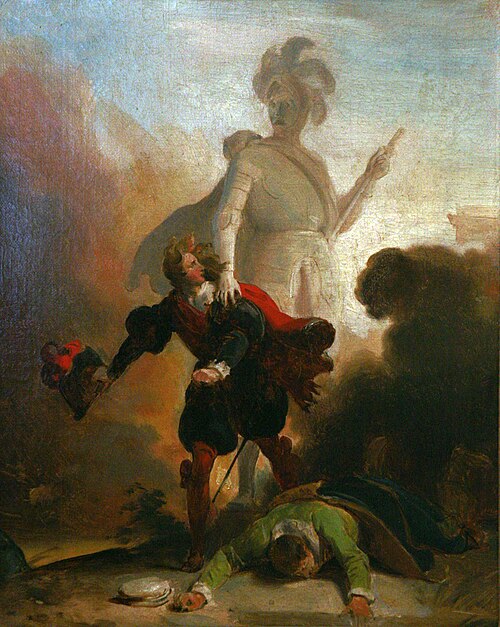
http://upload.wikimedia.org/wikipedia/commons/thumb/4/49/Don_Juan_and_the_statue_of_the_Commander_mg_0119.jpg/500px-Don_Juan_and_the_statue_of_the_Commander_mg_0119.jpg

Therapists hear stories. Tons of them.

Everyone has one.

The most significant stories represent the essential narrative of a person’s life. You could have just one story that expresses how you see yourself and your journey through time.

It may not even take the form of a specific tale or recollection. Instead, in a paragraph, you might explain how your life has progressed and who you are.

Perhaps you think you are lucky or unlucky. Maybe you see yourself as a “mover and a shaker.”  Do you imagine a handsome and suave (or beautiful and charming) soul as you look in the mirror? Or someone lazy or hardworking or resilient or weak or God-fearing?

But even if there is no yarn attached to the qualities you ascribe to yourself, the character traits you claim are still central to how you see yourself, something you refer to in quiet contemplation.

Nor does the story or characteristic have to be true. It just has to be something that you believe is true.

An example. An old acquaintance thought of himself as a lady’s man, making such politically incorrect comments as this simile: “A woman is like a bus — if you miss this one, there will be another one along in 10 minutes.”

He was clever, energetic, engaging, and outgoing but unremarkable in his level of success and appearance — not particularly tactful either. But when a woman rejected him, he was usually undaunted.

This gentleman even had a theme song of sorts. It was the soaring horn call from the Richard Strauss orchestral tone poem “Don Juan,” representing the bold, dashing title character he believed himself to be. And so, ever on the lookout for attractive women, he did, in fact, have numerous love affairs. Many ended badly, and he was as often rejected as adored.

Another person, no less likable or successful with the opposite sex, might have seen the identical romantic life as disappointing. But our “Don Juan” was rarely chagrined for long and continued to pursue women with vigor.

You might say that our hero had little self-awareness. But, the case can be made that he was more satisfied in living out his romantic life through his chosen vision of himself — through the story he told himself about himself — than if he had defined his role differently. 

He could have devised an alternate narrative, including that of the often jilted, luckless lover.

I am not promoting this man’s approach to women or his less-than-realistic view of himself. That’s not the point.

Instead, his view gave him much romance, happiness, and excitement. In other words, he would have said it worked.

Unlike our friend, I have seen people change their stories over a lifetime. For example, from feeling unlucky to feeling lucky, timid to bold, or mistake-prone to capable.

It is worth asking ourselves what stories we tell ourselves about ourselves. Again, they might not stand up to external scrutiny, but they don’t necessarily have to.

We frequently create self-fulfilling prophecies, succeeding or failing because of what we believe will happen or who we believe we are.

The man in question had a lot of romance because he believed many women would find him worth their time. Had he seen himself as a schlemiel, he would have had much less female companionship.

Was his glass half-full or half-empty? That, too, is part of his story, and he certainly looked at life with a hopeful, optimistic gaze and focused on what was best in himself, not his weaknesses.

The person I’ve described had many friends and much pleasure, not only of an amorous variety. He led an active, adventurous life and didn’t hold grudges. Even if his approach to living is not one you would personally choose, do not be too hasty to judge it (especially after I tell you that he is a loving father).

A great man?

No, but then, there aren’t too many of those.

But he found a story that served to achieve fulfillment.

Many of us do worse.

========

The top image is Don Juan and the Statue of the Commander by Alexandre-Evariste Fragonard, oil on canvas, circa 1830 – 835.

The photo below is Portrait of a Young Boy Looking in a Mirror, by A.M. Rothchild and Co., and provided by pellethepoet. Both of the pictures were sourced from Wikimedia Commons.

Tests of Character and What We Make of Them

Life is full of challenges. Not all demand courage.

Moreover, sometimes what looks like bravery might be foolishness.

Judge for yourself.

Judge me if you wish.

Before I began the independent practice of clinical psychology, I taught at two fine East Coast universities and then spent several more years working in a small private psychiatric hospital.

The institution’s owner was a remarkable man, remarkable because of his strange combination of incompatible characteristics. Those qualities included generosity, thoughtfulness, arrogance, philanthropy,  and vindictiveness.

Let’s call him SB.

Play with the letters to see if you can come up with a nickname. Perhaps choose a vowel for his middle initial.

This gentleman’s ego could have filled a large sports arena. I learned during my tenure to reason with him alone, not in public, a place where he might lose face. Confidential discussion often persuaded him to give up some of his dubious ideas.

The boss recognized my worth and treated me well for a few years. Ah, but almost everyone found himself in his metaphorical crosshairs as time passed.

One of SB’s brainchildren was the creation of a psychology internship program based at the hospital. The head man hired a part-time director, but the American Psychological Association accreditation team rejected his scheme — his baby. They cited the lack of a full-time chief as their biggest concern.

SB was displeased.

I was occupied with other activities within the facility, but SB wanted me as the savior of the program: its new high potentate. Some confidential conversations with the overseer offered hope he’d target someone else. I preferred my then-current work responsibilities. The request remained unresolved.

The new interns arrived on an autumn day like any other, but not a day like any other in my life.


At the time, I had a 19-month old daughter. My wife and I wanted our darling to benefit from a stay-at-home mom. Therefore, I was the sole financial support of my family, a fact known by SB.


Unknown to me, “the man” used the morning and early afternoon to introduce the aforementioned three graduate students to various staff members. I later found out he pushed several people around as he walked the newbies through his domain. No one was immune. Not doctors, nurses, psychiatric aides, or housekeeping personnel.


SB was a master of bending others to his will on the days he wasn’t smiling. The chieftain demonstrated to the twenty-something trainees his status as GOD relative to mortals.

My office overlooked a river at the far end of the building, leaving me last on the trail of tears. The maestro announced himself, and the young people joined the two older ones (I was almost 34 and SB in his 50s).

After introductions, the conversation sounded like this:

Dr. Stein, what have you decided about the directorship of the internship program?

I’d prefer to speak with you about it alone.

I’d like to know your answer now.

I’d prefer to speak with you alone.

Tell me now.

The exchange continued into infinity. The overlord tried to force the issue, and I repeated myself in the same words for about 10 years, psychologically speaking.

OK, not a decade as told by the clock. Maybe a few minutes if you add the silences. Lots of time spent staring at each other.

Another entity entered the room as soon as the confrontation began. No, not my past flashing before me, but my unlived future, towering like a gray shadow from a place just over my shoulder. Every person had a shadow but the fellow in charge.

Weeks later, I asked the fledgling psychologists for their take on the episode and their estimate of its duration. They were petrified. Everyone’s sense of time stretched like taffy.

Back to my office. Once SB realized he couldn’t make me talk in their presence, he ushered them out and told me I’d better say yes if I wanted to work at HIS facility. He gave me a couple of days to think it over.

Sounds like fun, doesn’t it?

The result: I took over as the new director and explored plans to exit the hospital. SB and I were soured on each other. No value would come in staying. I departed several months later, invited to become the junior member of small group practice, of which I became the head within a few years.

What else was going on inside of me during the contest? I envisioned the event this way:

One person tried to get over (on top of) the opposition, defeat the other — “put him in his proper (diminished) place.” SB intended to bend another human object to his will, bring him to his knees.

The other resisted.

For years I engaged in silent self-praise for holding to some unarticulated principle.

Nope. No doctrine existed. My intransigence was about being a man. I wasn’t fighting for freedom, civil rights, saving the planet, world peace, better schools, racial equality, or any other noble pursuit.

As you must recognize, I did give in to him later offstage, not in the drama he initiated. Indeed, I knew he owned the power to fire me from the start.

Despite mindfulness of my jeopardy and awareness my wife and daughter depended on me, I didn’t roll over. The months between that day and my resignation were fraught. I put myself through a good deal of worry and unhappiness, my spouse as well.

Not so smart, then? I might even agree with this determination.

Here’s an additional complication: I felt I could not do otherwise than what I did. I reacted out of instinct. I’d have been ashamed for capitulating in front of the arriving trainees.

I’d have defined myself as a coward even though my employer had every right to reassign me to a different niche in the organization.

Both SB and I behaved with an awareness of our audience. It doubtless reduced the two antagonists’ willingness to act differently than we did.

Though I did not realize it at the time, SB’s actions motivated me to leave his employment and begin a far more fulfilling role within my profession, a necessary step toward my professional independence.


The insecurity of my status required me to be more creative, learn additional skills, reinvent myself from a vocational and personal standpoint, and enhance the economic security of my little family.

From that perspective, SB did me a favor. My superior made me uncomfortable enough to alter my career path and take more risks. I became, in my judgment, less a person who allowed fate to carve the road I traveled and more a man who forged his own way.

As I progressed, more opportunities came to me. Confidence grew, and my perception of myself evolved into that of an individual who could make a life rather than endure it or hide from it.

SB meant me no favors, but if I met him today, I might thank him.

One more thing, I was lucky, wasn’t I? A poorer outcome might have occurred.

Until such challenges appear, we don’t know ourselves. Most of us imagine what we’d do in a variety of conditions we’ve never encountered.


When we read news stories about the misfortunes of others, too many of us achieve a cheap self-satisfaction by claiming we’d have made a different choice. We assure ourselves of a wise departure before a disaster unrecognized by its soon-to-be victims.

Unlike other weaker souls, our fantasy includes unfailing defense of our principles. The poor mass who suffered or died didn’t possess our foresight, intelligence, or hard work, so we think.

On the other hand, self-awareness comes at the price of realizing the dream of heroic behavior in unlived circumstances is like a soothing massage of our self-image.

I am no hero, and I do not claim the rank of a great man. I hope you extend yourself beyond whatever evaluation you make of me.

What I’ve written has value only to the extent a single reader considers himself and reflects on whether the tale offers insight into his own life.

That much is in his hands.

=======

Each one of these images is called Face-off.

The first is by Aaron from Seattle. The Jack-o’ – lanterns Face-off is the work of William Warby.

Next comes the Face-off Situation between Evan McGrath and Ken Olimb in Tegra Arena by Calle Eklund/V-wolf.

Finally, NASA/JSC and Robert Markowitz created Face-off Robonaut. All were sourced from Wikimedia Commons.

“What Am I Without It?” When Opportunities Follow Loss


They say we don’t know the value of a thing until it’s gone. If so, everyone on the planet has learned something during the pandemic.

Do you remember your last kiss or hug or handshake? We aren’t often told, “Hey, I wanted to mention, this is the last time, at least for a while.” How rude of Mr. Covid not to announce us.

For a portion of our fellow men, having a job and a place to live is newly uncertain. The future of recess on the playground and the source of the next meal leave question marks.

We miss smiles not blurred behind an electronic scrim on Zoom, the twinkle of another eye, a hand on a friend’s shoulder, and a meeting with his eyes.

The bottom half of faces, too.

If the deprivation we suffer illuminates our values, perhaps we will live a rearranged, reimagined life just ahead. One hopes the knowledge of “what is important” sticks with us.

Ours is to search for the joy we so miss, the balance stolen by the virus, the buoyant activities and interactions that made previous hard times endurable; the reliance, worship, and community encounters broken up and swept away like browned leaves in the wind.

At other times some decided to volunteer for losses. Peter Serkin, the recently deceased pianist, set music aside in his early 20s to travel. He ceased both practicing and performing to “find out who I am without it.” The artist returned to concert life and an extraordinary career informed by what he discovered during his self-imposed separation from his instrument.

Religions ask us to give something up, a loss imposed if you are a doctrinaire believer. Certain foods become forbidden. Your self-denial tells you how much your faith means to you, or perhaps how much you fear divine judgment.

Your devotion and comfort in the Deity grow from saying “no.” Saying “yes” to a moral code outside of church gives its own meaning, as well.

Time is a commodity we all lose all the time. Some careers stand frozen in place. Athletes don’t get their physical prime back. Young people need formative social experiences and pleasures that cannot be retrieved with ease from behind.

The philosopher Heraclitus said, “No man ever steps into the same river twice, for it’s not the same river, and he is not the same man.” The speeding passage of the seasons always requires our choice of one activity over another, one person over another. We might ask, how much time will I trade for how much money?

We are forever deciding where to focus attention, enduring stress to find the next job, risking a question in the hope of a particular answer, daily saying hello and goodbye. No wonder the Hebrew word “shalom” signifies both of those common words.

We are, if we are self-aware, frequently finding ourselves. A person who recognizes himself as changing and changeable knows he must remodel himself. Even without awareness of this necessity, he will be altered by time and events.

The first of the Ancient Greek Delphic maxims was “Know Thyself.” Most don’t, but even if they do, they ought to ask later, “Am I still the man I was? Who am I now? Do I want to be a different person living a different life differently?”

As the planet reopens, we will discover a new world, one with fresh dangers and novel opportunities. Indeed, our place in it, the place for us before COVID-19, may not be suitable after. To the good, we are still capable of becoming.

What you lose changes you. Though we come to expect it, the ache from the departure of a loved one remains tender for as long as it takes for the breeze to wear it away. Hearts are full of irreplaceable people, some alive in “a world elsewhere,” others muted shadows.*

Perchance a grand adventure awaits in the recovered and recovering times. Think of yourself as a sculptor or a portrait painter creating your own likeness.

Yours is the only hand that shapes and shades what is essential, knowing what you alone comprehend. Chance or fortune will fiddle with you, but you needn’t accept every bit of the fate they deliver.

You have a part to play if you can locate it. You haven’t, you say? Keep looking for the role to which you aspire. Life can break you, but it also carries surprise and wonder.

Late in his life, my dad often studied the cement a few steps beyond as he walked, perhaps reviving a habit begun in the Great Depression. He found pocket change, paper currency, and once a fancy watch. I’d not recommend the practice, but you won’t find anything unless you seek it.

First, tape over the hurt spots and find the hunter within.

============

*The three quoted words come from Shakespeare’s play “Coriolanus,” Act III, Scene III.

The top painting is “With an Umbrella,” 1939, by Paul Klee. The final photograph is “Arizona Sunset,” late July, 2020, S. of Tucson by Laura Hedien, with the kind permission of Ms. Hedien: https://laura-hedien.pixels.com/

Learning Who You Are

We reveal ourselves to ourselves by our actions more than our words. That is, if we choose to observe. Not all of us do and none of us look all the time. Instead, we disguise ourselves to ourselves, perhaps as much or more than we do with others. Maya Angelou said, “When someone (else) shows you who they are, believe them the first time.” Yet we often fail to accept the behavioral evidence of our essence. The reality is there, waiting in plain sight, waiting as long as we take. A dream summoned such a truth-telling college moment not thought of in decades. My grandson’s recent fascination with battling dinosaurs served as a backdrop, too; the kind of metaphorical identification a man my age discovers in those extinct beasts.

Evanston, Illinois, around 1967. My buddy Alan invited me to join him at a friend’s apartment. Alan knew M fairly well. The latter would create the circumstances for revelation. He lived in a modest abode typical of university students. Unmatched furniture, well-worn area rugs, a clean but not spotless space. M, himself, was more imposing: perhaps six-feet-tall, strapping arms hanging from broad chest and shoulders. Overall an impression of hearty, radiating physical strength, but also apparent good cheer.

The clock did not threaten. No school the next day. The three of us laughed a lot and we drank. This small group formed a rough triangle sitting on the floor a few feet from each other. I do not recall what brought me M’s displeasure. An idle comment? No matter, he was pissed. The M of robust build. The M who overmatched me by maybe 40 lbs. of muscle and loads of menacing intensity. The formerly amiable fellow wanted my apology, demanded it.

I tried to explain what I meant by the unfortunate utterance, misaligned with the meaning M took from my words. M insisted again, fueled by his liberal ingestion of alcohol, he more than me. I repeated the attempt to find the right nuance, the right cover; terms reflective of what I intended, not what he understood from my language. Back and forth, back and forth we went. M warned of the cost of my continued failure to give him satisfaction. My teeth were now in danger of disassembly, rearrangement, and extraction by a non-licensed dentist of sorts — who was out of sorts. A man whose fisted hands resembled mallet heads, like crude surgical instruments powered by entwined steel cables extending from his shoulders. Now you recognize why my grandson’s recent fascination with smashing toy dinosaurs together evoked this memory. Being a reasonable young man, knowing myself no match for M in brawn and recklessness, you might imagine I capitulated: gave him the confession he stipulated in whatever words the bloke preferred. You’d think so. I didn’t. I could tell you my intransigence was a matter of pure principle, since I want to think myself a principled person. I could say I was brave, but a lofty philosophical stance and courage don’t explain my noncompliance. Rather, I couldn’t do what he asked. It wasn’t in me. This is the way I am made. I take no extravagant credit for it most of the time. It’s kind of similar to being almost 5’9″ — my height then and now — an unchangeable thing. Like the length of my human fabric, the behavior was fixed. I wasn’t made to apologize for a statement I didn’t regret. If my child’s life were at risk, I’d have been flexible. My children were then not even a twinkle in my eye. Fighting for a principle over nothing of importance is, I might argue, foolish. Masochistic, too. No careful reasoning prepared me for the moment, nor did time permit.

Longtime friends witnessed many changes in me, qualities I worked to alter, insecurities and fears among them. Not everything is amenable to transformation, however. In fairness, I never wished to lose the capacity just described once I found it. While this peculiar talent can manifest in the ill-advised form presented here, it appealed enough to my self-concept to retain it, consistent with who I wanted to be. Thus, in a situation recommending a different way of being I revealed to myself who I was. But two other players took part in the drama, don’t forget. They also disclosed themselves, one in a manner far more commendable than anything I did or didn’t do.

Let’s go first to my antagonist, M. The host betrayed himself as a belligerent drunk. To fact-check this, a few days ago I talked with Alan (my companion in this adventure) and Harmon, someone who knew M longer than Alan; also a precious old friend to me, but not present at the drink-a-thon. By graduation neither one wanted anything to do with M because of his growing addiction and the anger it stoked. On to Alan. The final member of our ill-matched triumvirate showed an admirable quality as rare as it was necessary to me. As M’s rage moved toward climax, Alan said something to him designed to stay the impending explosion. Alan was not M’s physical equal. Though the tallest fellow in the room, my friend is slight and unathletic; a man at home with books and Bach, not fist fights. The back and forth shifted in Alan’s direction. At some point one of them hit the other, on the shoulder I’m guessing since I can no longer remember, and the other returned the blow.

To my surprise and relief the rising column of red in M’s eyes, like a thermometer’s mercury, started to fall. We left soon after, with all our body parts still attached. I’m pretty sure I thanked Alan as I drove him back to his place, but did so again this week. M could have dismantled him instead of me. This comrade of more than 50-years told me he recalled feeling responsible for putting me in the situation. Not everyone risks his own body as he did. Alan revealed himself. Had my ally not intervened, whatever number of teeth I put under my pillow at day’s end would not have earned compensation from the Tooth Fairy. She, I’m sure, doesn’t reward anyone of college age who should have known better.

——-

The top reproduction is Paul Klee’s The Bounds of Intellect. The next three are Egon Schiele’s Self-portrait (1916), the Seated Boy, and his Self-portrait in a Shirt. Finally, Paul Klee’s Battle Scene from the Comic, Fantastic Opera, “The Seafarer” and Joan Miro’s The Escape Ladder.

Knowing Yourself, Then Showing Yourself

Writers are reminded to “write what you know” and “show, not tell.” The instructions apply to fiction, but also pertain to the fact of who we are.

Therapists take the closed-up, armored patient, hoping to help him remove his metal plate covering.

His end goal?

To man up.

Up straight, chest out, eyes forward. Self-confidence and pride manifest themselves in the unspoken declaration, “Here I am.”

One encounters rejection this way, but our compensation is exploration of the world regardless of fear. What acceptance we obtain is less essential, but more often real; not the approval of those fooled by our costume, blinded by the bronze.

Much discussion exists on the subject of self-revelation to others, but a first step prepares you to lower your guard. It was inscribed on the Temple of Apollo at Delphi over 2500 years ago:

Know Thyself

A dangerous effort? The book of Ecclesiastes warns:

For in much wisdom is much vexation, and he who increases knowledge increases sorrow.

We seem to have a conflict here. Humans use rationalization, compartmentalization and four “D” words to keep their minds off troublesome realities: denial, dissociation, distraction, and drugs.

Socrates, another son of Greece, sided with Delphi over Ecclesiastes. The legendary teacher didn’t write, wore dirty clothes, and was sufficiently disclosing of what he stood for that he was sentenced to death for “corrupting the youth of Athens.”

He led them to question their own beliefs.

The philosopher chose his end over exile because he could only be himself as he wished to be, with his people.

Counselors are friendlier to Socrates than Ecclesiastes in their pursuit of the Delphian truth. They recognize no one can show himself who doesn’t know himself.  Otherwise he displays but half — the fragment of which he is aware.

The hearing impaired who are clueless to their deficiency resemble those without self-knowledge. Such men live in a world of sound, but perceive only a segment of it. The undiscovered portion leaves no evidence of absence, no apology in the form of a regretful RSVP.

But Ecclesiastes was no fool. Fearless self-insight exacts a fearful price. Once you realize how you hurt another, the recognition bleeds you. You bleed in the knowledge of who you have been, how you harmed. To the good, now you can improve, apologize. Permission for do-overs, however, is a rare, “sometimes thing.” The damaged don’t always stick around.

Nor does self-awareness recover lost time. Those who wait for aged parents to acknowledge their failure, encounter people for whom internal vision would come with an unacceptable redefinition of themselves.

Fifty-years of error cannot be borne except by the hearty in body and mind. Indeed, all of us of whatever age want to turn from the mirror’s truth, claim distortion, and blame the glass.

A splendid blogger, Clara Bridges, tells us, “I read and write poetry for myself, not for others, and in both cases the revelation is primarily of myself, to myself.”

Clara recognizes the power of journaling, not just expressive and therapeutic, but as a tool for piercing the layers of cloaking armor we wear in our everyday version of Halloween.

Bronze plate is an inflexible thing. Clanging hardware is cumbersome and noisy. All grace disappears, the wearer’s voice drowned out by the dissonance.

A Dance of Seven Veils calls to us. The music is seductive if you are open to hearing it and brave enough. Adding to Delphi’s admonition, it sings, “Know thyself, then show thyself,” one dropped veil at a time.

You partner with yourself in the first dance, others are invited later.

Who knew counselors offer dance lessons?

—–

The first image is Constance Talmadge, Head and Shoulders Portrait,1921, Library of Congress. The second is called, Looking in the Mirror, taken in Surmi, Tulgit, (a small village in Ethiopia) by Rod Waddington, 2014. Both are sourced from Wikiimedia Commons.

“I’m Beautiful and Smart, but I Always Wind Up with the Wrong Person”

P came to therapy with sadness and anger, as though she carried them in her backpack before unloading them on the low table between us. The surface was covered, her combination of feelings familiar to me. I already imagined difficulties. She’d be challenging, but I was not about to give up before I started.

P believed the world had been unfair. Boyfriends expected too much. They tired of her or betrayed her. A therapist doesn’t dispute this, but lives in hope the client will grieve to the point of readiness for self-reflection: consideration of his part in the staging, acting, and dialogue of life’s drama.

We try to aid in the process. A counselor asks about patterns of relationships. I wanted to know if P recognized the resemblances among her romantic adventures. “How do you explain it?” I asked.

They all seemed so nice at the beginning and then — and then they turned on me. I never, never thought …

With such people as P — and there are many Ps in any crowd — the “turning on me” takes several forms. The other becomes prone to anger or alcohol abuse or infidelity. That inconstant soul begins to spend more time with friends or starts to work too many hours; or changes into someone who finds his sweetie dull. He transforms.

He was not this way before.

P had done nothing to cause the Jekyll/Hyde malformation, “I swear,” she claimed. To me, her psychologist, it was not so simple. In her view, the lover was now a minor league version of the devil. Her Magic Mirror, a family heirloom, told her every day:

You are pure, you are grand; in this you had no hand.

Six relationships in 10 years, all with the same beginning and the same end.

In fact, P made at least one mistake, maybe two:

  • Either her judgment of human nature (companion variety) was poor and she kept picking similar types of unsatisfactory men or
  • The lady added some sour ingredients to the relationship formula, influencing if not inducing the unhappiness she reported, however little her contribution.

I asked Socratic questions to no avail. “What attracted you to the man?” “What did your friends think of him before you moved in together?” “Was there anything valid in his excuses or complaints about you?”

Nothing.

We are imperfect evaluators of our fellow-man, every one of us. Our unconscious affections and dislikes are drawn from resemblance to other important figures in our life, instinctive attractions or repulsions, interests and aspirations shared or opposed. Everyone makes mistakes in evaluating others. Friendship and love often founder on differences unknown in first moments.

Less frequently character is the issue, but this too takes time to reveal itself. Courage and morality don’t exist until tested by temptation, fear, or conflict. Most new acquaintances offer their best behavior. Routine daily experiences don’t require us to be brave souls or saints in order to display dutiful goodness. Almost all of us are pretty good at that.

Still, we must evaluate potential employers and friends, politicians and lovers without enough data, usually based on first impressions and behavior in periods of unchallenging normalcy. The lonely look for the perfect match for their imperfect selves. Instead they find another struggling human who fits less well than they hoped; or a honey who is ideal for a while, but not always in all ways. The same applies to the aforementioned bosses and friends.

The world of gauging the personal equation is forever in motion, done on the run. We do the best we can.

—–

P would leave treatment having grieved her broken heart, but without learning much or changing much. One’s personal inertia assumes he possesses every answer to life’s secrets. I’ve yet to meet such a one, but know several who tell me life is in the dance, not in stasis.

—–

I anticipated P’s merging with another man like the others, one who would turn her on and then turn on her. A therapist is not like a can opener, capable of piercing the defensive metal container enclosing his patients. He builds relationships, hopes to engender trust, but his tools are subtle, not surgical.

We ask our clients to give up one self-image for another, to murder the one and create a replacement. Counselors offer something better than dissolving the patient’s befogged understanding of himself, but harder. Some prefer their long familiar selves and want the world to change for them.

It never does.

If instruction would have made a difference, I’d have said this to my story’s troubled young heroine:

There is one constant in all the relationships you describe: you.
Do not mistake rage or hurt for infallible righteousness, no matter how they make you feel.

Imperfection and self-knowledge are hard to bear. Nearly all of us think we understand ourselves well, but perfect self-awareness would bring us to our knees. Instead of the full truth, we drew the outlines of our lives a while ago (with help from parents), marking what was acceptable, healthy, or necessary. For some, this meant a large life, for others a narrow one

If we were poor in our original self-creation — too much license here, too little assertiveness there, or avoidance everywhere — Personality Flaws crept into and colored the picture. They persist without effort; as if living, invisible masters of our existence. Time and repetition mean nothing to them, they last and last until the last, internal holes in the sidewalk of our being. Fall into them or repair the hazards as you wish. Waiting for you to wise-up is their comfort zone.

Many shortfalls reside inside, even for those who — like P — believe recurring dilemmas to be outside of themselves and their control.

A shame.

Remember what Cassius said in Shakespeare’s Julius Caesar?

Men at some time are masters of their fates: The fault, dear Brutus, is not in our stars, But in ourselves, that we are underlings.

Those words are harsh medicine. While Cassius’s judgement does not account for the external, invasive tragedies we suffer, they are an accurate understanding of the cause of many frustrations. His truth can be denied, but we cannot avoid the consequences except by work on the single aspect of life most in our control: what is inside us.

Then comes a better life.

The top photo is of the Spiral Staircase in City Hall, London, by Colin. Next comes Citadel of Qaitbay by Ahmed Younis Sit Saad. Chicago’s Rookery Building’s interior is represented in the third photo and the final one. The first shot is its Central Staircase, by Ken Lund. The other is another Staircase view, this one by Velvet. All are sourced from Wikimedia Commons. In between the Rookery shots, I’ve placed an Inside-outside Innovation picture, taken from Innovation Management.

What Does It Mean to be “Psychologically Minded?”

A good observer of the human condition notices some fellow creatures who don’t get it. Several are obtuse. Many can be described as too logical. Others naïve or unworldly. More than a few don’t think through what they do and why, dismissing opinions different from their own. Their certainty of everything betrays their awareness of nothing. Large numbers can’t recognize the obvious ingredients in their complicated emotional stew.

They don’t even hear the stewpot boiling over.

I’d characterize such folks as lacking a certain “psychological mindedness.” Though this is not my own term of art, it is a phrase without a single definition understood and accepted in the field of mental health. Still, I’ll try to describe one possible understanding of such a state of mind and why it might be useful to us. If you are psychologically minded, several of these qualities will be characteristic of you:

  • All your decisions are not understood by you. Mystery resides in everyone. We are each some combination of genetic programming, the formative influence of our parents, education, experience, and choice. Emotion and reason both play their part. Should you be so unwise as to claim understanding of all your motives, you are mistaken.
  • Illogic troubles your thought process and you know you aren’t alone. You don’t insist your every idea is structured like an architectural work of art, nor hold others to this standard. Were logic alone in charge, you’d be a robot. We arrive at some of our most vehement opinions intuitively and only then find justifying reasons with blinding speed, a process invisible to the internal eye.
  • You are aware mom and dad were imperfect and don’t dismiss their effect on you, for good or ill, probably both.
  • You don’t believe your achievements are the singular product of your special genius and effort. We are interdependent, all of us: impacted by the color of our skin, the economic and social circumstances of our birth, the presence or absence of societal and political unrest, the power of love and loneliness; and by a helping or dismissive hand, not to mention the accident of our appearance. You are on board with John Donne’s poetic truth, “No man is an island, entire of itself.” As my friend, Life in a Bind, suggests, “you think about yourself in the world from a slightly more distanced stance than others do, and with a longer lens stretching back into the past.”
  • You know grieving takes its own time and is best done with one or more faithful witnesses, not by the toughness required for bullet-biting; or burying sadness in perpetuity. Others are not advised by you to “get over it.”
  • Unfairness, you think to yourself, can be subjective and therefore a matter of perspective.
  • To a degree you know the danger of being hostage to the opinion of others.
  • You don’t “blame the victim” by asserting you’d have been smarter in a difficult situation: made a better choice, demonstrated more resilience, or maintained a higher moral standard. Without experience in the same circumstance, in truth, you cannot predict what you’d have done.

  • You recognize your lack of “all the answers.” You are humble in the face of the things you don’t understand and accept the need to learn more. You grasp at least a bit of the human necessity for continual transformation as you age and face unexpected situations requiring new solutions.
  • You don’t reflexively condemn others when something goes wrong, instead demonstrating occasional willingness to look into the mirror. Nor do you make automatic assignment of blame to yourself, realizing, at least, the cost of doing so, even if you cannot yet stop.
  • Once in a while you ask, “Why did I do that” or “Why did I say that?”
  • To paraphrase Life in a Bind again, psychological mindedness permits insight into mind traps: the alteration of perception when gripped by defenses like projection. What feels real emotionally may not be true.
  • To your dismay, you are cognizant of the human capacity to rationalize almost anything, murder included. Perhaps it has dawned on you that you too rationalize. You regret another painful truth: even wonderful and wonderfully talented people possess a dark side.
  • While some challenges are uncomfortable to face, you believe avoidance of a direct glance or assertive action might be a costly life strategy.
  • You are a part-time observer of yourself, not obsessed with yourself. You are neither totally inward-focused, unable to get out of your own head; or totally outward-focused – mindlessly “in the moment” – never reckoning with who you are. You agree with Socrates (“The unexamined life is not worth living”), but not so far as to spend all your time in examination, avoiding action and risk. If you cannot yet venture forth, your realize you must find a way.
  • You either play or wish to learn how to play.
  • Self-righteousness is something you avoid.
  • You understand that openness is double-edged: the pursuit of intimacy means guaranteed risk in search of potential reward. You opt for openness, at least in theory.
  • From time to time you think about your default tendencies. Perhaps you are inclined to approach or avoid, argue or make peace, court danger or play it safe, etc. On occasion you even think your strengths (and the penchant to overplay them) are your weaknesses.

If you recognize several of these qualities in yourself, you are a good psychotherapy candidate, assuming you muster the courage to gamble something great for something good. Your psychological mindedness is now and again misunderstood by friends who do not view the world with the nuance you do.

Keep going and growing. The world then becomes a bit more explicable and your understanding of yourself enlarged. The planet will take on colors never noticed on the black-and-white globe you used to inhabit. Your perspective may also attract new acquaintances.

Some will think you unnecessarily troubled, others conclude you are wise.

No free lunch.

Choose.

The image of The Human Mind comes from Wikimedia Commons via Flicker. No author is identified. The second Wikimedia photo is a Psychic Apparition. It comes from the collection of Tyne & Wear Archives and Museums, from a series called Psychic Photography From a New Angle.

“It All Just Amounts to What You Tell Yourself”

512px-dust_bowl_oklahoma

Great literature transports you into the lives of others to inform you about your own. Take The Grapes of Wrath. I’ll offer you a single scene to illustrate how we rationalize our actions. Tom Joad, the story’s hero, reframes cowardice into practicality, moves from fight to flight, and converts hesitation into wisdom; all with the help of a man who has already rationalized his own diminished life. We rationalize because we must — in order to live comfortably with our motives and our choices.

John Steinbeck’s novel is set in the Dust Bowl era of 1930s Oklahoma. Newly available machines allowed rapid and widespread plowing and cultivation of the native grass: an act of misguided surgery. The grass was essential to bind the earth to the land. When drought came, not only were conditions insufferable, but crops died for lack of moisture. The ground became unmoored and simply blew away. In some areas this “worst hard time” persisted for eight years. Dust storms blackened the sky. The fine dark particles invaded farm houses, killed animals, and impaired breathing. Visibility might be reduced to a few feet on a given day. The dust-occluded air produced occasional darkness as far away as New York City.

Tom Joad is a young man just released on parole after four years in McAlester prison. He killed a neighbor who attacked him in a bar fight. Tom and two acquaintances are on the land once occupied by his family. The Joads were evicted in a bank foreclosure. The men notice a police car coming to investigate.

Muley, one of the acquaintances, is an older man who experienced the merciless attitude of the bankers, their agents, and the law enforcement officers in evicting most everyone in the area while Tom was in prison. He and Tom talk about the vehicle heading in their direction:

TOM: We ain’t doin’ no harm. We’ll jus’ set here. We ain’t doin, nothin’.

MULEY: We’re doin’ somepin jus’ bein’ here. We’re tresspassin’. We can’t stay. They been tryin’ to catch me for two months. Now you look. If that’s a car comin’ we go out in the cotton an’ lay down.

TOM: What’s come over you, Muley. You was’nt never no run-an’-hide fella. You was mean.

Muley agrees with Tom that he is not the same man he was. Changing conditions changed him. He knows Tom’s nature is to fight, especially on the land Tom grew up on. Muley also reminds Tom of his parole. Any “trouble” and he will be sent back to prison.

TOM: You’re talkin’ sense. Ever’ word you say is sense. But, Jesus, I hate to get pushed around! I lots rather take a sock at Willy.

MULEY: He got a gun. … He’ll use it cause he’s a deputy. Then he either got to kill you or you got to get his gun away an’ kill him. Come on Tommy. You can easy tell yourself you’re foolin’ them lyin’ out (in the cotton) like that. An’ it all just amounts to what you tell yourself.”

Landscape

Indeed. Tom follows Muley’s advice to hide from the police rather than confront anyone.

As with other (mostly unconscious) life strategies, the way we explain our behavior to ourselves can help or harm. Some of us automatically rationalize so many choices we lose touch with who we are and how we hurt ourselves and our fellow man. Others reflexively come to unnecessary and unflattering conclusions about their deeds. They blame themselves and interpret events in a self-deprecating fashion. In effect, each of us has our own internal “make-up” artist. He is the part of us who tries to put a “good face” on the reasons we do what we do, the better to look at ourselves in a friendly mirror: one not too revealing of uncomfortable defects.

Think of a situation in which you fail to achieve your goal. Many explanations are available:

  • I’m a loser. (Here you’ve taken a single disappointment and indicted your entire being and character).
  • It was his fault. He was unfair. (In this example, right or not, someone else is blamed).
  • This is a temporary set-back.
  • Perhaps I need to approach situations like this in a different way. (Possible adaptation and learning enters the picture with this explanation).
  • I did the best I could. (Defeat is acknowledged, but there is also a self-comforting understanding of the event).
  • “Every knock is a boost.” (This was one of my dad’s expressions. He re-interpreted his defeats as exercises in strengthening his character).

Many other examples might be offered. Cognitive-behavior therapists try to help patients reframe their beliefs and assumptions about themselves and the world. They hope to free clients from self-damaging “self-talk.” CBT counselors encourage a reality-based, but adaptive way of approaching the task of thinking about and explaining our behavior to ourselves.

You and I are left with the question implied by Muley in his conversation with Tom: what do we tell ourselves?

I hope you give it some thought.

The top photo is called, Dust Bowl, Oklahoma. It shows a “father and sons walking in the face of a Dust Bowl storm in Cimarron County, OK,” April 1936. The picture was taken by Arthur Rothstein. The second image is Dust Storm Near Beaver, Oklahoma; July, 14, 1935. Both are sourced from Wikimedia Commons. If the Dust Bowl is of interest, you might want to watch The Grapes of Wrath, the 1940 movie adaptation of the Steinbeck novel. Henry Fonda stars as Tom Joad. The film is widely considered one of the 100 greatest American films. The Worst Hard Time: The Untold of Those Who Survived the Great American Dust Bowl is a terrific oral history of the period written by Timothy Egan. Finally, don’t miss Ken Burns’s documentary, The Dust Bowl.