What to Expect in Your First Therapy Session

http://upload.wikimedia.org/wikipedia/commons/thumb/6/6c/Freuds_House.jpg/256px-Freuds_House.jpg

Going to therapy for the first time takes some courage. You are about to talk about some very personal things to someone who is a complete stranger. What can you expect?

1. First of all, expect to be at least a little bit nervous at the beginning. But even before you get inside the therapist’s office, you will have to fill out some paper work. You will also receive a written description of the therapist’s practice, including such details as whether the therapist accepts your medical insurance and how he handles that. Additionally, he will give you information about how your medical records are safe-guarded and the extent to which those records are confidential.

2. The therapist should greet you, bring you into his consulting room, and sit face-to-face with you. Therapists generally want to convey “openness.” It is therefore rare for a therapist sit behind a desk, with you on the other side.

3. After a few “ice breaking” words, the counselor will ask you why you have sought treatment. If you already told him some of this on the telephone, he will want you to fill in the details.

4. Don’t feel that there is a particular “correct” order in which to tell your story. Simply tell it. Initial sessions should generally allow enough time for you not to be rushed. The therapist has probably scheduled at least 75 to 90 minutes to spend with you.

5. If it makes you feel better, it is entirely appropriate to bring an outline of the topics about which you wish to talk, and to consult this outline or read directly from it whenever you need to.

6. The counselor is likely to have some questions for you. He should want to know about your background, not only about the concerns that exist in your life at the moment. Unless he knows that history, he won’t be able to fully understand how you came to have the current difficulties and whether they represent a repetitive pattern in your life.

7. Among the topics you might be asked about are such things as a description of your parents and their approach to rearing you, relationships with siblings, the educational and social history of your school years, whether you changed residences with any frequency as a child, past and current health concerns for you and your family, the presence of any traumatic events in your life, your dating experience, the type of friendships you have or have lost, work background, alcohol or drug use, current medications, present family relationships (spouse/children), financial concerns, and past or current depression or anxiety issues.

Additionally, expect to be questioned regarding any evidence of mood fluctuations, sleep, digestive problems, headaches, caffeine use, suicidal or homicidal thoughts or actions, difficulties in maintaining attention, hyperactivity, hallucinations, delusions, hobbies, religion, how you feel about yourself, whether you can be assertive in your life (say “no” or ask for things), diet and eating/weight problems, obsessive thoughts, compulsive actions, and what you hope to get out of therapy.

Of course, the first session won’t have time to touch on all these areas in the initial session. A counselor will proceed gently.

8. You should not feel that you must discuss topics that are too uncomfortable for you. A sensitive therapist will give you permission to cover only the ground you wish to and a sense of control over the session’s progress so that you don’t become overwhelmed.

9. The therapist might well ask you what challenges you’ve had in life and how you have managed to overcome them. This kind of question helps you to know what strengths you have and to help you remember that you have surmounted past difficulties and therefore can rely on those strengths to help you surmount the current problems.

10. By the end of the session, the therapist should provide feedback about what you have said. This is, in part, to help you and the therapist know if he has heard and understood you and whether his initial impression of you seems appropriate.

11. The counselor, to the extent that he offers interpretations of the material you have presented, should let you know that this is a first impression and therefore not necessarily perfectly accurate. An expert therapist needs to hear your concerns about him personally, his ideas, the therapy approach he is recommending, and his effect on you. Such a person will not be offended by your concerns and wants to hear from you what feels right and what doesn’t feel right about the therapy process.

12. The counselor will normally allow a good deal of time to answer any questions that you have about him and his approach. Although most people usually do, it is not essential that you make another appointment at that time. If you already believe that this therapist is not the right one for you, it is perfectly appropriate to say so and ask him for a referral to another professional.

13. By the end of the session you ought to have a sense of direction and at least an initial treatment plan as articulated by the counselor. The therapist is likely to remind you of the importance of regular attendance and that your dedication to your own healing is essential to obtaining the results you want. Therapy, unlike medical intervention such as brain surgery, requires effort and activity on your part. It is also essential that you have the courage to look at yourself honestly, recognizing that in order for your life to be better you will have to be willing to change some things about yourself.

14. At the end of the first session you might feel exhausted, in part because talking about big emotions is hard work! You are likely to be less anxious than you were when you came into the session. You may feel some amount of relief at having talked about things that you have rarely if ever discussed before. If the therapist has done his job, you should have a sense of hope.

15. In the days following the first psychotherapy encounter, you might well find yourself still processing the material you discussed. This can be unsettling, but it is quite normal. Additionally, a person new to therapy can feel that he has said too much and made himself too vulnerable to the therapist, especially if he (the patient) is a private person. Some people will therefore not return to therapy after the first session. If you have this hesitation, however, remember that it is in your interest to persist despite your discomfort if you sincerely wish to change your life. Good luck!

—

The above image is the entry to Sigmund Freud’s office at Berggasse 19 in Vienna, Austria. It originally was posted to Flickr by James Grimmelmann and was sourced through Wikimedia Commons.

Father’s Day

Father’s Day can be complicated.

Like any day of honor, some tributes are deserved more than others, or not at all.

Some obligations are carried out with joy, while others are a matter of dutiful routine.

And sometimes there is pain, where once there was (or should have been) pleasure.

But, for myself, Father’s Day is pretty simple.

While I miss my dad (who died 11 years ago), the sense of loss is no longer great. He was 88 when he stroked-out in July 2000, soon to be followed by my mother in February 2001, and our family dog in November 2001: a tough 16 months.

The experience taught me what Hamlet’s uncle Claudius knew when he said to his wife (Hamlet’s mother), “O Gertrude, Gertrude, when sorrows come, they come not single spies, but in battalions.”

“When will dad be OK again?” my children asked my own wife. It took a little while, but eventually time and the loving support of family and friends did the job of healing.

But being healed isn’t the same as being indifferent and, as I said earlier, I still miss my father.

If you saw the movie “Peggy Sue Got Married” with Kathleen Turner and Nicholas Cage, think back to the scene of her time-travel from middle age to age 16; specifically, to the moment when she talked to her deceased grandmother on the phone, now suddenly back to life.

I’d give a lot to have a moment like that with my dad.


My father was a good story-teller. One of his favorites was about his time as a star Chicago Cubs pitcher.

He wasn’t, of course.

Somehow, all the records of his “career” in the major leagues had been “lost,” or so he told us. He also informed me and my brothers that he’d been able to pitch nearly every day, and was so reliable and dependable that his teammates called him “Rain or Shine” Milt Stein (able to pitch, “rain or shine”). We all came to value this funny tale and, in fact, had my wife and I had a male child, the boy’s middle name would have been “Rainer,” as in “rain or shine,” in honor of the newborn’s grandfather.

Another story he told frequently was based in fact rather than imagination.

Twenty year old Milt Stein had a tough time in 1932, the depth of the Great Depression. He could find little steady work, though he had enough to eat thanks to living with his parents. Finally, he landed a full-time job at the opening of the 1933 Chicago World’s Fair. His boss told him that he could work every day if he wished (although he didn’t have to), but work and money were so dear that he did — 170 consecutive days from May 27th into November.

http://upload.wikimedia.org/wikipedia/commons/thumb/a/ab/Chicago_world%27s_fair%2C_a_century_of_progress%2C_expo_poster%2C_1933.jpg/240px-Chicago_world%27s_fair%2C_a_century_of_progress%2C_expo_poster%2C_1933.jpg

It was a few years after my dad died when I first realized that these two stories were actually different ways of telling the same morality tale: my dad was “Rain or Shine” Milt Stein, reliable and hard-working, both on the imaginary playing field of his “major league” career and at the World’s Fair performing a real job.

I don’t even know if my father was aware of the connection between these stories.

Dad was an intelligent, but uncomplicated man. If he had lived in a more prosperous time he’d certainly have graduated college. But, as things turned out he worked as a postal supervisor, raised three boys, and was married to the same woman for almost 60 years.

When I was very little, my father played a game of make-believe with me. In those days before everyone had some sort of recording device, he used our floor model vacuum cleaner extension as a pretend microphone for a radio show he fashioned out of his imagination. We would take turns speaking into the nozzle as he interviewed me.

I guess my career in interviewing people goes pretty far back.

http://upload.wikimedia.org/wikipedia/commons/thumb/2/2f/Blue_vacuum_cleaner.svg/200px-Blue_vacuum_cleaner.svg.png

I owe my love of baseball, a sense of fair play, and a strong work ethic to my father; and the fact that years later, each night at bedtime, I would reach into my own imagination as he did with me during our “radio show,” to tell my young daughters a story; a different one nearly every night, especially with my first-born.

Dad was not a perfect man or a perfect father. His three sons all saw too little of him because of his dedication to work and the shadow of the Great Depression on his view of matters financial. He deferred to my mother too much for our well-being.

But it is Father’s Day, not the day to get into his shortcomings.

In 1985 Milton Stein’s youngest brother, my Uncle Harry, died suddenly. I’d not been very close to my uncle, so that loss didn’t much affect me except for the fact that it made my dad’s mortality palpable to me: if Harry, my father’s youngest brother could die, then surely my father would, possibly soon. The family history of heart disease had killed Harry, and my dad had narrowly escaped alive from his own heart attack at age 47, over 25 years before.

In the wake of Harry’s death, I asked my “old man” (now genuinely old) if he’d be open to doing a videotaped history of his life, with me as the interviewer — the “radio show” with the roles reversed. He complied readily.

I still have the four hours of video that my father and I created together. Much of it is filled with the detail of his life, but at a few points my normally controlled dad let down his guard.

Most moving of all was his recollection of returning to the USA from WWII service in Europe. He hadn’t seen my mom for about two years. He called her as soon as he was situated on American soil.

As I’ve detailed elsewhere (Love Letters), the catch in Milton Stein’s voice and the tears in his eyes as he recalled hearing the woman he ached for — the love of his life — would have been unforgettable even without the video evidence.

I’m sure that you can tell I have a soft spot for my dad.

And, lucky me, I have two wonderful daughters who will make me feel like the most important person in the world on Father’s Day.

But, I’m even luckier than that.

They make me feel like it is Father’s Day every day.

—

The photos above are all of my father, with the obvious exception of the vacuum cleaner, made available from the Open Clip Art Library; and the poster from the 1933 Chicago World’s Fair, created by Weimer Pursell, silkscreen print by Neely Printing Co., Chicago; both sourced from Wikimedia Commons.

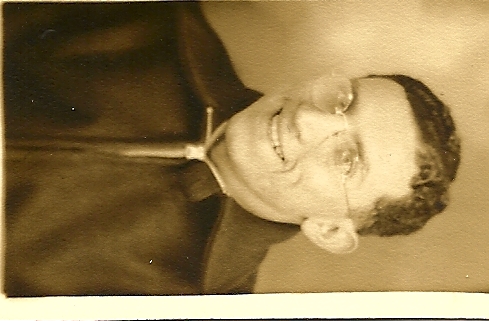
The first picture of my dad is probably from some time in the early to mid-1930s. The second photo looks as though he was a teenager when it was taken.

The night time snap-shot probably took my dad by surprise while he was on a date, before he met his wife-to-be (my mother). It was likely shot by a street photographer, who would have handed my father a numbered envelope that identified the negative. Dad would have had to mail the envelope to the company with payment in order to get developed copies of the picture.

I recall seeing such photographers in downtown Chicago at least as late as the 1960s. Now, of course, just about everyone carries his own camera/phone.

The final image is of the young Stein family in late 1959: my mom and dad and, left to right, Jack, myself, and Eddie.

The Importance of “Showing Up”

http://upload.wikimedia.org/wikipedia/commons/thumb/6/68/Reporter_raising_hand_at_US_Army_press_conference.jpg/500px-Reporter_raising_hand_at_US_Army_press_conference.jpg

Woody Allen denies he ever said, “Ninety percent of life is showing up.” Still, someone did.

Regardless of the author, what does it mean?

It refers to taking chances and working hard; if not welcoming challenges, at least not shying away from them. They often come without an announcement for those who listen for their call.

In and out of my clinical practice, I’ve met people who don’t “show up,” sometimes literally. Such individuals fail to put time and effort into therapy or whatever they “claim” is important to them.

How many people say their family is the essential thing in life but allocate their hours as if loved ones were second, third, or even lower on the list?

“Showing up” means stating you value something or someone and striving for consistency between your words and deeds. Of course, when acknowledging a person or thing has worth, you are taking the risk that a failure to search for it, discover it, or maintain it will disappoint you.

Other self-deceptions can also motivate the failure to be “present.” The parent who claims his children are Number #1 might substitute “quality time” for inadequate quantity. Where money is not an issue, providing gifts does not offer a worthy excuse for the lack of a benign and caring adult presence. Worse still is when the parent blames the young one or the spouse for his absence.

Teens are not free of their own self-willed ignorance about what they do. I treated some teenagers who denied school mattered and didn’t try hard. In this way, they protected themselves against possible frustration.

Better to be thought indifferent than unable to “do the thing you think you cannot do,” as Eleanor Roosevelt said. The adolescents in question armored their egos from the hurt that comes with the awareness of inability.

Ironically, some of these kids might have succeeded with sufficient dedication, persistence, and a little assistance. The decision not to “show up” became a self-fulfilling prophecy, guaranteeing the result they feared.

“Showing up” often brings unexpected benefits, as well. If people observe your face and your diligence, they may give you the benefit of the doubt. Your efforts and identity stamp you as someone reliable and conscientious.

The memory of those qualities attached to your name increases your chance of being called upon. Someone comes to believe in what you can do, sometimes even an unknown authority who has heard about you.

Is this luck? Perhaps. But by living this way, you will find yourself more often in the right place at an opportune moment. Or, as Branch Rickey said, “Luck is the residue of design.”

Determination pays off in unexpected ways. Countless stories tell us how bright and attractive women come to fall in love with men who, at first, make no impression.

Ultimately, these ladies admired the man who seemed dedicated and sincere in his pursuit (I’m not talking about stalkers). The strength of the man’s personality and the sheer amount of contact allowed her to see him in a fresh light.

Contrast this with gentlemen afraid to ask the woman out, unable to imagine she might reciprocate interest. The most successful suitors are those who don’t worry much about rejection, or if they do, refuse to let the potential pain stop them. They think more about the goal than future disappointment.

There is much to behold when the sun is ablaze, but what you focus on sometimes makes a transformative difference in where you land. Too many of us become as sightless as those who are blind.

A woman I talked with at a high school reunion said all the attractive girls wondered what they’d done wrong when the boys didn’t ask them out. Most of the young men were terrified! The ones who walked the high wire of romance had the field to themselves.

Fear doesn’t get you anywhere in life. We tend to regret missed opportunities more than those we reach for but fail to grab. On one’s deathbed, no one says, “Gee, I should have done less with my life.” The only exception to this rule of regret is spending more time with your children, a late sadness that trumps much else.

Many tell themselves they won’t act until the moment is right, as if waiting for their feelings to catch up to their desires is a recipe for accomplishment.

Instead, events often turn out the other way around: your hesitation changes over time because of repeated actions. And nearly as frequently, your emotions can be modified by what you tell yourself about them.

One can decatastrophize the situation by looking at it through an objective lens of reality and the lessons imparted by history rather than through the telescopic magnifying effect of emotion and imagination.

If fear prevents you from translating your values into action, their alleged importance might as well not exist. If your anxiety leads to avoidance, perhaps you will also miss what psychotherapy can do to put you on the right path in small steps.

Cognitive Behavioral Therapy (CBT) is often beneficial in dealing with social anxieties and other fears, producing empirically verified results otherwise unavailable. There is no shame in having fear; everyone experiences it, and some amount of anxiety is useful. However, allowing paralyzing worry to capture all your days must be escaped.

For those who dare to face their troubling anticipations (with a bit of help), life can provide rewards thought unavailable.

Don’t be afraid to change. “Show up” for life.

Remember, “This isn’t the rehearsal; this is the performance.”

—

The image at the top of the post is a reporter raising his hand to ask a question of U.S. Army General Ray Odierno at the Pentagon Press Conference on Iraq, June 4, 2010. It is a U.S. Army photo taken by Cherie Cullen.

The second image is a Poster for the Federal Theatre Project presentation of “Help Yourself” at the Musart Theatre, 1320 S. Figueroa, Los Angeles, Calif., showing a bank teller and a woman with bags and stacks of money, 1937, Library of Congress.

Finally, “The Bravery” is an album cover of a release by Kirill Fandeev. All three are sourced from Wikimedia Commons.

“I Know How You Feel”

Correct answer? I don’t. How could I?

But I may still be able to be helpful to you without absolutely knowing “how you feel.”

Why don’t I know exactly how you feel? I am not you. I am not your age or perhaps your gender. Maybe I’m not your religion. I wasn’t born in the same place under the same circumstances. My parents made more money or maybe less. They survived the Great Depression well, or badly, or not at all. And so on.

The point is, I’m not in your skin, so I can’t know precisely what it feels like to be there. It’s true, I might well have some idea, perhaps even a very good one. What might that idea be based on?

First of all, we are both human and have a certain set of broadly shared, although not identical life experiences. Secondly, as a therapist, I’ve talked to thousands of people who have told me what they think about certain things and how some events effected them. So I know the range of what is possible in reaction to an enormous number of events. I’ve also read much in the way of text books, been told much by my teachers, and have shared in the richness of emotion, perception, and experience found in great memoirs and novels.

And yet, despite all of this, I am open to surprise. My father died in the year 2000 at the age of 88. Rather suddenly. I’d known he was mortal at least since the time of his heart attack when I was 11. Prior to his death I’d counseled numerous people who were suffering from losses. I listened to their stories. Still, despite dad’s advanced age, I was shocked at the abruptness of his death, the “here today, gone tomorrow” reality of it. And surprised, too, by how tired I was for months afterward. As if some of the life force taken from him had been taken from me too. And even with this experience now well under my belt, even with having “lived” a loss like this (rather than just read about it or heard about it), I can’t say for sure that “I know how you feel” if you tell me about the death of your father. Your relationship with your dad might have been different enough, and his life circumstance different enough to explain some of this lack of identity.

You might ask me: “How then can you help me in grieving my own loss?” In several ways. I can listen to you and bear witness to your pain. I can be sympathetic. I can accept the emotions and stories you share: the varied combination of sadness, anger, exhaustion, and sense of separation from the world that comes with the death of a loved one. I can abide with you, acknowledge your pain, and let you knowI will “be there” until it passes. And, if you will accept the comfort, our relationship will help to reattach you to life, even while you are grieving something that tends to detached you from it.

You will never be exactly the same as you were before your loss, of course. But, you will very likely heal if you share your grief. If you hold it in or try to “move on” too quickly or shed your tears only privately — then your sadness might well pass more slowly or not at all. Human contact in the aftermath of a loss is crucial. A supportive spouse, friend or therapist can help. Time usually does the rest.