Turning a Loss Into a Win

You start by losing toys, dolls, and stuffies, though you usually find them. Playing marbles, you might lose your shooter if your opponent knocks it out of the circle with his own.

More distressing would be losing time with a busy parent who has other things to do. If you pester Mom or Dad to the point they call you a name like pest, your feelings get hurt.

You lose their respect and perhaps confidence in your lovability.

Still young, you possess infinite time. Innocence is another possession, though you won’t know you have it until it is lost and you have kids of your own. Unlike the loose change in your pocket, innocence cannot be recovered or replaced.

Neither can time. Try not to waste it.

As you become a bit older, you might fear losing a parent, as you do when they don’t arrive to pick you up at the promised moment.

When going out alone, the anxiety of getting lost may arise, and you may lose your way back home. Should you approach an antagonistic kid on the playground who doesn’t want you near, he could tell you to “get lost.”

School books and other important educational material or personal items are sometimes placed in the “Lost and Found.” Seeking, perhaps you shall find.

Games yield wins and losses. Avoid the latter category, but insight leading to beneficial change comes more often with defeats than victories.

Teachers will ask questions even if you don’t raise your hand. It is embarrassing to be at a loss for the correct answer.

Once you start dating, you will encounter those you find desirable who can’t be persuaded to go out with you. Privately, they might call you a loser, but they could be the ones who lose out.

Remember that.

Better still, discover someone compatible who finds you attractive. The time will come when you lose your virginity. Rapture tells you this is not a loss.

Young men, however, are displeased when they encounter the shock of hair in the bathroom sink. Losing the inborn cover on your head is a huge deal, at least until it is gone.

Your mane is not the main thing. Don’t style a comb-over. Without such superficialities as curly locks, realize that confidence is what counts.

Learning comes from all of the above. Adaptation is an essential lesson. If you recognize the enlightenment life offers you, take its sufferable and survivable blows, and seek the joy between the victories and losses. Time, thought, relationships, success, and failure provide teachable moments.

There are losses without loss. Think of the loss of self-consciousness and fear. Triumph over trauma is not losing. Financial reverses can often be recovered. The end of a job might lead to a better one. Good luck plays its part, as does time’s healing of heartbreak.

Losing can be turned upside down into a win at times. Searching for a new way to make a living, a partner, the gift of spoken eloquence, or wisdom—not one of these is easy. Discovering the world’s ways permits growth. Looking for work in his 20s in the jobless 1930s, my dad reminded himself, “Every knock is a boost.”

The endless reach for financial wealth is not so worthwhile as those tricks of the trade that enable a full life. Given the gift of time, it is often possible to learn how to meet life on its terms, face punishing losses, and find the road to adaptation, joy, friendship, good works, love, and laughter.

Do not forget to forget your troubles and find a compartment to put them in. Without play, you will be lost. Don’t worryyou will revisit them soon enough.

Build your will like a Lego castle.

With time, you will have lost much, gained much, and pushed forward on sunny and rainy days.

Weave kindness into your soul.

Tell me your secret if you can do better.

===========

The marbles were photographed by Wendy and sourced from Marble Collector/Wikimedia Commons.

Well-lived Words in a Time of Uncertainty

A man you have never heard of should be heard about. His name was William Sloane Coffin, Jr.  (1924 — 2006), longtime Chaplain at Yale University. He also lived in a time of uncertainty and did his part to create “good trouble,” as Congressman John Lewis called his own effort to improve the world.

You needn’t be religious to appreciate either man, though they both were devout.

Coffin’s many words demonstrate the scope of his thought and commitment to justice. Coffin’s dedication to living out his credo might well rank him among the few of us who are both great and good.

Those words touch on truth, love, taking a stand, intimacy, race, war, justice, poverty, faith, anger, fear, homophobia, forgiveness, and hope. I have selected 33 quotations below, along with three brief videos.

You can find his impressive Wikipedia biography here. Keep in mind that he died almost three years before Barack Obama became President.

  • The world is too dangerous for anything but truth and too small for anything but love.
  • Diversity may be the hardest thing for a society to live with, and perhaps the most dangerous thing for a society to be without.
  • Anybody who takes a stand is going to be wrong sometimes, but he who never takes a stand is always wrong.
  • Prophets from Amos and Isaiah to Gandhi and King have shown how frequently compassion demands confrontation. Love without criticism is a kind of betrayal. Lying is done with silence as well as with words.
  • I am reminded of all the undergraduates I knew and loved, many now crowding sixty, even seventy. Some of them have aged like vintage wine, heeding Albert Camus’s wisdom: ‘To grow old is to pass from passion to compassion.’
  • A few of them, however, looking back on the springtime of their lives, say, ‘Ah, those were the days!’ — and the worst of it is, they’re right! It was not the days, I suspect, but they who used to be better!
  • Fear destroys intimacy. It distances us from each other; or makes us cling to each other, which is the death of freedom…. Only love can create intimacy, and freedom too, for when all hearts are one, nothing else has to be one–neither clothes nor age; neither sex nor sexual preference; race nor mind-set.
  • Love is to make us more human, and that demands that we care so much for each other that we have not to be nice but to be honest. We have to be honest, for most real faults are hidden and therefore demand an outside revealer.
  • The consequences of the past are always with us, and half the hostilities tearing the world apart could be resolved today were we to allow the forgiveness of sins to alter these consequences…. if we were to say of ourselves, ‘The hostility stops here.’
  • No sermon on love can fail to mention love’s most difficult problem in our time–how to find effective ways to alleviate the massive suffering of humanity at home and abroad. What we need to realize is that to love effectively we must act collectively…
  • There are two ways to be powerful. One is to seek and acquire power, the other is not to need it. There are also two ways to be rich. One is to gain riches, and the other is not to need them.
  • Remember, young people, even if you win the rat race, you’re still a rat.

And more …

  • The banality of guilt is that it is such a convenient substitute for responsibility. It’s so much easier to beat your breast than to stick your neck out.
  • Socrates had it wrong: it is not the unexamined (life) but finally the uncommitted life that is not worth living.
  • You have to unlearn as well as learn, to clear away the weeds and thickets in order to see more clearly the various paths ahead.
  • Over the years I have been convinced that the more important question is not who believes in God, but in whom does God believe? Rather than claim God for our side, it’s better to wonder whether we are on God’s side. Faith is being grasped by the power of love, and there are many atheists with ‘believing’ hearts — the part of us that should be religious if you can offer only one.
  • Hope is a state of mind independent of the state of the world. If you heart’s full of hope, you can be presistent when you can’t be optimistic. You can keep the faith despite the evidence, knowing that only in so doing has the evidence any chance of changing. So while I am not optimistic, I’m always very hopeful.
  • Christians have to listen to the world as well as to the Word – to science, to history, to which reason and our own experience tell us. We do not honor the higher truth we find in Christ by ignoring truths found elsewhere.
  • For example, I don’t see how we can proclaim allegiance to the Risen Lord and remain indifferent to our government’s [and the world’s] intention not to abolish nuclear weapons. Or how can we think that the Risen Lord would applaud an economic system that reverses the priorities of Mary’s Magnificat – filling the rich with good things and sending the poor away empty? (Almost one American child in four lives below the poverty line, and one in three children of the world exist in terribly horrible poverty.)
  • To show compassion for an individual without showing concern for the structures of society that make him an object of compassion is to be sentimental rather than loving.
  • Few of us are truly evil; the trouble is, most of us mean well — feebly. We are just not serious. We carry around justice, love, and peace in our shopping carts, but along with a lot of other things that make for injustice, hatred, and war. Churches in our day are a bit like families: they tend to be havens in a heartless world, but they reinforce that world by caring more for its victims than by challenging its assumptions.
  • Love measures our stature: the more we love, the bigger we are. There is no smaller package in all the world than that of a man all wrapped up in himself.
  • In reality, there are no biblical literalists, only selective literalists. By abolishing slavery and ordaining women, millions of Protestants have gone far beyond biblical literalism. It’s time we did the same for homophobia.

And the last group …

  • Every time people see the innocent suffering, and lift their eyes to heaven and say, ‘God, how could you let this happen?’ it’s well to remember that exactly at that moment God is asking exactly the same question of us:  ‘How could you let this happen?’
  • People in high places make me really angry — the way that (some) corporations are now behaving, the way the United States government is behaving. What makes me angry is that they are so callous, really callous. When you see uncaring people in high places, everybody should be mad as hell.
  • Self-righteousness destroys our capacity for self-criticism. It makes it very hard to be humble, and it destroys the sense of oneness all human beings should have, one with another.
  • My understanding of Christianity is that it underlies all progressive moves to implement more justice, to get a higher degree of peace in the world. The impulse to love God and neighbor, that impulse is at the heart of Judaism, Islam, Christianity (and the other religions of the world). God is not confined to Christians.
  • I am not a pacifist. About the use of force I think we should be ambivalent — the dilemmas are real. All we can say for sure is that while force may be necessary, what is wrong — always wrong — is the desire to use it. It is hard to get even with violent people (especially terrorists). What is easy is to get more and more like them. ‘The warhorse is a vain hope for victory, and by its great might it cannot save.’ (Psalm 33) War is a coward’s escape from the problems of peace.
  • President Bush rightly spoke of an ‘axis of evil’ but it is not Iran, Iraq and North Korea. A far more dangerous trio would be: environmental degradation, pandemic poverty, and a world awash with weapons. Far beyond individuals, communities and nations, the world itself is on the brink of destruction. If we were serious, with the other nations, to engage the war on poverty around the world, that would stem the flow of recruits to the ranks of terrorists.
  • Every nation makes decisions based on self-interest and defends them on the basis of morality. In our time all it takes for evil to flourish is for a few good men to be a little wrong and have a great deal of power and for the vast majority of their fellow citizens to remain indifferent. The danger today is that we might become more concerned with defense than with (being a country) worth defending.
  • (We) can either follow (our) fears or be led by (our) values and (our) passions. All of this fear-mongering today (of immigrants, homosexuals, crime, and terrorists), I’m afraid, is quite deliberate because the more you can make people fear, the more a government can control you. The American people don’t feel a sense of personal accountability for what the nation should stand for. No one need be afraid of fear; only afraid that fear will stop him or her from doing what’s right.
  • (Yet, in the face of this), I remain hopeful. Hope needs to be understood as a reflection of the state of your soul, not as reflection of the circumstances that surround your days. Hope is not the equivalent of optimism. The opposite of hope is not pessimism, but despair. Hope is about keeping the faith despite the evidence so that the evidence has a chance of changing.
  • There never was a night or a problem that could defeat sunrise or hope!

A Checklist For Change

Mark Twain (aka Samuel Clemens)

If you meet someone not seen in 20 years, only to discover he is unchanged, you might ask

Why not? Shouldn’t he have been altered by time and experience?

Unless your old friend has been “on ice” — freeze-dried, flash-frozen, cryogenically preserved — isn’t change a reasonable expectation?

The writer Mark Twain thought so. He saw the long-gone youthful version of himself in need of lots of revision:

Ignorance, intolerance, egotism, self-assertion, opaque perception, dense and pitiful chuckleheadedness — and an almost pathetic unconsciousness of it all, that is what I was at 19 and 20.

Unfortunately, not everyone is as self-observing and motivated to reshape himself as was Twain. According to Edward Young in Love of Fame:

At 30 man suspects himself a fool;
knows it at 40, and reforms his plan;
At 50 chides his infamous delay,
Pushes his prudent purpose to resolve;
In all his magnanimity of thought
Resolves; and re-resolves; then dies the same.

The 19th-century writer Robert Louis Stevenson was less amusing and more scornful on the same subject:

To hold the same views at 40 as we held at 20 is to have been stupefied for a score of years, and take rank, not as a prophet, but as an unteachable brat, well birched (spanked) but none the wiser.

It is as if a ship’s captain should sail to India from the Port of London; and having brought a chart (map) of the Thames (River) on deck at his first setting out, should obstinately use no other for the whole voyage.”

What follows is a short (and incomplete) checklist of areas of personality or behavior that might be expected to alter during adult life.

The Thing You Cannot Do. Let’s start with something different for each person.

Late in her long life, Eleanor Roosevelt was asked what guidance she might give to the people listening to her on the radio. She said,

You must do the thing you think you cannot do.

Indeed there is no better or more crucial potential area of change than whatever the “thing” is for you. What is it that is too hard, too scary?

Only you know the answer.

Physical Activity. “Use it or lose it.” T.S Elliot put it in a few more words —

The years between 50 and 70 are the hardest. You are always being asked to do things, and yet you are not decrepit enough to turn them down.

Don’t let your bodily capacities go without a fight. Concede only what age requires, not more.

Interests. Do you read only the same types of books, listen only to the same music, engage in the identical hobbies of your youth? Some people keep learning, exploring, and investigating new things. They say that it keeps them young.

Beware of retirement without friendships and other interests to fill your former workday. Those who lack such things are often miserable. One is well advised to diversify one’s investments in activities and people, not just a financial portfolio.

Appearances. Ecclesiastes tells us “all is vanity.” That portion of the Bible reminds us that much of what we value has no real meaning or purpose. Thus, perhaps your attitude toward the “appearance” of things, whether it be a dress or your residence, might be subject to modification as you age.

The wise man or woman recognizes what is worth esteem and dismisses many contrary opinions of others.

Material Things. To continue the point just made, no one gets out alive. In the end, you leave life with as little as you had when you arrived. Nonetheless, some become more covetous, continuing to shop and buy in an apparent effort to outlast their possessions.

In contrast, others care less for “things” and disencumber themselves, including giving their money away.

Self-Assertion/Anger. One might hope to learn diplomacy, be more direct, enlarge the capacity to stand up for oneself, and reduce sarcasm, not to mention outbursts and a desire for vengeance.

KIndness. If you have not realized the importance of kindness, then you may as well live on a desert island by yourself.

Food. Do you eat only what your mother made for you? Other things might be delicious. Do you dine the same way you did growing up or moderate your appetite and control salt intake?

Time. Most people become more mindful of time’s passage as they age, sensing its increased velocity with less of the race track of time ahead. Robert Southey wrote,

Live as long as you may; the first twenty years are the longest half of your life!.

If this notion doesn’t alter how you use the fleeting moment — cause you to employ it wisely — you are not paying attention to a basic fact of human existence. For example, famous musicians (Artur Schnabel, Carlo Maria Giulini, and Bruno Walter) narrowed their repertoire as they aged. They wished to concentrate on the music most meaningful to them, knowing the day was short.

Sex. Biology and age dictate some changes in this department.

Plato applauded the reduction of passion in older men. He believed they were not as much the plaything of the hormonal flood as those in the burst of early manhood. Rationality was thereby increased in his view.

An old joke about intercourse and marriage goes something like this. If you put a penny in a jar every time you have sex in the first year of a permanent relationship and take one out every time after that, you will never empty the container!

Money. If you know someone who lived through the “Great Depression,” you may realize traumatic events can generate long-lasting effects. Many of those who survived a decade of 25% unemployment remained very careful about spending. Remember, too, the photos of children pushing wheelbarrows full of paper currency during the German hyperinflation of the 1920s just to purchase a loaf of bread.

On the other side are those who spend without regard to the possibility they might need it for a rainy day or their child’s education.

Ambition. Most of what is excellent in the world, and too much of what isn’t, is due to ambition. I’m speaking of blind and belligerent ambition in the latter case.

This quality tends to swallow younger selves, but some of the power-hungry are only chronologically mature, to humanity’s misfortune. Here are thoughts from Colin Davis, a 38-year-old symphony conductor, when he offered them:

I think that to so many, what happens (as we age) is the death of ambition in the conventional sense. The great driving motor that prods you and exasperates you and brings out the worst qualities in you for about 20 years is beginning to be a bit moth-eaten and tired.

I find that I’m altogether much quieter, I think; I don’t love music any less; but there’s not the excess of energy that I used to spend in enthusiasm and in intoxication (with it). I feel much freer than I’ve ever been in my life.

Friendship. Besides freedom from physical pain and financial instability, little produces mature life satisfaction as much as friendship. Many realize this as they age and come to value fraternity and intimacy more.

Appreciation. Some of us see the downside of life, others the upside. The unlucky may have good reason to be unhappy.

Unhappiness can also be found in how an individual perceives the world. His lived reality may not be much worse than the norm. As the losses pile up later in life, we do well to nourish our sense of gratitude.

Being Like Your Parents. Just about everyone tries to make sure they imitate only their parents’ good characteristics, leaving the rest behind. The act of disencumbering ourselves of this unwanted baggage is the job of a lifetime if one is honest.

Robert Lowell described its difficulty in “Middle Age” from For the Union Dead:

At forty-five,
what next, what next?
At every corner,
I meet my Father,
my age, still alive.

A sobering thought. But then, much depends on cherry-picking the best of your parents.

No time to lose. Or, perhaps, you needn’t make haste.

I guess it all hinges on what you think about the need to change.

But trust me, you do need to. Rainer Maria Rilke’s Archiac Torso of Apollo very simply:

You must change your life.

========

The top photo is of Mark Twain.

Signs of Insecurity: Behavior That Reveals a Lack of Confidence

Here is a post many people have found useful. This version has been updated since its publication in 2010:

Father’s Day (via Dr. Gerald Stein – Blogging About Psychotherapy from Chicago)

This is a revised and expanded version of a post I wrote two years ago about my father.

Father's Day Father’s Day can be complicated. Like any day of honor, some tributes are deserved more than others, or not at all. Some obligations are carried out with joy, while others are a matter of dutiful routine. And sometimes there is pain, where once there was (or should have been) pleasure. But, for myself, Father’s Day is pretty simple. While I miss my dad (who died 11 years ago), the sense of loss is no longer great. He was 88 when he stroked-out in … Read More

via Dr. Gerald Stein – Blogging About Psychotherapy from Chicago

How to Make Yourself and Those You Love Miserable

http://upload.wikimedia.org/wikipedia/commons/thumb/a/ae/Bertram_Mackennal_-_Grief.jpg/500px-Bertram_Mackennal_-_Grief.jpg

It is easy to find on-line guidance to a better life. But the recommendations contained on those self-help web sites (and in books that aim at the same audience) have become almost too commonplace to make any impact.

The remedy? Something that is just the opposite: a list of suggestions on how to make yourself and others miserable. Of course, I’m not wishing that you follow these directions. Rather, I’m hoping that some of you who might yawn at still another list of “things to do” to improve your life, will be struck by the things you already do that make it much worse.

Here goes:

  • Regularly compare your material and financial circumstances to others, especially to those who are doing better than you are.
  • Make a list of all the people who have wronged you over the years and try to remember exactly how awful they made you feel. Think about those who owe you an apology. Forgive no one. Let no slight be too small to dwell on it.
  • Carry on a vendetta. Stay up late at night planning and plotting how you might get back at people. Stay angry. Let all your hatred out in blistering, profane, and cowardly “flames” behind the mask of the Internet.
  • Give your children gifts rather than your time. Set no limits on them. Then wait until they are teenagers and wonder why they are depressed or rebellious.
  • Curse the darkness, the winter, the cold, the rain, the frailty of the human condition, and all the other things that you can’t change.
  • Get impatient with the people who are walking in front of you at a snail’s pace, the couples whose bodies and shopping carts block the entire grocery aisle, and the slow progress of the check-out line at the store.

http://upload.wikimedia.org/wikipedia/commons/thumb/7/74/John_F._Kennedy_Inauguration_Speech.ogv/mid-John_F._Kennedy_Inauguration_Speech.ogv.jpg

  • Make no contribution to the betterment of humanity. Assume an attitude of entitlement. Figure out how to avoid work. Idle away your time. Ask “what your country can do for you,” not “what you can do for your country” in opposition to JFK’s 1960 inaugural address admonition.
  • Forever rationalize your dishonorable or questionable behavior or deny it altogether, even to yourself.
  • Persuade yourself that you need to wait until you feel better before you do the difficult thing that you have been postponing. Keep waiting, even if the time never comes when you believe that you can take action.
  • Do not let conversation with your spouse or children get in the way of watching TV. Keep the TV on most of the time, most importantly at family dinners. If possible have a television in every room.
  • Ignore the beauty of a spring or summer day, the newly fallen snow, and the cheerful laugh of small child. Stay in-doors as much as possible, year round.

http://upload.wikimedia.org/wikipedia/commons/thumb/d/d8/Sommerblumen01.JPG/240px-Sommerblumen01.JPG

  • Allow yourself to be upset by overpaid, under-performing athletes who doom the home team to continued failure. Yes, Cubs fans, this means you!
  • Treat emotions of sadness, tenderness, and hurt as your enemy. Push them away and thereby alienate yourself from yourself. Curtail grieving and try to deaden your feelings to the point of numbness.
  • Work up as much hatred as possible toward opposition political parties. Listen to every talking head who wants to whip you into a frenzy.
  • Expect justice and fairness in all things.
  • Drink too much, drug too much, and spend every extra minute on the web or playing computer games instead of having direct human contact with someone who is in the same room with you. Further distract yourself from your problems by watching TV and listening to music. Escape reality.

http://upload.wikimedia.org/wikipedia/commons/thumb/4/4b/Jack_rose.jpg/120px-Jack_rose.jpg

  • Keep using failed solutions to your problems even though they haven’t worked in years, if ever.
  • Behave in mid-life the way you did as a young person; or, if you are a young person, behave the way you did as a child. Do not reflect on or learn from experience which might teach you something new.
  • Use others instrumentally. That is, value them only in terms of what they can do for you. Lie, cheat, betray, and steal from them if that serves your interests. Then wonder why people mistrust you.
  • Spend as much time as possible worrying about the future and regretting the past, rather than living in the irreplaceable moment.
  • Aim low. Avoid the disappointment that comes with high expectations. When the going gets tough, quit.
  • Train yourself to be a miser. Practice selfishness. Hold on to your money as if you expect to live forever and will need every last cent. Make Scrooge from A Christmas Carol your hero.

File:Chicklet-currency.jpg

  • Judge others less fortunate than you are by using the phrases “he should have known better,” “he didn’t try hard enough,” and the like. Assume that all people deserve whatever misfortune befalls them. Disdain compassion, but remain puzzled when others call you heartless.
  • Indulge in every available excess: unprotected sex, food, spending, smoking, caffeine, etc. Don’t exercise. Ignore medical advice and, even better, avoid going to your doctor. Treat your body badly and then wonder why it betrays you.
  • Be sarcastic, passive-aggressive, and indirect whenever you are injured rather than looking someone in the eye and expressing your displeasure in a straight-forward fashion.
  • Avoid facing things. Give in to your fears, anxieties, and phobias.

http://upload.wikimedia.org/wikipedia/commons/thumb/5/5b/Children_in_Sonargaon.jpg/240px-Children_in_Sonargaon.jpg

  • Don’t let anyone know you well. Believe that your vulnerabilities will always be used against you. Keep social interactions on the surface. Eschew intimacy and maintain your distance, thinking that this is the best way to avoid personal injury. Trust no one!
  • Assume that the normal social rules regarding fidelity to friends and lovers don’t apply to you. Hold on to a double-standard that favors you.
  • Insist on having your way. Don’t compromise. Don’t consider others’ needs or wants. Assume a position of moral superiority, self-righteousness, and arrogance in things religious, political, and personal.
  • Do everything others ask of you. Rarely say “no.”
  • Try to control people and events as much as you can. Don’t go with the flow. Micromanage. Hover over others. Repeat complaints to them incessantly. Remind subordinates, friends, spouses, and children of small errors, even if they are ancient history.
  • Make no significant effort to better your life. Depend on others to take care of you and make all significant decisions for you. Be a burden.
  • Raise all your children exactly the same way even though it is obvious that they are not all the same.
  • Imitate vampires (who have no reflection in the mirror and therefore keep their mirrors shrouded) by never really looking hard at your own reflection in the looking-glass. That is, never take a frank inventory of your strengths and weaknesses or the mistakes you’ve made. Be like the evil queen in Snow White, whose only desire was that the mirror would tell her that she was “the fairest of them all.”
  • Whenever you talk with someone, wonder what they really mean, pondering the possibility that they find you boring, stupid or physically unattractive.
  • Feed yourself on gossip more than food. Delight in talking about others behind their backs.
  • Value beauty, appearance, reputation, and material success over integrity, knowledge, kindness, hard work, and love.
  • Try to change others, but do not try to change yourself. Take no responsibility for your life circumstances, instead blaming those who have stymied you.
  • Stay just as you are regardless of changing life conditions. For example, if wearing warm clothes worked for you when you lived in Alaska, continue to wear them when you move to Arizona in July.

http://upload.wikimedia.org/wikipedia/commons/thumb/3/37/Enrico_Caruso_VI.png/240px-Enrico_Caruso_VI.png

  • Don’t forgive yourself. Maintain the most perfectionistic and demanding moral and performance standard even if you are not a brain surgeon. Stay up at night castigating yourself over every imperfection, no matter how small.
  • Make a list of all the things that are wrong with your life, all the opportunities lost, every heartbreak, and the physical features and bodily changes that you don’t like. Stew in your own juices. Salt your wounds. Pick at your scabs.
  • Take everything personally.
  • Permit friends, family, and co-workers to walk all over you. Do not stand up to them for fear of causing offense and disapproval.
  • Discount your blessings. Concentrate on the dark side of life.
  • Never even consider going into psychotherapy. Assume that this is something only for those who are weak and that anyone who needs to grapple with emotional issues in counseling demonstrates a failure of will power and logic.

With thanks for the inspiration for this essay to Dan Greenberg and Marcia Jacobs, co-authors of a very funny, but ironic book entitled How to Make Yourself Miserable.

The top image is Grief by Edgar Bertram Mackenna. The video frame that follows is from John F. Kennedy’s 1960 inaugural speech. The next image is Sommerblumenstrauss by A. Gundelach. The following photo by Andygoodell is A Jack Rose Cocktail. The fifth picture is of two children in Bangladesh by Nafis Kamal, while the sixth is called Chicklet-Currency courtesy of the U.S. Department of the Treasury. After the image from Disney’s Snow White, is a 1911 photo of Enrico Caruso, the great Italian tenor. All but the Snow White frame are sourced from Wikimedia Commons.

Courage For the New Year

http://upload.wikimedia.org/wikipedia/commons/c/cd/Churchill_V_sign_HU_55521.jpg

Many of you, I suspect, have had a tough time over the holidays. Perhaps lonely, perhaps worried about what the future will bring. Many all over the world are yet unemployed or underemployed. Things have been difficult.

I offer you, therefore, an audio excerpt linked below, from a late 1941 speech given by Winston Churchill, the British Prime Minister during most of World War II.

I hope that it will provide some solice and some reason to believe that a better future is possible.

Things were particularly dark for England in 1940. All of continental Europe had been conquered by the Nazis and night after night, the great cities of that island nation were bombed by the Luftwaffe, Hitler’s air force. The British Empire stood alone against the Third Reich and expected a land invasion. The United States had not yet entered the War and there was no certainty that it would.

Virtually no one thought England would survive.

But Churchill did and the Nazis were defeated.

In October of 1941, still prior to the USA’s entry into the war, Churchill was asked to speak to the students of Harrow School, an independent boarding school that was his alma mater.

What he had to say applies quite well to those, even today, who might fear that worse is to come in their lives, as well as those who despair over their current condition.

Listen to the first three minutes and ten seconds and take heart.

The entire excerpt is just over four minutes long.

Once you click on the blue link just below this paragraph, look at the upper  right corner of the page. Then scroll down and click on the Speech #33 (incorrectly identified as having been given in November 1941):

BBC Winston Churchill Speech to Harrow School

The image above is Winston Churchill on Downing Street Giving His Famous ‘V’ (For Victory) Sign, June 5, 1943. Sourced from Wikimedia Commons.

Violence and Intimacy

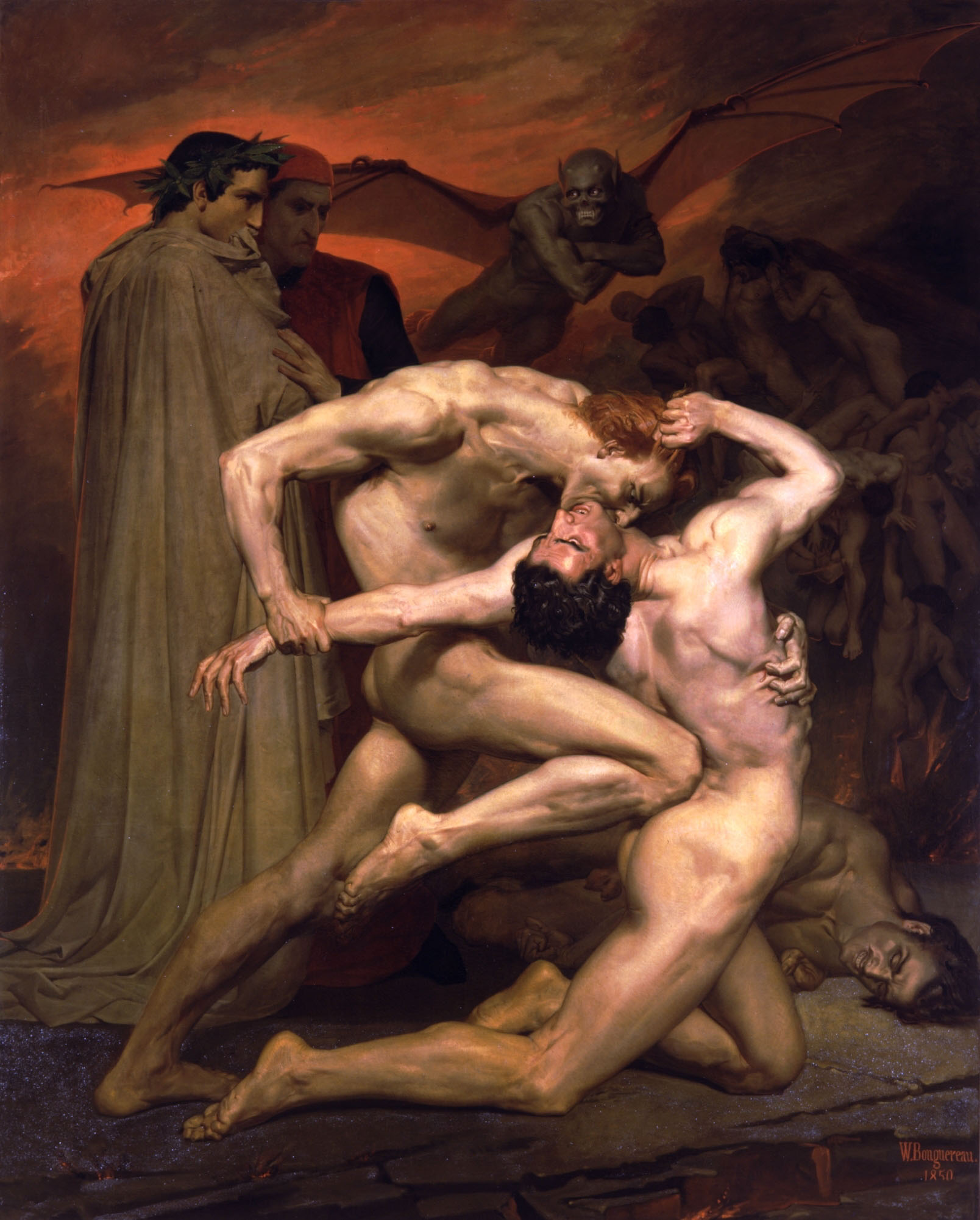
File:William-Adolphe Bouguereau (1825-1905) - Dante And Virgil In Hell (1850).jpg

Perhaps it shouldn’t surprise us, but one can do the most violence to another when one is close to that person. Physically close. Pinching, punching, pushing, plucking, picking, pulverizing — actions that can only be done at close quarters, the victim is pilloried and punished. Perhaps then, it is no wonder that human kind can be uncomfortable with and afraid of intimacy.

When physical vulnerability is compounded with the psychological, we tend to be even more careful. Those who are close to us know just where to strike, where the soft and breakable parts are; and they are just in reach.

I watched a History Channel feature the other night on The St. Valentine’s Day Massacre. The point was made that while the Thompson submachine gun was a useful weapon for killing at a distance, many of the most important gangland assassinations were done with a pistol, while holding or grabbing the victim, or pulling him close to make certain that he couldn’t reach for his own weapon. Intimacy again — the closeness that made injury possible, more certain, more lethal.

Remember Delilah of the famous bible story that featured Samson? Again, intimacy, this time of a sexual nature, allowed her to rob Samson of his strength by having his enemies cut his long hair while he slept.

When you were a kid, do you remember an aunt or uncle or grandparent who would hold you close and then pinch (and shake) your cheek between thumb and forefinger? It was alleged to be an act of affection, but whenever it was done to me, I couldn’t quite understand how something that hurt that much was supposed to show love.

I’m sure you know the origin of the handshake — an ancient custom designed to display the fact that you do not have a weapon in your hand with which to do injury at close range.

And, in the “you always hurt the one you love” department, we should not forget that “crimes of passion” account for many of the violent deaths in this country. That is, we are harming those we know, not strangers, in fits of intense emotion and impulsivity.

How does this relate to therapy? In part, because the therapeutic relationship is a somewhat one-sided intimacy. The patient makes himself vulnerable to the doctor, displays his wounds and expresses his emotions, trusting that his secrets and feelings will be safeguarded, treated with kindness and respect, and definitely not used against him. Therapists need to keep this in mind, lest they re-traumatize the person, injuring him in a way that is similar to the very torment that he came to therapy to heal.

Although a counselor’s power can hardly be considered “great,” it is considerable when it comes to his patients. Psychologists would do well to remember the quote from the movie Spider-man: “With great power comes great responsibility.”

The moral of the story? Allowing one self to become close and vulnerable to another person opens the door to the best and worst that life can offer. It is therefore of great import to choose a friend, a lover, or a therapist with care.

As the Knight Templar told Indiana Jones in Indiana Jones and the Last Crusade when the explorer had to pick out the Holy Grail from an assortment of old cups, “choose wisely.”

The above image is William-Adolphe Bouguereau’s 1850 painting Dante and Virgil in Hell sourced from Wikimedia Commons.

How Life is Like Climbing a Rope

File:US Navy 030822-N-3228G-011 A chief petty officer selectee climbs a 50-foot rope on the confidence.jpg

Early life is full of obstacles. Everything is new and the learning that you do in public, in front of your peers, allows for the possibility of humiliation.

Only later in life do you discover that while the challenges of adulthood are actually even more difficult, those same problems seem easier to negotiate because of the toughening derived from all the hits and misses of your formative years. The hard experience early on has made you stronger, at least if you did a reasonable job of learning things along the way.

Which reminds me of one of my high school challenges: learning how to climb a rope. In fact, life is a little bit like doing that.

References to moving up in the world abound. Everyone seems to want to get to the top.

In a high school gym of reasonable size, the rope hangs from a long distance away. My guess would be perhaps 25 feet up or more. The rope puts you in the position you have been in for much of your childhood: starting out at the bottom and spending a lot of your youth looking up — at your parents, your older siblings, your teachers, and all the things that seem impossibly out of reach because you are small.

And there you are, as the gym teacher tells you that you — yes, you — are supposed to climb the thing to the top. Today a rope, tomorrow the corporate ladder.

It is a solitary task. Just you and the rope. A little bit like you and the job of hitting a baseball, getting good SAT scores, making a career, winning a spouse. Your are on your own.

If you look at the top of the rope and think about how far away it is, how impossible is the task of getting there, you will have defeated yourself. Much like imagining how you might one day own a business or make a speech in front of hundreds of people or raise a family. Too far away and too troubling to think of until you get there, when it won’t seem so daunting after all. Of course, you don’t know that yet. Partly, because you haven’t yet climbed the rope.

If you wish, you can avoid the rope, try to pretend it’s not there, tell yourself that you don’t have to address that now. And, indeed, it will wait. The rope is very patient. Like all the problems of life, they continue to exist until we realize that we cannot escape them, that only by facing and mastering them do we really move beyond them, up and away.

No one told me or anyone in my gym class how to climb the rope. Indeed, I think that was intended to be part of the challenge. Like the rest of life, you have to be clever, think things through, watch others, and learn from experience before you can make much progress at mastering the coarse fiber that hangs there silent, implacable, and indifferent. It will not be the last time that you will confront the callousness of the world, and sometimes its disdain.

If you are anything like me, you won’t make it very far the first time you lay your hands on your threaded nemesis. You’ll worry too much, be self-conscious about those who are watching you, get stuck, slide back, and maybe suffer from rope burns as if your opponent is more than a “thing” and wants to inflict as much pain as possible. Life will do this to you too, just as you defeat yourself by over-thinking things, lacking a plan, wondering what others think of you to no good end, and “suffer the slings and arrows of outrageous fortune.”

But then you notice something — some things that suggest you are beginning to learn. First, you realize that you can’t stop when climbing a rope or give in to your fear; there is no time for rest or you will slide back. And you must give the rope climb, and life, everything you have. Not just your arms, not just your arms and legs, but your will: the tenacity and drive that won’t allow you to accept defeat.

Just as in all of the future that waits for you, you cannot give up, but must improve or regress. The law of gravity applies to the rest of life, too.

But, once you master the rope, you will gain in confidence and know a little bit more about the world and about yourself. A knowledge that can be applied in very different and difficult situations.

Perhaps you will realize other things, as well.

First, that there will always be other “ropes.” Life has no end of them, no end of the challenges and demands with which it will present you.

And you might even recognize something else that neither the gym teacher nor the rope told you.

Getting to the top wasn’t the most important thing.

No, more important were the strain, the challenge, the pull and the crawl, the sweat, the exhilaration, and the feel of the rope in your hands and against your legs. That is, the lived-in experience of the moment.

And, just as well, the realization comes that the rope was your friend all along.

Like life itself, it had lessons to give you.

The 2003 photo above of a 50-foot rope climb was taken by Photographer’s Mate First Class William R. Goodwin and is courtesy of the U.S. Navy.

Old But Useful Thoughts: a Stoic Guide to Life

The Stoic philosophers have gotten a bad rap. I know, this problem isn’t exactly as pressing as the unemployment rate, the deficit, and our military involvement in the Middle East.

I therefore beg your indulgence and hope you will read further. It just might influence how you think about life. The BP oil contamination can wait — and you can’t do anything about it anyway —  so don’t let it get the best of you, a point the Stoics would surely make.

The “bad rap” is largely the result of how we understand the word “stoic.” We define that word to refer to someone who is indifferent to emotion, deadened to pain, hardened and impassive; someone who has “killed” his feelings. But this is not what Zeno, a third century B.C. Greek philosopher had in mind when he founded his school of philosophy.

Rather, the Stoics saw that emotion could become extreme and destructive. They therefore looked to find some balance between head and heart, with the passions held in check.

More importantly, however, Stoics turned their attention to the importance of a person’s own behavior and inner life, seeking to help the individual find equanimity and satisfaction in life (in part) by not overvaluing the inessential, external things and events that crowd in on him. According to their line of reasoning, it is important to distinguish what is virtuous and important that is controllable from what is trivial and outside of one’s control. Then, by giving a paramount position to clarity of thought and self-reflection, one may achieve freedom from the excesses of anger, self-pity, jealousy, suffering, and anguish, as well as an overall sense that life hasn’t “played fair” with us.

Professor Luke Timothy Johnson has said the following about the contrast between the world view of a man like Marcus Aurelius, the Stoic “philosopher/king” of second century Rome, and our own way of thinking about “the good life:”

Marcus Aurelius was obsessed by the transitory character of all existent things. We (by contrast) take our institutions for granted. We think that life is long. We assume that we should be healthy. Marcus Aurelius spurned pleasure and sought duty. We are driven by the notions of feeling good, and the pursuit of happiness is often identified with the pursuit of pleasure. Marcus Aurelius identified freedom as a call to virtue and duty, whereas in present day America, we often think of freedom as the most radical form of individualism and doing what we like.

The Stoics would say that most of us are not free. Rather, we are slaves to making money, accumulating objects, and creating or defending a reputation. For them, “living well” didn’t mean living in the lap of luxury, but living simply, concerned with improving oneself and one’s conduct toward other men.

For these philosophers and like-minded people of today, the ups and downs of life, the illnesses, the job frustrations and relationships disappointments, and the calumnies of the jealous, not to mention death itself, are all seen as simply “in the nature of things.” Acceptance of what is “natural” and what is a normal part of the human condition is key to a Stoic’s way of taking the world as it is, not as one might wish it to be. If a Stoic is approached by someone who has suffered a reversal of fortune and is asking “Why me?” he would likely answer, “Why not you.” (Or anyone else, for that matter).

Stoics such as Seneca and Epictetus believed that by leading a virtuous life one could achieve happiness, regardless of what external misfortunes (including death) happened. This is surely farther than most of us would go, but that way of thinking does tend to normalize and minimize certain events that we consider to be “tragic.”

Those of us who live in Western Civilization run the risk of thinking that our happiness depends on how well our kids do in school (and whether they attend the “right” school), our next promotion or job title, the approval of our “betters,” making a certain amount of money or achieving an advanced social rank, and a gorgeous house in a fine neighborhood. The Stoics would say we are much too concerned with external things (rather than focusing on trying to lead a virtuous life). And, interestingly enough, contemporary psychological research tends to support the Stoics: those with tons of money are only somewhat more satisfied with life than those with just enough for the basic necessities.  Put another way, it is the striving for things outside of ourselves, the struggle to defeat or avoid the inevitable disappointments of life, that robs one of peace of mind.

In effect, the Stoics are saying that we pay too much attention to external things of little “real” value, and that in so doing we create our unhappiness, having chosen beliefs which lead us into the pain we seek to avoid.

Take an example. A parent wants his child to obtain a graduate school level education from a “good” school. The child, however, may not be of an academic bent, and doesn’t seem destined to achieve this goal, although he is otherwise a decent young man. And so the parent frets, feeling disappointment and frustration. Meanwhile, another parent, who has a similar child, doesn’t place so much value on this particular direction and doesn’t see it as an essential path for his child to follow. The first man is unhappy, the second is happy. The unhappiness is the creation of the first man’s opinion about things, it does not reside in the thing itself.  The parent is troubled because of his attachment to an idea, something that is external to him and is inessential for his contentment or the well-being of his son, however much he might think otherwise.

Now, you might think that the Stoic is unambitious and that he doesn’t try hard enough (or encourage his kids to try). Regarding the latter, I suspect that a real Stoic would value knowledge and learning and encourage the same in his child, but not make it a cause for desperation and the wringing of his hands. So, while not completely “hands off” the practical things of life, he achieves some distance from pain by thinking things through.

The Stoics desire to live in harmony with the way the world is, rather than to struggle against it. And, here again, they strive to improve themselves — their moral and intellectual state — rather than the state of their bank account or their rank in the pecking order of social and business life. In the words of Epictetus “…as the (working) material of the carpenter is wood, and that of (a sculptor is) bronze, so the subject-matter of the art of living is each person’s own life.” Thus, the philosopher attempts to attain a state of courage, justice, temperance, and wisdom; and always turns back to such thoughts in a constant effort to improve himself and practice what he preaches.

Interestingly, Stoics were also way ahead of everyone else in matters of social justice. For them, slaves were seen as the equal of other men, and women were thought to have just as much capacity for rationality as men, views that were unheard of in the ancient world.

And, as you might have noticed, the Stoics were not so far off from the mindset of Zen philosophy. In particular, both recommend living “in the moment,” being aware of the transitory nature of most things that make us unhappy, and the fruitlessness of spending too much time looking back (usually with regret or nostalgia) or looking forward (often in anxiety or the uncertain hope of a better future) while the unrepeatable present moment passes by.

Here are a few quotations from three of the great Stoic philosophers. Best to read them individually and think about each one, rather than to blow through them quickly. Who knows, one or another might change your life.

“But what says Socrates? ‘One man finds pleasure in improving his land, another his horses. My pleasure lies in seeing that I myself grow better day by day.'” (Epictetus, CLIII)

“If you are told that…one speaks ill of you, make no defense against what was said, but answer, ‘He surely (didn’t know) my other faults, (or) else he would have mentioned (those as well)!” (Epictetus, CLXIX)

“What wouldst thou be found doing when overtaken by Death? If I might choose, I would be found doing some deed of true humanity, of wide import, beneficent and noble. But if I (am) not be found engaged in (anything) so lofty, let me hope at least for this…that I may be found raising up in myself that (quality) which has fallen; learning to deal more wisely with the things of sense; working out my own tranquility…” (Epictetus, CLXXXIX)

“(I learned) from Alexander the Platonic, not frequently to say to anyone that I have no leisure; nor continually to excuse (my) neglect of duties…by alleging urgent occupations.” (Marcus Aurelius, I.12)

“Every moment think steadily…to do what thou hast in hand with perfect and simple dignity, and feeling of affection, and freedom, and justice; and to give thyself relief from all other thoughts. And thou wilt give thyself relief, if thou doest every act of life as if it were the last, laying aside all carelessness and passionate aversion from the commands of reason, and all hypocrisy, and all self-love, and discontent with the portion which has been given to thee. Thou seest how few… things are (required), …which if a man (has in hand), he is able to live a life which flows in quiet, and is like the existence of the gods; for the gods on their part will require nothing more from him who observes these things.” (Marcus Aurelius, II.5)

“Do the things external which fall upon thee distract thee? Give (yourself) time to learn something new and good, and cease to be whirled around (by external events).” Marcus Aurelius, II.7.

“Or is it your reputation that’s bothering you? But look at how soon we’re all forgotten. (It is) the abyss of endless time that swallows it all. The emptiness of those applauding hands.” (Marcus Aurelius, IV.3)

“Do not waste the remainder of thy life in thoughts about others…For thou losest the opportunity of doing something else when thou hast such thoughts as these: ‘What is such a person doing, and why, and what is he saying, and what is he thinking of, and what is he contriving,’ and whatever else of the kind makes us wander away from our own ruling power.” (Marcus Aurelius, IV.4)

“…By all means bear this in mind, that within a very short time both thou and he will be dead and soon not even your names will be left behind.” (Marcus Aurelius, IV.6)

—“In the morning when thous risest unwillingly, let this thought be present — I am rising to the work of a human being. Why then am I dissatisfied if I am going to do the things for which I exist and for which I was brought into the world.” Marcus Aurelius, V.1)

“Let it make no difference to thee whether thou art cold or warm, if thou art doing thy duty; and whether thou art drowsy or satisfied with sleep; and whether ill-spoken of or praised; and whether dying or doing something else. For it is one of the acts of this life; it is sufficient then in this act…to do well (with) what we have in hand.” (Marcus Aurelius, VI,1)

“The best way of avenging thyself is not to become like (the wrong-doer).” Marcus Aurelius, VI,6)

“…Keep thyself simple, good, pure, serious, free from affectation, a friend of justice, a worshiper of the gods, kind, affectionate, strenuous in all proper acts. Strive to continue to be such as philosophy wished to make thee. Reverence the gods and help men. Short is life. There is only one fruit of…this life — a pious disposition and social acts. Do everything as a disciple of Antoninus. Remember his constancy in every act which was conformable to reason, and his evenness in all things, and his piety, and the serenity of his countenance, and his sweetness, and his disregard of empty fame, and his efforts to understand things…and how he bore with those who blamed him unjustly without blaming them in return…” (Marcus Aurelius, VI, 30)

“Let not future things disturb thee, for (you will) come to them, if it shall be necessary, having…the same reason which now thou usest for present things.” Marcus Aurelius, VII,8)

“Is any man afraid of change? Why? What can take place without change?…Can anything that is useful be accomplished without change?…” (Marcus Aurelius, VII,18)

“The art of life is more like the wrestler’s art than the dancer’s, in respect of this, that it should stand ready and firm to meet onsets which are sudden and unexpected.” (Marcus Aurelius, VII, 61)

“No longer talk at all about the kind of man who a good man ought to be, but be such.” (Marcus Aurelius, VIII, 16)

“I have often wondered how it is that every man loves himself more than all the rest of men, but yet sets less value on his own opinion of himself than on the opinion of others…” (Marcus Aurelius, XII,4)

“How ridiculous and how strange to be surprised at anything which happens in life!” (XII,13)

“If it is not right, do not do it. If it is not true, do not say it.” (Marcus Aurelius, XII,17)

“(Good men) should not be afraid to face hardships and difficulties, or complain of fate; whatever happens, good men should take it in good part, and turn it to a good end. It is not what you endure that matters, but how you endure it. (Seneca, On Providence)

“Among the many splendid sayings of our friend Demetrius there is this one…’Nothing,’ he said, seems to me more unhappy than the man who has no experience of adversity.’ For he has not been allowed to put himself to the test.” (Seneca, On Providence).

“You are wrong if you think anyone has been exempted from ill; the man who has known happiness for many a year will receive his share someday; whoever seems to have been set free from this has only been granted a delay.” (Seneca, On Providence).

“What is the duty of a good man? To offer himself to fate…The soul that is earthbound and sluggish will follow the safe course; virtue takes to the heights.” (Seneca, On Providence).

“Inside (of yourself the universe has) given you every good; your good fortune is in not needing good fortune (to be happy).” (Seneca, On Providence).

“Revenge is an admission of pain; a mind that is bowed by injury is not a great mind. The man who has done the injury is either stronger than you or weaker; if he is weaker, spare him, if stronger, spare yourself.” (Seneca, On Anger).

“All of us are inconsiderate and imprudent, all unreliable, dissatisfied, ambitious…all of us are corrupt. Therefore, whatever fault he censures in another man, every man will find residing in his own heart….So let us show greater kindness to one another.” (Seneca, On Anger).

“No man will ever be happy if tortured by the greater happiness of another.” (Seneca, On Anger).

“The greatest outcry surrounds money: this is what brings exhaustion to the courts, sets fathers against children, concocts poisons, hands out swords to assassins and the legions alike; this is what wears the stain of our blood; this that makes the nights of wives and husbands noisy with quarrelling, and the crowd surge against the benches where the magistrates arbitrate; because of money, again, kings grow savage and engage in plunder, overthrowing states built by the long toil of centuries so they can rummage for gold and silver among the ashes of cities.” (Seneca, On Anger).

“…in the future have regard not only for the truth of what you say but for the question (of) whether the man you are addressing can accept the truth.” (Seneca, On Anger).

“…so long as each one of us prefers to trust someone else’s judgment rather than relying on his own, we never exercise judgment in our lives but constantly resort to trust, and a mistake that has been passed down from one hand to another takes us over and spins our ruin.” (Seneca, On the Happy Life).

“Human concerns are not so happily arranged that the majority favors the better things: evidence of the worst choice is the crowd.” (Seneca, On the Happy Life).

“For as far as pleasure is concerned, though it pours itself all around us and flows in through every channel, charming our minds with its blandishments, and applying one means after another to captivate us wholly or partly, who on earth, who has any trace of humanity left in him, would wish to have his senses tickled day and night and, abandoning the mind, to devote himself to the body?” (Seneca, On the Happy Life).

“For if a man has put himself beyond the reach of all desires, what can he lack? What need does he have of anything external, if he has concentrated all that he possesses in himself?” (Seneca, On the Happy Life).

“In my case, if wealth slips away, it will deprive me only of itself, but you (who value wealth too highly), will be stuck dumb, you will think you have been deserted by your own self if it leaves you; in my eyes wealth has a certain place, in yours it is center-stage; to sum up, my wealth belongs to me, you belong to yours.” (Seneca, On the Happy Life).

“I say that wealth is not a good as it is, since something that is found among wicked men cannot be called a good; for if it was it would make men good; as it is, since something that is found among wicked men cannot be called a good, I deny it this name. But that it is desirable, that (it) is useful and confers great benefits in life, I do admit.” (Seneca, On the Happy Life.)

“It is truly said…by Curius Dentatus, that he would rather be a dead man than a live one dead; it is the worst of evils to depart from the world of the living before you die.” (Seneca, On the Tranquility of the Mind).

“Nothing, however, delights the mind as much as a loving and loyal friendship.” (Seneca, On the Tranquility of the Mind).

“Small is the part of life that we really live. All that remains of our existence is not actually life but merely time.” (Seneca, On the Shortness of Life).

“…the greatest waste of life exists in postponement: that is what takes away each day as it comes, that is what snatches away the present while promising something to follow. The greatest obstacle to living is expectation, which depends on tomorrow and wastes today. What lies in the hands of Fortune you deal with, what lies in your own hands you let slip. Where are you looking? Where are you bending your aim? All that is still to come lies in doubt: live here and now!” (Seneca, On the Shortness of Life)

“But those who forget the past, ignore the present, and fear for the future have a life that is very brief and filled with anxiety…Their very pleasures are fearful and troubled by alarms of different kinds; at the very moment of rejoicing, the anxious thought occurs to them: ‘How long will this last?'” (Seneca, On the Shortness of Life)

“No man is crushed by misfortune unless he has first been deceived by prosperity. Those who love her gifts as if they are theirs to enjoy forever, who wish to be highly regarded because of them, lie prostrate in mourning whenever these false and fickle delights abandon their vacuous and childish minds that know nothing of any lasting pleasure: but the man who has not become puffed up by happy fortune does not collapse when there is a reversal.” (Seneca, On the Shortness of Life)

“When you have lost one who is most dear, it is stupid indulgence to grieve endlessly, but inhuman hardness not to grieve at all.” (Seneca, On the Shortness of Life).

The above image is of Marcus Aurelius.