
“Oh, grow up!” Is there anyone who escaped this humiliation as a kid? Often voiced by another kid, or some chronologically mature person who probably needed to “grow up” himself?
Still, it raises an important question: what does it mean to grow up? What qualities are present in those people we respect for their maturity?
Although it may not be very humble, let’s start with the quality of humility. And it’s important to remember that humility is not identical to a lack of confidence. Instead, it involves this recognition: in the big picture of the universe, you are a tiny part.
Unless your name ranks with Einstein or Beethoven, virtually no one will know your name in a hundred years.
As Goethe put it, “Names are like sound and smoke.” They disappear that easily. Humbling indeed. You probably aren’t as important as you think you are.
This means your problems, at least most of them, aren’t that important either. The ability to recognize the majority of troubles as transitory and temporary is another sign of maturity. Now, I’m not talking about brain cancer here, but the more garden-variety ups and downs of life. It sometimes helps to realize you will care little if anything about them in five years or even five months.
As the saying goes, “Don’t sweat the small stuff. It’s all small stuff.” At least much of it.
Another essential quality of being a grown-up, I think, is having a balance between your head and your heart. We all know people who are way out of balance—those who claim to be imperturbably logical, like the Mr. Spock-type Vulcans from Star Trek, and others who come apart at the most minor disappointment or frustration, letting their emotions twirl them around like passengers on a “tilt-a-whirl” amusement park ride.
Pain is part of us for a reason: distress must be attended to lest you leave your hand on the stove’s burner. Equally, your head is required for sound judgment and to learn from experience, be cool under fire, and forge ahead despite fear.
In other words, balance is a sign of maturity. Balance of work and play, action and contemplation, passion and repose. Socrates said one should be grateful for old age because the passions then rule us less. But do not live without passion, especially when you are young enough to enjoy it! He also said, “The unexamined life is not worth living.” And so maturity requires some thought about your life, where you’ve been and where you are going, why you have done what you’ve done, what worked and what didn’t, and what lies ahead. It requires an unflinching look in the mirror and the intention to improve.
This means being a “grown-up” demands one has learned from experience and continues to learn more as events transpire. My friend Henry Fogel has said, “I like to make new mistakes!” There is no point in repeating the old ones.
Another friend, Rich Adelstein, attempted to figure out the solutions to his then-current problems (he was 50 at the time) as a defense against their reappearance in the future. Once armed with those solutions, he thought, using them to confront whatever was ahead was the way to an improved life. He realized later, however, that there would be new problems requiring new fixes, and the version of himself who faced those novel challenges would be older and different, viewing matters from a different perspective than his 50-year-old self.
This is an example of maturity and a signpost to some of its characteristics, including the need to change, the ability and willingness to be flexible, and the awareness that learning along the way is required.
Rich was able to change his mind about the need to change.

What other qualities might be present in the “grown-up?” Confidence and the capacity for self-assertion. The ability to laugh, and to laugh at yourself, not at the expense of others. To take risks and do hard, embarrassing, scary, or frustrating things until you master them. To be independent in thought and deed, not to follow the crowd or require a caretaker to make decisions for you; and of course, the capacity for intimacy and love, knowing all the while that embracing others makes you vulnerable to loss.
An additional aspect of wisdom is having a sense of what is worth fighting for and what is not. There are more than enough battles worth fighting in this imperfect world, but one cannot take on all of them—an exhausting and impossible prospect. Therefore, maturity requires sufficient knowledge of oneself and the world to make decisions about standing fast, standing aside, holding to principles, or compromising.
We must recognize our strengths and face our weaknesses while trying to remedy the latter so that we can take at least some small part in repairing the world. And accepting a sizable portion of defeat as inevitable.*
So, yes, being a grown-up means accepting the world on its terms: that loss and disappointment, in causes and in people, are inescapable, and too strong a defense against them deprives you of the most important and precious things life has to offer: the thrill and camaraderie of fighting the good fight; and at a more personal level, love, closeness, tenderness, acceptance, and affection. These require unguardedness. Living as if your heart has never been broken and never can be displays both maturity and courage.
Responsibility-taking is another part of maturity, admitting that “yes, it was I who made the mistake.” We heard the story of George Washington chopping down the cherry tree a long time ago, an example of responsibility-taking and honesty. As the reference might suggest, honesty is no small part of the “grown-up” life.
The sages say honesty simplifies life. Too many justify their dishonesty by claiming they are trying to spare someone else’s feelings. Don’t be deceived. Usually, it is much more self-serving than that.
We’re back to humility, where we started. Part of being mature is having the humility to realize that you, too, might, “but for the grace of God,” be in someone else’s awful spot and, therefore, should be judged less harshly for whatever they have done or whatever has happened to them.
Perhaps they should not be judged at all.

Maturity means cherishing the quiet moments as much as the thrills. It also means living in the moment, mindful of everything, trying not to get caught up in hoping it were different (even though you might well be justified in doing so), allowing yourself to stay centered where you are in time, rather than looking back or forward while the irreplaceable, unrepeatable instant of your life passes by.
Look back too much, and you will be caught in the sadness of time past, unfulfilled longing, and regret while missing what is possible in the present. Similarly, living in the future tends to generate anxiety in anticipation of what may come. It deprives you of the present moment, matching the deprivation of those focused on yesterday.
Accepting and liking oneself is part of being a grown-up. It is not that you don’t need change, but that you should appreciate what is good about yourself and accept some of the inevitable limitations to which we all are prone—not to avoid self-improvement but to avoid self-denigration.
Being a grown-up means living a principled life, being committed to specific values, and putting those values to work in more than words. As the AA crowd likes to say, “Don’t just talk the talk, walk the walk.” And those principles, those values, must be informed by the fact we are all mortal, all in-transit, but the planet and the human race are here (we hope) for the long haul. We are “just visiting,” as the Monopoly board reminds us when we land on a particular space. Of course, the game of life and its younger players will outlast us only if we do our part to preserve the Earth on which it is played.
We must work to demonstrate our commitments. Freud was right when he said love and work are the essential organizing forces in any life. If you are mature, unless you are aged or infirm, there is work to be done. Doing it makes life more interesting and engaging, too. A mature person is not simply a spectator of the world before him.
One other quality I should mention in this pantheon of talents is gratitude. It is appreciation of what you have—simple things: a beautiful day, the affection of your children or grandchildren, the ability to move, the beauty and scent of flowers, a comfortable bed, a touching song or story, and good friends—all the stuff of life too easily dismissed.
Increasingly, I believe we must spend time looking in the mirror before pointing fingers and attacking. Most of the time, we are not so different from those we vilify. Make friends as you mature and into your senior years. You’ll be happier.*
We are well-advised to relinquish attachments to things with aging into old age. If, like me, you’ve lost your hair and some pace in your once swift steps, you recognize a body in the transformation process. You can rage against such changes, but it is preferable to hold the “things” you have with lightness, not gripping them in desperation. Mother Nature will win this one. Such alteration–previously unthinkable– isn’t personal. The defacing hand of the universe gets to everyone in time.*
Accept, accept what is outside of your control.*
Letting go (not giving up) offers less suffering. Detach gradually with equanimity. Every well-used car wears out the tire tread in time.*

I’d like to believe we learn from this turn of events. Among the lessons would be that no life is without suffering, as the Buddhists would remind us even in peaceful, “normal” moments. We all share the pressure of change happening faster than ever.*
A mature individual places significance on finding connection with those who, like us, are treading the water in the sea of woe we now live in. Those lacking physical touch, managing economic distress and political dystopia, silently beg for helping hands in those of us not dreading the lack of food or the inability to pay the rent. An enlightened person recognizes and responds to the shared dignity and need of others now more than ever.*
John Donne reminded us 400 years ago, “No man is an island.” His poem ended:
any mans death diminishes me,
because I am involved in Mankinde;
And therefore never send to know for whom
the bell tolls; It tolls for thee.*
As the cliche goes, we are more alike than we are different, despite the bigots who think they are superior. Maturity sets aside selfishness and class or racial distinction. Those in the military swear not to leave a fallen comrade behind. The planet’s widespread distress has enlisted us all in the army needed to raise each other up.*
Let the last words on being a grown-up go to Adlai Stevenson II in his 1954 speech at the senior class dinner of his Alma Mater, Princeton University. These 71-year-old words spoken by the 54-year-old Stevenson are as appropriate now as then:
…What a man knows at fifty that he did not know at twenty is, for the most part, incommunicable. The laws, the aphorisms, the generalizations, the universal truths, the parables and the old saws — all of the observations about life which can be communicated handily in ready, verbal packages — are as well-known to a man at twenty who has been attentive as to a man at fifty. He has been told them all, he has read them all, and he has probably repeated them all before he graduates from college; but he has not lived them all.
What he knows at fifty that he did not know at twenty boils down to something like this: The knowledge he has acquired with age is not the knowledge of formulas, or forms of words, but of people, places, actions — a knowledge not gained by words but by touch, sight, sound, victories, failures, sleeplessness, devotion, love — the human experiences and emotions of this earth and of oneself and other men; and perhaps, too, a little faith, and a little reverence for things you cannot see…
To my way of thinking it is not the years in your life but the life in your years that count in the long run. You’ll have more fun, you’ll do more and you’ll get more, you’ll give more satisfaction the more you know, the more you have worked, and the more you have lived. For yours is a great adventure at a stirring time in the annals of men.
—
Please note: The preAnsk in red/orange * indicates the preceding paragraph has been modified or created since the original post was published in 2009.
You might also find this interesting regarding maturity: Youth vs. Experience and Maturity: Who Has the Edge?
You can also take a look at this topic: Maturity: Ten Steps To Get You There.
—
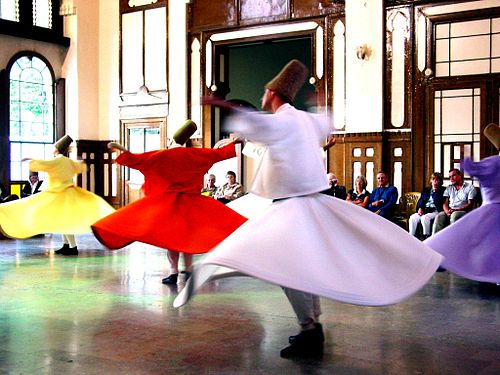
The top image is Mevlevi Dervishes Perform, created by K?vanc and sourced from Wikimedia Commons. According to the Wikimedia site, the Mevlevi Order is a Sufi order founded in 1273 in Konya, Turkey. “They are also known as the Whirling Dervishes due to their famous practice of whirling as a form of dhikr (remembrance of Allah).”
“Dervish is a term for an initiate of the Sufi Path… The Dervishes perform their dhikr in the form of a dance and music ceremony called the sema. The sema represents a mystical journey of man’s spiritual ascent through mind and love to ‘Perfect(ion).’ Turning towards the truth, the follower grows through love, deserts his ego, finds the truth, and arrives at the ‘Perfect.’ He then returns from this spiritual journey as a man who has reached maturity (hence my use of the picture for this essay) and a greater perfection, to love and serve the whole of creation.”
Next is a Banded Peacock Butterfly taken at the Chicago Botanic Garden in September 2020 by the superb photographic artist Laura Hedien, with her permission: Laura Hedien Official Website.
The third picture is inside-outside Innovation, taken from Innovation Management.
Next comes Letting It Go, the work of incidencematrix. A fritillary butterfly is about to leave an open palm.
Finally, the Whirling Dervishes photo is by Vladimer Shioshvili. With the exception of Laura Hedien’s photo, all the images are from Wikimedia Commons.

Bravo, Dr Stein. Another post chock full of love and wisdom. What Mr Stevenson said really is true. We hear “all” the aphorisms and words of wisdom but they don’t really register until we live them for awhile.
Thank you, Susan. Stevenson’s life, including an early accident and his life in politics, is fascinating. As a reader, you might enjoy learning more about him.
Brilliant, Dr. Stein! There is so much here to note but these jump out at me:
“The ability to recognize the majority of troubles as transitory and temporary is another sign of maturity.”
and
“To take risks and do hard, embarrassing, scary, or frustrating things until you master them. ”
and
“A mature person is not simply a spectator of the world before him.”
And so many more great points about gratitude and letting go. Thank you for this essay!
Thank you, Wynne. I don’t think it is possible to be “fully grown and mature,” but it is surely in our interest to do what we can on the grandest continuing personal project that engages us every day, like it or not.
I love your stories about Rich Adelstein…and Henry Fogel’s “I like to make new mistakes” because there’s no point in repeating the old ones makes me smile. Ensuring that I maintain the ability to do THIS – which you wisely pointed out:
“The ability to laugh, and to laugh at yourself, not at the expense of others.”
I find I need to do that every day as a form of self-care. And now I can consider it a sign of maturity, too! Thank you, dear Dr. Stein! 🥰
Thank you, Vicki. Yes , I used to strike people as deadly serious until they realized how much we laughed together. It is an essential aspect of enjoying life. Your blog posts reveal that about you, to the good.
Ohh…thank you for that, Dr. Stein. I try. I try. Many thanks to you for your friendship and cheers to all the facets of who we are…who we can be. 💕
There’s a lot to be said for lived experience isn’t there, especially if you really take the time to pay attention and reflect. I think of my immature moments (that still occur) as whimsical interludes helping to remind me that I really don’t know everything even when I think I do 😉
You have the lived experience right, Deb. Indeed, we are limited in understanding the world and ourselves. Freud thought this was probably a necessity. Thanks, Deb!
I always thought growing up happened distinctly for those of us who have raised children-when the world is no longer just me -but we become responsible for another. In January, I lost my dear dear father at 98 years old. My mother passed away a few years back. My Dad, aside from being an outstanding human being, was my rock-my example, my model of what it means to live a good life and to be human. I have humility and gratitude for everything he gave me. But I can tell you, that it was his passing that has made me feel as though now I am truly grown up. I am no longer a child-but a parentless child. I have grown up in his image, and the world’s decisions are now truly mostly mine.
My condolences on the loss of your father, Joanne. Fathers often carry a sense of stability for their children, a feeling that dad will always be there, even when his age betrays the evidence that he is less than what he was.
As you say, once parents are gone, we are on our own in a new way. As Jews like to say, “May his memory be a blessing.”
So well expressed, Dr. Stein: insights and wisdom of one who has matured along life’s journey. Thank you. Humility and gratitude have been the greatest lessons learned over the years. Knowing that “this, too, will pass,” carries me through difficult and dark days.