How Much is Enough?

Some say that people in the USA never think they have enough. An old friend once suggested an answer:

Too much is enough.

More money, up to a point, is enough, in theory, but we don’t fashion our lives in theory. We endure with jealousy, laughter, desire, hope, anxiety, joy, cheers, boos, toasts, dismissal, handsome and gorgeous companions, routine, exotic vacations, boring jobs, joblessness, and more.

The Roman Stoic philosopher, Seneca, said:

To be happy, you must eliminate two things. The fear of a bad future and the memory of a bad past.

He urged us to live in the only other available mental and emotional state: the moment, meaning this moment and every other one to come.

One can sometimes find peace by staying in the present. Perhaps this occurs in the stillness of meditation or when your mind is caught up in the flow of a task, a movie, a book, or a roller coaster ride.

The philosopher points out that we cannot change what is behind us. We therefore ought not to punish ourselves with the whip called regret, forever reliving the flogging of yesteryear.

A commitment not to repeat the mistake is essential before we place the strap in a strongbox to render it harmless.

The unknowable time ahead is the domain of Seneca’s other piece of advice. The future, he argues, creates more consternation than it deserves.

Nonetheless, the time ahead is inhabited by the catastrophizing balloon man who inflates our less serious concerns to the point of bursting.

A brief recollection of the many fears that did not come to pass can help reduce feverish, false, painful anticipation. An equal recall of having survived worrisome challenges offers the remembrance of endurance, a capacity still within us.

Another enemy of contentment is the sense that we are worth less than those we admire, leading us to compare ourselves to their achievements or the past and departed triumphs of our younger selves.

The road before us always forks, leaving one or more paths untraveled. Once down the chosen highway far enough, we come to recognize its imperfections.

The direction not taken survives, however, in an idealized form, existing in a fantastic unreality, fueling our lamentation over a decision impossible to undo.

We are left without enough, without the fulfillment our dreams urge us to realize. A necessary sober discovery informs us that the unchosen alternative is similar to the Christmas gift of which we would have tired within a few days.

Aging schedules a one-sided, unrequested meeting, delivering a progressive loss of capacities. We are not the hardy, risk-taking, fast-moving, limber, energetic, quick-thinking wizards of the early days.

The best solution is to maintain as many of our abilities as we can, accept what we cannot recover, and commit to what remains enjoyable and fulfilling.

The ghost of our past self must be dismissed, lest it rob us of our well-being in an unwinnable competition.

The philosopher and mathematician Bertrand Russell said this about expecting too much of life in our endless hunt for more, no matter what we already have:

The world is vast and our own powers are limited. If all our happiness is bound up entirely in our personal circumstances it is difficult not to demand of life more than it has to give. And to demand too much is the surest way of getting even less than is possible.

The man who can forget his worries by means of a genuine interest in, say, the Council of Trent, or the life history of stars, will find that, when he returns from his excursion into the impersonal world, he has acquired a poise and calm which enable him to deal with his worries in the best way, and he will in the meantime have experienced a genuine even if temporary happiness.”

Russell tells us to escape ourselves—diminish our self-preoccupation. As noted at the top of the page, many of us are born into expectations of success and the pursuit of it.

We need to move beyond the billboarded reminders of material things, palatial homes, the goal of writing books still read in 300 years, and wealth to place us in the 1%.

Better to listen for the quieter prompts to mend, contribute, and provide for what is needed elsewhere. Human and animal suffering remind us of those who are needier than we are.

A portion of what contributes to having enough is the beauty around us: the art, nature, painting, theater, ballet, poetry, and music.

Friends provide their own benefit, no less essential to a satisfying life.

Think too of the random smiles, those who serve us when we shop, the souls who cut our grass, and the graceful display of a young body swinging a baseball bat.

Don’t forget chocolate. There is never enough of that!

Kurt Vonnegut, the award-winning novelist, wrote the following poem on the subject of this essay, using his late friend, the famous writer Joseph Heller, to illustrate his point:

JOE HELLER

True story, Word of Honor:

Joseph Heller, an important and funny writer

now dead,

and I were at a party given by a billionaire

on Shelter Island.

I said, “Joe, how does it make you feel

to know that our host only yesterday

may have made more money

than your novel ‘Catch-22’

has earned in its entire history?”

And Joe said, “I’ve got something he can never have.”

And I said, “What on earth could that be, Joe?”

And Joe said, “The knowledge that I’ve got enough.”

Not bad! Rest in peace!

==========

At the top of the page is King Midas from Wonder Book, the work of Nathaniel Hawthorne and Arthur Rackham, 1922. It is followed by a Photo of an Old and Young Woman in Traditional Ukrainian Clothes, by Mikhail Kapychka. Both of these were sourced from Wikimedia Commons. A picture of Kurt Vonnegut comes just before a discussion of his poem in memory of Joseph Heller.

Signs of Maturity: What Does It Mean to “Grow Up?”

http://upload.wikimedia.org/wikipedia/commons/thumb/a/af/Mevlevi_Dervishes_Perform..._%28469777809%29.jpg/500px-Mevlevi_Dervishes_Perform..._%28469777809%29.jpg

“Oh, grow up!” Is there anyone who escaped this humiliation as a kid? Often voiced by another kid, or some chronologically mature person who probably needed to “grow up” himself?

Still, it raises an important question: what does it mean to grow up? What qualities are present in those people we respect for their maturity?

Although it may not be very humble, let’s start with the quality of humility. And it’s important to remember that humility is not identical to a lack of confidence. Instead, it involves this recognition: in the big picture of the universe, you are a tiny part.

Unless your name ranks with Einstein or Beethoven, virtually no one will know your name in a hundred years.

As Goethe put it, “Names are like sound and smoke.” They disappear that easily. Humbling indeed. You probably aren’t as important as you think you are.

This means your problems, at least most of them, aren’t that important either. The ability to recognize the majority of troubles as transitory and temporary is another sign of maturity. Now, I’m not talking about brain cancer here, but the more garden-variety ups and downs of life. It sometimes helps to realize you will care little if anything about them in five years or even five months.

As the saying goes, “Don’t sweat the small stuff. It’s all small stuff.” At least much of it.

Another essential quality of being a grown-up, I think, is having a balance between your head and your heart. We all know people who are way out of balance—those who claim to be imperturbably logical, like the Mr. Spock-type Vulcans from Star Trek, and others who come apart at the most minor disappointment or frustration, letting their emotions twirl them around like passengers on a “tilt-a-whirl” amusement park ride.

Pain is part of us for a reason: distress must be attended to lest you leave your hand on the stove’s burner. Equally, your head is required for sound judgment and to learn from experience, be cool under fire, and forge ahead despite fear.

In other words, balance is a sign of maturity. Balance of work and play, action and contemplation, passion and repose. Socrates said one should be grateful for old age because the passions then rule us less. But do not live without passion, especially when you are young enough to enjoy it! He also said, “The unexamined life is not worth living.” And so maturity requires some thought about your life, where you’ve been and where you are going, why you have done what you’ve done, what worked and what didn’t, and what lies ahead. It requires an unflinching look in the mirror and the intention to improve.

This means being a “grown-up” demands one has learned from experience and continues to learn more as events transpire. My friend Henry Fogel has said, “I like to make new mistakes!” There is no point in repeating the old ones.

Another friend, Rich Adelstein, attempted to figure out the solutions to his then-current problems (he was 50 at the time) as a defense against their reappearance in the future. Once armed with those solutions, he thought, using them to confront whatever was ahead was the way to an improved life. He realized later, however, that there would be new problems requiring new fixes, and the version of himself who faced those novel challenges would be older and different, viewing matters from a different perspective than his 50-year-old self.

This is an example of maturity and a signpost to some of its characteristics, including the need to change, the ability and willingness to be flexible, and the awareness that learning along the way is required.

Rich was able to change his mind about the need to change.

What other qualities might be present in the “grown-up?” Confidence and the capacity for self-assertion. The ability to laugh, and to laugh at yourself, not at the expense of others. To take risks and do hard, embarrassing, scary, or frustrating things until you master them. To be independent in thought and deed, not to follow the crowd or require a caretaker to make decisions for you; and of course, the capacity for intimacy and love, knowing all the while that embracing others makes you vulnerable to loss.

An additional aspect of wisdom is having a sense of what is worth fighting for and what is not. There are more than enough battles worth fighting in this imperfect world, but one cannot take on all of them—an exhausting and impossible prospect. Therefore, maturity requires sufficient knowledge of oneself and the world to make decisions about standing fast, standing aside, holding to principles, or compromising.

We must recognize our strengths and face our weaknesses while trying to remedy the latter so that we can take at least some small part in repairing the world. And accepting a sizable portion of defeat as inevitable.*

So, yes, being a grown-up means accepting the world on its terms: that loss and disappointment, in causes and in people, are inescapable, and too strong a defense against them deprives you of the most important and precious things life has to offer: the thrill and camaraderie of fighting the good fight; and at a more personal level, love, closeness, tenderness, acceptance, and affection. These require unguardedness. Living as if your heart has never been broken and never can be displays both maturity and courage.

Responsibility-taking is another part of maturity, admitting that “yes, it was I who made the mistake.” We heard the story of George Washington chopping down the cherry tree a long time ago, an example of responsibility-taking and honesty. As the reference might suggest, honesty is no small part of the “grown-up” life.

The sages say honesty simplifies life. Too many justify their dishonesty by claiming they are trying to spare someone else’s feelings. Don’t be deceived. Usually, it is much more self-serving than that.

We’re back to humility, where we started. Part of being mature is having the humility to realize that you, too, might, “but for the grace of God,” be in someone else’s awful spot and, therefore, should be judged less harshly for whatever they have done or whatever has happened to them.

Perhaps they should not be judged at all.

Maturity means cherishing the quiet moments as much as the thrills. It also means living in the moment, mindful of everything, trying not to get caught up in hoping it were different (even though you might well be justified in doing so), allowing yourself to stay centered where you are in time, rather than looking back or forward while the irreplaceable, unrepeatable instant of your life passes by.

Look back too much, and you will be caught in the sadness of time past, unfulfilled longing, and regret while missing what is possible in the present. Similarly, living in the future tends to generate anxiety in anticipation of what may come. It deprives you of the present moment, matching the deprivation of those focused on yesterday.

Accepting and liking oneself is part of being a grown-up. It is not that you don’t need change, but that you should appreciate what is good about yourself and accept some of the inevitable limitations to which we all are prone—not to avoid self-improvement but to avoid self-denigration.

Being a grown-up means living a principled life, being committed to specific values, and putting those values to work in more than words. As the AA crowd likes to say, “Don’t just talk the talk, walk the walk.” And those principles, those values, must be informed by the fact we are all mortal, all in-transit, but the planet and the human race are here (we hope) for the long haul. We are “just visiting,” as the Monopoly board reminds us when we land on a particular space. Of course, the game of life and its younger players will outlast us only if we do our part to preserve the Earth on which it is played.

We must work to demonstrate our commitments. Freud was right when he said love and work are the essential organizing forces in any life. If you are mature, unless you are aged or infirm, there is work to be done. Doing it makes life more interesting and engaging, too. A mature person is not simply a spectator of the world before him.

One other quality I should mention in this pantheon of talents is gratitude. It is appreciation of what you have—simple things: a beautiful day, the affection of your children or grandchildren, the ability to move, the beauty and scent of flowers, a comfortable bed, a touching song or story, and good friends—all the stuff of life too easily dismissed.

Increasingly, I believe we must spend time looking in the mirror before pointing fingers and attacking. Most of the time, we are not so different from those we vilify. Make friends as you mature and into your senior years. You’ll be happier.*

We are well-advised to relinquish attachments to things with aging into old age. If, like me, you’ve lost your hair and some pace in your once swift steps, you recognize a body in the transformation process. You can rage against such changes, but it is preferable to hold the “things” you have with lightness, not gripping them in desperation. Mother Nature will win this one. Such alteration–previously unthinkable– isn’t personal. The defacing hand of the universe gets to everyone in time.*

Accept, accept what is outside of your control.*

Letting go (not giving up) offers less suffering. Detach gradually with equanimity. Every well-used car wears out the tire tread in time.*

I’d like to believe we learn from this turn of events. Among the lessons would be that no life is without suffering, as the Buddhists would remind us even in peaceful, “normal” moments. We all share the pressure of change happening faster than ever.*

A mature individual places significance on finding connection with those who, like us, are treading the water in the sea of woe we now live in. Those lacking physical touch, managing economic distress and political dystopia, silently beg for helping hands in those of us not dreading the lack of food or the inability to pay the rent. An enlightened person recognizes and responds to the shared dignity and need of others now more than ever.*

John Donne reminded us 400 years ago, “No man is an island.” His poem ended:

any mans death diminishes me,
because I am involved in Mankinde;
And therefore never send to know for whom
the bell tolls; It tolls for thee.*

As the cliche goes, we are more alike than we are different, despite the bigots who think they are superior. Maturity sets aside selfishness and class or racial distinction. Those in the military swear not to leave a fallen comrade behind. The planet’s widespread distress has enlisted us all in the army needed to raise each other up.*

Let the last words on being a grown-up go to Adlai Stevenson II in his 1954 speech at the senior class dinner of his Alma Mater, Princeton University. These 71-year-old words spoken by the 54-year-old Stevenson are as appropriate now as then:

…What a man knows at fifty that he did not know at twenty is, for the most part, incommunicable. The laws, the aphorisms, the generalizations, the universal truths, the parables and the old saws — all of the observations about life which can be communicated handily in ready, verbal packages — are as well-known to a man at twenty who has been attentive as to a man at fifty. He has been told them all, he has read them all, and he has probably repeated them all before he graduates from college; but he has not lived them all.

What he knows at fifty that he did not know at twenty boils down to something like this: The knowledge he has acquired with age is not the knowledge of formulas, or forms of words, but of people, places, actions — a knowledge not gained by words but by touch, sight, sound, victories, failures, sleeplessness, devotion, love — the human experiences and emotions of this earth and of oneself and other men; and perhaps, too, a little faith, and a little reverence for things you cannot see…

To my way of thinking it is not the years in your life but the life in your years that count in the long run. You’ll have more fun, you’ll do more and you’ll get more, you’ll give more satisfaction the more you know, the more you have worked, and the more you have lived. For yours is a great adventure at a stirring time in the annals of men.
http://upload.wikimedia.org/wikipedia/commons/thumb/6/64/Whirling_Dervishes_2.JPG/500px-Whirling_Dervishes_2.JPG

Please note: The preAnsk in red/orange * indicates the preceding paragraph has been modified or created since the original post was published in 2009.

You might also find this interesting regarding maturity: Youth vs. Experience and Maturity: Who Has the Edge?

You can also take a look at this topic: Maturity: Ten Steps To Get You There.

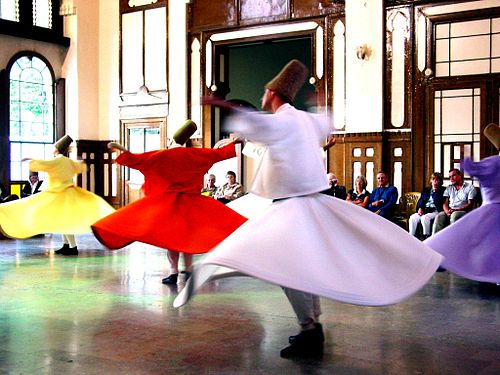
The top image is Mevlevi Dervishes Perform, created by K?vanc and sourced from Wikimedia Commons. According to the Wikimedia site, the Mevlevi Order is a Sufi order founded in 1273 in Konya, Turkey. “They are also known as the Whirling Dervishes due to their famous practice of whirling as a form of dhikr (remembrance of Allah).”

“Dervish is a term for an initiate of the Sufi Path… The Dervishes perform their dhikr in the form of a dance and music ceremony called the sema. The sema represents a mystical journey of man’s spiritual ascent through mind and love to ‘Perfect(ion).’ Turning towards the truth, the follower grows through love, deserts his ego, finds the truth, and arrives at the ‘Perfect.’ He then returns from this spiritual journey as a man who has reached maturity (hence my use of the picture for this essay) and a greater perfection, to love and serve the whole of creation.”

Next is a Banded Peacock Butterfly taken at the Chicago Botanic Garden in September 2020 by the superb photographic artist Laura Hedien, with her permission: Laura Hedien Official Website.

The third picture is inside-outside Innovation, taken from Innovation Management.

Next comes Letting It Go, the work of incidencematrix. A fritillary butterfly is about to leave an open palm.

Finally, the Whirling Dervishes photo is by Vladimer Shioshvili. With the exception of Laura Hedien’s photo, all the images are from Wikimedia Commons.

Overcoming Suffering and Our Fear of Change

Suffering, both physical and psychological, cannot be escaped. We can, however, minimize it by not adding to our discomfort.

For Buddhists, much suffering comes from our desire for permanence. In the West, we often refer to this as difficulty adapting to change.

It is hard to think of anything that doesn’t change. The weather, our relationships, and life itself are all temporary. We age and die. Our children grow, create their own families, and become independent — a double-edged modification necessary for their well-being and requiring an adjustment that, at times, is painful for us.

One’s effort to establish a vice-like grip over all the “temporaries” we hold dear can only fail. Our attempts to freeze-dry and maintain ideal moments of perfection are fruitless.

Those who believe in an afterlife often imagine the best parts of this one and hope the future will contain some glorious, magnified, blissful version of these moments. Many believe there will be permanence, for example, in their joyous reunion with departed loved ones.

Others run from thoughts of inevitable loss or nightmare difficulties ahead of them in this life. They seek TV, music, alcohol, drug abuse, or other distractions from such possibilities.

What if we could become impervious to suffering using a magic potion? Imagine further that the rest of the world stayed as it is.

Without any sense of loss, we would become indifferent to the misfortune of others. We would lose ourselves, become unrecognizable, and be unable to understand anyone else’s hardships.

Without the capacity to sustain personal injuries, our lives might be described as robotic, wooden, and hardened — indeed unchangeable. No new learning would be possible.

Doesn’t love require compassion and understanding, put out of reach by the magical drink? Would we even wish for love, be moved by a tender film, beautiful music, or art? Why might such an individual read fiction without caring what happened to the characters? Nor could he capably raise children to become decent human beings.

Given that the suffering connected with an impermanent human state is inescapable, we must come to terms with our lack of control and inability to achieve more than a temporary evasion of external stressors. 

A worthwhile alternative is the transformation of ourselves into creatures who, recognizing life’s inevitable difficulties, hold our knowledge of human transitoriness gently.

Rather than gnashing our teeth over the uncountable unfairnesses befalling the human race, there are alternatives. One might do better to recognize that we pay for love, the appreciation of beauty, and the blissful moments of exhilaration with the suffering and change that make up the other side of the coin of existence.

We can learn to give up the struggle for control of everything except that which is in our power. We can accept the pain and the shortness of our lives and learn how to live with them.

One step is to recognize we will not achieve permanent happiness in an ongoing process of craving much of what we believe will make us happy. We tend to react to purchasing a dream home or finding a desirable mate as if they are Christmas toys: short-lived sources of joy. We take them for granted before long, at least to some degree. As the English author Wordsworth reminds us, “Getting and spending we lay waste our powers.”

Homo sapiens do better to shift their focus from the complexity and lack of ease in any life by focusing on self-care, kindness, gratitude, displaying compassion, and listening to and recognizing the true nature of our friends and acquaintances.

We can ask those we care about whether they believe we understand them. And if they say no, tell them we want to do better. An essential feature of such attempts to improve relationships involves working on ourselves and diminishing whatever anger might lead us to hurt them.

Self-knowledge and meditation may lead us along this path. The latter also allows us to live more often in moments of tranquility.

The Buddha told a story about “the second arrow.” The arrows he described referred to the pain from events outside us. Of course, when the first arrow strikes, we feel anguish. We are advised, however, not to wrestle with it. Instead, begin by recognizing it.

One can come to an acceptance of the harm by releasing the tension and embracing our distress. Gentleness with ourselves, meditation, and ensuring not to enlarge our suffering allows the injury to heal to the extent possible.

The agony will grow if we keep struggling with the wound and remain preoccupied with the affliction and how it occurred. As the Buddha tells us, worrying over our pain is like a second arrow we shoot at ourselves.

===================

Both of the images come from Wikimedia Commons. The first is Meditation at Empty Cloud by Rikki. The second is the Buddha.

On Human Inconsistency, Hypocrisy, and a Touch of Genius

We think of ourselves and others in simple words and categories: good/bad, outgoing/bashful, assertive/passive, and so forth. Friends are offered halos until we are sad or angry enough to be done with them, and then the devil’s pitchfork becomes a part of the vision we recreate.

Not always, but often.

We are not all one thing or another. Consistency is more self-delusion than a reality. A close inspection suggests carve-outs, areas of our life where we are perhaps better or worse than our “imagined self:the way we like to think of ourselves or the way we can’t help but think of ourselves.

These are boxes and compartments of our unconscious making, to a degree. The parts we like are visible to our internal eye. More dubious sections live behind partitions.

Were the various zones fenced off by fixed lines with clear borders, we’d manage them with less trouble. The blurry, fuzzy, porous demarcations are scarier for us. We sense the leakage of our darker truths, harder to rationalize, harder to live with.

Life would be more fraught if we kept asking the question, “Who am I?Then we would be near relatives of the Wicked Queen in Snow White , who asked instead, “Mirror, mirror, on the wall, who is the fairest of them all?I’m told her therapist suggested she stick with the first pleasing answer and put the looking glass away.

All of us are hypocrites at times, but call others by the name. When was the last time someone told you, “Yes, I am a hypocrite. I said one thing and did another” — or “I believed one idea yesterday, but acted today as if I didn’t because, well, uh ... ”

Too often the changes are opportunistic, impulsive, or driven by fear. An admirable new direction requires the never-easy task of soul-searching, not a backflip.

Want a dramatic example of human inconsistency? If you are acquainted with Holocaust literature, you know some of the children of war criminals claim the apparent contradiction of having kind parents. Take Edda Göring, who died in December, 2018. She was Hermann Göring’s daughter, the man who headed the Third Reich’s Luftwaffe (air force), and a potential successor to Adolf Hitler.

Here is what Edda said about her dad:

I loved him very much, and it was obvious how much he loved me. My only memories of him are such loving ones. I cannot see him any other way.

Were this lady alone as an example of faith in a corrupt father, we might doubt the possibility. Again, people are self-contradictory. Perhaps Göring’s brutality stopped at the door of their home. He could have separated his villainous inhumanity from his private life.

Who among us, if well-treated by mom and dad, would believe he is the offspring of monsters?

Can anyone bear full self-awareness? Defenses, rationalizations, and mind-tricks must be acquired. Those drowning in self-criticism live in floundering guilt. They struggle to advance, to adapt, to be anything but transfixed by an accusatory finger before their face. The digit is theirs, at least by the time they are adults.

One of the hardest lessons in the social world is this: we must accept people whole — other than the abusers and unrepentant users — or become forever disappointed or resentful. Yes, humans can change, but it is easy to expect or demand too much.

Within our confusing and confused bipedal race, a handful of creatures display a genius of which inconsistency is an essential component. Their elements don’t appear to fit together, but the ensuing unpredictability itself produces fascination. When combined with an untroubled, occasional defiance of convention, their acquaintance causes diamantine delight.

They exist at the intersection of innocence and adventure, vulnerability and bravery. Four-way stops signs are not always observed in this spot. No wonder you wonder how they can survive at all.

Like Vincent van Gogh, you might call them intensifiers of experience and emotion, mimicking his search for a more yellow yellow, a more blue blue, a greener green. Life becomes like a canvass, filled without aid of paint or brush, textured as compared to the flatness many of us exhibit.

Such unparalleled spirits live to their fullest in moments both spontaneous and unselfconscious. Immersion in the present, however, comes at a cost. The world is encountered more through intuition and feeling than among those who lead with thought. Mindfulness of possible danger is given up in the embrace of the now.

Such precious artists of living should take care not to die for their art. Each one is the sole representative of an endangered species, missing even in Borges’s Book of Imaginary Beings.

Few understand them. Perhaps no one can, including the specimen himself. Indeed, if one greets you, you’ll blink before letting their light in again, the better to make sure no hallucination stands at a handshake’s distance.

Don’t mention the meeting to anyone, by the way. Like a unicorn or UFO sighting, no one will believe your report. Keep quiet and consider yourself lucky for the encounter.

If you are looking for consistency in passersby, here’s some advice. Stop looking. It isn’t there. Watch the sky instead for flying things or search the ocean for the life that swims. No complexity will be found in our winged, finned, and four-legged neighbors. You can live with them unperturbed.

Back here in the peopled world, little chance exists of finding individuals who are wholly integrated, top to bottom.

But the inconsistencies make life interesting, don’t they? Here’s to our contradictions. Let’s join van Gogh’s Drinkers, just above; the baby, too.

Salute!

——-

The second and third paintings are by van Gogh: Madame Roulin Rocking the Cradle and The Bedroom. The next image is Picasso’s Man with a Pipe. Finally, three more from van Gogh: The Poet’s Garden, The Drinkers, and Red Vineyards at Arles. All of these come from the Art Institute of Chicago with the exception of the last, which derives from Wikiart.org.

Sweet Memories and the Drowning of the Sun

A murder of sorts happens every day. You’ve seen it, but didn’t think to make a police report.

Remember the day at the lake? Or was it the ocean? You thought you watched the sunset.

Nope.

The invisible hands of the water pulled the yellow ball down, inch by inch. The flaming star drowned. The day was done and done for.

The world departs us without even a goodbye note. Well, you might say, the sun will rise tomorrow and you’d be right. Other things, different types of disappearances, are less predictable. A final meal with a parent or friend that seemed routine when it happened. The last conversation with a comforting voice. A live recital by a musician you won’t hear again. In the moment you don’t realize the “next time” is an idea about to be defeated by fate, but some day you’ll say, “Oh, that was the last time, wasn’t it …”

No, it’s not so serious. The old buddy might still be out there. The pianist is yet performing, but no longer at his artistic peak. Best not to go to his next concert, you say. Better to remember him at the height of his perfection. Some folks — athletes and actors, singers and trapeze artists — stay on stage too long. Of course the latter reside above the stage, but you get what I mean.

Last times happen because we cannot hold the globe still any more than we can stop a bull stampede.

Reading The Night Before Christmas to your little ones becomes a swan song, too. I loved my two charming girls cuddled around me on the eve of the once-a-year gift-athon. What they thought or felt I can’t be sure. Perhaps enjoying the ritual, my voice, and the closeness; but impatient to fall asleep, the better to jump over the nighttime to the morning.

As the years passed I’m pretty sure this habit of December 24th came to mean more to me than to my little sweeties, by then less little. I found uttering the words ever more touching. The girls were getting to an age when such things wouldn’t fit: the end of their childhood and a passageway leading to one fewer intersection of our lives.

I can’t tell you when we laid to rest the pre-holiday custom, but whatever the year, it was one of those things about which I am philosophical. Life can’t be freeze-dried, tiny creatures kept small in perpetuity. Put the flight of this ritual under the heading “a small price to pay for their growth and maturity; their flourishing.”

Thursday night, though, came an encore. The unremarkable routine of baby sitting at my youngest’s house offered no foreshadowing. Bedtime approached and with it the three books my grandson’s mom put next to the recliner in his room, his invitation to dreamland.

My boy responds to the drill as well as I do. He sits in my lap after we put on his pajamas and, once the recitation ends, gets tucked in.

How lengthy he’s gotten! He no longer fits snug in my lap. Remind me to buy a larger-sized space between my chin and my knees. Soon this three-year-old — long-limbed for his limited span of years — will be too big for this position.

I was about to pick up the first book when I spotted the title: The Night Before Christmas.

My eyes moistened, but I plunged in. He’d heard it before, but not from me. I’m an animated reader, so I gave the job passion: speeding up, slowing down; some parts louder, others softer. A performance.

The tear that started at the start made its way down my right cheek by the finish. I wiped the dew away and turned the mute printed words of the other two children’s stories into sound. Afterward my parents’ great grandchild scrambled into his bed, I kissed him, and we exchanged the words “I love you.” Once the lights were dimmed I left the room.

There have been moments in my life in imitation of eternity. Maybe they are eternity if you fully inhabit them, lose yourself, forget the hourglass and the daily sunset. Reciting this verse to my progeny makes me immortal for the few minutes it takes.

The man I am is well-past thinking money is the solution to anyone’s troubled soul, outside of purchasing necessities. I am incapable of religious faith, never my strong suit. I am done asking the question “What is the meaning of life?”

As a young man I wondered and wondered.

Choose your own meaning or no meaning, but for me I’ve never come up with a more pleasing one than revisiting The Night Before Christmas with my children; and now the first male in my parents’ genetic line since my brother Jack. So long as I can do that, the sun will hover in the sky, the flaming thing keeping all my loves warm, safely beyond the water’s reach.

The idea of a river drowning the sun was borrowed from Matsuo Bashō’s Narrow Road to the Deep North, 1694. The top photo is a Sunset from Zebulun Beach, Herzliya, Israel. The photographer is RonAlmog. The last picture is the work of Maureen Boyle: Freya’s Golden Tears in the Style of Gustav Klimt. Both the sunset and the Boyle were sourced from Wikimedia Commons.

How Much Do You Think About Your Future?

“What dreams may come?” wondered Hamlet as he considered whether “to be, or not to be.” The potential of an afterlife of nightmares stopped him short of self-murder. For the rest of us, the time beyond today is either ignored, dreaded, colored in unending rainbows; or maybe even calmly planned.

Experience suggests that whatever comes will include both good and bad; and depend, in part, on how we approach it.

One’s individual weather forecast depends, to a degree, on his history and inborn, genetic disposition. Yes, there are born optimists or born pessimists. Guess who has more fun?

Cognitive behavior therapists help the latter group’s struggle with catastrophization. The counselor trains his patient to recognize the error within the terror of anticipated disaster when little realistic likelihood exists. The worst of life is best encountered in the moment. Don’t pour worry over yourself, like a sticky syrup mucking-up every day. “Borrowing trouble” comes at much expense, killing our ambitions before they begin.

When we do think past the horizon, some of us mistakenly focus on only half of what must be done to raise our prospects. It is not enough to quit an awful marriage or job, despite the immediate relief of departure. What comes after? Ask how you deposited yourself in a swamp? Envision a destination and a plan of attack. None of this is easy.

I know people who need a permanent set of attached binoculars to check out next steps. Some take bodily risks. Think prodigious drinking, eating, or drugging. Nor do I speak of the ones who simply deny their self-abuse. Too many possess the “talent” (or curse) of shutting off their brains when offered a drink or walking into a restaurant: an unconscious, dissociative process like a selective amnesia. A hour earlier they intended to pass by the cocktail or the quarter-pounder with cheese. Faced with the devilish dilemma, the brain takes a vacation — temporarily closes-off a sliver of awareness. One might think of it as the sky on a clear day, but for one cloudy portion.

The future is a trickster. His opening act makes us believe we own an unused bank vault full of years. For those who do survive, unlived time is most often neither so wonderful or terrible as we imagine. Humans hedonically adapt. After a period of euphoria we tend to move back to our “set point:” our usual level of emotional equanimity or distress. Time’s passage also elevates our spirits from the first awfulness of many seeming disasters. Review your history. You might find lots of misfortune from which you bounced back.

Truth is, we are poor affective forecasters — weak at predicting the emotional residue of our adventures. Psychologists Daniel Gilbert and Tim Wilson tells us this leads to “miswanting.” We guess we will like some choices more than we do when they happen, in addition to “mispredicting” how long strong feelings will last afterward.

You think a $10,000 raise offers sustained joy? Most likely not for long. Simply put, after a year or two, most of us feel about the same as we did before the wonderful or terrible thing happened.

If you dislike the fallible weatherman, examine your prognostic success. In 10-years-time you could be surprised by how much you change and how those alterations complicate your ability to make predictions about what you will enjoy:

While I’m giving crystal ball warnings, beware of “bucket lists.” Other than people like my old buddy Ron Ableman, I knew many who kicked the bucket before they reached the list inside. Another group believed their long-awaited trip to Paris, for example, would have held more enchantment in the springtime of their life.

If you peg your well-being to winning an Olympic gold metal or some similar recognition, reconsider. Someone will win the distinction, but far more won’t. The impossible dream is the graveyard of life satisfaction. Instead, enjoy the process and more probable rewards along the way. A spot on the highest podium while your national anthem plays then will be the cherry on top.

The difficulty of depending on tomorrow for all your pleasure is well-described by Dan Greenburg and Marcia Jacobs. Their funny and all-too-true book is called How to Make Yourself Miserable.

The authors believe we manage the dreariness of our regular duties by looking toward to THE WEEKEND.

Unfortunately …

By Saturday morning you may be vaguely aware that Friday night wasn’t as great as you hoped it would be, but you don’t have much time to think about it because … you are still looking forward to the climax of THE WEEKEND — Saturday night. By Sunday afternoon, however, it is all over. Hope is dead. There is nothing further for you to look forward to, except the gloomy prospect of Monday morning and another whole week of drudgery at a job or school you detest. The weekend — like your life — can at last be viewed in its correct perspective: one colossal letdown, one gigantic anticlimax. On Sunday afternoon you are free to ponder all the great times you felt sure lay ahead, but never quite materialized.

We do need to suppose something better is in the offing — somewhere, somehow — and energize the resolve to get there. All those who trod a long educational road toward a career valued the lofty goal. The fathers of our antique religions realized the worth of a heavenly reward — a world without gravity — for the grave circumstances we ofttimes endure on earth. But, as Greenburg and Jacobs recognized, laughing at ourselves helps too, and sooner.

Just as a predictable joke is never funny, the most remarkable opportunities and joys take you by surprise.

In my own temporary stay on the planet, for example, I never contemplated that I might become a consultant to more than one major sports team. The unsought path just revealed itself.

Sure, I passed through down times and understand more will come, but I find little profit in attempting to improve the distance-vision of the nearsighted man I am. Indeed, if I live long enough, I’ll hesitate before buying unripe bananas. Most senior citizens are wise not to take a mental leap forward. They do well to make every day count.

Nothing is static. Expect sunny days and stormy weather and many partly cloudy skies. The ability to adjust to conditions is a skill necessary for you and me, both.

The largest portion of our contentment comes not beyond our noses, but by grabbing the beauty near at hand.

Of course, I have a surgically reconstructed left knee, so she may elude me.

—–

More on affective forecasting.

The first image, What Lies Ahead, was sourced from Eurotimes.org. The art work that follows is The Future of Statues, by Rene Magritte. It was sourced from Wikiart.org.


In Which Part of Life Do You Live: Past, Present, or Future?

How much is well-being or its absence – depression and anxiety – dependent on what you pay attention to? I mean the present moment, the past, or your future? Does one best way to focus your attention exist?

Let’s look at each of these three possible orientations to time. Today I’ll start where your body is, even if your mind isn’t:

THE PRESENT

Philosophers remind us that the present is all we really have. The past is gone and the future might not come.

At least three paths allow us to live within the fleeting instant:

1. MINDFULNESS BASED ON MEDITATION PRACTICE:

Much effort is needed to develop and maintain this kind of “in the moment” way of being; daily meditation practice for the rest of your days. In doing so you can train the mind to stay in the present and refocus whenever attention begins to move toward a distraction, worry, preoccupation, memory, or anything else but your being within one second at a time. No before or after. No holding on to feelings. You observe the world rather than dwell on it. Thus, for example, pain is less fraught because you do not obsess about it. A benign sense of detachment comes to master meditators. They notice everything, but don’t pile meaning and intense emotion on everything, thus freighting the bad into something worse. Research suggests these are the most contented people on earth.

2. EMOTIONAL OPENNESS TO THE PRESENT AND WHATEVER LIFE OFFERS IN THE NOW:

Unlike the meditation experts, those in this group lead intense lives. Their openness allows for much joy, as it does for sorrow. At their best they are unguarded and brave. I am not speaking here of people with ADHD, who risk being caught in a whirlwind of thoughtless and impulsive action, untroubled by the past or future. Rather, I refer to those who are free with themselves, not self-consciously governed by what others might say or see. They are quite natural, unaffected, and spontaneous. Their self (and self-consciousness) is lost.

Such lives are not full of rigid angles and rectangular shapes. They don’t always conform themselves to boundaries drawn on hard surfaces, as one must in formal sporting events, with perimeters decisively marked as fair or foul, in or out. Think ocean or sky, not ground, when you behold them: creatures who swim or fly. Theirs is a life of discovery and bright eyes. They wish to play, not keep score; celebrate while the sun still shines.

These gifted people (whether by nature or choice) don’t achieve the dispassionate serenity of meditation gurus, but they are more “alive.”

As William Blake wrote in Auguries of Innocence,  the talented few are able

To see a World in a Grain of Sand
And a Heaven in a Wild Flower,
Hold Infinity in the palm of your hand 
And Eternity in an hour.

3. ACHIEVING “FLOW:”

This is a cousin of #2, but applies best to work, competitive play, and hobbies. Here the path is not so much social or relational, but the singular focus on a task. In the case of elite athletes, for example, their concentration is extraordinary: They have been known to so “tune out” the sound of the crowd, that overwhelming cheers (when they finally do break through) can startle them, bringing them back to the amphitheater from the smaller arena of man against man. They had lost awareness of a stadium full of 60,000 observers. The psychologist Mihaly Csíkszentmihályi tells us, “this is a feeling everyone has at times, characterized by … great absorption, engagement, fulfillment, and skill … during which temporal concerns (time, food, ego-self, etc.) are typically ignored. The ego falls away. Time flies … and you’re using your skills to the utmost.”

The mastery and experience within you is matched to the challenge at hand. You won’t get this often watching TV (only seven to eight percent of the time). Neither will relaxation transport you into “flow.” You must do something. Csíkszentmihályi would have us believe ecstacy is possible in the “flow.”

Some suggest, however, we be careful of too much “in the now” living as defined by the first two paths. Isaiah Berlin, the philosopher and social/political historian, thought the detachment achieved in a Buddhist type meditation (Category #1) could be a cheat of life experience, a kind of defense mechanism against injury; valuable, but missing the full essence of life.

Those taken by the moment (Category #2) also risk some of the avoidable misfortunes that those who spend more time looking ahead might dodge. Members of this group would push back, however, claiming the reward of emotional and behavioral vulnerability is worth the risk. Take opportunity on, they might say: this life is the performance and not the rehearsal.

Nor should we forget, people suffering from Borderline Personality Disorder (BPD) are characterized as living in painful extremity too often. They can miss or discount the notion that nearly everything they are feeling at this instant is temporary, therefore potentially succumbing to passing emotional catastrophe. For them “the now” seems endlessly excruciating.

Want some homework? Ask yourself which “time zone” you usually occupy and which makes you happiest.

Stay tuned. One of my upcoming posts will deal with living in the past, which also has its ups and downs. An essay on future orientation will follow, along with some thoughts about the three types of time-focus and how to manage them.

The second image is Macaca fuscata in Jigokudani Monkey Park – Nagano, Japan, by Daisuke Tashiro. It was sourced from Wikimedia Commons.

Therapy’s Ultimate Goal: Embracing Life

Are there endangered emotions in the world, much like endangered species? The ones that disappear? Most of us had sentiments and enthusiasms as small children we now rarely experience. What might they be? Can we get them back?

The greatest events of life, I’d argue, are fleeting. The birth of your first child is one. An early, electric kiss. The clichéd “thrill of victory” as it is felt, not reported. A musical performance of sadness or exultation so powerful you float and reverberate for days. Immediacy, intensity, and loss of self-awareness are found in these moments. Routine breaks. One is swept away.

What do we try to do with such things? Extend them, for sure. Go back to the source and regain them. Produce more children, maybe; more kisses, for certain. Play in additional ball games, too. Perhaps attend the repeat-performance of the concert the next day. But, the repeat almost never captures the wallop, the poignancy of “the first time.”

Does the picture of a speeding bullet seize the essence, help us remember and relive it? The most precious things and people are priceless, in part, because of their short supply and elusiveness. Here and gone. No matter the effort, we can’t catch an emotional deluge in a bucket and keep it in the fridge, just so.

Yet still we try. We want the honeymoon to be endless. We want our child’s spontaneity to continue forever. We think the earth-moving moment should be mounted in a frame or frozen under glass, but its soul is in the movement, not the stillness. The carefully preserved butterfly does not fly.

Some of us, as we age, lose even the ability to be astonished by life, bowled over by happiness or love, sensation or tenderness. Most want a bit of protection, so we add, without thinking, one layer at a time, beginning in youth. Seems safer, more necessary, less risky. The arrows of fate then won’t pierce as far, hurt as much, or so we believe. We want to escape fatal bullets, but unintentionally kill ourselves – the life in us – by trying to avoid them.

The bravest therapy patients attempt to change no one but themselves in their effort to recapture the innocent wonder they had at the point of creation, or grab the life-enkindling thing for the first time. They have the courage to recognize the mirror’s image, to overcome the pain of treatment, to outlast and out-will the unendurable: a kind of therapeutic integrity not to be denied. They grip tragedy and wrestle him to ground. They rip the emotional scabs off their being and bleed until purified and joyous. I still cannot believe how open they are.

As an observer of myself, I can characterize personal life from my 20s to the present as an opening more than a closing. My work required this openness, but so did full immersion in the best private moments as they happened. To my continuing surprise I become more open, not less, even now. Saying what others might not say, but only think; expressing the deepest part of myself to those who care to listen. Looking into your eyes if I am touched by your being. Life hurts more this way, but feels right and perhaps I have no choice: I became and am becoming such a person with little intention. Who knows what version of myself might appear tomorrow?

Death sets the border on everything. The cliché tells us the cemetery is full of irreplaceable people, the last stop on a human world in transit. The trains of life’s are always in motion, much as we want them to wait a minute. The best of them are swift. That’s what makes a train. No picture of a locomotive moves at 60 mph unless you throw it across the room.

So my advice to all of us is this: eyes open, heart open, stay alert, let down your guard as much as your dare; but don’t lose the best of yourself. Make love to life as if she were your first and last, both. She just might be.

Of course, I’m uncatchable, but catch me while you can.

As the advertisements tells us, we are all on sale for a limited time only.

The top image is called Berliner gör’n by Till Krech and is sourced from Wikimedia Commons.

The Age of Social Comparison: When Self-Involvement Makes You Unhappy

We live in an age of entitlement and self-involvement.  A Metra train conductor offered an example last summer:

I was taking tickets and the train was getting pretty crowded. I noticed a middle-aged lady standing near an empty seat. I could tell she was asking a young woman to move a package so she could sit. Apparently, to no avail. So, I walked over to smooth the situation over. The younger woman was gorgeous, maybe 25 or so, and attending to her phone, not the person hovering over her. When I asked her to move the stuff she ignored me. I tried again, same result: head down, as if I didn’t exist. OK, now I bent down so I was harder to ignore and told her she needed to let the woman sit; said the other person had a right to a seat. Finally she talks, in a kind of astonished and disrespectful voice, ‘You don’t understand, I’m beautiful!’

Does her beauty make her happier, I wondered? Are her gorgeous selfies (I’m sure she has a ton) the path to everlasting bliss? Taking them, making them, reviewing them, sharing them, comparing them?

The back-to-back hardships of the Great Depression (1929-1939) and World War II (1939-1945), contributed to a more modest and realistic view of a life worth living: a selfie-less and more selfless life. In 1931, James Truslow Adams coined a soon famous expression capturing something now lost and redefined, “that the American Dream of a better, richer, happier life (be available) for all our citizens of every rank.” Not fame or Midas-like wealth, but “enough” in the reach of all.

Granted, he didn’t include blacks in his vision, but at least his view was independent of constant social comparisons, Kardashianized aspirations, and the belief more is always better: a bigger residence, finer clothes, and social status. Where happiness is somehow attached to what you buy and the ability to turn heads until they swivel. Where college is intended not to enlighten you to the glorious natural world, man’s loftiest thoughts, and responsibility to his fellow creatures, but to learn enough technique to receive special treatment for you and your wallet.

I believe a good part of today’s unhappiness, not including the genuine want suffered by so many, is that a large number of those doing pretty-well want more and more with no end to their wanting. Want for themselves.

Perhaps no limit exists because there is always someone with more. We envy greater beauty, infinite wealth, a bigger house, a superior job when they are not ours. Envy assumes “my life would be better if only …” according to Joseph Epstein. TV, not to mention the internet and other vehicles of voyeurism, show people flaunting their prosperity. We know how much they make for a living, where they reside, and what cars they drive. The “information highway” and its attendant loss of privacy fuels our desire and our frustration.

The question then becomes not how can I get more of what they have (and thereby grab on to more happiness), but does this path lead to my goal?

Christopher Boyce, Gordon Brown, and Simon Moore, in a 2010 article in Psychological Science, provided data from 12,000 British adults which supports the notion that comparing ourselves to others is a problem. The authors found that “the rank position of an individual’s income within his reference group dominated the explanation of life satisfaction. “In other words, “satisfaction is gained from each ‘better than’ comparison and lost for each ‘worse than’ comparison.’” Moreover, their subjects tended to make comparisons to those above themselves in income 1.75 times more than they made those comparisons to those below them.

Following the same logic, even if your wage increases by a substantial amount, your sense of well-being might not substantially increase unless the extra salary changes your rank within your comparison group (or unless your paycheck is relatively modest, as noted below). If all incomes go up without changing your rank you would be no happier.

All this envy-induced pain might be justified if it motivated people and led to the prosperity needed to unlock the door to serenity. The problem is, the key doesn’t work. Indeed, international ratings of life satisfaction put the USA high, but not as high as you’d think given our superior wealth. We rank 19th of the 34 OECD countries in the 2017 World Happiness Report.

Psychological research suggests that beyond $75,000 in annual income, you don’t get much hedonic bang for the additional buck. In other words, all the things you would buy with the extra money your neighbor has won’t make your moment-to-moment experience of life much more pleasing unless your income was unexceptional in the first place.

What does this mean at a practical level? In the December 23, 2010 issue of The New York Review of Books, Thomas Nagel wrote:

When I was growing up, if you wanted to see a movie, you had to go to the local movie theater, and you saw what was playing that week. Now I can see almost any movie from the entire history of cinema whenever I feel like it. Am I any happier as a result? I doubt it.”

Sound familiar? Similar to kids who are thrilled with their long yearned-for Christmas gifts, we adults put most new material acquisitions on the shelf or use them with little delight after a small passage of time. Warning: if shopping is the way you fill yourself up, this is your future.

The temporary “high” of a new purchase is diminished because of “hedonic adaptation.” Put simply, we get accustomed to things. The momentary excitement of the new possession soon wanes, like the smell of a new car.

Ah, but hope is not dead. The ancient moral philosophers of Greece and Rome recommended less concern with status, wealth, and material things. Instead, they suggested personal contentment would come from knowing yourself, performing social acts of virtue and public good, and friendship. Researchers now recognize the important part friendship, doing good, and being grateful can have on well-being.

The psychologist Csíkszentmihályi offers another path to satisfaction. He points to the capacity of productive and engaging work to produce a sense of “living in the moment:” unmindful of past and future because of being pleasantly engrossed in the present. This is called the “flow” state, one in which you are completely focused at a maximum level of performance and untroubled, positive experience. “In the zone” as athletes describe it. A different path to living in the moment, of course, is the mindfulness meditation of those master meditators who are among the happiest folks on earth.

Social scientists also remind us that married people are happier than those going solo, although it is unclear whether this is due to the positive influence of marriage on well-being, the possibility individuals who are relatively happy are more likely to marry, or some other cause.

Last point: data analysis by Christopher Boyce and Alex Wood in their 2010 article in Health Economics, Policy and Law found a short-term course of psychotherapy is at least 32 times more effective than monetary awards in improving a sense of well-being among those who have experienced some form of injury or loss.

I’ve said enough. I imagine you are scheduling a therapy appointment already.

The top Foto is the work of Catarinasilva25 and is sourced from Wikimedia Commons. The four paintings also come from Wikimedia Commons and are described in this way on Wikipedia:

The Four Freedoms is a series of four 1943 oil paintings by the American artist Norman Rockwell. The paintings—Freedom of Speech, Freedom of Worship, Freedom from Want, and Freedom from Fear—are each approximately 45.75 inches (116.2 cm) × 35.5 inches (90 cm), and are now in the Norman Rockwell Museum in Stockbridge, Massachusetts. The four freedoms refer to President Franklin D. Roosevelt‘s January 1941 Four Freedoms State of the Union address in which he identified essential human rights that should be universally protected. The theme was incorporated into the Atlantic Charter, and became part of the charter of the United Nations. The paintings were reproduced in The Saturday Evening Post over four consecutive weeks in 1943, alongside essays by prominent thinkers of the day.

Multitasking, Distracted Therapists, and the Digital Carousel

multitasking3

I knew the world was in trouble when, about 25 years ago, I witnessed a psychiatrist talking on two telephones at once: one in each hand, held up to each of his two available ears. He was standing in a parking lot dodging cars all the while.

God help him if he had more hands, more ears, more phones.

His behavior is called multitasking and, trust me, you can’t divide your attention as well as you think. At least, unless you are among the 2.5% of the population some researchers believe are “supertaskers.”

Scientists report negative effects of multitasking on concentration, productivity, the way it tends to increase stress, and the addiction-like stimulation attached to computers and other digital devices. Some academicians tell us our brains are being rewired by dazzling digitals — our focus distracted by novel, but irrelevant information. Might a therapist’s rewired brain be less capable of listening to you?

Even for non-counselors, the effects of multitasking are serious: impatience, fatigue, and a fragmentation of lived-experience. Error rates go up, speed of performance goes down. You have created a traffic jam in your brain.

Think for a moment.

How many things do you concentrate on to the exclusion of everything else?

My guess is you do lots of activities while watching TV: listening to music (turning off the TV sound of a sporting event you only want to see), holding a conversation with your child or spouse, reading a magazine, etc.

This becomes so routine, so normalized, that we are unaware of how many duties we take on incompletely. We switch from one to another, hardly noticing. Time is spent reorienting ourselves as we move between tasks, slowing progress. By attempting to do more than one thing at a time, we increase the amount of time taken on all the jobs so targeted.

When was the last time you savored a single bite of food? You didn’t if you were involved in conversation. If you check your mail every time your phone pings and answer each ring, you will find not only compromised focus, but electronic seduction away from the people you love, the music that could move you, and the joy of witnessing your child’s first step.

Have you ever driven in a mindful way? Felt the vibration of the car, the tactile sensations produced by your body against the seat, the variegated sky ahead, the sounds of the other cars, the curious shapes and shadows on the highway, the slight alteration in position and muscle movement when you press on the brake? No music, no speaking, no day dreaming: you and the machine and the road, alone.

Do you really listen to your conversation partner? Focus on the tonal quality of his voice, his inflections, the transforming expression of his face, the way he uses his hands, the volume of sound he produces, when he takes his breath, and the emotional weight of his words? Or are you distracted by other sounds and sights, a sense of impatience; and the chatter going on inside your head wondering what to say next, when you need to get home, how soon you can eat, or the presentation you must make tomorrow?

512px-human_multitasking_spp_1772_logo

My job as a therapist was to attend to what patients said and didn’t say, to detect the tiniest quiver in the voice, the slight raising of an eyebrow, the hint of a tear coming to the eye, the crispness and energy of the gait, the bouncing of a knee. And, if I did this they were usually freer to be trusting and prone to validate their own feelings — think their words and emotions had value because another person thought so.

I brought intensity and concentration to be in-the-moment with my patient, mindful of everything related to him; not preoccupied, day dreaming, or worrying about someone else. If a therapist half-listens he should be paid half the fee.

Though I was not always successful, I tried to be an enemy of routine.

You would not and should not go to a therapist who does less than keep this kind of focus (with only occasional lapses). Why then fragment your own attention? By doing many things at once you sacrifice full engagement and satisfaction with any one of them.

I do understand, especially for moms, you don’t always have a choice. I do understand that attention to one thing is often a luxury. All the more then, we must slow down what we can control for as little or as much as it is, battling a world driving us to speed up.

I imagine you are reading this on a computer or phone. You own these. But might it be just the other way around? Might it be the computer (and other digital distractions) “own” you?

How would your life be different if you practiced being in-the-moment, attentive to what is present at that time and place — making a living-space in your head so you can really live — not plow through the day on an attention-rotating carousel: a mind-sucking, soul-deadening, endless haste over things that won’t matter to you in 10 minutes or 10 days or 10 years?

Starting is not hard. Take one bite of food. Savor for color, texture, the sensations on your tongue, the taste and aftertaste — slowly.

The news on the radio on TV or online will wait. If World War III starts you will know. The “Vice President in Charge of Looking Out the Window” will monitor the weather. The downloaded music can be accessed at another time. The incoming text message is almost certainly not urgent. The phone can be turned off.

Difficult choices are required. Some things must be cut from your life. The incoming stream of electronic flotsam can be consulted only after a longer stretch of time has elapsed: first 10 minutes, then 15, longer and longer. Mindfulness meditation, if you make it a practice, will improve focus and joy in the things you love. One task and only one task must be the only thing you take on for, say, 45 minutes before a break or switching attention.

A few years ago I saw the following cartoon: a middle-aged, long-married couple were sitting together. The husband was reading his newspaper while his wife talked. He spoke: “I’m sorry dear, but I was distracted and missed what your were saying. Can you repeat everything you’ve said since we got married?”

Really.

The logo is called Human multitasking DFG Priority Program Logo as created by Sppteam. It was sourced from Wikimedia Commons. This essay is a revision of one I posted some years ago.