George Altman and the Art of Living

george_altman_autograph

Some men are great, but not good. Only a few are both good and great. Such a man was George Altman, who died at 92 on November 24.

His story goes beyond being a sports hero for a moment in time. It is about the way he lived his life.

Nineteen-sixty-one began well for George Lee Altman. The year also looked positive for Jack Randolph Stein — my brother, Jack — the ballplayer’s best nine-year-old fan. Jack studied the newspaper box scores and memorized Altman’s statistics. He defended Altman to any “unbelievers” who might have preferred some other big league star.

No defense, however, was needed in 1961: by baseball’s All-Star break, Altman led the league in hitting. The 6’4″ black outfielder blasted a home run in the game. Only a better Cubs team would have made the world of George and Jack perfect.

13213819

Ah, but the baseball gods are capricious, and the long ball Altman drove over the fence proved the high point of his Major League career. After another All-Star year in Chicago, he was traded to St. Louis and then to the New York Mets at a time when a ballplayer might be considered a “well-paid slave,” to quote Curt Flood about his own baseball career.

But this story ends well, so don’t lose heart. George Altman never did.

I offer you two stories here: one, a brief recounting of the life of an extraordinary athlete and man; the other, of a little boy who admired him. A tale, too, of the unexpected turns you meet if you live long enough.

Altman was 27 years old in 1961, and Jack was at the age when boys acquire heroes. Baseball permitted the love of a man of a different race in a way not allowed by almost any other public activities of the day.

Jack modeled himself after Big George. He adopted a similar left-handed batting stance and played the outfield as his hero did. My brother even hoped to spend time with him, something impossible after a ballgame in an ad hoc autograph line.

Jack wrote to the athlete at Wrigley Field, home of the Cubs. “Mom will cook you a meal of steak and beer,” he included as an enticement. No brewery inhabited our basement, and no beer lived in our refrigerator, but the letter found its way out the door. Jack waited. The whole family waited and wondered.

My brother received a picture-postcard with Altman’s photo on one side and his autograph on the other. No mention of steak and beer. No comment at all.

A little history: George Altman played a part in advancing race relations in the United States.

In 1947, Jackie Robinson, enabled by the Brooklyn Dodgers’ General Manager (Branch Rickey), broke the informal collusion among Major League Baseball’s owners to keep the game white: the color line. From Robinson’s arrival, it took until 1959 — the same year George Altman joined the Cubs — for every team to have at least one black player.

Big George was among the last to play ball in the Negro Major Leagues (a gifted dark-skinned player’s only alternative to the barred door of the Majors). They began to unravel when some of their best athletes found jobs in the newly integrated big leagues.

A rough road greeted “colored” men (as they were then called), even if they did leap the first barrier. Salary was modest, most took off-season jobs to survive, and racism among some of their white teammates presented itself. Managers were all white, and informal limitations prevented “too many” dark-skinned men from taking the field as “starters.”

Blacks had to room with blacks, whites with whites. Segregated hotels sometimes further separated the races. Little interracial socialization occurred after the game ended, and even in the dugout, the dark and the light often sat apart.

altman-ernie-bily

Altman had another superb season in 1962, but his trade to St.Louis left both the ballplayer and brother Jack disappointed. Injuries cut short much of Altman’s time in the big leagues, but he eventually became a brilliant star in Japan for eight seasons. Even then, however, he was a person on the outside. No longer an African-American in a white world, nor a college-educated man among men of more limited learning, he became an American in Asia.

George Altman grew up in North Carolina. His mother died of pneumonia when he was four. Willie Altman, his dad, made a living as a tenant farmer who became an auto mechanic. The senior Altman could be a hard man, a man of few words and hidden feelings; one who didn’t encourage his talented son’s growing athletic success or attend his games. But the junior Altman gave his all to succeed at everything he tried, including the back-breaking labor of picking cotton and tobacco during teenage summers.

Altman graduated from Tennessee State thanks to a basketball scholarship. He later became “semi-conversant” in Japanese during his playing days overseas, and a commodities trader at Chicago’s Board of Trade representing himself from the seat he purchased with some of his relatively high Japanese earnings. Along the way, he beat down colon cancer.

x9h7a3e6kcmdmce

Before he left Chicago, George Altman started a chess club for young people and helped build the Better Boys Foundation. In his 80s, he focused on high school-aged kids and combating the evils of drug abuse, but the Windy City continued to claim a special place in his heart.

The tall childhood hero once again came to mind with the Cubs’ 2016 World Series Championship. Perhaps, Jack hoped, a 55-year-old meal ticket could be punched as well. My brother tracked down his 1960s idol and made a date to visit him near Altman’s Missouri home.

The men who broke baseball’s color line are thought of as having advanced the status of their race despite the initially punishing reception of white baseball. Surely this is correct, but not the whole story. They also served all Americans of the time, not only by displaying their particular genius for the game.

Blacks were not just stereotyped, but invisible in mid-twentieth-century America: no black newscasters, no blacks in commercials, few blacks on TV or in the movies; and then, almost always in roles fueling the worst stereotypes of the time.

That changed with the vanguard of “Negro” baseball players. Even bigots now observed African-Americans in a new role, heard them speak in radio and TV interviews, and read human interest stories written about them. Unseen, anyone can be stereotyped. A man or woman in the flesh becomes a person, not so easily molded into an object of derision.

The black athletes of Altman’s generation played baseball well, but they played a more critical role in transforming America. The frozen, deformed national consciousness of people of color was reformed by their courage. We are better because of them, if still not perfect. We are better because of George Altman.

20170112_094110

Expectations nurtured over time become unspeakably high. The goal, once achieved, usually disappoints: too much pent-up anticipation. Not this. The still trim Altman met my brother at the appointed restaurant. The ballplayer didn’t remember the “steak and beer” invitation, nor did the pair dine on the menu items Jack had promised.

Still, the 55-year-old’s wish was otherwise satisfied — and not only because of the former Chicagoan’s pleasure at the success of the World Champion players who wore the same uniform he did. Here is Jack’s voice:

After a while I brought up some of the tragedies he endured, from poverty to racial prejudice to his son’s death in a head-on collision with a drunk driver; the loss of his grandson, too. Despite all this, George was an absolutely positive guy who appreciated his life and how he handled his most difficult times.

Since George was not legendary ballplayer, he seemed surprised anyone would drive a long distance to spend a couple of hours with him over lunch.  He enjoyed my detailed interest in his career and the recollections we shared of some of his greatest games.  For me, as I have learned more about George from his autobiography and our meeting, the hero of a nine-year-old boy became his hero again at 64-years-of-age. It was a happy experience for both of us.

Responding to a note of gratitude from Jack, George Altman wrote this:

Jack,

I thank you for the honor of your visit this afternoon. I thoroughly enjoyed every moment. You reminded me of some great experiences I had in baseball. Thanks for the memories. I’m honored that you would drive almost 700 miles (round trip) to have lunch with me. I am amazed at your knowledge of my career.

God bless you and your family.

Happy Thanksgiving.

Geo.

Where do resilience and grace come from? In the dedication of his autobiography, Altman first thanks God and then his mother, “whom I never really knew. Everyone who knew her said that she was a beautiful, kind, and loving person. I have tried to use her legacy as a guideline for my life.”

Then he names his wife, Etta, and his children, relatives, and friends, all acknowledged for “their love, comfort, and support.” Lastly, gratitude is expressed to five coaches, perhaps father figures, who are individually identified. As John Donne famously wrote, “No Man is an Island.” Whether he knows the line, George Altman knows the lesson.

The Stein family, ca. 1960. Left to right in the front row, Jack, Gerry, and Eddie.

The Stein family, circa 1960. Left to right in the front row, Jack, Gerry, and Eddie.

Back in the childhood I shared with my brothers, we never thought about players writing books or their lives in retirement. We were too busy watching those still active. The “stars” were, quite literally, in our eyes.

Mid-twentieth-century America presented an easy opportunity to believe in heroes. I mean the celebrated athletes of the time, especially baseball players. As Homer said of the combatants in the Trojan War, some were “godlike” men.

The human imperfections of anyone in the public eye today, however, have become inescapable. Each man’s and woman’s Achilles heel is x-rayed, dissected, and shamelessly exposed. We live in an age of full-frontal news. We know more, but are perhaps poorer because of it.

And then there are George Altman and other people like him, quietly living out their lives. There are never too many: intelligent, decent, and hardworking; gifted, grateful, and resilient.

How many of us can stand comfortably on a pedestal erected by a worshipful nine-year-old? The 64-year-old version of that little boy, my brother Jack, would tell you he met one: a man who made a difference, the rare example of a life well-lived.

————————————–

Most of the information about George Altman’s life comes from his autobiography, George Altman: My Baseball Journey from the Negro Leagues to the Majors and Beyond, written with Lew Freedman. The second image above is Norman Rockwell’s “The Dugout,” which appeared in the September 14, 1948, edition of The Saturday Evening Post. The painting well symbolizes the futility of most of the Cubs teams my generation watched as we grew up. The following dugout image includes, from left to right, Ernie Banks, Billy Williams, and George Altman. I do not know the names of the other players, but I would be pleased to be informed by those who do.

Signs of Maturity: What Does It Mean to “Grow Up?”

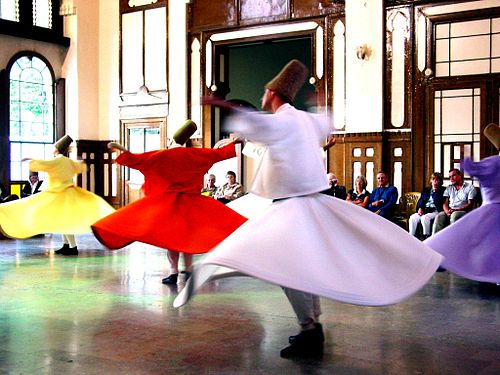
http://upload.wikimedia.org/wikipedia/commons/thumb/a/af/Mevlevi_Dervishes_Perform..._%28469777809%29.jpg/500px-Mevlevi_Dervishes_Perform..._%28469777809%29.jpg

“Oh, grow up!” Is there anyone who escaped this humiliation as a kid? Often voiced by another kid, or some chronologically mature person who probably needed to “grow up” himself?

Still, it raises an important question: what does it mean to grow up? What qualities are present in those people we respect for their maturity?

Although it may not be very humble, let’s start with the quality of humility. And it’s important to remember that humility is not identical to a lack of confidence. Instead, it involves this recognition: in the big picture of the universe, you are a tiny part.

Unless your name ranks with Einstein or Beethoven, virtually no one will know your name in a hundred years.

As Goethe put it, “Names are like sound and smoke.” They disappear that easily. Humbling indeed. You probably aren’t as important as you think you are.

This means your problems, at least most of them, aren’t that important either. The ability to recognize the majority of troubles as transitory and temporary is another sign of maturity. Now, I’m not talking about brain cancer here, but the more garden-variety ups and downs of life. It sometimes helps to realize you will care little if anything about them in five years or even five months.

As the saying goes, “Don’t sweat the small stuff. It’s all small stuff.” At least much of it.

Another essential quality of being a grown-up, I think, is having a balance between your head and your heart. We all know people who are way out of balance—those who claim to be imperturbably logical, like the Mr. Spock-type Vulcans from Star Trek, and others who come apart at the most minor disappointment or frustration, letting their emotions twirl them around like passengers on a “tilt-a-whirl” amusement park ride.

Pain is part of us for a reason: distress must be attended to lest you leave your hand on the stove’s burner. Equally, your head is required for sound judgment and to learn from experience, be cool under fire, and forge ahead despite fear.

In other words, balance is a sign of maturity. Balance of work and play, action and contemplation, passion and repose. Socrates said one should be grateful for old age because the passions then rule us less. But do not live without passion, especially when you are young enough to enjoy it! He also said, “The unexamined life is not worth living.” And so maturity requires some thought about your life, where you’ve been and where you are going, why you have done what you’ve done, what worked and what didn’t, and what lies ahead. It requires an unflinching look in the mirror and the intention to improve.

This means being a “grown-up” demands one has learned from experience and continues to learn more as events transpire. My friend Henry Fogel has said, “I like to make new mistakes!” There is no point in repeating the old ones.

Another friend, Rich Adelstein, attempted to figure out the solutions to his then-current problems (he was 50 at the time) as a defense against their reappearance in the future. Once armed with those solutions, he thought, using them to confront whatever was ahead was the way to an improved life. He realized later, however, that there would be new problems requiring new fixes, and the version of himself who faced those novel challenges would be older and different, viewing matters from a different perspective than his 50-year-old self.

This is an example of maturity and a signpost to some of its characteristics, including the need to change, the ability and willingness to be flexible, and the awareness that learning along the way is required.

Rich was able to change his mind about the need to change.

What other qualities might be present in the “grown-up?” Confidence and the capacity for self-assertion. The ability to laugh, and to laugh at yourself, not at the expense of others. To take risks and do hard, embarrassing, scary, or frustrating things until you master them. To be independent in thought and deed, not to follow the crowd or require a caretaker to make decisions for you; and of course, the capacity for intimacy and love, knowing all the while that embracing others makes you vulnerable to loss.

An additional aspect of wisdom is having a sense of what is worth fighting for and what is not. There are more than enough battles worth fighting in this imperfect world, but one cannot take on all of them—an exhausting and impossible prospect. Therefore, maturity requires sufficient knowledge of oneself and the world to make decisions about standing fast, standing aside, holding to principles, or compromising.

We must recognize our strengths and face our weaknesses while trying to remedy the latter so that we can take at least some small part in repairing the world. And accepting a sizable portion of defeat as inevitable.*

So, yes, being a grown-up means accepting the world on its terms: that loss and disappointment, in causes and in people, are inescapable, and too strong a defense against them deprives you of the most important and precious things life has to offer: the thrill and camaraderie of fighting the good fight; and at a more personal level, love, closeness, tenderness, acceptance, and affection. These require unguardedness. Living as if your heart has never been broken and never can be displays both maturity and courage.

Responsibility-taking is another part of maturity, admitting that “yes, it was I who made the mistake.” We heard the story of George Washington chopping down the cherry tree a long time ago, an example of responsibility-taking and honesty. As the reference might suggest, honesty is no small part of the “grown-up” life.

The sages say honesty simplifies life. Too many justify their dishonesty by claiming they are trying to spare someone else’s feelings. Don’t be deceived. Usually, it is much more self-serving than that.

We’re back to humility, where we started. Part of being mature is having the humility to realize that you, too, might, “but for the grace of God,” be in someone else’s awful spot and, therefore, should be judged less harshly for whatever they have done or whatever has happened to them.

Perhaps they should not be judged at all.

Maturity means cherishing the quiet moments as much as the thrills. It also means living in the moment, mindful of everything, trying not to get caught up in hoping it were different (even though you might well be justified in doing so), allowing yourself to stay centered where you are in time, rather than looking back or forward while the irreplaceable, unrepeatable instant of your life passes by.

Look back too much, and you will be caught in the sadness of time past, unfulfilled longing, and regret while missing what is possible in the present. Similarly, living in the future tends to generate anxiety in anticipation of what may come. It deprives you of the present moment, matching the deprivation of those focused on yesterday.

Accepting and liking oneself is part of being a grown-up. It is not that you don’t need change, but that you should appreciate what is good about yourself and accept some of the inevitable limitations to which we all are prone—not to avoid self-improvement but to avoid self-denigration.

Being a grown-up means living a principled life, being committed to specific values, and putting those values to work in more than words. As the AA crowd likes to say, “Don’t just talk the talk, walk the walk.” And those principles, those values, must be informed by the fact we are all mortal, all in-transit, but the planet and the human race are here (we hope) for the long haul. We are “just visiting,” as the Monopoly board reminds us when we land on a particular space. Of course, the game of life and its younger players will outlast us only if we do our part to preserve the Earth on which it is played.

We must work to demonstrate our commitments. Freud was right when he said love and work are the essential organizing forces in any life. If you are mature, unless you are aged or infirm, there is work to be done. Doing it makes life more interesting and engaging, too. A mature person is not simply a spectator of the world before him.

One other quality I should mention in this pantheon of talents is gratitude. It is appreciation of what you have—simple things: a beautiful day, the affection of your children or grandchildren, the ability to move, the beauty and scent of flowers, a comfortable bed, a touching song or story, and good friends—all the stuff of life too easily dismissed.

Increasingly, I believe we must spend time looking in the mirror before pointing fingers and attacking. Most of the time, we are not so different from those we vilify. Make friends as you mature and into your senior years. You’ll be happier.*

We are well-advised to relinquish attachments to things with aging into old age. If, like me, you’ve lost your hair and some pace in your once swift steps, you recognize a body in the transformation process. You can rage against such changes, but it is preferable to hold the “things” you have with lightness, not gripping them in desperation. Mother Nature will win this one. Such alteration–previously unthinkable– isn’t personal. The defacing hand of the universe gets to everyone in time.*

Accept, accept what is outside of your control.*

Letting go (not giving up) offers less suffering. Detach gradually with equanimity. Every well-used car wears out the tire tread in time.*

I’d like to believe we learn from this turn of events. Among the lessons would be that no life is without suffering, as the Buddhists would remind us even in peaceful, “normal” moments. We all share the pressure of change happening faster than ever.*

A mature individual places significance on finding connection with those who, like us, are treading the water in the sea of woe we now live in. Those lacking physical touch, managing economic distress and political dystopia, silently beg for helping hands in those of us not dreading the lack of food or the inability to pay the rent. An enlightened person recognizes and responds to the shared dignity and need of others now more than ever.*

John Donne reminded us 400 years ago, “No man is an island.” His poem ended:

any mans death diminishes me,
because I am involved in Mankinde;
And therefore never send to know for whom
the bell tolls; It tolls for thee.*

As the cliche goes, we are more alike than we are different, despite the bigots who think they are superior. Maturity sets aside selfishness and class or racial distinction. Those in the military swear not to leave a fallen comrade behind. The planet’s widespread distress has enlisted us all in the army needed to raise each other up.*

Let the last words on being a grown-up go to Adlai Stevenson II in his 1954 speech at the senior class dinner of his Alma Mater, Princeton University. These 71-year-old words spoken by the 54-year-old Stevenson are as appropriate now as then:

…What a man knows at fifty that he did not know at twenty is, for the most part, incommunicable. The laws, the aphorisms, the generalizations, the universal truths, the parables and the old saws — all of the observations about life which can be communicated handily in ready, verbal packages — are as well-known to a man at twenty who has been attentive as to a man at fifty. He has been told them all, he has read them all, and he has probably repeated them all before he graduates from college; but he has not lived them all.

What he knows at fifty that he did not know at twenty boils down to something like this: The knowledge he has acquired with age is not the knowledge of formulas, or forms of words, but of people, places, actions — a knowledge not gained by words but by touch, sight, sound, victories, failures, sleeplessness, devotion, love — the human experiences and emotions of this earth and of oneself and other men; and perhaps, too, a little faith, and a little reverence for things you cannot see…

To my way of thinking it is not the years in your life but the life in your years that count in the long run. You’ll have more fun, you’ll do more and you’ll get more, you’ll give more satisfaction the more you know, the more you have worked, and the more you have lived. For yours is a great adventure at a stirring time in the annals of men.

http://upload.wikimedia.org/wikipedia/commons/thumb/6/64/Whirling_Dervishes_2.JPG/500px-Whirling_Dervishes_2.JPG

Please note: The preAnsk in red/orange * indicates the preceding paragraph has been modified or created since the original post was published in 2009.

You might also find this interesting regarding maturity: Youth vs. Experience and Maturity: Who Has the Edge?

You can also take a look at this topic: Maturity: Ten Steps To Get You There.

The top image is Mevlevi Dervishes Perform, created by K?vanc and sourced from Wikimedia Commons. According to the Wikimedia site, the Mevlevi Order is a Sufi order founded in 1273 in Konya, Turkey. “They are also known as the Whirling Dervishes due to their famous practice of whirling as a form of dhikr (remembrance of Allah).”

“Dervish is a term for an initiate of the Sufi Path… The Dervishes perform their dhikr in the form of a dance and music ceremony called the sema. The sema represents a mystical journey of man’s spiritual ascent through mind and love to ‘Perfect(ion).’ Turning towards the truth, the follower grows through love, deserts his ego, finds the truth, and arrives at the ‘Perfect.’ He then returns from this spiritual journey as a man who has reached maturity (hence my use of the picture for this essay) and a greater perfection, to love and serve the whole of creation.”

Next is a Banded Peacock Butterfly taken at the Chicago Botanic Garden in September 2020 by the superb photographic artist Laura Hedien, with her permission: Laura Hedien Official Website.

The third picture is inside-outside Innovation, taken from Innovation Management.

Next comes Letting It Go, the work of incidencematrix. A fritillary butterfly is about to leave an open palm.

Finally, the Whirling Dervishes photo is by Vladimer Shioshvili. With the exception of Laura Hedien’s photo, all the images are from Wikimedia Commons.

In Praise of Pretty Girls of Age

I grant you that there are lots of things to think about, but today is another day to recover, mourn, cheer, blame, cry, or curse, depending on your position on the scale. They are all emotional words if you read them right.

Some analyze, too, but I will leave analysis aside as best I can.

Here is a bit of what you might call a thoughtful distraction by a famous writer, Robert Heinlein, and then a closing comment from me.

Well, how’s that? I love Rodin, as Heinlein clearly did, but the tragedy eludes me, maybe because I am not a woman.

We all age, and it is the nature of things. I have seen lovely older women, and I recognize not only the beauty of the present but automatically recreate, in my mind and my vision, some approximation of what Heinlein writes of their past beauty. But am I alone in seeing through the years and missing the tragedy of lost allurement?

I see the character in their faces, the aspect and complexity that only time allows.

My perspective as a man observes no sorry catastrophe in myself, though I am well beyond 70 and have had some challenging moments. We endure, regardless of gender, and know some things beyond this time and times past. We have no voice in trading our youth for that knowledge, but what can we do? Accept it and be grateful for what we’ve lived and still have ahead—quite a show ahead, I’d say!

We are on to what the ancient Chinese parable might characterize as “interesting times.”

Many women who are not young possess wisdom about this and other things. Their tragedy has been in their place in the world and its consequences. They are “interesting” in a way not captured in the parable. Such ladies have seen a lot, endured a lot, and won the character only they possess. I will have lunch with one soon, and she is over 90.

If I were you, I would be jealous!

Here’s to my lunch date, still a woman of mystery and much hard-won knowledge. She knows what it means to be a woman and the definition of misogyny.

Her name is Joan.

==========

The photo by Pedro Ribeiro Simões is called A Very Beautiful Older Woman, sourced from Wikimedia Commons.

Comparing Our Prosperity to That of Others

We are constantly measured against others: compared, sized up, and weighed like bananas at a fruit stand.

As a boy, teachers in my public school assigned seats according to each youngster’s academic excellence. Even without that and the particular misfortune of those in the last row, my classmates made plenty of comparisons.

Who was the smartest, the cutest, the most popular, the strongest, the tallest, the most likely to succeed? A bit later, the markers applied to the best smile, the toughest guy, the best legs, and the fastest runner. Further on, the standard became owning a car, a lovely apartment, admission to the finest college, and on and on and on.

Indeed, every day, we read our mirror’s prediction of what people will say about our appearance. Who doesn’t?

Our ancestors chose mates by making some of these comparisons. They selected strong and brave protectors, canny partners, and mates whose health and capacity for survival could be judged by externals. These included shape, musculature, and facial features, no matter how much these qualities were thought through.

Status among our siblings, neighbors, and coworkers eventually came down to a handful of attributes. Money remains our shorthand for success and the ability to live the life we want for ourselves and our children.

There will always be someone with more. The fast track to unhappiness is to watch and listen for signs of our fluctuating status. Shooting for the ladder’s top rung is the path to making yourself #1 in misery, like a person running a race on a treadmill. One or several others are always ahead of you. 

The commercials declare you should “be all you can be.” 

Money is not the only measure. In most situations, you get to decide. If you have a fine friend, he, by himself, is precious. So is a clear sky on a gorgeous day and the birdsong greeting the morning. In a meaningful sense, we are rich as long as we don’t further pollute the atmosphere and harm the songbirds’ habitat.

There is gratitude and wisdom in this.

The cliche tells us we come into the world with nothing and leave with nothing unless we insist on filling our grave with every penny we possess. Grave robbers will find it anyway.

The YouTube video above (“When is a Retiree Considered Wealthy?”) provides a 2023 description of how your accumulated wealth compares to all those who retire in the USA. 

Consider this a way to determine your standing on the financial ladder I mentioned. Curiosity says you will take a look—your choice. 

I don’t discount the value and necessity of dollars. However, as the YouTube video indicates, there is an enormous discrepancy between the folks with fistfuls of paper currency and almost everyone else. I’d be happy to pay higher taxes if it would be distributed to the neediest individuals.

That said, I’ve reached a point of caring about finances less than ever. Lucky as I am relative to most, I have seen too many who make themselves unhappy via endless contrasts. 

Occasionally, I try to notice whether they are carrying yardsticks and forever measuring, as I think they are. This group includes “some of my best friends,” as the old joke goes.

There is no built-in shame in accepting less than the best of every material thing or thinking King Midas, the man with the golden touch, was an idiot. That is unless you bow down to the fellow with the fattest wallet.

My attitude about money is simple. I give some away to charities and family, pay my bills, and have lived in the same home for 39 years. Having more money and spending more of it won’t make me happier.

Having worked at a summer job in an un-air-conditioned factory long ago, I understand something about one of the less attractive alternatives to the way I made a living, not to mention the men who had to stay after I was gone.

On my deathbed, I am confident no one will hear me say, “Gee, I wish I had that $25 back.”

But if things work out as I hope, I will speak of love.

“Do One Thing Every Day That Scares You”

The title by itself is scary. Will you read the post, or are you already put off by the possibility it will unsettle you?

After all, your flesh is not a suit of armor, and the daily news carries enough trouble before 10:00 a.m. to fill the whole day.

The problem with anxiety is that it waits with infinite patience. Hiding from it means it will pop up on its own schedule as an uninvited companion, knowing it can have its way whenever it wants to. Terror is like a schoolyard bully who smiles when he reads the “Kick Me” sign on your back.

I’m guessing the name Eleanor Roosevelt is not familiar to the majority of Americans, but she is the person who said, “Do one thing every day that scares you.”

This woman was scared as a child, friendless, terrified of the dark, and much else. Did I say she became the wife of Franklin Delano Roosevelt, the U.S. President from 1933 to 1945? The Chief Executive had his own challenges, including confinement in a wheelchair from which he couldn’t escape without assistance.

His future spouse, who would survive her husband by 17 years, was timid, unattractive, and lonely growing up. The early deaths of her parents left her with a severe, rejecting grandmother. Yet, she recreated herself as something more than a hesitant ugly duckling: “No matter how plain a woman may be, if truth and loyalty are stamped upon her face all will be attracted to her.”

Mrs. Roosevelt achieved world fame as more than the country’s First Lady. She took advantage of her position as a champion of civil rights for African Americans and brought dark-skinned guests into the White House. As a widow, Mrs. R. was appointed the spokesperson for her country as the U.S. Delegate to the United Nations General Assembly. 

The insecure child molded her fragile self into a fearless spokeswoman for her husband and on behalf of causes in which she believed. Not satisfied to vanish into a man’s shadow, her voice was heard everywhere. 

In a conversation around 1957, the interviewer asked her about dread and the courage to overcome it:

You gain strength, courage and confidence by every experience in which you really stop to look fear in the face. Your are able to say to yourself, ‘I have lived through this horror. I can take the next thing that comes along.’ You must do the thing you think you cannot do.

This woman did not take her privileged life for granted, nor did she glory in jewelry or high fashion.

The influential and wealthy family she was born into believed in noblesse oblige. These two French words describe the obligation of all those at the highest reaches of life to display generosity to people in need.

Might you wish to employ this woman’s suggestion about overcoming fear?

Act. Don’t wait. Take small steps. 

Make the phone call you dread, ask the favor you expect to be rejected or say no to someone who never reciprocates your kindness. 

Take an elevator to the top floor of the tallest building you can find, ride a roller coaster, or eat something new. 

Tell a joke and defend yourself when the bully shows up.

Fashion your own list of uncomfortable situations, such as eating in a restaurant alone or visiting a part of the city unfamiliar to you. Rank the items and begin at the bottom, the easiest.

Think of your day as a chance to experiment, to play with your life like a game. The crowd won’t remember you if you stumble. These spectators are far too preoccupied with themselves.

The Chinese word Weiji speaks to the issue of managing the kind of discomfort the former First Lady had in mind. The term is comprised of two characters. The first means dangerous or precarious. The second refers to a change point. In effect, we must adapt, remake ourselves, and overcome situations in our power to master.

As Eleanor Roosevelt conceived of life, each day carried many possibilities. Each person’s job was to use them.

Tomorrow is a mystery. Today is a gift. That is why it is called the present.

==========

All but the July 1933 photo of the 48-year-old Eleanor Roosevelt are the work of the wonderful photographer/artist Laura Hedien, with her permission: Laura Hedien Official Website.

The top image is a Supercell Storm Near Springfield, CO, on June 16, 2023. The Bald Eagle Along the Mississippi River, IL, was taken in April of the same year. Finally, a Grain Elevator Reflection, Nebraska, May 2023.

“The Best Meal I Had All Day” and Other Words of Wisdom

Emmanuel Terry, my Uncle Manny, is remembered by my brothers for something we heard from him whenever he came to dinner.

No matter the food he ate earlier, our gathering lacked completion until he said, “This was the best meal I had all day!” He smiled and we grinned at what became a necessary secular benediction at the evening’s conclusion.

Though we took his words as a joke, we might have better understood them as a true expression of appreciation, a thanksgiving for the feast and comradery of the moment.

Well before such festivities, Mr. Terry endured the Great Depression of the 1930s, psychiatric hospitalization, electroshock treatment, and service overseas in wartime. Late in life, he suffered the death of his wife, my Aunt Nettie. He knew loved ones and joyous reunions should not be taken for granted.

Uncle M. smiled a lot when we were together, drinking in the companionship and enjoying the laughter we all shared. And, yet, I am the inheritor of a few philosophy texts he read. Too bad I never thought to ask him what in those yellowed pages mattered to him.

Did they contribute to his gratitude?

This brings me to a friend (I’ll call him K), who is entering his 75th year on the planet, a bit longer than Manny achieved. On his birthday, the pandemic doing its worst, he wondered what he might wish for beyond the loving expressions of his children and friends.

While talking to his son-in-law a solution evolved. He planned to bestow some small benevolence on someone he didn’t know. But who, how? Close contact with people would risk lives, both his and the other.

K wasn’t deterred.

My buddy realized an acquaintance in another country might be useful in the endeavor. One owns an eatery in a city where bars and restaurants are open. He chose an establishment over 4000 miles away.

This longtime friend placed a call and asked the proprietor to serve a drink to every person in the place. His confidant would charge the tab to K.

The barkeep honored the anonymity desired by the benefactor of all the strangers. Thus the task was done.

My comrade suggested I take some similar action myself. I told him I would and, also write about his random act of kindness.

Perhaps you enjoyed a beer on my friend, but probably not. I’m guessing if he could have fed the world he would have. None of us can.

We can only do our small part.

Like Uncle Manny, K is a wise man and a grateful one.

It is no accident that these characteristics go together.

Such people make us better than we are.

———-

The adults flanking the young man at his bar mitzvah celebration are his Uncle Manny and Aunt Nettie. The gentleman seated at the right is George Fields. Yes, I am the boy in the middle. It was the best meal we had all day.

How I Plan to Survive Election Night: November 3, 2020

Two lovely friends asked how my wife and I planned to survive election night. I’m talking about the evening of this coming Tuesday.

Here are several things I’ll do and actions I’ll try to avoid. They take the form of a letter to myself:

Dear Self,

You’ve done your part. You traveled to Wisconsin to register voters. Postcard writing to encourage others to vote was worthwhile too. Peruse your credit card statement to find the names of all the candidates and investigative journalists who received financial support out of your pocket.

Like a fine fisherman, you cast your ballot. Not into the water, of course.

Write another check to a food bank. Here’s one you gave some money to: Greater Chicago Food Depository.

They all need more. Donate as much as you can.

Exercise early. Keep exorcisms for another day!

Time to distract yourself, especially in the waning hours of the big night. Read fiction. Watch situation comedies. Or launch a riviting mini-series and binge-watch. Glad you chose “Queens Gambit,” by the way. Thanks for the recommendation, Joan (the producer’s mom).

Fastening your eyeballs to the TV’s election report or your ears to the radio’s version won’t change the outcome. The power is not in you to jinx it. The result won’t be in your hands once the polls close.

Remember the strategy you used when the Cubs — your team — played Cleveland in the 2016 World Series? Rain delayed the last game in the 7th inning. No one knew how long the precipitation would last. What did you do? The contest was tied, but the hour was late, so you went to bed. You believed someone would set off fireworks if they won. The tiny explosions woke you; you smiled and slumbered on. The patient video recording waited for your attention in the morning.

Don’t drink. Ok, I realize you aren’t a reflexive drinker, but don’t start now. The liquor might knock you out, but a few hours later it’s likely to jolt you awake again.

Meditate. You know how to do this, and you do it every day. Maybe a little more is required.

The sun will rise early each day. Yes, if the bunch you voted against prevail, the climb back to normalcy will be tougher. Even if the gals and guys you’re rooting for win (an outcome you expect), the march forward will still be a challenge. You need to martial strength either way.

No matter the final tallies, no matter when they come, the people you love are there. The people who love you still live. Those departed continue in memories. Books wait for you to read them. Jobs need doing, and help should be given. There are jokes to share, classes to attend, and people to talk with.

Remember to blow the snow off the driveway when it arrives. The moon will keep you company until lengthening days begin to stretch their arms in a welcoming embrace. Sun and summer maintain their steady approach. Count on it.

The world needs healing, but you’ll do what you can, then pass the baton.

You remain a lucky man.

———

The Wikipedia Foundation created the top voting box image. Shizhao transferred the second one from Ukraine Today to English Wikipedia. They were both sourced from Wikimedia Commons.

What the Coronavirus Taught Me About Love

When I practiced therapy, I reminded myself to bring intensity to my work. Every day, every hour.

Each patient was a kind of wayfarer. His journey had reached a sticking point. He was faltering with sadness, loss, or anxiety, guilt or helplessness.

A bit like a pilgrim, the searcher hoped to find a balm for the soul.

Life brings routine. We create routines to make it easier, more efficient, to avert the wasteful reinvention of our daily tasks.

But routine deadens, too. A therapist must make the work fresh.

The healer must be present, concentrate, note the body language, and not offer words far from the point, missing the point. I tried to give each meeting “life.I didn’t always succeed. No one can, but the next time my patient visited offered another chance to join him in searching out an oasis: a green, peaceful, and certain place, where refreshment might bring renewal.

The aging of my parents brought home the recognition it always does. One never knows when the last time will be. The twilight handshake, the final moment of laughter, the embrace of someone we love.

I made sure to part from my folks with an “I love you.Now my children and grandchildren do this with their parents and grandparents.

These parting words are never enough by themselves. The pandemic tells me so. Its voice calls out, “There is more to do.

Why do I hear this now? Because I can’t do more, I am separated from so many, as you are. What, then, does “more” mean when the opportunity comes?

The voice did not say.

Here’s my answer.

The heartbreak of a goodbye must be balanced by delight in a hello. We must treat each new contact as a gift, greet the friend or lover, the father or a brother as though it were the first time: the moment we discovered something unique in him. Graceful, beautiful, kind — it does not matter. Strong, faithful, wise — whatever are the qualities embedded within him.

We need to try to sum up the other’s every sacrifice for us, all the touching words they said to us, their thoughts and prayers for us and approach him anew. With gratitude.

In another dreadful historical moment, Abraham Lincoln said, “we must rise — with the occasion. As our case is new, so must we think anew, and act anew.

The virus teaches us the day is short, no matter how long the sunshine lasts. The message is the same, regardless of the time or place. Since we do not have eternity, the moment and the people must be grasped, held close.

If we safeguard ourselves and others, and if we are lucky, a reunion yet will come.

When you see loved ones again, remember: speed to them as if it were the first time and the last time, every time.

—–

The photos above come courtesy of Laura Hedien, a gifted and generous photographer. They are The Look and Splashes. Much more of her work can be found at: https://laura-hedien.pixels.com/


The Upside: How to Survive Psychologically in a Challenging Moment

I cannot say I’d choose to witness the Coronavirus pandemic, but here I am, and so are you. What follows is some help in reducing your distress.

I shall not minimize the dangers, but no good comes of either dismissing them or worrying over them as one would a train wreck sure to happen. The situation is neither.

If you are keeping up with public health recommendations, you know this. If you are taking the advised hand-washing precautions, you know this. Moreover, various branches of government in the USA are beginning to reinforce the societal safety net for those who need such assistance.

More action will come, though increased disease is inevitable for a while.

Assuming you are maintaining your social distance, you’ve taken a significant step. But what do you do with a less structured day now, time that used to be organized by meeting friends, going to restaurants or bars, and working in an office rather than your residence?

When our minds are left to themselves, they often travel to dark places. Here are a few suggestions to help you stay in the light:

  • Notice the changes in your life and the lives of others, without catastrophizing. The present is a remarkable time to be observing the world’s reaction to the virus. Be curious, watching and listening instead of evaluating and judging. Meditation may help with this.
  • Many of us have said, “Gee, I wish I had more time.” Now some of us do. What did you mean when you spoke those words? What dreams do you hold you now can begin to fulfill?
  • Reach out to people by phone, email, and social media.
  • Remind yourself of the things for which you are grateful. Daily.
  • Plan your activities for the next day before bedtime. Give yourself a sense of control and accomplishment. Focus on the doable without excess ambition.
  • Do not watch the news or political commentary at every moment.
  • Exercise, if possible in the morning light, to reduce anxiety and improve sleep.
  • Learn something new. The internet is full of educational possibilities, many without any cost. Perhaps something as simple as learning how to tie a Windsor knot:

  • Remember that if you are socially isolated, the prescription of interpersonal separation gives you much company, even if you don’t see those comrades on the street. We’ve been offered an opportunity to make ourselves interesting for ourselves and to ourselves.
  • If you lament the lack of a robust dating life, you needn’t apologize. Many more people are alone because of the dangers of visiting their usual haunts and loved ones.
  • If you are going through hell, keep going. Don’t stop until you find the path out.
  • Religious faith is sustaining at such times. Prayer and reliance on a higher power can be helpful.
  • People are fighting for you in the healthcare system, many also in government. Efforts are being made to ramp up diagnostic testing. Laws are being passed to make the tests free. Legislation providing paid sick leave from work is also in process, though not everyone is yet included in the plan. Watch the brief video below. The outcome is positive.
  • Much political activism is occurring online. I do not mean arguing with people. Engage in making the world better from your home to support your desire to improve the country.
  • The challenge of living in the time of COVID-19 is a chance to develop a new depth of psychological resilience. The Stoic philosophers believed we discover who we are only when we are taxed.
  • Make a list of the difficult situations you’ve survived. What strengths within you enabled you to do so? Tap such qualities once again.
  • Clean out your abode. Donate or dump all those belongings you no longer need.
  • Far more distractions are available than ever before in world history. Use them.

This crisis, too, will pass.

—–

The top image is called Sunset Dancer by Hurriagusto07. It was sourced from Wikimedia Commons.

What if We Could Erase Painful Memories?

Why is memory this way? Why isn’t it content to hurt you once? Why must it remind you of all the times you’ve been hurt before?

If this doesn’t sound familiar, you have been asleep for a while.

Our hearts are given as hostage when we love. The kind of love doesn’t matter: children, friends, romance, and more. Our core is at risk when we treasure books and eyes fail, or music and hearing dims, or running and knees collapse.

Think of our loves as on loan from a magical library. This institution specifies no due date for the materials checked out.

Are we fools because the absence of a precise cutoff allows us to believe our possession is secure?

Perhaps someone already grabbed the object of our desire off the shelf. Will waiting help, hoping for the item to be returned?

You say rapture is yours? Then, suddenly, the library police snatch it away. No warning. No time to prepare. Maybe an accident robs you of your mobility or another love of a lover. No aid for this, no higher authority to whom you can appeal.

The officers provide only cruel compensation: a hole inside. The happiness of what remains begins to leak, the substance of life tunneling down the bottomless sink. Food doesn’t taste right, jokes don’t make you laugh, sleep gives no rest.

You climb in and reach for what is moving away. Or lack even the strength to lift you arm, open your hand, and try.

Oh, but shards of the remembrance cut, edges slow to depart.

Where is the repair shop when you need it, something to fill up the hole, smooth the jagged places? A replacement for “one of a kind” now gone? No second hand stores carry it, no reseller offers the missing part. A proprietor says they have something like it. You know they don’t.

What if you could simply forget you’d ever had the precious commodity, as if a surgeon removed an unwanted scar?

The top quote comes from Mem, by Bethany Morrow. The novel deals with some of the implications of memory erasure, also treated in the 2004 movie, Eternal Sunshine of the Spotless Mind. Outside of fiction, scientists envision a possible future including electro-convulsive therapy (ECT), brain implants, or other methods to treat PTSD by deleting disturbing memories.

The researchers make an assumption: the stinging, sorrowing, traumatic remembrances are distinct, limited, and not integrated with the rest of you. Not all troubling events fit into this tiny package, however.

Stop for a moment.

Would you sign up?

Many questions can be expected to arise if such a tool comes to the hospital nearest you. How would the doctor measure whether a memory is terrible enough and fenced-off enough to qualify for medical vanishing cream? Would the emotion disappear along with the recollection or might one experience the trauma without the reference to what caused it?

How would a forgotten past allow us to learn from our mistakes? Some amount of pain is both inevitable and necessary for human development.

What might such experiential carve-outs do to our humanity? How might we relate to those who remember the event, but didn’t use the medical white-out?

Could the richness of life and our capacity for empathy — our moral growth and resilience — diminish with a too ready instrumental “end (to) the heart-ache, and the thousand natural shocks that flesh is heir to?”*

If the technique were extended to matters of romantic heartbreak, would the wonder of love vanish too? Might our species turn reckless once assured that losses needn’t last past our next doctor appointment?

Remember, taking something away doesn’t add anything back. Would these scrubbed souls become like white boards without the written names and meanings of the people who were once our “everything?” Does spotlessness await or just mindless?

For now we must weather the bad luck and pack an umbrella. Perhaps go to a therapist or seek the drug dispensers, insurance approved or otherwise. We count on time to pass so we no longer count the time “since” and “after.”

I wish we were guaranteed a puddle remover for the rain and a hole closer for the drain. At least they tend to get smaller.

Gratitude for what abides offers consolation, though hard to summon with speed. New people, new tasks, new beauties beckon. Acceptance, too, is instrumental in healing, another job needy of practice and patience. Religion helps some find solace.

To me, the essential lesson is to live with urgency. Not stay up nights wondering when the librarian will demand the book back. Rather, to be exhausted by bedtime for having embraced the fullness and possibility of the sunlight. If, by evening, the tale of your life is claimed, the desk won’t be piled high with regret.

Your library card might appear battered by then. Look carefully, though, and recognize something else. Good use was made of your time and the invitation to enter a wondrous place called the globe. I mean the bounty offered there: books and relationships, work and sport, nature and laughter and fulfillment from striving to repair the world.

In a place where everything is borrowed and brief, Andrew Marvell’s centuries old advice, To His Coy Mistress, still applies:

Thus, though we cannot make our sun

Stand still, yet we will make him run.

——–

The second image is Erased de Kooning by Robert Rauschenberg.

*Excerpt from the “To be, or not to be” soliloquy in Shakespeare’s Hamlet, Act III, Scene I.