Is the Wisdom of Age Overrated?

6a00d8341c3e6353ef0148c78ca28a970c-800wi

Is the wisdom of age a function of learning something during your decades on the planet? There is, in fact, one other possibility: older people are just older and view the world from a different vantage point.

Let me explain.

Take the hormone-driven life of a sixteen-year-old boy. The sexual urge is like having a wild animal inside you. Erections, as noted in my post about the nude swimming classes of yesteryear, happen at the most inopportune moments and with astonishing frequency. They cannot be willed away any more than nocturnal emissions (a.k.a. wet dreams).

No 60-year-old man is subject to the same preoccupying, indomitable force. Therefore, he and the 16-year-old version of himself perceive the world differently, think about the sexual aspect of life with different degrees of obsession, and are enslaved by lust in proportion to spontaneous changes of the body.

Strenuous thought over those 44 years didn’t accomplish this. Age alone is the reason, a major physical and chemical change. You are not the same man you used to be. We do tend to think of the 60-year-old as wiser in controlling sexual urges, but he didn’t work or study with this aim. A reduced libido gradually developed in the normal course of life.

Now let’s switch things a bit. If the 60-year-old is wiser about mating, shouldn’t we advise our 16-year-old boy to be like his sage future self? I think not.

Our biological imperative is to reproduce. Intercourse is required and only a magician could impregnate someone without it, assuming no artificial insemination. Were a young man’s ravenous view of sex the same as his more distracted aged self, the human race might never have survived.

256px-Wooden_hourglass_2

OK, enough of bedroom activities. Let’s talk about ambition. Jean Améry said that a young person “is not only who he is, but also who he will be.” In other words, one’s self concept is informed by his or her expectations for the future. A youngster might envision herself becoming a physician, for example. Her imagined career defines how she looks at life and how she behaves; by dedicated study, among other behaviors.

For most men and women in their 60s, however, “who he will be” is not promising. The older person can still be serene and productive, but few bets are placed on his achieving higher status in business, sports, scientific discovery, or art. Seniors are disinclined to want more children of their own, even were their bodies to cooperate. If a person has not made his mark, he isn’t expected to as an oldie, at least in the ways described.

Happily, however, by the 60s most of us are less ambitious and are looking forward to retirement. Again, the question is: do those with less drive “learn” something by experience or might their bodies and diminished capabilities simply change their perspective?

I believe we do learn some things from life experience and a portion of a senior citizen’s wisdom is “earned.” Yet, with an energy boost, the intellectual sharpness, and the pulchritude of someone younger, the ambition might return. When science makes 60 into the new 40 or 30 or 16, I’m guessing ambition will also be revived and older people will trade the twilight for another round in the daylight of a more youthful competition to “make something” of oneself.

Now to a practical and personal example. My father became a wiser man as he aged. Dad was born in 1911. I videotaped a four-hour conversation we had about his life when he was in his mid-70s. His youth, like so many others living at the time, was dominated by the Great Depression. Imagine being 21, ambitious, and smart in late 1932, with no path to a lasting career. Where would jobs come from? How could he support a family? Might an appealing woman want him if he were impoverished? It is, unfortunately, still a problem today in the aftermath of the Great Recession.

The imperative to “make a living” explained most of his major choices even post-retirement. For my first 20 years, he worked one full-time job and two part-time jobs, plus a small business repairing cigarette lighters on our dining room table after dinner. My father was careful with money and took few financial risks. The shadow of the Great Depression, that ended with the ramp-up to World War II, was still present over 20 years after he returned from the European portion of that conflict.

The dominant problem of his life was financial security and paying the expenses for my mom and their three little boys. Sidestepping the cost to the entire family of his work-induced absences, Dad paid an emotional toll in the lurking fear of another economic crisis derailing his life and ours. In part, he labored because it defined him as a “man,” but finances were in the back of his mind. I don’t think it was an easy way to live, at least not from my observations growing up.

Gradually something changed. In the last 15 or more years of his long life, he seemed more at ease with himself, less worried and stressed. He continued to work part-time jobs for a while, but a peacefulness had come over him. He finally triumphed over the stalking shadow of 1932 and the rest of the Depression. The doubts receded.

Somehow dad accomplished a psychological distance from the monetary concerns that unsettled him long past the time they were realistic. Because he wasn’t an introspective guy, I attributed the change to the aging process rather than any kind of “aha!” moment triggered by a self-reflection he rarely practiced. He was an older man with an older body for whom things had worked themselves out.

In the same video interview, I asked him what he’d learned in his 75 years on the planet. He paused a moment, and then said something touching: “I’ve learned to appreciate some things.” He named my mom — still the love of his life — my brothers Eddie and Jack and myself; expressing pride his three good boys were independent and successful. What this 75-year-old version of my dad said was wise, but hardly unique.

Older people simply own a special perspective. If they have learned anything important from aging, it is to look at the part of the glass that is half-full, not half-empty. The oldies view their existence from closer to the end than the beginning, looking back through the lens of experience. And they see with different eyes — a changed body and brain, too. The fading of the ambition necessary in youth (if the older person has been lucky enough) has a positive influence on happiness. You would not think a settled, hormonally tamed teenager to be wise if he had this view of his world, but you might say it of a 75-year-old man.

In summary, many, but not all of the aged are wise. No, they didn’t take philosophy classes and spend hours thinking about their past in order to achieve it. I dare say, for most, it just happened to them.

To me, at least, I’m comforted that nature sometimes works to perfection. A flower blooms all by itself. Even as we are robbed of our youthful vigor, an unsigned but precious gift is silently slipped under the door unnoticed. Yet the fragrance is quite beautiful.

The wooden hourglass is the work of S Sepp and sourced from Wikimedia Commons.

“You Look Marvelous!” Worry About Looking Good and Worry About Feeling Good

Knock on Any Door Poster[7]

We pass invisible markers on the walk along the shifting sands of life. The signposts signify three stages:

  • 1. The total unself-consciousness of a little baby, who only knows that he feels good or bad, but has virtually no concern about the impact that his appearance makes on others.
  • 2. The period where appearance and impression matter. Comparisons are all around. Are you as pretty as she is? Does your hair look right? Do you have enough muscles? When are your boobs going to show up? Are you tall enough, handsome enough, thin enough — just simply “becoming” enough to beat out the competition; for the people you’d like to think well of you, that is?
  • 3. The third stage. It isn’t that you don’t care at all about how you look as you get past mid-life, but how you feel becomes much more important. If the pants are comfortable, who cares if they aren’t fashionable? Why try a new hair style when the one you’ve been using since 1974 seems so much a part of you? When did it become hard to get a restful night’s sleep? When did the aches and pains begin? And then there are the dreaded medications that make one symptom feel better and give you three side-effects that require their own medical solutions. Your doctor visits become more frequent and your conversations change from “How about those Cubs?” to “What did your doctor say?” And the doctor isn’t talking about your appearance, he is talking about how you feel.

None of this is good news. You are paying for your diminished vanity with augmented, expanded, supersized preoccupations of a different kind. As the famous and elderly pianist Menachem Pressler once said from the stage of the Ravinia Festival:

I have a friend who says that if you wake up in the morning and your over 80 and you’re not in pain — you’re dead!

There’s got to be a bright side to this, right?

Well, for one thing, less vanity isn’t so bad. As long as you still take a regular shower and put on deodorant and wear clean clothes, there is no possibility that you will be arrested by the “Vanity Police” for offending the sensibilities of those who live to be seen. They spend their lives trying to look like models in Vogue or GQ or Elle. These same people waste their life savings on hair stylists and new suits and the best looking shoes. They are the kind of folks who buy new glasses with every passing season because fashions have changed even if their eye prescription hasn’t.

There is freedom in liking yourself for who you are on the inside rather than who you please by your outsides. A little more confidence and a little less insecurity go a long way to a happier life. If the crowd’s applause means less to you, you’ve figured out something pretty important about contentment.

Ah, but the downside. I will use myself as an example. I am reportedly in very good health for a man of 125. Sorry, I couldn’t resist that. I mean, for a man my age who falls into the category of the “young old” or just a little bit beyond. I’m doing just fine. Who thinks up these categories anyway? Are there job listings in the newspaper and on Monster or other Internet sites for people who make up names like “Generation Y” or “Baby Boomers” or “Millennials?” Then, of course, there are the “old-old,” the “preposterously-old,” the “disgustingly-old” and the “better off dead.” At least, I think so.

When he was 88, my dad said he wanted to live to be 100. Of course, many years before, he said that if he could get to 70 he would have had no cause for complaint on the time that had been allotted to him. I do not know when he started to push the goal posts back, but I do know that a week after he made his new target public he stroked-out and never regained consciousness. It was the kind of event that my good friend Dan Morrison likes to call a “clean get-away.” No muss, no fuss, no lingering and best of all, no great pain. The kind of death that most of us are hoping for.

Ursula Andress and John Derek

Ursula Andress and John Derek

Feeling good yet? I know that it is unseemly to talk about these things. They are the kind of subjects that seem morbid and don’t exactly lift the mood. And yet there is at least one advantage to feeling somewhat less good as we age: it makes the ending a little more attractive. No, I’m not talking suicide here. What I’m saying is that if you are in the prime of life at age 92, feeling just as fine and fit as you did 70 years before, the idea of your demise will be much more horrifying than if various body parts are starting to fall off and you’re wondering if maybe living forever is not exactly desirable. You begin to think that perhaps John Derek was right when he said “Live fast, die young, and leave a good-looking corpse” in the 1949 movie Knock on Any Door. And remember, John Derek knew a bit about what it meant to be good-looking. This handsome actor/director married Ursula Andress, Linda Evans, and Bo Derek in succession. If there had been a Presidential Cabinet post for the evaluation of pulchritude, he would have gotten the job.

Bo Derek in the 1979 movie 10

Bo Derek in the 1979 movie 10

Here’s the bottom line: We want to live forever but we don’t want to get old. A contradiction, for sure. Best to accept the nature of things, concentrate on what you still can do rather than what you no longer can do, and make the “clean get-away” my friend Dan describes. In the meantime, do some good for young people, live “in the moment,” and enjoy the sunshine. I’ve heard it’s a lot darker in the Underworld — the afterlife described by the ancient  Greeks.

Have a nice day. Really.

Cosmetic Changes: How Far Will We Go?

http://a4.att.hudong.com/15/66/01300000560404126382666976558_s.jpg

A funny thing happened at this morning’s dental appointment. In the course of a routine cleaning, my lovely dental hygienist mentioned that I might want to consider Invisalign, a clear plastic alternative to metal braces. The reason: to create a greater cosmetic perfection to my lower front teeth.

I had a good laugh when she mentioned this. It’s not that I couldn’t use it, but what I said to her surprised even me: “You know Kristina, rather than do that, I think I probably ought to just replace my entire head!” Why, after all, have a perfect smile and still have the same bald head, the same wrinkles, and the same less than completely even and taut facial contours. “In for a penny, in for a pound,” as the old English saying goes. Don’t just paint the old car, buy a new one!

If you’ve had your car repaired, you will be able to relate. Fixing a damaged vehicle is expensive. The car doesn’t actually have to be beyond repair for it to be considered “totalled.” When the body shop tells you this, they mean that the expense of the parts and labor exceed the current value of the car. In other words, you’d be better off buying a new one. It displeases me to say that my head has reached that point.

Imagine the following conversation with a salesman: “I can offer you a good price on the new head you want, Dr. Stein. But, I’m afraid that there isn’t much I can give for trading in the old one.” God, the humiliation of it!

The picture of me (top, right) is actually pretty realistic. I have some serious mileage on this head and this body. To the good, however, my younger daughter recently commented on my upper body to the effect that (unlike all other middle-aged or older men she has seen) “you don’t have ‘man boobs,’ dad.”

You can only imagine how wonderful this made me feel. But, it is true, my body is pretty fit. Lots of aerobic exercise, a healthy diet, and weight lifting account for it. However, since I didn’t conduct therapy sessions with my shirt off, I didn’t hear much about my physique while I was in practice. Just as well, since I actually wanted to continue practicing. I wouldn’t have enjoyed a professional review board questioning me about the topic of “topless” therapy.

We’ve all seen those TV shows where someone gets a major “makeover.” Teams of surgeons and fashion consultants transform some unfortunate soul who really needs it. He or she never has to pay for this because the services are donated. Retail price would probably be a seven-figure sum. I’m not that vain or that rich.

I would, however, like to look like Jon Hamm or Brad Pitt for just one day. I’d also like to be Beethoven, Shakespeare, Rembrandt, and Willie Mays (a famous baseball player) — each in his prime, also for one day per person. It would be pretty neat to know what it would feel like to inhabit those bodies and brains from sunrise to sunrise, and to receive the world’s approbation for the same 24 hours. I’m not quite evolved enough to say I’d like to be a woman for a day, but I’ll bet it would be even more informative and interesting. None of this will happen, of course.

Yet.

Cosmetic alteration clearly has a future. And, I suspect, all of us who are less than perfect in appearance (in other words, just about everybody) have an appointment with that future. Let me explain.

http://upload.wikimedia.org/wikipedia/commons/thumb/d/dc/Dr_Jekyll_and_Mr_Hyde_1920_poster.jpg/256px-Dr_Jekyll_and_Mr_Hyde_1920_poster.jpg

There will be a time when you won’t have to have a million dollars to make yourself look like a million dollars. I imagine a future in which each person will have the capacity to holographically alter his appearance, even if the actual body hiding behind the holographic image isn’t the world’s most beautiful. Every day would be like Halloween, but with really good — and good-looking — masks. Mail-order catalogues, websites, and brick-and-mortar stores will have a department that lets you pick out the face you’d like to face in the mirror. Computer programs will let you “photo-shop” the image to your precise specifications. Everyone will be stunning! Sounds wonderful, doesn’t it?

How would that change the world, I wonder? Well, yes, there would doubtless be some who still want to stand out at any cost. Lots of perforations and punctures, body art, wild clothing, that sort of thing. But for the most part, just beauty as far as the eye can see. Jaw dropping appearances. Men would look like Jon Hamm or Brad Pitt if they wanted to, women could be as physically attractive as Marilyn Monroe or Beyonce, Jennifer Lopez or Katy Perry. A movie-star level of beauty all around.

The effect would be paradoxical, I think. In a world without disease or death, for example, no one would think about how he feels or worry about getting sick. In a climate that is always mild, sunny, and clear, no one would care much about the weather. And in a future of endless and omnipresent pulchritude — where anyone could become exquisite just by visiting the department store — the value of physical allure would surely diminish. The beautiful girl or guy would become something of a commonplace.

Other things would correspondingly count for more. The trophy spouse would have to be a Nobel Prize winner or an author; or someone of unusual charm or wit, generosity or kindness. A different world, for sure.

Until then? I think I will hold on to my old head. Despite some relatively high mileage, it has served me well. It is not the head of a handsome 25-year-old, but there are some good ideas and interesting experiences contained therein. I wouldn’t want to be without them. I’ve earned the weathering and learned from the lines. With a little buffing and waxing, it still does its job.

See you at the car wash.

The top photo is of Jon Hamm. The bottom image is a poster of John Barrymore as Mr. Hyde in the 1920 Paramount Pictures classic Dr. Jekyll and Mr. Hyde. It is sourced from Wikimedia Commons.

Retirement

http://upload.wikimedia.org/wikipedia/commons/thumb/9/93/Sunset_Zebulun.jpg/500px-Sunset_Zebulun.jpg

Long story short, I’m retiring from the practice of psychotherapy at the end of 2011.

The full story is why.

Where do I start?

It is difficult to write this without giving the wrong impression. It would be easy to sound entitled, for example. But, truth is, I’m no more entitled than anyone else who worked for a living and reached a certain age. Nothing special about me in that way.

It would also be easy to sound as though I don’t enjoy my work when, in fact, I usually do. Indeed, while I’m doing it — in session, listening to my patients, thinking about what they are saying and what they are not; what they are feeling and what they are not — I am doing something that gives me satisfaction as it is happening. I listen, I joke or laugh, I witness their pain, I try to make sense of things for myself and for them, I try to support their growth and healing. I call on all I have learned in life and in books, all my training and experience tell me might be helpful.

I am stimulated and challenged, immensely lucky to have had the chance to do this.

It can be (and often is) terrifically interesting and rewarding. Everyone has a story and I am a lover of stories; the listening and the telling.

Most of the people who I have seen are, if you look hard enough, captivating and decent people trying to make their way through the thicket of life without a map. Some had wise and sensitive parents who gave them some clues about where the ground would give way and how to make it out of the canopied forest and into the light. But, for them, as it is for me and you, any guidance can only be partial. We all feel, fairly often, that we’ve lost our way on the path, if indeed there is one.

Other people have taught me — some of you who were my patients and are reading this have taught me — everything I know. OK, not everything, but more than I can ever say. It has been a privilege to work for you, with you, and on you; to help you and to give meaning to my own life by doing so.

http://upload.wikimedia.org/wikipedia/commons/thumb/9/9c/Mark_Messier_retirement.jpg/500px-Mark_Messier_retirement.jpg

Mark Messier

I have been in the full-time private practice of clinical psychology since 1982 — almost 30 years. Before that, I was the Chief Psychologist and head of the psychology internship program at Forest Hospital. And before that, an Assistant Professor of Psychology at Douglass College, Rutgers University and a Visiting Lecturer at Princeton.

I have to go back to the summer of my sophomore year in high school in order to find a time when I was last “free.” All the years following found me working or going to school full-time, sometimes both; almost 50 years. Even when you are a junior grade college professor, which all assistant professors are, you are working on your research during the summer, so there isn’t much time off.

And if you are like me, from time to time you wonder what it would be like to take what is now called “a gap year.” Essentially a year off the treadmill any job can feel like at times. Twelve months to do something different. A year without having to manage my practice and be responsible for the lives of others.

Professionally responsible, that is. Which means being available by phone and in person. And a year not having to oversee the business end of the practice, that, when you are a solo practitioner, is something you must do. Not to mention dealing with insurance issues (don’t get me started on that one). Although, I have a wonderful office manager who is astonishingly good at taking this on, it is a part of private practice most health care professionals just hate.

So the idea of a “gap year” has appealed for a long time, as a period of refreshment to recharge and give perspective. But, virtually no one in my profession does this. It isn’t practical and the engine of an ongoing business takes on a life and momentum of its own, easier to maintain than to restart, if you can restart it.

And then there is the fact that as a therapist you are always in the middle of things with the people you serve, never at an end-point with everyone all at once. You don’t go into a career as a therapist unless you have the sense of responsibility I mentioned earlier. You don’t want to let anyone down. You want to help them get to the finish line or at least to the point it can be seen in the distance.

For some therapists including myself, it is a routine that has an established and comforting rhythm. Some can’t imagine another life. For them and for me, it has been a career enhanced by the status and monetary compensation attached to it. They start in practice, as I did, wondering if it will all work out and discover it all does. In the beginning they wonder if the phone will ring with calls from people who want their services. In the end, as it has been for me, the bigger concern is saying “no” because there is simply not enough time to see everyone.

How then did I finally reason this out, you might ask. How did I decide this was the time?

While I don’t deserve retirement more than anyone else, I am able to do it. That was consideration #1: assuming a normal life expectancy, could I live without running out of money? You never know for sure, but it seems a reasonably safe prediction.

I know some people keep working in my profession out of the fear of future financial distress. But at this point in my life, fear tells me more what I should be trying to do than what I should avoid. So, having done my homework on the subject of my fiscal future, I’m willing to take the risk.

Then there was the question some of us ask ourselves, “How would I change my life if I knew that I had only ____ years to live” (fill in the blank with whatever number would cause you to change your life). This is usually an abstract question and it remains this for me, since I don’t have any life threatening diseases I know of.

But still, we aren’t promised a life that goes on forever, and there are some other things I’d like to do in my indeterminate future. I have books and moviesI’d like to read and watch. There are places I’d like to visit, things I’d like to learn about that don’t have to do with my profession.

I’d like to be able to sleep late, exercise more, commute less, socialize a bit more. I no longer wish to “mind my own business” (literally), but rather to be free of the cares that are particular to any kind of corporate enterprise, especially when many others depend on me. Time for a bit more self-indulgence then.

I will spend more time out-of-doors, in the natural light (literally), rather than working “inside,” trying to help people find the light (figuratively).

This might sound like a complaint, I know. That others have depended upon me professionally has been gratifying and has compensated me well beyond the dollars and cents of it. But it is time to try something else.

One of the things I have done and hope to continue to do is oral history interviewing. I’ve done this with a fair number of Chicago Symphony musicians who are retired or are retiring, so I get to hear about how they made the decision to quit and how it is going once the job is set aside. These men and women don’t typically give up music, but it no longer takes on the dominating position in their lives. Mostly, they seem pretty happy after they are done. They have given their all for a world-class team and their pride in that helps to sustain them once it is finished.

I can imagine a similar feeling about my work as a therapist.

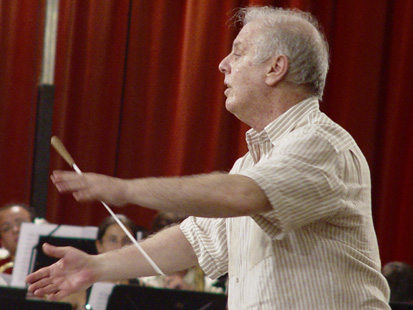
http://upload.wikimedia.org/wikipedia/commons/5/53/Daniel_Barenboim.jpg

Daniel Barenboim

But I’ve heard a few cautionary tales too. One that has gone the rounds is about the CSO’s former Music Director Daniel Barenboim and a string player of long-standing. This man had been a wonderful musician, but he had aged to the point of needing to step aside for the good of the ensemble. The problem was that the CSO had been his life, with little in the way of hobbies or other interests to fill that life, so he just kept going and denied what his ears and fingers were telling him.

One day at a CSO rehearsal, the Music Director made the matter public and uncomfortable for him and his cohorts. Addressing the musician, Barenboim said something to him like, “Wouldn’t you rather be at home than to have to be here doing this strenuous job?”

“I will die in this chair!” came the indignant response.

“Well, you know, we can have it moved to your home!”

Barenboim, of course, was enormously clever to say this, but terribly tactless as well. The poignancy of the player’s dilemma, if the conductor grasped it, was set aside for the momentary pleasure of one-upping the man.

In the end, the musician did leave the orchestra. But, someone who knew him quite well told me his retirement was empty, because playing in the orchestra was the only thing that had given meaning to his later life.

All of which is a long way of saying I don’t think I’m that guy. Most people I know who have retired, including CSO musicians, eventually seem to figure out how to organize their time usefully, even if there is a period of adjustment along the way.

Ultimately, though, clinching the decision has not been a matter of thought or reflection, but simply listening to my body.

A childhood anecdote might help make my point.

Like most kids, I enjoyed amusement parks; especially the high rides, the roller coasters. When I was small, my dad would take me to Chicago’s legendary Riverview Park, a place that had several of those attractions. The highest and fastest and scariest was called “The Bobs.”

File:The Bobs at Riverview (JJH).jpg

My dad was probably in his middle-40s at the time. He didn’t seem to be nearly as excited about going as I was, but took some pleasure in the fact that I enjoyed it immensely. “The Bobs,” however, was definitely a problem for him. It didn’t scare him, it didn’t thrill him, it just knocked him around in an uncomfortable way, and he said so. If you’ve ever ridden a contraption like that, you know you get jostled pretty seriously, thrown from one side of the car to another, bumping into your companion and the hard restraining surfaces.

I always wondered what he was talking about when he referred to the roughness of the ride. All the movement seemed great fun for me and was in no way troublesome. But, when I came to be his age and in his seat with one of my own children, then I knew exactly what he meant. Funny how we meet our parents again as we age, meet them in the mirror — meet them in ourselves, feeling what they felt when we were little, at a time that they were the age we have now become; the age where the experience of living in a more mature body finally creates the understanding.

While doing therapy is nothing like the physical experience of riding a roller-coaster, doing it in your 60s (at least for me) has not been the physical experience of doing it earlier in my career. If someone had told me 20 years ago, it would fatigue me in the way it does today, I’m sure I would not have had any more understanding of what they were saying than I did when I was 10 and my dad told me he didn’t like the physical experience of being thrown about on the hurtling high-ride.

I find the fatigue puzzling. After all, I just sit there and listen to you and talk to you. I have never felt more consistently able to concentrate on what you are saying, or better (more therapeutic) at doing my job. But then comes the end of the day, and I am both exhausted and sometimes a bit “wired,” even though I work shorter days than ever.

I’ve been playing with ways to make it less physically demanding: taking lots of vacation, doing regular aerobic exercise and weight lifting, reducing my case load, and working only four days a week for quite some time. None of that has done the trick.

Go figure.

As I said, it is time.

To all of you with whom I’ve had personal contact, thank you. Even to those of you where that contact didn’t help, I sometimes was able to learn some things that deepened my understanding and eventually benefited others. Best of all, of course, to those of you who did profit from our time together, thanks for trusting in me and allowing me to know the vulnerable, hurt places inside that were needful of something good.

I plan on remaining involved with the Zeolite Scholarship Fund, a philanthropic enterprise of which I am president.

And I do intend to keep writing this blog. I have not closed the door to professional opportunities involving psychology, and expect to keep my license in case something interesting turns up.

I cannot say with certainty I will never do therapy again, just not for a while.

And from time to time I’ll tell you how retirement looks from the other side in these web log updates.

Stay tuned.

http://upload.wikimedia.org/wikipedia/commons/thumb/9/94/Turner%2C_J._M._W._-_The_Fighting_T%C3%A9m%C3%A9raire_tugged_to_her_last_Berth_to_be_broken.jpg/500px-Turner%2C_J._M._W._-_The_Fighting_T%C3%A9m%C3%A9raire_tugged_to_her_last_Berth_to_be_broken.jpg

Images from the top: Sunset from Zebulun Beach at Herzliya, Israel, 11/20/06, by RonAlmog; Retirement of Mark Messier on January 12, 2006, taken by dtnyc383; Daniel Barenboim rehearsing the West-Eastern Divan Orchestra in Pilas, Sevilla, Spain on July 25, 2005, uploaded by Fernando Delgado Béjar from the Enciclopedia Libre; a picture of “The Bobs” from a postcard sold at Riverview Park, uploaded by JohnJHenderson. Finally, J.M.W. Turner’s 1838 painting of The Fighting Temeraire, being tugged to her last birth. All are sourced from Wikimedia Commons.

Looking at Old People or “Is Fifty the New Forty?”

http://upload.wikimedia.org/wikipedia/commons/thumb/8/8b/Happy_Old_Man.jpg/500px-Happy_Old_Man.jpg

You might not want to read this.

It’s gonna get scary.

I recently went to a funeral attended by a number of people who were middle-aged and beyond. The crisscrossed lines in their faces resembled an electric grid.

Still, one noted a few exceptions. Some, always female, had facial features that appeared to be immobilized by a Botox overdose. No forehead lines, no wrinkles, no movement; for the price of frozen time they had also obtained, at no extra charge, a visage as smooth as stone and as hard to animate. When trying to smile, a few of these folks looked like their faces were about to crack, while necks and hands told a different story.

Then there were the face-lifts that didn’t recapture youth so much as they made one look like someone else. Not better, but different. A few others sported eye and jowl lifts that had lost their hydraulics. I guess the old saying applies: what goes up must come down.

The men didn’t have this problem, but made an equally pathetic effort to disguise ancient origins. One guy had a comb-over that started behind his left ear and ended just over his right ear. Didn’t his wife notice this? Whose idea was this anyway? What was the man thinking?

Bad toupees suggested a recent visit to an Oriental rug bazaar in order to buy a discarded carpet remnant.

I am bald myself, but make no effort to disguise it. I do remember, however, hearing about something called scalp reduction surgery designed to get more coverage out of the hair you have by reducing the territory on top of your head.

I can imagine the following conversation:

Surgeon: ‘Well, Dr. Stein, we’ve studied your head, your hair-line and scalp and we have some good news and some bad news.”

Me: “Tell me more, Doctor.”

Surgeon: “The good news is that we can give you a full head of hair!”

Me: “And the bad news?”

Surgeon: ‘Your head will be the size of a pea.”

Back to the distaff side, a few of the women seemed to be hoping that you wouldn’t look at them closely because you’d be distracted by the dazzle of their jewelry. One seventy-ish lady had so many bracelets that she wasn’t able to lift her arm to shake hands. Her metallic bands created an orchestra-like percussion effect that drowned out the clergyman’s eulogy whenever she moved a millimeter.

Then there were the older men and women who dressed in styles more suitable to young people. One muscular guy wore a shirt revealing just enough to suggest that a lot of iron had been successfully pumped, but that all recreative work had stopped above the shoulders, sort of like an unfinished home rehab that never got to the top floor. “I don’t think that is his real head,” my wife whispered to me. We both wondered who his surgeon might be.

Ginger Rogers in Her Youth

A few of the older ladies wore skirts or dresses that befitted teens and twenty-somethings. The attire was usually combined with a long-haired coiffure that reminded me of how Ginger Rogers looked in the dreadful old age of a once gorgeous creature, still thinking that her beautiful blond hair should be worn just as it had been 50 years before.

If desperation had a fragrance, the room would have been ripe with it. But then, as Billy Crystal’s old SNL character “Fernando” used to say, “I’d rather look good than to feel good.”

The problem was, no one really looked good, even with all the obvious effort.

Is 70 then the new 60, as some like to say? Is 50 the new forty?

Is dead the new alive?

My advice? Accept the unacceptable. Hold on to your dignity.

Try hard not to look like an idiot.

As wise men have said for centuries: “There’s no fool like an old fool.”

The top image is called Happiness by Marg, sourced from Wikimedia Commons.

September Song

http://upload.wikimedia.org/wikipedia/commons/thumb/d/d2/Pin_Oak_Leaves.jpg/512px-Pin_Oak_Leaves.jpg

I was talking to an unmarried friend recently, not a young man, who presented me with a dilemma that was troubling him. It seemed that an attractive and intelligent woman, much younger than he, was showing an interest in him.

Friendship? Romance? Business advantage or advice?

All yet to be determined.

But he wondered whether to pursue the relationship, particularly if it might become romantic, sexual.

Now my friend is extremely bright, a thinker all his life. Indeed, this is how he makes his living — thinking, evaluating, considering, pondering, weighing, judging; and then conveying the result of those calculations to others, who pay him well for his service.

He sees lots of potential problems, although he doesn’t know the woman well at all — yet. Might she be interested in him only for his ability to assist her professionally? Wouldn’t others looks askance at the two of them together, a woman of 30 and a man of 55?

Or could one of the things that now attracts her to him — his capacity as a mentor or guide, someone who has much more experience of some very interesting things — eventually be seen as a problem when she tires of the “student” role and begins to resent the “teacher?” Wouldn’t the generation gap, the memories and formative influences that they don’t have in common, eventually separate them?

Now all these, and more, are not unreasonable thoughts. The problems that he sees could very well occur.

But other men might see it differently. They would welcome the attention of a young and attractive female, the energy, the sexual tension, the admiration, the possibility of what still might be. Indeed, some men of any age could well believe that they’d won some sort of dating lottery in just this situation.

But then, my friend lives in his head a lot, a thinker, as I said. And thinkers think. Not because it always works, not because they have to, but because it is almost as natural and automatic as breathing. Simply because they’ve always done it.

Most of us, past a certain age, just keep doing what we’ve done and getting what we’ve got. Not that what we’ve got has always been that great, but the unknown future seems fraught with danger and only the safety of the well-trod path appears to offer any security. Better the mediocre “known” than the dangerous, but perhaps promising “unknown.”

And so, the man who has always worn only Brooks Brothers suits for fear of others criticizing his wardrobe choices will still wear those suits; and the adult who had little money while growing up will continue to under-tip the waiter and sit in the “cheap seats” in the theater despite the fact that he has a million dollars in the bank and a secure pension on top of it; and the orchestra musician too long beyond his prime will play the violin still, not because he so loves it, but because he doesn’t know what he’d do with his time if he quit the thing to which he has devoted his entire life.

One is trapped by social expectations and insecurity, another held tight by the dead hand of the past, a third lacking the imagination or courage to reinvent himself. All are like sail boats becalmed, in a still-state of living without life.

But the days grow short as you reach September

When the autumn weather turns the leaves to flame

One hasn’t got time for the waiting game

My advice to my friend? See what happens. You aren’t young any more. Life is short. Who knows what it may yet have in store?

Before long spring will be in the air again. Even if it is not the spring of your youth, the earth’s spring might yet enliven you.

And listen to Walter Huston’s recording of September Song, music by Kurt Weill, words by Maxwell Anderson.

His rendition remains the best ever, even if barely sung, because of a sensibility that knew very well that of which he sang — the September of life and the hope of romance to heal the lonely heart.

The photo above is a Picture of Pin Oak leaves turning color c/o: Rmccrea, Wikimedia Commons.

The quotation is from September Song.

Do You Know Who You Are? A Meditation on Identity, Mid-life Crisis, and Change

http://upload.wikimedia.org/wikipedia/commons/8/85/Pentdod_gruen_neu_anim.gif

Who are you?

In times of war, men define themselves by three pieces of information only: name, rank, and serial number. I suppose that the peace-time equivalent is name, profession, and age; not social security number, which you are wise to keep to yourself for fear of identity theft. Stolen identities aside, the question of who you are is still an important one.

But let me formulate it differently.

How would you describe yourself? What human characteristics or traits or values are essential to you? What makes you different from any other person on earth?

Let’s start at the beginning of life. You are given a name. How does the name define you and influence the rest of your life? If you are A Boy Named Sue, as in the old song, you can be sure that your identity and life have been changed by your parents’ decision about appellation. Indeed, there is now research evidence that some names, those thought to be used predominantly by blacks, cause potential employers to discriminate against a job applicant’s resume when compared to individuals with the same qualifications who have names that are less racially-linked.

Name-changing has long been a way for white Americans to avoid discrimination based on ethnicity or religion. Others had their names compromised when reaching this country from Europe and were processed for entry to the USA on Ellis Island. Thus, a Paderewski became a Patterson and a Rifkin became a Riff, due to the simplifications created by the randomly assigned immigration official. And, from the start, the new arrival had to deal simultaneously with a change of name, a new nationality, a loss of homeland, and the now restricted opportunity to use his native language, all playing on the question of his identity. Meanwhile, his young offspring encountered the attitude of teachers (and, much later) potential employers or lovers to someone named Patterson rather than Paderewski, just as he saw himself as the former and not the latter.

For the immigrant, the “dislocation of place” both parallels and creates the dislocation of his sense of who he now is. The person has gone from being (perhaps) an unremarkable resident of his home country to someone “different,” who speaks (at best) with an accent, and who has a history that is at odds with the shared past of his new neighbors. The man has become, truly, a stranger, but he is not just strange to others—he is strange to himself.

Just as some people voluntarily attempt to hide their ethnicity, so too do some few work to hide their race. You might want to watch the 1959 movie, Imitation of Life, starring Lana Turner and John Gavin, for a cinematic take on this subject, the attempt to pass for white. More recently, Philip Roth’s year 2000 novel The Human Stain (and the movie of the same name) deals with a black University professor passing as a white man; and Bliss Broyard’s 2007 memoir One Drop: My Father’s Hidden Life—A Story of Race and Family Secrets describes her father Anatole Broyard’s self-transformation from black to white within the literary world.

And one must give at least brief mention of a condition called Gender Identity Disorder, in which children may be born anatomically of one sex, but of the opposite sex in terms of identity.

Religion also helps create one’s sense of self. As the European generation who survived World War II began to approach death, a number of adult Polish Catholics discovered, through these aging parents or other relatives, that they were born Jewish. The children had been rescued from the Holocaust by Polish gentiles. It was therefore often easier and safer to treat them as Catholic during the Nazi occupation than to try to persuade them to keep a secret of their religion. Once this identity alteration was performed, however, it proved to be hard or uncomfortable to undo, particularly in a nation with an antisemitic history. The revelation of the religion into which they were born surely transformed the identity of a number of these religiously recast people.

Revelations of another kind occurred in post-World War II Germany. The children of Nazi authorities and SS members did their best to keep their identities secret for fear of being prosecuted for crimes against humanity. Nonetheless, their children sometimes discovered (to their dismay)  the answer to the question “What did you do during the war, daddy?” This type of revelation can lead the child to wonder who he really is, and whether he has inherited some of the unfortunate qualities of his father.

The 1989 movie Music Box starring Jessica Lange and Armin Mueller-Stahl deals with a similar circumstance, but one transported to the Chicago area. It involves the question of a father’s activities in Hungary during the war and his daughter’s legal defense of him against the US government’s attempt to deport him.

If you have seen or read the Arthur Miller play All My Sons, you know still a different take on the same theme, this time without war crimes entering picture, at least as they are usually defined. The play takes place in post World War II America. Joe Keller ran a wartime factory with his former neighbor, Steve Deever. The men knowingly shipped defective airplane cylinder heads causing the death of 21 U.S. Air Force pilots. Steve goes to jail for this, although somehow Joe is exonerated of the crime. But when Joe’s pilot son Larry finds out what his father has done, his shame translates into suicide, so devastated is he by the identity-altering knowledge of who his father is and what his father has done.

As I hope these examples make clear, the question of your identity also involves awareness of who your parents were or are. Adopted children often seek out their biological parents, as do those who have been abandoned and left with only one parent to raise them. They also lack the medical history that informs the lives of those of us who know our parents well. The difference can mean life or death. Am I at risk for heart disease or not? It depends, in part, on who your parents are or were, and that information can change your life.

Children who have lost a parent to disease or death-by-accident or in war-time have a similar problem, even if they don’t have to deal with the knowledge that a parent or parents gave them up, and the attendant implication that they were worthless to those parents. And, their identity is influenced by the fact that they are “different:” the ones who lack a parent, have no partner at the daddy-daughter dance, have no father to teach them to play ball and no male parent to root for them at the Little League game.

Shifting gears, our identities are surely influenced by physical and intellectual characteristics: short/tall, young/old, handsome/homely, smart/stupid and so forth. But not all such qualities are fixed. Witness the change in identity that happens as people age, especially if they were once beautiful or handsome, or once athletic and now infirm. For those who trade on superficial characteristics exclusively, the change that comes with the passage of time is more than troubling.

Gorgeous women, in particular, find that they no longer turn the heads of men so much, if at all. Instead, the male of the species looks to other, younger women. Germaine Greer talked about this in terms of becoming “invisible,” though she found freedom in it to be more herself, less concerned with how she looked. One way or the other, it is an identity changer. Similarly, those who are injured, scared, or lose a limb or a breast must redefine themselves, reconfigure who they are in their own minds just as they have been quite literally reconfigured physically.

On the other hand, if you receive an organ transplant, you face an unusual assault to your sense of self. You are no longer the physical entity of earlier days, but now have a part of another person inside of you.

Yet, sometimes external changes do not alter identity very much. I have counseled more than one naturally beautiful adult woman who was the fat kid or the ugly kid while growing up, or the child who was criticized and belittled by parents. Too often the early labels seem to adhere to the person’s self concept as if they were tattooed on their flesh. Thus, it is not a surprise that cosmetic surgery does not always achieve the sense of self-worth that the patient is looking for.

Other life events can also transform one’s self-image. Men are notoriously vulnerable to a loss of identity when they retire or lose a job and are no longer the CEO, breadwinner, “doctor/lawyer/Indian chief” of their working days. I recall hearing it said that for a time after his retirement from baseball, the great New York Yankee outfielder Mickey Mantle had a recurring dream about trying to reenter Yankee Stadium by crawling under the fence that surrounded the ball field and getting stuck there! This is a stereotypical example of a man who was suffering from his loss of identity as an athlete.

So too, women who defined themselves exclusively in terms of their job as mothers frequently seem bereft and without a sense of self when the children leave the nest. In addition, women historically are more likely than men to define themselves by their partner, and achieve a sense of who they are by who their partner is. Being, for example, “the doctor’s wife” might have some value until the day that you are the doctor’s ex-wife. But, it must be said that men do this, too, and take some measure of self-definition and pride in having a talented or beautiful or charming wife.

Before closing, one must certainly comment on the notorious mid-life crisis of identity usually associated with men. Some men begin to get the sense of time passing them by and of not having accomplished all that they wished for in life. Jean Améry has said that a young person “is not only who he is, but also who he will be.” In other words, his self concept is informed by the expectations he has for his future. For most men in middle age, however, “who he will be” is not all that promising.

As the (usually unconscious) sense of mortality and “doors closing” begins to encroach, males have been known to act foolishly in order to hold on to or recapture their youth. A fast, new model car will suffice on occasion, but the stereotyped search for a new model “trophy” love is certainly something I’ve encountered in my clinical practice. It has been known to take the form of a rekindled high school or college romance, as well, for those men less concerned about external appearances and more about “the road not taken.”

However the crisis manifests itself, the crisis-driven actions inevitably fail to find the “Fountain of Youth” that is their real goal. Grudgingly or not, one must accept one’s mortality and the accompanying aging process or make some big and painful mistakes, costly to yourself and to others around you, as the price of trying to hold onto an identity whose time has passed. Dylan Thomas wrote, “do not go gentle into that good night,” but, gentle or not, go we will.

A few years beyond the mid-life crisis stage, most men and women find themselves thinking about different things than they were in their youth. Thoughts related to sex diminish and thoughts about aches and pains increase. In both cases, the mind is reminded by the body of one and not the other. The only difference is that the body steals upon you with sexual thoughts and feelings while young and, as these diminish, perversely tries to make up for it with sensations that hurt more! If you are like me, the first change you notice is that you actually have knees. Now, for the first time, you are aware of the work they do, and the knowledge is not consoling. These thoughts and sensations make their own contribution to who you are.

Finally, Richard Posner, the public intellectual, scholar, and judge has asked an interesting question about identity. What if, Posner wonders, we send a young man to prison for a serious crime, but he reforms himself and becomes an admirable human being during his lifetime confinement? Are we still punishing the same man 40 years after the wrong has been done? Certainly his name is the same and his history marks him as the same man. But his personality might have been altered by rehabilitation, reflection, experience, study, faith, or any or all of the aforementioned.

I hope that it is clear that identity is not so simple a thing. It is made up of one’s history and those histories of one’s forebears. At least partially, it is a function of a name and a place and a time, whether friendly to a person or not, particularly if society is prejudiced. Physical characteristics, too, play their part, as do what we think and what we do; and, of course, whether we have much self-awareness or, instead, see ourselves as different from who we really are.

And, it is a thing that can change — that must change — as we age and take on new roles in our families and in our community; and as changes occur not just in our mind’s eye, but in the mirror.

It is worth some thought, I think, that question with which I began.

Who are you?

The image is called Pentaeagondodekaeder by Lokilech, sourced from Wikimedia Commons.

The Meaning of Life is…

Thoughtful people since the beginning of time have looked for the answer to the biggest question of all: what is the meaning of life? But recently I’ve begun to wonder whether perhaps it is the wrong question. The existentialists have long suggested that it is our job, each of us, to find our own meaning. But even if you believe in the idea that we must take responsibility for the one life that we have and view it as a creative act, to make what we can of it, I’m still not convinced that the question is the best one available.

What then might be a better question? The question I’m thinking of is, what are the meanings of a life, the purposes to which one puts that life? In other words, the meaning of a life, its target or goal, would be viewed as a changeable and changing thing, not just different from one individual to another as the existentialists suggest, but different depending upon the moment that the question is asked of any single life. It might be one thing when you are 15 and quite another when you are 50, still another at 75.

But first let us consider very briefly the answers to the original question, what is the meaning of life? One could go on at length about the various “isms: hedonism, stoicism, and so forth. I will not do this. Others know more about them and have already discussed them at great length. Still, one must give a nod in the direction of the meaning of life being the simple biological fact of procreation, continuing the human race. The religious might argue that the will of God for each individual as the meaning for that particular person, along with doing honor to God’s law. Then there are those who believe that life is intended to increase one’s understanding and knowledge, or to have the maximal amount of pleasure, or to perfect oneself by fulfilling your innate talents and capacities, or to make the world a better place than you found it, or quite simply to love in a deep and abiding fashion.

But, my current thought is that there is no single meaning for all persons, but changing meanings as we grow up and age. Early-on, the meaning of our lives is perhaps to be found in discovering what we can do, who we are, and mastering the extraordinary number of things any little person has to learn just to get out the door and off to school. Not far into the process one must determine how to relate to people, how to honor yourself without disrespecting others, figuring out where you stand in the pecking order of athletic, intellectual, and social competition. Discovering one’s vocation must be on the list, since most of us take so much meaning from what we do for a living, be it as a captain of industry, a scholar, a salesperson, or parent. All the better if what we do for a living provides a sense of fulfillment, creativity, acknowledgment, accomplishment, and growth.

Meaning is to be found in a life-partner too, in love, in family, in raising a child, and in risking your heart. And over time, friendships, especially if they are life-long, have great value and define us as people and as members of a tiny group of two or more friends or part of a community, pulling-together to do something worthwhile.

In war-time, loyalty, comradeship, and courage take special meaning; even to the point that, a few years before World War II, the Japanese government proclaimed loyalty as essential to the national morality. And, in the war itself, the idea of behaving honorably in the face of certain death, never allowing himself to be captured, guided the Japanese soldier and gave meaning to his service. Emperor, country, and comrades counted for a lot; even the importance of family sometimes diminished in the heat of battle, by comparison, when it was necessary to steel one self against the terror of combat.

Under less severe circumstances, learning is something that gives purpose as we work to understand ourselves and the human condition, as well as particular things about the world. Later on in life, for many people comes a certain generosity of spirit, a desire to help those who are coming after us, to lend a hand. And the shortness of time contributes to intensity of feeling, making the beauty of the earth, a smile, a song, an act of kindness, or an embrace all the more touching because we know that before too long, the sweetness of life will no longer be ours to savor.

Having taken all this time on the question I’ve raised, I think there is danger in spending too much time on trying to answer the question, “What is the meaning of life? If one has learned anything from life itself, it is that the time is precious and waiting in contemplation for a revelation of what we should do risks squandering the time we have. But most of us are comforted by a sense of direction, and one should try to determine what is of value, and to conform one’s behavior to what is important and worthy of effort and time. Indeed, mindfulness and commitment-based psychotherapies work very hard to encourage the person to become detached from things that are not important, and instead to focus him on his values and how to “live” them.

There is worth, then, in simply knowing that the clock is ticking and that the day is short; but only if that knowledge creates a sense of urgency in you and the desire to make the most of the time.

As John Donne wrote so long ago:

“Therefore, send not to know

For whom the bell tolls,

It tolls for thee.”