Beyond Words

Sometimes, beauty or a touching moment surpasses our ability to describe it. Think of a child’s birth, his playful innocence, or just a smile.

Music does this, too. Gustav Mahler, a composer of grand symphonies, said, “If a composer could say what he had to say in words, he would not bother trying to say it in music.”

And yet, occasionally, we find words that bring us very close to the tender or the overwhelming. Here is such a one, a poem beyond words, though made of them.

I hope you enjoy it. Watch and listen or read:

Small Kindnesses

By Danusha Laméris   

I’ve been thinking about the way, when you walk
down a crowded aisle, people pull in their legs
to let you by. Or how strangers still say “bless you “when someone sneezes, a leftover
from the Bubonic plague. “Don’t die,” we are saying.
And sometimes, when you spill lemons
from your grocery bag, someone else will help you
pick them up. Mostly, we don’t want to harm each other.
We want to be handed our cup of coffee hot,
and to say thank you to the person handing it. To smile
at them and for them to smile back. For the waitress
to call us honey when she sets down the bowl of clam chowder,
and for the driver in the red pick-up truck to let us pass.
We have so little of each other, now. So far
from tribe and fire. Only these brief moments of exchange.
What if they are the true dwelling of the holy, these
fleeting temples we make together when we say, “Here,
have my seat,” “Go ahead — you first,” “I like your hat.”


Danusha Laméris — From her website: https://www.danushalameris.com/

Her first book, The Moons of August (2014), was chosen by Naomi Shihab Nye as the winner of the Autumn House Press Poetry Prize and was a finalist for the Milt Kessler Book Award.

Her second book, Bonfire Opera, (University of Pittsburgh Press, Pitt Poetry Series), was a finalist for the 2021 Paterson Poetry Award and recipient of the 2021 Northern California Book Award in Poetry. 

Her third and newest collection, Blade by Blade (2024)  is now available through Copper Canyon Press.

Danusha is currently on the faculty of Pacific University’s low residency MFA program.

“I Was Only Joking”

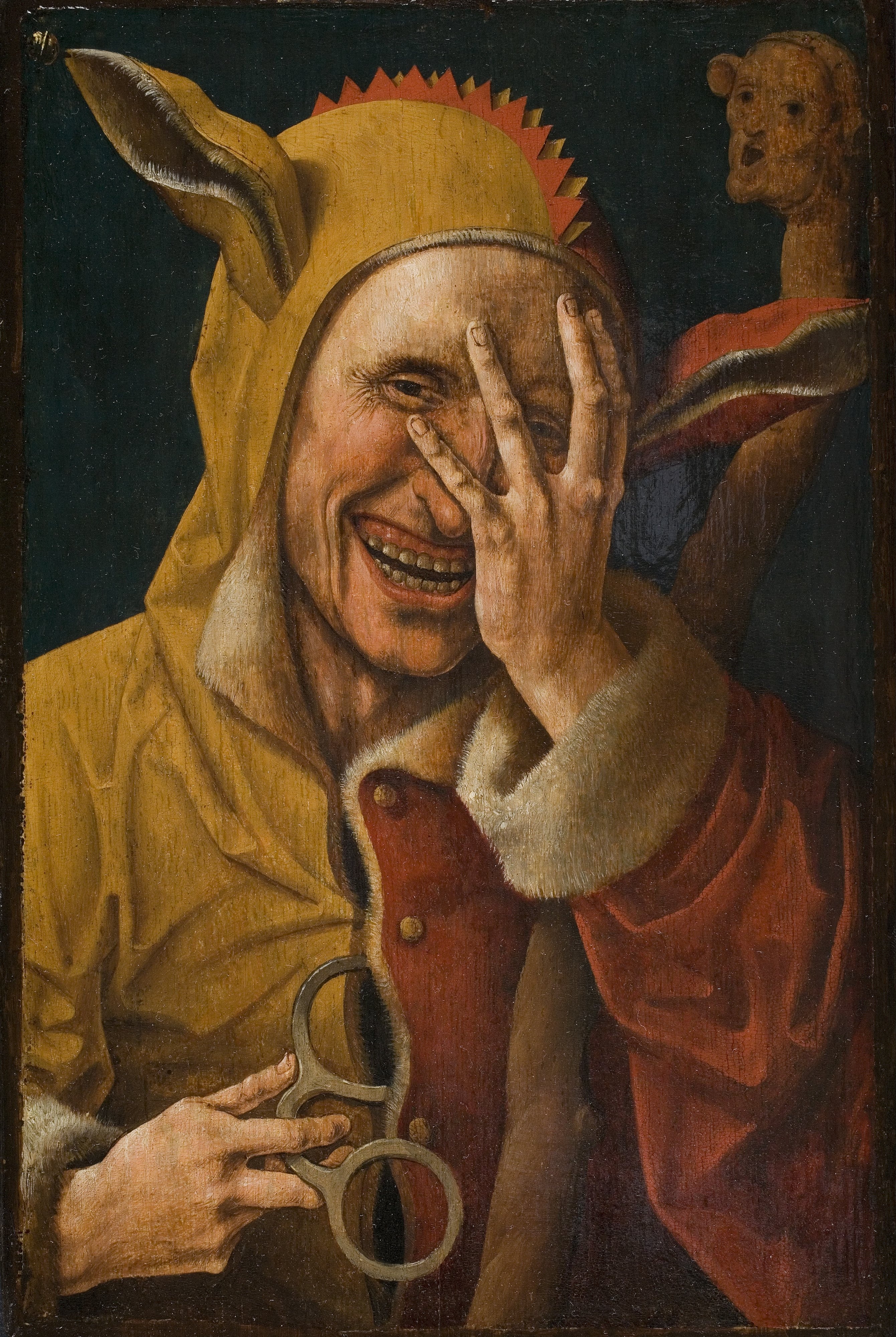
http://upload.wikimedia.org/wikipedia/commons/1/1a/Laughing_Fool.jpg

I’ll give you an example of an ill-timed joke. It happened during the oral examination for my Masters thesis at Northwestern. Oral exams tend to generate a good deal of anxiety in the examinee, and I was no exception to this. The protocol is that the examining committee first meets together and then calls you into the room to join them. After exchanging greetings, the chairman of the committee, your thesis advisor, opens the gathering to questions from the other committee members. And so it was that Philip Brickman asked me the first question, beginning just this way:

There is a very serious problem with this thesis.

Dead silence ensued. My anxiety level went up 400%. I began to imagine my future taking a very wrong turn into four lanes of on-coming traffic. And then, after a pause that seemed to last for ages, he turned to the “Acknowledgements” section of the thesis and said:

Philip is spelled with one “L.”

Philip was calling attention to the fact that I had spelled his name “Phillip,” with two “Ls.” I have no memory of exactly what happened immediately after, although I can imagine that everyone laughed. I certainly was relieved; maybe that was Phil’s intent. But, however funny or well-intentioned, it was also a bad joke, one totally at my expense and possible only because of the vulnerability of anyone sitting for an oral exam, and Phil’s authority as one of the examiners. I had no residual resentment toward Phil, who was otherwise always more than pleasant toward me and, I should add, quite a significant research psychologist. But, I give you this example to point out that humor at another’s expense is a problematic undertaking.

I am sure that there are very few of us who haven’t ever taken advantage of the insecurity, vulnerability, or anxiety of someone, to make just such a remark as Phil made. I’ve certainly done it. It is a very human thing to do. And worse if it is done in front of an audience than one-on-one. I’m raising the point only because sometimes people who are sarcastic or mean-spirited do this with regularity and glee. And often, if the target of the humor complains, the jokester will blame the alleged “over-sensitivity” of the person who is the butt of his comment with admonishing words like, “you can’t take a joke,” “I was only kidding,” or “you are too sensitive.”

Maybe, maybe not.

But, once done, we owe the person who we toyed with the courtesy to respect his wishes and whatever sensitivities he does have, whether “over” sensitive or not. To do so is the civil and polite thing to do. Children are especially easy targets for barbs of the kind I’m describing and need particular respect, I think. Life is tough enough for the little guys and girls without adults taking advantage of their unshielded tenderness. That, at least, is my 2 cents on the subject.

And, if you are curious, I did pass the oral exam!

The image above is that of a Laughing Fool (ca. 1500) sourced from Wikimedia Commons.

What Should be the Last Word on the Question of Civility and Rudeness?

Memo to Kanye West, Serena Williams, and Representative Joe “You Lie” Wilson:

If you do not wish to be treated offensively, do not give offense.

In other words, live by the Golden Rule.