Darkon: What Role-Playing Games Tell Us About Real Life

It is easy to dismiss people who play role-playing games.

Geeks, losers, nerds, they’ve probably been called all these things and more. As William Shatner said on Saturday Night Live to the costumed attendees at a Star Trek Convention, “Get a Life.”

But if you watch the 2006 award-winning feature-length documentary Darkon, you just might get a different idea.

Darkon is “live-action role-playing game” or LARP. That is, real people create and dress-up as characters in a quasi-medieval world. They also fashion back-stories of the origins of these alter-egos that don’t sound much different from religious and biblical legends. Perhaps Moses was found in the bulrushes by an Egyptian princess, but you can be sure that Darkon players have backgrounds no less imaginative.

The Darkon gamers affiliate with other like-minded souls within the game, inventing national groups who strategize about how to enlarge their country’s domain. In order to achieve this, some combination of negotiation and combat between armies is required. The movie Darkon shows just such activities as they are played out by the “Darkon Gaming Club” in Baltimore.

Both men and women, usually in their 20s and 30s, enact a stylized form of combat involving “weapons.” Those instruments of war must be made according to guidelines designed to insure the safety of the soldiers, but the rules permit imaginary “injury” to be inflicted and one side or the other to triumph.

Enormous amounts of energy and time go into the realization of this fantasy world. Public parks, forest preserves, and school grounds are claimed as the battle-ground upon which occur many of the negotiations and all of the wars.

One player, a stay-at-home dad named Skip, doubtless speaks for a good many of the Darkon enthusiasts, when he talks about feeling “…born out of time… I feel like I have some great destiny and I have just to find it.” Clearly, Skip looks for that destiny, in part, within the game. You may think that such people are troubled as you read this on the computer screen, but Skip comes across as an earnest, intelligent, thoughtful, and principled man within the film itself.

The central figures of the documentary include a business executive in the real world who leads the most successful and largest group of Darkonians, a former stripper who is a single working mother, a college student who works part-time as a barista, a buyer in a fabric store, an assembly line worker, and many individuals who find their real lives boring and anonymous. They make no mark and live lives outside of the game that recall Thoreau’s comment on “quiet desperation.”

For some, including the most successful player within and outside the game, this role-playing world appears to serve a therapeutic function: “Playing (my character) helped me become the man I wanted to be in real life.” Opportunities for leadership, negotiation, and political as well as combat strategy transferred to the streets, offices, and board rooms of everyday existence, building his self-confidence and changing him even when the costume came off.

Meanwhile, others struggle with marginalization both within and without the game, but live in the hope of, quite literally, “reinventing” their characters and taking a more commanding and successful role. Some recognize the need to develop social skills in order to have real-life success. But, one suspects, that others not featured in the movie get caught up in the escapism that any such exercise might provide. They never grow out of the game.

As I watched this documentary I couldn’t help but think of the changes that industrialization and urbanization brought to workers during the period known as “The Industrial Revolution.” People went from being independent solo-practitioners working for themselves as tailors, blacksmiths, farmers, and weavers, to employees of others in larger and larger enterprises. The phrase used to describe what they became was “wages slaves,” clearly no longer free and independent.

Perhaps then, the Darkonians are only looking for what most of humanity has lost in a world of big machines, buildings, computers, and cities: some sense of individuality and uniqueness.

Or, like the ancient Greeks of Homer’s day, maybe they seek honor and glory. Honor in that pre-literate day tended to come in the form of goods, precious metal, slaves, concubines, and the like; in other words, mostly material things or things that could be counted or displayed or used. Sort of like today, perhaps you are saying to yourself. In our world, honor is conferred by status and very similar material things – the size of your house, the amount of money in your bank account, a trophy spouse, the car or cars you drive, a gorgeous vacation home, etc.

Glory (the Greek word kleos) was another matter. What might glory have consisted of in a world in which the idea of heaven had not yet been invented? It took the form of a reputation or fame that continued beyond death. And, since there was no written word, you and your accomplishments had to be sufficiently great to generate discussion, song, and story once you were gone. This was usually achieved by being a great hero or warrior. In war, then, one could hope to grasp both of these things: the honor that came with sacking cities and accumulating wealth, slaves, and sexual partners; and the glory of a reputation for fearlessness, strength, and tenacity that would transcend your death.

In other words, a lot like what the Darkon players hope for inside and outside the universe of the game.

Earnest Becker, the sociologist and Pulitzer Prize winning author of The Denial of Death (a book esteemed by Bill Clinton, by the way) talked about each man’s hero-project: the attempt to distinguish himself from other men. It is an effort that Becker thought was motivated by our fear of death and a desire for a kind of symbolic immortality via achievement. Or, perhaps, a self-delusion made possible through accomplishing important feats, thus allowing oneself to deny the inevitable demise of all living things, including one’s own end.

One Darkonian states that the game is “…like watching TV, but you are the hero. If you could watch Brad Pitt or be Brad Pitt, which would you rather do?”

But, there is also darkness here, as another perceives it, “There is a certain desperation to life. It’s all terminal — we are going to die. Maybe fantasy and religion and all those things are (like Darkon), if not crutches, vehicles to get you from birth to death.”

Sometimes a game is more than a game.

The above image is a scene from Darkon.

On Sacrifice

http://upload.wikimedia.org/wikipedia/commons/thumb/2/2b/Rembrandt_-_Sacrifice_of_Isaac_-_WGA19096.jpg/500px-Rembrandt_-_Sacrifice_of_Isaac_-_WGA19096.jpg

Would you like to know who you are? Then it is essential to know what is of real value to you. One way of finding that out is by asking the question, “What would I be willing to give up for something that I claim is important to me? What would I be willing to sacrifice for love, or great wealth, or power, or honor, or for my child’s well-being?”

What we are willing to sacrifice defines us, both as individuals and as a society. But first, let’s look at what the word sacrifice means:

The on-line Merriam-Webster’s dictionary gives the following definition of the noun sacrifice:

1 : an act of offering to a deity something precious; especially : the killing of a victim on an altar
2 : something offered in sacrifice
3 a : destruction or surrender of something for the sake of something else b : something given up or lost <the sacrifices made by parents>
4 : loss <goods sold at a sacrifice>

Thus sacrifice involves loss and giving something up.

In primitive societies, it often included murder.

Human sacrifice was intended most often to appease a God, win the God’s favor, or avoid the God’s wrath. Igor Stravinsky wrote a famous ballet about this, The Rite of Spring.

More recent depictions of this sort of behavior have included Friedrich Dürrenmatt’s 1956 novel, The Visit. In this story a wealthy woman (Claire Zachanassian) returns for a visit to her home town, a place that has fallen on hard times. She departed in disgrace many years before when she was impregnated by her young lover. This person denied the charge of paternity and bribed two people to support his case by claiming that they had been intimate with her. Shamed by the townsfolk, Claire eventually turned to prostitution.

Her return home is noteworthy for a “proposition” she has for the town where her former lover continues to live as a respected businessman. She will bequeath an enormous sum to the hamlet if it will do one simple thing: put to death the man who caused her disgrace. In effect, the book asks the question of what this woman is willing to sacrifice for revenge (her money, her morality) and what the town’s people are willing to give up for money. The movie of the same name starred Ingrid Bergman and Anthony Quinn.

http://upload.wikimedia.org/wikipedia/commons/thumb/b/b3/Adi_Holzer_Werksverzeichnis_835_Abrahams_Opfer.jpg/500px-Adi_Holzer_Werksverzeichnis_835_Abrahams_Opfer.jpg

More recently, a very different sort of sacrifice is depicted in a 1967 episode of the original Star Trek TV series, The City on the Edge of Forever. While in an irrational state, the ship’s physician enters a time portal on an alien planet, one that takes him back to 20th century USA in the midst of the Great Depression.

At the instant that this happens, the Enterprise starship disappears from its orbit of the world on which the time portal exists. Captain Kirk and Mr. Spock, already on the planet in pursuit of Dr. McCoy, recognize that he must have altered history in such a way as to result in a universe in which their space vehicle never existed.  Kirk and Spock therefore enter the time portal themselves at a moment in history slightly before they believe that McCoy reached 20th century earth, in order to prevent whatever action he took that changed subsequent events.

While back in time, Kirk and Spock meet a social worker named Edith Keeler, who runs a soup kitchen for the down-and-out victims of the Depression. Soon, Mr. Spock uses his technological prowess to discover that Dr. McCoy will eventually have something to do with Edith Keeler herself.

In one possible historical thread, Spock finds a newspaper obituary for her. In another, however, he discovers that she will lead a pacifist movement that delays the USA’s entry into World War II, resulting in Hitler’s victory and the very alteration of events that prevented creation of the star fleet of which the Enterprise starship is a part. Thus, in order to create the more benign future known to the three officers, Edith Keeler must die.

There is only one complication. Captain Kirk and Edith Keeler (played by Joan Collins) have fallen in love.

The climatic moment comes when Dr. McCoy and Captain Kirk see each other across the street for the first time on 20th century earth. As they rush to reunite, Edith Keeler (on a date with Kirk), attempts to cross the street to join them, heedless of the fact that a fast-moving truck is headed toward her. The doctor attempts to rescue Kirk’s love, but is restrained by Kirk from doing so. Edith Keeler is killed.

The heartbreak is heightened by the incredulous McCoy’s indictment of his captain and friend: “I could have saved her…do you know what you just did?.” Unable to speak, Kirk turns away while Mr. Spock says quietly, “He knows, Doctor. He knows.” Thus, Kirk has sacrificed Edith Keeler’s life and his own happiness, to prevent her from actions that would have led to world enslavement by the Third Reich.

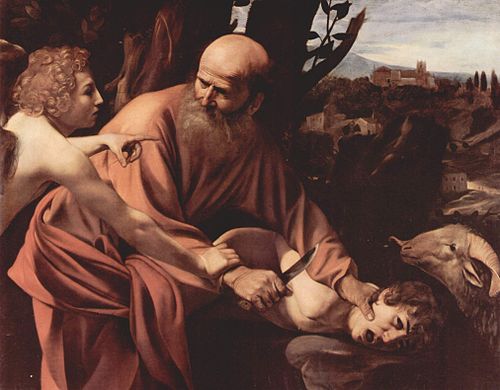
I have always been troubled that two of the most important biblical stories involve human sacrifice. The tale of Abraham and Isaac finds the former, the founder of the Jewish faith and monotheism, asked to sacrifice his son Isaac in order to prove his devotion to God. As he prepares to do this, an angel appears and stays his hand. A lamb is slaughtered instead. Rembrandt depicted this beautifully in the painting reproduced above.

Remember now, that I’m a psychologist. I cannot look at this painting without wondering what the child Isaac might be thinking and feeling in the aftermath of this moment. How will his relationship with his father be changed? Might there have been other possible ways of testing Abraham without permanently scarring his son?

The foundation story of Christianity poses a virtually identical dilemma, with the sacrifice of Jesus to pay for the sins of humanity. I fear that we are so used to abstracted representations of these events, that we have become inoculated against the trauma depicted by them and the human, societal, and theological implications of such horrors, reportedly authorized by God.

http://upload.wikimedia.org/wikipedia/commons/thumb/4/45/Michelangelo_Caravaggio_022.jpg/500px-Michelangelo_Caravaggio_022.jpg

Of course, most of our sacrifices are much less dramatic. Do we give up eating what we might want in order to be fit and live a longer and healthier life? Do we brush off the attractive member of the opposite sex who “comes on” to us, in order to maintain our marital fidelity, avoid injuring our spouse and children, and keep whole our integrity? Do we sacrifice time having fun or attempting to climb the career ladder in order to go to our child’s boring orchestral recital and enduring hours of “Twinkle, Twinkle, Little Star” played by tiny violinists, all of whom are out of tune?

I’m sure you can imagine many more such choices and sacrifices of your own.

We make decisions, all of us, about the question of national sacrifices too. Jobs vs. clean air, tax cuts vs. social services, giving to charity vs. keeping the money for ourselves, liberty vs. the promise of security, and most poignant of all, the decision of when war is necessary despite the sacrifice of the unlived lives of our young adult children.

Just as an exercise, you might want to make a list of all those things you spend time on that are inessential, all the things that you could live without if it came to something really important.

Or, still another exercise: if you could only take 10 things or 10 people with you to a desert island, who or what would they be and who or what would you leave behind? And what cause would be great enough for you to agree to go to a desert island in the first place?

Who are we as a nation? Who are you as a person?

We might know more about our country and ourselves if we first ask what we are willing (and unwilling) to sacrifice.

The top image is the Sacrifice of Isaac by Rembrandt. The second picture, taken by Michael Gäbler, is of Adi Holzer’s hand colored etching Abrahams Opfer from 1997. Finally, Caravaggio’s version of the same scene Die Opferung Isaaks from 1594-96, sourced via the Yorck Project. All of the above come from Wikimedia Commons.

Where is the Mad Hatter? Tea Party Anyone?

mad-hatter.jpg

A certain tea party is much in the air these days. You know the one I mean. The one that takes its name from the famous Boston Tea Party.

It turns out, though, that it isn’t the only tea party we might choose to reference at this moment in history.

But back to Boston. On December 16, 1773 (Beethoven’s third birthday, by the way) the good people of that good city dumped some imported tea into the harbor in protest of a tax that had been levied on it by the British government.

The problem was that Massachusetts was a colony and had no representation among the legislators who voted to create the tax back in the home country. This made the future Bay State’s residents angry. The colonists’ action was one of the signal undertakings leading to the Revolutionary War and US independence.

Thus, today we have a so-called libertarian political movement known as the Tea Party. That turn of phrase, of course, is a clever play on words, since it refers to both the Boston Tea Party and to the idea of a political party, which “The Tea Party” is.

Yet another “tea party” comes to mind. Those of you who have seen the Disney movie “Alice in Wonderland” or read the Lewis Carroll novel “Alice’s Adventures in Wonderland,” might remember it. Having fallen down a rabbit hole, Alice finds herself in a fantasy world where not a lot makes sense. Indeed, Carroll’s novel is the first in what is called the “literary nonsense genre.”

Before too long, Alice is led to a tea party involving the Mad Hatter, the March Hare, and a Dormouse. In the movie version, Alice never is actually allowed to drink any tea, although it is all around her being drunk by the other revelers at the festivities. A failure of “trickle down economics,” no doubt.

In addition to not being allowed any tea, Alice finds herself prevented from explaining how she arrived in Wonderland and is, in fact, told that she is rude.

The guests are in the midst of celebrating the 364 “unbirthdays” in any year (all the days other than one’s birthday). To the good, I suppose, Alice’s birth certificate is not requested. The “unbirthday” party simply continues on its own, indifferent to her attempts to explain where she came from, make sense, and get through to the party leaders.

The White Rabbit, the creature she followed down the rabbit hole, eventually adds his own craziness to the setting, preoccupied as he is with a watch that is “two days too slow.” Rabbits of color were not invited to the gathering, it seems.

Although not mentioned in the party scene itself, the Mad Hatter is being punished by “time.” The punishment consists of time standing still at precisely 6:00 PM, which, since it is tea time, means that the Mad Hatter must have a tea party all day long; stuck in the past, while all the rest of the world goes forward.

Finally, Alice leaves the tea party, declaring it “the stupidest tea party I’ve ever been to in all my life.”

All of which raises the following question: can a country fall down a rabbit hole?

The next thing you know, someone resembling the Queen of Hearts will be shouting “Off with his head!”

Party On?

Misery Meets Reality TV: Queen For A Day

http://upload.wikimedia.org/wikipedia/commons/6/6f/John_Collier_Queen_Guinevre%27s_Maying.jpg

How much of others’ misery can you stand? How much of their success?

Television has an answer for us, but more about that a little later.

According to Dan Greenburg and Marcia Jacobs in How to Make Yourself Miserable, it is essential that your life should stay within the “Acceptable Failure Range,” lest you lose your friends. Exceeding that range in either direction — too much success or too much unhappiness — will alienate some people. Or so the authors say, tongue in cheek, in this funny old book.

Although I don’t know of research evidence to support this notion, I suspect there is something to it. It is easy enough to fall into the shadow of a friend who glories in his attainments and reminds you regularly of all his achievements.

If the old saying, “Misery loves company” is true, one must be careful about being too full of yourself and your good fortune around friends.

Similarly, many people fear that others will tire of their tales of unhappiness and woe. They anticipate causing their acquaintances to experience compassion fatigue and shun them. This expectation leads some of the afflicted to avoid discussion of deeply personal injuries, or to speak about them only infrequently. Indeed, our society encourages an upbeat, “can do” attitude and expects us to “move on” perhaps more quickly than we can easily manage.

Faced with unhappiness or life crisis, it is interesting to observe how a person handles it. Some find relief in talking about it and appreciate patient and supportive listeners. Others do not want to speak or think about it, turning to distraction or to a very small group of confidants. Taking your cue from the person in distress is best.

If you can handle difficult and painful conversations, you are a very good friend indeed. And, if there is a practical and specific kind of assistance that you can offer (running errands, preparing meals, driving to a doctor’s office), you will provide more help than if you simply say “let me know if there is anything I can do.”

As a society, we seem to have an ambivalent relationship to disaster. When it happens to someone else, it can be fascinating. No wonder that TV stations use a motto to describe how to determine the first story on the news: “If it bleeds, it leads.”

When the calamity is in Uzbekistan, it is one thing. It is then easy to keep our distance: it is both out there, thousands of miles away; and “in there” — inside the TV set. Moreover, when the media inundate us daily with so many tragedies, each individual one loses its impact.

So-called “reality” no longer seems quite real.

Unless it happens to your brother-in-law and it becomes quite something else.

In the 1950s and ’60s, there was an old TV program called “Queen For a Day.” A forerunner of the ubiquitous reality TV of today, it featured “real people” (only women) telling the MC the profoundly unfortunate circumstances of their lives and usually breaking down while doing so. Ultimately, each contestant was asked what she would like if she won; this usually took the form of medical equipment or household appliances.

An applause meter registered the studio audience’s approval so as to choose the winner. Sort of like a latter-day Roman Colosseum, the virtually all-female spectators determined who among the lady “gladiators” got a “thumbs up.”  The program was some form of “see if you can top this,” with each contestant effectively hoping to surpass her competitors in terms of desperation and heartbreak, often describing diseased children and extraordinarily bad luck.

Once the “Queen” was crowned and perched on a makeshift throne (to the tune of “Elgar’s Pomp & Circumstance March #1, which you know as the processional music to which you graduated high school), she received not only the requested item, but a carload of other things, perhaps including a vacation.

One can only imagine what the losers felt like, having once again been consigned to the anonymous trash heap of human misery. Perhaps they thought, “Wasn’t my life bad enough?” Almost certainly, failing to win added to their already long list of disappointments, despite a few consolation prizes.

The TV writer Mark Evanier called this program “one of the most ghastly shows ever produced,” further finding it “tasteless, demeaning to women, demeaning to anyone who watched it, cheap, insulting and utterly degrading to the human spirit.”

Of course, there was nothing demeaning about the misfortune itself. But, the fact that these women had to parade it in front of a national audience — a group of strangers — all in the hope of some material reward (however, necessary), was lamentable. Indeed, the discomfort of the contestants was not disguised.

Many of today’s reality TV “stars” require no such financial incentives to lay bare (sometimes literally) whatever is most personal in this more shameless moment in the history of civilization.

Having said all that, should you dare, you can watch various episodes on youtube.

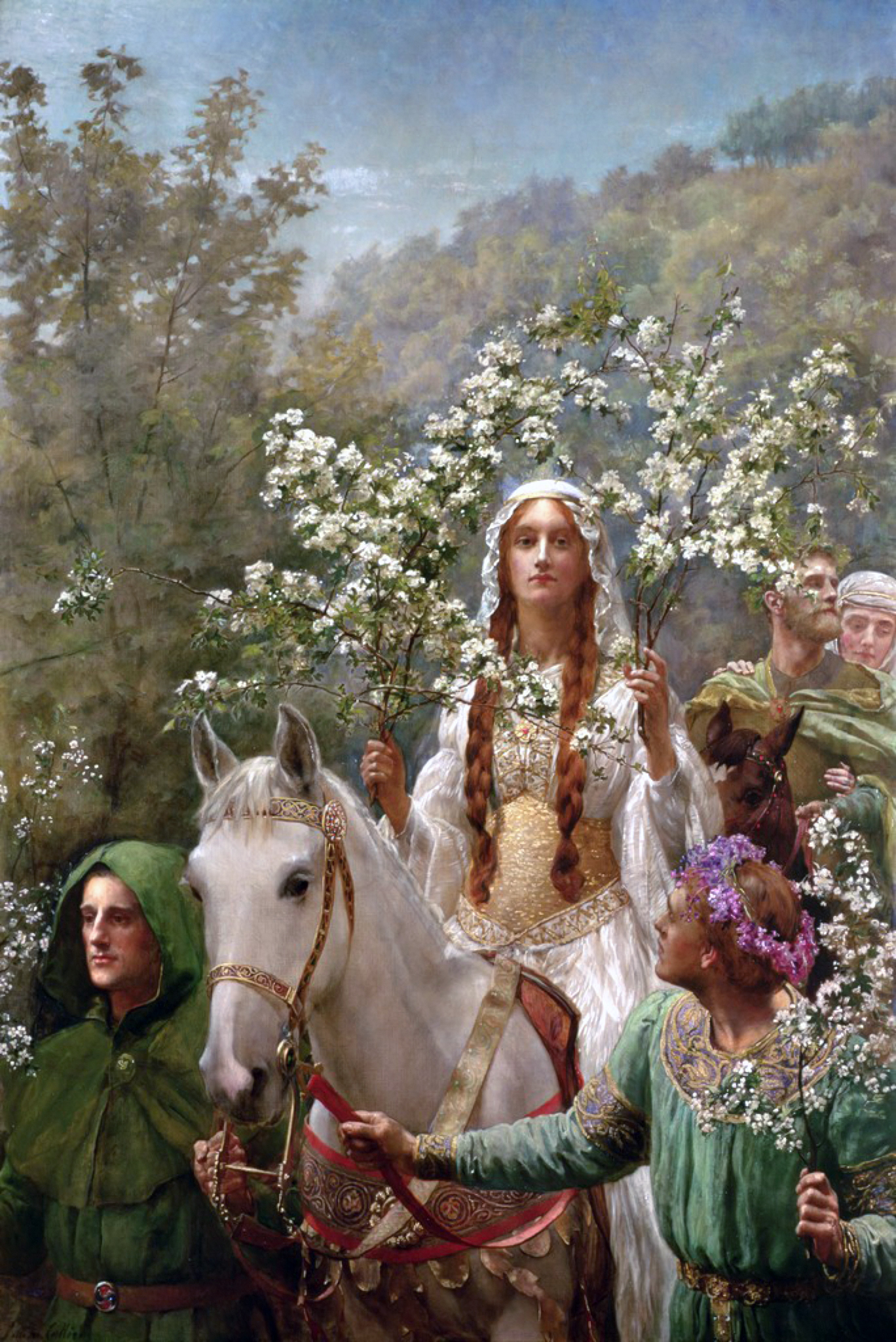
The image above is John Collier’s Queen Guinevre’s Maying (1900) sourced from Wikimedia Commons.

Betrayal

MBDJUCA EC066

While betrayal comes in many forms, certainly among the very worst is the betrayal of a child by a parent. As a therapist, one hears perhaps too many of these stories for comfort. There are generic ones, where parents steal money or credit cards from their offspring; use up the college fund that a grandparent left the child; and perpetrate (or allow) verbal, physical, or sexual abuse. Then there are the very particular and peculiar ones that require some amount of invention, but still break the heart.

A few stories then, followed by an attempt to answer the question “Why?”

Take a set of parents who invested themselves in “surface” things — how they looked to others. They needed the right car, the right house in the right neighborhood, the right clothes, and the right friends. And so, when one of their children had a less than attractive nose, they required this youngster to have a “nose job.” The youth was OK with the nose that nature had delivered, but this wasn’t satisfactory to the parents.

You might say that the surgery benefited the youngster, but only on the surface. It delivered the message that the child’s opinion (the desire not to have the surgery) didn’t matter, that a frightening and unnecessary operation would be inflicted, and that the offspring was not good enough without a cosmetic overhaul. All of this negated whatever benefit accrued to looking more pleasing to the eye.

Another example. Two sisters. The younger was very bright, but not particularly attractive. The older one was gorgeous, but not so bright. What did the parents do? They referred to them in public as “the smart one” and “the pretty one.” Both compliments, it’s true, but so ingeniously fashioned and used that the real message to the younger one was “You are ugly” and to the older one “You are stupid.” Devastating.

Or the parents whose oldest child committed suicide by using a handgun that had been given him by his father. After the funeral the father gave the gun to the brother next-in-line. Next-in-line for what? What was the unspoken message here?

How about the young man, a college student, disliked by his abusive father? This was back in the days before the voluntary army, back in the time of Vietnam and the draft. The father knew that his son needed to manage a full-time course load in order to keep his student deferment.

So what did the father do?

He required that his offspring pay rent to stay in the family home knowing that his kid couldn’t afford it, even though the money wasn’t essential to the upkeep of the residence. Ultimately the young man couldn’t manage his studies because of the job. He had to quit school and was drafted, then sent to S.E. Asia. His father never wrote him letters in those days before email and, in fact, sold all the son’s possessions including his car while he was overseas.

What was the message from father to son? I don’t want you to succeed? I don’t want you home? I don’t expect you to survive? I don’t want you to survive? Or all of the above?

Why do they do it? The parents, I mean. First off, we know that if you have been abused by your parents, you are more likely to abuse your children than those people who have not had this awful experience. In effect, you are at risk of becoming the thing that you hate, perhaps even rationalizing the brutal behavior of your dad or mom. “They did the best they could” is a common theme that adult children use as they reflect back on their parents’ approach to child rearing and try to minimize and normalize the mistreatment they received. Similarly, the words spoken by the abusive parent, “I’m only doing this for your own good,” often serve as a “cover” for less than benign intentions.

Children who are being abused have little recourse but to put a good face on their parents’ behavior. To realize that one’s parents are vicious or frankly deranged leaves a child desperate and hopeless. If, on the other hand, the young one can find some reason to continue to admire the parent, he may find his home life at least slightly less terrifying.

Kids in this situation are desperate to find any signal of hope about the future. If they see their predicament for what it is, hope is dead. They are stuck and there is no place to go. It is therefore (in some sense) more comforting to believe that the reason for the mistreatment is their own fault, than to think that their elders are simply evil. If mom and dad are believed to be crazy or vicious, the child can only despair. On the other hand, if the young one believes that his behavior is somehow deserved, then by working to change himself he can at least imagine that he will win better treatment from his folks.

With no alternative family to which to compare his situation, the child has no model of parenting that is different, no clear standard that tells him that his parents are corrupt, at least until many years into the abuse at a time when he is older. If, in his effort to normalize the situation, the child does find something admirable about the parent, and perhaps even something good about that person’s behavior, he is more likely to emulate it later. Furthermore, in trying to obtain a sense of mastery over his life, kids will often experiment with the very behavior that has been perpetrated on them. That is, they may obtain satisfaction (as well as an outlet for their anger) by being brutal with others, who might be their siblings or their school mates.

One could go on about this subject for quite some time, but if you’d like a place to start exploring it, you might want to read For Your Own Good by Alice Miller. Miller looks at case histories of abuse, including some very controversial speculation about Adolph Hitler and what childhood experiences might have contributed to his sociopathy.

It is definitely worth your time and attention.

The image comes from the MGM movie, Julius Caesar. Casca, about to stab Caesar, is played by Edmond O’Brien and Caesar by Louis Calhern. The movie features Marlon Brando as Marc Antony and James Mason as Brutus.

War Requiem

http://news.bbc.co.uk/nol/shared/spl/hi/picture_gallery/07/magazine_faces_of_battle/img/3.jpg

War — the cost of war — seems worth consideration on the occasion of Memorial Day 2010. Perhaps you have seen the movie Brothers. It will be in the same spirit, I hope, that I reflect a bit on the cost that any war brings, however necessary it might be. I will do this by quoting two poems and directing you to some wonderful music using poetry as text.

World War I,  “a war to end all wars” according to President Woodrow Wilson, generated lots of verse. British poets, in particular, found the pity in wartime, and as Wilfred Owen wrote, “the poetry is in the pity.” Owen fought and wrote about fighting, as in a letter to his mother just after his arrival in France:

“I can see no excuse for deceiving you about these 4 days. I have suffered seventh hell.

I have not been at the front.

I have been in front of it.”

The 25 year-old Owen was to die in battle just one week before the armistice on November 11, 1918.

When Benjamin Britten, the pacifist English composer, was commissioned to write music in honor of the reconsecration of Coventry Cathedral in 1962 (which had been destroyed in World War II), it was Owen’s World War I poetry and the Latin Mass for the Dead to which he turned. The piece, for large orchestra (with the addition of a chamber orchestra), three vocal soloists, and chorus, alternately rages against and laments the ravages of wartime.

The War Requiem ends with the Owen poem Strange Meeting, sung at the première by an English tenor and a German baritone, no coincidence as England and Germany fought against each other in both World Wars.

In this poem (excerpted below), the narrator finds himself in the bomb shelter and sleeping quarters below the trenches of the enemy, “down some profound dull tunnel,” as part of a night raid where he encounters dead and dying soldiers. There, he and his enemy recognize their shared human bond:

…Then, as I probed them, one sprang up, and stared
With piteous recognition in fixed eyes,
Lifting distressful hands as if to bless.
And by his smile, I knew that sullen hall
By his dead smile I knew we stood in Hell

“Strange friend, ” I said, “here is no cause to mourn.”
“None,” said the other, “save the undone years, the hopelessness.
Whatever hope is yours, was my life also…
For by my glee might many men have laughed,
And of my weeping something had been left,
Which must die now. I mean the truth untold,
The pity of war, the pity war distilled.
Now men will go content with what we spoiled,
Or, discontent, boil bloody, and be spilled…

I am the enemy you killed, my friend.
I knew you in this dark: for so you frowned
Yesterday through me as you jabbed and killed.
I parried; but my hands were loath and cold.
Let us sleep now…”

The English language changed because of World War I. Phrases and references to the word “trench” became part of common parlance, as in the phrase “in the trenches” which still refers to working at a hard, grinding task; and even the phrase “trench foot,” which led back to a type of frost bite common in the muddy, cold, wet, and verminous condition of those dark places inhabited by the warriors.

Or, how about “trench fever,” a bacterial infection associated with the lice that bred there. The expression “No Man’s Land,” plays back to the space between the trenches — between you and the enemy trench — which could be a few hundred yards. It was the place belonging to “no man” or side in the conflict, and it was the place where no man could easily survive. So too, when one army decided to launch an attack on the other, they had to go “over the top” of the trench and into hostile fire.

But it was to a much earlier use of the trench in warfare that the poet Patrick Shaw-Stewart would refer.

Patrick Shaw-Stewart was born on 17 August 1888 in Wales, and fought as part of the British Expeditionary Force at Gallipoli on the Chersonese peninsula during World War I, not far from the site of the Trojan War.

Gallipoli was a disaster for the British. Shaw-Stewart was on three days leave from the front on the island of Imbros when he wrote the untitled poem that follows. It refers to the Trojan War as represented in The Iliad, so a little background is required to better understand it.

The war began soon after the Trojan prince Paris abducted Helen, the most beautiful woman in the world, but the wife of one of the Greek kings (Menelaus). The Greeks organized their own expeditionary force and followed Helen to Troy so they might retrieve her.

Many years into the conflict, Achilles, the greatest of the Greek warriors, stopped fighting because the leader of the Greeks (Agamemnon) had taken away Achilles’ concubine. Achilles’ rage and his decision not to fight is called “The Wrath of Achilles.” In addition, Achilles knew if he returned to battle he would not survive the war. Despite this, he resumed the fight and turned its tide, with the goddess Athena beside him, both shouting in a trumpet-like, horror-inducing scream to make the Trojans flee.

Achilles and Athena stood at the ditch in front of the wall built by the Greeks to protect their ships. Achilles’ head was surrounded by an aura of flame created by the goddess (to which the poet refers in the heart breaking last stanza), so better to terrify the Trojans, who panicked and ran away.

Shaw-Stewart tells his own Illiad-like war story from the standpoint of his temporary leave from fighting:

I saw a man this morning
Who did not wish to die
I ask, and cannot answer,
If otherwise wish I.

Fair broke the day this morning
Against the Dardanelles ;
The breeze blew soft, the morn’s cheeks
Were cold as cold sea-shells

But other shells are waiting
Across the Aegean sea,
Shrapnel and high explosive,
Shells and hells for me.

O hell of ships and cities,
Hell of men like me,
Fatal second Helen,
Why must I follow thee?

Achilles came to Troyland
And I to Chersonese :
He turned from wrath to battle,
And I from three days’ peace.

Was it so hard, Achilles,
So very hard to die?
Thou knewest and I know not-
So much the happier I.

I will go back this morning
From Imbros over the sea;
Stand in the trench, Achilles,
Flame-capped, and shout for me.

Much like Achilles, Patrick Shaw-Stewart survived the Gallipoli campaign, but not the war.

He was 29 at the time of his death.

Two Americas, But Not the Two You Think

http://upload.wikimedia.org/wikipedia/commons/thumb/6/6c/H1N1_USA_Map_by_confirmed_cases.svg/240px-H1N1_USA_Map_by_confirmed_cases.svg.pnghttp://upload.wikimedia.org/wikipedia/commons/thumb/c/ca/H1N1_USA_Map.svg/240px-H1N1_USA_Map.svg.png

Before his marital infidelity discredited him, John Edwards spoke eloquently about “two Americas.” He talked of differences between the health care, financial stability, education and housing available to these two different parts of our society.

But there is another American divide that has created two other Americas: on one side the fighting men and women in our armed services (along with their families) and the rest of us on the other.

If you are unhappy about the polarization of our society, look no further than the differences that have been institutionalized by the volunteer army. However much good was achieved by the decision to eliminate the military draft, surely the absence of shared sacrifice has contributed to the ease with which we take opposing positions to our fellow-citizens on matters that have to do with national security.

No longer does the USA pull together for the long haul in the way that was possible during World War II. In part, “the Good War” was good because enough people believed in the values for which the USA fought, knowing that their children, husbands, and brothers would defend those same values with their lives; and it was good because the people of this country (regardless of class) shared in the rationing of goods and the sheer terror of having their loved ones abroad and in harm’s way.

If a war is worth fighting, it should not have merit only because the children of other people are fighting it, even if they do so voluntarily.

These thoughts occurred to me as I listened (on CD) to the book Final Salute by Pulitzer Prize winning author Jim Sheeler. This book is about the officers who inform families that they have lost a loved one, and of the families who suffer the unspeakable pain of the death of a son, a husband, a wife, a brother, or a sister; a dad or a mom.

The book takes no sides on the question of the War in Iraq. Yes, you will hear occasional comments in support or opposition, but you will not think as much about these policy questions as about the human beings you meet along the way. Several families will become your acquaintances as well as the warriors — the Marines — who died serving our country. And you will also get to know Major Steve Beck, a Marine tasked to inform the families of their loss, the man who delivers a message nearly as shattering as the projectile that killed their loved one.

Major Beck and the Marines live by the creed that they shall leave no comrade behind. And, consistent with this value, Major Beck leaves no family behind, providing comfort and support long after the knock on their door that changes everything, that creates a “before and after” without end.

I wish I had the words to convey what is in this book. I don’t. But I can say that it is plainly written, eloquent in its simplicity, aching in its beauty, profound in its impact. It does not work to make melodrama of what is already poignant enough. Rest assured that you will think about war, any war, differently after reading or listening to Final Salute; unless, of course, you are a member of the “other America,” the one that fights the wars and sends its loved ones into conflict. If you belong to the bereft group within that group, then there is nothing contained in this book that you do not already know at a level too deep for words.

If you have lost just such a one as the young men portrayed in Final Salute, I can only give my condolences to you and your loved ones. It is thanks to the willingness of the few to serve on behalf of the many that the rest of us are safe.

We — those of us in the non-fighting America, those of us for whom the wars in Afghanistan and Iraq are abstractions — perhaps remain too comfortable, too detached from something of desperate importance: the work done far from home in our name by the children of other people. And too removed and distant from how these “best and brightest” of their families risk and sometimes give up everything they hold dear.

We need to remember that, for these families, the human cost never fully goes away.

They are out there, these inhabitants of “the other America.”

We walk by them unaware every day…

Kafka said that “a book is like an ax, to break the frozen sea within us.”

This is such a book.

The maps above are the work of Allstrak, courtesy of Wikimedia Commons.

Jerry, Raya, and the Shadow

http://upload.wikimedia.org/wikipedia/commons/1/14/Russia_stamp_no._583_-_In_memory_of_the_Holocaust_victims.jpg

Do you ever find yourself thinking of an old childhood friend? Someone you haven’t seen in an age?

My friend Jerry lived across the alley from me in Chicago’s West Rogers Park neighborhood.

If you grew up in the suburbs, you probably don’t know much about alleys. I met some of my best friends there, playing lots of softball in the narrow confines of cement bordered by an endless row of garages on each side. I learned to climb roofs to retrieve softballs that landed there and (like my friends) occasionally beat a hasty retreat when a line-drive shattered a garage door window.

Jerry wasn’t much of a softball player. He had dark brown hair combed straight back, handsome features, and a smile of devastating charm. His eyes could be impish and alive as he stood there in the shadow of one of the garages on a summer evening taking a drag on his cigarette, especially when he talked about something slightly naughty for a 12-year-old, like sex.

Or they could be sad and mournful, as if he knew something that none of the rest of us knew about.

His parents were Holocaust survivors.

He lived with them on the first floor of a two-flat building. He had a sister, I seem to recall. His aunt and her husband owned the upstairs flat. Jerry’s mom, a sweet woman who had likely once been very pretty, was always kind to me; but worn out, faded in appearance, weary, looking older than my mom, although they were probably about the same age.

Jerry’s father was short, with a bristly, full head of salt-and-pepper, almost angry hair. He was never mean, but there was a grim severity about him, a desperate seriousness. I never once saw him smile.

Jerry told me that his dad disapproved of him. Jerry’s relatively poor school work was the reason. I could never understand why Jerry didn’t do better at his studies. He could be witty and clever — he was certainly bright enough. But, he didn’t have much interest or heart for it, seemed not to try very hard, even was held back by a half-year, winding up in my eighth grade class despite the fact that he should already have been in high school.

I remember one conversation. Something about money. Jerry told me that his parents were pretty careful with their money and didn’t want him to spend it unwisely. But, he said, there was one exception. “They say that for food I can have as much money as I want — so I can buy it anytime I want.” Peculiar, I thought. Nice of them, I guessed. But, it stuck there in my mind, not fitting somehow, an inconsistency that I couldn’t fully understand.

My friendship with Jerry dropped away in high school. He continued to struggle in school and we both gravitated toward other people. I don’t think he graduated, but I heard that he eventually got his GED (high school equivalency degree).

When I was in college or graduate school I ran into him on the bus. We had one of those semi-awkward reunions, catching up on our lives, not having much more than that to say. Jerry was then a hair dresser. And, I suspect, a good one, since he always had an artistic flair.

I met Raya in college. She was tall and very pretty, with wavy, long brown hair. Her form was willowy, and she moved with the grace of a dancer, as if trying, in her fluid motion, not to disturb the air. Raya spoke with an accented English, having come to this country with her parents from Israel only a few years before.

It was hard not to find Raya attractive, but she was very quiet and conversations were always a struggle. I find that curious in looking back, because you’d think that I would have asked her tons of questions about her life in Israel and how it was different than Chicago.

Maybe I did.

Nonetheless, Raya and I went on two or three dates. I remember the first one, driving to her home to pick her up and meeting her father there. He reminded me of Jerry’s dad: a very strong and dark presence, grave, serious, not to be trifled with.

At the time, I probably wrote that off to the protective relationship between a father and a daughter. As I said at my youngest’s wedding, the job of being a father to a beautiful daughter is not an easy one. You spend a lot of time thinking unkind thoughts about little boys, wondering what plots they might be hatching to ensnare your female child!

In any case, Raya and I went to a movie that evening, the highly rated The Pawn Broker starring Rod Steiger. I didn’t know anything about it, just that it was the movie on everyone’s lips. I don’t think Raya knew much about it either.

It turned out to concern a man, played by Steiger, who lost his family in the Holocaust, later becoming a pawn broker in Spanish Harlem; and especially about his relationship with a young Hispanic man who works for him, and a social worker who attempts to draw him back into the world from the dark, shadowy place into which he retreated after his wartime experience.

It was not long into the film before I noticed that Raya was quietly weeping. I asked her if she was OK, but she tried to minimize her upset. And when the movie was over, she told me that her parents were concentration camp survivors.

Now, you’d think I would have been more careful about this, about what exactly the movie was about and who exactly was this pretty girl underneath her surface beauty and grace.

But, to my discredit, I hadn’t been.

Apparently, Raya didn’t hold this against me particularly, because we went out one or two other times. But, as I said, it was difficult to generate conversation and we parted in a not-unfriendly way. Perhaps there were things too deep for words, things that one simply couldn’t talk about on a “date” with someone you hardly knew.

It might be of interest to you to know that the word “Holocaust” was not immediately applied to the genocidal murder of six million Jews by the Nazis during World War II. In fact, if you watch the old 1959 Alfred Hitchcock movie North by Northwest, you will see in the scene just following Cary Grant’s narrow escape in a corn field, a prominent newspaper headline using the word “holocaust” to describe the explosion of an oil truck when it collided with a low flying airplane.

These days, that word is rarely applied to anything except the European Jewish experience of the 1930s and 1940s.

Today, April 12, 2010, is Holocaust Remembrance Day.

Back in the time that I was in high school, the 1960s, virtually no reference was made to these events. One simply did not talk about them in any great depth and it was not the subject of special study or attention in class. In fact, this failure to mention it was particularly true of the homes of most of the survivors. But, the children of these unfortunate people, mostly about my age, came to know enough about what happened to their parents to give them special consideration, and to try to protect them and compensate them for what they lost in the European tragedy.

It was a heavy burden for the generation just behind the survivors, one written about for the first time by Helen Epstein in the classic book, Children of the Holocaust. For everyone else among Jewish children of the time, the shadow of the event was there, even without a name. Simply the idea that but for the accident of time and  place — had you been born just a few years earlier in Europe — you would have almost certainly been a human target in a deadly game, along with everyone else you loved.

Long after my relationships with Jerry and Raya ended, I was reading a book by a French Holocaust survivor in which he described his return to Paris. It was within a few months of his homecoming. The man was on the subway, close to two teenage girls who were talking together. He heard one say how hungry she was; “I’m starving,” she said.

The survivor knew the words, understood the meaning, and thought to himself, “I have no idea what she is talking about.” Put another way, this man knew “starvation” to mean the severe malnourishment that he experienced in a concentration camp, not the colloquial, everyday meaning that the girl was giving it, an expression he might have used himself in the time before the war.

When I read that passage, I flashed back to my conversation with Jerry, the one when he told me a bit about his parents’ exception to their usual cautiousness with money: “They say that for food I can have as much money as I want — so I can buy it anytime I want.”

And then, I understood just a little bit, what they must have meant.

I wonder where they are now, Jerry and Raya.

I wonder who they are now.

It would be nice to know.

The image above is Russian Stamp No. 583 created by Russian Post, Beylin V., painter. It is sourced from Wikimedia Commons.

The Stress of Everyday Life

http://upload.wikimedia.org/wikipedia/commons/thumb/b/b8/Tension_belt.jpg/500px-Tension_belt.jpg

Much ink and electronically generated language have been expended commenting on the oppressive and stressful nature of everyday life. We are expected to move too fast, produce instant answers to complex problems, and respond with a fax or an e-mail or a text on the spot.

Many of us travel long distances just to get to work. We hardly know our neighbors and, even if we do, don’t have the time to talk to them. Each of us has his own individualized shipping container (called a car), further separating us from each other. We relate to gadgets more than to people — voice mail and snail mail need answering, internet sites demand surfing, our phones are always on and in our pockets — even vacations don’t place us out of reach of urgent demands and obligations.

Teacher conferences require our attendance, our children plead for our time and homework help. The house needs minding, the lawn needs mowing — there is never any rest.

Witness this commentary:

I cannot help but regret that I did not live fifty or a hundred years sooner. Life is too full in these times to be comprehensible. We know too many cities to be able to grow into any of them, and our arrivals and departures are no longer matters for emotional debauches — they are too common. Similarly, we have too many friends to have any friendships, too many books to know any of them well; and the quality of our impressions gives way to the quantity, so that life begins to seem like a movie, with hundreds of kaleidoscopic scenes flashing on and off our field of perception — gone before we have time to consider them.

I should like to have lived in the days when a visit was a matter of months, when political and social problems were regarded from simple standpoints called “liberal” and “conservative,” when foreign countries were still foreign, when a vast part of the world always bore the glamour of the great unknown, when there were still wars worth fighting and gods worth worshipping.

These words were written by George Kennan, a Pulitzer Prize winning author, diplomat, and scholar.

Yesterday, you ask?

No.

They were written 83 years ago in his journal, on December 20, 1927 when he was 23.

They can be found in his book, Sketches From a Life, published by Pantheon.

The above image is Tension Belt by LeonWeber, sourced from Wikimedia Commons.

Jackie Robinson, Ford Frick, and the National Health Reform Debate

http://blogs.dallasobserver.com/sportatorium/Jackie%20Robinson.jpg

With even one eye shut and one ear covered it would have been hard to miss all of the acrimony expressed by and toward our elected representatives in recent days. And, some are saying, that this is unprecedented—this loss of civility, this frank hatred, including acts of vandalism and threats of murder.

Many are decrying the failure of some Republican politicians to rebuke the hate-mongers in an unconditional and decisive fashion, as Republican Representative John Boehner has: “I know many Americans are angry over this health insurance bill, and that Washington Democrats just aren’t listening. But, as I’ve said, violence and threats are unacceptable. That’s not the American way. We need to take that anger and channel it into positive change.”

Well, unfortunately, angry words and angry actions are really nothing new in “The Land of the Free and the Home of the Brave.” You will find them on both the political left and the political right within living memory: the violent “Weather Underground” of the Vietnam War era, The Black Panthers, the lynchings of blacks in the period between the end of the Civil War and the passage of Civil Rights legislation, the hate crimes against gays, the gauntlet of verbal abuse shouted at black children trying to integrate the schools of Mississippi and Alabama in the mid-20th century, the bombing of abortion clinics; the Oklahoma City bombing; the assassinations of JFK, Martin Luther King, and Robert Kennedy; and on and on.

But, every so often in the midst of all this angst—this stuff that makes one despair about the human condition—someone stands up and does something remarkable; something that makes you proud to be an American, and hopeful about the future of the human race.

Turn the page of your history book back to 1947 and to Jackie Robinson of the Brooklyn Dodgers, the first black man permitted to play in the Major Leagues in the 20th century. What follows is heavily dependent upon (and quotes from) Jules Tygiel’s Baseball’s Great Experiment: Jackie Robinson and His Legacy.

Robinson faced a revolt by some of his own teammates who attempted to organize a petition against him. Kentucky-born Pee Wee Reese, who was to become a great friend and supporter of Robinson, later remembered, “In the park that I grew up in, there were no blacks allowed. Blacks got in the back of the buses, they had a special fountain to drink from. I don’t guess that I ever shook the hand of a black person.” Reese expected Robinson to fail because white people in his part of the country always believed that Negroes had no guts.

“You hear this all your life, you believe it.”

The petition died aborning because most of the players would have no part of it, and because of threats from management. But the bigoted sentiments were still there for Robinson to deal with. His teammate Kirby Higbe was asked on a radio interview how he’d come by such a strong arm. His answer? From pelting Negroes with rocks.

Dodger manager Leo Durocher laid down the law: “I don’t care if a guy is yellow or black, of if he has stripes like a f___in’ zebra. I’m the manager of this team and I say he plays.”

The Philadelphia Phillies were the worst of the race-baiters. Led by Alabaman Ben Chapman, the Phillies showered unspeakable derision on Robinson in their first series with the Dodgers early in the 1947 season.

According to Harold Parrott, “At no time in my life have I heard racial venom and dugout abuse to match the abuse that Ben sprayed on Robinson that night. Chapman mentioned everything from thick lips to the supposed extra-thick Negro skull…(and) the repulsive sores and diseases he said Robinson’s teammates would become infected with if they touched the towels or combs he used.”

Chapman knew that Robinson couldn’t fight back because of the disruption that would cause, the very thing that many predicted and used as an excuse to defend the segregation of the Major Leagues. Everyone soon came to know that Robinson, who received varsity letters in four sports at UCLA, was a sitting duck. “Plenty of times I wanted to haul off when somebody insulted me for the color of my skin,” Robinson later said. “But I had to hold to myself. I knew I was kind of an experiment…The whole thing was bigger than me.”

One teammate thought that Robinson, the sole black on the field, was the loneliest man he had ever seen. Red Barber, the Dodger’s radio announcer, said that Robinson was the only man he had ever seen who could actually play better when he was angry.

The death threats flooded in—the people who wrote that they would be carrying a rifle into the ball park to kill him. Opponents tried to spike him, pitchers threw at his head and body. Even his Southern teammates received hate-mail for allowing themselves to take the field with a “n____r.”

But Robinson’s teammates stood up to Ben Chapman and the Phillies. Fellow Alabaman Eddie Stanky called Chapman a coward. Meanwhile the St. Louis Cardinals baseball team plotted a May strike against Robinson and the Dodgers. Ford Frick, the National Baseball League President, quashed the strike and faced down the Cardinals:

If you do this you will be suspended from the League. You will find that the friends you think you have in the press box will not support you, that you will be outcasts. I do not care if half the league strikes. Those who do it will encounter strict retribution. They will be suspended, and I don’t care if it wrecks the National League for five years. This is the United States of America, and one citizen has as much right to play as another.

The National League will go down the line with Robinson whatever the consequence. You will find that if you go through with your intention that you will have been guilty of madness.

As I said earlier, we have been here before, in this dark place in America that seems to surface especially in difficult economic times or in times of change, of which we have both just now. America is changing today, just as it was changing in 1947, and that metamorphosis brings out the worst in some of us. But the courage of people like Jackie Robinson, and the decisive confrontation of unfairness by people like Ford Frick, are heartening.

At the 1948 Democratic National Convention, Senator Hubert H. Humphrey made an impassioned speech in advocacy of a strong civil rights plank that failed to become a part of the Democratic Party’s platform in that year’s election. His words are worth remembering, as he recalled the founding of the nation in 1776:

To those who say, ‘we are rushing this issue of civil rights,’ I say we are 172 years late. To those who say, ‘this issue of civil rights is an infringement on states rights,’ I say that the time has arrived for the Democratic party to get out of the shadow of state’s rights and walk forthrightly into the bright sunshine of human rights.

Eventually most of Robinson’s skeptical teammates and competitors came to think differently and act differently than they had, at least to the point of accepting that blacks had as much right to play the “Great American Pastime” as they did. Still, the animosity did not end immediately.

As noted by Stuart Miller in the April 25, 2010 New York Times, Robinson continued to be the target of pitched balls in those days before batting helmets. In his first eights seasons he was lower than third in HBP (Hit By Pitches) only once. Moreover, the handful of blacks then in the National League—people like Monte Irvin, Sam Jethroe, George Crowe, Billy Bruton, Ernie Banks, and Hank Thompson—were similarly treated. In the American League, Larry Doby, Luke Easter, and Minnie Minoso found it no different.

Time passed, the hard-line bigots left the game, and others who were more open and less shocked and offended by integration took over the field of play. When Ernie Banks joined the Chicago Cubs in 1953, management saw to it that he join the club at the same time as (and roomed with) Gene Baker, so as to avoid the issue of having one black man and one white man live together.

It took 10 years from the time of Robinson’s debut for the Philadelphia Phillies to allow a black man into a Major League uniform, with the Detroit Tigers behind them. The last to integrate was the Boston Red Sox squad in mid-1959.

Along the way America changed too, for the better. And one must believe that the voices of the fulminating, frustrated few on the political landscape today will eventually be replaced by those who are less self-righteous and more in control of their emotions.

As a therapist it is impossible to do my work without believing that people can change.

It doesn’t always happen, of course.

But it happens more than enough to keep pitching.