The Stress of Everday Life Redux

http://upload.wikimedia.org/wikipedia/commons/thumb/b/b8/Tension_belt.jpg/500px-Tension_belt.jpg

Much ink and electronically generated language have been expended commenting on the oppressive and stressful nature of everyday life. We are expected to move too fast, produce instant answers to complex problems, and respond with a fax or an e-mail or a text on the spot.

Many of us travel long distances just to get to work. We hardly know our neighbors and, even if we do, don’t have the time to talk to them. Each of us has his own individualized shipping container (called a car), further separating us from each other.

We relate to gadgets more than to people — voice mail and snail mail need answering, internet sites demand surfing, our phones are always on and in our pockets — even vacations don’t place us out of reach of urgent demands and obligations.

Teacher conferences require our attendance. Our children plead for our time and a car ride to assist them in their own over-scheduled lives, already buckling under the demands of metropolitan living. The house needs minding, the lawn needs mowing — there is never any rest.

We have gone from a time 50 years ago when only doctors were “on call” to one where 12-year-olds can be electronically summoned at any moment. The machines we built to assist us have started to take us over, like the “Cylons” in the science fiction future of Battlestar Galactica.

http://upload.wikimedia.org/wikipedia/commons/a/a5/Cylon_Centurion_head.jpg

Witness this commentary:

I cannot help but regret that I did not live fifty or a hundred years sooner. Life is too full in these times to be comprehensible. We know too many cities to be able to grow into any of them, and our arrivals and departures are no longer matters for emotional debauches — they are too common. Similarly, we have too many friends to have any friendships, too many books to know any of them well; and the quality of our impressions gives way to the quantity, so that life begins to seem like a movie, with hundreds of kaleidoscopic scenes flashing on and off our field of perception — gone before we have time to consider them.

I should like to have lived in the days when a visit was a matter of months, when political and social problems were regarded from simple standpoints called “liberal” and “conservative,” when foreign countries were still foreign, when a vast part of the world always bore the glamour of the great unknown, when there were still wars worth fighting and gods worth worshipping.

These words were written by George Kennan, a Pulitzer Prize winning author, diplomat, and scholar.

Yesterday, you ask?

No.

They were written 85 years ago in his journal, on December 20, 1927 when he was 23. They can be found in his book, Sketches From a Life, published by Pantheon.

The top image is Tension Belt by LeonWeber. The lower photo is the head of a Cylon Centurion by ckroberts61. Both are sourced from Wikimedia Commons. This essay is a slightly revised version of one I posted a couple of years ago.

Beware of Therapy Past Mid-life: Reflections on Reading “The Sense of an Ending”

http://upload.wikimedia.org/wikipedia/commons/thumb/e/e3/Hamo_Thornycroft-Lot%27s_Wife.jpg/240px-Hamo_Thornycroft-Lot%27s_Wife.jpg

“Don’t look back, something might be gaining on you.” Satchel Paige’s words suggest that life should be lived “full steam ahead,” not weighed down by regular retrospection. Most people take the advice to heart, at least to some extent, even if having never read it or heard it.

And, past age 60, my experience as a therapist suggests that such reconsideration of one’s own history becomes less and less likely. Unless tragedy strikes, a senior citizen who is a therapy virgin is not likely to seek the counselor’s services. No, the story that we tell ourselves about our life usually becomes fixed and — one must say it — self-serving, so that one does not become overwhelmed by remorse and the things that “should have” (or should not have) been done: the failed persistence, poor choices, and chances not taken; the damage done to others, including our children, our lovers, and our friends.

It is as if our old brain knows what our young brain couldn’t imagine: that there will come a time when there is not enough of a future to redeem the past.

We are, most of us, pretty well rationalized.

Yet this is what Julian Barnes’s prize-winning book The Sense of an Ending is about: the reflection upon and reevaluation of a life of 60-some years, by the author of that life, Barnes’s fictional narrator Tony Webster. And, if you are inclined to such self-analysis or even the common speculation about why people in your life do what they do, you might just find it the best work of fiction that you’ve read in a long time.

On the face of it, the story appears to be a simple one: a tale about pre-college friends including Tony, and his relationship with his first serious girlfriend; then losing touch with all those people, one of whom suffers tragedy. Finally, a jump of 40 years and the reinterpretation of that tragedy and those relationships, as well as his second-thoughts about himself. All of this occurs because of an apparently inexplicable event that disrupts Webster’s “peaceable” way of being.

Until that new monkey-wrench is thrown into the works, Tony thought he’d “wanted life not to bother me too much, and had succeeded.” Somehow he’d trod a course that set aside youthful ambitions and hope for excitement, settling for things (and women) that were predictable and straight-lined. Eventually, he will realize that “We thought we were being mature when we were only being safe. We imagined we were being responsible but were only being cowardly. What we called realism turned out to be a way of avoiding things rather than facing them.”

What he must now face — the way in which long-ago actions have continued to have consequences — is the mystery that Tony (and the reader along with him) will soon come to know.

The book raises a number of issues:

  • How much can you trust your own memory?
  • How much of your memory is selective and comforting?
  • How much are you responsible for what happens to you in your life?
  • How much are your actions responsible for what happens to others?
  • Past what point is self-reflection destructive or, to paraphrase a Jack Nicholson character, “Can you handle the truth?” assuming that it is knowable?
  • How much damage to others do even the most careful of us cause?
  • Is it possible to be completely honest with oneself?

Most of the time one does want to — need to — think that “I am the master of my fate: I am the captain of my soul.” The world would be too scary otherwise.

A simple example illustrates the complexity here:

In graduate school a friend requested me to help his girlfriend move some things from one apartment to another. Although I owned a car, I took the rapid transit and got off at the wrong subway stop, one station away from where I should have been. I didn’t realize until I walked a bit that it was in a terrible neighborhood. In the event, I arrived at my destination safely on foot.

But instead, you could have read this story on the next day’s front page:

Northwestern Graduate Student Murdered Near Cabrini-Green Housing Project

That no one did has always seemed to me a matter of pure luck.

What if I hadn’t been so lucky? Others would ask themselves, how did this happen? Doubtless, my friend would have found out; his girlfriend, too. Would they have felt guilty? Neither intended to set the chain of events in motion, yet both were a part of that chain.

As Tony Webster would say, “There is accumulation.” One thing leads to another.

Why didn’t I drive? Even I can no longer answer this question; I simply have no recollection of how I came to the decision to take the subway. Was it to save money? Was it because I thought it would be difficult to find parking? Was my car in the repair shop?

And why didn’t I walk back to the subway stop soon after I got off the train, the better to go to the next station? Shouldn’t I have been more aware of my surroundings and a little more terrified? Was I too cheap to pay another fare? And if I was, to what extent was that based on how I’d been raised, lessons learned at home about the dearness of the dollar? And if that is so, do my parents have some responsibility in the chain of events?

The example I’ve just given you might seem a bit silly, but I assure you that Barnes’s protagonist confronts a set of events that are much more compelling, involving real events and relationship complications, not things that didn’t happen, as in my illustration. But in both instances, one can ask oneself many questions: Why did I do that? What if I’d not done that? What if I’d done something different?

On the answers to these questions — really, on the actions themselves — lives can depend; at least the quality of a life.

http://upload.wikimedia.org/wikipedia/commons/thumb/c/ce/Flickr_-_don_macauley_-_Hamo_Thornycroft-Lots_Wife.jpg/500px-Flickr_-_don_macauley_-_Hamo_Thornycroft-Lots_Wife.jpg

The Sense of an Ending reminded me a bit of John Irving’s A Prayer for Owen Meany. In each novel the author gives you enough information to put you in the position of an important character in the book, forcing you to live with the same incomplete knowledge that the character has of how things will end up. In Barnes’s work, this will likely cause you to want to reread the book, just as Tony Webster attempts to reread his life through letters and photos, the incomplete testimony of others, and his own imperfect and self-justifying memory. But at 163 pages, the rereading is just as engrossing as the first read-through (for me, just one day earlier).

If you believe that, in Kafka’s words, “a book should be an ax to break the frozen sea within us,” then know that this is such a book.

All of us are, or could be, like Tony or Lot’s wife, from the tale of Sodom and Gomorrah. Lot is the nephew of Abraham in the biblical Book of Genesis. Lot and his wife are permitted to leave before God’s destruction of the two famously iniquitous cities, but there is a catch. They are instructed by angels not to look back. When Lot’s wife does, she is turned into a pillar of salt.

Yet we must look back, mustn’t we? At least some of the time? Isn’t that how we learn? As a therapist, I would certainly say so.

But the biblical rejoinder comes to mind from Ecclesiastes 1:18:

For in much wisdom is much vexation, and he who increases knowledge increases sorrow.

Or in the words of Tony at the book’s end:

There is accumulation. There is responsibility. And beyond these, there is unrest. There is great unrest.

————————————————————————————————————————————————————————————————————————————————————————————————

The positive aspect of looking back can be found here: The Handwriting on the Wall.

The two images are photos of Hamo Thornycroft’s sculpture Lot’s Wife. The first is the work of Yair Haklai. The second is the uploaded photo of Donald Macauley by Amada 44. Both are sourced from Wikimedia Commons.

“You Should Always Have Enough ‘F**k You’ Money:” Relationship Power in Politics and Life

http://upload.wikimedia.org/wikipedia/commons/thumb/a/a5/David_Frost_Rumsfeld_interview.jpg/500px-David_Frost_Rumsfeld_interview.jpg

My apologies for the profane title. There is just no delicate way to get this idea across, as the musician Larry Adler knew when he first wrote it.

What he was trying to say was, unless you are able to do what you want despite the personal or financial cost, you really don’t have as much power as you might think.

More about Mr. Adler later.

But for now, take a look at the above 2005 photo of journalist David Frost (on the left) and Donald Rumsfeld, then U.S. Secretary of Defense, as an example of what Adler was talking about. I imagine you can guess who is in control of this interview — who has the power.

In order to be successful, a reporter must have access to the people who make the news. And, if politicians find you to be too aggressive in your questioning, they will go elsewhere. In this relationship, the politician usually has more power.

This tells us why so many TV political reporters seem incapable of pursuing answers to the tough questions that need to be put to politicians; indeed, why the tough questions often go unasked.

The truth is, they are not incapable, they are simply unwilling and hesitant. Afraid of being cut off from access.

Why? Because unlike the politician they wish to interview, they cannot go elsewhere to tell their story. That gives the politician more power.

Power also explains much else about relationships; that is, who is in charge, regardless of who might appear to have the upper hand.

I’ll get to your relationships later in this post.

But first let me address the connection between politicians and members of the news media in greater depth.

Understanding this might help you understand your own life.

Let’s start with a few premises. Most TV and radio interviewers are not well-known. Their ability to obtain interviews with the most prominent people in the world depends on the good will of those people. And, there are many, many more interviewers than there are people in positions of power.

So let’s say that you’re a low-level reporter, a man of small reputation, who wants to talk with a congressman on TV. You start by asking a question and get in response the politician’s well-rehearsed talking points on the subject, which are not likely to precisely address the query.

Perhaps the politician says, “The American people want X.” Do you challenge this? Do you say, “Well, Congressman, according to the last five polls we have on this subject, the American people actually don’t appear to want X. Not even close. Why do you persist in saying that they do in spite of the data?”

No, not likely, not usually.

Why not?

As I’ve implied above, the reporters need the public servants much more than the public servants need the reporters. Since there are many more interviewers (and news outlets) desiring the time of the elected official, the latter can avoid an unfriendly interrogator. He can go elsewhere with his talking points, to a place where he will receive a less challenging reception.

Put simply, we are dealing with supply and demand.

Because of a surplus of TV, radio, and internet news sources, the terms of engagement will usually be dictated by the man who is in demand, not the relatively anonymous reporter who can always be replaced by someone in the long line of other aspiring journalists. Only the best known, most popular or well-respected members of the press are in a position to do their jobs thoroughly and well: to ask the tough questions, get them answered, and forcefully challenge self-serving untruths.

If, however, you are the aforementioned anonymous reporter who actually tries to do his job, relentlessly challenging falsehoods and the efforts of elected officials to change the subject, you lose access to them.  Without “newsmakers” to be interviewed, your show’s sponsors abandon you and your boss fires you. And so, to avoid this outcome, you may surrender a bit of your integrity and permit answers that are unresponsive to your questions, while ignoring those comments that are disingenuous, preposterous, misleading, or frank lies.

The independence of the reporter and the politician is only apparent. It doesn’t reflect their real interdependence, with the “pol” most often holding the reins, able to direct the conversation as he wishes; answer what he wants in the way he wants and ignore the rest.

This sort of thing doesn’t stop with political reporting.

http://upload.wikimedia.org/wikipedia/commons/thumb/3/30/CNBC_Fast_Money_team.jpg/500px-CNBC_Fast_Money_team.jpg

If you watch CNBC for moment-by-moment financial news, expect drama over sobriety; expect red-faced intensity to match the gyrations of the changing numbers on the screen. So-called authorities are given a platform for economic analysis, typically without a serious challenge to the limited understanding anyone has of the financial markets.

The show specializes in overly simple economic opinions and predictions offered by “experts,” who provide only brief justification for their statements. Nearly all of the talking-heads who offer that advice seem equally certain about what they are saying, even if their positions are diametrically opposed. Unfortunately, the audience, made up of average investors, will find the underlying issues far too complex and insufficiently elucidated to do much more than pick one of the speakers who “sounds good” and hope that his judgment is right.

Why is this permitted to happen?

Although the reporters do appear to be bright, well-educated people, their first job is to make sure we watch them — nothing more noble or enlightening than that; certainly the goal of helping us understand what is important about financial events is lower on their list of priorities.

As a result, CNBC does what is necessary to make drama out of financial happenings, hoping that you will stay tuned in. It treats the ups and downs of the stock market as big news, even when that news is very temporary and of little or no lasting importance. Large moves up on the Dow Jones Industrial Average can be received as if “Happy Days are Here Again,” while down-days are made to seem as if the sky is falling.

If your investments appear to be tanking, I wouldn’t call on one of these people to talk you off the ledge (as in the case of the rather stiff creature just below, who looks as if she has been watching CNBC too much recently).

http://upload.wikimedia.org/wikipedia/commons/thumb/1/19/Heurich_Mausoleum_by_Louis_Amateis_%28ca._1895%29_Control_IAS_76004848_frontleft.jpg/500px-Heurich_Mausoleum_by_Louis_Amateis_%28ca._1895%29_Control_IAS_76004848_frontleft.jpg

Sensation-producing guest commentators are often featured over those who are inclined to say “this too shall pass” or “I don’t really think anyone can explain movements in the financial markets on a day-to-day basis.” The latter message is problematic for CNBC not only because it is boring, but because it defeats the show’s premise: that your stock portfolio will benefit if you regularly watch and learn from the program, despite the stomach acid created by its over-dramatized, hyperbolic presentation of financial commentary.

Rarely is anyone on CNBC permitted a really detailed and lengthy defense of his predictions about upcoming commercial trends. That would be too much like taking a course in economics, famously called “the dismal science.” But a thorough and complex look into the crystal ball at fiscal “Tomorrow Land” is surely required given the historic failure of financial analysts to create an accepted and accurate method of doing this.

Program hosts really don’t want to offend by pointing out the limits to economic future-casts, so statements by guests are rarely aggressively challenged, although some of the regular CNBC presenters are quite happy to argue with each other, since fights just might attract more viewers.

But even worse, a guest commentator is not required to provide a performance record of his accuracy in predicting the future of the financial markets, in the way that a baseball player’s hits, runs, and errors might point to a player’s value to the team.

I find the absence of that kind of score card quite remarkable. Financial analysis and advice is a business that focuses entirely on numbers. Yet the reporters infrequently track the predictions made by those same guest commentators. Such data might, after all, result in some pretty embarrassing questions like “Gee, four months ago you were certain of X, now you are saying you are certain of Y and over the past three years your predictions have been correct only 31% of the time, so why should we believe you now?”

As Burton Malkiel notes in his classic book on investment, A Random Walk Down Wall Street, the great majority of investment managers do not do as well in choosing profitable stocks for their clients as would a randomly chosen selection of similar equities. This fact, by the way, has stood the test of time and is part of known and accepted economic knowledge.

In other words, if the predictive failures of the experts were displayed on the TV screen, those consultants with a history of mediocre clairvoyance (which is most of them) wouldn’t come within a mile of CNBC or any similar media outlets. Given that the hosts don’t want their program to fail, they cannot easily say that “the emperor has no clothes.”

Don’t expect this to change any time soon.

They have given away that power in return for commercial success.

So what else are we talking about here, beyond the political and financial domains?

I believe that what I’ve written here about power in relationships applies just as well to the connections between leaders and followers, performers and their audience, the pastor and his flock. In all these relationships there are conditions in which the unseen power of one person or group will produce deference or capitulation from the other person or group, even when we’d think this shouldn’t be so.

Some of the most admired people sometimes fear that they will lose their audience. As a result, they become hostage to others’ opinions and betray their own better instincts by giving away their power to those same “others.”

I am reminded of a story told by Yehudi Menuhin regarding Pablo Casals in Menuhin’s book Unfinished Journey. Menuhin, a world-famous American violinist, was the first Jewish musician after World War II to play under the direction of Wilhelm Furtwängler, the most famous German conductor of his time. Furtwängler was a controversial figure because he had chosen to stay in Germany during the period of the Third Reich and was believed to have compromised himself by allowing his artistic talents to be used for propaganda purposes by the Nazi state. But he was never a member of the Nazi Party and helped save the lives of a number of Jewish musicians. In other words, a man with a complex history.

In 1947, already under heavy criticism for his musical contact with Furtwängler, Menuhin hoped to arrange a recording to be conducted by Furtwängler with the equally famous cellist Pablo Casals. Casals was then 71-years-old and revered for both musical and extra-musical reasons. He had refused to set foot in his Spanish homeland so long as Franco, the fascist dictator, remained in power there, and he publicly opposed Franco from his self-imposed exile in France.

http://upload.wikimedia.org/wikipedia/commons/thumb/8/85/Pau_Casals_centenary_statue.jpg/500px-Pau_Casals_centenary_statue.jpg

The stage was set: the musician Furtwängler, tainted (perhaps unfairly) by fascism and the musician Casals, hero to the anti-fascists. They had made music together of great beauty and refinement before Germany was ruled by Hitler and his gang. Could Menuhin bring these two men together now that the war was over?

http://upload.wikimedia.org/wikipedia/commons/thumb/f/f3/DBPB_1955_128_Wilhelm_Furtw%C3%A4ngler.jpg/500px-DBPB_1955_128_Wilhelm_Furtw%C3%A4ngler.jpg

Let Menuhin tell the story:

I asked Casals his opinion of Furtwängler… Furtwängler he admired, not only as a conductor but as a German: he had been right to stay in Germany and do what he could for music and musicians. Reassured, I suggested that I might try to arrange a recording of the Brahms Double Concerto to be made by Casals, Furtwängler and myself. He accepted in principle.

I made several attempts to pursue the matter (with the record company EMI; they) were interested.  For Furtwängler it would have been a most valuable accolade, given by the foremost antifascist musician; but all approaches were deflected by Casals — he would love to make the recording but couldn’t at the moment. Finally, some two summers later, after perhaps the third prodding, he sent me a letter which with disarming frankness betrayed the limits of his independence: he assured me that he personally had nothing against Furtwängler and could envisage few greater pleasures than playing with him, were it not for the fact that to do so might compromise his antifascist stance and dismay his followers. In other words, he was prepared to let me know he didn’t have the courage of his convictions; so long as those convictions were approved by his admirers, they were strong convictions indeed, but in other circumstances not strong enough to withstand guilt by association with a man wrongfully accused.

Now think back to those politicians I mentioned before — the ones who have their way with reporters who fail to strenuously cross-examine them; but by contrast, many of these “pols” go along with the “party line” of the people who are supposed to be on their side. I am talking about public officials who conform with servile adherence to tests of political purity maintained by some of their constituents, (for example, a pledge never to raise taxes on anyone regardless of circumstances, no matter how rich the person might be).

Such politicians can dictate interview terms with some of the journalists, but appear hostage (like Casals) to their “friends” and supporters, be they big business or labor unions or the people who fund their campaigns for reelection.

Look around you. Look at clergymen and their congregations, at wives and husbands, at parents and children, at employers and employees. And, look too, at you and your lover, if you happen to be unmarried. Figuring out who might have the upper hand (and why) is not always an easy thing. But if you cannot live without a certain person’s approval, you do not have as much leverage as it might otherwise appear. You are likely to give too much ground, too often.

Larry Adler, the twentieth century American harmonica virtuoso, very clearly saw the “power” element in human relationships at work in the period just after World War II. As a man who had been “blacklisted” for alleged Communist sympathies during the McCarthy era, he did not want to be anyone’s hostage, even at the cost of his livelihood. He spoke his mind publicly at a time when doing so was dangerous.

Although he was not a Communist, he believed that no one in a free country had a right to require him to take a loyalty oath or declare his political sympathies — in effect asking him how he would vote. In the midst of a political witch-hunt — at a time when many employers and concert-promoters demanded this kind of reassurance — his refusal resulted in the loss of his ability to get work, forcing a move to England simply to make a living.

The title quotation for this post comes from his autobiography, It Ain’t Necessarily So.

Just to reiterate:

You should always have enough ‘F**k you’ money.

You don’t have it unless you are willing to act on it; that is, unless you are prepared to refuse conditions imposed by someone else, even at great cost to yourself.

But it’s more than just about money, isn’t it?

If you love status, approval, applause, material things, the sexual attention of others (or money) more than who you are and what you stand for, you are in trouble, my friend.

And the person who figures this out will have power over you.

Powerful or powerless?

Most of us aren’t heroic.

Still, you must choose.

Indeed, you have already made the choice.

http://upload.wikimedia.org/wikipedia/commons/thumb/2/21/Larry_Adler%2C_City_center%2C_NYC%2C_January_1947_%28Gottlieb_00031%29.jpg/500px-Larry_Adler%2C_City_center%2C_NYC%2C_January_1947_%28Gottlieb_00031%29.jpg

The top image is David Frost (left) Interviewing Donald Rumsfeld on June 14, 2005, photo taken by Robert D. Ward. The second picture is of CNBC’s Fast Money Team until 2007 – 5 – 18. The statue on the ledge that follows comes from the Heurich Mausoleum by Louis Ameteis ca. 1895 and was photographed by Wikipedia Saves Public Art. The fourth image is a Centenary Statue of Pablo Casals at Montserrat, Spain taken by UserMdd4696. Just below it is a 1955 commemorative postage stamp of Wilhelm Furtwängler, scanned by NobbiP. Finally, a photo of Larry Adler taken at City Center in New York, ca. 1947 by William P. Gottlieb. All are sourced from Wikimedia Commons.

My Way or the Eternal Highway: The Business of Heaven

http://upload.wikimedia.org/wikipedia/commons/thumb/b/bb/Ascent_of_the_Blessed.jpg/500px-Ascent_of_the_Blessed.jpg

Does heaven exist and, if so, will your atheist brother get in?

This is the sort of question that bothers lots of the faithful. And a Christian pastor named Rob Bell has stirred the pot with Love Wins: A Book About Heaven, Hell and the Fate of Every Person Who Ever Lived.

I guess that would include you and me.

Apparently, what most bothers the more doctrinaire believers about Bell’s tome is that eventually everyone, even those who do not lead fully exemplary Christian lives, can be saved and go to heaven. In other words, “love wins” even for people whose beliefs don’t line up with those who go “by the (good) book” during their lifetime, even including the possibility of heavenly eternity for those of entirely different religions.

No more need to worry about that brother of yours, your mom or dad, or all those honorable people whose religious faith (or lack there of) is different from yours.

This would mean, of course, that there is no longer any need to convert others to your particular way of thinking and believing.

Look for the missionaries to be lining up at the unemployment office.

And it would also mean that you don’t really have to follow the letter of the law as it is written in the old religious document upon which you have been reliant. After all, you will get a chance to go to heaven anyway.

And then there are all the judgmental people who would have to stop passing judgment in earthly imitation of a “Last Judgment” that would no longer be exclusive.

And all the hellfire-and-brimstone preachers who keep Sunday morning TV crackling who would need to update their resumés; as would their cameramen.

Boy, the unemployment line is getting pretty long by now, isn’t it.

Seems like Pastor Bell’s point of view would mean trouble for those individuals whose livelihoods depend on getting even more people to look at the world (and the world beyond) in the same way that they do. After all, in the religious market place there are only so many souls who are interested enough in salvation to show up for worship on the sabbath. So, you’d better round-up whomever you can and get them to “buy-in.”

The cynical among us might just think that there could be a post-prison job for Bernie Madoff in this somewhere. Oh, wait, I forgot that Jimmy Swaggart and Jim Baker snapped up those jobs some time ago.

But before you line up at my office with a flaming torch in your hand, I do want to make something clear.

I’m not suggesting that all of those who want to save your soul are self-serving. I’m sure that the vast majority do so for the right reasons. But, where money is to be made, where churches and temples require repair and maintenance, where books and religious accessories are sold and salaries are paid, you do need to keep an eye open to motives less pure than your eternal reward.

Earthly rewards have a way of messing things up.

A 1951 movie comes to mind. The Man in the White Suit starred Alec Guinness as Sidney Stratton, a chemist and inventor who creates a virtually indestructible fabric that repels dirt. At first he is hailed as a genius and hero. Later, when clothing manufacturers and their employees realize that his invention will put them out of business, he is their target.

Heaven without a well-guarded gate and an earthly admission fee, like a white suit that will last forever, just might create some enemies. Apparently, Rob Bell has a few of those.

Then there is the question of what constitutes heaven. Several possibilities come to mind:

  • A heaven that every one eventually can reach even if they don’t make it on the first try — something like the “love wins” heaven of Pastor Bell. I would guess that such a heaven would be sort of like some grand family reunion, where all past grudges are forgiven, everyone gets along, and Aunt Edna’s fruitcake actually tastes good.
  • The standard-issue version of heaven where there is a judgment and there is a permanent hell for those who don’t pass the evaluation that happens at the end of life. In it, you (if you are anything like your current self) will miss your atheist brother who is in the “other place” for eternity because he screwed up the mere three score and seven years he had on earth — (under)grounded for life and then some. Moreover, if you care about what is going on with your brother while you are in a better place, you just might also be bothered by the troubling events on earth. None of that seems like much fun to me.
  • In the next possible conception of an afterlife, your brother still is in hell, but you don’t care; even though you loved him when you were alive. In other words, you have been transformed into a creature quite different from the one you were on earth, but you are having a grand time. Greek mythology anticipated this, by suggesting that the newly departed were required to drink from the river Lethe, whose waters caused them to forget their lives on earth.
  • The 1998 Japanese film After Life offers still another notion of a posthumous existence. Heaven would consist of living forever in whatever single moment you choose from your life history on earth. To live “in the moment” necessitates that you give up that part of yourself which, like all humans, allows you to look back and remember the past, as well as to look forward and anticipate the future. Experiencing whatever single event is most precious involves sensations and feelings of joy or delight attached only to that isolated slice of time rather than to thought, worry, reflection, or concentration on other things, even including other positive relationships, experiences, and events. With respect to the question of your brother mentioned earlier, unless he was involved in the single moment you choose to occupy for eternity, you’d simply never think about him.
  • Finally, there is the possibility that there is no heaven and no corresponding hell either.

Of course, it’s not as if I really know.

Do you?

The top image is Ascent of the Blessed ca. 1490 by Hieronymus Bosch, sourced from Wikimedia Commons.

Have You Had Your Daily Dose of Anger?

http://upload.wikimedia.org/wikipedia/commons/c/c1/Bigfuckyou.jpg

There is a test built into this essay, but not the kind you think.

There will be questions at the end, but they will make sense only if you read everything.

And even then, the questions are not the kind that allow for right or wrong answers.

Intrigued?

Read on.

In today’s bull’s-eye are teachers, unions, government workers, National Public Radio, and Washington politicians.

Yesterday it was bankers, stock brokers, deal-makers, hedge fund managers, and Wall Streeters in general.

It’s also been Obama for a while.

Anger doesn’t seem to be in short supply. And all these folks recently have been or continue to be convenient targets.

The argument pretty much goes like this: if only so-and-so (referring to an individual or group) were different, better, dead, living in another country, out of power, punished, making less money, or otherwise emasculated, then all the rest of us would be much better off.

They, the same so-and-sos, are the ones who are dragging us down, making the country worse, and so forth.

Of course, sometimes it’s true. But isn’t it interesting that even when the so-and-sos are disempowered, there are still just as many angry people around, looking for and finding another target?

Have you heard very many people deride BP (British Petroleum) lately? You know, the authors of that big Gulf of Mexico oil spill? No, the angry voices have moved on to other resentments.

Life is full of frustrations, a lack of control, and lots of unfairness. The highways are too full, the money we are paid too little, the bosses too demanding, the work too hard, the hours too long, the spouse uncooperative, and the kids are out of control.

Change alone can be frightening — enough to make a person angry — and, gosh knows, the country is certainly changing in ethnic and racial make-up, while the distance between rich and poor increases.

It did seem that people were quieter about their discontents a while back; certainly in the ’50s, not so much in the 1960s when the civil rights movement met the Vietnam War, and protests were all around.

http://upload.wikimedia.org/wikipedia/commons/d/d3/Vietnam_War_Protest_in_DC%2C_1967.gif

I’m told the ’30s were pretty tame in the USA, despite the fact that people were out of work in large numbers (25% unemployed), many more than today. An equivalent level of hardship in 2011 might well generate a revolution.

What accounts for the change from mid-twentieth century America to today? Perhaps the after-glow of a shared national effort (World War II) and the prosperity that followed it made for less sense of grievance. But that wouldn’t explain the modest level of ear-splitting rancor of the Great Depression years.

Others would point to a subsequent loss of faith in government due to corruption or incompetence that made it an easier target, going back as far as the Johnson administration’s escalation of US involvement in the Vietnam War, the Watergate scandal of the Nixon administration, or the nonexistent WMDs (weapons of mass destruction) we were told with certainty required the hurried invasion of Iraq.

Social critics would identify permissive child rearing which allowed children not only to be seen, but also heard and listened to, instead of “seen and not heard;” or the Freudian penchant for finding the roots of adult problems in one’s parents’ child-rearing practices (thus, shifting the blame from oneself to others who become the target of resentment).

Or perhaps it was the creation of a social safety-net that led people to believe that they were “entitled” to things they had not earned and encouraged them to “demand” more dollars out of other people’s pockets — which found those people not taking kindly to the idea and in some cases quite opposed to safety-nets in general; nor should we forget a legal profession ready to exact payment for real and perceived wrongs.

And some might point to public anger as the last vestige of the “Don’t Tread on Me” motto found on the Gadsden flag of Revolutionary War days, the thing that helped enable the colonists to fight the British. Surely, it was then a more than necessary evil.

But for whatever reason, among us are angry people who find lots of fault with others, less often than with themselves.

http://upload.wikimedia.org/wikipedia/commons/thumb/d/d8/Gadsden_flag.svg/240px-Gadsden_flag.svg.png

Few of the those most insistent that things be done their way seem to have read their history books; nor have they thought through the consequences of their actions down the road.

The notion that “IF IT FEELS RIGHT, IT IS RIGHT,” seems persuasive, until you realize that just the opposite position might feel just as right to someone else. And every self-righteous person always thinks as the WWII Germans did: “Gott mit uns” (God is with us).

The red-faced, clench-fisted, self-appointed defenders of all that is good and proper (as they see it) refuse to compromise on anything. Blustering assertion has replaced reasoned and well-researched argument.

Little time is taken to locate and read — yes read, not watch or listen to — a reliable and thorough daily news source.  Instead, many of us hear and watch the “info-tainment” of the 10 O’Clock news, or partisan “news” reports and sound bites presenting arguments that are one-sided and sometimes factually inaccurate, becoming the pawns of someone else’s vision of the way the world should be.

If the fountain that you drink at makes your blood boil, should you come back for more?

Rallying cries to “preserve the constitution,” poor analogies to the Holocaust or the Soviet Union, and threats of imminent “dictatorship”  or “tyranny” have all been used to justify steaming outrage and urgent action. The word “government” is treated as if it were spelled with four letters, just as word actually made of four letters, “B-u-s-h,” was used in a similar derisive, “dirty word” way before his page was turned by a new election.

“Liberal” policy threatens encroaching socialism to certain groups on the right, while the “conservative” agenda augers the creation of a permanent “underclass” and the domination of business interests over the little guy on the left.

We make improper use of the names we call the objects of our anger. For example, but for a few extremists, there is no “far left” or “far right” in this country. “Far left” is communism, “far right” is fascism. Maybe I’m missing something, but I don’t see any major politician who resembles Lenin or Hitler, or who is advocating their policies.

http://upload.wikimedia.org/wikipedia/commons/thumb/d/d1/Obama-Nazi_comparison_-_Tea_Party_protest.jpg/240px-Obama-Nazi_comparison_-_Tea_Party_protest.jpg

Instead of thoughtfulness, there is a lot of venting. Anger, of course, is self-justifying, and fairness is in the eye of the beholder. Which is why the angry zealots do not usually seek psychotherapy voluntarily. Those few who wish to are advised to take a look at Ronald Potter-Efron’s Stop the Anger Now as a starting place.

Meanwhile, internal inconsistencies in one’s world view are ignored by those who are most incensed. Social conservatives who wish to legislatively forbid Gay marriage or abortion are attempting to regulate some very private events, but generally wish less government control over health care and fewer national rules for business and finance. Meanwhile, those who are socially liberal want their private lives kept private, but look to more constraint and control over health care and business practices.

In effect, the social conservatives want the government into the bedroom and out of your wallet, while the liberals want it out of the bedroom, but into your wallet.

Since 1940, significant groups within the good old USA have voiced strenuously opposition to:

Japanese Americans (who were interned in concentration camps if they lived on the west coast during World War II, even though most were US citizens), people who might have dabbled with Communism during the Great Depression (many intellectuals did), and “pre-mature antifascists” (who were suspected of being Communists after World War II, despite their prescience and courage in taking action against the Spanish and German fascists during the Spanish Civil War).

Others with a bull’s eye on their backs have included Blacks, civil rights activists, hippies, the “military-industrial complex” during the Vietnam War, anti-war protesters in the same period, doctors who perform abortions, Mexicans, Muslims, illegal immigrants, Gays (especially after the Iron Curtain fell and a new object of enmity was required to replace the USSR); and, of course, Presidents Roosevelt, Truman, Nixon, Clinton, George W. Bush, and Obama.

Not to mention Donald Rumsfeld and Dick Chaney.

I’m sure I’m leaving some important people out.

Clearly, some folks earn our intense dislike.

But many of those listed above simply seemed to be easy targets or had ideas or origins that were “different.”

My point is that there is a lot of misplaced anger out there — a bit like kicking the dog when you walk in the door because your boss gave you a hard-time at work.

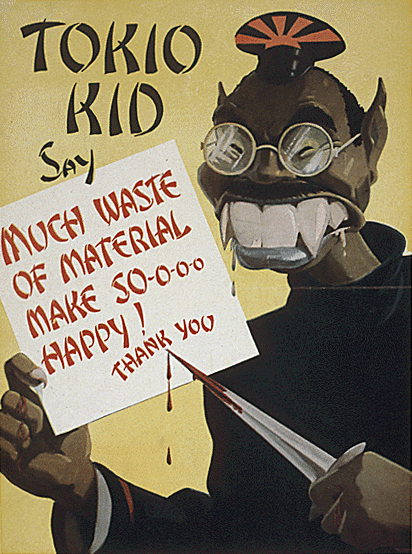
Even where anger is justified, it can go off the rails. As John Dower notes in his brilliant book War Without Mercy, the Pacific portion of World War II was a race war. Both sides dehumanized and demonized the enemy in caricatures and words. One can only imagine what U.S. citizens of Japanese ancestry felt when they looked at posters such as this, a buck toothed, saber toothed, drooling, myopic, dog-eared, satanic travesty of their image:
http://upload.wikimedia.org/wikipedia/commons/3/33/Tokio_Kid_Say.png

Even in less fraught times, in-groups commonly defend against out-groups, while out-groups are trying to get in. The pie that represents the “American Dream” seems to be getting smaller, and everyone wants a pretty big piece. I suspect that some of the rage we see today is in response to the precarious, dangerous, and competitive nature of life itself: the daily indignities, the feelings of helpless, and the sheer dazzling and frightening speed with which things change faster than we can keep up.

And perhaps some other part is just our biological and genetic inheritance — the “fight or flight” capacity for anger that our ancestors had to have in order to take on the real threats to their existence and protect those they loved.

As an old 1960 Twilight Zone episode illustrated brilliantly, we are prone to believing that The Monsters are Due on Maple Street even if there are no monsters. If you haven’t ever seen it or haven’t watched it in a while, it shows how chaos and unpredictable change added together can trigger the search for scapegoats, even among the innocent in an average suburban community.

If instead you consult Brigitte Gabriel, author of They Must Be Stopped, you will be told that “America has been infiltrated on all levels by radicals who wish to harm America. They have infiltrated us at the C.I.A, at the F.B.I., at the Pentagon, at the State Department.”

And who are “they?” Muslims living in the U.S.A.

Really? Or is Ms. Gabriel simply Wisconsin Senator Joseph McCarthy in a dress? McCarthy was the man (eventually censured by the Senate) who told us of the non-existent infiltration of the government by Communists back in 1950:

The State Department is infested with communists. I have here in my hand a list of 205—a list of names that were made known to the Secretary of State as being members of the Communist Party and who nevertheless are still working and shaping policy in the State Department.

Joseph McCarthy.jpg

McCarthy never came up with hard evidence for his claim and sometimes changed the number of alleged traitors in government. Nor has Gabriel offered such evidence for her accusations.

When will Ms. Gabriel mention that the independent research group Triangle Center on Terrorism and Homeland Security, affiliated with the University of North Carolina, Duke University, and RTI International reports something rather different? It indicates that Muslims provided tips that helped thwart 48 of the 120 U.S. terror attacks planned by their co-religionists since 9/11/2001 .

Long story short: beware of angry people. Their anger just might be turned in your direction. Today, perhaps, they are your friend. But tomorrow?

Beware of those rabble-rousers who stir up the discontented. Enough of them can be found on cable TV, talk radio, and on the Internet. They aren’t your friends either.

Be careful of those who only occasionally see more than one side to any story; and the only side they tend to see is their own.

Be on guard against the people for whom angry expression and impulsive action are the solutions and not the problems.

If you are attracted to someone who appears to be your big, strong, and powerful protector, remember that your only real protection is in yourself and the rule of law; and that one day you may find that the fearsomeness of your companion has become a threat to you.

Beware, too, of angry people with a drink in their hands (McCarthy was one such), unmindful of the disinhibiting potential of alcohol to set their rage loose.

In 1919, just after World War I, William Butler Yeats wrote in The Second Coming:

Turning and turning in the widening gyre
The falcon cannot hear the falconer;
Things fall apart; the centre cannot hold;
Mere anarchy is loosed upon the world,
The blood-dimmed tide is loosed, and everywhere
The ceremony of innocence is drowned;
The best lack all conviction, while the worst
Are full of passionate intensity…

Are we are in one of those moments again?

I guess that depends on how the quieter voices respond.

The future is up to every one of us.

Make the future.

End of today’s sermon.

Now for the test questions.

Have you found yourself muttering under your breath as you read the above?

Have you cursed to yourself about the opinions I’ve expressed?

While I don’t claim impartiality, in more than one case I have pointed at difficulties on both sides of American politics. Have you been able to see the other side’s point of view even a little?

Do you believe that anyone who leans in a different political direction is unworthy of your respect or your ear?

Do you have good friends who look at politics from other than your perspective?

Can you have a well-reasoned, honest, and civil conversation with someone who does not hold your position about any of the issues described above? And, if you do, do you permit the possibility of altering your stance a bit?

Do you search for the facts that are available from non-partisan news sources and do they ever persuade you to change your mind about something?

Is there anyone on the other side of the aisle who you admire? Even a small amount? Is there a single writer from the opposition party who’s regular column you read?

Have your past judgments about others, as well as your personal and business decision making, been so good that you are utterly certain of the validity of all of your political opinions today? Put differently, has your life been such a shining example of wisdom and inerrant behavior that it is impossible that you are wrong?

No one on earth has ever been all-knowing in the arena of world affairs and even those solutions that work tend to have a short shelf-life. Angry self-righteousness, however, can last rather longer.

If you are unwilling to change course (in politics or anything else), consider new information, or compromise in a rapidly transforming world, you will have taken the fixed position of a stopped-clock — right only twice a day.

But, no matter your political persuasion, you will be angry all day.

The top image is A (gentle)man giving the middle finger angrily by Mgregoro. The second image is that of a Vietnam War Protest in Washington D.C. by Frank Wolfe, October 21, 1967, followed by the Gadsden Flag by Lexicon, Vikrum. The next photo pictures Protesters at the Taxpayer March on Washington by dbking, which occurred on September 12, 2009, after which is a U.S.A. propaganda poster from World War II:  Tokio_Kid_Say.png. The final image is a 1954 photo of Senator Joseph McCarthy taken by United Press. All are sourced from Wikimedia Commons.

How to Make Yourself and Those You Love Miserable

http://upload.wikimedia.org/wikipedia/commons/thumb/a/ae/Bertram_Mackennal_-_Grief.jpg/500px-Bertram_Mackennal_-_Grief.jpg

It is easy to find on-line guidance to a better life. But the recommendations contained on those self-help web sites (and in books that aim at the same audience) have become almost too commonplace to make any impact.

The remedy? Something that is just the opposite: a list of suggestions on how to make yourself and others miserable. Of course, I’m not wishing that you follow these directions. Rather, I’m hoping that some of you who might yawn at still another list of “things to do” to improve your life, will be struck by the things you already do that make it much worse.

Here goes:

  • Regularly compare your material and financial circumstances to others, especially to those who are doing better than you are.
  • Make a list of all the people who have wronged you over the years and try to remember exactly how awful they made you feel. Think about those who owe you an apology. Forgive no one. Let no slight be too small to dwell on it.
  • Carry on a vendetta. Stay up late at night planning and plotting how you might get back at people. Stay angry. Let all your hatred out in blistering, profane, and cowardly “flames” behind the mask of the Internet.
  • Give your children gifts rather than your time. Set no limits on them. Then wait until they are teenagers and wonder why they are depressed or rebellious.
  • Curse the darkness, the winter, the cold, the rain, the frailty of the human condition, and all the other things that you can’t change.
  • Get impatient with the people who are walking in front of you at a snail’s pace, the couples whose bodies and shopping carts block the entire grocery aisle, and the slow progress of the check-out line at the store.

http://upload.wikimedia.org/wikipedia/commons/thumb/7/74/John_F._Kennedy_Inauguration_Speech.ogv/mid-John_F._Kennedy_Inauguration_Speech.ogv.jpg

  • Make no contribution to the betterment of humanity. Assume an attitude of entitlement. Figure out how to avoid work. Idle away your time. Ask “what your country can do for you,” not “what you can do for your country” in opposition to JFK’s 1960 inaugural address admonition.
  • Forever rationalize your dishonorable or questionable behavior or deny it altogether, even to yourself.
  • Persuade yourself that you need to wait until you feel better before you do the difficult thing that you have been postponing. Keep waiting, even if the time never comes when you believe that you can take action.
  • Do not let conversation with your spouse or children get in the way of watching TV. Keep the TV on most of the time, most importantly at family dinners. If possible have a television in every room.
  • Ignore the beauty of a spring or summer day, the newly fallen snow, and the cheerful laugh of small child. Stay in-doors as much as possible, year round.

http://upload.wikimedia.org/wikipedia/commons/thumb/d/d8/Sommerblumen01.JPG/240px-Sommerblumen01.JPG

  • Allow yourself to be upset by overpaid, under-performing athletes who doom the home team to continued failure. Yes, Cubs fans, this means you!
  • Treat emotions of sadness, tenderness, and hurt as your enemy. Push them away and thereby alienate yourself from yourself. Curtail grieving and try to deaden your feelings to the point of numbness.
  • Work up as much hatred as possible toward opposition political parties. Listen to every talking head who wants to whip you into a frenzy.
  • Expect justice and fairness in all things.
  • Drink too much, drug too much, and spend every extra minute on the web or playing computer games instead of having direct human contact with someone who is in the same room with you. Further distract yourself from your problems by watching TV and listening to music. Escape reality.

http://upload.wikimedia.org/wikipedia/commons/thumb/4/4b/Jack_rose.jpg/120px-Jack_rose.jpg

  • Keep using failed solutions to your problems even though they haven’t worked in years, if ever.
  • Behave in mid-life the way you did as a young person; or, if you are a young person, behave the way you did as a child. Do not reflect on or learn from experience which might teach you something new.
  • Use others instrumentally. That is, value them only in terms of what they can do for you. Lie, cheat, betray, and steal from them if that serves your interests. Then wonder why people mistrust you.
  • Spend as much time as possible worrying about the future and regretting the past, rather than living in the irreplaceable moment.
  • Aim low. Avoid the disappointment that comes with high expectations. When the going gets tough, quit.
  • Train yourself to be a miser. Practice selfishness. Hold on to your money as if you expect to live forever and will need every last cent. Make Scrooge from A Christmas Carol your hero.

File:Chicklet-currency.jpg

  • Judge others less fortunate than you are by using the phrases “he should have known better,” “he didn’t try hard enough,” and the like. Assume that all people deserve whatever misfortune befalls them. Disdain compassion, but remain puzzled when others call you heartless.
  • Indulge in every available excess: unprotected sex, food, spending, smoking, caffeine, etc. Don’t exercise. Ignore medical advice and, even better, avoid going to your doctor. Treat your body badly and then wonder why it betrays you.
  • Be sarcastic, passive-aggressive, and indirect whenever you are injured rather than looking someone in the eye and expressing your displeasure in a straight-forward fashion.
  • Avoid facing things. Give in to your fears, anxieties, and phobias.

http://upload.wikimedia.org/wikipedia/commons/thumb/5/5b/Children_in_Sonargaon.jpg/240px-Children_in_Sonargaon.jpg

  • Don’t let anyone know you well. Believe that your vulnerabilities will always be used against you. Keep social interactions on the surface. Eschew intimacy and maintain your distance, thinking that this is the best way to avoid personal injury. Trust no one!
  • Assume that the normal social rules regarding fidelity to friends and lovers don’t apply to you. Hold on to a double-standard that favors you.
  • Insist on having your way. Don’t compromise. Don’t consider others’ needs or wants. Assume a position of moral superiority, self-righteousness, and arrogance in things religious, political, and personal.
  • Do everything others ask of you. Rarely say “no.”
  • Try to control people and events as much as you can. Don’t go with the flow. Micromanage. Hover over others. Repeat complaints to them incessantly. Remind subordinates, friends, spouses, and children of small errors, even if they are ancient history.
  • Make no significant effort to better your life. Depend on others to take care of you and make all significant decisions for you. Be a burden.
  • Raise all your children exactly the same way even though it is obvious that they are not all the same.
  • Imitate vampires (who have no reflection in the mirror and therefore keep their mirrors shrouded) by never really looking hard at your own reflection in the looking-glass. That is, never take a frank inventory of your strengths and weaknesses or the mistakes you’ve made. Be like the evil queen in Snow White, whose only desire was that the mirror would tell her that she was “the fairest of them all.”
  • Whenever you talk with someone, wonder what they really mean, pondering the possibility that they find you boring, stupid or physically unattractive.
  • Feed yourself on gossip more than food. Delight in talking about others behind their backs.
  • Value beauty, appearance, reputation, and material success over integrity, knowledge, kindness, hard work, and love.
  • Try to change others, but do not try to change yourself. Take no responsibility for your life circumstances, instead blaming those who have stymied you.
  • Stay just as you are regardless of changing life conditions. For example, if wearing warm clothes worked for you when you lived in Alaska, continue to wear them when you move to Arizona in July.

http://upload.wikimedia.org/wikipedia/commons/thumb/3/37/Enrico_Caruso_VI.png/240px-Enrico_Caruso_VI.png

  • Don’t forgive yourself. Maintain the most perfectionistic and demanding moral and performance standard even if you are not a brain surgeon. Stay up at night castigating yourself over every imperfection, no matter how small.
  • Make a list of all the things that are wrong with your life, all the opportunities lost, every heartbreak, and the physical features and bodily changes that you don’t like. Stew in your own juices. Salt your wounds. Pick at your scabs.
  • Take everything personally.
  • Permit friends, family, and co-workers to walk all over you. Do not stand up to them for fear of causing offense and disapproval.
  • Discount your blessings. Concentrate on the dark side of life.
  • Never even consider going into psychotherapy. Assume that this is something only for those who are weak and that anyone who needs to grapple with emotional issues in counseling demonstrates a failure of will power and logic.

With thanks for the inspiration for this essay to Dan Greenberg and Marcia Jacobs, co-authors of a very funny, but ironic book entitled How to Make Yourself Miserable.

The top image is Grief by Edgar Bertram Mackenna. The video frame that follows is from John F. Kennedy’s 1960 inaugural speech. The next image is Sommerblumenstrauss by A. Gundelach. The following photo by Andygoodell is A Jack Rose Cocktail. The fifth picture is of two children in Bangladesh by Nafis Kamal, while the sixth is called Chicklet-Currency courtesy of the U.S. Department of the Treasury. After the image from Disney’s Snow White, is a 1911 photo of Enrico Caruso, the great Italian tenor. All but the Snow White frame are sourced from Wikimedia Commons.

On the Elusiveness of Vindication (and How Special It is When It Happens)

http://upload.wikimedia.org/wikipedia/commons/thumb/8/86/Rembrandt_Harmensz._van_Rijn_013.jpg/256px-Rembrandt_Harmensz._van_Rijn_013.jpg

I suspect there is hardly anyone among us who has not hoped that the person who broke our heart would come back to us, see the light, apologize, and say:

You know what? I was wrong. I didn’t give you a chance. I should have. You deserved better treatment than you received from me. It was unfair of me to blame you as I did, not to see how good you are.  I hope that you will forgive me and we can start over.

Vindication can take a number of forms. It might involve being reinstated to a position you lost unfairly, being exonerated of a crime you were alleged to have (or convicted of having) committed, receiving a belated medal for acts of courage performed in combat, or having a parent apologize for abusive or neglectful mistreatment.

There is only one problem.

When the injury is great, these things almost never happen. Or, if they do, they come much too late. Think about the occasional news story that documents the exoneration of someone who had been wrongly imprisoned after years behind bars, now finally permitted to return to civilian life. Or the long-denied medal for heroic service to one’s country in an almost forgotten war, awarded to a man now aged or perhaps deceased, and therefore only a posthumous recipient of the honor.

Perhaps even rarer is the parent who apologizes for child abuse. First, such people rarely acknowledge the extent of what they have done. And, to the degree that there is any recognition or admission of  mistreatment of their child, it is nearly always minimized on the one hand, and justified on the other; justified, usually by the child’s alleged misbehavior or provocation.

By the time the parents in question are senior citizens, the fog of time and self-deception has clouded and distorted their memory. Moreover, were they to admit (even to themselves) what they had done, they would almost certainly be shattered and humbled by that self-awareness; and left with the fact that there would be no way to make up for the lost time and the pain they inflicted – not enough of a future available to redeem the sorry state of the past and remove the stain on their conscience.

Perhaps it is therefore not surprising that they do not admit their errors even when confronted – in effect cannot do so psychologically without jeopardizing their ability to live with any measure of equanimity.

My wife likes to say that her favorite punishment for such people would be one minute of self-awareness. Unfortunately, they are the least likely among us to achieve this kind of insight.

A useful book to read on the subject is Frauen by Alison Owings. Owings interviewed numerous German women who had lived through the period of the Third Reich. She observed the extent to which self-deception, rationalization, and denial were present as they looked back upon what they claimed they knew or witnessed (or didn’t know), and what they did or didn’t do in response to the mistreatment and murder of their Jewish neighbors by the Nazis.

Beyond the individual level, even nations have a problem admitting that wrong has been done in their name. Turkey continues to deny the Armenian genocide of the twentieth century’s second decade, while Austria and France have historically skirted their participation in the Holocaust, preferring to be considered co-victims with other sufferers of Germany’s misdeeds.

And, it was not until 1988, that the United States formally apologized for the 1942 forced internment of Pacific Coast residents of the USA, solely because they were of Japanese decent, in the aftermath of the attack on Pearl Harbor. Of those people, 62% were US citizens.

While none of what I’ve described thus far permits a very optimistic take on human nature, I do want to relate one very beautiful story I heard from a former patient on this subject. It stands out because it demonstrates that obtaining personal vindication does happen every so often, and can produce any enormously healing experience for both parties involved. I’ve changed the circumstances of the story to disguise the identity of my patient, but I think you will get the idea.

The young woman in question was a high school volley ball player, a member of the school’s team. She was a junior and had played, usually as a starter, for most of the season. Her coach was a young woman as well, that is to say, a relatively new teacher, just shortly out of training.

Toward the end of the season, the student’s mother was to receive a special award from her workplace. Mom and dad both wanted their daughter to be at the dinner honoring the mom, and the young athlete wanted to be there as well. Unfortunately, the award ceremony conflicted with an important game for her team. She explained in advance to her coach that she would not be able to play in that game, but the coach was furious. Thereafter the coach repaid her absence by keeping her on the bench for most of the remainder of the season and treating her with disdain.

Although she liked volleyball, my future patient chose not to try-out for the team as a senior, expecting either to fail to make the roster chosen by the same coach; or, if permitted to be on the team, anticipating the same sort of mistreatment from her for another year. And so, the athlete’s high school athletic career ended prematurely.

This turn of events did not, however, destroy her love for the game. She continued to play in various park district leagues for many years. But the memory of being humiliated by the coach did not go away, nor of the lost senior year of competition that she might otherwise have enjoyed, playing a game she loved.

Perhaps 10 years after the incidents I’ve described, this woman was now my patient. And one day she told me that just the day before she had found herself in another volley ball contest against a new team. And, wouldn’t you know it, she saw that one of the opposing players was her old coach, now in her early to mid-thirties.

My patient recognized the coach, but hoped the recognition was not mutual. As the game progressed they soon enough were face-to-face across the net from each other. The coach said “hello,” calling her by name, and my patient replied in kind. Perhaps, she thought, that would be the end of their interaction.

At the end of the game, however, the coach came over to my patient. She asked if she could speak with her privately. They moved away from the other volleyball players to a place where they would not be overheard.

What the young woman’s ex-coach said went something like this:

I’ve thought about you for many years. I realize that what I did to you was very unfair. I took your decision not to play that game too personally. Of course, there was nothing wrong with your attending a dinner recognizing your mother. Who wouldn’t have? I was very young, but I should have known better than to treat you as badly as I did. I have felt guilty for years that I caused you pain and that I made it almost impossible for you to even think of trying-out for the senior team. I have been hoping to run into you all this time, so that I could say this. I’m so sorry.

As my patient related this story to me she was in tears, enormously touched by what the coach had said. The coach had given her closure for a painful part of her history and had done it with grace, courage, and integrity; taking full responsibility for injuring my patient. In so doing, I suspect the coach found relief too, because her former charge was an enormously likeable, decent, and forgiving person.

Everyone here was a winner.

As I said, the tale stands out for me because this kind of ending occurs so rarely. I suspect many of us have been the victims of similar hurts.

But, perhaps more importantly, some of us have probably inflicted comparable injuries on others.

Sometimes its worth reflecting on that — on one’s own failures and mistreatment of others.

You just might discover that like the coach, there is still an opportunity to put things right.

Of course, that is up to you.

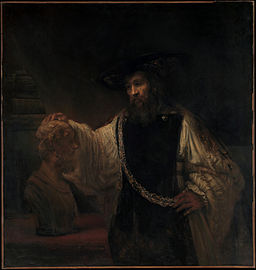
The image above is Aristotle Contemplating a Bust of Homer by Rembrandt, sourced from Wikimedia Commons.

The Long Road to Becoming Rich

Most of us are raised to believe the path to happiness is a simple one: get a good education, obtain a high status and well-paying  job, find the love of your life, have children, stay healthy, and do good in the world.

But what if you have done all these things and you are still not happy?

My friend “Rock” has given me permission to tell you his story. And his tale sheds some light on what can prevent life satisfaction and how you can find it after all.

Rock was a charming, active, and extraordinarily bright and curious little boy, the second of his parents’ two children. Both mom and dad had to work at a time when most middle class American families did well enough on a father’s salary alone, well enough to permit the mother a life at home raising the kids and keeping house. As a consequence, Rock was a “latch-key” child before the expression had been invented, coming back from school to an empty home, passing the lonely time until the after-work arrival of his parents.

The modesty of the family’s material life was no small annoyance to Rock’s mom, who was disappointed in her husband’s limited capacity as a bread-winner. Unfortunately, “Al” Adelstein had no defense against his wife’s repeated verbal assaults. He could do no better with his limited education than work in a hat factory. Purchasing a home was out of the question given the family’s finances, so Mrs. Adelstein faced the further disappointment of living in an apartment when most of her peers owned homes.

The spillover of her episodic avalanche of unhappiness and anger sometimes fell on little Rock.

Not only did he witness his mother’s tirades at his dad, but he discovered she had enough discontent left over to criticize and disapprove of him. Cruel pranks were not out of the question either, as on the day mom and son were waiting for a baby sitter. But, Mrs. A unexpectedly disappeared before the sitter arrived, driving the small boy to a near-panic state, believing he had been abandoned. At last, his mother emerged from her hiding place, laughing at the “joke” she played on her terrified child.

Nonetheless, our boy did surpassingly well at school.

After skipping a full year in grade school, he was to be the only National Merit Scholar in the group of nearly 600 unusually bright, motivated, and accomplished students who comprised the Mather High School class of 1964.  He placed second in both the City of Chicago and Illinois State Science Fairs, and went on to acquire degrees from three different Ivy League universities, the last of which produced a combined Ph.D/J.D., that is, simultaneous doctorates in Economics and Law.

In high school, he would sometimes say to me he hoped to achieve something great in his life.

But life is funny about such things, and our friend didn’t become famous.

Instead he went on to be a full professor and (for a time) Chairman in his Department of Economics at Wesleyan University, wrote scholarly papers (about 30 or so of these), gave talks nationally and internationally, and taught with passion and intensity, winning the first ever teaching award given by a school founded in 1831.

And just  to give you a sense of the scale of his achievement, he spent a year at the Institute for Advanced Study at Princeton, a place associated with names like Einstein and Oppenheimer.

But still, on some days he thought back to his high school wish to do something great and wondered if the really great thing would ever happen. Because, you see, nothing in the accomplishments I’ve mentioned — accomplishments that seemed so impressive to everyone else — was very satisfying to Rock. And the feeling of discontent he carried with him from childhood into the life of a university professor never left him. This, despite the good education, the high status and well-paying  job, the love of his wife Sandy, two adoring children, and the excellent health of all concerned.

He was, perhaps, a bit like Virginia Woolf’s Mr. Ramsay in To the Lighthouse; like him, an academic; like him, unhappy. A man who had:

…a splendid mind. For if thought is like the keyboard of a piano, divided into so many notes, or like the alphabet is arranged in 26 letters all in order, then his splendid mind had no sort of difficulty in running over those letters one by one, firmly and accurately, until it had reached, say, the letter Q. He reached Q. Very few people in the whole of England ever reach Q… But after Q? What comes next? After Q there are a number of letters the last of which is scarcely visible to mortal eyes, but glimmers red in the distance.

For Rock, like Mr. Ramsay, there was always one more letter just out of reach.

…because, in effect, he had not done the thing he might have done.

It wasn’t something Rock talked about much, even to his closest friends. For him, like most men of our generation and before, the “athlete’s creed” is honored: don’t complain, don’t look back, just rub some dirt on your “injury” and keep playing the game — mind over matter, and the heart (and the hurt) be damned.

In the summer of 1998, my buddy and I took a long road trip from his home in Connecticut to the Baseball Hall of Fame in Cooperstown, New York. It was the fulfillment of a childhood wish of two middle-aged baseball fans who were also two life-long friends.

And, it was a time to be together and talk.

Really talk.

When I’m alone with someone for a while, I often ask, “If you could have dinner with anyone in the history of the world, living or dead, who would it be?” You get some interesting answers. Jesus is mentioned a lot. Great writers and musicians are named along with other famous people of various kinds. But, Rock’s answer was a little bit different.

“Well, if I could really have dinner with anyone, I’d like to have dinner with my mother — I’d like to think she would believe I’d turned out pretty well in life.”

You see, Rock’s mother died just after he graduated from college, so she never knew about some of the items on his long list of achievements, although his Science Fair and National Merit Scholarship awards, not to mention his admission to M.I.T., all happened well before her death.

Our conversation didn’t stop with that question and, as our time passed on the road, I got to know more about Rock’s home life — the turmoil I related earlier.

One story in particular stands out.

In order to get to the University of Illinois campus at Champaign/Urbana, where the State of Illinois Science Fair was held, Rock had to carry his science project and take public transportation. While it was a bit of a chore, the return trip was sweet. Imagine, at age 16, you have placed second among all the potentially eligible students in the State!

And so it was that he walked in the door of his parents’ apartment, feeling pretty full of himself, beaming at the thought of his triumph; feeling what you feel when you are young and the sun is out and the day is glorious and your adrenaline is flowing and you are on top of the world.

His mother greeted him.

“How did you do?” she asked.

“I finished second in the State of Illinois!” he enthusiastically answered.

“Why not first?”

Before Rock and I reached the Hall of Fame, it was clear to both of us, I think, that the “great thing” he hoped to achieve would never be great enough to make him feel whole. And the roots of his unhappiness were to be found in the circumstances of his early life with his parents. Not even a Nobel Prize or a plaque in the very Hall of Fame we were to visit could have cured the sense of being insufficient to win the approval of his folks.

As the therapist he saw soon after would say to him, “The heart has no clock on it.” Meaning the injuries of childhood wait for us to attend to them. The wound is sometimes as fresh as the day it happened, even if 30 years have passed. And so, at last, the “athlete’s creed” was set aside through the hard work of therapy, and he was able to feel good about an adult life that, all along, had been good objectively.

My friend is one of the Zeolites, a small group of high school buddies — all members of the same park district softball team of years past — who created a college scholarship for the disadvantaged kids at our old school. And Rock has donated more money to it than just about anybody, as well as traveling from Connecticut to Chicago nearly every year to be with us and to be present at the scholarship ceremony, as many of the out-of-state Zeolites are.

He is a smart, funny, and decent man, a man of enormous emotional generosity, warmth, and good will.

Best of all, Rock’s story has a happy ending. Because, in fact, in the aftermath of therapy, his wife Sandy helped him realize the “great thing” was something he’d actually achieved long before.

Not the kind of greatness he expected to lead to fortune and fame, but the kind that sends generations of young people into the world who are somehow different and better because of his influence, and who even today frequently return to Middletown, Connecticut to let him know he was the teacher, the one teacher, who made a difference in their lives.

In 2007 we honored him at the annual dinner of the Mather Class of 1964/65 for the difference he made in the lives of the Zeolites and our class’s effort to make a difference in the lives of a few of Mather’s recent graduates. In addition, he received an engraved paperweight as a token of our affection and esteem.

Although he has given the scholarship an awful lot  of money, he is not wealthy in any conventional sense.

Rather, he is rich in the hearts of all those students whose lives he has touched.

He is rich in the love he has for his family and friends.

And he is rich in the love and respect his family and friends have for him.

It should be no wonder then, the inscription on the paperweight with which he was presented reads:

Rich Adelstein

…the noblest Zeolite of them all…

From the Mather Class of 1964 and 1965

And the Zeolites

May 4, 2007

The photo above is of Rich and Sandy Adelstein.

A Christmas Story: Telling the Truth and Breaking the Heart

Was she seven years old? I don’t remember my eldest daughter’s exact age when she asked the question:

“Dad, is Santa Claus real? Nicole (a friend in school) said he isn’t.”

I had learned long before this, the value and importance of being honest.

I looked at Jorie, but perhaps could not see just how invested she was in her belief in Santa.

What I could see, however, was that she trusted me. And, in the few moments before I answered, I quickly determined that I could not break that trust.

“No Sweetie, he isn’t.”

I can still see her little face melt into a waterfall of tears. I comforted her as best I could; so did her mom.

It was not the last time that I caused pain to someone I love, but I think it was the first time I’d done this to any child of mine.

Welcome to the real world, honey; the place where things aren’t always as they seem or as we would like them to be. A place where hard reality trumps fantasy; a place where someone who “loves you to pieces” tells you something that breaks your heart into pieces.

That was a long time ago. I’ve wondered what else I might have done instead; something to save this little person from the pain of a message amenable to postponement.

Should I have said, “What do you think, Sweetie?” Was there a possible Socratic dialogue — an artfully crafted sequence of questions leading her to the same truth and not hurt so much?

Could I have tried to change the subject, to avoid the answer and let her continue to believe anything she wanted?

Or, should I have simply lied? “Of course there is a Santa, Sweetie.” And then left her open to the potential ridicule of friends, as well as some doubts about whether her dad was trustworthy.

Janet Landman, in her book Regret: the Persistence of the Possible, likens regret to the dilemma of coming to a fork in the road and making a choice. You walk down the chosen road for a while, before you realize it isn’t quite as good as you had hoped. Eventually you conclude, “I probably should have taken the other path.”

It really doesn’t matter which road you choose. Nothing in life is perfect. But in your imagination the alternative remains idealized. Only in your mind, in the world of abstraction and fantasy, does perfection reside — the perfect job, the perfect mate, the perfect result, the perfect performance of whatever kind.

And, for me, the perfect answer to a simple question.

Sometimes in life there is no ideal solution, no right path, only a bunch of imperfect possibilities. And, of course, we never know what it would have been like to choose the other road at that precise moment. Because, as Heraclitus said, “You cannot step into the same river twice.” Meaning that with the passage of time, the river has changed, and so have you.

No, you cannot un-ring the bell. No do-overs when it comes to the knowledge of whether Santa is real.

We must live with the inevitable heart breaks, whenever they come. In the one life we have, we can never be quite certain what would have happened had we lived it differently.

Ultimately, one can only accept the terms life allows. The contract we (metaphorically) sign by having the audacity to take our first breath at the moment of our birth allows for no escape clause from hard knocks. Not, at least, while life goes on.

I still wish I could have protected Jorie from the terrible knowledge I delivered so innocently that day, not just the knowledge about Santa, but about life. Indeed, as I think about it, it isn’t the knowledge from which I wish I could have sheltered her, it is from the pain of life itself.

But, such things are not in our power. Life will have its way with us. If we are lucky, we will also have the compensations of beauty, joy, friendship, laughter, learning, and love.

Jorie and I lost a little innocence that day.

The good news?

Our love abides.

Money = Happiness? The Problem With Envy

http://upload.wikimedia.org/wikipedia/commons/thumb/f/f3/Inveja_covarrubias.jpg/256px-Inveja_covarrubias.jpg

If seven is really a lucky number, you wonder why Pope Gregory (the Great) gave us Seven Deadly Sins in the 6th century: Pride, Greed, Lust, Envy, Gluttony, Anger, and Sloth.

Not, you will notice, Dopey, Grumpy, Doc, Happy, Bashful, Sneezy, and Sleepy. But then, he probably hadn’t seen Snow White and the Seven Dwarfs.

I would argue that envy is the most troublesome of the seven qualities mentioned by Gregory in the day-to-day life of the Western World, particularly in our commercial life. It plays a role, I will further argue, that pretty much guarantees our unhappiness.

And who better to hold responsible than the advertising industry. Whomever invented the notion of The American Dream, advertising has certainly shaped it.

The “dream” looks something like this. It includes a big house (usually in the suburbs) with the latest and finest appliances, multiple high-end cars, jewelry and finely tailored “fashion forward” clothing, computerized gadgets in our pockets, and a fat bank account. It is not simply success at “keeping up with the Joneses,” but surpassing them.

Schopenhauer put it neatly when he wrote that “a human being, at the sign of another’s pleasure and possessions, would feel his own deficiency with more bitterness.” The cure offered by “the American Dream?” It is to obtain those possessions, often including a comely and dashing partner, expecting that contentment will follow.

Joseph Epstein describes it well in his wonderful little book Envy (upon which this essay draws) when he notes that envy is akin to the question “Why me?” that is often asked by the victim of tragedy. But, since envy is triggered by others’ good fortune and material well-being, the question becomes: “Why not me?”

Envy is further related to thoughts regarding life’s unfairness and the notion that I deserve good fortune more than my less worthy neighbor or business associate.

Epstein notes that the advertising industry is little more than an “envy-inducing machine” designed to make us feel bad and promising a material cure that will make us feel good. However, since there are always people who have “more” than we do (and presumably deserve it less), we will forever be in the chase for the carrot at the end of advertising’s (and our neighbor’s) stick.

Envy assumes that “my life would be better if only…” and it is partially the basis of the alleged “class warfare” that has been going on in the USA for a while. TV, not to mention the internet and other vehicles of voyeurism, show us people flaunting their prosperity and their “life style,” and make it all appear pretty wonderful. We know how much people make for a living, where they reside, what cars they drive, and sometimes even the details of their tax returns. The “information highway” and its attendant loss of privacy fuels our envy.

There was a time in the Western World, no more than 50 years ago, when modesty was seen as a virtue and drawing attention to one’s prosperity was thought unseemly. Now, the material well-being of the luckiest of us is pretty much shoved down everyone else’s throat; ironically enough, at a time when a good many people can’t afford a good meal that would progress through that same orifice.

I half-way expect some well-fed figure in the half-baked Alaska of contemporary politics — someone who is advocating the end of unemployment benefits for those long out-of-work and out-of-luck — to echo the line attributed to Marie Antoinette. You will recall that when she was told that the people had no bread, she said, then “let them eat cake.”

Christopher Boyce, Gordon Brown, and Simon Moore, in a 2010 article in Psychological Science, provide data from 12,000 British adults which supports the notion that our tendency to compare ourselves to others is a problem. The authors found that “the rank position of an individual’s income within his reference group dominated the explanation of life satisfaction.” In other words, “satisfaction is gained from each ‘better than’ comparison and lost for each ‘worse than’ comparison.'” Moreover, they report that people tend to make comparisons to those above themselves in income 1.75 times more than they make those comparisons to those below them.

This also implies that even if your income increases by a substantial amount, your sense of well-being might not substantially increase unless the extra salary changes your rank within the group of people you tend to measure yourself against (or unless your income is relatively modest to begin with, as noted below). If all incomes go up in your social or business cohort without changing your rank among these people, then you would not be expected to be happier, according to this line of thinking.

All this envy-induced pain might be justified by saying that it motivates people, makes them work hard, and that “in the land of the free and the home of the brave,” we are free to win the prize and defeat our envy by obtaining the prosperity that will unlock the door to happiness. And indeed, international ratings of life satisfaction put the USA quite high, but not as high as you’d think given our superior wealth.

The problem is that psychological research suggests that beyond $75,000 in annual income, you don’t get much hedonic bang for the additional buck. In other words, all the things you would buy with the extra money that your neighbor has but you don’t, won’t make your experience of life a lot more satisfying unless your income was modest in the first place.

What does this mean at a practical level? In the December 23, 2010 issue of The New York Review of Books, Thomas Nagel writes:

When I was growing up, if you wanted to see a movie, you had to go to the local movie theater, and you saw what was playing that week. Now I can see almost any movie from the entire history of cinema whenever I feel like it. Am I any happier as a result? I doubt it…

Sound familiar? Remember the thing you couldn’t wait to get as a kid and how great the anticipation was? But once you have the thing it becomes part of the background of your life, yesterday’s news. Like kids who are thrilled with their gifts on Christmas, we adults are likely to put the toys on the shelf or to use them without much delight after just a little passage of time. But if the acquisition of such things is the way you try to fill yourself up, the danger is that you will try to buy more with the same unfortunate result.

The concept behind this tendency for the temporary “high” of the new refrigerator to diminish is called “hedonic adaptation.” Just like a foul smell noticed when you enter a room, if you stay in the room for a while your nose adjusts or “habituates” and the smell no longer seems so bad; indeed, you might not notice it at all. Just so, the momentary excitement of the new possession wanes before long.

Research suggests that we each have a relatively stable level of life satisfaction that cannot be sustained at a higher level by episodes or events of good fortune. Like rats, we are on a “hedonic treadmill,” having to work at the job of happiness just to keep up, unable to do much more than maintain a somewhat fixed degree of life satisfaction.

Ah, but hope is not dead. The ancient moral philosophers of Greece and Rome recommended less concern with status, wealth, and material things. Instead, they suggested more personal contentment would come from knowing yourself and improving your human qualities, performing social acts of virtue, civic involvement, and friendship.

The psychologist Csíkszentmihályi offers another path to satisfaction in lived experience. He has demonstrated the value of productive and engaging work that finds one “living in the moment,” unmindful of past and future because of being pleasantly engrossed in the present. He calls this the “flow” state, one in which you are completely focused and totally involved at a maximum level of performance and untroubled, positive feeling.

When you are in the “flow” state, you are “in the zone,” as the athletes would describe it.

Social scientists also remind us that married people are happier than those going solo, although it is unclear whether that is because of the positive influence of marriage on well-being, the possibility that people who are relatively happy are more likely to marry, or some other cause.

Last but not least, data analysis by Christopher Boyce and Alex Wood in their 2010 article in Health Economics, Policy and Law found that a short-term course of psychotherapy is at least 32 times more effective than monetary awards in improving a sense of well-being among those who have experienced some form of injury or loss.

I’ve said enough. I imagine you are leaving for a therapy appointment already.

The above image is Envy, an engraving from Jacob Matham’s series The Vices, plate #5, ca. 1587. Courtesy of Wikimedia Commons.