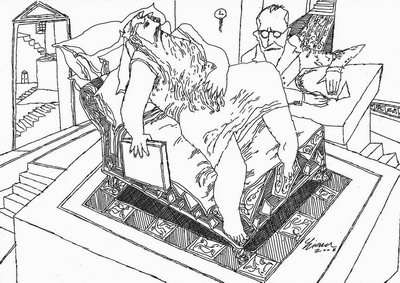
“Please be Honest with Me:” Of Sex, Wisdom, and the Danger of Telling the Truth

When someone asks you a question and says, “Please be honest with me,” I have a word of advice: be careful.

Two examples will illustrate the point. One comes from Greek mythology; the other from my own experience in, of all places, kindergarten. Hard lessons were earned and learned in each one. Sometimes telling the truth is a big problem. Sometimes no answer is right.

The Greek myth in question has to do with Teiresias. According to one version of the story, this young man was walking along, minding his own business, when he came upon two snakes having sex. He hit the pair with his walking stick, but displeased the Goddess Hera in the process. Hera punished the young man by turning him into a young woman. Not only did “she” then live as a woman for seven years, but bore children.

Apparently, when she again found snakes mating, she delivered another blow to them, thus releasing her from Hera’s spell and transforming her back into a man. Some sources suggest that Teiresias killed the female reptile in the first instance, thus explaining Hera’s anger, and the male in the second, thereby evening the scales.

Fast forward to a conversation between Hera and her husband Zeus, the chief God. The pair couldn’t agree on the question of which gender enjoys sex more. Zeus claimed it was women, while Hera was certain that males had more sexual pleasure. How to resolve the question? What better way than turn to the only person who had ever been both a man and a woman, our friend Teiresias.

His answer went as follows:

If the pleasures of sex were divided in ten,
there’d be nine parts for women and one part for men.

Oops. Teiresias apparently forgot that he was dealing with Hera once again, the same person who had changed his sex. She now punished him a second time by blinding him permanently. Zeus could do nothing to change this, but did try to compensate Teiresias by giving him the gift of prophecy. Thus, ironically, Teiresias became a blind seer, a man who could “see” into the future despite his inability to see through his eyes.

Skip now even further ahead to a little boy named Gerry Stein.
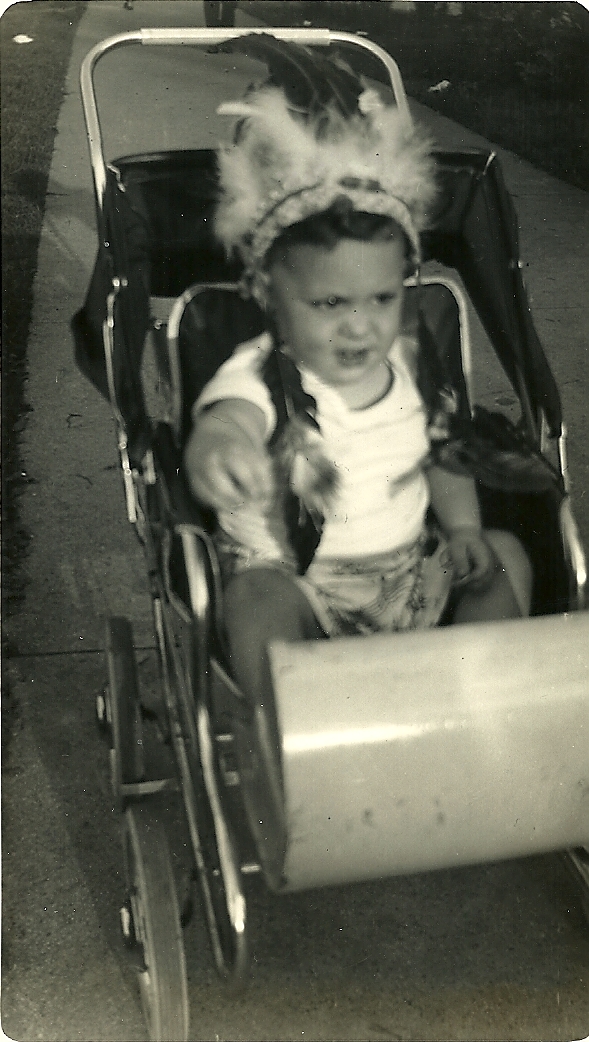
I was a dashing little person. Resplendent in the Indian (Native American) head-dress my parents gave me or the cowboy holster and six guns that I wore around my waist. Of course, the contradictions among those elements of attire didn’t bother me. Perhaps they were an early indication of my tendency to see both sides of an argument.

I was a six-year-old. I didn’t wear my western outfit to school, but I was still pretty cute: a curly-haired, fresh-faced, sweet little boy, with large hazel eyes. And I had three girlfriends! Count ‘em: three! Way more than any of the other little boys in my kindergarten class. Was it at Avondale School or Jamieson? I don’t remember that.

Little did I know that I was about to meet my Waterloo. Little did I know that the great disasters of life are largely unforeseen; and that fortune can turn in an instant. Teiresias, whose name I wouldn’t encounter for many years, could well have warned me.

The teacher gave us an assignment to draw something. I don’t recall just what it was. But I was good at anything having to do with art and quickly finished off my mini-Picasso masterpiece. That gave me a little time. And so I walked over to the place where two of my girlfriends were hard at work on their own artistic products.

What exactly did it mean that I had three girlfriends? I was six, for God’s sake. I never saw them outside of our kindergarten class. I doubt that I ever held hands with even one of them. Still, there was a sense of security, a point of pride in “having” three pretty little females each of whom also thought that I was her boyfriend, and each of whom was just as clueless as I was about what that might mean.

I can still see myself standing in front of the first two charmers, who were, by the way, best friends. And I can still hear the question that one of them asked me, much like the question posed to Teiresias by Zeus and Hera: “Gerry, whose picture do you like the best?”

Remember, I was six. Maybe even five. No life experience. A piece of unripe fruit, yet to be churned by the cruelties of the human food processor that is daily life. For sure, I was pure and naive. And terribly, terribly honest.

So I answered. I chose one. I don’t remember which one. I only remember the aftermath.

The unchosen female immediately burst into tears. “You made me cry. You aren’t my boyfriend anymore!”

I was stunned. It might even have been her question that prompted the answer she was blaming me for. I considered using the Nuremberg Defense (“I was just following orders).” But before I could say anything, the next hammer dropped.

Her companion, girlfriend #2, looked at me and said: “You made my friend cry. You aren’t my boyfriend any more.”

My stock was falling like the Dow Jones Industrial Average on “Black Friday.” I was down two-thirds on my net girlfriend-worth. I was sweating. I didn’t know what to do. I must have mumbled something about being sorry. But the hard-hearted pair facing me, like Hera x 2, had rendered their unchangeable verdict. The Gerry Stein Fan Club was quickly disbanding.

In my desperation I did what most anyone would do. I ran over to my one remaining girlfriend, the better to secure my position with her. God knows, if she asked me what I thought of her drawing, I was prepared to tell her that not even Rembrandt could have done half as well.

Unfortunately, in my haste I wasn’t especially careful about where my feet were going. And the hard wood floor had recently been polished, making traction tricky and braking balky. I over-ran my target and accidentally stepped on my remaining girlfriend’s foot. This damsel, now in distress, quickly began to cry. And you already know the rest: “You made me cry. You’re not my boyfriend any more.”

Dazed, stunned, disillusioned, and confused, I probably would have walked into traffic if we hadn’t been in a secure environment. Everyone else continued to busy themselves in drawing and conversation. I alone was crushed, alienated from humanity, feeling for the first time in my life the cruel indifference of a world that goes on about its business, ignoring the human road-kill still to be observed in its peripheral vision.

Little did I know that my moment of lifetime peak popularity with the opposite gender had passed, but at least I retained my vision, unlike Teiresias.

As I see it (sorry for the pun, Teiresias,) both Teiresias and I acquired some wisdom under difficult circumstances. His tendency to displease those in charge, Hera in particular, led Zeus to give the newly blinded man the gift of prophecy. With that, one could be sure that he would handle potentially disastrous situations involving snakes and vengeful Gods quite differently in the future. And indeed, he became esteemed for giving good advice and important warnings to other mythic Greeks.

My kindergarten disaster — my childhood tsunami-like encounter with three girlfriends — was also instructive. No, I didn’t become a seer, a visionary, or a prophetic advisor to princes and kings. But I did become a little wiser about the ways of the world; about dealing with women; and about the punishment that sometimes comes by just answering a question scrupulously. I learned the truth in Clarence Darrow’s observation that “There is no such thing as justice, in or out of court.”

Wisdom almost always comes at a high price. Just take it from me and Teiresias.

—

Thanks to Keith Cleveland, Instructor in the University of Chicago’s Basic Program of Liberal Education for Adults, for relating the portion of the Teiresias myth that I have discussed. All photos are of the author. The first comes from September, 1965, taken by Steve Henikoff. The second is dated August 15, 1948. The third is undated.

A Step Toward Happiness: Learning How to Lose Without Being a “Loser”

Imagine a beautiful, wealthy young woman. She falls in love with a man named Compeyson, who cares only to make off with some of her money. On her wedding day she discovers the fraud and is left at the altar. From that day forward, she lives in a state of mourning, continuing to wear her wedding dress as a badge of her perpetual sense of victimization. The cake is left on her dining room table uneaten.

Perhaps you recognize that I’ve just described Miss Havisham, an important character in Great Expectations by Charles Dickens. A wasted life, I expect you would say. A mistake never to get over the lost love and the humiliation. Surely people aren’t like that, are they?

Yes, I’m afraid, some are. Their dysfunction is less obvious without the yellowed wedding dress and the uneaten cake, but it is still there.

Another example: imagine a man who wants a career in high finance, a tough and competitive road to travel successfully. He’d trained for it and worked hard to get to the top. For a time he was making his way up the administrative ladder within an important bank in a big city. Then an economic downturn and a change in management caused a corporate reshuffling. His career never recovered and he never again worked in his chosen field. While he made an acceptable living, his mind always returned to “what might have been.” It remained hard to feel satisfied with the remainder of his work or his life.

The unfortunate path I’ve just described is real enough, but it rests on some shaky assumptions:

  1. That life would have been great if only the man could have achieved success in his chosen profession.
  2. That life cannot be satisfying for him in any other field of endeavor or by any other means.

Psychologists who do research on what makes for happiness might disagree. And, in fact, that research tends to support the idea that the flush of excitement and happiness that comes with winning the race, new romance, or a major achievement doesn’t last nearly as long as people expect it to.

We humans tend to be pretty poor at estimating the accuracy and durability of what will make us happy. For example, Daniel Kahneman and David Schkade took a look at what effect living in a nice climate might have on life satisfaction. Students living in California and the Midwest were recruited for this experiment. In general, regardless of where they were going to school, the college students tended to think people would be happier living in California. But, in fact, there was no difference in the life satisfaction of those who lived in the harder climate conditions of the Midwest than in the milder ones associated with the West Coast.

In part, it would appear, we are prone to focus on items like climate that we will become accustomed to as time passes. Similarly, you might be delighted over the terrific new car or new house you just bought, but it is likely to recede into the background of your life as you get some distance from the moment you acquired it. Put differently, going out with Brad Pitt or Marilyn Monroe might be terrific for a while, but in a few years the dazzle and novelty tend to wear off.

It turns out that life satisfaction and the happiness we experience along the way are strongly influenced by our inherited temperament. You can be fantastically wealthy and unhappy — or relatively modest in your level of success and affluence and be happy. Of course, this issue is much more complex than I am suggesting. But, if I were to prescribe a brief recipe for happiness, it would have to do with making a decent enough living at labor you deem worthwhile to live modestly but well (research says that a household income of $75,000 is usually enough) and having people in your life who you love and who love you back, both friends and relatives.

One other thing: to some extent, happiness depends on what you are paying attention to. Kahneman suggests that misery can often be traced to having goals that are especially hard to achieve. A laser focus on obtaining great success in a performing art like music or dance or theater is almost a guarantee of continuing disappointment (since so few make it to the top). The danger is that those who aim for triumph in fields such as these tend to unconsciously make their entire happiness dependent on their level of achievement, to the exclusion of other factors that might contribute to a satisfying life.

Of course, it needn’t be just an attempted career in the arts that frustrates a person. Athletic accomplishment at the highest level is only attained by the few. Nor are Nobel Prizes given out at the bingo parlor. If you pin your happiness on writing the “Great American Novel,” becoming the next Steve Jobs, or being a scientist whose name will still be in bold relief in the next century’s text books, you have almost certainly guaranteed a significant level of displeasure.

What then does this say about all the rest of us? Especially in our attempt to get over the failures and rejections by employers and lovers that are the commonplace experiences of life?

The disappointed banker I mentioned earlier would have to reorient his thinking, get over his defeat, and “invest” himself in some new line of work or another facet of his life — like family, community, friends or hobbies. The same might be said of the baseball player who never becomes a Major League star or a physics professor who never produces the scientific breakthrough he was hoping for and continues to work at it into his old age, never giving up or accepting that he didn’t become the man he hoped to be; never satisfied by the work itself as opposed to the glory he hopes will come from it.

Chemutai Rionotukei Running in the 2007 St. Silvestre Road Race in Sao Paulo, Brazil

What is preventing these men from feeling happier about their lives? Perhaps it is their belief that a satisfactory life amounts to winning a figurative pot of gold at the rainbow’s end of their career, as in the top image; not necessarily money, but a kind of vocational or social jackpot. In part, this self-imposed requirement makes it harder to grieve their losses. They continue to focus on what might have been or what might still be. The failed banker is looking back on the career he wished he had and re-running the same old movie of his life with the same old unhappy ending, even before that life is over. The physics professor is still trying to produce the next major scientific discovery, not willing to accept that his colleagues have already rendered their verdict on his work.

The former individual replays the lost ballgame of his life 10 years or more after it ended, while the scientist continues to play the game into extra innings without progress, even after the fans have left the stadium and the lights have been turned off. The tyranny of “what might have been” can be the equal of “what might yet be” in its capacity to diminish those lives that might be good in every other way. The mistake of giving up too late or not at all on a fruitless pursuit is just as costly as “giving up too soon” on one that would have been profitable with more persistence.

You needn’t be a great man or woman in order to have a satisfying life. If you must become a financial wizard or a Nobel Prize winning scientist, then you have probably overestimated the importance of these endeavors and undervalued the other possibilities in your life, including the things you might already have:  interesting work, health, love, and some amount of admiration by others, even if the latter quality isn’t as much as you wanted.

Miss Havisham, the failed banker, and the perpetually striving scientist have all made the mistake of believing that their happiness depended upon a particular thing; and by failing to grieve when that thing wasn’t achieved. They have idealized what a life with that thing would be like (be it a particular spouse, money and status, or scientific achievement and glory). Each one remains stuck in a state of bitterness (Miss Havisham), disappointment (the banker), or longing and frustration (the scientist). Others, with less fixed goals and more intellectual and emotional flexibility, would  be unhappy only temporarily, eventually withdrawing their emotional investment in what they never had; moving on to find some other focus of their attention and effort.

As the title of this essay suggests, it is important in life to learn how to lose; how to give things up and set them aside. In fact, I’d argue that this is more important to life satisfaction than victory in the game of romance or your chosen profession, which, unless you are Einstein, will probably be pretty modest. I suppose that my suggestions here would result in fewer scientific breakthroughs and fewer great violinists. On the other hand, there would be more happy people.

Even on the day after you take home the Nobel Prize, should you be a genuinely great man and a lucky winner, you must deal with the fact that there is still the laundry to do. Even after winning the fair maiden, there are still bills to pay, children to raise, and differences over which movie to attend (and worse). Most of us frequently misunderstand that the object we are chasing usually doesn’t make that much difference to the rest of your life, even if it seems desperately important at the moment. Unless of course, you think it really does make all the difference; which means that the problem resides in how you think about it.

If you must be a big-deal banker or a Nobel Prize winner, then I guess you will keep gnawing on the meatless bone of your failure or pursuing the miniscule possibility of a late success. No, you shouldn’t be a bum and automatically give up some admirable goal, especially if you are young. But, I am here to tell you that the goal you have believed all your life to be essential to achieve, just might take you off course and your chance of satisfaction with it.

Sometimes only by accepting your losses can you make your life into a winning proposition.

The End of the Norfolk Relay 2006 at the Athletics Track, Lynnsport.

—

The top image is called Pot of Gold in Arkengarthdale by Andy Waddington. Next comes a photo of Men Running in a Chariot Race at the Piha Surf Club Carnival in New Zealand, ca. 1938 sourced from the National Library, NZ. The picture of Chemutai Rionotukei is the work of Ricard from Sao Paulo, Brazil. Finally, the relay race photo was taken by Katy Walters. All are sourced from Wikimedia Commons.

About Grieving, About Friendship… About My Friend Bob Calsyn

When you lose someone you care about, for a while you walk around in a daze. Of course, there is the sadness. But less often mentioned are the sense of disorientation and the random memories; the moments your eyes fill with tears and the fatigue you can’t seem to shake. For a while you are scattered and off-balance until, finally, the jumble of things settles down and life returns to “normal.”

I am writing this in the midst of the jumble. My friend Bob Calsyn died on Friday, September 21st. His wife Maria called from St. Louis with the news. I let a couple of my old friends know. They are Bob’s old friends too, from our days in grad school at Northwestern. And I heard independently from Dave Kenny, another NU alum. If Dave isn’t — I should say wasn’t — Bob’s best friend, then surely he was tied with the other contenders for first place.

I told Dave I was thinking of writing something about Bob and asked if he might offer some of his own thoughts. His remarks below are adapted from those he read at the memorial he attended in St. Louis on September 25th. (In each case that I quote him, his comments are set off from the rest of the text and begin with his name in BOLD CAPITAL LETTERS).

What I’d like to do here is to tell you why Bob mattered to all of us. But the truth is, I need to tell you. I need to get this out to honor Bob — to honor the loss suffered by Maria and Bob’s children and siblings and all those who were closest to Bob. And, not least, to help myself with the jumble I mentioned at the start.

What follows is a series of recollections of a wonderful man and great friend, much of it in Dave Kenny’s voice; along with some of my own memories, a little of my own philosophizing about the nature of friendship and loss, and some things just about me. Someday, you too will be in the midst of the jumble. Maybe it will help.

DAVE KENNY:

I knew Bob for 44 years. When we met at Northwestern we had a lot in common: both oldest child of a large family, both lapsed Catholics, both of us had mothers who wanted us to be priests, and both of us had a strong commitment to social justice. We very quickly became friends. What Bob accomplished in four years at Northwestern was truly remarkable: earning his Ph.D., serving two years as a Conscientious Objector to the Vietnam War, doing a one year clinical psychology internship, and becoming a father, much of the time commuting 14 miles from Hyde Park to Evanston. The later incredible academic success of his sons Dylan and Chris was foreshadowed by Bob’s.

Bob, unlike me, continued in his commitment to social justice throughout his entire lifetime. He was passionate about ending homelessness and he worked diligently in this effort. I never told Bob how grateful I was that he let me play a small role in his work.

For the record, Robert Joseph Calsyn was a product of Rock Island, Illinois and Alleman High School; the child of working class parents. He graduated from Loyola University in Chicago before attending grad school. Bob served as the Chairman of the Psychology Department at the University of Missouri, St. Louis, as well as being Director of its Gerontology Program.

There is something about schoolmates. At Northwestern, our group of graduate students was more than usually close. The Psychology Department was small, so we had lots of classes together, the way you do when you are 10 years old. We ate together, socialized together, went on double-dates; some of us roomed together. We passed through the same moment in history and the same stage in our lives in the same place. It was hard not to bond.

The men in the group played lots of softball and football and basketball against other Northwestern departmental conscripts. Bob usually played second base for our softball enterprise, which we called the Psyclones — a play on words since we were all studying to be psychologists. He played hard, but that particular game was tough for Bob, especially making accurate throws to first base. Still, Bob was an essential part of a pretty good team. Even if we’d have been slightly more perfect without him, we wouldn’t have had nearly as much fun or had the benefit of his “heart.”

In sports like touch-football Bob was fierce, taking particular pride in the devastating, bone-rattling blocks he delivered to opponents who couldn’t imagine them coming from a man who was no more than 5’8″ (173 cm) on a good day. Bob was no plaster saint. He knew the full range of four letter words and used them when necessary, as they tend to be in sports, especially in games played with the sweaty tenacity that Bob brought to them.

DAVE KENNY:

Our friendship endured and we saw each other in eight different states. Many of those visits were near water which Bob loved: the coast of Maine, Cape Cod, Long Island Sound, and of course, his beloved Anna Maria Island (where Bob and Maria had a vacation home). Bob was strange about water. He loved to watch and hear it, but he was not a fan of being in it. However, don’t forget that Bob grew up and spent most of his adult life near the Mississippi River. Maybe not going in the water made good sense.

I didn’t see Bob a lot after grad school. We’d visit occasionally, at first when I was teaching in New Jersey and he came to nearby New York City, later in Chicago, and a few times in St. Louis. Our relationship took the form of letters, then email and occasional phone calls. I got to read and critique some of his short stories; he helped with career issues for one of my children.

And yet, for me at least, a person like Bob lives inside of you in a continuous way even when there is no continuity in actual contact. He was always on an imaginary list of people who I thought of as my friends. Bob was someone who you were sure would be dependable, helpful, and unfailingly honest. He told you what he thought, not what he believed he “should” say or what he thought you wanted to hear.

We “knew” each other, could talk about anything. We knew where each of us was coming from — came from — in both a literal and figurative sense. He didn’t keep score. Bob was always there when you needed him, someone who was compassionate, gave sound advice, and was incredibly funny.

DAVE KENNY:

Bob had his own view of nutrition. He introduced me to Dairy Queen Blizzards. I remember him cooking donuts and beignets in his kitchen. We always had a 3PM cookie break when working together. For breakfast he would ignore his wife Maria — his Argentine bombshell — and sneak off to eat at Waffle House or Denny’s, not the healthy breakfast she suggested.

Bob and Maria (ca. 1994)

My friend retired from his faculty position in 2009. Not long after he was diagnosed with cancer. This made our contacts more frequent. Somehow Bob remained optimistic in spite of multiple tumor sites that never fully disappeared.

Bob continued to play tennis, the game he loved best, even though the treatment compromised his breathing. Singles were now out, so he played doubles. I didn’t see the down moments and I’m sure that there were more than a few. But his resilience, his ability to live life and to keep really “living it” and enjoying himself was astonishing. And he could still be there for me, as when I had a long conversation with him about retirement: whether to do it, when to do it, what it was like for him, and what it might be like for me. We had plans to see each other on the first weekend in October in St. Louis.

People find it difficult to talk with someone who is battling “Death,” a bigger than “Life” opponent with an undefeated record. It is, indeed, hard to know what to say. Mostly you listen, even if most of us think we must have some sort of magic words to deliver when, in fact, no such words exist. Bob made it as easy as possible.

The day after Bob died I heard John Adams’s musical composition, On the Transmigration of Souls, presented by the Milwaukee Symphony and Chorus. Bob liked classical music, so it seemed a nice coincidence; more than that, the composition is a commemoration of those lives lost in the terrorist attack on the World Trade Center on September 11, 2001. An interview with the composer on the New York Philharmonic website includes the following:

… I’d probably call the piece a ‘memory space.’ It’s a place where you can go and be alone with your thoughts and emotions. The link to a particular historical place — in this case 9/11 — is there if you want to contemplate it. But I hope that the piece will summon human experience that goes well beyond this particular event.

‘Transmigration’ means ‘the movement from one place to another’ or ‘the transition from one state of being to another.’ … And I don’t just mean the transition from living to dead, but also the change that takes place within the souls of those that stay behind, of those who suffer pain and loss and then themselves come away from an experience transformed.

I guess you hear what you want to, what you need to, what you can’t escape. Of course, I couldn’t help but think about Bob during the performance…

Bob managed to write a novel, all the while dealing with his illness. It is called Primal Man and you can buy it on Amazon. You won’t be disappointed. The story is a murder mystery that takes place in a university setting. This comes from a brief interview of Bob in the St. Louis Post-Dispatch on September 4, 2011:

Q: Had you written fiction before?

Bob: No. but I’ve always read mysteries.

Q: This primal man is apparently an exhibitionist?

Bob: Primal man exposes himself to female students and throws them an index card that says, ‘Men are hunters, women are gatherers. Gather yourself home.’

Q: How does psychology figure in?

Bob: It helps you explore character. I was an administrator for many years. I thought writing a mystery was a more socially acceptable outlet than strangling my colleagues.

Bob was a confident man, but not arrogant. For all the scholarly articles he produced and all his advocacy for homeless, mentally ill people, he told me one day at the St. Louis Zoo that he thought of himself as a “journeyman.” Indeed, he considered each one of us who got Northwestern psychology doctorates in 1972 in the same light, with one exception. Dave Kenny was and is that exception, an internationally known academic who has changed the way people think about social psychology research, its design, and its analysis. But, I don’t believe Bob meant to disparage any of us, and certainly not himself. He simply knew that there was a pretty big difference between being Bob Calsyn or Gerry Stein and being Beethoven.

Bob didn’t care about or aim to be a great man. He was too busy living his life, loving his wife, doing his work. He was too busy delighting in his kids and grandchildren, playing tennis, and having a beer (but not at the same time)! The irony, of course, is that the way that Bob lived was a kind of un-self-conscious, rough-hewn work of art, something to be admired and emulated. As Marc Anthony said over the body of Julius Caesar in the Shakespeare play, “When comes such another?”

DAVE KENNY:

In thinking over my friendship with Bob, it occurred to me that Bob and I never argued and Bob never got mad at me. We disagreed all the time, but our disagreements did not result in arguments. Bob regularly told me that I was wrong, but he never did so in a way that said, “I’m better than you” or “You are a bad person.” He sincerely wished, as I did, that I was a better person. Bob did have lots of reasons to be angry at me: missing deadlines, drinking too much, not staying in contact… Bob would get angry at Republicans, at demagogues, and perhaps even his colleagues. But he channeled his anger against his colleagues by writing short stories and killing them off there.

Bob always was one step ahead of me. He left a high-powered college to go to a more low-key institution. He got married and had children, ended his difficult marriage, and remarried; he had grandchildren and retired — all before me. Now Bob, you have done it again and you have died before me.

Upon reflection, Bob was more of an older brother to me than a friend. He was doing things before me and giving me advice on how to do them. My big brother Bob helped me cope with all of the major transitions in my life, especially my divorce. We know that Bob faced a terminal disease and death courageously and remarkably. Again I will be following Bob, and I hope I can muster 10% of his courage, but I hope that mustering does not happen too soon.

Dave Kenny

We cannot know what others are feeling except by analogy to our own emotions. Those of us who have lost a friend may think we are hurting and we are, but surely the intensity and nature of the feelings experienced by those closest to Bob can’t be known, at least not by me. Everyone’s grief is different, formed by the tapestry of experiences they had with the departed — all the memories and struggles, the laughter, the kindness, and the human imperfections that are inevitable on both sides of any relationship.

For those closest, their lives will now be marked with the idea of “before and after;” before and after Bob died and how much that difference made. To all those who were closest to Dr. Calsyn, and to those (like me) who were a step or two back, my condolences.

That said, from the outside and some distance, it looks to me like Bob had a wonderful life. Too short, for sure, but wonderful. Not without pain or disappointment or hard times, but full of compensating joy, success, and love. He gave life and the people in his life everything he had. He traveled, competed, and he knew when to rest and take a walk on the beach. Bob didn’t “phone it in.” He lived more in 66 years than most of us would do in twice that time. Like the ballplayer who tries to stretch a triple into a home run and is thrown out at the plate, he was a thing to behold.

On the subject of baseball, I’m reminded of an old story about Babe Ruth, the most famous baseball player ever. Actually, it is about the Babe’s funeral, which happened on a particularly hot day in New York City. It seems that two of his old teammates, Joe Dugan and Waite Hoyt, couldn’t help but comment on the weather, especially since they’d served as their friend’s pallbearers and the heat hadn’t made that easier:

Joe Dugan: I’d give a hundred dollars for a beer.

Waite Hoyt: So would the Babe.

Here’s to you, Bob. How lucky I was to know you.

——–

The top image is the Calsyn Family (ca. 2001). From left to right: Bob’s son Dylan and Dylan’s wife Beth and their daughter Zoe; Maria, Bob, Soledad Van Emden (Maria’s daughter and Bob’s stepdaughter), Bob’s son Chris, Margaret van Emden; and John van Emden, Soledad’s husband. Since this picture was taken, three more grandchildren have arrived: Abigail, Ella, and Max.

The photos are courtesy of Dave Kenny. My very special thanks to Dave for his contribution to this essay, especially given the enormous difficulty he had returning home to Connecticut from Bob’s memorial in St. Louis. Thanks, also, to Judy Goodman, Steve Hanan, Angela Shancer, and Diane Tyrell for their helpful and speedy comments about an earlier draft; and for their friendship.


What Do Patients Think About Their Therapist? What a Counselor Does About “Transference”

http://upload.wikimedia.org/wikipedia/commons/6/6e/Fussball_und_Freud.jpg

Patients wonder what their therapist is thinking. Therapists wonder what their patients are thinking. It is not much different from what happens between husbands and wives, parents and children, bosses and employees — or is it?

I’ve written about what doctors think about their patients before: What is Your Therapist Thinking? But today I’ll focus on what the patients are thinking about their counselor and how therapists are “supposed to” handle that. I say supposed to, because we don’t always do it well. It is one of the trickiest parts of a counselor’s job.

Patients have feelings and expectations about a counselor, in part, because he resembles someone else. This is called transference. In other words, the client’s sense of this new person is transferred from someone else who is important to him, simply because the new acquaintance resembles the old one. It happens automatically and without thinking; a kind of mistaken identity.

No, you don’t think your therapist has red hair if his hair isn’t actually red. But you do see him through the lens of your past experiences, and react to him because of certain real or imagined similarities to others. All of us do this in all sorts of relationships. It occurs whenever we have unconscious feelings and assumptions about someone who reminds us of someone else; which is a lot, even if we don’t know it. The feelings toward the old person (be it a parent, a sibling, a boss, or a lover) can become quite mixed up with the real human qualities of any new individual, including a new therapist.

Indeed, this is made easier by the fact that the therapist limits how much the patient knows about his personal life. In effect, the shrink is a kind of blank slate upon which the client “fills in the blanks” left empty by a lack of real information. Not surprisingly, all of us are prone to repeating old behavior patterns in new relationships; and, to the extent that a new person evokes old feelings about what the relationship is and what it can become, the transference can play out the patient’s repeated relationship difficulties right in the therapist’s office.

Take a hypothetical situation. Let’s say that your dad was a hard guy. He was critical of you, didn’t give you enough attention, and seemed to favor your siblings. Now, many years later, you meet your new therapist. Is he any of these things? To some extent it doesn’t matter. For example, the fact that your shrink only sees you once a week can reopen the tender wound of your neediness — your failure to win your father’s time and attention. You might feel that your doctor isn’t as available as you’d like him to be, in person or on the phone. You might interpret some of his statements as being disinterested, even when they are not so intended.

The counselor can be more important to you than he would otherwise be because of your unresolved, unconscious desire to get the affection and approval of this admired authority figure, who, like all authority figures, can easily remind you of dad. The hurt and/or anger that you feel when the shrink does not fill your need for a “good” father is almost inevitable. You might want to leave therapy because of it.

http://upload.wikimedia.org/wikipedia/commons/thumb/9/97/FIESA_7_Freud_276.jpg/256px-FIESA_7_Freud_276.jpg

What is a therapist supposed to do when this happens? If he reacts defensively to the patient’s demands or disappointments, he is unlikely to do him any good. In fact, the counselor who responds angrily can create one more injury of the same kind that was inflicted by the patient’s father, thereby adding to the client’s mistrust and misery. Even if the healer tries hard to give him what only a father can give, the patient will still not be satisfied. After all, the therapist cannot literally fulfill the childhood yearnings that come from anyone’s vanished youth. The hunger of a 10-year-old for good parenting can no more be satisfied when he is 30 than can a literal hunger for a good meal at age 10 by a delicious dinner 20 years later.

What the therapist can do is the following. First, he can be compassionate and understanding. He often anticipates that the patient’s old losses and resentments (his past disappointments concerning his dad) are likely to play out in the therapeutic relationship. When they do, the psychologist will try to gently assist the client to see that the feelings bubbling up are not fully appropriate, but come from the historical emotions attached to the father that have been superimposed onto the shrink. If the patient is open to exploring this, he will gradually be able to purge his internally complicated connection to his parent. This is a grieving process, a cathartic expression and understanding of the sadness and/or anger that continue to live inside of him, even if the parent is dead.

If all goes well in therapy, the therapist will eventually no longer evoke the transferential emotions; no longer remind the patient of the parent. And not only will his relationship with the therapist be less complicated, but so will all those other interactions with lovers, bosses, or friends which used to unconsciously trigger the same feelings. Finally, the old injuries will be healed sufficiently to be set aside, clearing the way to better social interactions in the future.

I am certainly not saying that all of the feelings that patients have about their doctors are mistaken. Therapists have the same potential flaws as everyone else. They can be good or bad, attentive or unreliable, too easily hurt or too distant. Some want your admiration and some don’t much care. They have feelings about the patient that grow out of their own relationship history. This is called a countertransference. Regardless, the potential for the transferential issues I’ve described is always there, just as the therapist’s countertransference toward the patient must be carefully watched to prevent the damage that it can do.

Do you find all of the above some sort of psychobabble that doesn’t apply to you? Trust me, transference is real. The more that you believe your relationships are “logical” and that your past doesn’t reach into your present, the more that it probably does, unless of course you have dealt adequately with it in some sort of therapeutic process, whether in treatment with a professional or in your own self-analysis.

http://upload.wikimedia.org/wikipedia/commons/5/5a/Moses_hos_Freud.jpg

Therapy and transference are much more complicated than I’ve described. What you’ve read is a simplification based on a hypothetical relationship between a father and his adult child who is in therapy. If you are not in therapy, even if your relationships are going quite well, it still may benefit you to take a look at patterns of connection you make with friends or lovers: the kind of people you are drawn to and the types of individuals who usually “push your buttons,” get you angry, or disappoint you in some way. We can all learn a lot by just connecting-the-dots of our life history, seeing the resemblances among the people who keep returning, even if their names are different the second or twenty-second time around.

It is easy to blame others when relationships fail. Relationships aren’t easy. But, the more unsatisfactory and repetitious your social life is, the more likely that something in you needs attention.

—

The top painting is called Therapy by Gerhard Gepp. Apparently, the patient (a soccer ball or football) is thinking about being kicked around. Might he have transferential feelings toward the therapist and feel badly treated by him, as well? The second image is a photograph of Sigmund Freud in Session with a Patient, from the Seventh International Sand Sculpture Festival in Portugal. The artist is RHaworth. Finally, a cartoon of Freud Treating Moses by Moa1. All are sourced from Wikimedia Commons.

Do You Have a Bad Attitude?

Life is difficult enough without making yourself miserable. Those who begin with a negative, “can’t do” point of view often justify themselves by saying that they don’t want to get their hopes up; that the world is unfair and one should be prepared for it. But in so doing they can create their own misery and bring down the mood of those who are close by.

I’ll discuss below a few variations on this theme — different forms of “bad attitude” along with some potential solutions:

1. Focusing on the past. While I am a firm believer in learning from the past, one must remember that it is yesterday’s news. Short of daydreaming about a happier time in your life or doing the essential work of grieving, it can fuel sadness without compensating benefits. The past holds too many unfulfilled hopes, failures, and broken romances. It is the storehouse of betrayals — about “what might have been.” It is the place where things that went wrong can fill your mind and heart with regret. It is a wasteland of missed opportunities, lost beauty, and a nostalgia that is no more satisfying than trying to fill your stomach with the photo of a past meal. Visit the past, but don’t live there.

2. Living in a frightening future. An exclusive focus on the future can be as deadly as a preoccupation with the past. The twin dangers of living in the future are worry/anxiety and make-believe daydreaming. Most who live in the future usually live a life of dread, overpredicting catastrophe and underestimating their ability to survive misfortune.

The only thing we have in life with any certainty is the present. Any chance of happiness depends upon one’s ability to find a way to live in the moment and find satisfaction there, experiencing it and whatever it brings, accepting life on its terms. Plan for the future but be careful not to live in that future any more than you live in the past.

The goal ahead might be very worthwhile, but try to enjoy the journey to get there. Mindfulness meditation, Stoic philosophy, the Zen tradition, and ACT (Acceptance and Commitment Therapy) can help reorient you to determining what is important in life; setting aside what is inessential, distracting, or worrisome; and living according to those principles in the present moment.

3. Pessimism or the self-fulfilling prophecy. Pessimism is a close cousin to worry and anxiety over events that may never happen. It smothers spontaneity, joy, and drains energy. It renders defeat in the game of life even before the game has begun. It anticipates a guilty verdict from the jury that causes one not even to show up for the trial. Pessimism destroys motivation and generates avoidance of challenges or half-hearted effort, at best. Depression and pessimism drink from the same poisoned well.

4. Throwing a wet blanket on the happiness of others. Don’t be a buzz-killer, a kill-joy, or a party pooper. Avoid raining on someone else’s parade. Don’t be an emotional suicide bomber, someone who brings down oneself and all those around you. A bad attitude can consist of always seeing the single dark cloud on a glorious sun-lit day, especially if the sun is shining on someone else. It is the “yes, but” response to the other’s good fortune, her excitement, and her dreams. It attempts to make others suffer as much as you are. This attitude masquerades as attempting to “be helpful” or “realistic” or trying to prevent the friend or child “from being hurt.” Perhaps. But it is a cautionary or negative/critical message at the wrong time, in the wrong place, to the wrong person.

5. Rejecting the encouragement or helpfulness of others. Most people want to ease your suffering, to offer you some encouragement or hope or solace. But if you have a bad attitude, you will reject all of this. You will say “I’ve thought of that already” when you are offered a suggestion or “I’ve already tried that” or “That won’t work because…” Instead, your bad attitude may isolate you from those who only wish to offer their presence and show their affection for you; their simple desire to hold your hand in a difficult moment. In the worst case you will drive such people away, thereby increasing your sense of separation from the world and guaranteeing a solitary misfortune.

6. Perfectionism or the belief that things can always be better. Some of us can’t accept a grade of 99% on the test, simply because we could have done better. Short of performing brain surgery, it is useful to be able to accept the imperfect nature of life and ourselves. Do your best, prepare for the race, study hard; but realize that perfection (if it is to be found at all) resides only in the works of Mozart, Rembrandt, Shakespeare, and a few others. If you punish yourself for falling short of that ideal, you have misunderstood the nature of life on earth and guaranteed that you will be joyless.

7. Whining and complaining. Worse than those who see only the dark side of life are those who not only see it, but won’t let you get away from them before they tell you about it in malcontented detail. They tend not to focus on abstractions. Rather, their concern is not the unfairness of life, but the unfairness of their life. There is no surer way of driving people away than to adopt this particular version of a bad attitude.

8. Fighting every battle. Some people seem perpetually aggrieved and angry. They live with a chip on each shoulder, daring life to knock the wood off. Life will knock it off, but not in the way that they expect. Their anger will breed anger in others. And in fighting perpetually, they will miss any sense of contentment or joy.

No one can take on all the battles worth joining, let alone those that will produce nothing of value. As an antidote to rage, gratitude for the things in life too easily taken for granted can be coupled with acceptance of the things that you can’t change. Ideally, these two abilities will usually counterbalance the frustrations and resentments of life without robbing you of the capacity to fight the good fight when necessary. Telling the difference between those skirmishes that need you and those you should pass is crucial. If you are too angry too often, seek counseling.

9. Refusing to take life seriously. If you’ve been paying attention, there is a relatively new popular expression among teens and a few others. It is called YOLO or “you only live once.” It justifies mindless foolishness; not just ill-considered behavior, but action that is not considered at all. It can be an excuse for doing whatever you want or refusing to do whatever someone else might advise. YOLO suggests that you are not living in the future, not living in the past, and not living in any really mindful present. If you were, the thought of driving 60 miles an hour down a side street in a school zone would never be translated into actually doing it. We seem to make enough mistakes in life without adopting a philosophy of life that virtually guarantees it.

10. Too much realism. While it helps to see the world as it is, there is the risk of it being too much of a good thing. The world as it is today (or most any day) includes poverty, genocide, and betrayal; infirmity, disease, and heartbreak; stress, cruelty, and the big one: death. Everyone you know will die and that also includes you. Focus on all of this just enough to make the most of your precious and too short life. Focus on it just a little more and you will be so depressed that you won’t want to get out of bed.

—

If you have any of the bad attitudes I’ve described, your first response will usually be to justify it; perhaps even to see it as a strength. But I would ask you if you are satisfied with your life as it is? If not, then you may need to investigate that same attitude, especially those aspects that actually could be making the problem worse. Ask friends and family what they see in you that needs to change — if they have enough courage and love of you to tell you the truth (and you have the guts to take it). Looking in the mirror — seeing yourself as others see you — is brutally hard, but can be a first step to enlightenment and a better life.

Read Czikszentmihalyi about “flow” and those wonderous moments when one is so involved in a productive/creative action that one loses all sense of time and self. Read Daniel Gilbert’s Stumbling on Happiness, Martin Seligman, Daniel Kahneman (Thinking Fast and Slow) and other “positive” (hedonic) psychologists about what makes for happiness and how to get there.

It can be helpful to make a list of those things for which you are grateful. Indeed, it may be of assistance to look back at the day to find what it can teach you or what was good (even on a bad day). Yes, I know that plenty that is bad does happen and has happened and will happen. But we humans must not live in these moments of misery for too long without grieving our losses and moving on, learning to accept the nature of life, and learning that the very best times are unreflecting, unself-conscious, utterly spontaneous experiences that we don’t think about, we simply are living them.

In part, our job is to pull our head out of its backward look, out of its forward glance, and play the game that is exactly where we are — right here, right now. That ultimately means more action, more experiment, more risk and less thought — swimming in the pool of life without regard to getting wet. It matters not if you start in the shallow end of the pool because most of us do — just don’t stay there.

Rear Admiral Grace Murray Harper knew more than a little about the water and about the voyage. She put the idea of living your life with a good (rather than a bad) attitude very well:

A ship in port is safe; but that is not what ships are built for. Sail out to sea and do new things.

—

The top image is Emotions X by Franz Xaver Messerschmidt (1736-1783) downloaded by access. The second is Messerschmidt’s The Constipated, dowloaded by Sailko. Both are sourced from Wikimedia Commons.

Dr. Frankenstein and the Curse of Self-Awareness

http://upload.wikimedia.org/wikipedia/commons/thumb/a/af/Megan_Fox_LF.jpg/256px-Megan_Fox_LF.jpg

Does self-awareness bring happiness? Most people seem to believe their portion of self-awareness is sufficient for contentment. Others don’t think about the question. The latter live without much excavation of what is deep in the cavernous underground of their psyche.

I intend to write more about this subject, but will introduce the topic with the story of two people who don’t know themselves well. After reading, you might ask yourself how much self-awareness you possess and whether it improves your life.

My take on the subject may surprise you.

—

If you watched Ralph for 30 minutes straight and walked away, you would be unable to describe him. He was a man with no distinguishing qualities: not too heavy, not too thin; not too much hair (if there is such a thing), but not bald either; a man of indifferent facial features rendering him unremarkable. Although mega smart, his eyes displayed no light or life. Indeed, his brain’s powerful wattage came as a surprise and then only after you’d gotten to know him.

Nor did withdrawn Ralph have many friends; wait — any friends. Vocation became all. If I gave you the name of what he did, you probably wouldn’t comprehend it. Suffice to say, this brainiac possessed a specialized knowledge of something to do with physics. Still, if one is preoccupied by such arcane, abstract, and technical work — a marginalizing kind of territory — conversation is hard.

What Ralph did have, to the shock of anyone who met his family, was a knock-out wife named Fox. And, funny enough, she resembled Megan Fox: equally sultry, but more curvaceous, with hair so black you wondered if it came from a bottle of dye. Indeed, Fox existed as a woman to die for. Ralph was close to fulfilling the expression’s prediction: dying inside because of her.

The honeymood period had been different. This woman only now devoted her life to turning heads. She observed men to see if they ogled, and so they did. The throng turned toward her, where she once blended unknown and unnoticed into every crowd.

When they married, Fox was as plain as white bread. Much like Ralph, in fact. Maybe I’m being too kind to her. Her nose reminded one of a driver frozen in place at a four-way traffic stop, unable to decide which way to go. Her jaw was too small, so her bottom teeth bunched up, like a classroom of eager students all raising their hands. Her “bum” was absent — one of the many straight, boyish lines on a body screaming for curves.

This young woman’s ear lobes had been marred by a failing intern at a bargain “piercing shop.” The cretin used something like a train conductor’s punch to do the job. Meanwhile, her oversized, protruding ears (as if ready for takeoff) created a human likeness to Disney’s Dumbo. Fox’s feet made grace of motion a challenge, too. Topping everything, the delicate dear-one’s sensitive eyes responded with pain to sunlight, requiring an almost vampire-like avoidance of the summer outdoors. In total, this woman appeared a mess on the outside, while her insides couldn’t help noticing and sent out distress signals.

Given the lady’s neediness, perhaps Ralph’s arrival falls into the “meant to be” category. She struggled to reach for a top shelf grocery item and asked for his aid. When he provided the assistance she started chatting him up, telling him the details of her miserable life. “Oh my God, thank you. I don’t know what I would have done if you hadn’t been here to get the Cheerios. I always have such trouble with these things. No one ever seems to give me the time, so sometimes I go without.”

Fox went on and on. The relationship might have been different, if only lonely Ralph had been a more confident and not so good-hearted. A woman eager for his company should not be ignored, he thought. Soon they were sitting together in the supermarket’s cafe. He still listened and she still filled the conversational carbon dioxide with her ill-fated history. The pattern had been set.

http://upload.wikimedia.org/wikipedia/commons/thumb/3/3d/Girlfriend_and_I.jpg/256px-Girlfriend_and_I.jpg

Ralph couldn’t help but notice two things. First, she enjoyed talking to him. Second, he garnered appreciation despite doing almost nothing. Our fellow’s muteness around women mattered not. Since Fox engaged in endless monologue, he found an uncommon ease in being with her.

A third idea occurred to this Everyman, too: he pitied the injured creature. The recitation of her life disappointments touched him. The masculine heart broke as he auditioned the ugly duckling disses she described, her parents’ neglect, and the absence of outstanding qualities in a world demanding them.

Ralph looked beyond Fox’s outsides to the “poor girl” insides he saw on the newsreel of sorrow she re-ran. They became a couple. At first, Fox was overjoyed for a boyfriend — one who would listen to her! Ralph wanted a girlfriend just as much, so it seemed inconsiderate to begrudge the woman he loved for her uncontrollable regurgitation of life’s raw indignities. Besides, she seemed grateful he’d drop anything for her, and he felt wanted and purposeful in being able to better this woman’s life.

Marriage inevitably followed courting. Children inevitably followed marriage. Challenges inevitably followed children. “Oh, Ralphie, look at what Molly (their two-year-old) did. I’m too totalled-out to clean up the mess. Can you take care of it, Ralphie?” What could the dear man do? He’d come home from work “totalled-out” himself, but Fox needed rest. Their daughter couldn’t be alone to create further disorder, Ralph said to himself.

As time passed Fox came to treat our boy’s devotion as an entitlement, treat Ralph’s patient listening as an entitlement, treat Ralph’s bread-winning and housekeeping and childcare as an entitlement.

The miserable male consoled himself. She’s had such a hard life, he thought. She’ll soon snap out of it. Maybe if I can do more, things between us will be good again. “Good,” meaning back to the time Fox offered gratitude and the kids were distracting her husband from focusing on her. Then, one day, she asked for something new.

“Ralphie, my doctor says he knows a foot specialist who can fix my feet so it’s not so hard to walk. Wouldn’t that be great? We can afford that, right Ralphie? How about it?”

Well, you know Ralph. Refusal of a reasonable request was unthinkable. He achieved an abundant living and knew it. It was the least he could do for the woman he loved and the mother of his children.

Although Fox had to go through a difficult period of recuperation, the surgery made walking the natural, unconscious thing it is for most young people. Once the healing advanced, her surgeon recommended training in ballet. Ralph’s wife became the embodiment of grace, a creature whose movement across space was streaming and seamless — something to behold.

For a brief period the spouse was even grateful to Ralph, but within a few months wretched routine resumed. Customary indifference and lack of approbation were Ralph’s daily bread, duly accepted. Until, of course, the next thing Fox wanted.

“Ralphie, my doctor says he knows a plastic surgeon who can fix my schnoz. Wouldn’t that be great? We can afford that, right Ralphie? How about it?”

Ralph didn’t jump at this suggestion quite as fast as the idea of taking Fox’s feet to the repair shop. Moreover, he’d grown to like the way Fox’s nose couldn’t seem to make up its mind about the best route to take from its bridge to her nostrils.

Still, she was the woman he loved and the mother of his children. Before too long, Fox had a nose to die for. Straight, not too big, not too small; “just right,” as Goldilocks would have said. Fox spent hours staring at her proboscis in the mirror, admiring the surgeon’s craft and her enhanced appearance: what you might call attractive if your standards for beauty weren’t too high.

http://upload.wikimedia.org/wikipedia/commons/thumb/7/75/A_Bela_e_a_Fera_-_The_Beauty_and_the_Beast.jpg/256px-A_Bela_e_a_Fera_-_The_Beauty_and_the_Beast.jpg

Sex, however, didn’t improve. Romance had never sizzled, but Ralph accepted what his companion offered. Since he’d never had intercourse with anyone else, for a long time it satisfied. Now, however, frequency diminished. Fox also made it more “conditional.”

Let me explain.

The wife complained of headaches and exhaustion — both words sometimes uttered when the other is preoccupied with something else, their brain is somewhere else, and they only wish their partner were elsewhere, too. Fox had an ever-changing, ever smaller list of body parts available for touching, and a growing catalogue of forbidden sex acts. These, she claimed, might cause a brain hemmorhage.

“The Mayo Clinic will prove it. Take me there, you’ll see!”

He didn’t. She’d won the point.

For his part, Ralph began to think of Fox’s torso as a terrain undergoing lots of highway and road repair. He imagined her naked physique covered with little CAUTION and DANGER signs: arrows indicating detours, and tiny flagmen waiving him right or left, but always into a dead end. The helpless bloke wished for the radio traffic reports one hears every 10 minutes, desperate for guidance to the least hazardous routes. Alas, no station carried the needed updates on Fox’s body map. All Ralph got was static.

http://upload.wikimedia.org/wikipedia/commons/thumb/b/be/Singapore_Road_Signs_-_Temporary_Sign_-_Detour.svg/256px-Singapore_Road_Signs_-_Temporary_Sign_-_Detour.svg.png

Other than when Ralph kissed Fox on her rear end (which she loved but left him cold), ardor was ever more frustrating for our Mr. R. Indeed, as Fox transformed into a fox, the limitations multiplied and the frustration grew.

Attempts at sex caused a mindset akin to days without food, knowing the closest restaurant took a three-hour drive and remained open for just 15 minutes beginning at 3 AM every other week; and the food was cold and tasteless and they never had what you wanted on the menu; and the wait staff were impatient and complained and banged around with pots and pans while you were trying to eat; and the servers were pestering you to hurry up because they were closing soon.

Well, you won’t be surprised when I tell you the surgical requests kept coming. They took the usual form: “Ralphie, my doctor says he knows a surgeon who can do ‘X.'” Next came a complete reworking of her jaw, mouth, and teeth; later breast implants, buttock rounding, and cheek inserts. Botox injections targeted a variety of places. An “ear job” followed to close up the holes left by the conductor’s punch and pin them back so that they didn’t stick out. Soon Fox requested an alteration of her hairline, in addition to lots of consultations with makeup artists, skin specialists, and hair stylists.

The family’s dull doll became unrecognizable — movie-star beautiful. She also transformed into a one-woman cheerleading squad for the wonderful doctor who picked out the best people to work their magic; with not a word about Ralphie, the guy who paid the surgeons and kept doing everything else he’d always done — ever faithful, ever devoted, ever taken-advantage-of, all-day-sucker Ralphie.

Nor was the new “arm candy” an unalloyed benefit to him. Ralph was told he was a lucky hombre, but overheard strangers wondering about the ill-matched “FR” pair. Someone would take her away from him, they guessed.

By the time Fox reached her early 40s, her physical transformation was complete. She passed for 30, at most, and pursued a life unimaginable during her frumpy, freaky, friendless teens. The kids both attended college out-of-state and Ralph never stood in the way of what she wanted. Ralphie earned a fine salary, she rationalized. In fact, however, he worked overtime to pay for the kids’ tuition, the old doctors’ bills, and Fox’s impulse purchases.

With fewer responsibilities due to the the children’s departure and no more surgeons to consult, the manufactured femme fatale realized she missed her divorced doctor, the man she so idolized: the person who guided her to achieving her new, traffic-stopping, stunning state of being. Their meetings started when she dropped in at his office, unannounced, and said hello. Soon they scheduled lunches. Long ones. Ralph couldn’t help but wonder if something was happening.

http://upload.wikimedia.org/wikipedia/commons/thumb/e/ec/Deep_Sadness.jpg/256px-Deep_Sadness.jpg

One day at sunrise, while Fox slept in and the provider was taking a rare vacation day, he drove to a nearby beach. As a young man, when he was the friendless class nerd, he’d walk along the lake front, let the sun soothe him, and nursed his malaise. Sometimes it worked. The sound of the waves and the warmth of the rays eased his craptastic condition. Perhaps he got lost in a fantasy of winning an adoring girlfriend who would become his wife.

How did things gone so wrong, he wondered? The stillness of the deserted beach provided no comfort. “What can I do? I still love her.” Ralph was talking aloud. “If only I can regain what we had on our first day in the grocery.”

Ralph’s right foot caught on something and he fell on his face, eating a mouthful of sand and pebbles. Disrespect everywhere. Not even the beach likes me, he thought.

As Ralph got up he noticed the object he tripped over. A hard item protruded from the otherwise flat surface. He pulled at it: a golden Middle Eastern style lamp. Scuffed and dented, it nonetheless looked as though it had once been a fine product of the metal artisan’s craft. Ever prepared to do cleaning, the Sad Sack took out his handkerchief and tried to shine it up a bit.

That’s when the genie appeared.

For the conclusion of this story, go to Dr. Frankenstein and the Curse of Self-Awareness: Part II (Conclusion).

—

The top photo is of Megan Fox, by Luke Ford. Next comes Girlfriend and I by Christian Reusch. That is followed by Beauty and the Beast by Giovana Milanezi, uploaded by Johnny MrNinj and a Singapore Road Sign by Woodennature.  Deep Sadness by Erik Charlton is the fifth image. All are sourced from Wikimedia Commons.

The Simple Beauty of a Power Outage

Powerless.

They said it would be over by the next day; the Commonwealth Edison recorded message said so, that is, about the power outage that began at about 9 PM Tuesday night, June 21, 2011.

It would be over by Wednesday. An estimate? A guess? A hope? Of course, there was the caveat that it could go on until Friday night or maybe even longer. Storms, tornadoes, fallen trees, and downed power-lines had done it. Nothing to do but wait. And so we did nothing, my wife and I.

http://upload.wikimedia.org/wikipedia/commons/thumb/6/6f/Bright_Darkness.JPG/500px-Bright_Darkness.JPG

The first thing we noticed was the quiet. Quieter than the usual quiet, which, it turns out, isn’t really still. No music, no TV, no radio, no computer (with its “You’ve got mail” greeting), no air conditioning; just the low-frequency chugging of a few distant gasoline powered generators. Everything by candlelight and flashlight. Time to sleep: earlier than usual, more dictated by the sun than by the clock.

—

Wednesday morning. Still no power. It is still still. How dependent are we on electricity? What about the food? The stuff in the refrigerator and the freezer? It is cool out, not to worry — yet. We will get ice, pack it in the freezer and refrigerator if we need to.

Things are slowing down. Listening to bird sound and song — pretty nice. The quiet seems to simplify things. The rooms look different by candlelight. The shadow of a lamp, not the usual light-giving object itself, but the elongated, misshapen outline of the object on the other side of a candle, cast against the wall.

Easier to think. Easier to read: no distractions. And then there is the pleasure of sitting in the dark or in the half-light, just listening to the small squeaks and creaks of the house; the small sound of footsteps, your breath and your heartbeat — all the things so easily missed, so meditative.

http://upload.wikimedia.org/wikipedia/commons/thumb/8/86/Remiz_pendulinus_-Estonia_-singing_by_partly_built_nest-8_cropped.jpg/500px-Remiz_pendulinus_-Estonia_-singing_by_partly_built_nest-8_cropped.jpg

The latest Edison recording said that the power was expected by 10 this Thursday morning. “Check that,” as Cubs announcer Jack Brickhouse used to say — now the prediction is 2 PM. And later a real person at Edison tells me that we should be back to normal by 11 PM tonight, still Thursday. Maybe another trip to get ice will be needed.

—

Bored? Not at all. It is remarkable how interesting little things can be: the perspiration accumulating on your upper lip after you’ve lifted weights; the physical sensation of your feet as they touch the floor; the feedback from muscles and joints simply doing their job, if you are paying attention; the tiny sounds your neck makes when you turn your head; the air around your fingers as your open hands extend beyond the touch of the chair’s arm rests.

In T. S. Elliot’s words from Burnt Norton, I arrived

At the still point of the turning world. Neither flesh nor fleshless;
Neither from nor towards; at the still point, there the dance is…

—

Friday morning, 6:03. The power company’s message now says that they think we will be back in business by 5:30 PM. Over 440,000 “customers” have been without power, meaning that many more people have been affected than originally reported. One-hundred-sixty crews from other states are working on the problem, along with the Illinois contingent of 440 repair groups.

By now I’ve finished Sissela Bok’s Exploring Happiness: From Aristotle to Brain Science and am on the home stretch of Philip Roth’s Sabbath’s Theater. Thank goodness for the Light Wedge battery-powered reading accessories provided by my youngest daughter. Much better than candlelight.

The planned week off from work is stretched, but not by impatience; rather, by the ratcheting down of the slave-driving electronic grid and its attendant, inessential distractions. I have less to do, but more focus in doing it. A bit like an earlier time, I suppose — most of human history, after all, was lived by nature’s tempo, not according to man’s technologically created stopwatch. No electronically calibrated exercycle to use, so I walk more.

Remember how, when you were a kid in the car with your folks and a train stopped the traffic at the railroad crossing? How neat it was to look at all the different cars going by? How it made your eyes crazy with back-and-forth movement? How if the train was long enough you started to count the cars, all of them or just particular types like box cars or cattle cars? How some of the names on the sides of the cars suggested far away places — different states that you’d never been to? When did being “stuck” at a train crossing become an inconvenience and not a delight, something that slowed you down, something to get angry about?

http://upload.wikimedia.org/wikipedia/commons/thumb/5/53/Gundelsheim_-_Class_50_and_Freight_Train.jpg/500px-Gundelsheim_-_Class_50_and_Freight_Train.jpg

Two-thirteen PM Friday afternoon. The dishwasher is whirring! The lights are flashing! The power is back! Wow, electricity! The dazzle of a working computer, of artificial light, of TV!

That won’t last, of course. It didn’t even literally last because we lost power again one week later, again at night, although only for a few hours.

The long powerless interlude was pretty nice, partly because it wasn’t a flood or a tsunami; partly because we had hot water and motorized transportation; partly because it wasn’t too hot. Happily, as little as it was, it didn’t go on forever. Just long enough to give some perspective.

Take nothing for granted.

—

The photo reproduced at the top is called Old Bottles of Wine Aging by Candle Light, by Steffan Hausmann. The second photo is Sky at Sunset from Brancoli’s Crux on December 26, 2007 by Luccio Torre. Next is A European Penduline Tit in Estonia on June 19, 2010, the work of Alastair Rae. The final image is of a Class 50 steam locomotive near Gundelsheim Station, Germany taken on April 4, 1970 by Roger Wollstadt. All are sourced from Wikimedia Commons.

The Kardashians Meet Jerry Springer: On Watching “The Queen of Versailles”

Would a yearly outlay of a million dollars on clothing be enough for you? The documentary film The Queen of Versailles shows what is possible when you strike the word “enough” from your vocabulary. It introduces you to a couple who give new meaning to the phrase “conspicuous consumption.” They are easy to laugh at, as many audience members at the showing I attended did, but the hilarity is based on an inability to see oneself in David and Jackie Siegel, the Florida husband and wife who set out to build the biggest house in the USA. If that doesn’t sound much like you or me — well — just keep reading.

The story begins before the economic meltdown of 2008 that hammered David Siegel’s time-share real estate empire, Westgate Resorts. It ends in 2011 with him still trying to rescue both that business and the completion of a 90,000 square-foot estate fashioned after the Palace at Versailles. He intended to build it, as he says in the movie, “because I could.” The Siegels envisioned 30 bathrooms, 10 kitchens, stadium-level sports facilities, grand staircases, and a wing — a wing — for the children, who number eight living with them; not to mention the 19 member staff who were already present in the 26,000 square-foot Florida mansion that had become “too small.”

Where did David and Jacqueline come from? Mr. Siegel’s midwestern parents were addicted to gambling and lost everything on their visits to Las Vegas. He recalls that his mother, on a return trip from a gaming disaster, asked her husband if she could have a candy bar. He responded that there was no money left even for that. As a result, every Christmas Day, the 74-year-old Mr. Siegel buys himself a large Hershey bar and eats it in memory of his mom. Perhaps his parents’ failure at the gambling tables of Nevada also was behind the 52-story “vacation ownership resort” he built for his business there, a kind of posthumous triumph at the scene of his parents’ defeat. At least, before David’s empire started to disintegrate.

Mrs. Siegel, his 43-year-old surgically enhanced former beauty queen wife, also came from a humble background. Her college degree allowed her to work in engineering, but she seems uninterested in anything associated with what might be called an intellectual life. Indeed, the Siegel’s eight children (one is actually Jackie’s niece) had apparently not been encouraged to prepare for college until David’s financial distress created doubts about his ability to support them.

Nor do we observe any discussion of religion or values, although one might surmise that “The Golden Calf” is the only object of serious worship. Still, viewers should remember that the family was filmed over a period of three years. We only get to see those few moments that fit the narrative the producer/director, Ms. Greenfield, wants to show us — the story she wants to tell.

That said, Mr. Siegel is pretty much a self-proclaimed workaholic, portrayed as having little intimacy with his children. Indeed, he sees his wife as just another child, but one who compulsively buys things, including a large tin of caviar for herself even as the banks are threatening foreclosure. Yet the film maker Lauren Greenfield is careful to capture Jackie’s generous, warm, and outgoing nature. Indeed, she appears to be fonder of her husband than he is of her, despite the fact that even one of their children recognizes that Jackie was something of a trophy for dad.

Mr. and Mrs. Siegel sitting on what appears to be a throne.

A couple of the most telling moments in this very entertaining but sad story come when Jackie and the kids, unable to fly the private jet that they are accustomed to, have to travel like the rest of us. This prompts mom to ask them “How is it, flying commercial?” When she attempts to rent a car, the young man behind the rental desk is stunned to hear her ask, “What’s the name of my driver?” There is none, of course. Back home, Jackie does have a driver and a limousine, to boot. But the disarray caused by having to lay off 15 of the 19 servants and nannies is something to behold, resulting in a level of filth and dog poop that belies the luxuries that the Siegels still find a way to afford.

It appears that Mr. Siegel was not pleased with the movie and sued Lauren Greenfield for “defamation.” I can only imagine that the story he envisioned when he was on top of the world was very different from the film you will see at the theater. Joe Nocera’s article in the The New York Times reports his claim that his business has bounced back and that his palatial home is being completed after all. For anyone who, like Mr. Siegel, gloried in his success and hoped for another feather in his cap, his big screen setback would have been a bitter pill.

So what does all this have to do with you and me? Most of us have been captured (at least a little) by the empty quest for “stuff” that is “The American Dream.” Are we more modest in our aspirations than the Siegels partially because we don’t have the opportunity that they had to indulge those desires? As a result, we either settle for the big screen TV or two or three that we really don’t need or wish we could buy at least one. What I’m talking about is the worm in the rotten core of the consumption-driven apple that most of us want a bite of.

I write this about a day after having seen the movie. My emotional reaction is interesting, at least to myself. The film produced two feelings in succession that still linger. The first was the sense of emptiness at the heart of the Siegel’s lifestyle. As Wordsworth said, “Getting and spending we lay waste our powers.”

The second reaction, however, was to think of my wife and children, my family and friends, my good health, and realize just how lucky I am. The Siegels can have their private jet and dazzling luxury. More — more is the pity.

Bald is Beautiful? Reflections on Hairlessness

I recently had a brief on-line conversation with my old friend Steve Henikoff (pictured above), whom I met in fifth or sixth grade at Jamieson School in Chicago. I mentioned that I was struck by his father’s baldness as soon as I was introduced to his dad, Armand. I recall thinking to myself that Steve would therefore probably go bald too, and that I would be exempt because my dad had a full head of hair. That shows you how little I knew about genetics — how unaware I was of the fact that Male Pattern Baldness (MPB) wasn’t that simply acquired. Not surprisingly, Steve has a great head of hair to this day and I am — well — just look at the picture on the right.

Steve, however, was not a fan of his father’s nose and claims to have the spitting-image — sneezing-image? – of his dad’s schnozzola. I never noticed anything about his father’s nose that seemed remarkable. But, Steve certainly inherited the best of Armand and Sylvia Henikoff’s brain-power, as he is an internationally recognized researcher at the Fred Hutchinson Cancer Research Center and one of the few folks in the world elected to the National Academy of Sciences (NAS). The NAS is the Hall of Fame of living scientists, comprising approximately 2200 members and 400 foreign associates, of whom about 200 have won the Nobel Prize.

Steve’s hair undoubtedly contributed to his success. Yes, I know he graduated from the University of Chicago and Harvard and is fantastically smart. But I’m here to report that it was his hair that enabled him to become world renown. Doubtless, if not for my own shiny pate, I would be right beside my old buddy on the NAS roster. I tell myself this so that I can sleep at night.

I, unlike Steve, began to lose my hair in college. I noticed a few too many strands on the bathroom sink during a summer that I worked at MIT and shared an apartment with Rich Adelstein and a friend of his. My initial reaction was that those black hairs couldn’t be mine. I looked for name tags attached to the individual hairs, but finding none, didn’t think too much about it. I simply buried the idea of this being some sort of early warning signal. By the beginning of graduate school at Northwestern, however, there was no doubting that something was happening — to me! My roommate then was blond. Ownership was indisputable.

A bald man who has cleverly figured out how to distract you from his baldness.

Passing thoughts occurred to me about the potential speed of my condition’s progress, but since it wasn’t obvious to anyone else I didn’t agonize about it. I suppose that I might have done some calculations. “Let’s see, if I have X number of hairs and I am losing hair at the rate of Y hairs per day, then I will be bald as a coot by — Tuesday!” As I say, I didn’t do this and wouldn’t recommend this exercise in self-abuse.

Talk about vanity. Before long I was trying to figure out whether I would look better if I had longer hair in the area of my temples or if shorter hair would achieve a better disguise. But I still had lots of wavy hair, despite the beginning signs of a bald spot on my crown. I was a poster child for the early stages of Male Pattern Baldness, which, unlike female baldness, tends to be localized at the start, rather than a thinning of the hair over the entire scalp.

By the 1980s a blood pressure medication called Minoxidil (Rogaine) was producing good results for some of the men who used it to deal with their hair loss. I knew friends who vouched for its safety and effectiveness. But somehow I couldn’t get around the idea of taking medicine for something that had more to do with self-image than with health. I’d also seen too many bad hair-pieces by that time, and heard that the care and feeding of those creatures — “Is the animal on your head still alive?” — was time-consuming. They also reportedly generate a good deal of heat on the top of the scalp, not being ventilated the way that real hair is.

Other possibilities presented themselves. For example, some guys look good with their heads shaved. The danger here, I think, is coming off as a little too intimidating; plus, you need the right shaped head. Not for me.

The idea of a serious comb-over seemed worst of all. I always wonder about the romantic partners of these guys. Don’t they have the guts to say “You know dear, I have to tell you that combing the six-foot-long hairs from behind your left ear to cover the top of your head makes you look like CRAP!!!”

Scalp reduction surgery was more intriguing. As I’ve written elsewhere, it is designed to get more coverage out of the hair you have by reducing the territory on top of your head.

I can imagine the following conversation:

Surgeon: ‘Well, Dr. Stein, we’ve studied your head, your hair-line and scalp and we have some good news and some bad news.”

Me: “Tell me more, Doctor.”

Surgeon: “The good news is that we can give you a full head of hair!”

Me: “And the bad news?”

Surgeon: ‘Your head will be the size of a grape.”

According to Wikipedia:

One large-scale study in Maryborough, Victoria, Australia showed the prevalence of mid-frontal baldness increases with age and affects 73.5 percent of men and 57 percent of women aged 80 and over. A rough rule of thumb is that the incidence of baldness in males corresponds to chronological age. For example, according to Medem Medical Library’s website, male pattern baldness (MPB) affects roughly 40 million men in the United States. Approximately 25 percent of men begin balding by age 30; two-thirds begin balding by age 60.

The news that you have (or will have) some company in the hair loss department is cold comfort, especially if you lose too much hair early, which I didn’t. As with money, status, jobs, and just about everything else in life, we are more likely to make comparisons to those who are better-off than those who are lower on the totem-pole than we are.

Question: Does this look more like Steve’s father or me?

A man who is honest with himself will admit that the reason he wants hair on the top of his head is to look good for others. When you are alone reading a book in your room, I doubt that many guys think that the experience would be better if they could run a hand through thick and wavy locks every few minutes and say to themselves: “Boy, you know I liked The Great Gatsby the first time I read it, but it’s really much better now that I have a hair transplant!” No, I don’t think so.

So this is about making a good impression, rather than a bad impression or no impression at all. It is about being sexually attractive even if you have no real interest in having sex with those who might admire you. And, as with many other things, it is emotionally tougher for women, some 30 million of whom have hair loss issues in the USA alone.

Eventually, at least for most guys who don’t try to change the course of nature, you reach the point that your baldness can neither be disguised nor denied. You are a bald guy. Face it. Because, I’ll tell you what, it isn’t the worst thing in the world. Think of some of the advantages:

  1. You will find yourself thinking much less about either hair arrangement or being without hair. It is just who you are.
  2. You will save money on hair spray, hair cuts, and hair-care products.
  3. You will save hours combing your hair and have much more time for re-reading The Great Gatsby.
  4. You can rent out the top of your head as advertising space — “Eat at Joe’s Restaurant” — and make some extra money.
  5. Some woman actually prefer bald men and many value other qualities more highly than hair.

There is one other advantage, but I’m afraid I can’t transfer this to my brothers in baldness. It came in the form of a 2008 handmade Father’s Day card from my daughter Carly. To help you understand the message, you need to know that we have a cabinet-filled room full of CDs which is mostly devoted to my listening to music. If you happen to be in the kitchen, you can see into the room easily, and see me from behind as I am seated on a couch. Here is what Carly wrote on the inside of the card:

Dad,

Your bald head has always had a warm place in my heart. Sounds peculiar, I know. But ever since I was little, I would look at the back of your head sitting in the music room and it comforted me. The image still does. It’s because that picture (below) represents my Dad who is always there to listen, to give ample hugs, to give sound advice, to dole out corny jokes, and when he smiles I know how much he loves me. To someone else it may be just a bald head, but to me it’s the gleaming ray of sunshine that is my Dad!

As perhaps you can imagine, reading that was worth all the hair loss in the world.

—

The photo of a Bald Eagle was taken by Vlad Butsky and is sourced from Wikimedia Commons.

Why Some Patients Shouldn’t be Treated: When Therapy Can Make Things Worse

http://upload.wikimedia.org/wikipedia/commons/thumb/5/57/Stub_surgeons.svg/128px-Stub_surgeons.svg.png

Therapists are programmed to do therapy the way that surgeons are programmed to do surgery. For some of them, it can be the almost automatic elixir for whatever is ailing. But is treatment always a good idea? Here is a cautionary tale, a story of one occasion where I counseled someone to forego therapy with me — and why.

The woman was about 55 years old, still fit and attractive, with bright eyes and an engaging smile. She gave an impression of someone of inner strength and conviction. One imagined that she had her share of male attention over the years. But turning heads was not what she valued, entirely to her credit. No, she meant to make a difference in the world, to get some recognition for her work, to make a name and do something of value with her life. And she knew, by 55, that she probably had a limit on how much could be accomplished in her lifetime. After all, her parents had both died before age 70.

Although she had a loving husband and three children, something was missing. It wasn’t money since her family was well-fixed. She had a few good friends, so she wasn’t lonely, even if few knew the full extent of her complicated inner life. And her husband adored her, despite frustration that he couldn’t remedy her dissatisfaction.

He worried that she seemed to rely on alcohol too much, usually after dinner, never before. Drink was kind of a sedative, something that calmed that unsettled feeling that shadowed her much of the time. Anti-depressant and anti-anxiety medication had failed her; too many side-effects, she felt. You might say that she lived with an itch that couldn’t be scratched.

http://upload.wikimedia.org/wikipedia/commons/thumb/2/21/Back_scratcher.jpg/256px-Back_scratcher.jpg

Mrs. Half-Empty Lovely Life. Let’s call her that, or Mrs. HELL, for short. Because that is what her life was like, some sort of heavenly hell. She knew it was beautiful. She tried to persuade herself that she should be satisfied with it. She realized that she was incredibly lucky compared to nearly everyone else on the planet. People in her church admired her, her husband and children loved her, and everyone was healthy. But still she needed a few drinks at the end of the day — her only respite from the coiled spring of tension and disquiet that lived inside of her. Nothing seemed to scratch that itch I mentioned. And you might ask, where did that itch come from?

I learned about her early life in the course of an initial interview. She had been special, so her father had said. He was a minister who hoped to become a great man in his religious denomination. But he volunteered to be a chaplain in wartime and, however much this was a noble thing to do, it derailed his assent in the church hierarchy. Dad never achieved the exalted level of recognition he sought. Ah, but there was his daughter, born just nine months after he returned from overseas! What might be possible for her? She was his favorite and dad encouraged her to imbibe from the fountain of faith and ambition that sustained him. His church was a liberal one, so the assent of a woman just might be possible. That hope tied them together and his death left the task to her alone, the thing she knew he wanted for her and for himself.

In fact, she did become a clergywoman. But, at some point, her career stalled. Everyone thought she was great, or so they said. Everyone loved her sermons, or so they said. But somehow, when it came to advancement in her denomination, she never got as high as she thought she should. There was a rung on the ladder just out of reach. She remained a big fish in a small pond. She wanted to do something that people would remember. She wanted to be a bishop and, if truth be told, even more. There were important reforms to the church that she believed were desperately needed for the good of all. But her current position didn’t permit that kind of impact and she had her doubts about it ever happening.

Prayer, the thing that you might think would give her comfort, didn’t give enough. Wine actually gave more. The minister was reaching the point where she was pretty sure that the project — her dad’s project for her, but one she believed in fully — would not be achieved. Yet, she continued to plug away, trying to influence others with more power in the church to make some of the changes Mrs. H thought to be essential. She wrote letters advocating her ideas, brilliant and well-reasoned. “Oh, yes, thank you, we will give your suggestions every consideration,” they said. But the ideas never took hold. Perhaps sexism played a part in her frustration, but Mrs. H was mostly concerned with the goal, not the reasons why her conception of a reformed church institution went nowhere.

http://upload.wikimedia.org/wikipedia/commons/thumb/0/07/Pyaar-ke-Side-Effects_Official-Poster.jpg/256px-Pyaar-ke-Side-Effects_Official-Poster.jpg

The frustration brought her to consult me. She’d heard that I treated other ministers and had been helpful. We talked, even though she felt vaguely uncomfortable with the idea of seeking counseling; surely, she thought, her parents had raised her to be tough and God alone should be a sufficient source of reliance.

That reliance led Mrs. H to conclude that even if her ideas didn’t triumph in her lifetime, perhaps someone would eventually act on her vision of what the denomination might become. “I’d like to think maybe someday in heaven, I’ll be able to look down on all this and realize that what I did wasn’t in vain. I’d like to think that my efforts will have made a difference.”

I asked her about the solace that she gave to her flock and the value she put on that part of her life. Indeed, she acknowledged that it was important, but somehow it seemed too individualized, not sweeping enough, not the institutional change she was aiming for. Helping people one-by-one was all very good and important, but…

She could not give up the project. We talked about her alcohol use, the benefit of prayer, the possibility of trying meditation. She mentioned the anti-depressant side-effects and her sensitivity to medication. Her work made sharing her frustrations with people in her church community difficult. She did share them with her husband and a couple of other adults, but that didn’t provide more than temporary assistance.

Mrs. H talked a lot about her dad. How much she loved and respected him. How much he hoped that she would rise in the church hierarchy and make it a different and better place, one more pleasing to both man and God.

Dad’s devoted daughter often wondered what he was making of the antics on earth from his spot in heaven, her own struggles in particular. I asked her if she believed that he would want her to keep trying to advance her vision for the church or perhaps give up on the project that was causing her so much anguish. She knew that he wanted her happiness, she said in response. She was certain he would be chagrined at her frustration, but couldn’t imagine her father ever being comfortable with quitting on something important. Sure, he would tell her to give herself a break, but wouldn’t he really be disappointed? That is the way that Mrs. H thought.

This good woman had a life that some would say was blessed: a husband she loved and who loved her, great grown children and sweet grandchildren; a respected position and as many material things as she cared about. Yet she was gripped by something that defined her entire life, her relationship to her father, and her afterlife (as she envisioned it); something to which she had devoted close to 40 years of training, experience, and effort.

http://upload.wikimedia.org/wikipedia/commons/thumb/5/5c/858MilanoDuomo.JPG/256px-858MilanoDuomo.JPG

In light of all this, what might therapy do for (or to) such a person? And what did I try to do?

I recommended another medication consult with a terrific psychiatrist. I said that we should meet again after that. When Mrs. H returned, however, she said that the psychiatrist could provide nothing that the previous physicians hadn’t already prescribed, those drugs that had produced intolerable side-effects.

When you’ve done psychotherapy for a long time, you get to know who is really open to change and who is not. As I saw it, Mrs. HELL was not open to giving up on the multi-generational efforts of her father and herself; she was not open to accepting defeat whether due to sexism, her own personal limitations, or even the shortness of life. And she was most certainly not open to questioning her religious faith or seeing any unfairness in God’s “plan” for her, even as much as none of it was sufficient to sustain her.

But what if, somehow, I had been able to find a way in — to get her to question one or more beliefs? Weren’t these like the pillars that hold up a building, however shakily? What if she came to see that her father should not have freighted her with the responsibility to carry on his mission? What if she began to recognize unfairness in the behavior of the church hierarchy or sexist discrimination in their treatment of her? Or, what if she came to think that she would never see the posthumous completion of her task from a lofty spot in heaven, either because her ideas would die with her or because heaven didn’t exist?

If Mrs. H came too close to any of that, she probably would have become even more depressed and unsettled than she already was. Therapy would have been too much like pulling on a loose thread in a sweater, only to cause the entire garment to unravel. She might have felt guilt for prematurely giving up on her father’s vision, internally conflicted about him, and doubtful of the fairness of judging someone who had been so good to her. If anything, it’s likely that Mrs. H would have blamed herself for “buying in” to a life that dad hadn’t actually demanded of her. Rage at the church might have contributed to her turmoil, especially the men who didn’t give her ideas due consideration; and made it harder to minister to her flock. And if Mrs. H somehow began to question the possibility of the kind of afterlife she had imagined, the entire edifice of her religious faith could have collapsed.

At some point in treatment she would likely have come to believe that she’d wasted the best years of her life, without a clear future plan or the time required to create and achieve it. Depression would almost certainly then intensify along with an increase in alcohol abuse. Therapy, if it could help, would take years, by which time even more of Mrs. H’s life would be behind her. Indeed, the fact of having to engage in a lengthy and expensive therapeutic process could well add an additional layer of resentment and regret.

I told this woman, lovely and bright, that I didn’t think I could help. Since she didn’t ask why, I wondered if she was hoping that I would say just that. I knew there were two reasons for my decision: I didn’t believe I could get her to look at herself and her situation in a new way; and, even if I could, it would be too destructive for her to do so.

I suggested that she continue to pursue possible psychopharmacological (medication) treatment as a first line of potential healing. I recommended some other therapists who might have a different perspective on her dilemma if she wished to try counseling with someone else. Put simply, I thought the grieving process of getting over the failed family project of reforming her religious denomination would have been worse than simply letting her continue to struggle. The treatment held the risk of drowning her. For now, at least, she was still above water. I suspected that as time passed her reliance on the idea of a heavenly victory would increase and provide more sustenance. I may have been wrong in my evaluation, but that is what it was.

The way I look at it, then and now, is that sometimes a well-intentioned act can cause damage. Take the following example. It is rather extreme, but it makes the point. A concentration camp prisoner tells the story:

I shall never forget how I was roused one night by the groans of a fellow prisoner, who threw himself about in his sleep, obviously having a horrible nightmare. Since I had always been especially sorry for the people who suffered from fearful dreams or deliria, I wanted to wake the poor man. Suddenly I drew back the hand that was ready to shake him, frightened at the thing I was about to do. At that moment I became intensely conscious of the fact that no dream, no matter how horrible, could be as bad as the reality of the camp which surrounded us, and to which I was about to recall him.*

http://upload.wikimedia.org/wikipedia/commons/thumb/f/fe/Bonfire_inferno.jpg/256px-Bonfire_inferno.jpg

As Dante Alighieri knew, hell’s Inferno has many levels of pain — some better, some worse. Viktor Frankl, the writer of the concentration camp story, points to the risk of awakening people to misery that is even greater than the unhappiness they are currently experiencing. Physicians are instructed that they should “first, do no harm.” I always tried to remember that, even though I successfully treated a great many people, and rarely turned anyone away in the manner I’ve just described.

Therapists can be life savers. Literally. But, none of that changes the fact that sometimes the cure really is worse than the disease. Good therapists must know the difference.

—

For those who have tried therapy without good results, you may want to read this: What to do When Therapy Doesn’t Help.

The top image is a Surgeon Icon by Angelus. The second is a Man Scratching Back With a Back Scratcher by en:User: Archos. It is followed by a poster for the movie Side Effects, a production of Pritish Nandy Communications. Next comes, the Facade of the Cathedral of Milan, Italy by MarkusMark. Finally, a Bonfireby Madmatt52. All are sourced from Wikimedia Commons.

*Viktor E. Frankl, Man’s Search For Meaning: Revised and Updated (New York: Washington Square Press, 1984), 48.