How Self-Consciousness Misleads Us: The “Rock” Guitar Performance Anxiety Story

http://upload.wikimedia.org/wikipedia/commons/thumb/7/76/Guitarist_girl.jpg/256px-Guitarist_girl.jpg

Everyone will know. You believe everyone will witness your screw-up, how you embarrassed yourself. Friends and strangers, both. They will see the perspiration and hear the stammering. Your face shall transform into a tomato-like ball of redness. It might as well get sold at a fruit market.

Yes, someone will make a video, too, making you an international laughing-stock. Forever.

We fear the worst and fear takes us over. We become hostage to worry. We crawl inside the fear are devoured. Fear surrounds us, breathes into us, and binds us. We are trapped.

Only it’s not true. We’ve all lived moments like the one in the story I’m about relay. Not identical to this event, but just as excruciating and sure to be permanent, we thought. Not so bad after all, I hasten to tell you.

“Rock” was a graduate student at the University of Pennsylvania. Extraordinary — a remarkable scholar in fact; a shining academic star. Black wavy hair already flecked with gray — he made an impression. He was gifted with words on paper and with the words he spoke. “Rock,” a nickname belying a less than chiseled physique, would come to win two awards for teaching at another prestigious university. Rich Adelstein, his real name, remains one of the few people who is eloquent without a script.

Playing the guitar, however, is something else. Always was. And music is what his friends asked him to make at their wedding. “Just for a few minutes; anything you want. You’ll be a star!”

How could Rock say no? He chose a Bach transcription, not more than three minutes long.

http://upload.wikimedia.org/wikipedia/commons/3/37/Amanda_Fran%C3%A7ozo_At_The_Runner_Sports_Fragment.jpg

The day came. A torrid day in a sweltering summer. Rock knew the piece by heart, had played it many times in the privacy of his apartment. There, Bach was effortless, fluent. But at a wedding, in front of lots of people?

You sweat the anticipation. You count the time. The sands of the hourglass push down and the hands of the hooded hangman slip the noose under your head. Tightening, tightening. There is no escape. You’re expected participation is public knowledge. You can’t claim sudden illness without betraying your cowardice, your conscience, and your comrades.

The moment arrived. Rock sat in the chair in front of perhaps 200 wedding-well-wishers. His fingers, unlike his voice, were not the part of himself he trusted.

The perspiration began even before the first note. More notes, more perspiration. Our boy’s arm pits oozed. His winter-weight, flannel suite – the only one he owned – was soaking through. The sweat came in waves, like the kind that sweep you off your feet and carry you out to sea. The guitarist’s mind was overwrought with the terror of public humiliation. His brain buzzed. The shining brilliance of Rock’s head, always full of ideas, was now brilliant and shining for an uncustomary reason. My friend was barely above the water, caught in a whirlpool, capsizing in a feverish river of illuminated perspiration and panic.

Rock’s fingers moved on their own, to the good. They were, however, getting harder to motivate. “A little while longer. If I can go on for a little while longer,” he said to himself. His digits seemed to get larger, like plump sausages; unbendable, heavy. Stiffening. And then, the unimaginable: his fingers went on strike. The unreliable labor force stopped laboring.

True, a single moment of silence was not inappropriate. But a moment is not 15-seconds, or 30-seconds, or a minute. Time transformed, became timeless. Rock stared at the stationary digits.

No vibration. Eternity. Strain. Second upon second upon second. How many? Finally, the music began to sound. By sheer force of will the piece was finished.

The audience applauded. No shouts or cheers. Surely everyone knew. How could they miss a suit jacket doubling as swim wear? Surely they were talking about him, giggling about Rock, feeling sorry. Surely people would remember.

A reception followed. The man of words had no words to describe his mortification. Yet, no one looked at him more than anyone else. No comment on his dampness. A few even told him they enjoyed the performance. Not a soul asked “What happened?” or “Are you OK? We worried about you.”

A woman appeared. Middle-aged. A stranger, well-dressed, with a cultured, intellectual aura.

“Oh, God,” Rock thought.

“I really enjoyed your performance,” she said with enthusiasm. “The dramatic pause, in particular!”

She wasn’t kidding. The disqualifying paralysis – the moment of ruin – was to her the creative highlight.

Life went on: a life of accomplishment, good works, and recognition. An admirable life, untouched by momentary catastrophe. Indeed, a catastrophe in one place alone: the mind.

Most of us have had some version of this experience. And survived. People usually notice less than we think. Most disasters are temporary. Even when the audience does recognize a difficult situation, they tend to forget. The event is replaced by some other, newer story about someone else. We are much more concerned with our own lives than the lives of others. Thus, our daily tasks, relationships, victories, failures, deadlines, and distractions allow little room for concentration on another’s momentary discomfort.

A few rules for the next time you have a “Rock” Guitar experience:

  1. Remember, “this too shall pass.”
  2. Your internal emotions and what others detect are not the same. You probably don’t look or sound as bad as you think.
  3. Don’t proclaim your inexperience, nervousness, or troubled state. Do not cue the audience to search for problems they would otherwise likely miss. Do not apologize afterward.
  4. Remember, however bad the day, you will soon be yesterday’s news, replaced by some other event. More probable still, the crowd’s preoccupation returns to what we all spend most of our time thinking about: ourselves.
  5. Remind yourself that you are not unique. Even professional athletes drop baseballs in front of 50,000 people in the stands and millions watching on TV.

Not convinced you will live to fight another day? That your bad moment will go unnoticed or be forgotten? Then I am forced to tell you about the most inappropriate, politically incorrect, embarrassing experience of my life. This is a story you can’t top. No one ever has: Generosity and Kindness: A Story of Political Incorrectness.

—

The top image is called  Guitarist Little Girl (Dorothy Takacz) — Budapest, Hungary by Takkk. The second photo is entitled Drops of Sweat by Bibikoff. Both are sourced from Wikimedia Commons.

Betting on Life: A Psychologist’s Guide to Making Retirement and “Bucket List” Plans

http://upload.wikimedia.org/wikipedia/commons/thumb/d/d8/Card_games_and_game_tokens_01.jpg/256px-Card_games_and_game_tokens_01.jpg

When you reach a certain age (which some of you have not), you might have occasion to fill out a retirement planning questionnaire. It is a sobering experience. It asks all the expected questions, but somehow still unsettles you. How much do you make? How much do you owe? How much have you saved? And then the big one: how long will you need the money after you retire? Or, to put it differently, how long do you expect to live? You know, how long before you “kick the bucket,” from whence the phrase “bucket list” comes?

Even if you are very young, you are probably already making an unconscious bet on your future. You are assuming that some things must be done pretty soon and that others can wait. Implicit in this decision is that you will be alive long enough to do those things you choose to delay. If you are relatively young, you probably will. But, of course, there are no guarantees. If you’d like to find out what the Northwestern Mutual Life Insurance Company thinks your life expectancy might be, you can take an easy and free 13 question test that will take less than five minutes and give you an immediate estimate: Lifespan Calculator.

When you get a bit older, however, the probabilities begin to turn. You might not want to think about this, and some of you could be about to search the net for the latest update on Snooki; in other words, a topic that is less weighty and more amusing. Still with me? Good. You are a brave soul.

—

All of us take risks, including young people, and we usually avoid disaster in spite of that. The sun rises tomorrow despite drinking too much, having unprotected sex, and eating the wrong things. I don’t advise you to do stuff like that, but I can’t imagine having any kind of life worth living if one were so cautious as to avoid all possible risks, always wear a bullet-proof vest, and never give one’s heart away for fear that it might be broken.

But, time does tend to march on, and the odds don’t improve with its passage; specifically, the chance of having enough time to do all the things you might want to do. I bring this up because I retired in December and have had tons of conversations with people in the last two years about their retirement plans. I wanted to learn as much as I could in order to inform myself about what I might be getting myself into.

I talked with a lot of very smart people, some who weren’t retired and couldn’t imagine it, some who were retired involuntarily, and some who made a choice to do it. I tried to find out the ups and downs of it all and, now that I am retired myself, I’ve been asked questions by people who are hoping to learn from my experience; to find out what things are like on this side of the work force.

What have I learned? First, even though I feel good about my personal choice, I know that it fits only the particular circumstances of my life and personality. I can’t promise you that you would be as pleased with the decision to retire as I have been thus far. It might be absolutely wrong for you.

Second, if you are young it might be useful to run through the list below while you have the time to achieve fulfillment in the first half of your life. The eventual retirement decision will be easier if you make good use of the early years and have little regret over misspent time that can no longer be recovered.

Third, I realize that there are risks on both sides of the choice. You can retire when you are at the top of your game or when you are well-past your prime. You can retire when you are still healthy and active enough to enjoy life or when your body and your brain make that impossible. You can retire with enough money to live comfortably or discover that the days of your life have outpaced your ability to pay for lunch.

http://upload.wikimedia.org/wikipedia/commons/thumb/9/97/No_death.svg/256px-No_death.svg.png

What factors, then, do people think about as the try to figure this out? For the sake of this list, I’ve not included those individuals for whom continued work is an absolute necessity because they are without the financial resources to retire even for a short time:

1. Money. Even though some people have enough money to retire for a while, many are afraid to take the risk of retirement for fear of eventual destitution. Others have knocked themselves out to make a high salary and find the idea of walking away from that income to be difficult. This is particularly true for people who have known financial hardship in their lives, those who see their income as a kind of measure of their rank among their peers, or folks who simply put great importance on dollars and cents.

In the absence of financial necessity, the decision to retire pits the value of money vs. the value of time, unless your work itself is engaging enough to be the best possible use of that time. Put differently, ask yourself whether you would continue to do the work you do in the absence of financial compensation. The answer will tell you something about how much you value the job vs. how much you value the money that it provides.

2. Lifestyle Issues. This is certainly correlated with the money concerns I’ve just mentioned. The difference with this item, however, is that some people believe it is essential to live just as they always have, or perhaps even more grandly, in terms of vacations and the other non-essential things that money can buy: fine clothing, expensive dinners, and the like. They plan to continue working so that their level of non-essential expenditures can be maintained.

3. Responsibilities, Obligations, and a Strong Work Ethic. Continued work can be driven by having relatives who are financially dependent or have large medical expenses. But even without such demands, I know individuals who have a strong desire to serve others and believe they have a duty to an organization, a team, or simply their fellow-man or woman. Others, however, have a sense of guilt if they do not “work,” because they were required to do so growing up and evaluated accordingly by their parents. For them, work is driven not so much by its “meaning,” but by some sense of having to do it in order to measure up to an old, internalized standard of what makes them worthy of affection or approval.

4. Hobbies, People, and Interests. If one is to have a decent retirement, it is essential to have interesting things to do. Lying around, watching TV, and observing the grass growing are not weigh-stations on the highway to happiness. For most people, a good retirement requires human contact. Those whose social ties are to be found largely in the office can get pretty lonely after the office is permanently closed to them. For doctors, that can include the absence of social fulfillment derived from seeing patients; for teachers, it can be the sorely missed daily contact with students.

Similarly, productive endeavors are essential. Worry and anxiety are likely to close in without some way of organizing your life and engaging in fulfilling activity, even if that activity is labeling your coke bottle collection. Folks who have developed neither social networks nor hobbies often keep working for fear of what the alternative would be like. The routine of work can be comforting and give you a sense of stability. Without an adequate retirement routine — especially for those prone to worry or anxiety — there is also the risk of reliance on the self-medication of alcohol or recreational drugs. Before you retire, you’d best have an idea of how much you will still need the society that work provided and the routine it required, and how else these might be achieved.

5. Energy. If you still feel enormously energetic most of the time once you reach 65 — well, then you are a better man or woman than I am. Some of us retire, at least in part, because the physical cost is greater than it used to be. Others, because they have less resilience available to deal with the stress of working — the “emotional overhead” of staying in the rat-race. Moreover, if you want to have an active retirement, you do still need to have some gas left in the tank. Wait too long and you will be running on empty. It is one reason why a few of us choose to get off the escalator.

6. The Lure of the “Bucket List.” Most of those who belong to the “mature” or middle-aged set have the idea that they will eventually get to the category of things that I mentioned at the beginning of this essay: those items that have been postponed until there is “enough time” to do them. Thanks to the movie starring Jack Nicholson and Morgan Freeman, the concept of The Bucket List has entered popular consciousness.

The list provides an incentive to flee your day job while you still have the capacity to enjoy the activities you’ve delayed. They don’t have to be elaborate or difficult to achieve. The list can include items as simple as taking a course of study in something you’ve always had an interest in, reading Proust’s magnum opus, or learning how to sail or fly a kite. My friend Ron has a very thoughtful list that is part-way toward completion. He has already done things like working for Habitat For Humanity and going to see a space-shuttle launch. The “great hot dog tour” waits for him. Yours truly will be riding shot-gun alongside of him, hoping that eating our way across the country on a diet of “red-hots” (a kind of sausage on a bun) won’t kill us.

Don’t think, however, that everything can be postponed. Something that sounded good at age 25 might not feel as good if you accomplish it at 65. All work and no play when you are young sets you up to miss the boat on those things that are best done early. Paris in the springtime of the year feels better in the springtime of your life, when you can flirt with a comely young Parisian rather than watch someone else do it and realize that you should have made the trip decades before.

http://upload.wikimedia.org/wikipedia/commons/thumb/3/31/Gr%C3%BCner_Eimer_im_Watt.JPG/256px-Gr%C3%BCner_Eimer_im_Watt.JPG

7. The Joy of Work and Making a Contribution. I am pleased to say that I know a number of people who get great joy and fulfillment out of doing the job that they also do to make a living. Why give something up if it is akin to a “calling?” Symphony conductors are well-know to continue their work well into their 80s, so strong is their passion for making music. I also had a legendary pediatrician, Dr. Albert Stein (no relation), who maintained his medical practice into his 90s. For myself, I found my work as a clinical psychologist very satisfying. But was it a “calling?” Probably not.

8. The Desire for Freedom From the Oppression of the Clock and “Responsibility.” The wear and tear of life can erode your soul. The second-hand of the clock slices you a small sliver of your life, like a piece of pie that you can no longer consume. We are a “time driven,” deadline-driven society. The machines and electronic devices task us to keep up with them. E-mail, voice mail, and text messages seem to demand instant responses in a way that letters and a hand-written message taken by your secretary did not a few years back. Workplaces often expect you to surrender your life to the company, putting your family second, your friends third, and any personal time out of the question.

You might know that the origin of the word “deadline” comes from a line that was drawn in a military prison yard during the Civil War to make sure that the prisoners did not get too close to the prison wall. If you did cross the “deadline,” it was assumed that you intended to escape. You were shot simply for violating it. Today’s work deadlines might just be killing us too. In Japan, they even have a word for working yourself to death. It is called karõshi.

9. The Desire to Spend More Time with Your Spouse, Family, Grandchildren, and Friends. This is not exactly a “bucket list” item, but can be very important, nonetheless. First, however, I should point out that some people postpone retirement for fear of spending more time with their spouse! Others are surprised only after they have left the job that there are complications from more proximity to their partner. Best to know whether you are really compatible with the older version of your companion (and she with you) before the decision to quit work. If not, make plans to do lots of things separately. With respect to others, one of the most often cited benefits of retirement is the ability to be with grandchildren and the opportunity to spend more time with old friends or make some new ones.

10. Status and Its Loss. Many of us define ourselves, at least in part, by our work. For those who take particular pride in what they do and the status that it confers, it is especially difficult to surrender their profession. Loss of identity is a risk. In such cases a satisfying post-work life requires that one be flexible enough to re-define oneself and no longer feel the necessity of being “the big guy” who is indispensable to the organization. The truth is that work will go on without us. Put very darkly, “the cemetery is full of indispensable people.” However much your absence might mean on a personal level, there is probably someone who can do your job as well or better than you can, other than raising your children and grandchildren.

11. The Ability to Appreciate and Accept Things. It is useful at any age to feel gratitude for the things you have. It is equally beneficial to enjoy simple pleasures: a beautiful day, laughter, and the excitement of a game of ball — especially if you are playing in it.

If you are aging well there will be some loss of restlessness and driving ambition over time — a sense of being “in the hunt.” Be grateful for that, too. Unless you have tamed the beast that youthful ambition can be, you will feel more like the pursued than the pursuer when that youth is well behind you. Win the games you can win while you have the grace and speed and drive of a young man. A good retirement usually requires a belief in accomplishment that one can look back on — the feeling of a job well done. If retirement age finds you still maniacally trying to beat the competition, you should either stay working or ask yourself why you remain driven.

—

I think it is pretty easy to fool yourself about the reasons you continue to work, as well as those that might cause you to retire. But, from a psychological viewpoint, the greatest risks in life are usually those that require change. Even though retirement isn’t the same as walking a tightrope over Niagara Falls, to some people it feels that way.

The decision to stop working requires not only that you establish a new kind of life, but some amount of courage in facing the fact that you won’t live forever; and that even if you do live many more years, you might not be in the shape required for the life you imagine. High achieving individuals are generally good at postponing gratification, perhaps too good. Be careful not to fool yourself into thinking that there will always be more “good” time.

That said, neither work nor its absence in retirement ever produce a perfect state of being. Work or no work, all the same daily indignities are available, from people cutting you off in traffic to dealing with insurance companies over a claim. Few people achieve serenity, but acceptance of things “as they are” can occasionally come close. If and when you decide to retire — assuming that you have planned it well, have enough money in the bank, and have a sustaining curiosity about life and people — you just might find it to be lovely.

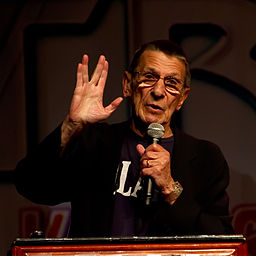
Whatever your choice, Star Trek’s Mr. Spock (Leonard Nimoy in both the images below) has the best salutation: “Live long and prosper;” to which a fellow Vulcan would respond “Peace and long life.” These extra-terrestrial, science fiction-based humanoids are said to have lifespans that can extend beyond 200 years. Yet, as the above salutations suggest, even they remain mindful of the preciousness of time.

http://upload.wikimedia.org/wikipedia/commons/thumb/4/4a/Leonard_Nimoy%2C_2011%2C_ST_Con-2.jpg/256px-Leonard_Nimoy%2C_2011%2C_ST_Con-2.jpg

—

The top picture is called Card Games and Game Tokens by victor vic. The second image is called No Death (the grim reaper crossed out) by Benjamin Hauber. It is followed by a Green Bucket by 4028mdk09. All are sourced from Wikimedia Commons. Finally, Leonard Nimoy as Mr. Spock in the 1960s and at the 2011 Star Trek Convention, the latter by Beth Madison, sourced from Wikimedia Commons. In each instance he is giving the sign that goes along with the salutation “Live long and prosper.”

Fooling Yourself Into Failing Yourself: The Trap of Anxiety and Avoidance

File:Fear of a blank planet.jpg

“But I just don’t like to do that.”

That is what she told me — the young woman who said she didn’t want to go to a restaurant alone. “Why should I do that? I’d much rather eat with someone and be able to talk at dinner. Eating alone wouldn’t be any fun.”

True. Most of us would prefer a dinner companion. It probably would be more enjoyable to dine with a friend. But there is an important distinction here. It is between being able to do something that you might prefer not to do, and being unable to do the thing because it is uncomfortable for you; maybe even frightening. And, it is between deluding yourself into thinking that the activity might be boring or stupid when the truth is that you are afraid to do it.

Deluding and denying. We do it all the time. “I don’t like to do that. Why would I want to do that? Why do I have to do that?” And so we persuade ourselves that we can live without certain experiences, side-stepping the things we don’t know about or haven’t done — the small and large challenges of life.

But what are we really doing here?

http://upload.wikimedia.org/wikipedia/commons/thumb/4/4a/WeirdTalesv36n1pg068_Shocked_Woman.png/240px-WeirdTalesv36n1pg068_Shocked_Woman.png

For the young woman in question, her repeated need to be accompanied to places — her fear to act alone — caused her to be dependent upon people, especially boyfriends. As a result, she found it difficult to be without a male companion for very long and, when she did find one, discovered that she wanted (and needed) to be with her lover more than he wanted and needed to be with her. Thus, her insecurity about being alone and her avoidance of doing things alone made her dependent upon others.

Eventually, the “clinging” drove her boyfriends away. Then she really was alone. Finding herself abandoned and rejected, she turned her reliance on family or friends; if she had those friends, that is, because she had spent so much time with her boyfriends that she’d neglected making platonic friends, along with the work required to keep them.

Some people who are avoidant don’t realize how anxious they are — how much fear dominates their lives. After all, if you turn down invitations to parties because of underlying social anxiety, you manage to avoid getting nervous as you think about the party, dress for the party, drive to the party, walk in the door, and then try to fit in.

The fact that you don’t feel anxious doesn’t necessarily mean that you don’t have anxiety problems. In fact, sometimes a better way to determine whether you have a life-compromising form of anxiety is to make a list of the things you will not do unless forced to at gun point.

  • Things like giving a public speech, raising your hand in class, traveling to the downtown area of a big city, driving on the expressway, making a phone call, going to a party where you know few people, and eating at a fancy restaurant or any place where you are not familiar with the cuisine.
  • Things like going to a movie, play, lecture, or concert alone; flying, sending a poorly prepared dish back to a restaurant’s kitchen, saying “no,” returning an item at the store, etc.
  • Things like trying some new activity on your own or voicing a strong opinion that just might be criticized by someone else; and not looking for a new job for fear of the interviewing process.

Please notice that I’m not talking about some of the very commonly experienced fears such as spiders, high places, and confined places: the phobias we call arachnophobia, acrophobia, or claustrophobia and the like. Rather, my focus is on the anxieties that make for daily difficulties — that make a life so narrow that it begins to look a little bit like this:

http://upload.wikimedia.org/wikipedia/commons/thumb/f/fa/Toledo_narrow_street.jpg/240px-Toledo_narrow_street.jpg

To the avoidant, anxious person, the narrowly confined life seems safer. It is fraught with fewer frustrations and failures. It demands less. It feels less foreboding.

If you are heavily invested in social media, you can even persuade yourself that your electronic social life of texting, instant messages, blogging, tweeting, role-playing games, and hundreds of Facebook friends is better than the real thing. And what might the real thing be? Dedicated time unmediated and uninterrupted by technology spent with a person who is right in front of you and within the reach of an outstretched hand.

Can you approach social situations without a preliminary drink or joint? Are you certain that the alcohol or marijuana you use to unwind is recreational rather than an effort to self-medicate your anxiety? Yes, we are pretty good at talking ourselves into just about anything rather than seeing ourselves as we really are.

But if we are avoidant, there is a price:

  • The same things done over and over and that can be done only in the same places and in the same way; and sometimes only in the realm of electronically achieved distance and safety.
  • The need to rely on others who provide an emotional security blanket, or substance use upon which one is also reliant.
  • The self-doubt and the worry that accompanies thoughts of leaving our “comfort zone.”
  • Too much time spent looking at a television or a Smart Phone or a computer screen.

Avoidance offers no growth and no “life,” only the illusion of safety and the temporary relief that we all know from our school days when the teacher was sick and the test was postponed. I suppose that you can try to postpone the “tests” that life offers until the end of your days. Believe me, I’ve seen it happen. I’m talking about a life of challenges unmet, mastery unachieved — the narrow life that Thoreau described when he said:

The  mass of men lead lives of quiet desperation. What is called resignation is confirmed desperation.

And, in a companion quote often misattributed to Thoreau:

Alas for those that never sing,
But die with all their music in them.

But he also wrote:

Great God, I ask for no meaner pelf

Than that I may not disappoint myself,

That in my action I may soar as high

As I can now discern with this clear eye.

We live in “The Age of Anxiety” according to W.H. Auden. In any life there is a first time — a clumsy, unsure time — for everyone and every thing. We fear the judgment of others, the embarrassment, and the mortification of taking a chance and stumbling in public. We compare how we feel inside to the apparent (but not always real) serenity, calm, and self-confidence of others as we look at them from the outside. We condemn ourselves for lost time and opportunity, say to ourselves that we are “too late” or “too old” to take on a new challenge, and thereby guarantee that even more time will be lost; perhaps all the time we will ever have.

We tell ourselves that we can’t try a thing until we first feel better, calmer, and more confident; not realizing that “trying” is just what we need to do in order to feel better about the thing; failing to grasp that anxiety is not the biggest part of the problem, but that a failure to act in spite of the anxiety is.

If you are anxious enough or avoidant enough you might well avoid counseling, too. That is a shame, because there are very good treatments available in the realm of Cognitive Behavior Therapy (CBT). For a discussion of therapy for Social Anxiety Disorder, for example, you can look at this: Social Anxiety Disorder and Its Treatment.

Only if you fully realize that your avoidant coping strategies are costing you something of value will you call a therapist. Are you afraid to call? Is it less distressing to email? Did I hear you say, “Maybe tomorrow?” You may not detect the sound, but the clock is ticking.

As Eleanor Roosevelt said, “You must do the thing you think you cannot do.”

Now.

http://upload.wikimedia.org/wikipedia/commons/2/2e/RelojDespertador.jpg

—

The top image is described as Fear of a blank planet, cover by Lasse Hoile Porcupine Tree Band 2005: http://www.porcupinetree.com/ “OTRS Ticket 2006082110002647.” The Illustration of a Shocked or Frightened Woman has been altered by AdamBMorgan from the original that appeared in Wierd Tales (September 1941, Volume 36, Number 1). The next image is One of the narrow streets in the old part of Toledo, Spain by Allessio Damato. Finally, An old style alarm clock captured by Jorge Barrios. All are sourced from Wikimedia Commons.

A Question of Trust: A Story That Leads Back Home

The old guy was an easy mark. He’d had a stroke a few years before, made a good recovery with no evident physical effects, but certainly wasn’t the bright young man of his youth. And he wasn’t just any old guy. He was my dad.

“Rain or Shine” Milt Stein, an appellation that referred to his reliability and work ethic, was 83, but still active. Early every morning he took a walk of perhaps a mile in the area near the condo he shared with my mother, who was seven years his junior.

It was the very steamy summer of 1995, the hottest in Chicago’s history, topping out at 106 degrees Fahrenheit (41 degrees Celsius). On the day in question the temperature was already in the 90s, although not yet 7 AM. A relatively young couple with a small boy approached him.

“Our car broke down, sir. Do you have any water — water to drink?” It was a Sunday and stores would not open for three hours or so.

Milt Stein was a gentle and decent man. Perhaps he noted that the family wasn’t especially well-dressed — that their clothing was damp with perspiration. Approximately 750 deaths by heat and dehydration had been reported in the news recently. The condo was only a couple of blocks away. He led the family there.

My mom was shocked when dad unlocked the door and the family entered. Much less trusting than my father, Jeanette Stein never would have permitted this if she had been given a choice. Beauty, charm, and a quick wit were my mother’s strong suits. Faith in humanity wasn’t high on the list. She often said that “no good deed goes unpunished.” Mom knew this wasn’t exactly politically correct and wondered what others might think of her lack of trust. She sometimes made a joke of it by saying (always with a twinkle in her eye), “People say I’m kind, but what I want to know is, what kind?”

No time for such comments now. Strangers were inside her home. As she viewed it, the “aliens” had breached the gate. But what could she do? Dad was already on the way to the kitchen to get some glasses and fill them full of water. Meanwhile, the man and woman began to talk excitedly to my mother.

The boy disappeared.

It all happened quickly. Within just a few minutes everyone had been hydrated and the trio departed. But when my parents went into their bedroom, they noticed that a closet door was open and a cardboard box on a shelf there was ajar. The box was empty of the $10,000 in jewelry it had contained only a few minutes before. The little boy had done his crafty worst. He had taken the treasure.

The police were engaged quickly. A report was filed and the officer told my parents that there had been similar episodes in their neighborhood recently. None of this made my dad feel any better. He felt the fool and, unfortunately, my mother’s criticism of his trusting nature didn’t encourage a quick emotional rebound from the event.

Surprisingly, the police actually were able to recover more than half of the jewelry within a few weeks. But Mrs. Stein’s approval wasn’t so quickly retrieved by Mr. Stein. Mother would tell people the story and father would have to admit that, yes indeed, his kindness had not been repaid in kind.

So what we have here is a difference of temperament or personality on questions of trust and compassion — two models of how to live. You probably have a few family stories yourself, the kind that illustrate similar things, get repeated, and eventually become amusing, even if they didn’t begin that way.

As time passed, my always-clever mother found a humorous way to tell this tale. First she would explain the details of the “con.” Next mom would comment about my father’s naivety and mention the recovery of some of the jewelry almost as an afterthought. But you just knew she couldn’t end it there and the twinkle in her eye gave away that she was getting ready for the knock-out punch. Mrs. Stein pointed her index finger at the man to whom she had been married for nearly 45 years, took a deep breath, wound up and delivered:

“People keep telling me that I should change the locks on the condo. But the problem is, he’s got a key!”

—

The image above is my mother as a young woman. This is a revised version of a story I wrote some time ago.

What We Wish for Our Children: On the Pursuit of Happiness

It is perhaps inevitable that we hand the family flag to our children, sometimes even before they are born, hoping that the little ones will wave it for all to see and admire. We want them to be something special. We want them to cure cancer, make money, be gorgeous, become famous, produce equally singular grandchildren — all of that and more. Somehow — in there somewhere — we think happiness is to be found and will be theirs. That notion is implied, not stated. It assumes that all those achievements and acquisitions will automatically lead to that blessed state of well-being, or at least not diminish their chances of getting there.

As we, the parents, get older though, I think that our hopes and dreams for our kids sometimes change. Perhaps it is, in part, because we have now had many chances to see our offspring hurt — to see them really unhappy. Broken hearts, dashed prospects, defeats on the field of play that we call life. Perhaps we begin to wonder if ACHIEVEMENT is worth the cost, if luck is just possibly more important than talent, if physical beauty is as crucial as we used to think it was. Perhaps we come to realize that no one can “have it all” and that choices have to be made in any life about which baskets will hold our eggs, those fragile parts of us that can be so easily cracked.

Philip Larkin’s poem Born Yesterday gets to the heart of this matter. Written in 1954, it was dedicated to little Sally Amis, the new child of his friends Hilary and Kingsley Amis. He first talks about those things that others are likely to wish for her: things like perfect love and beauty, worthy enough for certain, but not especially likely. And, indeed, he hopes that she can have those things. But then he changes course, knowing that she probably won’t be that lucky.

Larkin suggests that she could do worse than be ordinary. He implies that the qualities that make one different from others — he calls these qualities “uncustomary” — can complicate your life, even if they are remarkable or special, including great talent or beauty. His birthday wish for her is therefore a bit shocking: “In fact, may you be dull –/If that is what a skilled,/Vigilant, flexible,/Unemphasised, enthralled/Catching of happiness is called.”

To me, what he is getting at here is that the ultimate gift for any of us is to have a kind of openness to life, the capacity to experience each day with the wonderment of a child who was, as the title suggests, Born Yesterday. The idea is to discover (or rediscover) that wide-eyed watchfulness that just about all newborns have, that makes the world enthralling. Happiness, in this context, is something to be “caught” almost randomly, not achieved or the result of hard work, but a matter of attitude toward the world and the ability to see it afresh and let the passing moments dazzle you.

If he is right, then most of us and most of our children don’t have to be great heroes or heroines, athletes or leaders, Nobel Prize winners or creative geniuses or supermodels. Happiness might just be in reach, if only one can stretch out one’s arm to catch it.


Here is the poem:

Tightly-folded bud,
I have wished you something
None of the others would:
Not the usual stuff
About being beautiful,
Or running off a spring
Of innocence and love –
They will all wish you that,
And should it prove possible,
Well, you’re a lucky girl.

But if it shouldn’t, then
May you be ordinary;
Have, like other women,
An average of talents:
Not ugly, not good-looking,
Nothing uncustomary
To pull you off your balance,
That, unworkable itself,
Stops all the rest from working.
In fact, may you be dull –
If that is what a skilled,
Vigilant, flexible,
Unemphasised, enthralled
Catching of happiness is called.

—

The photos are of my children when they were small: Jorie and Carly Stein, respectively.

How to Apologize and How Not to Apologize: When “Sorry” Isn’t Enough

http://upload.wikimedia.org/wikipedia/commons/thumb/e/ed/Francisco_de_Zurbar%C3%A1n_053.jpg/256px-Francisco_de_Zurbar%C3%A1n_053.jpg

Is saying that you are sorry the same thing as making an apology? Indeed, many of us have said “I’m sorry for your loss” too often to keep track: to relatives, friends, business associates, and acquaintances. Were we trying to apologize or attempting to provide a consoling message? Were we admitting guilt for what happened or expressing sympathy?

The answer should be easy. When we say that we are “sorry for the loss” we are voicing concern and attempting to comfort, not taking responsibility for the death. Unless, that is, we specify that we caused the demise of the loved one. But ordinarily, we are communicating that we are sad that it happened, not culpable.

When a person is, in fact, blameworthy, he has not necessarily done something terrible. Accidents do happen and sometimes injuries are very small. But, surely the most difficult apology to make must be to acknowledge one’s part in the death of a child. I bring this up because George Zimmerman, the man whose gun shot killed 17-year-old Trayvon Martin following a conflict with him in February, is widely reported to have “apologized” to Martin’s family when he said the following in court at a bond hearing:

I wanted to say I am sorry for the loss of your son. I did not know how old he was. I thought he was a little bit younger than I am, and I did not know if he was armed or not.

Yet, whatever his intention, Zimmerman did not actually apologize. Leaving aside the legal wisdom of making such a statement in court, I’d like to discuss what would have been required for Zimmerman to apologize rather than simply express sympathy, which is what he accomplished.

According to Aaron Lazare’s book On Apology, one must:

  1. Acknowledge the harm that you inflicted — for example, “I broke your toy” or “I shoplifted the purse” or “I shot and killed your loved one.”
  2. Say that you are sorry for what you have personally done, admit that you should not have done it, and express remorse; not simply that you are sorry that a loss occurred.
  3. Attempt to compensate the injured party or parties in some way. In the case of public humiliation caused by a cruel joke, for example, it would be appropriate (although perhaps impractical) for you to make a public admission of your foolishness in front of the same people who were present when you embarrassed the other person. Similarly, if you broke his window, you would need to repair or replace it, or get someone else to do this.
  4. You must do your very best to make sure that your behavior isn’t repeated.

Simply saying “I’m sorry” isn’t enough. Nor is it sufficient to state, “I’m sorry if I’ve hurt you,” a turn-of-phrase we hear from public figures, but one that is absolutely inadequate. According to Lazare, it is crucial that the transgressor be precise in admitting what exactly he did that caused harm, making no excuses that diminish his responsibility. This is the same sort of thing that happens in court, when, after a plea bargain, the accused admits exactly what he did without justifying it, and recounts the consequences that followed from that behavior. In legal terms it is called “allocution.”

Although George Zimmerman didn’t apologize to Trayvon Martin’s family, he did try to explain away his (unspecified) action when he stated, “I did not know how old he was. I thought he was a little bit younger than I am, and I did not know if he was armed or not.” If we look at the requirements of an adequate apology listed above, we can see that Zimmerman met none of them. He did not state that he was responsible for the death of the teenager and the pain that the family is suffering, he did not say that he was sorry for taking the action, he offered no compensation to the family, and he said nothing about changing his behavior (such as trying to avoid future conflicts or deciding not to carry a gun, for example). I understand that the legal process made some of this inadvisable, but that fact does not alter the definition of what an apology is and what it is not.

http://upload.wikimedia.org/wikipedia/commons/thumb/a/af/1885-proposal-caricature.gif/177px-1885-proposal-caricature.gif

Clearly, we cannot and do not apologize for everything. But, if we spill some milk, it really is nice and proper for us to say that we are sorry for what we’ve done and try to clean it up. Most of us do, except for those times when we blame the other by saying “You shouldn’t have put the milk there” or expect someone else to mop the floor.

Apologizing can be surprisingly rewarding, even if difficult. It can help to repair injuries and improve relationships. Apologies can sometimes provide closure to those parties who have suffered significant losses, where adequate compensation is not possible. They can contribute to mutual understanding and lead to forgiveness and letting go.

An example of an attempt to produce such reconciliation between perpetrators and victims was the Republic of South Africa’s Truth and Reconciliation Commission, created after apartheid was ended in that country in 1994. Apartheid was the white government’s policy of racial segregation, denial of human rights, discrimination, and mistreatment of blacks. The Commission included public hearings in which some of the victims testified to their experience. Perhaps more significantly, perpetrators of violence were also permitted to make public statements of their responsibility for wrong-doing and to request amnesty.

There is quite a distance between spilled milk and spilled blood, no question about it. But the possibility of reconciliation, however remote, can only come with a properly voiced apology and the expressed regret that should come with it. Life is full of disagreements, differences, and damage, in addition to unintentionally hurt feelings. Those who are able to feel remorse and admit wrong doing set the stage for the possibility of some amount of healing. Indeed, the perpetrator and the victim are very occasionally bonded together more strongly by the experience.

I hear you saying, “That’s a lot easier to say than to do.” True enough. As one of the members of the comedy team Cheech and Chong used to say, “Taking responsibility is a lot of responsibility.” Self-interest often recommends denial of fault, as in the case of a trial in a court of law. And yet, sometimes common decency, conscience, and a caring heart dictate that we try to repair what we have broken.

—

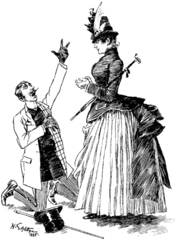
The first image is St. Francis in Meditation, a painting by Francisco de Zurbaran from 1635-1639. It is followed by an 1885 Caricature of a Marriage Proposal by H. Schlittzen. Both are sourced from Wikimedia Commons.

On Giving to Street People

http://upload.wikimedia.org/wikipedia/commons/thumb/4/4d/HOMELESS.jpg/256px-HOMELESS.jpg

Chicago must be a lousy place to be a street person. Not that there is any good place to be homeless. But the cold, wet, and wind are an awful combination. From November until well into April — nearly six months in all — the weather is pretty foul: 131 days a year below freezing with upwards of 37 inches of snow, on average.

I took the Metra train downtown on a recent Friday and made the mile walk on Jackson Street going east from Union Station to Orchestra Hall. Within about a block I saw a man, probably in his 30s, with sandy hair and skin that was just a bit ruddy, betraying a little too much exposure to the elements. Temperature was in the 40s (Fahrenheit) and a fine mist would later develop into some serious precipitation. The windchill doubtless made it colder by a few degrees. It was a typical Chicago wind in Winter: unfriendly.

The man had a sign identifying him as a homeless veteran. Hung around his neck by a string appeared to be his discharge papers, covered in plastic, to let passers-by know that his military service was documented. I saw a white-haired fellow give the vet a dollar; perhaps the model stimulated me to reach into my pocket for the only change I had, 50 cents. The vet said, “God bless you.”

The interaction raised an issue I’ve never thought about deeply. Oh, I’ve thought about it a bit many times. How can you not if you live in a city where many such apparent down-and-outers also live? Sometimes I’d give a little money, most times not. What is the right thing to do in a situation like this?

I suppose that most of us don’t think about it because to do so is emotionally troubling. It is hard to face — face to face — the unfairness of the world. We’d rather not, I imagine, consider the possibility that “there, but for the grace of God, go I.” We just walk past or say “no” when asked to spare some change. If we make eye contact, the abstraction becomes real, the idea of a beggar becomes one particular human being. And if we look too long, or think about him or her, or exchange words, we are now in a relationship of sorts. He is no longer a stranger.

The veteran to whom I gave two quarters got me to thinking of all this, but I didn’t see too many more handwritten signs or encounter any verbal solicitations on my way to Michigan Avenue. Still, there was the middle-aged man whose sandwich board declared CAPITALISM IS RUINING AMERICA, but he appeared to be making a political statement, not requesting assistance. Somewhere along the way, I decided on a plan. I would always have at least half a dollar in change and give it to whomever was the first street person whose path I crossed on any given day.

http://upload.wikimedia.org/wikipedia/commons/thumb/d/d2/Homeless_Man.jpg/256px-Homeless_Man.jpg

Some ask the question, “How do you know if they really need it or what they are going to do with it? Maybe they’ll just buy a bottle of wine.” Maybe they will. I surely don’t know and though I’m a clinical psychologist, can’t trust an assessment based on appearances or a few words, unless the man is staggering and smelling of alcohol.

The clergyman F. Forrester Church addressed this in a 1988 TV interview that appeared on PBS and is transcribed in Bill Moyers: A World of Ideas:

Well, again, there is no perfect solution. Later in his life, Tolstoy, the great Russian novelist, was utterly born again in his own sense of illumination with Christ. The first thing he decided was to take all his royalties, every bit of them, and to give them to the poor. Now this upset his wife and eleven children, because all of a sudden, in Christian Socialism, as he called it, Tolstoy was going to spread everything evenly. The second problem was that when Tolstoy went out and gave this money to the poor in his neighborhood, they all drank themselves into a stupor. He came back and said, ‘How can I act morally?’ He does the right thing, he gets the wrong results.

As long as one recognizes that one can do the right thing and get the wrong results, what one does is give what money is in one’s pocket walking down the street. When a person says to me, ‘I’m gonna use this for food,’ I don’t say to him, ‘Well, be sure you use it for food.’ I say, ‘I don’t care what you use it for — here’s a little extra.'”

Church’s position is not one that everyone takes. Some suspect that the street person must have done something to deserve misfortune — made bad decisions, didn’t take school seriously, failed to work hard enough. I’m sure there are times when they are right. Many assume that the panhandler is mentally ill or an addict. Others will give money to shelters or to charitable organizations that serve the poor; passing by the signs, tin cups, and quietly voiced solicitations without action or guilt. A small number will organize politically on behalf of the underprivileged or pray for them. And then there are those who do nothing, think nothing about it, and smoke a cigar.

http://upload.wikimedia.org/wikipedia/commons/thumb/b/b5/Homeless_anchorage.jpg/512px-Homeless_anchorage.jpg

I was getting closer to Symphony Center now. My mind was drifting to other solicitations and other times. When I was in school a man looking for help appealed to what he believed was a shared ethnic origin. On a different occasion I saw a gorgeous, fair-skinned woman in her early 20s dressed in black, wearing a hooded cape. She asked for money too — to support Satan worship! Then there was the man who played classical tunes on the tuba (badly) before and after Chicago Symphony concerts in front of Orchestra Hall. Was he legless? I seem to remember that. One day, I believe it was near Christmas time, several members of the orchestra’s brass section stood beside him encouraging patrons to donate.

On concert days, a slender and gracious woman faithfully stands at the pedestrian entrance to the Grant Park South parking garage, just in front of Symphony Center, as she has for a number of years. She sells StreetWise, (a modest sized weekly written by the homeless and which benefits them) quietly calling out the name of the paper and wishing you a good night whether you buy or not. The sellers are themselves homeless. Nor should I forget the mother I’d seen in Oak Brook, probably in her 30s, with weathered skin, unwashed dishwater blond hair, and the saddest possible expression. Her sign told of her family’s desperation. She stood at the lip of the ramp exiting the Tri-State Tollway at 22nd Street, only two miles from one Chicago’s most tony shopping centers. I know that I gave her some folding money at least once. I responded similarly to a woman who could have been her sister by all appearances, whose handwritten cardboard described a recent injury to her leg (which was clearly in a cast); her small child sat with her, next to the mother’s crutches. I passed her on Adams Street, also on the way to a concert, simply a different route and a different day.

There must be humiliation in this. To ask for something not earned and to take it; to be assertive when the world has knocked you flat. Maybe I should always have some small denomination, fast-food gift certificates with me, like those sold by McDonald’s? One of my children has been known to give a piece of fruit from her lunch when a poor soul approaches her. It is surely safer than taking out your wallet in public, where someone can snatch it away.

For at least one man, there was no humiliation, but rather entitlement. When I gave him a dollar a number of years ago, he complained that I hadn’t given him more. He called me names as I walked away.

http://upload.wikimedia.org/wikipedia/commons/thumb/4/49/Japanese-homeless-woman.jpg/256px-Japanese-homeless-woman.jpg

In the Great Depression they wrote songs about poverty. Perhaps the most famous is about a World War I veteran written in 1931, Brother, Can You Spare a Dime, lyrics by Yip Harburg, music by Jay Gorney:

They used to tell me I was building a dream, and so I followed the mob,
When there was earth to plow, or guns to bear, I was always there right on the job.
They used to tell me I was building a dream, with peace and glory ahead,
Why should I be standing in line, just waiting for bread?

Once I built a railroad, I made it run, made it race against time.
Once I built a railroad; now it’s done. Brother, can you spare a dime?
Once I built a tower, up to the sun, brick, and rivet, and lime;
Once I built a tower, now it’s done. Brother, can you spare a dime?

Once in khaki suits, gee we looked swell,
Full of that Yankee Doodly Dum,
Half a million boots went slogging through Hell,
And I was the kid with the drum!

Say, don’t you remember, they called me Al; it was Al all the time.
Why don’t you remember, I’m your pal? Buddy, can you spare a dime?

Once in khaki suits, gee we looked swell,
Full of that Yankee Doodly Dum,
Half a million boots went slogging through Hell,
And I was the kid with the drum!

Say, don’t you remember, they called me Al; it was Al all the time.
Say, don’t you remember, I’m your pal? Buddy, can you spare a dime?

http://upload.wikimedia.org/wikipedia/commons/thumb/f/f6/Homeless_Veteran_in_New_York.jpeg/256px-Homeless_Veteran_in_New_York.jpeg

Entering Orchestra Hall for the day’s Chicago Symphony concert, I thought about the lady who was standing in front of an auxiliary entrance to Union Station a few weeks back. That gateway led directly down to the tracks, so I needed to consult the schedule that was placed to the left of the doors. She must have seen that I looked puzzled and offered to help. She asked where I was going and I answered, thinking that she would have more knowledge than I. But I quickly found the “where” and “when” of my train’s departure on the board. As I started to walk toward the tracks she surprised me by asking if I could spare some change. As I reached into my pocket, I said, “I thought you worked here.” “I wish!” she answered, thanked me, and resumed her post of potential assistance, as an entrée to making herself a real person with a service to offer, no longer a stranger without value who could be more easily ignored.

At the concert’s intermission, I remembered the ancient Greek word xenia which refers to strangers or those of foreign origin. You probably know the word xenophobia, derived from the Greek, which refers to a fear of strangers or outlanders. But there is another word, philoxenia, that describes the concept of hospitality and the mutual obligations between stranger and host. In the world that gave us Homer’s Iliad and Odyssey, the host was expected to offer hospitality without asking questions, and to give the guest a gift at the time of his departure. In turn, the guest was expected to be respectful of the host, not to take advantage of his generosity.

Indeed, it was a violation of this concept of philoxenia that set off the Trojan War, when Paris, a son of Troy’s King Priam, made off with Menelaus’s wife Helen (soon to become Helen of Troy) while staying as a guest in his home. Isn’t this something akin to what we fear in the encounter with the street person? Not that our wife will be stolen, but that we will nonetheless be ripped-off?

I took the same route back to Union Station after the concert, encountering more damp and blustery weather. As you will recall, I now had a plan to give change at the outset of my journey on foot, which I’d done a few hours before. So, as I defined it, I’d taken care of my obligation. Walking west I was almost run down by a heavy woman on a pretty fast-moving motorized device, a speedier and less restricting version of a wheel-chair. She mechanically announced, “Beep-beep, beep-beep” to no one in particular, as she moved through and overtook the rush hour pedestrians heading toward the train station. Another woman was standing on the north sidewalk of Jackson Street feeding pigeons and having a good time of it.

There were more homeless or presumed homeless people out now, perhaps because they knew that the streets would be filled with the working stiffs leaving downtown for home. Then, in a single block I saw four different solicitors, including the veteran to whom I’d given my 50 cents earlier; no end of folks really, in the economic mess we find ourselves in as a nation; no, as a world.

My plan clearly was failing. But where shall I find a new one?

http://upload.wikimedia.org/wikipedia/commons/thumb/3/3d/CANADAMIKE.jpg/512px-CANADAMIKE.jpg

—

For a follow-up to this essay from the perspective of a homeless man, please go to Man’s Humanity to Man.

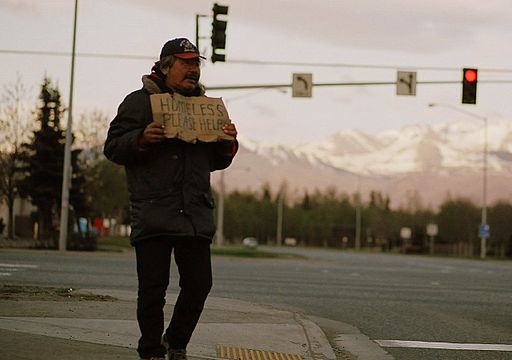
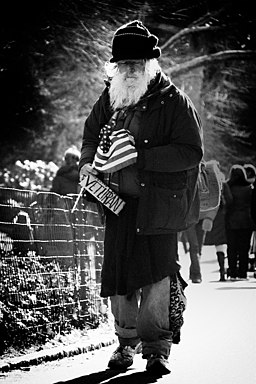
The first photo is called Portrait of a Homeless Manby Larry Allen Skalstad. Next is Homeless Veteranon the streets of Boston, MA by Matthew Woitunski. The third image is titled Homeless Man in Anchorage, Alaskaby Andrew Brown. It is followed by Japanese Homeless Woman Seeking Help in Hamamatsu City, Japan by Comessu, then Homeless Veteran in New Yorkby JMSuarez. Finally, a Homeless Portraitureof the same man in the first image, again by Larry Allen Skalstad. All of these are sourced from Wikimedia Commons.

The Ultimate in Name Dropping

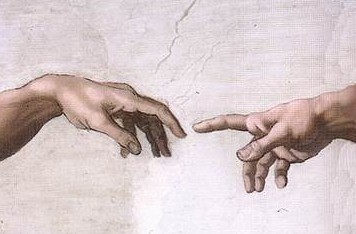
http://upload.wikimedia.org/wikipedia/commons/d/d8/Hands_of_God_and_Adam.jpg

We do our very best to make ourselves feel important. This starts at an early age, when we are too small to amount to much, but able to identify with those who do. “My mom is better than your mom” is a way of proclaiming to the world and ourselves that we have value because of who we hang around with, who made us, and who protects us.

In this kind of “My dad is bigger than your dad” category of speech, however, there is one name that trumps all others: God — the big “G” or “A” or “J” or “Y” or whatever name or acronym or letter you care to substitute.

I am not about to bash religion here. Nor will I praise it, but simply comment on how some people abuse it.

Those folks tend to use the name of God the same way that others do when they refer to the luxury car they drive or a super-model girlfriend. Their perhaps subconscious intention is to stake a claim to a lofty status in the world. God is reduced to some sort of personal mentor or best buddy in high places — very high places. This is especially true when they believe that God has a particular, personally charted plan that, for example, explains why the apartment they’d been hoping to get was available just when they needed it.

Really? God is a real estate broker? God cares whether you have an eastern view out your window so you can see the sun come up? God wants you to have a dishwasher in the kitchen at no extra charge? This isn’t religion, but simple arrogance and conceit; sometimes also a self-defense against the fear of being just another lowly and vulnerable human being.

Some people, usually televangelists, report secret messages God has communicated only to them. Such bulletins echo their own previously stated beliefs. They often come in the form of statements like, “God brought the hurricane down on that town because there was too much sin in that place” or some similar pronouncement. Apparently, the fact that people who weren’t sinful also died in the hurricane is not troubling, either to the messenger of God or to the Almighty himself. But to be God’s emissary — to be the only one of the seven billion people on earth who God chose to offer this bit of wisdom — wow! “See, I’m pretty special, God talks to me about stuff he doesn’t say to any of you.” In other words, “My dad is really, really bigger than your dad!”

Isn’t it curious that these latter-day, self-proclaimed prophets never report the following? “God came to me in a dream last night. He said unto me, ‘Reverend, you are an ass. Why do you think I would want to use you — you — as my mouthpiece. You’re a schlemiel for goodness sake! Keep your mouth shut for once and stop telling people you’ve got a personal pipeline to me. You have no idea what you are talking about!'”

What I’m getting at here is a bit like what is observed as sports fans raise index fingers and shout “We’re #1” when their team wins. We? They may be working dead-end jobs and coming home to ungrateful families, but there is solace, consolation, and uplift in being a part of an athletic powerhouse; in getting some trickle-down benefit from victories that are experienced vicariously. Value is conferred on a single individual when he associates himself with something bigger and better.

Still, few sports fans make the to-do over their favorite team that is done by those who claim a special God-given status and believe themselves to be on the “A-List” of his best followers. God’s extraordinary attention to them is better than an invitation to a State Dinner at the White House. These folks say that God is #1 in their lives, but it is actually the other way around. For them, their special standing with “the Big Guy” is what is important. You don’t have to be creative, talented, or charismatic because God is your buddy. Mary Jo, down the street, may not have time for you — she just dumped you, after all — but God still thinks you are the real deal. Holy Cow! Who needs Mary Jo or Kim Kardashian anyway, when you can have God as a trophy friend?

Might the bible or some other ancient religious document have anything to say about this? Indeed, Micah 6:8 suggests that maybe we aren’t supposed to glory in any kind of special status with the alleged Creator of the Universe:

“He has showed you, O man, what is good. And what does the LORD require of you? To act justly and to love mercy and to walk humbly with your God.”

Humbly. Enough said.

—

The above image is a portion of Michelangelo’s 1509 fresco The Creation of Adam, from the ceiling of the Sistine Chapel. God touches Adam’s finger to give him life. It was photographed by PDArt and sourced from Wikimedia Commons.

Looking For Someone to Take Care of Us

http://upload.wikimedia.org/wikipedia/commons/thumb/7/78/US_Navy_051014-N-8796S-046_A_Pakistani_child_sits_in_his_fathers_arms_aboard_a_U.S._Navy_MH-53E_Sea_Stallion_helicopter_while_his_mother_and_father_are_air_lifted_to_medical_treatment.jpg/256px-US_Navy_051014-N-8796S-046_A_Pakistani_child_sits_in_his_fathers_arms_aboard_a_U.S._Navy_MH-53E_Sea_Stallion_helicopter_while_his_mother_and_father_are_air_lifted_to_medical_treatment.jpg

I woke up in tears: torrential, engulfing, uncontrollable. I was flailing and alone — oh, so desperately heartbroken and alone. My mother was dead. It was the worst moment of my life and remains so to this day; even worse than when she actually died.

I was having a nightmare. Sitting up in bed, daylight snatched me from the kidnap of bad dreams. The sleep-induced catastrophe that bound my psyche disintegrated. And what followed was a sense of gratitude and relief that was equally unique in my experience. I was a school-aged boy, old enough to know about death; old enough to know that it meant never again being with the deceased, never having the guidance, comfort, and security only a parent provides.

What does one do in these moments when something awful and beyond our control is in the room with us — inescapable, hovering, mocking — towering over us and burrowing inside of us? What can provide comfort when a parachute is not in reach and the emptiness in our stomach tells us that we are falling from a great height; when we are drowning and there is no Houdini to help us escape the watery prison filled with our tears and our terror?

I dare say that some of us pray or feel like praying, even if we don’t believe in God. We scramble for something that will provide security. We look for someone to take care of us, an entity bigger and stronger who will make it all better. The battlefield tells a version of the story, where badly wounded, fetal-positioned soldiers cry out for their mothers.

This sense of impotence doesn’t require a situation that involves life and death. I have heard professional musicians tell me that they have more anxiety when their students perform in an important recital than when they perform themselves, fearing the worst will happen. They feel the lack of control, the troubling absence of direct influence on events; the sense of being up a creek without a paddle. If things go badly there is nothing that they can do. They can only watch the slow-motion, life-passing-before-your-eyes unraveling of things until the performance ends.

We feel this with our children, too. A child’s suffering, especially when the world treats him unfairly, can insinuate the same feeling of helplessness in the parent. We are taken hostage, as Francis Bacon said, by the misfortune of those we love. Better it should happen to us than to them.

Many of us are drawn to those who recreate the small child’s impression of parental, god-like omnipotence. These are the people who will “be there” for us in a pinch. I’ve always thought that Ronald Reagan, the 40th President of the United States, was popular more for the rock-solid sense of reliance he inspired than for the particulars of his political philosophy or accomplishments. He seemed bigger than life and able to sooth all doubts about our national future. With him in charge, one didn’t have to worry. No matter the storm, he would bring the ship of state safely to port.

http://upload.wikimedia.org/wikipedia/commons/thumb/a/a8/US_Navy_110818-N-XK513-070_A_Sailor_shares_photos_with_a_Ghanaian_child.jpg/256px-US_Navy_110818-N-XK513-070_A_Sailor_shares_photos_with_a_Ghanaian_child.jpg

How badly do we want someone to care for us, to protect us, to hold us in the palm of his hand? Surely, this is the appeal of Psalm 91:4 of the Hebrew Bible, where God is described as someone who will “cover you with his feathers, and under his wings you will find refuge…”

What happens, though, when the gods seem to be turning away from our misfortune or unhappiness, or worse, creating it? Greek myth tells us that Achilles’s immortal mother Thetis held her child by the ankle as she dipped him in the river Styx, thus making him invulnerable except for the place where she grabbed him (his Achilles heel, which the magical water did not touch). Achilles’s father was a mortal, which meant that their son would eventually perish without special attention from his mother. Yet she failed to dip him a second time to cover the baby’s vulnerable ankle.

The story has been told that a group of prisoners at the Nazi concentration camp Auschwitz went so far as to indict God, although many, many doubtless did so privately and alone. A court proceeding of sorts ensued, complete with judge, prosecutor, and defense. Ellie Wiesel, 83-year-old Nobel Laureate, author, and survivor of that place says that he witnessed a small number of inmates playing out this “trial” of God: “It happened at night; there were just three people. At the end of the trial, they used the word chayav, rather than ‘guilty’. It means ‘He owes us something.’ Then we went to pray.”

“Then we went to pray.” We do so need a god-like figure, a father, a mother, a protector, don’t we? Even a god who has been “convicted;” even a parent who is less than perfect, as all parents are. As the old Gershwin song tells us, we want “someone to watch over me.”

http://upload.wikimedia.org/wikipedia/commons/thumb/c/c7/Mother_and_Child%2C_1912.jpg/256px-Mother_and_Child%2C_1912.jpg

There’s a saying old, says that love is blind
Still we’re often told, “seek and ye shall find”
So I’m going to seek a certain lad I’ve had in mind

Looking everywhere, haven’t found him yet
He’s the big affair I cannot forget
Only man I ever think of with regret

I’d like to add his initial to my monogram
Tell me, where is the shepherd for this lost lamb?

There’s a somebody I’m longin’ to see
I hope that he, turns out to be
Someone who’ll watch over me

I’m a little lamb who’s lost in the wood
I know I could, always be good
To one who’ll watch over me

Although he may not be the man some
Girls think of as handsome
To my heart he carries the key

Won’t you tell him please to put on some speed
Follow my lead, oh, how I need
Someone to watch over me

Won’t you tell him please to put on some speed
Follow my lead, oh, how I need
Someone to watch over me

Someone to watch over me

—

The top photo is a Pakastani Child Sits in His Father’s Arms aboard a U.S. Navy Helicopter, where his mother and father are being airlifted for medical treatment following the October 8, 2005 earthquake. Next,Yoeman 1st Class David Honegger Shows Pictures to a Ghanaian Child. Finally, Mother and Child by Henry Essenhigh Corke. All are sourced from Wikimedia Commons.

How I Saved Superman

superman

In little boys the line between reality and fantasy is a fine one. Santa is real, magic is possible, and mom and dad are the strongest, best, and most wonderful people in the world. In your imagination, fictional characters walk the streets and the greatest of them all, Superman, can really fly.

Day-to-day life in a home of three boys is, however, more complicated. In the home I grew up in with my brothers Ed and Jack, the magic — most of it, that is — quickly wore off.

Dad was usually working one of his multiple jobs and mom was overmatched by raising all of us, to some extent, on her own. Sibling rivalry was inevitable. We all wanted more time and attention and a different kind of time and attention.

From dad, a focus on us as individuals and our specific interests and talents would have been welcome, instead of the more distracted and generic love that came from a man who was always about to leave for work, at work, just back from work, or worried about work and the business of making a living. As a child of the Great Depression, he designed his life to prevent a “Second Coming” of the economic hardship he’d endured in the 1930s.

Mom’s life had no such organizing principle to streamline and normalize it. Perhaps as a result, her internal turmoil wasn’t contained. Relating to her was a tightrope walk.

As challenging as dad’s early life was, mom’s was infinitely more difficult. Her father, a charming bon vivant, was alcoholic. Meanwhile, her mother was suspicious, hard of hearing, and cycled between vicious criticism of her children and a claustrophobic, suffocating love of them. Perhaps worst of all, the family’s frank poverty allowed my mother only enough money for a candy bar at lunch. Before long, malnutrition made her an easy target for tuberculosis, while the family’s economic desperation and social chaos robbed her of any sense of value other than her physical beauty.

Although mom would have rejected the idea, her dad and mine almost certainly made her feel abandoned, even as different as they were. She was in second place with both. To grandpa, it was drunken outings that he preferred; to dad, it was work away from home. And the turmoil of a childhood household with lots of little kids and an ill-equipped mother at the helm was exactly where she found herself again, this time assigned the role her mother had played years before.

The frustration and anger boiled over at her children rather than her parents or her husband. Copying her mother, my mom would complain about each of her children to the others. Comparisons occurred regularly. “Why aren’t you more like ______.” We all heard this and thought we were each the least favorite child because we didn’t know that it was a game without winners. What you did well didn’t count for nearly so much as what you didn’t or did wrong.

Jealousy grew in this way, with each boy thinking the other was getting a better deal. But my mother could also be extraordinarily warm, your fiercest defender against the outside world, and heartbreakingly sad, as she struggled with her own parental and sibling relationships. Only later did I realize I probably got the best of both of my folks, their only child for most of my preschool years.

As the oldest child, I was expected to be more mature than they were. My job was to take some pressure off my parents, and to some degree, be a protector of Ed and Jack.

Eddie was an active, eager, extremely smart little guy, while Jack was an especially loveable child, as huggable as could be. Like all younger brothers (Ed is four years my junior and one year older than Jack), Eddie wanted my time and companionship; perhaps, all the more, because of dad’s absences and Ed’s quick displacement by Jack as the youngest. But, of course, big brothers don’t have the time or don’t want to give it, even as much as little brothers want it and need it. I’m sure my rejection hurt him.

Doubtless, our temperamental differences made things harder. I was scholarly and reserved, carrying the family banner of school performance as far as it would take me. He was active and devilish, the kid who rushed in and sometimes made a mess. We didn’t always get along.

In almost any life there are things you wish you could go back and do over, put right; take what you have learned the hard way and be nicer retrospectively. Yes, I was a kid, even if older than he, and certainly didn’t know down from up. Still, I wish I’d been a better older brother.

Yet there were moments when I did the right thing. Although I was no fighter, I took on our next door neighbor when that boy, slightly older than I, tried to push Ed around. I didn’t win the fist fight, but the point was made that my brother wasn’t fair game. And my mother said that the other kid had a hard time combing his hair for a few days, at the place on the side of his head that I landed my most forceful blow. A few years later and a similar incident happened when an older boy from the local parochial school took on Eddie. This time I wound up on my back. As I said, I was not a great pugilist.

Encounters like this often happened in the alley, as did many activities that were much more fun. In playing games there you could tap your imagination and take a role home didn’t offer. You might be a baseball hero, emulating Ernie Banks or Billy Williams, seeing yourself as the Superboy that parental judgment didn’t recognize. Approval at home might be in short supply, but as Ernie or Billy or Clark Kent’s alter ego there would be no end of cheering for you. And so you escaped from home’s gravity to a fantasy the alley permitted where, like Superboy and Superman, you could fly.

When we were all pretty small, Superman, starring George Reeves, was one of the most popular American TV shows. Reeves (not the late Christopher Reeve, who took the Superman role in the movies) was a handsome, powerfully built hero who every little boy wanted to be like. And with that, “to fight for truth, justice, and the American way” as the idea was understood in the 1950s. Thus, TV provided an iconic image even more potent than the comic books we read, while the alley gave you a playing field to enact whatever heroism might come to mind.

http://upload.wikimedia.org/wikipedia/commons/9/9d/Stamp_Day_for_Superman.jpg

But alley’s also held physical threats rather than the emotional ones inside the house. To retrieve an errant batted ball, you climbed the gutter downspout up to a flat-topped garage. A line-drive might explode a garage door glass window. And if you tripped, the concrete pavement could make for a painful landing and broken teeth. Quite a bit different from the sanitized and supervised public spaces where kids play today and not as safe as they are.

It was in the alley that Eddie showed some particular compassion for me. I was in the seventh grade. The game was a two vs. two touch football contest. In trying to elude a tag I dodged to the right — full-steam into a jutting garage abutment. The right side of my head made the crunching contact. I knew instantly that I was badly hurt. I dropped the ball and walked the few steps home.

Eight-year-old Ed saw me — saw what I’d done to my ballooning forehead and my shutting but blood-shot right eye — and burst into tears.

Ed Stein

As Ed and Jack got older we played games away from home, mostly in summer softball leagues in various parks in Chicago and Evanston. Ed was a fine first baseman and a power hitter who once hit three home runs in a single contest. Jack, the best athlete among us, was a gifted, strong-armed, left-handed outfielder; fleet afoot and capable of slashing line-drives to all fields. He went on to become an award-winning amateur body builder and a successful business man. These were the guys you wanted on your side.

Jack Stein

But not everything in Ed’s life came as easily as hitting a long ball. School was a hard place despite Ed’s intellectual gifts. The rules chaffed. Trouble beckoned. The wrong friends, the kind your folks tell you not to hang around with, weren’t helpful. Some of them would, much later, die of their own recklessness. Accidents, suicide, murder, drugs? In a wild crowd, everything is possible.

For a time, Ed’s life was like a coin in the air. Heads or tails? Who knew?

Finding your way is rarely easy and it wasn’t for Eddie. But Ed managed — through intellect, hard work, and courage — to shed the bad influences and create a wonderful business as a home remodeler of artistic sensibility and refined craft. He is a devoted husband and father; a smart, generous, and decent man who you still want on your side.

And somehow, as sad as it was, the death of our parents meant an escape from the adult version of the crazy-making sibling animosity that my mom never fully stopped fomenting. The death of one’s parents doesn’t always result in closer sibling relationships, what with fighting over estates and bequests. But in our family everyone played fair and it made reconciliation easier.

Ed, Jack, and I figured out that being friends, not just brothers, was something desperately important. That grudges, regardless of the cause, needed to be set aside. That apologies needed to be made. That love, after all, matters more than just about anything. That all the things that bind you — your memories of your folks, your time together growing up in the same home, a shared blood-line, and a desire to live by the Golden Rule — are more important than your differences.

But, as I said before, there were a few early moments when differences didn’t matter and brotherhood did, a harbinger of what was to come. One last childhood memory, then, to reinforce the point that just occasionally we did the right thing as kids. It was back when Ed was still young enough to confuse reality and fantasy. Probably even before he started school.

What am I getting at?

A time when Ed thought Superman actually could fly!

One afternoon, while I was playing in the backyard, Ed was indoors watching Superman. And when the program ended, he decided that it was a really great day for a solo flight. Before long he’d tied a white towel around his neck as a makeshift cape, opened the window facing the backyard, and got out on the ledge that was perhaps 12 feet off the ground, preparing for launch.

By the time I noticed him, Ed was flexing his knees the way Superman did just before take-off. I yelled for him to stop, and for the time being he hesitated. But how to get him turned around and back into the house? He could easily fall trying to make that maneuver. And, if I went back upstairs to pull him inside, there was every chance he would take the opportunity for his inaugural flight after all.

A sewer manhole cover lay just below the window, the place where Eddie would land, not on the more forgiving grass of the backyard. I didn’t know where my mother was and efforts to call out to her weren’t getting her attention. No one else was around.

There was only one thing to do.

I got underneath the window and asked Ed to jump into my arms. I braced myself. He didn’t take much persuasion.

“Ooof,” I groaned as his small body hit my chest and my arms. He didn’t exactly float down. I staggered, but didn’t fall. No one got hurt; no brain damage or broken bones on either side. No trip to the ER at Swedish Covenant Hospital, a place where Ed, Jack, and I all did more than a little time in those years.

In saving another you sometimes save yourself, find the best in yourself — find something that is important to both of you. And wind up in each others’ arms, where you belong. It just took a few more decades to get back to that spot.


So there you have it: the story of how I saved Superman.

A brother who became a friend. Someone you can depend on. A man whose career remodeling things and fixing things is a metaphor for what all three Stein boys did with our lives: repair and recreate ourselves, as many people have to do, but most don’t do nearly so well as Eddie.

A man who learned that a cape was not required to make his spirit soar.

A super man.

Happy Birthday, Eddie.

—

The images, in order, beginning with the second image: Ed Stein hitting a double in a softball game many years ago; Jack Stein at a body building competition in recent years; Stamp Day For Superman featuring George Reeves, 1954, from a U.S. Treasury Film; and Ed Stein and the author. All but the family photos are sourced from Wikimedia Commons.