Whatever Became of Miss Pancake?


Most of us are prone to judging people by what they look like or how they sound — how they pose and shape themselves for the camera of our perception and insight.

Many clever people can put on a good “show” and lead us to believe that the surface of things really does suggest something stable, decent, and worthwhile below the sight lines.

But, as Miss Pancake’s story suggests, sometimes what you think you see isn’t what you get.

The foundation underneath the surface makeup may not be nearly so pretty.

Indeed, outer beauty can suggest a fantasy, something that is very much “made up.”

Miss P was born in 1927, the youngest of her parents’ four children, both immigrants from Eastern Europe.  Along with many other Eastern European Jews, they saw America as a land free of the most obvious forms of anti-Semitism and a place of great economic opportunity. Her father, as the story goes, traveled to the USA in 1912 from Rumania, after a brief stop in England.

Only one problem: he missed his boat to the USA. Its name? The Titanic, or at least, that is what he told everyone.

He went by the name Leo. A tall, dashing, easy-going man with a wicked smile, able to speak at least a little of several languages. His wife Esther was quite a contrast: homely, stocky, with a prematurely lined face; an argumentative woman who never mastered English and never met a person she could trust.

Leo, a Chicago house painter who was hospitalized and nearly died during the 1918 influenza epidemic, made a good living in the 1920s when money was easy to come by and as easily spent. But he was also unreliable, alcoholic; an embarrassment to his kids when he was loaded. Still, a funny, voluble, charming sort of inebriate, never mean-spirited. And always warm and affectionate with children.

The Great Depression was the ruin of Miss Pancake’s family. Nothing unusual there, since 25% of the country was unemployed. Failed banks, bread lines, “hey buddy, can you spare a dime?” Our heroine might have remembered the terror of bill collectors coming to their door and everyone inside pretending not to be home. At some point Leo couldn’t take the unhappy household anymore and left for Winnipeg, Canada, where he had some relatives, conveniently forgetting to take his wife and children along.

But Esther was tenacious and knew that Leo was her only meal-ticket, even if the meals he could buy were now pretty meager. She followed him to Canada, where Miss P’s older siblings remembered the fear that their classmates had of someone from Chicago, the city of Al Capone and his friends. Eventually, they returned to the USA with Leo coming along for the ride.

Esther was the powerhouse of the family. She could brow-beat her husband Leo, who never made a decent financial recovery from the loss of his painting business and whose alcoholism was always an easy target. And his late night carousing left the four children as fair game for Esther’s mix of claustrophobic love, suspicion, and withering criticism as she played one child against the other, leaving them all unhappy.

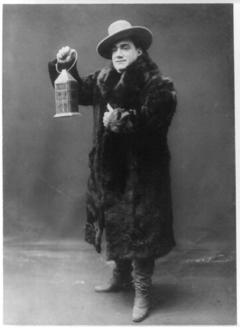
In spite of it all, little Miss P grew to be a beauty. Tall and leggy, buxom, with full lips and a toothy smile, she was quite a dish. You can see the beauty queen above as she looked in her hey-day.

But as the last one left at home when all the other children had moved out and gotten married, Esther held on to her like grim death. No one was ever “good enough” for her, at least according to her mom.

Miss P was witty, bright, and could play men to show her a good time. She worked as a legal secretary in a big deal La Salle Street law office for a wealthy and prominent Chicago lawyer at a time when such a job had a measure of prestige, before women had much access to the practice of law or medicine beyond being helpful to a male who did.

Miss P. could be generous, even if that devotion always had strings attached. She played the role of confidant to many of those she targeted, eagerly attentive until she figured out how she could use the information they were revealing to her — a tactic she had doubtless learned from her suspicious and manipulative mother.

So long as her beauty and charm lasted, Miss P enjoyed the company of well-to-do men who would shower her with gifts. But, as the bloom came off the rose, her life became stranger and stranger. For a number of years she continued working as a legal secretary. Finally, she decided that there were other ways to make a living than working for an employer who expected you to show up every day and collected your Social Security and withholding taxes.

At some point she was also hospitalized at a state psychiatric hospital with a diagnosis of Paranoid Schizophrenia. She was a reluctant patient, to be sure; not patient enough to wait for a medical discharge, she escaped through an open window.

By now Miss P had alienated all but two of her relatives, both nephews.

She would sometimes promise them that when she was gone they would inherit her estate, but it was hard to imagine that she had much of one. Nonetheless, they extended themselves to her out of their sense of obligation and good will more than any anticipation of a posthumous payoff; when she got cancer on her nose and sometimes needed help in getting to the doctor, they were there for her.

It is hard to characterize what Miss P then did for a living, but scamming people comes to mind. It seems that this took several forms. Variation One involved buying articles from one store, presumably on sale, and then either reselling them for more than the purchase price or returning them to another store in an attempt to retrieve the retail, non-sale price. Eventually some stores wanted no part of her business, having gotten wise to her scheming.

Variation Two required her to buy used merchandise or find things that others had discarded. I’m not sure to what extent this depended upon her ability to “dumpster dive,” but I’d be surprise if she didn’t claim some goods this way. Then she would run advertisements in places like The Reader, a free weekly newspaper that permitted ads she didn’t have to pay for.

On one such occasion Miss P sold some used stereo equipment that didn’t work to someone who, understandably, thought it did. When he called to complain and wanted a refund, she retorted, “Who do you think you’re dealing with? This isn’t Marshall Field’s!”

Variation Three had to do with her residence. Although she often rented apartments, sometimes she lived in the lobbies of posh hotels, washing up in the ladies room and sleeping in the lobby chairs, while her goods remained in storage. Again, eventually some of the establishments got wise to her.

Perhaps the most lucrative variation, however, might have been various nuisance law suits she filed against alleged “wrong-doers,” including the multiple land-lords she had over the years, perhaps against physicians who treated her, as well. These sometimes resulted in significant settlements.

In 2001 she soon expected to be between apartments and asked one of her nephews to pick up several suit cases, presumably all her worldly goods that weren’t deposited in a storage facility, and to hold them until she was settled in another rental unit. He dutifully did so, bringing the suitcases to his suburban home.

Several weeks later, however, when she asked that the goods be returned, Nephew #1 relied on Nephew #2 to deliver them. Miss P claimed that two suitcases were missing. A manipulation? A delusion? Who could tell? Phone contact with Nephew #1 didn’t jog her memory about the number of pieces of luggage she left with him, nor cause him to confess to the charge of theft that she was leveling against him.

Given how far gone she was, by now she probably believed her own preposterous story.

It wasn’t too many days before a police car appeared in front of Nephew #1’s home. Miss P was in the back seat. The officer rang the bell, only to find her nephew’s wife alone at home. He questioned her about the allegations and was satisfied that nothing untoward had happened, confiding to her that Miss P was, in fact, a pretty strange bird.

The officer wanted to leave, but the alleged criminal’s spouse insisted that he first search the premises, to satisfy himself and Miss P that nothing of her’s was in their home. But the beauty of paranoia is that evidence or its absence counts for nothing. Our heroine simply believed that whatever had been stolen from her had been sold before she and the police arrived.

Still, you’d think that with the police’s failure to find anything, Miss P would have been at a dead-end.

No one got off so easily once Miss P had targeted him.

Later in the year, claiming indigence, the Circuit Court of Cook County waved the filing fee that normally would have been required of Miss P to file suit against her relative. With Nephew #2 in attendance for the bench trial along with Nephew #1’s wife, Miss Pancake claimed $1200 in damages for the personal property that she alleged to have been “wrongfully detained,” namely, “two marble tables, one statue, nine pieces of luggage, one carry-on bag; and clothing.”

She lost.

Twelve days later her motion for a new trial was denied.

The judge in her suit was her next target. Our beauty queen completed a form entitled “Request For Investigation of a Judge or Associate Judge” that she submitted to the State of Illinois Judicial Inquiry Board. In it, she alleged that Judge Good (certainly not a good day for him):

…has a disability. He cannot read or has eye problems. He should use glasses. Also, he (sic) is known by Daley (Center) employees that he never reads evidence. He just judges people by appearance only.

Incoherently specifying various abuses she suffered at the hands of the judge, including being discriminated against as a senior citizen, she complained that the judge had stated in open court that

…he liked the defendant because he was rich. Then, he also (said,) “Boy, lots (of) money.”

Two years later, no longer able to sue Nephew #1, Miss Pancake sued his wife over the same property, with the same result, although this time Miss P’s kinsman hired an attorney in the hope of ending the repeated confrontations with his aunt once and for all. This time Judge Plenty, obviously sensitive to the plaintiff’s peculiar and disjointed communications, requested that she be assessed as to her capacity for self-care by the Cook County Guardian’s office.

Nothing came of that assessment, other than, I suspect, a good deal of nervousness on her part at the possibility that she might lose her independence.

A month later, our inexhaustible protagonist consulted a private attorney of her own in an effort to continue the pursuit of her personal property, but that man wrote her to say she had no case, and that (having failed to persuade Judges Good and Plenty) she had exhausted all legal remedies with any reasonable likelihood of producing the compensation that she was seeking.

And that is the way Miss Pancake’s relationships with her family ended.

No contact with anyone ever again.

Time passed.

Nephew #1 would read of her death in the obituary column of the Chicago Tribune. A little investigation revealed that she had become a ward of the state and died of Alzheimer’s Disease.

Who would have thought that the story of the beautiful and clever Miss Pancake would end this way?

The moral: don’t judge a book by its cover, candy by its box, or a pancake by its package.

http://upload.wikimedia.org/wikipedia/commons/thumb/8/82/Good_%26_Plenty_licorice_candy.JPG/240px-Good_%26_Plenty_licorice_candy.JPG

—

The photo just above is of Good & Plenty candy, taken by Glane23, sourced from Wikimedia Commons.

What Music Would You Take to a Desert Island?

http://upload.wikimedia.org/wikipedia/commons/b/b4/BinaryRhyme_The_Five_Browns_Rachmaninoff_for_Sisters_at_CBC_Radio_Studio_Sparks.jpg

Toward the end of Woody Allen’s wonderful movie Manhattan, the character he plays asks himself “Why is life worth living?”

His answer?

Well, there are certain things, I guess, that make it worthwhile.

Like what?

For me, I would say, Groucho Marx, to name one thing… Willie Mays and the second movement of the Jupiter Symphony (by Mozart) and Louis Armstrong’s recording of Potato Head Blues… Swedish movies, naturally… Sentimental Education by Flaubert… Marlon Brando, Frank Sinatra, incredible apples and pears by Cezanne, the crabs at Sam Wo’s… Tracy’s face…

Humor then, followed by the art of a gifted baseball player, music, movies, a work of fiction, visual art, food, and the young woman he realizes he loves, almost too late.

Your list would be different, mine would too. But isn’t it interesting how prominent music is on lists such as this, how often people find that an interest in music binds them to lovers, friends, and the joy of living?

A popular radio program on the BBC since 1942 has been asking what music you’d take with you if you were a castaway. It is called Desert Island Discs and it has hosted interviews of nearly 3000 prominent people in that time, trying to find out what tunes would be essential if they were marooned on the proverbial desert island.

On their website Desert Island Discs you can hear a number of these programs and discover the musical choices of folks like Martin Sheen, Alice Cooper, Tom Jones, Tim Robbins, Emma Thompson, Jerry Springer, Barry Manilow, Whoopi Goldberg, J K Rowling, Stephen King, Simon Cowell, Colin Firth, Patrick Stewart, Kim Cattrall, Kiri Te Kanawa, Luciano Pavarotti, and many others from the world of science, philosophy, literature, and government.

Back to Woody Allen’s question, what makes life worthwhile for me?

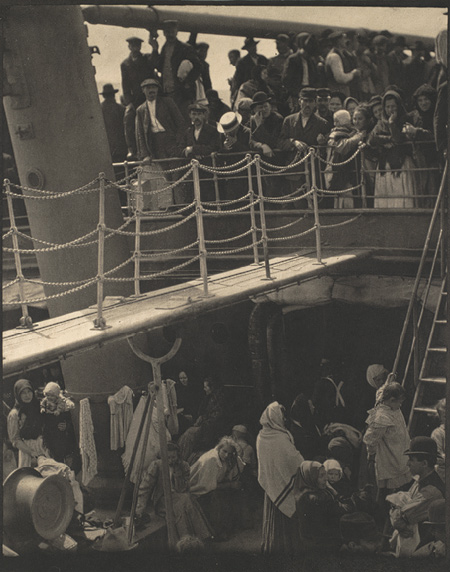
My wife and children, my friends and my brothers… Brahms’s Symphony #4, Beethoven’s Symphony #3, Mahler’s Ich bin der Welt abhanden gekommen, and I’ll Be Seeing You… Judy Collins… Alfred Stieglitz’s photo The Steerage and Van Gogh… The Lives of Others, The Best Years of Our Lives, Lost Horizon, and The Prizoner of Zenda (the last two movies with Ronald Coleman)… getting to know (really know) people…

Anna Karenina, A Tale of Two Cities, and A Prayer for Owen Meany by John Irving… baseball and the Zeolite Scholarship Fund… Shakespeare… Chocolate… Dim Sum, Superdawg (a Chicago area hot dog drive-in), and almost anything cooked by my wife Aleta… Precious and Peanut (family dogs)… listening to and telling stories… the satisfaction of doing something difficult and well… a good cup of coffee and the singing of the birds on a spring morning.

File:The Steerage 1907 Stieglitz.jpg

And if you asked me what would I want in any heaven worth the name?

All that plus my father in middle-age and my mother before life defeated her.

Put another way, I guess I am living in something pretty close to heaven on earth.

Not bad at all.

—

Since, for most of us, food is one of the joys of living, you might want to take a look at an interesting and recently initiated blog on that subject: Adventures in Food.

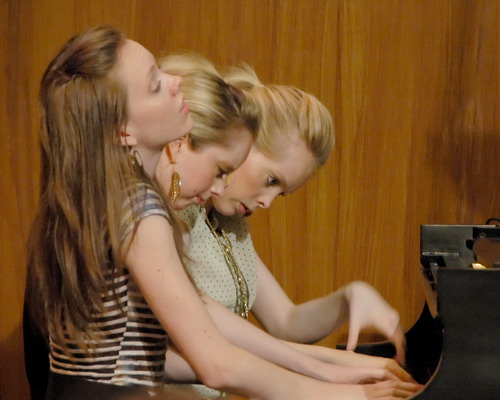
The top photo is Brown sisters Melody, Deondra, and Desirae performing on a Steinway grand piano at CBC Radio Studios in Ottawa, Canada as part of the Ottawa International Chamber Music Festival on September 12, 2006. Photo by Mike (Binary Rhyme) Heffernan. The bottom photo is The Steerage taken by Alfred Stieglitz in 1907. Both are sourced from Wikimedia Commons.

How Duke Snider Burst My Bubble (and What I Learned about the Birds and the Bees)

http://raymondpronk.files.wordpress.com/2011/02/duke_snider_hitting.jpg?w=500&h=374

Will Rogers said “a difference of opinion is what makes horse racing and missionaries.”

But, as a child, I thought that there were certain things with which everyone would agree, where no difference of opinion was possible.

Like the idea that playing baseball was the best imaginable way to make a living and the dream of every red-blooded American male.

Duke Snider taught me otherwise. It was a hard lesson that I learned some time in the 1950s, simply by watching a TV interview of the gifted ball player.

It must have been about the time in 1956 when his infamous article in Collier’s magazine appeared: “I Play Baseball for Money — Not Fun,” co-written with Roger Kahn.

But I didn’t know anything about that. All I knew was that in the middle of the aforementioned interview, when the admiring TV personality questioned him, Edwin Donald “Duke” Snider said that he would rather be on his avocado farm in California than playing center field for the Brooklyn Dodgers.

What! What did he say? And, by the way, what’s an avocado? Here was this handsome, power hitting, left-handed batsman, both graceful and swift, doing something I could only wish I might do; and what did he say?

How can a man I thought to be a hero, a member of the World Champion Dodgers, a teammate of Jackie Robinson, want to be a farmer? Heck, is a farmer and prefers it to playing ball. How is this possible?

As a little kid in Chicago in the ’50s, I had never actually seen a farm. I knew vegetables came out of cans and never thought very much about the people who actually grew them and put them into cans.

In fact, the only time that the question of farming ever came up in conversation around my house, was when I asked my dad where I came from.

Yes, the sex question.

My dad’s answer was simple. He said, “I planted the seed.”

I was badly thrown by the answer, led in the direction of corn and beans and all sorts of things that presumably were grown by farmers, along with small boys.

It took me years to recover from this misinformation and probably delayed my sexual development by a full decade.

Later in his life, Duke Snider admitted that his attitude wasn’t always the best. His New York Times obituary of February 28, 2011 quoted him as saying, “I had to learn that every day wasn’t a bed of roses, and that took some time. I would sulk. I’d have a pity party for myself.”

That summer afternoon of the televised interview I saw must have been one of those days.

I guess the Duke didn’t care for the “boos” he sometimes received, occasionally unfavorable newspaper commentary, the pressure, the travel, and the sheer grind of a long season.

But, I suppose there was a worthy lesson in Duke’s complaint to the local sportscaster.  In fact, there were a few lessons:

  • Make the most of every day.
  • Accept the up-and-down nature of life.
  • Remember that there might be a lot of people who only they wish they could be as well-situated as you are.
  • If you are a farmer, check carefully before turning on the threshing machine, lest you injure a baby boy.
  • And, maybe most important of all: be careful what you say. Kids are listening.

Have You Had Your Daily Dose of Anger?

http://upload.wikimedia.org/wikipedia/commons/c/c1/Bigfuckyou.jpg

There is a test built into this essay, but not the kind you think.

There will be questions at the end, but they will make sense only if you read everything.

And even then, the questions are not the kind that allow for right or wrong answers.

Intrigued?

Read on.

—

In today’s bull’s-eye are teachers, unions, government workers, National Public Radio, and Washington politicians.

Yesterday it was bankers, stock brokers, deal-makers, hedge fund managers, and Wall Streeters in general.

It’s also been Obama for a while.

Anger doesn’t seem to be in short supply. And all these folks recently have been or continue to be convenient targets.

The argument pretty much goes like this: if only so-and-so (referring to an individual or group) were different, better, dead, living in another country, out of power, punished, making less money, or otherwise emasculated, then all the rest of us would be much better off.

They, the same so-and-sos, are the ones who are dragging us down, making the country worse, and so forth.

Of course, sometimes it’s true. But isn’t it interesting that even when the so-and-sos are disempowered, there are still just as many angry people around, looking for and finding another target?

Have you heard very many people deride BP (British Petroleum) lately? You know, the authors of that big Gulf of Mexico oil spill? No, the angry voices have moved on to other resentments.

Life is full of frustrations, a lack of control, and lots of unfairness. The highways are too full, the money we are paid too little, the bosses too demanding, the work too hard, the hours too long, the spouse uncooperative, and the kids are out of control.

Change alone can be frightening — enough to make a person angry — and, gosh knows, the country is certainly changing in ethnic and racial make-up, while the distance between rich and poor increases.

It did seem that people were quieter about their discontents a while back; certainly in the ’50s, not so much in the 1960s when the civil rights movement met the Vietnam War, and protests were all around.

http://upload.wikimedia.org/wikipedia/commons/d/d3/Vietnam_War_Protest_in_DC%2C_1967.gif

I’m told the ’30s were pretty tame in the USA, despite the fact that people were out of work in large numbers (25% unemployed), many more than today. An equivalent level of hardship in 2011 might well generate a revolution.

What accounts for the change from mid-twentieth century America to today? Perhaps the after-glow of a shared national effort (World War II) and the prosperity that followed it made for less sense of grievance. But that wouldn’t explain the modest level of ear-splitting rancor of the Great Depression years.

Others would point to a subsequent loss of faith in government due to corruption or incompetence that made it an easier target, going back as far as the Johnson administration’s escalation of US involvement in the Vietnam War, the Watergate scandal of the Nixon administration, or the nonexistent WMDs (weapons of mass destruction) we were told with certainty required the hurried invasion of Iraq.

Social critics would identify permissive child rearing which allowed children not only to be seen, but also heard and listened to, instead of “seen and not heard;” or the Freudian penchant for finding the roots of adult problems in one’s parents’ child-rearing practices (thus, shifting the blame from oneself to others who become the target of resentment).

Or perhaps it was the creation of a social safety-net that led people to believe that they were “entitled” to things they had not earned and encouraged them to “demand” more dollars out of other people’s pockets — which found those people not taking kindly to the idea and in some cases quite opposed to safety-nets in general; nor should we forget a legal profession ready to exact payment for real and perceived wrongs.

And some might point to public anger as the last vestige of the “Don’t Tread on Me” motto found on the Gadsden flag of Revolutionary War days, the thing that helped enable the colonists to fight the British. Surely, it was then a more than necessary evil.

But for whatever reason, among us are angry people who find lots of fault with others, less often than with themselves.

http://upload.wikimedia.org/wikipedia/commons/thumb/d/d8/Gadsden_flag.svg/240px-Gadsden_flag.svg.png

Few of the those most insistent that things be done their way seem to have read their history books; nor have they thought through the consequences of their actions down the road.

The notion that “IF IT FEELS RIGHT, IT IS RIGHT,” seems persuasive, until you realize that just the opposite position might feel just as right to someone else. And every self-righteous person always thinks as the WWII Germans did: “Gott mit uns” (God is with us).

The red-faced, clench-fisted, self-appointed defenders of all that is good and proper (as they see it) refuse to compromise on anything. Blustering assertion has replaced reasoned and well-researched argument.

Little time is taken to locate and read — yes read, not watch or listen to — a reliable and thorough daily news source.  Instead, many of us hear and watch the “info-tainment” of the 10 O’Clock news, or partisan “news” reports and sound bites presenting arguments that are one-sided and sometimes factually inaccurate, becoming the pawns of someone else’s vision of the way the world should be.

If the fountain that you drink at makes your blood boil, should you come back for more?

Rallying cries to “preserve the constitution,” poor analogies to the Holocaust or the Soviet Union, and threats of imminent “dictatorship”  or “tyranny” have all been used to justify steaming outrage and urgent action. The word “government” is treated as if it were spelled with four letters, just as word actually made of four letters, “B-u-s-h,” was used in a similar derisive, “dirty word” way before his page was turned by a new election.

“Liberal” policy threatens encroaching socialism to certain groups on the right, while the “conservative” agenda augers the creation of a permanent “underclass” and the domination of business interests over the little guy on the left.

We make improper use of the names we call the objects of our anger. For example, but for a few extremists, there is no “far left” or “far right” in this country. “Far left” is communism, “far right” is fascism. Maybe I’m missing something, but I don’t see any major politician who resembles Lenin or Hitler, or who is advocating their policies.

http://upload.wikimedia.org/wikipedia/commons/thumb/d/d1/Obama-Nazi_comparison_-_Tea_Party_protest.jpg/240px-Obama-Nazi_comparison_-_Tea_Party_protest.jpg

Instead of thoughtfulness, there is a lot of venting. Anger, of course, is self-justifying, and fairness is in the eye of the beholder. Which is why the angry zealots do not usually seek psychotherapy voluntarily. Those few who wish to are advised to take a look at Ronald Potter-Efron’s Stop the Anger Now as a starting place.

Meanwhile, internal inconsistencies in one’s world view are ignored by those who are most incensed. Social conservatives who wish to legislatively forbid Gay marriage or abortion are attempting to regulate some very private events, but generally wish less government control over health care and fewer national rules for business and finance. Meanwhile, those who are socially liberal want their private lives kept private, but look to more constraint and control over health care and business practices.

In effect, the social conservatives want the government into the bedroom and out of your wallet, while the liberals want it out of the bedroom, but into your wallet.

Since 1940, significant groups within the good old USA have voiced strenuously opposition to:

Japanese Americans (who were interned in concentration camps if they lived on the west coast during World War II, even though most were US citizens), people who might have dabbled with Communism during the Great Depression (many intellectuals did), and “pre-mature antifascists” (who were suspected of being Communists after World War II, despite their prescience and courage in taking action against the Spanish and German fascists during the Spanish Civil War).

Others with a bull’s eye on their backs have included Blacks, civil rights activists, hippies, the “military-industrial complex” during the Vietnam War, anti-war protesters in the same period, doctors who perform abortions, Mexicans, Muslims, illegal immigrants, Gays (especially after the Iron Curtain fell and a new object of enmity was required to replace the USSR); and, of course, Presidents Roosevelt, Truman, Nixon, Clinton, George W. Bush, and Obama.

Not to mention Donald Rumsfeld and Dick Chaney.

I’m sure I’m leaving some important people out.

Clearly, some folks earn our intense dislike.

But many of those listed above simply seemed to be easy targets or had ideas or origins that were “different.”

My point is that there is a lot of misplaced anger out there — a bit like kicking the dog when you walk in the door because your boss gave you a hard-time at work.

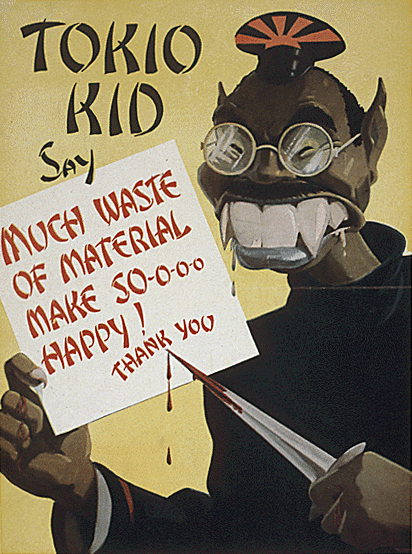
Even where anger is justified, it can go off the rails. As John Dower notes in his brilliant book War Without Mercy, the Pacific portion of World War II was a race war. Both sides dehumanized and demonized the enemy in caricatures and words. One can only imagine what U.S. citizens of Japanese ancestry felt when they looked at posters such as this, a buck toothed, saber toothed, drooling, myopic, dog-eared, satanic travesty of their image:

http://upload.wikimedia.org/wikipedia/commons/3/33/Tokio_Kid_Say.png

Even in less fraught times, in-groups commonly defend against out-groups, while out-groups are trying to get in. The pie that represents the “American Dream” seems to be getting smaller, and everyone wants a pretty big piece. I suspect that some of the rage we see today is in response to the precarious, dangerous, and competitive nature of life itself: the daily indignities, the feelings of helpless, and the sheer dazzling and frightening speed with which things change faster than we can keep up.

And perhaps some other part is just our biological and genetic inheritance — the “fight or flight” capacity for anger that our ancestors had to have in order to take on the real threats to their existence and protect those they loved.

As an old 1960 Twilight Zone episode illustrated brilliantly, we are prone to believing that The Monsters are Due on Maple Street even if there are no monsters. If you haven’t ever seen it or haven’t watched it in a while, it shows how chaos and unpredictable change added together can trigger the search for scapegoats, even among the innocent in an average suburban community.

If instead you consult Brigitte Gabriel, author of They Must Be Stopped, you will be told that “America has been infiltrated on all levels by radicals who wish to harm America. They have infiltrated us at the C.I.A, at the F.B.I., at the Pentagon, at the State Department.”

And who are “they?” Muslims living in the U.S.A.

Really? Or is Ms. Gabriel simply Wisconsin Senator Joseph McCarthy in a dress? McCarthy was the man (eventually censured by the Senate) who told us of the non-existent infiltration of the government by Communists back in 1950:

The State Department is infested with communists. I have here in my hand a list of 205—a list of names that were made known to the Secretary of State as being members of the Communist Party and who nevertheless are still working and shaping policy in the State Department.

Joseph McCarthy.jpg

McCarthy never came up with hard evidence for his claim and sometimes changed the number of alleged traitors in government. Nor has Gabriel offered such evidence for her accusations.

When will Ms. Gabriel mention that the independent research group Triangle Center on Terrorism and Homeland Security, affiliated with the University of North Carolina, Duke University, and RTI International reports something rather different? It indicates that Muslims provided tips that helped thwart 48 of the 120 U.S. terror attacks planned by their co-religionists since 9/11/2001 .

Long story short: beware of angry people. Their anger just might be turned in your direction. Today, perhaps, they are your friend. But tomorrow?

Beware of those rabble-rousers who stir up the discontented. Enough of them can be found on cable TV, talk radio, and on the Internet. They aren’t your friends either.

Be careful of those who only occasionally see more than one side to any story; and the only side they tend to see is their own.

Be on guard against the people for whom angry expression and impulsive action are the solutions and not the problems.

If you are attracted to someone who appears to be your big, strong, and powerful protector, remember that your only real protection is in yourself and the rule of law; and that one day you may find that the fearsomeness of your companion has become a threat to you.

Beware, too, of angry people with a drink in their hands (McCarthy was one such), unmindful of the disinhibiting potential of alcohol to set their rage loose.

In 1919, just after World War I, William Butler Yeats wrote in The Second Coming:

Turning and turning in the widening gyre
The falcon cannot hear the falconer;
Things fall apart; the centre cannot hold;
Mere anarchy is loosed upon the world,
The blood-dimmed tide is loosed, and everywhere
The ceremony of innocence is drowned;
The best lack all conviction, while the worst
Are full of passionate intensity…

Are we are in one of those moments again?

I guess that depends on how the quieter voices respond.

The future is up to every one of us.

Make the future.

End of today’s sermon.

—

Now for the test questions.

Have you found yourself muttering under your breath as you read the above?

Have you cursed to yourself about the opinions I’ve expressed?

While I don’t claim impartiality, in more than one case I have pointed at difficulties on both sides of American politics. Have you been able to see the other side’s point of view even a little?

Do you believe that anyone who leans in a different political direction is unworthy of your respect or your ear?

Do you have good friends who look at politics from other than your perspective?

Can you have a well-reasoned, honest, and civil conversation with someone who does not hold your position about any of the issues described above? And, if you do, do you permit the possibility of altering your stance a bit?

Do you search for the facts that are available from non-partisan news sources and do they ever persuade you to change your mind about something?

Is there anyone on the other side of the aisle who you admire? Even a small amount? Is there a single writer from the opposition party who’s regular column you read?

Have your past judgments about others, as well as your personal and business decision making, been so good that you are utterly certain of the validity of all of your political opinions today? Put differently, has your life been such a shining example of wisdom and inerrant behavior that it is impossible that you are wrong?

No one on earth has ever been all-knowing in the arena of world affairs and even those solutions that work tend to have a short shelf-life. Angry self-righteousness, however, can last rather longer.

If you are unwilling to change course (in politics or anything else), consider new information, or compromise in a rapidly transforming world, you will have taken the fixed position of a stopped-clock — right only twice a day.

But, no matter your political persuasion, you will be angry all day.

—

The top image is A (gentle)man giving the middle finger angrily by Mgregoro. The second image is that of a Vietnam War Protest in Washington D.C. by Frank Wolfe, October 21, 1967, followed by the Gadsden Flag by Lexicon, Vikrum. The next photo pictures Protesters at the Taxpayer March on Washington by dbking, which occurred on September 12, 2009, after which is a U.S.A. propaganda poster from World War II:  Tokio_Kid_Say.png. The final image is a 1954 photo of Senator Joseph McCarthy taken by United Press. All are sourced from Wikimedia Commons.

Searching for Sanctuary and the Kindness of Strangers

http://upload.wikimedia.org/wikipedia/commons/thumb/c/cc/I_Wait%2C_by_Julia_Margaret_Cameron.jpg/500px-I_Wait%2C_by_Julia_Margaret_Cameron.jpg

Sometimes it is the next door neighbor or the checkout lady at the store. Sometimes it is a friend’s mom or dad. Sometimes it is an aunt or an uncle, a grandparent or a teacher.

Their role is to provide a glimmer of hope, kindness, and a little bit of the love that by rights should come from the parent, but doesn’t; just enough to make life tolerable; just enough to get the child through the bitterness of life at home with some small sense of self-worth and the hope that the future might be better.

Benign and caring adults are remembered all your life, even if you passed through a less than dire childhood.

I can recall two men in my own life who showed kindness and an interest in me, whose connection felt good to me, who offered respect and seemed to enjoy the times that we talked. One would play catch with me on occasion, something I dearly treasured because my father was often at work. Mr. Maddock, our next door neighbor, was a handsome man with two sons of his own, but always had a good word and took the time to say it.

Another, Bob Hanel’s dad, a man tall and slender, talked baseball with me when he walked down the alley with his small dog. “Such a big man and such a small dog,” I remember thinking. He was blond, like his crew cut son. The younger Hanel, my older buddy Bob, became a dentist, I believe.

And, now that I think of it, there was the owner of a soda shop/candy store on Lincoln Avenue near Washtenaw, Mr. Sharon, who was loved by all the kids who frequented his establishment. A roundish and white-haired man with a warm and soothing manner, and a ready smile. He called me “son,” a common mode of address from a “stranger” to a male child in the ’50s and ’60s that implied a certain kind of protective relationship between a man and a boy.

A heart condition eventually laid Mr. Sharon low and he had to sell the store.

Ironic that his heart should have caused him trouble, because — for me at least  — his heart was the best part of him.

I’m sure that adults who fill this saving role in the lives of troubled kids think nothing of what they are doing. They probably don’t know how tough it is for the child.

Parents usually succeed in hiding these things from the public. The household ethic is to keep up appearances. And the warning is never to talk about what happens inside the house while out of the house. Most children keep to this admonition, honoring the parents’ concern for reputation over reality, not wishing to disappoint mom or dad by an act that would be considered disloyal.

So much can be achieved for kids like this, just by being stable, smiling, asking a question, offering a cookie or a soft drink.

It means the world:

My last name begins with the letter “M.” Jane’s begins with “N,” so she sat behind me in the first grade. We lived just a block from each other. We became friends.

The first time I was allowed to go to Jane’s house, I was amazed at how different it was from my home.

Janes’s mother was out of bed, dressed, made meals, did laundry, cleaned their home and took Jane and her siblings places outside their house. I felt terribly sorry for them. Everyone knew that moms were supposed to lay in bed all day and give orders!

Making meals, cleaning, laundry, etc. were what the maid did. They didn’t even have a maid!

As I later realized, my mom’s illnesses were the kind that no doctor could diagnose, nor persuade my mother that they did not exist.

My family had more money that Jane’s. In retrospect, it must have been a hardship to keep feeding me, year after year, yet Mrs. N never even hinted that I should go home. Not even once.

Jane’s father came home every evening and had dinner with the family. Very strange. I wondered why he wasn’t always at work like my dad.  Jane’s father wasn’t all that fond of my omnipresence, however.

I’m guessing Mrs. N never let him tell me to go away.

Over the years, Jane and I became inseparable. We spent almost every waking moment together. We  did this at Jane’s house, rarely at mine. My home was bigger — had more room and more quiet. Neither one of us wanted to be there, although it was never discussed, simply understood. We played at her house, we ate dinner at her house, every weekend I slept at her house. This went on from age seven to approximately age 16.

During all this time, I never realized what a gift Mrs. N was to me. It was only much later that I came to understand that this woman probably saved me. I had a safe place to go. I had a place where no one criticized me. Where people were alive, not constantly “dying.” It was a relief not to be in the tomb I called home.

My mother believed that if something was easy for her, it should automatically be easy for me. One day she wanted me to swallow a Coricidin capsule. I couldn’t. My usually “bed-ridden” mother chased me around the house trying to force me to swallow. At last I was backed into a corner in the kitchen and told that I was going to swallow that pill or “I am going to know the reason why!”

It wasn’t a pretty day. Pill swallowing was enormously difficult for me. I don’t remember if I ever got that pill down.

As soon as I could, I fled to Jane’s house. Mrs. N made no comment about the incident. I’m not sure if it was then or a little later she suggested that if I put a tablet in a little applesauce, it might make it easier to swallow. It worked and mother never gave me grief about pills again.

As a young adolescent, I would run away from home, usually leaving in the middle of the night. I’d walk the streets of our neighborhood. Eventually, I’d head for Jane’s house and climb in the front window.

The first time this happened, Mrs. N was up waiting for me. My mother had called her looking for me. Somehow Jane’s mom knew that I’d show up at her house. She immediately called my mother, who had called the police. Mrs. N then said she would put me to bed with Jane.

For a couple of years, I ran away a lot. The police told my mother not to call them anymore. Eventually, she stopped noticing that I was gone. So, when I was ready to come back, I’d just crawl in through the window in Jane’s house, not my own. Mrs. N let me.

No critical comments.

She never, ever told me I was a bad kid who should stay home.

She never told me not to do it.

She simply accepted me.

On rare occasions, she would very subtly say something that led me to believe she didn’t approve of the way my family treated me. However, she never put down anything my family did.

Twice a year my father would take me shopping for seasonal clothes, to up-scale stores like Marshall Fields and Saks Fifth Avenue.  I had nicer clothes and many more of them than Jane and her siblings.  When, on occasion, Mrs N would be taking Jane and her other children shopping for clothes, she took them to what we called “schlock shops.” Basically, these were the counterparts of today’s Loehmann’s.

She would take me also. I wonder if she knew how wonderful it was to have a woman’s point of view and a “family” experience?

Mrs N never said a word, really. There was just her unending acceptance. I actually thought it was normal, unremarkable. After all, Jane and I were best friends. She never let me believe that I was getting anything special.

Mrs. N allowed me to be in every part of her family life throughout my entire childhood. I never wondered, until this very minute, if she loved me.  Perhaps so. Perhaps not. I was not exactly a lovable child. Yet, she saved me. I don’t know if she did it consciously. Although I think she knew how desperately I needed her.

The years went by. Jane moved out-of-state. The only time I saw Mrs. N was when Jane came home for a visit with her husband, and later, their children. Once again, I fell back into Jane’s family. I hung-out at Mrs. N’s house whenever I could. She was still welcoming and accepting.

When I got married I asked Jane to be the matron of honor in our very small wedding. My husband and I had no plans after the ceremony. The next thing I knew, there was a luncheon following — given by Mrs. N at her home.

Mrs. N died a while ago. In adulthood, I often tried to tell her she saved me and how much I had come to appreciate her. She pooh-poohed me. Yet, she was always there for me, without my really knowing it.

That, I think, was the greatest gift of all.

—

The above image is I Wait, an 1872  photo of Rachel Gurney by Julia Margaret Cameron, sourced from Wikimedia Commons.

The Last Day of School and Other Sighs of Relief

http://upload.wikimedia.org/wikipedia/commons/thumb/b/bf/VJ-day-cernobila.jpg/240px-VJ-day-cernobila.jpg

Every so often something happens that feels like a great weight has been lifted off of some important body part.

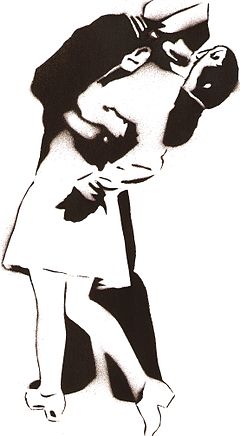
The end of war, as in the famous Times Square VJ Day photo of Alfred Eisenstaedt, produced just that giddy, “it’s good to be alive” combination of gratitude, joy, relief, and abandon. In the spontaneous madness of public celebration, the sailor sweeps a nurse unknown to him into his arms.

I dare say that the U.S.A. probably hasn’t experienced anything quite like that shared moment since World War II ended in 1945.

But most of us born after that event probably know some smaller examples of the same feeling from our post-war childhood.

Remember the last day of school when you were young? In the Chicago Public School system, the final day was always curtailed. And as the seconds of the shortened day counted off, all you could think about was how the vast expanse of summer time (“when the livin’ is easy,” as Gershwin’s Porgy and Bess told us) lay ahead.

Imagine, over two months (until the day after Labor Day) without the classroom grind!

Amusement park rides, ball games (played and watched), movies, swimming, TV, catching fire flies, trading baseball cards, and sleeping late all beckoned. And, best of all, no homework, no tests, just about no responsibilities.

When I was very small, I’d actually imagined something even better. I don’t recall my age, but I must have been about seven. It was the foggiest day ever. One could see perhaps only a quarter of a block ahead and the world became this mysterious, fantastical, enshrouded place that looked like a different planet than I had inhabited the day before.

http://upload.wikimedia.org/wikipedia/commons/thumb/6/60/Hydrocarbon_fog.jpg/240px-Hydrocarbon_fog.jpg

And somehow, on the 15 minute walk from Talman Avenue to Jamieson School, I got the idea in my head that perhaps, just perhaps, my school had disappeared! Minnie Mars Jamieson School still occupies about 2/3 of a square city block in the Budlong Woods neighborhood of Chicago’s northwest side. It is three stories high — all bricks and mortar and intimidation.

But still, if I couldn’t see it, surely it wasn’t there. It didn’t occur to me that all the other befogged buildings on the walk to school were coming into view once I got close enough to them. I didn’t consider what it might have taken to raze the gigantic edifice quietly over night. And sure enough, as soon as I got close, the structure rose up before me and looked down on me, as if to say, “Not so fast, buster. You can’t get out of school that easily. I’ve been here since 1937 and I’m always going to be here. Get used to it.”

No, reality could not be escaped. And, as if to counterbalance the relief I felt on school’s last day each year, the business world concocted a dreaded campaign to suck the life out of the last few weeks of “freedom” one experienced at the end of summer.

Even today it is called by the same name: THE BACK TO SCHOOL SALE.

It seemed to me that all of the stores except for those selling food and tires must have come together in some secret meeting place with the following agenda:

Those kids seem altogether too happy. They are enjoying their time off too much. How can we bring them down to earth?

I’d like to meet the now, undoubtedly long-dead genius who answered that question. The guy who got all the other retailers to promise that they would create gigantic billboards and store signs, employ men wearing sandwich boards, run newspaper and magazine ads, and create radio and TV commercials that would, at precisely the same moment on August 1st, make it impossible for any kid in America to completely enjoy his last month of liberty.

The ads and signs seemed to count-off the days on your stay of execution: 25, 24, 23…tick, tick, tick, 13, 12, 11…tick, tick, tick, 3, 2, 1.

back-to-school-resistance-is-futile1

If you recall James Cagney or some other movie actor going to pieces as he walked down death-row to the electric chair, then you have some idea of what this felt like even if you never went to school a day in your life.

“Oh, no, not that, anything but that!”

It was only many years later, when I became a college professor, that I began to realize that the teachers probably felt as bad about the end of summer as the kids.

But, as I think about it, in the nostalgic after-glow of a long-departed youth, its hard not to be grateful for that joyous end-of-school, end-of-war, sense of relief that still visits me from time to time.

Yes, I get the back-to-school feeling on occasion as well. But it seems more manageable now, easier to accept.

It’s almost spring now. Think Frederic Delius’s achingly beautiful, six-minute tone poem, On Hearing the First Cuckoo in Spring. And, to greet the summer we have the first movement of Gustav Mahler’s Symphony #3, the movement he called “Summer Marches In.”

The end of the school year is near.

The world is full of delight.

Enjoy the small pleasures.

—

The top image is card stencil spray paint from a photocopy of the famous VJ day image by Alfred Eisenstaedt sourced from Wikimedia Commons. The second photo is Hydrocarbon fog.jpg by Cambridge Bay Weather. Both are sourced from Wikimedia Commons.

Of Grasshoppers and Ants: When Winter Comes

http://upload.wikimedia.org/wikipedia/commons/f/f8/The_Ant_and_the_Grasshopper_-_Project_Gutenberg_etext_19994.jpg

It is an age-old dilemma and an age-old story. Spend or save? Play or work?

Aesop told it in the tale of The Ant and the Grasshopper. The grasshopper sings the summer away while the ant works to store food for the cold months. When winter comes, the grasshopper is out of luck.

There are numerous different versions of this story, but I’ve always wondered about one particular, very human variation. What happens when two people, close friends or lovers, are both engaged in a lifestyle that only one can afford?

The woman, a high-powered executive with a salary to match, can afford to live the way she does; expensive meals, nice trips, Broadway musicals and the like. The man has the same tastes as his lady friend and enjoys indulging them no less, but isn’t a big-time earner. His is a “live for today” attitude, and let tomorrow take care of itself.

Finally, though, the man has a reversal of fortune; perhaps he loses his job. Or, let’s say that he must retire. Both remain healthy and active, but the small amount of savings in the man’s account is mostly gone, spent on all those dinners and trips, the wine and the laughter that accompanied the good times. The woman still wants to live in the same old way: not counting the pennies. The male is largely dependent on his severance and unemployment benefits in one scenario, or on his modest Social Security and retirement checks if he is a bit older.

What happens now?

A few different possibilities:

1. The woman adjusts her life style and learns to live in a new way, still spending the same amount of free time with the man; the man, too, realizes he cannot live as before and finds less expensive ways of having a good time. Travel is severely curtailed. Lavish restaurant meals are now just memories. They accept the new financial terms dictated by his financial status and still enjoy the relationship.

1a. Both parties try to live with less expense, but it doesn’t work for them. The man believes that the woman could support some approximation of the previous level of entertainment and luxury if only she wished to. The woman regrets the need to set aside “fun,” even if it is in an effort to maintain the relationship. Each one feels the strain.

2. The woman decides that she still wants to live in the old way and is willing to pay for her friend to accompany her. Some amount of “hostile dependency” is inevitable, with the man feeling resentment that he has lost “standing” in the relationship. Meanwhile, the woman matches his resentment with a sense that her lover is not sufficiently grateful for her generosity.

3. In the final scenario the woman decides she wants to live as before, but she doesn’t intend to pay for her friend’s expenses all the time. So she leaves him behind with some frequency, going to expensive dinners with female friends, going on trips alone or with others who can pay their own way. She does not want to mortgage her economic future to indulge her friend.

Of course, this path risks its own tensions. The man is angry at being left behind and the financial strain of trying to keep up with his companion to the extent that he can. The woman resents his resentment, because she is paying for more than before, even if not for everything.

The lovers are spending less time together now and therefore might have more opportunity to meet someone else of the opposite sex with whom these difficulties would not be present. Temptation exists where none existed before.

Now, I imagine that you might have one of several responses. “Too bad,” would probably be one, a shame that they have had this reversal in fortune that has changed the relationship.

On the other hand, some of you might blame him for being the “grasshopper” who didn’t save for the winter. Others could find the woman selfish and self-involved if she chooses either the second or the third “solution,” unwilling to be more generous toward the man she says she loves.

In my experience, it would be relatively rare for two people accustomed to a somewhat extravagant way of living to adjust to a more modest lifestyle when such an adjustment is necessary only for one of them. Indeed, in the present example, one can fairly assume that shared interests in elegant dining, good seats at sporting events, and travel were among the elements that attracted one to the other and bound them together.

In the end, we outsiders often think that the proper solutions to — let’s face it — non-life-threatening problems like these are obvious and should be easy to implement.

But when you are in the middle of the thing itself, it often isn’t as easy as it looks from the grandstand.

If only this couple could realize their good fortune in having each other, friends and family, and their good health (Solution #1), as well as the relative unimportance of living grandly…

http://upload.wikimedia.org/wikipedia/commons/1/12/Goya-La_ri%C3%B1a.jpg

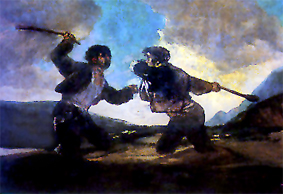
There is a famous 1819 painting by Francisco de Goya, La Riña. It shows two men attempting to beat each other, stuck in muck and mire. Nothing too remarkable in that.

But what is stunning about the composition is how it contrasts the brutality of the antagonists with the staggering beauty of the landscape they inhabit. Just as in the case of the hypothetical man and woman I’ve described, who (unless they can comfortably arrive at the first solution) will live in some unnecessary measure of tension and unhappiness, these men, too, do not see the beauty around them or value it highly enough.

And so the consolation of what the lovers still have together — those things about their relationship that are free of any cost — is dismissed, just as the beauty and wonder of nature are ignored by these men, sacrificed to their resentments.

Sound familiar?

—

The first image above is The Ant and the Grasshopper, from Aesop’s Fables, a 1919 illustration by Milo Winter, available from Project Gutenberg and sourced from Wikimedia Commons. The second is the Goya painting I described, which resides in the Prado, with the same source.

Sex: When Your Spouse Says “No”

http://upload.wikimedia.org/wikipedia/commons/thumb/8/85/Van_Loo_Naked_Man_and_Woman.jpg/240px-Van_Loo_Naked_Man_and_Woman.jpg

People always give reasons. Over the years, I’ve heard lots of them from couples, especially on the subject of sex.

These usually come in the form of complaints from husbands and excuses from wives, although it is the other way around more often than you might think. The excuses are frequently indirect expressions of marital discontent. Unfortunately, spouses do not always read these for what they are, especially men.

As you might have heard, men are from Mars (where a different language is spoken)! And, frankly, it is a planet where bluntness comes easily, and romance and consideration can be in short supply.

Many things have been known to come in the way of sex: depression, exhaustion, communication problems, physical difficulties, fear of performance failure, anger, an abuse history, and stress, not to mention a partner’s clumsiness and selfishness (or indifference) in the course of the act itself.

Here are a few of the reasons for sexual refusal that I’ve heard about most often, followed by thoughts concerning the failure of some males to get the message, the power of women, and a poetic plea on behalf of passion:

  • You aren’t kind to me.
  • It’s too early.
  • It’s too late.
  • Where were you when I needed help with the kids?
  • Maybe tomorrow.

—

  • You just yelled at me and now you expect me to make love?
  • I’m tired.
  • I’ve got a headache.
  • I’ve got a stomach ache.
  • You don’t treat me right.

—

  • That’s all you think about.
  • The kids might hear.
  • Wait until I finish my chores first.
  • I’m having my period.
  • I’m feeling unattractive.

—

  • I just need some “down time” to rest and be alone.
  • I don’t like the way my body looks.
  • I’ve got to study.
  • You mean the football game is over?
  • I wanted to watch this program (movie).

—

  • I’m feeling too full.
  • You never compliment me.
  • I need to get something to eat first.
  • You need to shave and shower.
  • I’ve got to clean.

—

  • Your not tender enough.
  • There isn’t enough time.
  • I just put on my makeup and did my hair.
  • Why is this the only time you show me any affection?
  • It doesn’t seem like you really want to do this.

—

  • I’ve got to do my nails.
  • I’m upset. I need you to listen to me, not get frustrated and insist I do things your way.
  • I’m waiting for a phone call.
  • The repair man is coming.
  • I’ve got a cold.

—

  • You never help with the chores, the errands, and the shopping.
  • I’m too warm.
  • I’m having a hot flash.
  • We never talk.
  • I want an apology first.

—

  • I’ve got an infection.
  • Where were you when I asked you to help with the cleaning?
  • I was just going to exercise.
  • I think I pulled a muscle.
  • My back hurts.

—

  • I’m not in the mood.
  • I feel too much pressure.
  • It didn’t work the last time.
  • You need to be more romantic.
  • Why do I always have to initiate it?

—

  • You finish too soon.
  • You criticize me too much.
  • You take too long.
  • You fell asleep the last time before we could do anything.
  • I don’t like it when you are drinking.

—

Instead of indirectness, some women might be advised to take a page from Aristophanes comedy Lysistrata, first performed in 411 BC. In the title role is a woman who organizes other Greek females to withhold sexual favors from their husbands or lovers until they agree to end the Peloponnesian War.

On the other hand, I’m reminded of the poem To His Coy Mistress by Andrew Marvell, the seventeenth century British poet and statesman. The narrator speaks to his reticent love about the shortness of life and her reluctance to seize the passionate and sexual day.

Unfortunately and perhaps unfairly, Marvell didn’t also pen a companion rhyme that favored the need for kindness, romance, shared responsibility, respect, and sacrifice in order to set the stage for passion as well as marital bliss.

Still, most men will identify with Marvell’s sense of urgency, all too aware that life is not infinite: “Had we but world enough, and time, this coyness, lady, were no crime…”

He continues: “The grave’s a fine and private place, but none I think do there embrace.”

The poet reminds the woman he loves that they will not always be in the bloom of youth and beauty, or capable of the explosive rush of passion that the springtime of life offers:

Now therefore, while the youthful hue, sits on thy skin like morning dew,
And while thy willing soul transpires
At every pore with instant fires…

Marvell closes with the idea that while they cannot stop the forward motion of time, at least their physical passion can make the most of it:

Thus, though we cannot make our sun
Stand still, yet we will make him run.

Like it or not, fair or not, marriages do die for lack of sex.

Sometimes that leads to infidelity, sometimes to divorce, and too often to a grim stalemate that is a bad imitation of what marriage can and should be, rather like being members of a two person prison chain-gang — something for each partner to think about before the flame of mutual attraction goes out.

—

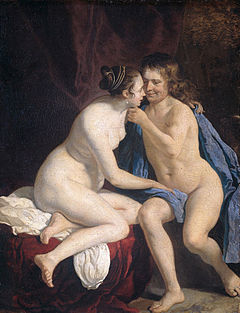
The above image is Lovers by Jacob van Loo, a seventeenth century Dutch painter. Sourced from Wikimedia Commons.
How to Make Yourself and Those You Love Miserable

http://upload.wikimedia.org/wikipedia/commons/thumb/a/ae/Bertram_Mackennal_-_Grief.jpg/500px-Bertram_Mackennal_-_Grief.jpg

It is easy to find on-line guidance to a better life. But the recommendations contained on those self-help web sites (and in books that aim at the same audience) have become almost too commonplace to make any impact.

The remedy? Something that is just the opposite: a list of suggestions on how to make yourself and others miserable. Of course, I’m not wishing that you follow these directions. Rather, I’m hoping that some of you who might yawn at still another list of “things to do” to improve your life, will be struck by the things you already do that make it much worse.

Here goes:

  • Regularly compare your material and financial circumstances to others, especially to those who are doing better than you are.
  • Make a list of all the people who have wronged you over the years and try to remember exactly how awful they made you feel. Think about those who owe you an apology. Forgive no one. Let no slight be too small to dwell on it.
  • Carry on a vendetta. Stay up late at night planning and plotting how you might get back at people. Stay angry. Let all your hatred out in blistering, profane, and cowardly “flames” behind the mask of the Internet.
  • Give your children gifts rather than your time. Set no limits on them. Then wait until they are teenagers and wonder why they are depressed or rebellious.
  • Curse the darkness, the winter, the cold, the rain, the frailty of the human condition, and all the other things that you can’t change.
  • Get impatient with the people who are walking in front of you at a snail’s pace, the couples whose bodies and shopping carts block the entire grocery aisle, and the slow progress of the check-out line at the store.

http://upload.wikimedia.org/wikipedia/commons/thumb/7/74/John_F._Kennedy_Inauguration_Speech.ogv/mid-John_F._Kennedy_Inauguration_Speech.ogv.jpg

  • Make no contribution to the betterment of humanity. Assume an attitude of entitlement. Figure out how to avoid work. Idle away your time. Ask “what your country can do for you,” not “what you can do for your country” in opposition to JFK’s 1960 inaugural address admonition.
  • Forever rationalize your dishonorable or questionable behavior or deny it altogether, even to yourself.
  • Persuade yourself that you need to wait until you feel better before you do the difficult thing that you have been postponing. Keep waiting, even if the time never comes when you believe that you can take action.
  • Do not let conversation with your spouse or children get in the way of watching TV. Keep the TV on most of the time, most importantly at family dinners. If possible have a television in every room.
  • Ignore the beauty of a spring or summer day, the newly fallen snow, and the cheerful laugh of small child. Stay in-doors as much as possible, year round.

http://upload.wikimedia.org/wikipedia/commons/thumb/d/d8/Sommerblumen01.JPG/240px-Sommerblumen01.JPG

  • Allow yourself to be upset by overpaid, under-performing athletes who doom the home team to continued failure. Yes, Cubs fans, this means you!
  • Treat emotions of sadness, tenderness, and hurt as your enemy. Push them away and thereby alienate yourself from yourself. Curtail grieving and try to deaden your feelings to the point of numbness.
  • Work up as much hatred as possible toward opposition political parties. Listen to every talking head who wants to whip you into a frenzy.
  • Expect justice and fairness in all things.
  • Drink too much, drug too much, and spend every extra minute on the web or playing computer games instead of having direct human contact with someone who is in the same room with you. Further distract yourself from your problems by watching TV and listening to music. Escape reality.

http://upload.wikimedia.org/wikipedia/commons/thumb/4/4b/Jack_rose.jpg/120px-Jack_rose.jpg

  • Keep using failed solutions to your problems even though they haven’t worked in years, if ever.
  • Behave in mid-life the way you did as a young person; or, if you are a young person, behave the way you did as a child. Do not reflect on or learn from experience which might teach you something new.
  • Use others instrumentally. That is, value them only in terms of what they can do for you. Lie, cheat, betray, and steal from them if that serves your interests. Then wonder why people mistrust you.
  • Spend as much time as possible worrying about the future and regretting the past, rather than living in the irreplaceable moment.
  • Aim low. Avoid the disappointment that comes with high expectations. When the going gets tough, quit.
  • Train yourself to be a miser. Practice selfishness. Hold on to your money as if you expect to live forever and will need every last cent. Make Scrooge from A Christmas Carol your hero.

File:Chicklet-currency.jpg

  • Judge others less fortunate than you are by using the phrases “he should have known better,” “he didn’t try hard enough,” and the like. Assume that all people deserve whatever misfortune befalls them. Disdain compassion, but remain puzzled when others call you heartless.
  • Indulge in every available excess: unprotected sex, food, spending, smoking, caffeine, etc. Don’t exercise. Ignore medical advice and, even better, avoid going to your doctor. Treat your body badly and then wonder why it betrays you.
  • Be sarcastic, passive-aggressive, and indirect whenever you are injured rather than looking someone in the eye and expressing your displeasure in a straight-forward fashion.
  • Avoid facing things. Give in to your fears, anxieties, and phobias.

http://upload.wikimedia.org/wikipedia/commons/thumb/5/5b/Children_in_Sonargaon.jpg/240px-Children_in_Sonargaon.jpg

  • Don’t let anyone know you well. Believe that your vulnerabilities will always be used against you. Keep social interactions on the surface. Eschew intimacy and maintain your distance, thinking that this is the best way to avoid personal injury. Trust no one!
  • Assume that the normal social rules regarding fidelity to friends and lovers don’t apply to you. Hold on to a double-standard that favors you.
  • Insist on having your way. Don’t compromise. Don’t consider others’ needs or wants. Assume a position of moral superiority, self-righteousness, and arrogance in things religious, political, and personal.
  • Do everything others ask of you. Rarely say “no.”
  • Try to control people and events as much as you can. Don’t go with the flow. Micromanage. Hover over others. Repeat complaints to them incessantly. Remind subordinates, friends, spouses, and children of small errors, even if they are ancient history.
  • Make no significant effort to better your life. Depend on others to take care of you and make all significant decisions for you. Be a burden.
  • Raise all your children exactly the same way even though it is obvious that they are not all the same.
  • Imitate vampires (who have no reflection in the mirror and therefore keep their mirrors shrouded) by never really looking hard at your own reflection in the looking-glass. That is, never take a frank inventory of your strengths and weaknesses or the mistakes you’ve made. Be like the evil queen in Snow White, whose only desire was that the mirror would tell her that she was “the fairest of them all.”
  • Whenever you talk with someone, wonder what they really mean, pondering the possibility that they find you boring, stupid or physically unattractive.
  • Feed yourself on gossip more than food. Delight in talking about others behind their backs.
  • Value beauty, appearance, reputation, and material success over integrity, knowledge, kindness, hard work, and love.
  • Try to change others, but do not try to change yourself. Take no responsibility for your life circumstances, instead blaming those who have stymied you.
  • Stay just as you are regardless of changing life conditions. For example, if wearing warm clothes worked for you when you lived in Alaska, continue to wear them when you move to Arizona in July.

http://upload.wikimedia.org/wikipedia/commons/thumb/3/37/Enrico_Caruso_VI.png/240px-Enrico_Caruso_VI.png

  • Don’t forgive yourself. Maintain the most perfectionistic and demanding moral and performance standard even if you are not a brain surgeon. Stay up at night castigating yourself over every imperfection, no matter how small.
  • Make a list of all the things that are wrong with your life, all the opportunities lost, every heartbreak, and the physical features and bodily changes that you don’t like. Stew in your own juices. Salt your wounds. Pick at your scabs.
  • Take everything personally.
  • Permit friends, family, and co-workers to walk all over you. Do not stand up to them for fear of causing offense and disapproval.
  • Discount your blessings. Concentrate on the dark side of life.
  • Never even consider going into psychotherapy. Assume that this is something only for those who are weak and that anyone who needs to grapple with emotional issues in counseling demonstrates a failure of will power and logic.

—

With thanks for the inspiration for this essay to Dan Greenberg and Marcia Jacobs, co-authors of a very funny, but ironic book entitled How to Make Yourself Miserable.

—

The top image is Grief by Edgar Bertram Mackenna. The video frame that follows is from John F. Kennedy’s 1960 inaugural speech. The next image is Sommerblumenstrauss by A. Gundelach. The following photo by Andygoodell is A Jack Rose Cocktail. The fifth picture is of two children in Bangladesh by Nafis Kamal, while the sixth is called Chicklet-Currency courtesy of the U.S. Department of the Treasury. After the image from Disney’s Snow White, is a 1911 photo of Enrico Caruso, the great Italian tenor. All but the Snow White frame are sourced from Wikimedia Commons.

Of Fathers and Children and Stories of Old Ball Games

http://upload.wikimedia.org/wikipedia/commons/thumb/f/fa/Baseball_Softball_Love_Festival.jpg/256px-Baseball_Softball_Love_Festival.jpg

Dreams, like spider webs and hard-hit softballs, are difficult to hold on to.

But sometimes those dreams and the stories of those hard-hit balls connect us to both our past and to our posterity.

In my case, to my father and my children.

Let me tell you a story…

On a recent morning I awoke in the midst and the mist of a just-ended dream, thinking about something that happened a long time ago. An event of no particular importance, but just about the most intense moment of my life.

I was playing right field in a game of 16″ softball at James Park in Evanston, Illinois. The team was called the Psyclones, a pun on the fact that most of us were graduate students in the “Psyc” department at Northwestern University. A pretty good team for a bunch of educated guys, one that won more often than it lost.

Sixteen-inch softball is a game played almost exclusively in the Chicago area. Everywhere else a softball is 12″ in circumference and caught with a gloved hand. But “real men,” as Chicago males fancy themselves, favor a game with a bigger ball caught bare-handed, one that is rock hard at the contest’s beginning and softened, but never really soft even after it has taken a pounding from wooden and metal bats.

In truth, the ball is your enemy. Sixteen-inch softball — Chicago-style softball — is a game that leaves you with broken or dislocated or jammed fingers if you play it for any length of time.

On the day in question the Psyclones were playing the best team in our league, the outfit that had won the first round of a two round championship season. But as the second round drew to a close these two teams were tied. If only we could beat the other guys, we would win the second round and face the same team once more in a single contest to decide the league championship.

As the final inning began, our team was ahead 3-2. We were three outs away from victory.

Their first batter took a ball. Then, on the second pitch, he hit a low line-drive like a laser headed for the right-center field gap. It was clearly mine to catch if it was to be caught, but I didn’t know if I could get to it in time to prevent it from going for a home run and tying the score.

An outfielder learns to gauge the flight of a batted ball — the speed, the distance between himself and the ball, the effect of gravity, and his own movement — so as to intercept it just before its return to earth. You do this instinctively. It is all reaction, no part thought, entirely based on experience, all the while running, straining, and preparing for the intersection of your body and the “Clincher,” as those softballs were called.

I was not prepared for this particular line-drive, however. No one had informed the ball that gravity was supposed to get the best of it. And as I neared the spot where I might have a small chance to catch it, the nervy Clincher had the audacity to proceed in the most irresponsible way.

The ball was actually rising. It had been hit so hard that it had not yet arced.

My path had taken me to my right, but also away from home plate. In order to intercept the spheroid I had to twist my body back to my left (so that I could more nearly get in front of the ball), turning and leaping and reaching simultaneously.

Wham!

The ball hit my hands as my body faced left field, even as I was moving in the air toward deep right center field.

The Clincher started to bounce free, but I grabbed it a second time, then hit the ground and staggered, running fast, tilting toward the turf, aiming to take a header.

But instead of eating dirt and watching the ball bounce away, I kept my balance.

In another moment I was finally stationary.

And amazed.

I was still on my feet with the ball in my hands.

Shouts of congratulations and encouragement sounded out across the field from my teammates. Other than a few friends and those of the opposition, the grandstand could not have held more than a couple of dozen onlookers, but a few voices called out from there, as well.

Simultaneously, a chemical charge ran through my body, a wonderful exhilaration, a tingling flush of adrenalin. And with it, a tremendous split-second, unrealized urge to cry that took me by surprise.

And almost as quickly, in the time it took for the next batter to come to the plate, all that was gone and the game continued.

The following hitter walked, but then we retired the side and the game was ours.

It wasn’t the very best performance of my exceedingly modest athletic career. I’d played games in which I’d hit two home runs and even a basketball contest where I scored 2/3 of my team’s points on 10 consecutive jump shots. I’d also made “circus” catches before — other successful leaping-diving-acrobatic maneuvers, sometimes to save the game.

But nothing in my life ever came close to the super-charged voltage of “the catch,” the flood of emotion to the point of tears, not as experienced in sadness or joy, but for the need of a kind of fluid outlet for all that high-octane chemical “juice.”

—

If you’ve played sports with any significant level of committment, then you know how the game becomes more than a game — sometimes becomes a thing that feels like life or death. But realistically, in the big picture, or even a pretty small picture, this game meant nothing. Winning the championship (we didn’t) meant nothing.

All of it was part of a “pastime,” something we do to enjoy ourselves and test ourselves, both at once; something to show what we can do and exorcise all the demons inside of us that are waiting to be purged; a play we act out just because we are human and we need the outlet and the (hoped for) mastery of a physical and psychological challenge.

—

Why did I think of it just now? Why the dream?

I can’t say for sure, but maybe (in part) it’s because my youngest daughter recently sent me and my wife an outline for a video and oral history that she proposes to do soon with each of us separately. And, of course, she wants to know about all the important moments in our lives. Which would necessarily include this particular athletic episode, an instant of no objective importance other than the feeling it produced; something of value because of the sensation alone. It didn’t mean anything, but it felt meaningful.

Carly, the aforementioned young woman, has watched the same kind of video I produced of my dad that she hopes to create with me; something I did about 25 years ago.

I am touched that she wants this, since I remember very well why I wanted to do it with my father. To bond with him, to receive whatever very personal things he would share in the course of it, to understand him and therefore myself more fully. And most importantly, to create something that would outlive him, leaving some part of him that I might catch hold of and keep hold of, like the 16″ softball. Something that would, like that catch, be over in a short time but last a long time — in the video, in his words, in his feelings, and in my memory.

A thing, like “the catch,” that would be unimportant but all important. And only to me.

My dad was at the game I mentioned, the game where I made “the catch.” I remember him congratulating me, commenting on how extraordinary it was. Extraordinary to me for reasons I have mentioned. Extraordinary to him, I suppose, because I was his son. For others, not so much. No, you can probably watch its equal or better regularly on your TV during baseball season.

When I was a little boy I remember my dad telling me of his own athletic exploits as a young man and being fascinated. Some time later we found ourselves at the site of one of those events. It was a relatively small school yard enclosed by a fence, with a tall flag pole attached to that boundary in deepest, but not very deep center field.

From home plate it was easy to see that one could hit the ball over the fence without too much difficulty, so the ad hoc rules of the game required that any ball hit out of the park in fair territory would be considered an “out.”

The players had to tailor their hitting strokes to the restricted conditions. Only safely hit line-drives and ground balls could be of any help to your team. And money was on the line, so said my dad as he told the story of his game, since the two sides had made a bet on the contest.

The young man who was to become my old man came to bat with a runner on first base late in the battle, with the score tied 1-1. He tried to place-hit the ball into right center field, and normally was quite adept at such a task. But, on that day his efforts to keep the ball in bounds appeared to have failed him. Too much of the 16″ ball struck too much of the wooden bat and the former took off in a long, high arc toward the not-so-distant reaches of the ball yard, sure to clear the center field barrier.

But, to his surprise, not to mention the delight of his mates, the center field flag pole got in the way, and with a dull metallic twang sent the shot back on to the field, by which time Milt Stein was standing on second base, and the baserunner had crossed home plate with the winning run.

Dad was a good story-teller and he had a good audience in his little boy, even when that boy was no longer very little.

—

What is it about baseball, softball, and the bond between parents and children?

Much has been written about sharing a game of catch, being introduced by your parent to a sport that he loves and you will come to love, watching together in the great ball parks of our country in the sunshine and under the arc lights, cheering together for the home team. It is one of those things many dads are good at, something that doesn’t require very many words.

But, I think there is another feature to this act of bonding.

It is the story of the game itself. The thrills, the disappointments, the surprises — the mutually experienced emotions.

The sharing, in other words, of a story.

And when the story of the game is told (especially if your father was in the game) — your father to you, you to your children — the child “sees” the tale through the lens of your memory and his own imagination. He learns what matters to you, how you shape the words, remembers how your eyes light up, drinks in the moral lessons about effort and courage and winning and losing.

The child roots for and admires the parent, even though the drama may be ancient, unchangeable history. The telling is personal, almost like a secret message, something that can only be decoded by the heart of the little boy or girl who loves the story-teller who is already his hero, with or without the “heroism” depicted in the tale.

Later, the child will take the parent role with his own children, relating the narratives of his father along with his own, tying him to and keeping faith with his hero, now aged or departed; and keeping the chain-letter of attachment alive as he brings the youth and grace and speed and strength of his parent alive once more, along with his own youth, when he first heard the tale told.

It is a sweet and tender and irreplaceable thing, this telling of stories to your children.

Nothing better in the winter for a baseball fan or an ex-softball player who is, more importantly, a father.

Time to start the camera, Carly.

—

The image above is Baseball Softball Love Festival by THOR, courtesy of Wikimedia Commons.