Lost and Found: A Different Way to Think About Your Life

656px-Lost

A very old question asks you whether you think of your glass as half-full or half-empty. But permit me to make a suggestion: think of your life in terms of what you’ve lost and what you’ve found over all the years you’ve spent on the planet.

Take all the victories and failures, the things you can do and the things you can’t anymore, the friendships you’ve lost and the ones you’ve gained and put them in a basket. Don’t forget to include what you’ve learned over the course of your life — learning in terms of knowledge found in books and the knowledge that only comes from experience. Add your greatest joys and your worst moments. Be sure to fill the bushel with physical skills and abilities too, talents you had once upon a time and all those you still possess, including the new ones.

If you do this, I’ll bet you find that your container includes some of the following:

  • That you are wiser than you used to be, in some small ways and maybe even a big way or two. Perhaps this is part of what is called Maturity.
  • That, especially as you approach mid-life, you are less easily rattled by some of the things that used to overwhelm you. To some extent, you’ve probably learned to cope or even mastered fears you thought you never could.
  • That you might not be as spry or as fast in a footrace, but that you care less about it than you did in your youth.
  • That you act more like the tortoise and less like the hare because you know (most of the time) that “slow and steady wins the race.” Or maybe just because you’re not quite as fast as you used to be and have figured out a strategy to deal with that, kind of like a baseball pitcher who loses his fastball and still wins by dint of craft, guile, and perhaps developing a new pitch.

Glass_half_full_kind_of_day

I’m sure, as you reach for things to put into the basket, that you will remember how much some of those that are gone mattered to you, and how some still do. But, I’ll bet you’ll be surprised to see that you’ve replaced a number of them, perhaps with people or activities or skills that compensate for many of those that have disappeared. Maybe not all, or, just maybe, just as much or more than what you’ve lost.

What we are talking here is about adaptation. Adapting to life and to aging. Grieving and moving on. Licking your wounds and coming back to find out what the universe still holds that is good for you. And that sometimes what is good for you is also good for others around you, in part because of the feeling your generosity gives you.

Not everyone can do this. If we’ve had too many losses, some of us don’t even go to the “Lost and Found” Department to find out whether what we value is there. Part of the problem is that no one told us that the “Lost and Found” Department of Life isn’t like the one in school or in a department store. In those places, if you are lucky, you find exactly what you lost — the thing itself.

No, life’s “Lost and Found” Department is different. It holds every one of the things you’ve lost and doesn’t usually give those exact items back, all precisely as we left them or as they left us. But if you go there and look hard enough, you just might find objects or capacities — people or experiences — as good as what you lost, a few better, a number worse. And if you travel there with the right attitude, you can find things that are priceless. One of those surprises is not actually a thing. It is the knowledge that it is often possible to adapt to those that are truly gone.

It’s a little like the way a heart breaks, a love is lost, and one finds that it heals or someone else enters your life or other people and activities compensate you. The “Lost and Found” Department of Life doesn’t work perfectly, of course. You must be willing to make the best of it. But, there is one thing that is essential if you are to give it and life a chance.

You have to go there and see what it contains. Without that, there is no finding what you’ve lost; or something new; or something better; or something that will do.

No guarantees, not even safety. But life is full of surprises, as I said. It might be time that you forget about looking at glasses half-empty or half-full, and look instead beyond what’s been lost and see what you can find in that new place, the yet to be discovered things in life’s “Lost and Found.”

Good luck to you. Good luck to us all.

This article was inspired by Frank Bruni’s February 1, 2014 New York Times essay on the subject of Peyton Manning and aging, called Maturity’s Victories.

The top image is the Lost Properties Office symbol at a railway station in Poland. The author is Mohylek. The second picture by Pete Unseth is called Glass Half Full. Both were sourced from Wikimedia Commons.

Getting Over a Breakup: The Role of Love, Hate, and Time

512px-Castle_on_a_hill_(7964914374)

Most of us believe that hate is the opposite of love. Is it really? Both are intense emotions. If love captured you before a breakup, hate indicates a continuing strong attachment to that person even after. Put differently, if you are still angry, you are not “over” him or her. You have not let go. You have not moved on.

To continue feeling either love or hate means that the “relationship” is quite alive, even if it is quite different from what it once was. Perhaps you haven’t seen the person or spoken to him in years. He matters to you, even if it isn’t in a good way. He is living inside of you, playing on your emotions, influencing how you think and what you do; an imaginary companion who might not “know” you exist, but who shadows your existence.

As Edgar Rice Burroughs said:

I loved her. I still love her, though I curse her in my sleep, so nearly one are love and hate, the two most powerful and devastating emotions that control man, nations, life.

If you are really “over” someone else, you are (more or less) indifferent. You simply don’t care any more. You don’t spend any significant amount of time thinking about him or her, recalling either the memories of aching beauty or breaking heart-strings. And when something does remind you of the person, at most you might feel a bit wistful, but certainly not depressed or resentful. No, that individual now matters very little.

How do you get there, get over that lost love? Getting angry is a part of the process, just as allowing yourself the sadness of his loss. Talking to friends, or perhaps a therapist is useful, too. They need only listen to you and provide support, not judgment or advice. Don’t expect to heal quickly, but avoid holding on too long, hoping for love’s return. Don’t make comparisons to what others have gone through. One size doesn’t fit all.

Throwing out photos, old letters, and deleting old voice-mail and electronic messages can help. Don’t lacerate yourself by re-reading the same letters and greeting cards forever. Hold a mock-funeral service if you need to.

A quick return to dating usually doesn’t improve things, since some of your lingering emotions can cause you to become involved with your new acquaintance too deeply, too soon, on the rebound. Don’t fool yourself into thinking that you will begin to date but won’t permit yourself to get too close. Before you know it you will be back in a new and probably ill-conceived romance.

Don’t resort to alcohol or other temporary fixes that, in the end, can only make it worse. Don’t distract yourself too much, but do try to be active and get on with life.

Beware of bathing in your sadness. The shower of tears is too painful to endure longer than necessary. Remember that others have suffered in just this way. Do, eventually, get off the cross. We need the wood. It gives us something to build with.

You may have to reevaluate your former love. If you still believe that he was a paragon of virtue and perfection, you’re inclined to think of yourself as unworthy of his affections. If, however, you can see him realistically, you are more likely to recognize that perhaps his loss of you was greater than yours of him, even if he isn’t aware of it. Get a ladder and pull the S.O.B. off the pedestal (in your imagination only)!

Don’t expect vindication, one of the rarest commodities in the world. Waiting for your ex to apologize for not realizing your value is like waiting for next Christmas when you are 10-years-old and the calendar reads December 26th.  It almost never happens and when it does, it is much too late. Moreover, a search for the right words or actions to persuade him to change his mind is a fool’s errand. But then, we are all fools in love.

Although time moves slowly, let time be your friend. You need the tears, so fighting them and controlling them can sometimes be counterproductive, slow recovery down. Most of us survive and learn from these losses. Figure out why you chose this person and take care not to make the same mistake again, especially if you are inclined to put all your relationship eggs in one basket, discovering only after the breakup that you have few friendships to provide you with emotional support.

A breakup is like a mini-death. Treat it that way. Don’t isolate yourself. Remember a time when you felt better and believe that, however impossible it seems now, you will eventually feel better again.

As Oscar Wilde said, since “No man is rich enough to buy back his past,” there is only one direction left to go. Onward.

The top image is called Castle on a Hill by Jimmy McIntyre, uploaded to Wikimedia Commons by russavia.

About Grieving, About Friendship… About My Friend Bob Calsyn

When you lose someone you care about, for a while you walk around in a daze. Of course, there is the sadness. But less often mentioned are the sense of disorientation and the random memories; the moments your eyes fill with tears and the fatigue you can’t seem to shake. For a while you are scattered and off-balance until, finally, the jumble of things settles down and life returns to “normal.”

I am writing this in the midst of the jumble. My friend Bob Calsyn died on Friday, September 21st. His wife Maria called from St. Louis with the news. I let a couple of my old friends know. They are Bob’s old friends too, from our days in grad school at Northwestern. And I heard independently from Dave Kenny, another NU alum. If Dave isn’t — I should say wasn’t — Bob’s best friend, then surely he was tied with the other contenders for first place.

I told Dave I was thinking of writing something about Bob and asked if he might offer some of his own thoughts. His remarks below are adapted from those he read at the memorial he attended in St. Louis on September 25th. (In each case that I quote him, his comments are set off from the rest of the text and begin with his name in BOLD CAPITAL LETTERS).

What I’d like to do here is to tell you why Bob mattered to all of us. But the truth is, I need to tell you. I need to get this out to honor Bob — to honor the loss suffered by Maria and Bob’s children and siblings and all those who were closest to Bob. And, not least, to help myself with the jumble I mentioned at the start.

What follows is a series of recollections of a wonderful man and great friend, much of it in Dave Kenny’s voice; along with some of my own memories, a little of my own philosophizing about the nature of friendship and loss, and some things just about me. Someday, you too will be in the midst of the jumble. Maybe it will help.

DAVE KENNY:

I knew Bob for 44 years. When we met at Northwestern we had a lot in common: both oldest child of a large family, both lapsed Catholics, both of us had mothers who wanted us to be priests, and both of us had a strong commitment to social justice. We very quickly became friends. What Bob accomplished in four years at Northwestern was truly remarkable: earning his Ph.D., serving two years as a Conscientious Objector to the Vietnam War, doing a one year clinical psychology internship, and becoming a father, much of the time commuting 14 miles from Hyde Park to Evanston. The later incredible academic success of his sons Dylan and Chris was foreshadowed by Bob’s.

Bob, unlike me, continued in his commitment to social justice throughout his entire lifetime. He was passionate about ending homelessness and he worked diligently in this effort. I never told Bob how grateful I was that he let me play a small role in his work.

For the record, Robert Joseph Calsyn was a product of Rock Island, Illinois and Alleman High School; the child of working class parents. He graduated from Loyola University in Chicago before attending grad school. Bob served as the Chairman of the Psychology Department at the University of Missouri, St. Louis, as well as being Director of its Gerontology Program.

There is something about schoolmates. At Northwestern, our group of graduate students was more than usually close. The Psychology Department was small, so we had lots of classes together, the way you do when you are 10 years old. We ate together, socialized together, went on double-dates; some of us roomed together. We passed through the same moment in history and the same stage in our lives in the same place. It was hard not to bond.

The men in the group played lots of softball and football and basketball against other Northwestern departmental conscripts. Bob usually played second base for our softball enterprise, which we called the Psyclones — a play on words since we were all studying to be psychologists. He played hard, but that particular game was tough for Bob, especially making accurate throws to first base. Still, Bob was an essential part of a pretty good team. Even if we’d have been slightly more perfect without him, we wouldn’t have had nearly as much fun or had the benefit of his “heart.”

In sports like touch-football Bob was fierce, taking particular pride in the devastating, bone-rattling blocks he delivered to opponents who couldn’t imagine them coming from a man who was no more than 5’8″ (173 cm) on a good day. Bob was no plaster saint. He knew the full range of four letter words and used them when necessary, as they tend to be in sports, especially in games played with the sweaty tenacity that Bob brought to them.

DAVE KENNY:

Our friendship endured and we saw each other in eight different states. Many of those visits were near water which Bob loved: the coast of Maine, Cape Cod, Long Island Sound, and of course, his beloved Anna Maria Island (where Bob and Maria had a vacation home). Bob was strange about water. He loved to watch and hear it, but he was not a fan of being in it. However, don’t forget that Bob grew up and spent most of his adult life near the Mississippi River. Maybe not going in the water made good sense.

I didn’t see Bob a lot after grad school. We’d visit occasionally, at first when I was teaching in New Jersey and he came to nearby New York City, later in Chicago, and a few times in St. Louis. Our relationship took the form of letters, then email and occasional phone calls. I got to read and critique some of his short stories; he helped with career issues for one of my children.

And yet, for me at least, a person like Bob lives inside of you in a continuous way even when there is no continuity in actual contact. He was always on an imaginary list of people who I thought of as my friends. Bob was someone who you were sure would be dependable, helpful, and unfailingly honest. He told you what he thought, not what he believed he “should” say or what he thought you wanted to hear.

We “knew” each other, could talk about anything. We knew where each of us was coming from — came from — in both a literal and figurative sense. He didn’t keep score. Bob was always there when you needed him, someone who was compassionate, gave sound advice, and was incredibly funny.

DAVE KENNY:

Bob had his own view of nutrition. He introduced me to Dairy Queen Blizzards. I remember him cooking donuts and beignets in his kitchen. We always had a 3PM cookie break when working together. For breakfast he would ignore his wife Maria — his Argentine bombshell — and sneak off to eat at Waffle House or Denny’s, not the healthy breakfast she suggested.

Bob and Maria (ca. 1994)

My friend retired from his faculty position in 2009. Not long after he was diagnosed with cancer. This made our contacts more frequent. Somehow Bob remained optimistic in spite of multiple tumor sites that never fully disappeared.

Bob continued to play tennis, the game he loved best, even though the treatment compromised his breathing. Singles were now out, so he played doubles. I didn’t see the down moments and I’m sure that there were more than a few. But his resilience, his ability to live life and to keep really “living it” and enjoying himself was astonishing. And he could still be there for me, as when I had a long conversation with him about retirement: whether to do it, when to do it, what it was like for him, and what it might be like for me. We had plans to see each other on the first weekend in October in St. Louis.

People find it difficult to talk with someone who is battling “Death,” a bigger than “Life” opponent with an undefeated record. It is, indeed, hard to know what to say. Mostly you listen, even if most of us think we must have some sort of magic words to deliver when, in fact, no such words exist. Bob made it as easy as possible.

The day after Bob died I heard John Adams’s musical composition, On the Transmigration of Souls, presented by the Milwaukee Symphony and Chorus. Bob liked classical music, so it seemed a nice coincidence; more than that, the composition is a commemoration of those lives lost in the terrorist attack on the World Trade Center on September 11, 2001. An interview with the composer on the New York Philharmonic website includes the following:

… I’d probably call the piece a ‘memory space.’ It’s a place where you can go and be alone with your thoughts and emotions. The link to a particular historical place — in this case 9/11 — is there if you want to contemplate it. But I hope that the piece will summon human experience that goes well beyond this particular event.

‘Transmigration’ means ‘the movement from one place to another’ or ‘the transition from one state of being to another.’ … And I don’t just mean the transition from living to dead, but also the change that takes place within the souls of those that stay behind, of those who suffer pain and loss and then themselves come away from an experience transformed.

I guess you hear what you want to, what you need to, what you can’t escape. Of course, I couldn’t help but think about Bob during the performance…

Bob managed to write a novel, all the while dealing with his illness. It is called Primal Man and you can buy it on Amazon. You won’t be disappointed. The story is a murder mystery that takes place in a university setting. This comes from a brief interview of Bob in the St. Louis Post-Dispatch on September 4, 2011:

Q: Had you written fiction before?

Bob: No. but I’ve always read mysteries.

Q: This primal man is apparently an exhibitionist?

Bob: Primal man exposes himself to female students and throws them an index card that says, ‘Men are hunters, women are gatherers. Gather yourself home.’

Q: How does psychology figure in?

Bob: It helps you explore character. I was an administrator for many years. I thought writing a mystery was a more socially acceptable outlet than strangling my colleagues.

Bob was a confident man, but not arrogant. For all the scholarly articles he produced and all his advocacy for homeless, mentally ill people, he told me one day at the St. Louis Zoo that he thought of himself as a “journeyman.” Indeed, he considered each one of us who got Northwestern psychology doctorates in 1972 in the same light, with one exception. Dave Kenny was and is that exception, an internationally known academic who has changed the way people think about social psychology research, its design, and its analysis. But, I don’t believe Bob meant to disparage any of us, and certainly not himself. He simply knew that there was a pretty big difference between being Bob Calsyn or Gerry Stein and being Beethoven.

Bob didn’t care about or aim to be a great man. He was too busy living his life, loving his wife, doing his work. He was too busy delighting in his kids and grandchildren, playing tennis, and having a beer (but not at the same time)! The irony, of course, is that the way that Bob lived was a kind of un-self-conscious, rough-hewn work of art, something to be admired and emulated. As Marc Anthony said over the body of Julius Caesar in the Shakespeare play, “When comes such another?”

DAVE KENNY:

In thinking over my friendship with Bob, it occurred to me that Bob and I never argued and Bob never got mad at me. We disagreed all the time, but our disagreements did not result in arguments. Bob regularly told me that I was wrong, but he never did so in a way that said, “I’m better than you” or “You are a bad person.” He sincerely wished, as I did, that I was a better person. Bob did have lots of reasons to be angry at me: missing deadlines, drinking too much, not staying in contact… Bob would get angry at Republicans, at demagogues, and perhaps even his colleagues. But he channeled his anger against his colleagues by writing short stories and killing them off there.

Bob always was one step ahead of me. He left a high-powered college to go to a more low-key institution. He got married and had children, ended his difficult marriage, and remarried; he had grandchildren and retired — all before me. Now Bob, you have done it again and you have died before me.

Upon reflection, Bob was more of an older brother to me than a friend. He was doing things before me and giving me advice on how to do them. My big brother Bob helped me cope with all of the major transitions in my life, especially my divorce. We know that Bob faced a terminal disease and death courageously and remarkably. Again I will be following Bob, and I hope I can muster 10% of his courage, but I hope that mustering does not happen too soon.

Dave Kenny

We cannot know what others are feeling except by analogy to our own emotions. Those of us who have lost a friend may think we are hurting and we are, but surely the intensity and nature of the feelings experienced by those closest to Bob can’t be known, at least not by me. Everyone’s grief is different, formed by the tapestry of experiences they had with the departed — all the memories and struggles, the laughter, the kindness, and the human imperfections that are inevitable on both sides of any relationship.

For those closest, their lives will now be marked with the idea of “before and after;” before and after Bob died and how much that difference made. To all those who were closest to Dr. Calsyn, and to those (like me) who were a step or two back, my condolences.

That said, from the outside and some distance, it looks to me like Bob had a wonderful life. Too short, for sure, but wonderful. Not without pain or disappointment or hard times, but full of compensating joy, success, and love. He gave life and the people in his life everything he had. He traveled, competed, and he knew when to rest and take a walk on the beach. Bob didn’t “phone it in.” He lived more in 66 years than most of us would do in twice that time. Like the ballplayer who tries to stretch a triple into a home run and is thrown out at the plate, he was a thing to behold.

On the subject of baseball, I’m reminded of an old story about Babe Ruth, the most famous baseball player ever. Actually, it is about the Babe’s funeral, which happened on a particularly hot day in New York City. It seems that two of his old teammates, Joe Dugan and Waite Hoyt, couldn’t help but comment on the weather, especially since they’d served as their friend’s pallbearers and the heat hadn’t made that easier:

Joe Dugan: I’d give a hundred dollars for a beer.

Waite Hoyt: So would the Babe.

Here’s to you, Bob. How lucky I was to know you.

——–

The top image is the Calsyn Family (ca. 2001). From left to right: Bob’s son Dylan and Dylan’s wife Beth and their daughter Zoe; Maria, Bob, Soledad Van Emden (Maria’s daughter and Bob’s stepdaughter), Bob’s son Chris, Margaret van Emden; and John van Emden, Soledad’s husband. Since this picture was taken, three more grandchildren have arrived: Abigail, Ella, and Max.

The photos are courtesy of Dave Kenny. My very special thanks to Dave for his contribution to this essay, especially given the enormous difficulty he had returning home to Connecticut from Bob’s memorial in St. Louis. Thanks, also, to Judy Goodman, Steve Hanan, Angela Shancer, and Diane Tyrell for their helpful and speedy comments about an earlier draft; and for their friendship.


What Do Patients Think About Their Therapist? What a Counselor Does About “Transference”

http://upload.wikimedia.org/wikipedia/commons/6/6e/Fussball_und_Freud.jpg

Patients wonder what their therapist is thinking. Therapists wonder what their patients are thinking. It is not much different from what happens between husbands and wives, parents and children, bosses and employees — or is it?

I’ve written about what doctors think about their patients before: What is Your Therapist Thinking? But today I’ll focus on what the patients are thinking about their counselor and how therapists are “supposed to” handle that. I say supposed to, because we don’t always do it well. It is one of the trickiest parts of a counselor’s job.

Patients have feelings and expectations about a counselor, in part, because he resembles someone else. This is called transference. In other words, the client’s sense of this new person is transferred from someone else who is important to him, simply because the new acquaintance resembles the old one. It happens automatically and without thinking; a kind of mistaken identity.

No, you don’t think your therapist has red hair if his hair isn’t actually red. But you do see him through the lens of your past experiences, and react to him because of certain real or imagined similarities to others. All of us do this in all sorts of relationships. It occurs whenever we have unconscious feelings and assumptions about someone who reminds us of someone else; which is a lot, even if we don’t know it. The feelings toward the old person (be it a parent, a sibling, a boss, or a lover) can become quite mixed up with the real human qualities of any new individual, including a new therapist.

Indeed, this is made easier by the fact that the therapist limits how much the patient knows about his personal life. In effect, the shrink is a kind of blank slate upon which the client “fills in the blanks” left empty by a lack of real information. Not surprisingly, all of us are prone to repeating old behavior patterns in new relationships; and, to the extent that a new person evokes old feelings about what the relationship is and what it can become, the transference can play out the patient’s repeated relationship difficulties right in the therapist’s office.

Take a hypothetical situation. Let’s say that your dad was a hard guy. He was critical of you, didn’t give you enough attention, and seemed to favor your siblings. Now, many years later, you meet your new therapist. Is he any of these things? To some extent it doesn’t matter. For example, the fact that your shrink only sees you once a week can reopen the tender wound of your neediness — your failure to win your father’s time and attention. You might feel that your doctor isn’t as available as you’d like him to be, in person or on the phone. You might interpret some of his statements as being disinterested, even when they are not so intended.

The counselor can be more important to you than he would otherwise be because of your unresolved, unconscious desire to get the affection and approval of this admired authority figure, who, like all authority figures, can easily remind you of dad. The hurt and/or anger that you feel when the shrink does not fill your need for a “good” father is almost inevitable. You might want to leave therapy because of it.

http://upload.wikimedia.org/wikipedia/commons/thumb/9/97/FIESA_7_Freud_276.jpg/256px-FIESA_7_Freud_276.jpg

What is a therapist supposed to do when this happens? If he reacts defensively to the patient’s demands or disappointments, he is unlikely to do him any good. In fact, the counselor who responds angrily can create one more injury of the same kind that was inflicted by the patient’s father, thereby adding to the client’s mistrust and misery. Even if the healer tries hard to give him what only a father can give, the patient will still not be satisfied. After all, the therapist cannot literally fulfill the childhood yearnings that come from anyone’s vanished youth. The hunger of a 10-year-old for good parenting can no more be satisfied when he is 30 than can a literal hunger for a good meal at age 10 by a delicious dinner 20 years later.

What the therapist can do is the following. First, he can be compassionate and understanding. He often anticipates that the patient’s old losses and resentments (his past disappointments concerning his dad) are likely to play out in the therapeutic relationship. When they do, the psychologist will try to gently assist the client to see that the feelings bubbling up are not fully appropriate, but come from the historical emotions attached to the father that have been superimposed onto the shrink. If the patient is open to exploring this, he will gradually be able to purge his internally complicated connection to his parent. This is a grieving process, a cathartic expression and understanding of the sadness and/or anger that continue to live inside of him, even if the parent is dead.

If all goes well in therapy, the therapist will eventually no longer evoke the transferential emotions; no longer remind the patient of the parent. And not only will his relationship with the therapist be less complicated, but so will all those other interactions with lovers, bosses, or friends which used to unconsciously trigger the same feelings. Finally, the old injuries will be healed sufficiently to be set aside, clearing the way to better social interactions in the future.

I am certainly not saying that all of the feelings that patients have about their doctors are mistaken. Therapists have the same potential flaws as everyone else. They can be good or bad, attentive or unreliable, too easily hurt or too distant. Some want your admiration and some don’t much care. They have feelings about the patient that grow out of their own relationship history. This is called a countertransference. Regardless, the potential for the transferential issues I’ve described is always there, just as the therapist’s countertransference toward the patient must be carefully watched to prevent the damage that it can do.

Do you find all of the above some sort of psychobabble that doesn’t apply to you? Trust me, transference is real. The more that you believe your relationships are “logical” and that your past doesn’t reach into your present, the more that it probably does, unless of course you have dealt adequately with it in some sort of therapeutic process, whether in treatment with a professional or in your own self-analysis.

http://upload.wikimedia.org/wikipedia/commons/5/5a/Moses_hos_Freud.jpg

Therapy and transference are much more complicated than I’ve described. What you’ve read is a simplification based on a hypothetical relationship between a father and his adult child who is in therapy. If you are not in therapy, even if your relationships are going quite well, it still may benefit you to take a look at patterns of connection you make with friends or lovers: the kind of people you are drawn to and the types of individuals who usually “push your buttons,” get you angry, or disappoint you in some way. We can all learn a lot by just connecting-the-dots of our life history, seeing the resemblances among the people who keep returning, even if their names are different the second or twenty-second time around.

It is easy to blame others when relationships fail. Relationships aren’t easy. But, the more unsatisfactory and repetitious your social life is, the more likely that something in you needs attention.

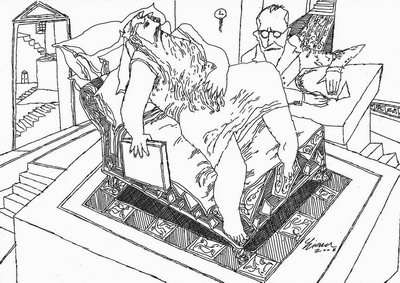
The top painting is called Therapy by Gerhard Gepp. Apparently, the patient (a soccer ball or football) is thinking about being kicked around. Might he have transferential feelings toward the therapist and feel badly treated by him, as well? The second image is a photograph of Sigmund Freud in Session with a Patient, from the Seventh International Sand Sculpture Festival in Portugal. The artist is RHaworth. Finally, a cartoon of Freud Treating Moses by Moa1. All are sourced from Wikimedia Commons.

“I’m Still So in Love:” Why We Must Give Up the Ghost

http://upload.wikimedia.org/wikipedia/commons/e/e2/Unioncemetery02.jpg

Some patients haunt your memory.

I recall treating a teenager who had lost her father suddenly.  It had actually been many years since he died, but she remained cut-off from the world and her family.

Friends were kept at a distance, her mother was pushed away, and her stepfather was never permitted to come close to her, try us he might.

Never ever.

Her mother and mom’s second husband worried about her self-isolation, so they brought her in to see me.

As the treatment progressed, I discovered that this young woman thought about her father a lot.

Every day.

She would review the memories that she still retained of his kindness and warmth.

Of course, I’d never met him, but I got the sense that she had idealized him — fashioned her memory so as to make him a vision of perfection that no flesh and blood mortal can hope to achieve.

And the recollected reproduction of her father, almost like a ghost, remained the most intimate connection of her life.

Not just historically, but even while I was treating her.

In fact, sometimes she would talk to him; one way, naturally, since she was not psychotic. And that provided her with a kind of closeness that was the best she could do to recreate the comfort that her dad had provided when this young woman was little.

As the protagonist states in Robert Anderson’s play I Never Sang For My Father, sometimes “death ends a life, but not a relationship.”

The people — the real people who reached out to my patient — found her unresponsive. They could not compare — could not compete — with the vanished flawlessness of her dad; an excellence that, after all, probably never existed in the first place, however dedicated and fine a man he might have been.

Moreover, her “relationship” with her father was safe: the dead cannot die on you; or reject you; or move away. They are utterly reliable and totally benign, unlike the rest of us.

As most of us do, my patient had been trying to protect herself from the injuries that life delivers from without, but left unguarded those equally tender places that are open to the wounds that come from within.

When a child loses a parent early on, she often loses the surviving parent, as well.

No, not to death, but to grief. Having lost a spouse, the surviving despondent parent (more often than not) is unavailable to aid the children. She is too bereft herself to be able to be the life-giving, supportive, attentive, omnipresent presence that children sometimes need a parent to be.

Worst of all, it is precisely at this time of loss that the child needs the surviving parent most desperately. And, it is at precisely this time that the remaining parent is least available and least capable of giving what he or she might wish to give, if only he or she could.

The result is a double-loss: one dead parent and another who is, for a time at least, a dead man walking, the half-alive state that we all know from the shock and privation and emptiness of a broken heart; a heart that one cannot imagine will ever heal.

It is no one’s fault, certainly not that of the grieving adult. Rather, this is just one of those dreadful ironies of the human condition: in the moment of loss and for some time after, the now-single parent has no capacity to do what must be done.

But the child needs that impossible thing, all the same.

Once I came to understand that my patient was still in a relationship with her father, her therapeutic needs became clear.

She needed to grieve the loss of her father to a satisfactory conclusion — a grieving that had been prevented by her fear of bringing up her own loss with her mother as much as her mother’s inability to console her child.

She needed to realize that she had put her life on hold by clinging to a ghost who, of course, could only provide so much warmth.

She needed to open herself to a stepfather who longed to engage her, even if he could not be the plaster saint her father had become; and the peers who were ready to provide their own rewards, even if they could not replace her dad.

The therapy worked out well.

My patient did not so much lose her relationship to her deceased father as let him go to a different place in her memory and in her heart.

It helped for her to answer the question, “What would your father want for you if only he could tell you?” Because the only answer he would have given (and she knew this) was that the beloved father of her dreams would want the best for her; and for her to reattach to life and to the people who could give her something that he could not.

After all, he was dead.

And so, she said goodbye to him. At last, she let him die.

So that, finally, she could live.

The photo above is of ectoplasmic mist at Union Cemetary, CT on 10/29/2004 by 2112guy, sourced from Wikimedia Commons.

Father’s Day (via Dr. Gerald Stein – Blogging About Psychotherapy from Chicago)

This is a revised and expanded version of a post I wrote two years ago about my father.

Father's Day Father’s Day can be complicated. Like any day of honor, some tributes are deserved more than others, or not at all. Some obligations are carried out with joy, while others are a matter of dutiful routine. And sometimes there is pain, where once there was (or should have been) pleasure. But, for myself, Father’s Day is pretty simple. While I miss my dad (who died 11 years ago), the sense of loss is no longer great. He was 88 when he stroked-out in … Read More

via Dr. Gerald Stein – Blogging About Psychotherapy from Chicago

Why Therapists Want to Talk about Your Childhood

File:VysokePece1.jpg
Why do we have to talk about my childhood? Shouldn’t I be over that? What difference does that make now?

Sometimes, it makes all the difference.

Not everyone requires an in-depth therapeutic look at their childhood. Many people can benefit from short-term treatment to get over a crisis, a recent loss, or current relationship issues.

Others will profit from a cognitive-behavioral approach (CBT) that works to change present day action, thought, and emotion.

But there are times when the past is a dead-weight on one’s life, preventing any kind of lift-off into a more productive, joyous, lofty, airborne, less anxious and guilty way of being; one that is not grounded by a gravity — an invisible force — that seems to pull one back to a repetitive cycle of sadness, regret, and chronic avoidance of challenges.

An example:

Take an intelligent young woman in her 20s — movie-star beautiful — with a quirky sense of humor, and more than average intelligence. Her parents praised only her beauty, but derided everything else about her. From an early time their constant criticism made her worried about displeasing friends; and later on, lovers.

She learned that she could make a dazzling first impression while hiding her anticipation that others would find out what she offered was only skin deep.

This woman’s super-model exterior and surface gaiety belied her belief that there was nothing inside of her that was really valuable. She hid the thoughts and feelings that her parents had always put down, so as to prevent people from discovering her vulnerabilities.

But even when she was successful at “fooling them into thinking” that she was better than she really was, the praise and approval she received only persuaded her that she was a good actress — that beneath the stage makeup she was nothing — just nothing but an empty, worthless shell.

Her anxiety about being “exposed” for the fraud she felt herself to be was combined with a depression that grew out of her failure to win her parents’ love. And, in order to achieve that love, she continued to try to extend herself and prove herself to them, only to be rejected or neglected or taken advantage of once again, thus confirming her sense of worthlessness.

Unfortunately, she was also drawn to potential boyfriends and platonic companions who resembled her parents in their mistreatment of her — as if the only love worth having was one that would allow her to triumph over rejection and win the affection of someone who resembled her parents in their lack of affection for her.

Our heroine succeeded in graduating from college and getting a good job. But none of this filled her up more than temporarily, just as a new purchase of an attractive dress might make her feel good for a few hours or days until she sank back into her default state of sadness and misgiving.

Now imagine that you are her therapist. What would you do?

Tell her that she is beautiful, talented, and accomplished (as evidenced by her academic and vocational success)?

She has already tried to tell herself this, she has already heard this from others, and she still feels bad.

Work with her to improve her social skills?

She is already skilled socially; “a good actress,” as she would characterize it. She is able to be assertive professionally and put-up a good front; until, of course, it involves a personal relationship about which she feels strongly.

Send her to a psychiatrist for anti-depressant or anti-anxiety medication.

Perhaps, but this does not guarantee that she won’t continue to have the same self-doubts and make the same bad relationship choices of people who treat her poorly.

Use Cognitive Behavioral Therapy (CBT) to help her “talk back” to her negative self-attributions (put-downs of herself) and help her to evaluate herself more objectively.

This is not likely to be sufficiently helpful by itself if she continues to favor people who reject her, caught in some version of the old Groucho Marx joke: “I wouldn’t want to be a member of any club that would have me as a member.”

Use CBT to help her gradually stand-up to the people who are treating her badly.

Again, this might be somewhat useful, but will be countered by her belief that there is something wrong with her, and that she deserves the mistreatment she receives. Moreover, it will be hard to be assertive because of her terror that she will lose these same people if she pushes back against them.

What then is left?

In my opinion, this lovely young woman will have to begin to see (really see) and feel what has happened in her life, going back as far as necessary to the mistreatment she received at the hands of her parents: their failure to give more than lip-service to loving her, their cruelty, their inattention when she did something that should have been praised, their criticism, and their tendency to make her feel deficient and guilty.

If she does not see them for who they are, she is likely to continue to believe that it was largely her own inadequacy that caused her to fail in her quest for their love. And, if she continues to place them even on a relatively low pedestal, she will also keep reaching out for love from all the wrong people — the people who remind her of those parents; those who possess the only kind of love she wants because it is unconsciously associated with her parents.

It is not enough that this patient becomes intellectually aware of all that I’ve described.

For therapy of this kind to be successful, she will have to feel it, not just know it.

Feel it intensely.

Why?

Early life is a “hot” moment in virtually any life. Emotions are highly charged in children. We have not yet learned how to regulate those feelings, and so we are very, very vulnerable to injury. Nor do we have any of the defenses or the intellectual understanding of things and of people that will help us later to navigate the choppy waters of life.

And so, in this “hot” and challenging early time in our existence, we begin to formulate solutions to the difficulties of life.

For example, if voicing opinions different from dad’s beliefs results in his condemnation, many kids will learn to keep their mouths shut and internalize their feelings. Meanwhile, they are likely to feel diminished and less good about themselves if there is too little love and too much criticism.

A parent’s opinion counts enormously in the formation of the child’s self-image.

Time passes and the child perhaps has succeeded in reducing, at least a little, the amount of displeasure, anger, and targeted discontent coming from his mom or dad. So the behavior of keeping a low profile and “acting the part” that the parents expect is reinforced, even though depression and self-loathing are below the surface.

Such choices are made by the child unconsciously, but seem to make the best of a bad situation and become a well-ingrained pattern of behavior.

Eventually the child becomes a teen and soon a young adult, away from a good portion of the daily parental disapproval. Now, having established some defenses and skill in handling life, the crackling tension of early childhood is over. Instead of the ever-present hot moments of early life, existence now consists mostly of many more “cool” moments in which the pattern of behavior becomes solidified and habitual.

Think of it this way. A small child is like a piece of metal in a forge or foundry. The searing affective cauldron of early life is like the super-heated nature of a forge, designed to make the metal malleable so that it can be wrought or cast. Unfortunately, in the childhoods I’ve been describing, the little piece of metal that is this tiny life is shaped by the destructive forces of the household into a form that is warped; not fully serviceable.

With the passage of time and the “cooling down” of the emotional intensity of that life, the newly shaped adult — like the forged or cast piece of metal — is no longer malleable. The pattern and outline he or she is now in — the self-opinions and self-defenses that were established in the forge — have taken on a permanent, fixed form. The same ways of living developed while young continue to be used to some extent, even if they are not all that useful; even if conditions have changed.

Obviously, new learning is still possible, but at the deepest level — the level of self concept and self-love, as well as the tendency to be drawn to certain kinds of people when looking for love — alteration of the shape or form or way of living is much harder to achieve.

What then does therapy do to assist with this much-needed alteration?

The therapist and patient work together to re-enter the “forge” of childhood, that time of “hot” moments when personality was fashioned into its current image.

Once back in the foundry, the emotion generated in recollecting that time can make one malleable again: capable of being reshaped and of reshaping oneself into a less self-critical person who believes in his value and no longer seems so drawn to people who are excessively critical.

Therapists who do this kind of “depth” or “psychodynamic” psychotherapy may well encourage the patient to journal — even to write autobiographical essays. They can be assisted in remembering what seem like incidental details of early life such as their school teachers, the friend who sat next to them in third grade, the path they took to walk home, what TV shows they watched, the time of day that mom or dad came home, the summer vacations that were taken, the sounds present in the home, the aroma of cooked foods, and so forth.

Anything that might be useful to jog emotion and memory is fair game, including old photos and report cards, conversations with siblings or childhood friends, and revisiting the neighborhood in which one was raised.

The process can be painfully difficult. Indeed, it must generate significant emotion to reproduce, as far as possible, the forge-like nature of early life — the conditions which permit a realignment of internal interpretations, understanding, and feelings. Grieving over the losses of the past can only come with openness to whatever is felt and discovered in digging up the psychic “can of worms” that sometimes is to be found in one’s past.

And it is the emotion connected to the early trauma that, when finally re-experienced to at least a partial degree, proves cathartic and informative; allows one to realize that “it wasn’t your fault;” at least not to the disqualifying extent that you have come to believe it.

Sometimes there is a “break through” moment, as in the film Good Will Hunting with Matt Damon and Robin Williams. But even without that kind of emotionally generated epiphany, this type of treatment can be transformative.

Of course, not everyone needs to do this. A more cognitive behavioral approach along side this type of exploration may also be helpful in some cases.

But sometimes there is simply no substitute for the hands-in-the-dirt and feet-to-the-fire process that I’ve described.

Take heart.

If your therapist wants to talk to you about your childhood, sometimes it might just be exactly what you need; just exactly the cauterizing instrument that your hurt is waiting for.

Remember — the heat of the forge can be hard to withstand, but upon emerging from it perhaps you will notice that its warmth has healed your lonely heart.

The above image is Metallurgist working by the blast furnaces in Třinec Iron and Steel Works courtesy of Třinecké železárny, sourced from Wikimedia Commons.

The Long Road to Becoming Rich

Most of us are raised to believe the path to happiness is a simple one: get a good education, obtain a high status and well-paying  job, find the love of your life, have children, stay healthy, and do good in the world.

But what if you have done all these things and you are still not happy?

My friend “Rock” has given me permission to tell you his story. And his tale sheds some light on what can prevent life satisfaction and how you can find it after all.

Rock was a charming, active, and extraordinarily bright and curious little boy, the second of his parents’ two children. Both mom and dad had to work at a time when most middle class American families did well enough on a father’s salary alone, well enough to permit the mother a life at home raising the kids and keeping house. As a consequence, Rock was a “latch-key” child before the expression had been invented, coming back from school to an empty home, passing the lonely time until the after-work arrival of his parents.

The modesty of the family’s material life was no small annoyance to Rock’s mom, who was disappointed in her husband’s limited capacity as a bread-winner. Unfortunately, “Al” Adelstein had no defense against his wife’s repeated verbal assaults. He could do no better with his limited education than work in a hat factory. Purchasing a home was out of the question given the family’s finances, so Mrs. Adelstein faced the further disappointment of living in an apartment when most of her peers owned homes.

The spillover of her episodic avalanche of unhappiness and anger sometimes fell on little Rock.

Not only did he witness his mother’s tirades at his dad, but he discovered she had enough discontent left over to criticize and disapprove of him. Cruel pranks were not out of the question either, as on the day mom and son were waiting for a baby sitter. But, Mrs. A unexpectedly disappeared before the sitter arrived, driving the small boy to a near-panic state, believing he had been abandoned. At last, his mother emerged from her hiding place, laughing at the “joke” she played on her terrified child.

Nonetheless, our boy did surpassingly well at school.

After skipping a full year in grade school, he was to be the only National Merit Scholar in the group of nearly 600 unusually bright, motivated, and accomplished students who comprised the Mather High School class of 1964.  He placed second in both the City of Chicago and Illinois State Science Fairs, and went on to acquire degrees from three different Ivy League universities, the last of which produced a combined Ph.D/J.D., that is, simultaneous doctorates in Economics and Law.

In high school, he would sometimes say to me he hoped to achieve something great in his life.

But life is funny about such things, and our friend didn’t become famous.

Instead he went on to be a full professor and (for a time) Chairman in his Department of Economics at Wesleyan University, wrote scholarly papers (about 30 or so of these), gave talks nationally and internationally, and taught with passion and intensity, winning the first ever teaching award given by a school founded in 1831.

And just  to give you a sense of the scale of his achievement, he spent a year at the Institute for Advanced Study at Princeton, a place associated with names like Einstein and Oppenheimer.

But still, on some days he thought back to his high school wish to do something great and wondered if the really great thing would ever happen. Because, you see, nothing in the accomplishments I’ve mentioned — accomplishments that seemed so impressive to everyone else — was very satisfying to Rock. And the feeling of discontent he carried with him from childhood into the life of a university professor never left him. This, despite the good education, the high status and well-paying  job, the love of his wife Sandy, two adoring children, and the excellent health of all concerned.

He was, perhaps, a bit like Virginia Woolf’s Mr. Ramsay in To the Lighthouse; like him, an academic; like him, unhappy. A man who had:

…a splendid mind. For if thought is like the keyboard of a piano, divided into so many notes, or like the alphabet is arranged in 26 letters all in order, then his splendid mind had no sort of difficulty in running over those letters one by one, firmly and accurately, until it had reached, say, the letter Q. He reached Q. Very few people in the whole of England ever reach Q… But after Q? What comes next? After Q there are a number of letters the last of which is scarcely visible to mortal eyes, but glimmers red in the distance.

For Rock, like Mr. Ramsay, there was always one more letter just out of reach.

…because, in effect, he had not done the thing he might have done.

It wasn’t something Rock talked about much, even to his closest friends. For him, like most men of our generation and before, the “athlete’s creed” is honored: don’t complain, don’t look back, just rub some dirt on your “injury” and keep playing the game — mind over matter, and the heart (and the hurt) be damned.

In the summer of 1998, my buddy and I took a long road trip from his home in Connecticut to the Baseball Hall of Fame in Cooperstown, New York. It was the fulfillment of a childhood wish of two middle-aged baseball fans who were also two life-long friends.

And, it was a time to be together and talk.

Really talk.

When I’m alone with someone for a while, I often ask, “If you could have dinner with anyone in the history of the world, living or dead, who would it be?” You get some interesting answers. Jesus is mentioned a lot. Great writers and musicians are named along with other famous people of various kinds. But, Rock’s answer was a little bit different.

“Well, if I could really have dinner with anyone, I’d like to have dinner with my mother — I’d like to think she would believe I’d turned out pretty well in life.”

You see, Rock’s mother died just after he graduated from college, so she never knew about some of the items on his long list of achievements, although his Science Fair and National Merit Scholarship awards, not to mention his admission to M.I.T., all happened well before her death.

Our conversation didn’t stop with that question and, as our time passed on the road, I got to know more about Rock’s home life — the turmoil I related earlier.

One story in particular stands out.

In order to get to the University of Illinois campus at Champaign/Urbana, where the State of Illinois Science Fair was held, Rock had to carry his science project and take public transportation. While it was a bit of a chore, the return trip was sweet. Imagine, at age 16, you have placed second among all the potentially eligible students in the State!

And so it was that he walked in the door of his parents’ apartment, feeling pretty full of himself, beaming at the thought of his triumph; feeling what you feel when you are young and the sun is out and the day is glorious and your adrenaline is flowing and you are on top of the world.

His mother greeted him.

“How did you do?” she asked.

“I finished second in the State of Illinois!” he enthusiastically answered.

“Why not first?”

Before Rock and I reached the Hall of Fame, it was clear to both of us, I think, that the “great thing” he hoped to achieve would never be great enough to make him feel whole. And the roots of his unhappiness were to be found in the circumstances of his early life with his parents. Not even a Nobel Prize or a plaque in the very Hall of Fame we were to visit could have cured the sense of being insufficient to win the approval of his folks.

As the therapist he saw soon after would say to him, “The heart has no clock on it.” Meaning the injuries of childhood wait for us to attend to them. The wound is sometimes as fresh as the day it happened, even if 30 years have passed. And so, at last, the “athlete’s creed” was set aside through the hard work of therapy, and he was able to feel good about an adult life that, all along, had been good objectively.

My friend is one of the Zeolites, a small group of high school buddies — all members of the same park district softball team of years past — who created a college scholarship for the disadvantaged kids at our old school. And Rock has donated more money to it than just about anybody, as well as traveling from Connecticut to Chicago nearly every year to be with us and to be present at the scholarship ceremony, as many of the out-of-state Zeolites are.

He is a smart, funny, and decent man, a man of enormous emotional generosity, warmth, and good will.

Best of all, Rock’s story has a happy ending. Because, in fact, in the aftermath of therapy, his wife Sandy helped him realize the “great thing” was something he’d actually achieved long before.

Not the kind of greatness he expected to lead to fortune and fame, but the kind that sends generations of young people into the world who are somehow different and better because of his influence, and who even today frequently return to Middletown, Connecticut to let him know he was the teacher, the one teacher, who made a difference in their lives.

In 2007 we honored him at the annual dinner of the Mather Class of 1964/65 for the difference he made in the lives of the Zeolites and our class’s effort to make a difference in the lives of a few of Mather’s recent graduates. In addition, he received an engraved paperweight as a token of our affection and esteem.

Although he has given the scholarship an awful lot  of money, he is not wealthy in any conventional sense.

Rather, he is rich in the hearts of all those students whose lives he has touched.

He is rich in the love he has for his family and friends.

And he is rich in the love and respect his family and friends have for him.

It should be no wonder then, the inscription on the paperweight with which he was presented reads:

Rich Adelstein

…the noblest Zeolite of them all…

From the Mather Class of 1964 and 1965

And the Zeolites

May 4, 2007

The photo above is of Rich and Sandy Adelstein.

Guilt about Betraying Parents: “They Did the Best They Could”

http://upload.wikimedia.org/wikipedia/commons/thumb/f/f9/Parents_with_child_Statue_Hrobakova_street_Bratislava.JPG/500px-Parents_with_child_Statue_Hrobakova_street_Bratislava.JPG

Young children are not the only ones who believe that their own mom and dad are the best in the world.

You know the sort of thing I mean: “My dad is stronger than your dad” and the like.

Adults do this too. Or, at least, try very hard not to think the worst of them.

Any therapist with experience has heard many heartbreaking stories about children who have been abused, deceived, lied to, cruelly and unfairly criticized, used, mistreated, and neglected. He has heard from the adult children what their parents did do and didn’t do — about folks who perpetrated the abuse directly and others who looked away or simply told the son or daughter to “try not to upset dad” rather than protecting him or her from dad.

The now-adult children will make up lots of excuses about such things: “They did the best they could” or “They didn’t know any better” or “Lots of parents were that way when I was growing up” or “How can you expect anything better when my folks had even worse childhoods themselves” or “They were having so many of their own problems at the time” or “Other people had it worse than I did” or “They’re old people now and I wouldn’t want to hurt them (by bringing this up)” or “It happened a long time ago; what is the point of talking about it now.”

Or simply, “It feels wrong to talk negatively about them.”

Most of the patients about whom I am speaking come to therapy with some sense of personal inadequacy, low self-esteem, and unhappiness, if not depression. Some have these feelings despite a considerable set of personal achievements. They may be captains of industry, millionaires, doctors, lawyers, college professors, and professional athletes. Many of them have a good and loving spouse and adoring children. But, no matter what has been accomplished or how good their current life is in an objective sense, it doesn’t seem to be enough.

Others try to fill themselves up with acquisitions: a new car, a new house, a new spouse, a new watch or appliance or piece of clothing; and, for a brief period — an hour, a day, a month — this might even boost their mood. But then, things return to the steady-state of emptiness as the shopping-therapy fails.

For these people, the ones who seem to “have everything” but remain unhappy, the Marilyn Monroes of the world, the solution usually requires that long-standing internalized negative self-attributions (critical thoughts or beliefs about oneself) be reviewed and challenged. Sometimes cognitive behavior therapy is able to achieve this.

But there are other instances when the negative verdict of a difficult childhood is so indelibly stamped on the soul of the patient, that he must look back at the original painful source of his injury, grieve his losses, and reevaluate who his guardians were and what they did, or didn’t do.

In cases such as this, the set of excuses I mentioned earlier becomes a problem. Words like “They did the best they could” stand between the patient and his ability to look frankly at his early life without feeling that he is betraying his parents in so doing.

Here is what I frequently say to those of my patients in this predicament:

First, you will do no harm to them in talking to a therapist. There is no rule that says they must be told what you are relaying to a counselor. Indeed, if your parents are dead (as is sometimes the case), then they cannot be told and are safe from any injury that you believe you might do to them.

You need not concentrate only on what they did that might have hurt you. It is equally important to look at what they did that might have helped, and at the complications in their own lives that made good parenting a challenge.

But, even if they showed you some consideration and kindness from time to time, if it really wasn’t so bad, why are you careful to raise your child differently than you were brought up?

Realize that good child rearing is not simply the sum total of all the positives and negatives of your parents’ approach to you, such that the former will always balance out the latter. Imagine that your parent gave you a million dollars and put it in your right hand; and then said, “Now in return, you must allow me to disable your left hand.” Would this be an example of good parenting? Would the provision of a million dollars compensate you for the lost use of your left hand? Not to just anyone, but due to the behavior of your parent?

Yes, it is likely true that some others had it worse than you did. But does that mean you are free of injury? Imagine that you are walking down the street. You pass a man in a wheel chair. He is moving the vehicle by use of his two arms and you think to yourself, “Poor man.” But, a few blocks down, you now encounter another wheel chair-bound individual. Unlike the former person, this man’s arms are incapacitated.

If you are to measure the physical state of these two men against one another, you are likely to evaluate the second man as worse off than the first. But, just because the first person is better off, one must admit that he still is unable to walk.

As I said, there is almost always someone worse. But that doesn’t mean that your injury counts for little or nothing.

Finally, the look back is intended not to keep you focused there, but to liberate you so that you can live more fully in the present; it isn’t to be angry with your parents or to harm them (although anger might be involved in the grieving process). Rather it is to free you from the weight of a childhood that you still carry, the sense of your own falling-short that you can’t otherwise shake, to leave you lighter and less burdened by the long reach of your youth.

Wouldn’t loving parents want this — for their child to be happy and free from any hurt they might have caused? What would you want for your child?

You see, the heart has no clock built into it. Even though you may think very little about the time elapsed, the heart still keeps a living record of the damage, as fresh as the day it was inflicted. You’ve tried ignoring it; you may have tried other types of therapy. Perhaps it is time.

You needn’t feel guilty. You needn’t feel disloyal. Your heart waits patiently for its cure. The therapy is not intended to place blame or to harm your parents, but to heal you.

Looking back may be able to help with that.

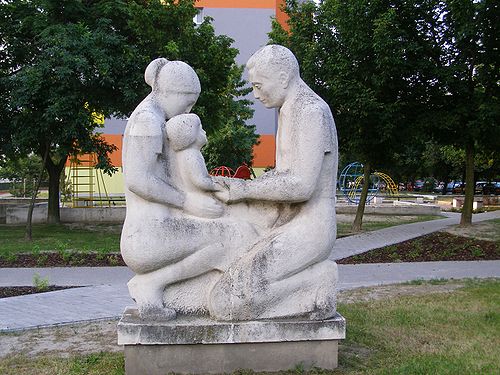
The image above is Parent with Child Statue, Hrobákova street, Petržalka, Bratislava by Kelovy, sourced from Wikimedia Commons.

Watching Your Parents Age

There comes a time in life when you notice that your parents are aging — particularly if you live at some distance from them — see them only once or twice a year. A few more wrinkles, a little less hair with a little less color, an infinitesimally small decline in the speed of the mind or the body.

As spectator sports go, this one isn’t much fun to watch.

Of course, it touches the heart of the child who, like most children, loves her parents. And, if the parent is wise or observant, he or she can see the concern in the child’s eyes as the offspring anticipates worse to come, up to and including the death of the people who once-upon-a-time meant everything to her, and still mean almost as much. Such a parent might remember back to the experience of witnessing something akin to the “time-lapse photography” of her own parents, with all the same attendant concerns now felt by her offspring.

As the famous Latin phrase reminds us, “sic transit gloria mundi.” So pass away the glories of the earth.

What is one to do?

Well, at the most basic level, there is nothing one can do to stop the aging process, one can only slow it. Perhaps your parents can be encouraged to exercise more, eat better, take their vitamins, and get regular medical check-ups. Or, if you are the parent, you can do this without encouragement, realizing that the longer you remain fit, the more satisfying your life can be and the less concern you will visit upon your kids.

But, at a relationship-level, there are some things that can be done. In fact, quite a few.

The first, is to ask yourself what is the status of the relationship. Are you able to be yourself around your folks? Do they really know you? Do you have to bite your tongue for fear of setting-off a conflict? Do you speak with them about things more personal than the weather, the score of the Cubs game, and other small talk? Do you say “I love you” to them and do they let you know that they love you and are proud of you, in words and deeds? Are they too critical? Do they treat your children (their grandchildren) well?

And if there are problems between you and mom or dad, what then?

The first thing to consider is how long you have carried this concern inside yourself. Is it something minor or something that has caused great pain? Are you contributing to the problem by your own comments, actions, or inactions? Would therapy help to process the sense of injury or anger and the feeling of not measuring up to what your parent(s) expected; the failure to obtain your parents’ whole-hearted approval, dedicated time, and expressions of affection?

Most adults want to think the best of their parents, and attempt to put the past behind them, however unfortunate it might have been. Trust me, there are almost always parents who were worse than yours. But this does not mean that yours were good, or that the issues you carry inside of yourself are finished just because you rarely think about them.

I know, you have thought to yourself, “they did the best they could.” But as Winston Churchill said (and could have applied to any of us): “It is not enough that we do our best; sometimes we must do what is required.”

If there are things still unfinished between you and your folks, it is often helpful to make a final effort to put them right (unless you have already done this or your folks are clearly beyond redemption). While aging parents are not regularly open to a reconsideration of what they have done for you or to you, at the very least such an attempt sometimes serves to relieve you of the regret you might feel once they are gone, as you say to yourself “If only I had…”

And, if such an effort fails, this can open the door to needed therapy to grieve the injuries, losses, and unhappiness of that relationship — the things that never got resolved. If, on the other hand, you come to a new understanding or intimacy with your parents, all the better, while you still have time — the time of their lives — to enjoy this reformed and improved connection.

But what should you do if you get along well with your folks, feel loved and have always felt loved by them? How can you deal with their aging?

First, don’t forget about them. If they made time for you, you should make time for them. A good way can be to talk with each of them about their early life, one-on-one. You might discover some interesting information about your family history and even see patterns in your parents’ lives that you are repeating in your own; some good, some not so good.

You may discover that your parent lights up when talking about the past. Their heartbreaks and disappointments in life can also be of no small assistance in forming your own understanding of how your folks came to be the people who they are, and parented you in the way that they did.

And, while they still have life, enjoy them and let them know how much they mean to you. Say the things you would say in giving a eulogy, only do it while they can still hear it. (Good advice in relating to your friends, as well).

Talk with them about what is really important. What have they learned in life that they might want to pass on to you? How do they feel about aging? How do they feel about death and whether there is anything beyond death?

I know this can be touchy stuff. Here is some more: speak to them about writing a will and take a look at it, if they will allow you. Yes, this makes it seem like you are only interested in cashing-in on their worldly goods once they are gone. But, a properly written will that the heirs find acceptable can make the distribution of their estate much easier for all of their kids and avoid court battles and life-long enmity among those relations.

Even more important, ask them how they would like to approach medical emergencies, life support, and extraordinary medical procedures. And, if you can, persuade them to write a “living will” and designate someone to have their “power of attorney” for health care decisions in the event that they should become unable to exercise such judgment on their own.

Here is a story about how this can come in handy, as well as about the difficulty of following your parents’ wishes in just such a situation.

In my mother’s last days, at age 82, she lay unconscious in a hospital bed. She’d lost my dad about seven months before. My two brothers and I knew her to be depressed following his death and in chronic pain from a variety of ailments. She had told me that she prayed every night to her mother and my father that she should die. My folks had assigned the medical power of attorney to my brother Ed, and we all knew by what was written and what was said to each of us, that she did not want anything extraordinary done to keep her alive.

A few days before she died, during one of Eddie’s visits to the hospital, one of her physicians approached my brother and strenuously urged him to authorize an extraordinary procedure. My brother listened as the man attempted to “guilt” him into acting in a way that he knew my mother would have objected to had she been conscious. Eventually the brow-beating ended with Ed still steadfast in upholding my mother’s wishes — but he had been shaken.

Shortly after, I arrived to join stalwart Ed in our vigil at the hospital. Almost before he could say “hello” to me, Ed told me what had happened and, totally unlike him, broke down in my arms. Unless you have “been there” as Ed was, having to say “no” to a medical professional insisting that you should do everything possible, however small the odds, to keep your loved one alive, I don’t think that you can know what such an experience feels like.

This was the woman who had given him life and had comforted him in difficult moments; who protected him, fed him, laughed with him, and cried for him.

But, he did the right thing, the thing my brother Jack and I knew was necessary, and the thing that my mother had unequivocally expressed to be her desire.

Churchill’s words apply here too: “It is not enough that we do our best; sometimes we must do what is required.”

Ed did exactly that, displaying a kind of courage not to be found even in war-time.

So, if you are lucky enough to have an acceptable relationship to parents who are still around, take advantage of the time. And if you are parents who are lucky enough to have healthy and devoted children — same message.

Treat the time as precious — the time and the people.

The image at the top is Rembrandt’s Head of an Old Man in a Cap.

The image at the bottom is my brother Ed, hitting a double in a 16″ softball game at Chicago’s Peterson Park, a number of years ago.