Of Clocks and Weddings and Getting Cold Feet

http://upload.wikimedia.org/wikipedia/commons/thumb/2/29/Marshall_Field_and_Co._clock_at_State_St..JPG/500px-Marshall_Field_and_Co._clock_at_State_St..JPG

It could have happened to you, but it probably didn’t.

The young man was 28 years old and in love with a 21-year-old beauty. His prospects were not great, but he had finally landed a steady job at the Post Office near the end of an economic downturn. Marriage was now possible, his intended said “yes,” and her parents gave their permission.

A marriage license would be required.

They agreed to meet in downtown Chicago at the famous Marshall Field and Company Building, now known as Macy’s. That block-long edifice faces State Street on the west, Randolph on the north, and Washington on the south.

The time was set. From Field’s they would make the short walk to City Hall to get the legal document.

“We’ll meet under the Field’s clock,” he’d said off-handedly and she’d quickly agreed.

The day came and at the appointed time he was there. Right under the clock at Randolph and State as he’d promised.

Only she wasn’t.

What could have happened? Did she get delayed? Was she injured?

Or, just perhaps, did she get cold feet?

Meanwhile, a lovely young woman aged 21 stood at the corner of Washington and State.

And she was thinking to herself, “What happened to Milton? He is always so punctual. Where could he be? I’m standing under the clock just as we agreed.”

You see, a small misunderstanding had occurred. Marshall Field’s had two clocks, one at each State Street corner.

It wasn’t long before one or the other figured things out and walked toward the corner opposite. The meeting occurred, only a little late. The marriage license was obtained and the wedding followed later that year, just as planned.

Both the bride and the groom showed up for that, on time and in the right place.

My parents’ wedding.

How easily it all could have gone wrong, in which case, you wouldn’t be reading this and I wouldn’t have written it, because I never would have been even “a twinkle” in my father’s eye, as he sometimes referred to me.

And my wife couldn’t have married me — a man who didn’t exist. And our kids would never have been born, etc., etc.

Getting “stood up” at weddings is hardly unheard of. Movies have been made about such events. Think Runaway Bride with Julia Roberts and Richard Gere.

Then there was the 2005 media circus surrounding Jennifer Carol Wilbanks, who disappeared in order to avoid wedding bells, later falsely stating (in an effort to explain her absence at the alter) that she had been abducted and sexually assaulted.

The worst “real life” tale of this type that I ever heard from someone personally involved in the event concerned a “high society” wedding — one for which no expense had been spared, enormous numbers of people had been invited, and everyone showed up other than the groom, who didn’t even call ahead to cancel or ever apologize to his fiance by letter, e-mail, phone, or text message, and certainly not face-to-face.

And then there is an Internet story of a young man who actually went so far as to go through the wedding ceremony and reception, only to speak to the assembled throng of well-wishers declaring that he intended to get an annulment the next day because of his new wife’s recent sexual escapade with his best man, upon which he pulled out photos of the two that more than verified his report.

Now there are those who would say that “everything happens for a reason,” and that everything turns out well in the end.

I am not one of those people. I believe in accidents, good and bad, which seem to be randomly distributed despite our best efforts to control events.

And, as far as happy endings are concerned, they do happen sometimes, although not everything ends happily.

But, I do believe that you have to make the best of things.

The young woman of the “high society” wedding I mentioned was humiliated and devastated, but did eventually marry a man who loved her to pieces and actually showed up on their wedding day to prove it. They’ve been married forever and continue to be very much in love.

And, it’s hard to argue that the man who promised annulment would have been better off married for more than a day to his unfaithful if temporary spouse.

Let’s hope they both learned something from the experience and went on to find happiness elsewhere.

In the end, especially when you are young, most set-backs are relatively brief, especially if you have some resilience.

Of course, whatever children might have been born of the last two ill-starred matches I’ve described never came to be.

A good thing? Not a good thing?

Did we miss the next baby Beethoven (who was born of a very unhappy marriage)?

I can’t say.

All I know for sure is that I’m glad my folks had enough confidence in their love to stick around, and that one of them walked down the block to find the other.

But for that… well, you know.

—

One of the two State Street clocks of the old Marshall Field and Company Building in Chicago, now known as Macy’s. Sourced from Wikimedia Commons, photo by DDima.


Of Grasshoppers and Ants: When Winter Comes

http://upload.wikimedia.org/wikipedia/commons/f/f8/The_Ant_and_the_Grasshopper_-_Project_Gutenberg_etext_19994.jpg

It is an age-old dilemma and an age-old story. Spend or save? Play or work?

Aesop told it in the tale of The Ant and the Grasshopper. The grasshopper sings the summer away while the ant works to store food for the cold months. When winter comes, the grasshopper is out of luck.

There are numerous different versions of this story, but I’ve always wondered about one particular, very human variation. What happens when two people, close friends or lovers, are both engaged in a lifestyle that only one can afford?

The woman, a high-powered executive with a salary to match, can afford to live the way she does; expensive meals, nice trips, Broadway musicals and the like. The man has the same tastes as his lady friend and enjoys indulging them no less, but isn’t a big-time earner. His is a “live for today” attitude, and let tomorrow take care of itself.

Finally, though, the man has a reversal of fortune; perhaps he loses his job. Or, let’s say that he must retire. Both remain healthy and active, but the small amount of savings in the man’s account is mostly gone, spent on all those dinners and trips, the wine and the laughter that accompanied the good times. The woman still wants to live in the same old way: not counting the pennies. The male is largely dependent on his severance and unemployment benefits in one scenario, or on his modest Social Security and retirement checks if he is a bit older.

What happens now?

A few different possibilities:

1. The woman adjusts her life style and learns to live in a new way, still spending the same amount of free time with the man; the man, too, realizes he cannot live as before and finds less expensive ways of having a good time. Travel is severely curtailed. Lavish restaurant meals are now just memories. They accept the new financial terms dictated by his financial status and still enjoy the relationship.

1a. Both parties try to live with less expense, but it doesn’t work for them. The man believes that the woman could support some approximation of the previous level of entertainment and luxury if only she wished to. The woman regrets the need to set aside “fun,” even if it is in an effort to maintain the relationship. Each one feels the strain.

2. The woman decides that she still wants to live in the old way and is willing to pay for her friend to accompany her. Some amount of “hostile dependency” is inevitable, with the man feeling resentment that he has lost “standing” in the relationship. Meanwhile, the woman matches his resentment with a sense that her lover is not sufficiently grateful for her generosity.

3. In the final scenario the woman decides she wants to live as before, but she doesn’t intend to pay for her friend’s expenses all the time. So she leaves him behind with some frequency, going to expensive dinners with female friends, going on trips alone or with others who can pay their own way. She does not want to mortgage her economic future to indulge her friend.

Of course, this path risks its own tensions. The man is angry at being left behind and the financial strain of trying to keep up with his companion to the extent that he can. The woman resents his resentment, because she is paying for more than before, even if not for everything.

The lovers are spending less time together now and therefore might have more opportunity to meet someone else of the opposite sex with whom these difficulties would not be present. Temptation exists where none existed before.

Now, I imagine that you might have one of several responses. “Too bad,” would probably be one, a shame that they have had this reversal in fortune that has changed the relationship.

On the other hand, some of you might blame him for being the “grasshopper” who didn’t save for the winter. Others could find the woman selfish and self-involved if she chooses either the second or the third “solution,” unwilling to be more generous toward the man she says she loves.

In my experience, it would be relatively rare for two people accustomed to a somewhat extravagant way of living to adjust to a more modest lifestyle when such an adjustment is necessary only for one of them. Indeed, in the present example, one can fairly assume that shared interests in elegant dining, good seats at sporting events, and travel were among the elements that attracted one to the other and bound them together.

In the end, we outsiders often think that the proper solutions to — let’s face it — non-life-threatening problems like these are obvious and should be easy to implement.

But when you are in the middle of the thing itself, it often isn’t as easy as it looks from the grandstand.

If only this couple could realize their good fortune in having each other, friends and family, and their good health (Solution #1), as well as the relative unimportance of living grandly…

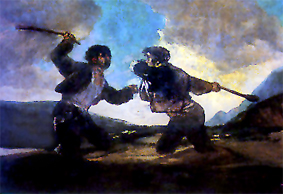
http://upload.wikimedia.org/wikipedia/commons/1/12/Goya-La_ri%C3%B1a.jpg

There is a famous 1819 painting by Francisco de Goya, La Riña. It shows two men attempting to beat each other, stuck in muck and mire. Nothing too remarkable in that.

But what is stunning about the composition is how it contrasts the brutality of the antagonists with the staggering beauty of the landscape they inhabit. Just as in the case of the hypothetical man and woman I’ve described, who (unless they can comfortably arrive at the first solution) will live in some unnecessary measure of tension and unhappiness, these men, too, do not see the beauty around them or value it highly enough.

And so the consolation of what the lovers still have together — those things about their relationship that are free of any cost — is dismissed, just as the beauty and wonder of nature are ignored by these men, sacrificed to their resentments.

Sound familiar?

—

The first image above is The Ant and the Grasshopper, from Aesop’s Fables, a 1919 illustration by Milo Winter, available from Project Gutenberg and sourced from Wikimedia Commons. The second is the Goya painting I described, which resides in the Prado, with the same source.

Growing Apart in Marriage

Grant_Wood_-_American_Gothic

In the black and white world of “absolutes,” life decisions are easy and obvious. But life as it is actually lived becomes a good deal more complex and muddy.

Here is an example:

Take a middle-aged man and wife, both approaching 50. They married young for many of the same reasons that other people do: physical attraction, the fun and good times of first love, and religious faith.

He had been groomed to work hard, build businesses, and accumulate wealth. She had been raised to refinement, home making, and the raising of children. Although both were college graduates, neither saw education at the time as more than the expected and required thing to do.

They both succeeded at their appointed tasks. He was often absent, working late to achieve and maintain the commercial success that he won. She had the major responsibility for raising the children and keeping the home a beautiful and congenial place in which to live.

Time passed. As the children left the home, she turned increasingly to her religious community for companionship and to the comfort provided by her faith, the one which he professed only nominally. She attended less to her physical well-being and gained weight. She was satisfied with her life, fulfilled and sustained by her belief in God and a like-minded group of co-religionists. This woman believed her relationship to her husband was satisfactory in terms that were typical of a long-married couple with grown children.

The man, on the other hand, became more interested in philanthropy and involved himself in charitable projects in which the wife was uninterested, simultaneously turned-off by the religious focus of his wife; indeed, by now he had become sceptical of organized religion, if not agnostic in his outlook. And, in the free time that his success afforded him, he worked-out and kept fit. As well as discovering a passion for history, philosophy, and science, he read voraciously for pleasure. The world of ideas had captured him.

The wife would encourage her husband to pray with her and to attend bible study groups, but his study of the history of religion made him doubt the authority of the documents that his wife accepted as the foundation of her world view. She was calmed by the certainty of her belief in God, while he had become a sceptic.

For her part, the increasing “intellectuality” of her husband and his decision to return to school for occasional classes left her untroubled, but unable to connect with his newly developed interests. His efforts to engage his wife in conversation about the things that he found intensely exciting found her indifferent, unable even to feign curiosity. That was simply not who she was.

And so they grew apart, although her life remained satisfactory to her, since she was not looking for the intellectual interaction that her husband wanted; or sex, for that matter, although she dutifully complied with his desire to continue a physical relationship with her. Other than the children and  the practical matters that occupy business partners or roommates, there wasn’t much depth of communication, and certainly no meeting of minds.

The woman did not sense the extent of her partner’s disaffection, his feeling of emptiness, or experience these feelings herself. She was close to the children while he had only business associates, no close friends. Nor was he one to talk about his feelings with her easily, so that his wife’s lack of intuition left her unaware of his loneliness and his desire to engage with someone who stimulated him in every sense.

Indeed, intensity was not what his wife wanted, not in bed, not in the world of ideas, not in thoughtful conversation about his feelings. When he did try to achieve these things with her, he was left even more disappointed than before.

Still attractive to women, with a strong personality, good looks, and the status conferred by money and power, he was tempted by younger, more admiring females who offered a sense of engagement that his wife seemed not to value. Still, the ethic of responsibility with which he was raised gave him pause, and he experienced a feeling of anticipatory guilt as he thought about the prospect of being unfaithful.

—

Whether this man acted on the temptation for an extra-marital affair or sought a divorce is not something I’d like to address quite yet. First, I want to raise some basic questions about relationships and responsibility:

1. Should this couple stay married for what might be another 40 or more years?

2. Is it possible that the idea of fidelity — the promise of a lifetime of faithfulness — made more sense when lives were shorter than they are today? The average lifespan of 50 at the turn of the 20th century has now been extended, at least in this country, to the mid-70s for men, and even longer for women.

3. How much should we be held accountable for a decision (to marry) made at a relatively early age that does not — cannot — fully anticipate the unpredictability of changes in personality, behavior, and beliefs that may occur in any life?

4. To what degree should one member of a marital couple sacrifice his or her happiness so that the other member remains satisfied and content?

—

So what happened?

The female was not interested in marital therapy (although she did give it a half-hearted effort), instead believing that it was her husband’s lack of religious faith that should be the target of intervention, and that only if he was properly devoted to God would he be relieved of his troubles. He eventually did have affairs, but when his wife found out he saw what injury he had done to her, felt guilty, and renounced infidelity (and the divorce he also contemplated) going forward.

The husband attempted to accept his wife’s limited interests in the things that stoked his imagination. In his mind he had already hurt her enough and therefore could not demand more.

This woman was now, once again, contented in her life, if ever mindful of her husband’s potential for further betrayal, of which she did not hesitate to remind him. The couple stayed in their rural suburban community away from the stimulus of the city that he craved, partly as his penance for harming her, and partly (she hoped) to keep him away from temptation. He did not again pursue other women or respond to their attempts to entice him.

Later, as his involvement in the world of business began to wind down he suffered a diminished and unsatisfactory life, relieved only by the self-stimulation of reading, his increased closeness to the children he had left for his wife to raise while he pursued the bread-winner role, the grandchildren who received the best of him (as his children had not), and the joy that came with being an active part of their small lives.

—

Most of us know at least one old friend, someone we hardly ever see anymore, with whom we somehow remain close. “We pick up wherever we left off, even though we haven’t seen each other in years,” or so we say in such situations. But we also know the experience of growing apart from a person we might even see fairly often.

In the first instance we have taken different routes in life, lived away from each other, but wound up in the same psychological, intellectual, and emotional place. In the second example, even though our external paths have not differed very much, our internal compasses led in different directions. We may be close by, but we are no longer close.

—

The relationship problems exemplified by the couple that I’ve described grew out of the divergence of these two human personalities as time passed. It would be easy to see one partner as evil and one as good, but I hope that it is clear that this situation was more complicated than that. The husband was not cruel. He did not wish to harm his wife and, in the end, was clearly leading the less happy life of the pair.

He had sought fulfillment by pursuing other women, at least temporarily. But did not his wife pursue her own self-interest, as well? It included a kind of marriage between herself and an institution of faith — the church and the people who made it up. That it did not involve sexual infidelity, however, does not mean that it had no effect on her husband. Indeed, he craved an intellectual, emotional, and physical exhilaration that his wife found unnecessary to her well-being.

It could be argued that in ultimately choosing fidelity to his wife, forsaking the kind of betrayal he had visited upon her earlier, the man had betrayed himself and the possibility of a satisfying companionship for himself ever after.

Life does not always easily correspond to neat categories of right and wrong, good and evil. Even the Ten Commandments are not seen as absolute by most Christians and Jews, at least those who justify killing in wartime or self-defense, or accept the State’s right to perform capital punishment.

Sometimes people who once matched well, change. Sometimes you can do nothing wrong and get an unfortunate result. Sometimes the choices that partners make prohibit mutual satisfaction because of who they are, not because one is good and one is bad. A relationship that works for both parties today may not continue to work indefinitely.

It is a bit unsettling to look at life this way.

But that is the way it looks from here.

—

The image above is American Gothic by Grant Wood, sourced from Wikimedia Commons.

A Christmas Story: Telling the Truth and Breaking the Heart

Was she seven years old? I don’t remember my eldest daughter’s exact age when she asked the question:

“Dad, is Santa Claus real? Nicole (a friend in school) said he isn’t.”

I had learned long before this, the value and importance of being honest.

I looked at Jorie, but perhaps could not see just how invested she was in her belief in Santa.

What I could see, however, was that she trusted me. And, in the few moments before I answered, I quickly determined that I could not break that trust.

“No Sweetie, he isn’t.”

I can still see her little face melt into a waterfall of tears. I comforted her as best I could; so did her mom.

It was not the last time that I caused pain to someone I love, but I think it was the first time I’d done this to any child of mine.

Welcome to the real world, honey; the place where things aren’t always as they seem or as we would like them to be. A place where hard reality trumps fantasy; a place where someone who “loves you to pieces” tells you something that breaks your heart into pieces.

That was a long time ago. I’ve wondered what else I might have done instead; something to save this little person from the pain of a message amenable to postponement.

Should I have said, “What do you think, Sweetie?” Was there a possible Socratic dialogue — an artfully crafted sequence of questions leading her to the same truth and not hurt so much?

Could I have tried to change the subject, to avoid the answer and let her continue to believe anything she wanted?

Or, should I have simply lied? “Of course there is a Santa, Sweetie.” And then left her open to the potential ridicule of friends, as well as some doubts about whether her dad was trustworthy.

Janet Landman, in her book Regret: the Persistence of the Possible, likens regret to the dilemma of coming to a fork in the road and making a choice. You walk down the chosen road for a while, before you realize it isn’t quite as good as you had hoped. Eventually you conclude, “I probably should have taken the other path.”

It really doesn’t matter which road you choose. Nothing in life is perfect. But in your imagination the alternative remains idealized. Only in your mind, in the world of abstraction and fantasy, does perfection reside — the perfect job, the perfect mate, the perfect result, the perfect performance of whatever kind.

And, for me, the perfect answer to a simple question.

Sometimes in life there is no ideal solution, no right path, only a bunch of imperfect possibilities. And, of course, we never know what it would have been like to choose the other road at that precise moment. Because, as Heraclitus said, “You cannot step into the same river twice.” Meaning that with the passage of time, the river has changed, and so have you.

No, you cannot un-ring the bell. No do-overs when it comes to the knowledge of whether Santa is real.

We must live with the inevitable heart breaks, whenever they come. In the one life we have, we can never be quite certain what would have happened had we lived it differently.

Ultimately, one can only accept the terms life allows. The contract we (metaphorically) sign by having the audacity to take our first breath at the moment of our birth allows for no escape clause from hard knocks. Not, at least, while life goes on.

I still wish I could have protected Jorie from the terrible knowledge I delivered so innocently that day, not just the knowledge about Santa, but about life. Indeed, as I think about it, it isn’t the knowledge from which I wish I could have sheltered her, it is from the pain of life itself.

But, such things are not in our power. Life will have its way with us. If we are lucky, we will also have the compensations of beauty, joy, friendship, laughter, learning, and love.

Jorie and I lost a little innocence that day.

The good news?

Our love abides.

Violence and Intimacy

File:William-Adolphe Bouguereau (1825-1905) - Dante And Virgil In Hell (1850).jpg

Perhaps it shouldn’t surprise us, but one can do the most violence to another when one is close to that person. Physically close. Pinching, punching, pushing, plucking, picking, pulverizing — actions that can only be done at close quarters, the victim is pilloried and punished. Perhaps then, it is no wonder that human kind can be uncomfortable with and afraid of intimacy.

When physical vulnerability is compounded with the psychological, we tend to be even more careful. Those who are close to us know just where to strike, where the soft and breakable parts are; and they are just in reach.

I watched a History Channel feature the other night on The St. Valentine’s Day Massacre. The point was made that while the Thompson submachine gun was a useful weapon for killing at a distance, many of the most important gangland assassinations were done with a pistol, while holding or grabbing the victim, or pulling him close to make certain that he couldn’t reach for his own weapon. Intimacy again — the closeness that made injury possible, more certain, more lethal.

Remember Delilah of the famous bible story that featured Samson? Again, intimacy, this time of a sexual nature, allowed her to rob Samson of his strength by having his enemies cut his long hair while he slept.

When you were a kid, do you remember an aunt or uncle or grandparent who would hold you close and then pinch (and shake) your cheek between thumb and forefinger? It was alleged to be an act of affection, but whenever it was done to me, I couldn’t quite understand how something that hurt that much was supposed to show love.

I’m sure you know the origin of the handshake — an ancient custom designed to display the fact that you do not have a weapon in your hand with which to do injury at close range.

And, in the “you always hurt the one you love” department, we should not forget that “crimes of passion” account for many of the violent deaths in this country. That is, we are harming those we know, not strangers, in fits of intense emotion and impulsivity.

How does this relate to therapy? In part, because the therapeutic relationship is a somewhat one-sided intimacy. The patient makes himself vulnerable to the doctor, displays his wounds and expresses his emotions, trusting that his secrets and feelings will be safeguarded, treated with kindness and respect, and definitely not used against him. Therapists need to keep this in mind, lest they re-traumatize the person, injuring him in a way that is similar to the very torment that he came to therapy to heal.

Although a counselor’s power can hardly be considered “great,” it is considerable when it comes to his patients. Psychologists would do well to remember the quote from the movie Spider-man: “With great power comes great responsibility.”

The moral of the story? Allowing one self to become close and vulnerable to another person opens the door to the best and worst that life can offer. It is therefore of great import to choose a friend, a lover, or a therapist with care.

As the Knight Templar told Indiana Jones in Indiana Jones and the Last Crusade when the explorer had to pick out the Holy Grail from an assortment of old cups, “choose wisely.”

—

The above image is William-Adolphe Bouguereau’s 1850 painting Dante and Virgil in Hell sourced from Wikimedia Commons.

Love Letters

It is said that the art of letter writing is dead.

A pity. The age of instant electric communication has robbed us of one of the most touching ways to express the heartache — the exquisite pain — of a love who is out of reach.

Just over 60 years ago, there was a time when only a letter (or a then-expensive telegram) made any contact possible with one’s far-away love.

Such was the case during World War II for my parents.

Spouses in a marriage that ages well tend to retain very fond memories of their early days together. Whenever I see a new couple in marital therapy, I always ask them how they happened to meet and what drew each to the other. If the relationship still has “life,” these questions invariably warm the conversation. The partners have enkindling memories of the “honeymoon” period. The spark of that early time —  “the days of wine and roses” — continues to fuel the relationship they have today.

My father entered the U.S. Army on December 12, 1943 and was honorably discharged in March, 1946. Most of that time was spent overseas, in places like England, France, Luxembourg, Belgium, Switzerland, and Germany. The day that he and my mom received the news of his inevitable departure to wartime Europe, she was attending the wedding of her cousin. The tears that everyone thought reflected her response to the marriage ceremony were about something else entirely.

—

I don’t have any of my mother’s letters to my dad, but only some of those he sent to her, mostly as World War II was dying down. They married late in 1940, so their relationship was still very fresh when he left for the European theater. His April 1, 1945 letter to her still includes a dried out daisy that he picked for her in Paris. His words surely reflected the thoughts of many that day:

My Adorable Sweetie Pie,

This is Easter Sunday and everywhere in this world people have gone to church to pray that this terrible war will soon be over. I, too, hope so for many reasons, but mainly that I can return to you and stay, and that (my brothers) Eddie and Harry need not be exposed to any more danger. Do the folks know about Harry being wounded? I hope not…

It ends:

Do you know, sweetie, that I’m simply wild about you. Gosh, I love you so. Great big kisses and hugs from the lonely husband who loves you.

My dad’s letters frequently tried to cheer up my mother. She lived with her parents for part of this time and they were no love-match. Many people thought that the war would go on for years more. My mother’s only brother was eventually drafted and put in training for the invasion of Japan. That event never occurred, of course, as the Japanese surrendered after Hiroshima and Nagasaki were destroyed by atomic bombs.

Stateside it was well-known that many of the U.S. soldiers were not faithful to the girlfriend or wife back home. My mother must have expressed concerns in a letter to which my father responded on April 4, 1945:

You signed this ‘Your Best Sweetie,’ but it should have said ‘Your Best and Only Sweetie,’ because that is what you are. Does that answer your question? And now to answer your air mail of March 13th. It started with that gorgeous poem about Spring and, gosh sweetie, it gave me goose bumps to know that ‘the day I return will be your Spring.’

Victory in Europe came on May 8, 1945, but my father would remain there until late February of the following year. The time passed slowly for both my parents-to-be, as noted in his missive of June 18, 1945:

I know I could perk up your morale if I came home, but they won’t let me just now. I know, too, how much your heart and body ache for me because I am undergoing the same each and every minute. You are vital to my complete happiness.

My mother suffered from tuberculosis before my folks were married. It would recur again in the 1950s. My dad was mindful of the fragile state of my mother’s health:

Sweetie, you are working much too hard for a little girl who isn’t well and you must cut it out. Gee, I wish I was around to protect you and snuggle you in the thunder and darkness of the rain.

Poor darling, you even talk to my picture, begging me to come home, and how I wish I could answer that I’ll be home in a few hours or days or weeks. But it will be a while yet and we must just be patient and hope and pray it will be very soon. The good God above must see how hungry and helpless we are without each other and I am sure He will answer our prayers soon…

All my love belongs to you, sweetheart, every drop of it.

Dad’s letters talk of many different things: day-to-day life in the army, the problem with officers, places he has seen, family matters, army food and the much better food they sometimes had after Germany’s defeat, gifts and money he was sending mom, the progress of the war, the first Bastille Day after Paris was liberated (at which celebration my father was present), and even references to the children they hoped to have together.

File:Cheret-Folies-Berger.jpg

On July 9, 1945 my dad sent mom a page from the Army’s magazine Stars and Stripes. That portion of the magazine displayed pencil drawings of the beautiful women at the Folies Bergere, a famous Parisian show that included popular entertainment and scantily clad female performers. On it he wrote the following:

This will give you an idea of what the Folies Bergere is like. I’d rather look at you, though.

Not everything my father witnessed brought a smile, however. This comes from October 19, 1945:

We have two colored boys in our convoy, who were carrying our postal equipment. When we went to supper here in Germany, the Sargent who ran the mess hall made them eat in a separate room. The colored boys were fighting mad for which I can blame them little. I complained about this treatment to the mess Sargent, who said that the First Sargent had made it a rule. I went to the latter and told him off plenty (my dad was by now a Staff Sargent). His answer was that I didn’t have to eat in the mess hall either if I didn’t like the rules.

So this is for what we fight. I finally talked to the colored boys and pacified them somewhat.

On February 14, 1946 the end of the seemingly endless wait to return home was close at hand. By now dad had been 11 days in La Havre, not yet assigned to a ship for his cross-Atlantic voyage:

Well, at least I will be with you soon and I know ‘wonderful you’ are waiting with all the love and devotion a guy could ask for. I love you, sweetie.

On February 26th, after 12 more days in La Havre, he was headed home.

—

In the mid-1980s, 40 years after these events, I asked my dad what it was like the first time he saw my mother again. His most moving recollection wasn’t their actual reunion, rather it was the first time he heard her voice when he called her on the telephone, just after his arrival in New York. His voice cracked as he remembered that moment and tears came to his eyes.

Soon after that call, he must have written her this post card:

My last letter to you. From now on I’ll tell you in person. Gosh, it will all be so wonderful soon.

My father would have been 99 years old today.

—

I’ve reposted this blog from 2010 in honor of my dad’s 100th birthday anniversary.

Parenting: When Love is Not Enough

madame roulin with her baby marcelle by vincent van gogh

Well meaning parents don’t always do well.

Or, to put it more bluntly, you can mess up your children without really trying.

Take the following example: two caring, well-educated, good people. They were in love with each other and loving toward their children.

One child was handsome, outgoing, and had a sunny disposition. Other children and adults were drawn to him. He awoke every morning with a smile on his face and brought cheer to those around him. Although not a great student, this boy was certainly bright enough; he made his way more than adequately in the world of friendship, study, and eventually, work.

His brother, however, did not have it so easy. To start, his body was ungainly. Even as a kid, he lumbered and lurched in locomotion. His cumbersome, block-like (not overweight) form caused him to stand out. Because of  a lack of refined adroitness in matters of balance and dexterity, he was always the last boy picked in the choosing of teams on the playground and in the gym class.

To the good, he was astonishingly bright and intellectually curious, but this only fueled the separateness he felt, to which his graceless body also contributed. Outgoing though he was, peers tended to shun and ridicule him. Social skills did not come instinctively and this young boy’s efforts at outreach neglected the usual questions that facilitate social contact: queries like “How are you?” or “What did you do over the weekend?”

Monologues rather than conversations were the result, further emphasizing this kid’s peculiarity and securing his status as an outsider.

His parents were at a loss. Certainly, they treated their dear son with kindness and affection, and applauded his prodigious intellect and curiosity about the world. But, when they saw his unhappiness and discovered that peers marginalized and ridiculed him, each of the parents tried to put a good face on things. While they defended him when they actually witnessed the cruelty he received, the boy’s hurt was not discussed very much at home. The parents minimized or ignored his pain, believing it best to encourage him to believe that things would soon get better and telling him not to let the ill-treatment of the other children bother him.

Soon enough, this child tended to his wounds by himself, confiding little in his parents, as if he instinctively realized that they would not or could not offer him any response that would feel good. Those times late at night, often just before bed, when a child is most vulnerable and open to spill his pain, passed without the flow of consolation. Thus, like many children (especially boys) who find themselves feeling empty and alone, deadening his emotions was preferable to exposing his heart to further injury.

To be fair, mom and dad figured that their boy would come to them if he needed or wanted to talk, and read his attempts to kill his emotions as a lack of need for the solace that can be achieved by having a shoulder to cry on. Indeed, they thought that he would be angered by any attempt to invade his privacy and bring up uncomfortable topics.

Nor did the elders provide guidance in how to be more reciprocal with people or give him direction in how to create conversations rather than monologues. They never pointed out that it was important to show interest in what others were doing or saying, despite the fact that both of them routinely displayed this with their children and in their own social lives. Instead, the parents reasoned that their son was already feeling hurt and rejected; and they feared that they might injure him further by telling him that his conversational style could be improved.

—

By the time of his adulthood, our subject had become what one might expect based on his early life. Surpassingly bright, he went to an elite college and had a coterie of those who admired his intellect and creativity, but no real friends. The pain of rejection had long since been pushed down deep inside, to the point that he might not have recognized the need or value of “closeness.” He was as out of touch with the emotional side of his own life as he was with the feelings of his conversational partners. Our young man seemed to have little need to find out about what was going on “inside.” Nor did he understand that his failure to ask questions to peers could be seen as arrogance, indifference, or peculiarity.

Still, our youthful gentleman led an interesting life because he sought out intellectual stimulation and threw himself into numerous activities within the world of the sciences and the arts. But, it remained a solitary existence, even if it was no longer clear to what extent he felt marginalized, so cut-off did he seem from the matters that connect head and heart.

His parents still tried to put a good face on their son’s way of living, as much as they knew about it, since they continued to be hesitant to ask him sensitive questions. But deep down they wondered whether he could possibly have any close friends (not to mention lovers) given his way of talking to people. Even now they felt that it was too late to bring up things that might cause him pain or trigger his anger at them for prying into his life.

Instead, the parents would occasionally comment to friends about their unusual son, make good-natured jokes about him, and simultaneously take enormous pride in his considerable intellectual and vocational success in the very stimulating, if strangely disconnected life he had fashioned for himself.

In defense of the elders, it should first be said that they could have done much worse. Their son didn’t do drugs, steal cars, embezzle money, or trip old people crossing the street. They parented him instinctively, as most of us do with our children. They certainly did not want to hurt him but, in their tiptoeing around his emotional pain, they failed to recognize opportunities to provide needed consolation and guidance concerning the social skill he lacked.

One can imagine that things could have been different. Had the parents been comforting and validating of his early humiliations rather than choosing to minimize them, perhaps he would have felt less isolated and not cordoned off his feelings even from himself. Had mom and dad gently guided him in how to converse, he might have had more social success and seemed less odd because of his penchant to prattle on about himself. If the parents encouraged their child to salve his own and others’ unhappiness by first providing that soothing themselves, maybe intimate relationships would have flourished.

It is impossible to know for sure. Child-rearing isn’t like a laboratory experiment, with an experimental and a control group. The “what if” questions are never answered with certainty. Sometimes nature has its way, no matter a guardian’s best and most understanding efforts at nurture.

—

Raising children isn’t easy. If you are lucky, you have a child like these parents’ first born, who responded well to the instinctive default parenting style of mom and dad.

But, for those of you who have more than one child, it quickly should become clear that they do not come out of the womb as identical sprouts, each needing just the same amount of sun, temperature, water, and nutrition. No horticulturist would treat a tropical plant in the same way that we would care for one that can only flourish in a more temperate climate.

And yet, even today, parents too often believe that “one size parenting” fits all children, and that it is the child’s job to adapt to the parents’ approach to upbringing rather than the other way around.

Put another way, you can be a good parent to one child and a less-than-good parent for another, simply by taking the identical approach to each of them.

The rule is simple: be the parent your child needs you to be.

Search yourself. Ask what your offspring requires. What will work best for this particular little human being?

Then, if you discover that the required approach to child-rearing doesn’t come easily to you, learn and stretch yourself.

You are responsible for a human life.

No job in the world is as important.

—

The above image is Vincent van Gogh’s Mother Roulin With Her Baby.

Off to College and Saying Goodbye

Paintings Reproductions David, Jacques -Louis The Farewell of  Telemachus and Eucharis

It is that time of year. Some kids are going to college for the first time. A difficult moment for all concerned.

If you are a parent, your child may have been spending much of the last year or two pushing you away; being disagreeable; wanting to spend more time alone; confiding in you less.

It could be adolescent rebellion in a fairly moderate form, but, more likely, it is his striving for independence; and his anticipation of the real break — the one that finds him living in a different state; both a state of mind and a State of the Union.

As most of us know, it usually feels better to be the one who ends a relationship first or enacts a change in it — separates, creates a distance — than to be on the receiving end of that action. But, whatever it is, it is tough for sure.

The farewells can be tearful and terrifying, mostly for parents. The kids have their anxieties too, but don’t want to betray them as openly as the elders do. The students’ brave front is as much to persuade themselves that everything will be fine outside the nest as to keep their ambivalence in check, lest they encourage mom and dad to show even more emotion and make the parting harder.

I remember spending a good portion of our drive back home from an off-to-college goodbye with tears in my eyes, having taken our eldest to the Champaign/Urbana campus of the University of Illinois. Within a few days we heard from her though. Sure enough, homesickness.

Letting go of your children is hard, as I’ve written elsewhere on this blog. You have to have faith that your offspring have learned something by age 18 and that they will survive, bruised but unbowed. Not much you can do anyway, unless you are prepared to keep them hostage in your basement forever.

They will return of course, but they won’t be the same. That too is a good, if  ambivalent thing, a sword that cuts both ways. As a parent, you’ll remember the cuddly and loving stage, the moment when you were everything to them and they couldn’t get enough of you. In trade, you get to see your children flourish (one hopes) as adults, a wondrous thing when you remember back to how little and helpless they once were.

But, be patient. The “full bloom” just might take some time and some struggle. Keep the faith.

Regardless, you do get more peace, quiet, and privacy as a bonus.

A new relationship, then — something different rather than better or worse.

The “saying goodbye” comes by degrees. At first, they return for summer vacation and holidays. Later, they will live away and see you less often. Such is life.

My wife and I kept a very old car for our daughters to use when they were home, even after both had graduated college and gone on to grad school. Finally, a minor accident rendered it beyond repair and we donated it to charity.

For a few days after the auto had been taken away, my wife and I both felt a little bit low. We talked about it. Of course, it wasn’t hard to figure out. The car was a symbol, something tied to the time they lived with us, and something that said they would be coming back. Now, with the car gone, we both had to face  that there was no coming back with the regularity of the past.

Their lives were elsewhere.

When I gave the toast at my eldest’s wedding, I told the following story:

I remember the day that we took Jorie to Champaign/Urbana to the Illini Towers dorm, to begin her college education at the University of Illinois. We thought we would be clever about it, so we woke up very early that Saturday morning and drove fast so that we would be among the first to get into the building and unloaded. But we were out foxed by several hundred people, who had gotten up earlier and driven faster and were already way ahead of us in line to use the couple of elevators and the small number of carts to get their child moved in.

It was a long, hot, late summer day. And as we stood in line  waiting, I had a feeling of familiarity, as if I had done this before. Of course, I had never moved Jorie into any new place, so I couldn’t easily figure it out.

As the morning changed to afternoon (and we were still in line), I thought back to the day that Jorie was born. At 1:00 AM, that is to say, in the dead of night, Jorie gave the signal and we were off to the hospital. And that too was a long day as we waited for the labor to progress. Finally, at 9:34 PM, over 20 hours later, Jorie arrived in this new world. And I realized that the long day of waiting for her to be born was what the long day of waiting at Illini Towers reminded me of.

The only difference was that on that day at the hospital we were waiting to say hello to her, and on the day at Illini Towers we were waiting to say goodbye.

Shakespeare was right.

“Parting is such sweet sorrow.”

But, life does go on.

—

The image above is The Farewell of Telemachus and Eucharis by Jacques-Louis David.

The Ultimate Comment on Marrying Younger Women

Pablo Casals and his Wife, Martita, 1960 - copyright Lisl Steiner

They used to be called “May/December” romances — a younger woman and an older man. The lady was variously described as a “gold digger” or a “trophy wife,” more often the latter now. Sometimes you see the reverse, a woman senior to the man — a gigolo, if he is “kept” by her.

The relationship involves a kind of social exchange. The aging man trades his status or wealth for the woman’s beauty, fertility, and a return to the springtime of life.

When my daughters, both young women, hear about such things, all they can say is “gross.” The female isn’t the “gross” part.

Other factors do play in. Sometimes the tally of years is irrelevant. The puzzle pieces don’t always fit in age-acceptable matters of romance. Should a rare magic happen, age similarities or differences matter little.

The man who marries a woman of greater years, like the woman who enjoys a seasoned man, might also have unresolved parental issues. Transference is what Freudians would call it. Put another way, the adult child’s unconscious invites a second chance for the kind of love represented by the parental stunt-double — the new, older person; especially where such love was never won from the parent.

Nor should we overlook the attractions of mortality itself: another soul speeding to death’s gate before oneself. For those of us at war with time, the brevity of the rose’s bloom makes it even more appealing than if it were everlasting. We value things and people, in part, because we won’t always have them. The perishable delights of life create urgency and the desire to hold on tight before Cinderella’s clock strike’s midnight — and we all turn into pumpkins.

There is, however, a less dark possibility. Pablo Casals, the famous cellist/conductor of the mid-20th century was 81-years-old when he married his 20-year-old cello student, Marta Montañez Martínez. Robert Baldock, Casals biographer, wrote: “No one who knew them or saw them together during the final years of Casals life could doubt … that they married for love.” Indeed, Casals said his attraction to his wife came, in no small measure, from her physical resemblance to his mother in her youth.

Still, people being people, some wondered about the match. The musician put it this way in 1970, three years before his death:

I was aware … that some people noted a certain discrepancy in our ages — a bridegroom of course is not usually thirty years older than his father-in-law. But Martita and I were not too concerned about what others thought; it was, after all, we who were getting married — not they. If some had misgivings, I can only say our love has deepened in the intervening years.

An apocryphal version of the student/maestro story is amusing. Casals got engaged and then informed his MD of his upcoming nuptials. The physician expressed alarm.

“You’d better think before you do anything — this might be lethal!”

Casals didn’t respond right away, but appeared to consider the doctor’s words. Only then came the answer.

“Well, you know, if she dies, she dies.”

Quite vigorous for most of his remaining years, Casals passed away at age 96 in 1973. The Immortal Beloved lives yet.

—

The image above is of Pablo Casals and his wife, Martita 1960 by Lisl Steiner, with permission: http://www.lislsteiner.com/

Moms on Mother’s Day

Nurturing, caring, loving, concerned, patient, compassionate, expressive, reliable, watchful, tender, giving, interested, independent, graceful, affectionate, accepting, enthusiastic, encouraging, strong, wise, and kind

or

preoccupied, worried, stressed, indifferent, cold, selfish, shrill, overwhelmed, judgmental, angry, impulsive, erratic, hard, numb, inconsistent, weak, troubled, vain, dependent, clumsy, clueless, and cruel.

As a parent and as a child, here’s hoping you came out and come out on the right side of this.

http://upload.wikimedia.org/wikipedia/commons/thumb/e/ea/Caravaggio_FlightIntoEgypt_detail_Mary_and_Child.jpg/256px-Caravaggio_FlightIntoEgypt_detail_Mary_and_Child.jpg

Rest on the Flight Into Egypt (detail) by Caravaggio