Where Does Greatness Come From? A CSO Story

Frederick_Stock

Organizations have a culture even when they aren’t cultural. The ethic can be noble and good, bottom-line oriented, or a great many other things. But the question for me as a psychologist has been, how do they get that way?

Indeed, I’ve wondered how some of them become dedicated to a higher purpose, where the individuals believe that there is something more important than themselves at least some of the time. Well, I think I have the answer with respect to at least one such institution: the Chicago Symphony Orchestra (CSO).

Not all orchestras behave well. The mid-20th century version of the New York Philharmonic was described by William R. Trotter in Priest of Music: The Life of Dimitri Mitropoulos, as having “an attitude comprising, in more or less equal parts, paranoia, economic insecurity, pride, touchiness, and tough-guy, chip-on-the-shoulder arrogance.” It took many years before conductors looked at an invitation to lead “the Dead End Kids” as something better than entering the lion’s den.

Not that seeing the conductor as an enemy has ever been the sole property of Manhattan musicians. Cellist John Sant’Ambrogio, in his memoir The Day I Almost Destroyed the Boston Symphony and Other Stories, relates the following joke:

Question: If you find yourself in an elevator with a conductor and a rattlesnake, and you only have two bullets, which one do you shoot first?

Answer: You shoot the conductor twice, because you can never be too sure you got him the first time!

The CSO was known to be different. Whatever the private opinions about the person on the podium, there was a level of respect and an orchestral standard to maintain: the best possible performance, whatever the circumstances.

Some years ago I asked the late Ed Druzinsky, the CSO’s principal harpist from 1957-1997, what he could tell me about this. His answer referred to the two orchestral posts that preceded his time in Chicago, Pittsburgh and Detroit:

As a harpist I have to get (to the hall) early. I do my warming up. I don’t carry my instrument with me like the others do. They can practice at home and warm up and just come down and play… And I always like to get there early anyway. In Pittsburgh I used to have to wait until the janitors would come to unlock the doors. Then I went to Detroit and, following my same practice, there were one or two other guys also there (early). I came to Chicago, I was part of a crowd. That surprised me at first.

Is there some way in which this is enforced? Ed continued:

Say someone comes into the Chicago Symphony and he is not that conscientious. He is surrounded by people who come early and practice. And they look down at him, and they say “What’s the matter, get with it.” And he adapts. But it was like that with Stock. These are traditions that pass from one generation to another as people come and go in the orchestra.

1936-37_season_announcement

Frederick Stock, the CSO’s Music Director from 1905 until his death in 1942, had been with the ensemble from 1895 as a violist under its founder, Theodore Thomas; and succeeded Thomas when he died. Might this conscientiousness go back that far, as Ed suggested?

I asked Milton Preves shortly before his death in 2000. Preves had joined the CSO under Stock in 1934 and became its viola principal from 1939 until his retirement in 1986. Preves recalled that Stock would come through the hall early — “for a ten o’clock rehearsal he would come at nine, or little after” — to see who was on stage practicing.

Ed Druzinsky said that before George Solti, Music Director from 1969-1991, the CSO was “the world’s greatest unknown orchestra.” Under Frederick Stock the CSO toured little, even domestically. And in those days of railroad travel, Chicago was a long way from the cultural centers of the East, where reputations were made and lost.

While Stock would be pleased that the professionalism he instilled remains intact, it is doubtful that he would recognize today’s CSO as his own. In Stock’s time it was an almost all-male, all-white enclave with Central European roots. Now it is approximately 40% female and 20% Asian or Asian-American, with a woman as president; as well as including openly gay and lesbian players. Auditions are performed on carpeted floors, behind screens that prevent the listeners from letting externals get in the way of judging musical qualities alone.

Much as some aspects of the CSO’s corporate culture needed to change, Stock’s hard-won work-ethic survives. Although Solti and his band made the CSO famous, we should remember that musicians like Stock and the self-disciplined players in his wake prepared the way. Even now, over 70 years since Stock last gave a downbeat, he is, in some sense, still on stage in Orchestra Hall, Chicago.

The reproduction of the CSO’s announcement of its 1936/37 season comes courtesy of the orchestra and its Archivist, Frank Villella.

Two Life Lessons From Dale Clevenger

clevenger

There are people who have traveled great distances to spend an afternoon with Dale Clevenger, but since he lives in a nearby Chicago suburb, I didn’t have to. Those who journeyed thousands of miles are musicians who dreamed of the chance to be coached by the world-famous solo French Horn player of the Chicago Symphony Orchestra (CSO). Most of them wanted to improve their technique on that fiendishly difficult instrument. Most of them hoped to heighten their musicianship, elevate their art in performance.

I don’t play the horn, but in the course of recording Dale Clevenger’s oral history for the CSO, I received some lessons, too.

Not about music, but about life. About the beginnings and the ends of things. About the way careers in any field are started; and how they finish.

The first had to do with auditions. And also the need for perseverance despite repeated rejection.

If you are a musician, an audition can feel as though you are on stage naked in front of a small group of listeners who will decide whether you have “the chops:” the ability to make music at the highest possible level. But if you aren’t a musician, you probably still have had something close to this experience: giving an oral report in school, sitting for an oral defense of your masters thesis or dissertation, giving a speech; or perhaps simply going for a job interview or asking someone on a date.

Clevenger had significant successes before he came to the CSO. He played in the Kansas City Philharmonic, the Radio City Music Hall Orchestra in New York, and the American Symphony under Leopold Stokowski (the conductor Disney captured on film in Fantasia). He toured Europe with the Pittsburgh Symphony and recorded the Shostakovich Symphony #7 with the New York Philharmonic under Leonard Bernstein.

While a member of the American Symphony, at age 22, a big chance came: an opening in the world-renowned Berlin Philharmonic Orchestra, several steps above any of the ensembles with which he had previously worked full-time. The Berlin band was in New York on tour, performing in Carnegie Hall. And when he walked on stage for the audition, he performed not for a small group of listeners, but for the entire orchestra, as well as its storied music director, Herbert von Karajan.

Dale Clevenger: “I played for about 20 minutes. That’s a long audition.”

Gerald Stein: “And I would think, an intimidating one, too. That is, if one were inclined to be intimidated.”

Dale Clevenger: “That’s the key. I wanted to show them what I could do. I was not worried too much about intimidation.”

When the audition was over, Herbert von Karajan told the young performer that he played “very well,” but that he didn’t match “the tone” of the Berlin horn section; in effect, didn’t fit their sound. “But,” said Karajan, “you will have a fine job one day.”

Karajan was right. In January, 1966, Clevenger would win the competition to become the Principal Horn player of the Chicago Symphony. But not before failing to become a permanent member of the orchestras in New Orleans, Dallas, the New York Philharmonic, Pittsburgh, the Metropolitan Opera, and even his first try at the CSO in 1965.

I asked him how one deals with those kinds of defeats. He then proceeded to tell me about a Boston Symphony horn player who had only gotten that job on his 48th professional audition:

Dale Clevenger: “How do you stick it out? How do you do that? Would I have done that? I don’t know, but I don’t think so. There are a lot of people who play five to 15 auditions (before they win a big one). I played 9 or 10. It didn’t affect my ego. You just keep going. (For example), how can an actor be an actor unless he is used to the failure to get jobs? It’s not possible. You have to try to find the positive in that situation.”

Not to mention lots of practice to keep improving.

In the course of our long conversation, I also talked to the virtuoso about his coming departure from the CSO. And, he told me that he’d written a farewell letter to his colleagues. We’d arrived at a the second life lesson — about gratitude and saying goodbye.

If there is a more graceful way to leave the stage, I don’t know it; especially his quotation of a line from the vocal text of Mahler’s 8th Symphony, borrowed by Mahler from Goethe, which is perhaps the best description I’ve ever heard applied to a life devoted to recreating that which is indescribable: the music of the great composers.

February 12, 2013

My dear friends and colleagues of the CSO,

One of the most euphoric days of my life was the day I was engaged to play solo horn in this great and classic orchestra. All of you know exactly that feeling. To quote Mahler in the 8th Symphony, “Das Unbeschreibliche, hier ist’s getan” (“What cannot be described with words, we have done”). I have been so fortunate for forty-eight seasons to do just that. It is with incredible bitter-sweetness, joy, and sorrow that I announce to you that at the end of June I plan to retire from this amazing Chicago Symphony Orchestra. I am the most fortunate and grateful musician ever to have played here, the elite of the elite of orchestras. This will end an amazing tenure, but retiring from music I am not. Indiana University has engaged me to be a Professor of Horn starting August 1, 2013.

You are truly some of the finest musicians on the planet. To have had the pleasure and privilege of making music and sharing the stage with you in thousands of concerts is a sweet memory I shall cherish to my grave. Please, I encourage you all to do everything possible in your power the keep my Chicago Symphony Orchestra “the best of the best!”

A very heart-felt thank you for these wonderful years,

Dale

Wonderful years, too, for those of us who just listened. Thank you, Dale. And thanks for the lessons.

The Greatest Music Ever Written

Katielyn-campbell-cmon-band

For someone who really didn’t like music very much until age 16, I am a particularly good example of how people can change. Of course, I’d heard the popular music of the time. It couldn’t be escaped. That included Elvis, the Beatles, the Beach Boys, and so forth. “Surf City,” as sung by Jan and Dean, was especially appealing.

The idea of “two girls for every boy” (mentioned in that song) gave me hope there were places where my odds of dating success might improve. I was then as misguided in approaching women as was Don Quixote in attacking windmills. “The Impossible Dream” for sure.

Early in high school we were told the really great music was “classical” and were forced to listen to it for a year in Music Appreciation class. In the second semester of that year, our marginally stable teacher thought it would be a good idea to subject us to a complete cycle of four operas by the 19th century German composer Richard (pronounced Rick-card) Wagner (pronounced Vagh-ner). If you didn’t pronounce it properly, the teacher began to foam at the mouth, so I proved to be a pretty fast learner.

The “Ring Cycle” (not the Lord of the Rings) was an ordeal, however you pronounced Wagner’s name. It lasts about 15 hours, give or take. Making 14-year-olds listen to this is akin to Chinese water torture, only worse. My opinion on this point hasn’t changed much. Suffice to say that nothing about the experience inclined me toward a positive view of classical music.

In the working class neighborhood of my youth, the few boys who carried violins were thought to be effeminate or snobs. They were bullied and humiliated. They weren’t the kids you wanted on your softball team. Playing a string instrument made you a kind of pariah, with the danger of some local tough guy deciding to see how you’d react if he broke your violin over your head. While I didn’t personally assault any of these “sissies,” I certainly didn’t respect them.

Age 16 was a turning point. My friend “Rock” somehow persuaded his parents to permit him to buy a subscription to the Saturday night concerts of the Chicago Symphony, no less than 15 individual events. He’d listened to classical music on a few radio stations, decided he liked it, and heard ads for the concerts on the same FM frequencies. His poorly educated parents listened to his plans, wondered if the Martians had taken control of their son and substituted an alien, but let him go anyway. Maybe they thought he’d actually use the money to return to Mars.

Before long Rock was playing some of this music when I visited his parents’ apartment and I started to like it. But, did I really enjoy it? I wondered about this a lot. Perhaps, I thought, I really didn’t like the music, but fancied the idea of having this in common with one of my best friends. But even if this weren’t true, I reasoned, maybe I just wanted to be associated with something “high brow” to put me in a different class than those around me, elevate me into the realm of the most sophisticated and intelligent adults.

Within a few months the question was answered. I really did like it, spent money from my after-school job on classical records, and began going to Chicago Symphony concerts. I read the backs of LPs (the long gone, vinyl, long playing records — hence the acronym LP) and books on the lives of the composers. I subscribed to record review magazines. I was hooked.

manuscriptjpg

But what is classical music and is it really any better than the music of the day, aka popular music?

One definition on the web says classical music is:

  • Serious or conventional music following long-established principles rather than a folk, jazz, or popular tradition.
  • (more specifically) Music written in the European tradition (developed) during a period lasting approximately from 1750 to 1830, when forms such as the symphony, concerto, and sonata were standardized.
Or how about this, from Martin Davidson’s The New Musical Dictionary:

An egocentric superiority-complex name for the area of music that stretches from Bach to Bartok and beyond. Since this area of music is, in general, by far the most popular area of music worth listening to (Davidson’s italics), maybe it should be called Popular Music. All the Popular Music not worth listening to (including much of the stuff between Bach and Bartok and beyond) could then be called Popular Muzak (or Money Music since the financial aspect would appear to be its over-riding motive).

A strong opinion, for sure. And one that suggests the formality and elitism that puts off some people about the musical classics. And indeed, there are no mosh pits, no head-banging, no pogoing; only the expectation of quiet and the problem of knowing when to applaud and what to wear. But let me suggest some other obvious differences between classical and popular music.

Moshpit3

Almost all of the most common music that is called popular involves the human voice, mostly in songs. While so-called classical music includes songs, it also comprises choral works, opera, and many pieces that are purely instrumental and can last for more than 1.5 hours; much longer than any song. But, it should be mentioned, I am talking about Western traditions in both cases, since (for example) Indian music includes a form called the Raga, which is instrumental and can go on for a very long time.

For me, both the instrumental nature of much of this music and its length makes a lot of difference. I am more drawn to non-vocal music than song, choral, or operatic works, with some exceptions. And, for much of classical instrumental music, there is a complexity that is greater than that found in songs. Moreover, the length of many of these pieces (Beethoven’s Nine Symphonies, for example, are not less than 25 minutes each and most are much longer), allows the composer to create a cumulative emotional impact that is harder to do with shorter forms.

Think of the difference between a blog post and a full length novel. As composer Gustav Mahler put it, “A symphony must be like the world. It must contain everything.” Not surprisingly, he used big orchestras and took his time, usually over an hour per symphony.

Some people mistake soft, dreamy music for classical music. You know, the kind of music that might be playing in the background when you get a massage; or what used to be called “elevator music.” But anyone who has heard Beethoven’s 5th Symphony or Stravinsky’s “Rite of Spring,” knows that the notion of classical music being relaxing can be way off base.

Sir Georg Solti, Conductor

Sir Georg Solti, Conductor in Rehearsal

You might be asking whether I like anything but the classics. Well, I’ve been known to favor Judy Collins and even Johnny Cash, as well as a couple of other songs that touch me very deeply like “September Song.” Mostly I listen to classical instrumental and orchestral music. I’m not a fan of most operas, even though my younger daughter makes a living in the field. And, I used to be a classical music snob.

Once I got into the classics I tended to look down on those who weren’t. My problem, not theirs. For a long time I thought one needed only exposure to the classics and you would inevitably come to enjoy them. Now, I suspect, it has more to do with how your brain is wired; and, it is also a matter of taste. But, as they say, if you haven’t tried it, you don’t know what you are missing. And, it took me both the year of exposure to the classics I had in the Music Appreciation curriculum I endured, plus the passage of a couple of years; and then even more exposure through my friend Rock and listening to classical radio before I was finally won over.

As I have written elsewhere, liking classical music doesn’t make you a better person. Some of the musicians are every bit as miserable human beings as you will find anywhere: unfaithful, greedy egomaniacs. In that respect, there is little difference between popular and classical music.

Examples? Richard Wagner stole the wife of one of his friends (who was also a champion of his music) and wrote anti-Semitic tracts in his spare time. Beethoven was a horribly disagreeable and rude person who routinely ran afoul of his landlords and was forever moving from one apartment to another. Hitler and Stalin both listened to the classics for pleasure. The slow movement of Bruckner’s Symphony #7 was broadcast in Germany immediately after the announcement of Hitler’s death.

Then comes the question you have been waiting for: what is the greatest music ever written? No two people will agree on this and since I am not a musicologist, I cannot give you technical reasons, only a very personal list. But, as Gustav Mahler said, “What is best in music is not to be found in the notes.”

Mahler

I first encountered this question when the Chicago Sun Times music critic Robert C. Marsh wrote an article detailing his choice of the 10 greatest symphonies. I don’t recall whether he ranked them, but memory tells me these were the 10 winners:

  • Beethoven Symphonies 3, 7, and 9
  • Mozart Symphonies 39 and 40
  • Brahms Symphony 4
  • Haydn Symphony 104
  • Tchaikovsky Symphony 6
  • Prokofiev Symphony 5
  • Schubert Symphony 9 in C (sometimes given the number 8). Not to be confused with the “Unfinished” Symphony.

It might have been that article that prompted a few of us in German class, including my friend Rock, to approach our learned teacher with the question: “What do you think is the greatest piece of music ever written?” We all assumed his answer would be Beethoven’s 9th, whose “Ode to Joy” finale was well-known even back then. It was certainly a piece we all loved.

Jack Willis, the teacher, surprised us. He said that his choice was Beethoven’s Quartet in c#, Op. 131. (The “Op.” stands for Opus, meaning that it is thought to be the 131st composition Beethoven ever wrote). That statement sent me to the record shop to listen to this difficult piece. It took a long time to get into it, but Jack Willis’s high opinion of the quartet was certainly vindicated in its perfection of form and lofty emotional content.

If I were to make up a list of favorites, I’d include a few that aren’t symphonies. And, after much thought (but subject to revision), here is my list of 12 compositions, in no particular order:

  • Mahler’s song “Ich bin der Welt abhanden gekommen” (I am lost to the world). It is a piece of heart-breaking poignancy that I cannot listen to without tears.
  • “I’ll Be Seeing You,” music by Sammy Fain, lyrics by Irving Kahal. This 1938 song took on new meaning when the USA entered World War II in 1941 and love letters were exchanged across the ocean. The lyrics are worth quoting:

I’ll be seeing you
In all the old familiar places
That this heart of mine embraces
All day through.

In that small cafe;
The park across the way;
The children’s carousel;
The chestnut trees;
The wishin’ well.

I’ll be seeing you
In every lovely summer’s day;
In every thing that’s light and gay.
I’ll always think of you that way.

I’ll find you
In the morning sun
And when the night is new.
I’ll be looking at the moon,
But I’ll be seeing you.

(The last two stanzas are then repeated).

  • Brahms Symphony 4
  • Beethoven Symphonies 3 and 9
  • Mozart Symphony 39
  • Mahler Symphonies 3 and  9
  • Brahms Piano Quintet
  • Beethoven Quartet 14, Op. 131
  • Schubert Sonata in B Flat, D. 960
  • J.S. Bach Brandenburg Concertos (I’m cheating a bit here. These are six different pieces, but often performed together).

Well, it is pretty clear that I lean very heavily toward the classics. For me, music is one of the greatest joys of life. I’m pretty good with words, but even the most eloquent person finds that there are limits. As Mahler said, “If a composer could say what he had to say in words, he would not bother trying to say it in music.”

The first photo is Kathie Lynn Campbell playing with C’mon Casa in Montreal on January 27, 2006. Photo by Gates of Ale. Second comes an undated musical manuscript exhibited at Igreja de Sao Francisco, Evora, Portugal by Ceinturion. The  Mosh Pit was photographed by Daniel Lin. All these were sourced from Wikimedia Commons.

What Mindset Should You Have For a Challenge?

Red_Bull_FIM_Motocross_of_Nations_2008_start_line

The great athletes and musicians have something to teach us about preparation. But, probably not what you think.

Yes, they work hard and practice, practice, practice. They have a “day of performance” routine to get enough rest and usually are careful not to eat too much before the event. But as the clock ticks down to the big moment, mindset can be key. Whether competing in a race or playing in a symphony orchestra, “attitude” counts.

For the solo trumpet player who begins Mahler’s Symphony #5, mental outlook is crucial. He plays alone for over 20 seconds and dominates the sound when joined by the orchestra for the next 20. If it goes badly, even the musically uneducated know it. The 70 minute performance has been set on the wrong road and sometimes never recovers. How did the greatest orchestral trumpet player of the 20th century get into the proper frame of mind for this? Adolph “Bud” Herseth, the Chicago Symphony’s principal trumpet from 1948 to 2001, did something very simple.

Adolph "Bud" Herseth

Adolph “Bud” Herseth

According to longtime Chicago Symphony violinist Arnold Brostoff, it amounted to writing a bit on his sheet music. Brostoff happened to be looking at Herseth’s music stand during a break in a Chicago Symphony rehearsal of that piece just as his colleague stepped away for a few moments. What he saw at the head of the solo trumpet passage were two letters, “TP,” in Herseth’s handwriting. There is no musical notation matching those letters, so Brostoff was puzzled.

Herseth returned shortly thereafter and Brostoff asked him what it meant.

The answer? “Think positive.”

If you’d like to see and hear Herseth facing this musical challenge, click on the link:  Mahler Symphony #5.

The first photo is the Red Bull FIM Motocross of Nations 2008, Donington Park, England by Mark. It is sourced from Wikimedia Commons.

Last Words: Be Sure to Choose Wisely

The elderly Lady Nancy Astor, the first female member of the British House of Commons, awoke during her last illness to find that her family was assembled around her bed. Clever to the end, she said, “Am I dying or is this my birthday?”

Most of us associate the idea of last words with the solemn and quotable pronouncements of great men and women, not the sassy commentary of the once beautiful English politician pictured above. Here is something more typical: John Adams, our second President, alternately rival and friend of Thomas Jefferson, found some relief and gratitude in uttering “Thomas Jefferson still survives” as he (Adams) lay dying.

What he did not know in the pre-electronic year of 1826, was that Jefferson had predeceased him by a few hours. Nor did either of them appear to reflect on the irony that these founding fathers both expired on July 4th, precisely 50 years after the Declaration of Independence that they both signed and Jefferson wrote.

On a less ironic note, those of us in Chicago might have heard of Giuseppe Zangara, an anarchist, who took aim at President-elect Franklin D. Roosevelt as he and the Mayor of Chicago shook hands in Miami’s Bayfront Park on February 15, 1933. The bullet hit Mayor Anton Cermak, who reportedly said to FDR, “I’m glad it was me instead of you.” Cermak died soon after and is memorialized to this day by a Chicago street that bears his name.

There are other kinds of last words, of course. And though most of us probably won’t plan out what to say in advance, I think you will agree that you could do worse than follow the example of Ernesto Giulini, an Italian timber salesman born in the 19th century. He gathered his family around his death-bed, including musician-son Carlo Maria, to remind them that the word “love” — “amore” — should guide their thought and conduct throughout their lives. And one can only imagine how many times the words “love” and “I love you,” have been on the lips of both the dying and their survivors at the very end of earthly things. The religiously faithful have been heard to add, “See you on the other side.”

A rather more wry approach to imminent mortality is attributed to Voltaire. Asked by a priest to renounce Satan, he reportedly uttered: “Now, now my good man — this is not the time for making enemies.”

As Voltaire’s comments suggest, timing is everything and it is best to consider carefully what you want to be remembered for — and by whom. Last words from or to our parents tend to linger in the memory of those who survive, sometimes because of what was said, sometimes because of what wasn’t. Too many people — including some of my ex-patients — lament never having heard the words “I love you” from a parent at the time of his death or any time before.

We are often cautioned to part from loved ones on a high note, not a dissonant one, lest someone be left with the recollection and pain of a final disagreement, or the regret of causing an injury in what proves to be the last possible moment. Nearly all of us would avoid cruelty if we only knew when that would be. Usually we don’t. The dead may not care, but those surviving surely do.

Two unfortunate examples from my clinical practice come to mind in this regard. One woman, whose mother had died many years before, had difficulty in shaking her mom’s last minute assertion, “You’re an ass, Jenny (not her real name).” It is not the only such example I can recall hearing from one or another of my patients. But the all-time cake-taker, the grand prize winner in an imaginary “Hall of Shame” of ill-timed and venomously expressed invective, are the words of a rebellious teenager to his severely taxed father.

A long history of mutual destructiveness typified their relationship. It seems that the pater familias was inept and self-interested in raising his son, and the son repaid his parent’s cruelty and clumsiness with as much drug use and petty crime as he could muster. Nor did it help that the family was under financial pressure and that the two adults of the home were a badly matched, fractious pair.

The father had only recently sustained a heart attack when the school reported to him and his wife that the son had once again been suspended. The “mother-of-all” shouting matches ensued between the middle-aged man and his first-born disappointment. And then, the last words: “You’re going to kill me.” And the reply, “I don’t care.”

Not 24 hours later the words were realized. Deserved or not, the father was dead of a second cardiac arrest. And despite the fact that one could easily make a convincing argument that his death would have happened very soon even without the argument as a trigger, it is easy to imagine a lasting sense of guilt in the son.

That said, I’m not opposed to standing up to people who have injured you, including parents, well before they check out of this mortal coil. Choosing to say, “I know what you did (even if you deny it or justify it) and I won’t let you do it any more” is sometimes perfectly appropriate. That act of self-assertion can be therapeutic, even though it is usually not essential.

You can also recover from childhood mistreatment without confronting the offender. Witness those individuals who do so when their abusive parents are already dead and therefore unavailable for real-life discussion. What is essential, however, is to make certain that any continuing mistreatment stops. This usually means that you, the by-now adult child, have to stop it: walk away, say “no,” or hang up the phone — whatever is required.

If, instead, you aim to change the offender, be prepared to be disappointed. Most won’t change or even admit that they did anything wrong. But if you wish to overcome your fear and master the situation, that mastery, at least, is possible. Nor should you usually hesitate for fear of “killing” your parent, as in the example I’ve given, especially if health issues aren’t present. That is the only story of its kind I’ve ever been told.

Better, though — so much better — to live among friends and relatives who live as Giulini’s family lived, with love at the center of their being. That way, even if there is no time for a formal goodbye, nothing will have been left unsaid: respect and affection will be well-known long before the end because of the way each treated the other. I’m told that the old Italian expression for this is “volersi bene” or “voler bene:” an untranslatable sentiment indicating that you cannot be happy without the happiness of the other. Yes, much better this way.

Perhaps it is no mistake that in English and German the words for life and love are so close. Change the word “live” by one letter and you have “love.” In German, change the word “leben” (to live) by adding one letter and you have “lieben” (to love). Not just last words or Ernesto Giulini’s last words, but words to live (and love) by.

Lady Astor (1909) by John Singer Sargent, is sourced from Wikipedia Commons. The photo of Carlo Maria Giulini comes from the front cover of the superb biography by Thomas Saler, published by University of Illinois Press. The present essay is a revised version of an earlier blog post from 2009: “Last Words: Be Careful What You Say.”

What Does Music Tell You About Someone New?

When you meet someone new, you probably don’t begin the conversation by asking “What is the meaning of life?” Nor is it likely that you will inquire about anything “personal” or probe for skeletons in his family’s closet.

Instead, you are more likely to talk about things like music.

We get to know each other by testing the waters and discovering whether we share interests, a sense of humor, a style of living. Usually, it is only later that questions of values are raised. Until then, if the new person seems attractive, intelligent, funny; and roots for our sports team and likes our music, that is enough.

We make assumptions. In effect, we say to ourselves, “If you’re a Cubs fan, then your heart must be in the same place as mine because I’m a Cubs fan. If you like the same music I do, then you must share the same sentiments — the same taste.” From data such as this we predict our potential friend or lover to have an acceptable “sense and sensibility” — one that is close enough to match our own.

But, we don’t always get this right, do we? It turns out that just because Person X likes the same music and roots for the same team, he might not be a good match for us at all.

Here is a very dramatic example that illustrates the point.

Let’s say you like the “Ode to Joy” from Beethoven’s 9th Symphony. And, even if your new friend hasn’t heard it, he probably would agree with its vision of a world in which “alle Menschen werden Brüder,” which means “all men become brothers.” Better still if he actually has heard it and enjoys both the music and the sentiment of universal brotherhood. The shared affinity between you and this person might suggest that you will get along well together.

Not so fast. The video link will take you to a performance of the closing four minutes of that symphony that will teach you otherwise: Beethoven’s 9th Symphony.

Hieronymus Bosch: “The Garden of Earthly Delights” (right panel)

The place is Berlin. The date is April 19, 1942. And the audience is filled with Nazis (the film will show you this), all listening intently to the words “all men become brothers.” OK, they aren’t uniformly crazy about Beethoven. The concert, after all, is celebrating Hitler’s birthday (which would occur the next day), so some listeners are there for the celebration if not the symphony. But, I doubt that many of the Nazi Party Beethoven fans were troubled by the contradiction between those words and their day job: murdering people, including the groups they considered “Untermenschen” (subhumans), comprised of Jews, Gypsies, Slavs, and Homosexuals.

Just in case you are wondering how anyone in the audience could actually applaud the idea that “alle Menschen werden Brüder,” the answer is to be found in the peculiar Nazi conscience. Simply put, since the Nazis had defined the groups I mentioned as less than human, those who believed in Nazi ideology saw themselves as doing a positive good for Germany by eradicating those same groups. And, since the “Untermenschen” were not thought to be “human,” they couldn’t be the “brothers” to any of those people in the audience who thought of themselves as the very best of the human race. Thus, the words of the poet Schiller which Beethoven used in his 9th Symphony seemed to them perfectly consistent with the Nazi view of the world.

No, I don’t think you will soon run into a Nazi who likes Beethoven or whatever other music might be your favorite. But, if you are looking for internal consistency in people, you are likely to be disappointed. Some “great men” cheat on their wives. Some brilliant writers are terribly troubled. Some good-looking and delightful people don’t know how to handle money.

The moral to the story is this: the next time you meet someone new, don’t assume that superficial things tell you everything you need to know. The way he dresses, the place he lives, or the car he drives might actually be irrelevant. And don’t assume that his love for the same music that you love tells you anything about his generosity, his kindness, or his morality.

Even the beautifully harmonized syllables “alle Menschen werden Brüder” are, after all, just words.

The top image is called Female Musicians at Aurangzeb’s Wedding, 1636, posted to Wikimedia Commons, as was the Bosch painting.

What Music Would You Take to a Desert Island?

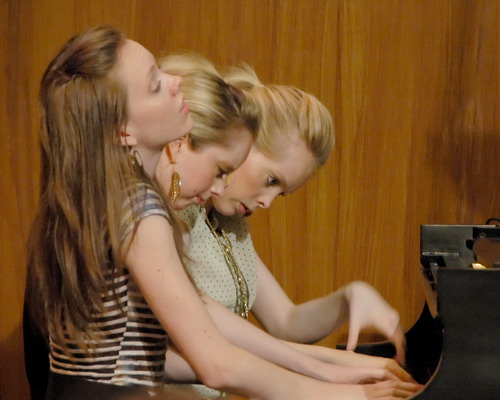
http://upload.wikimedia.org/wikipedia/commons/b/b4/BinaryRhyme_The_Five_Browns_Rachmaninoff_for_Sisters_at_CBC_Radio_Studio_Sparks.jpg

Toward the end of Woody Allen’s wonderful movie Manhattan, the character he plays asks himself “Why is life worth living?”

His answer?

Well, there are certain things, I guess, that make it worthwhile.

Like what?

For me, I would say, Groucho Marx, to name one thing… Willie Mays and the second movement of the Jupiter Symphony (by Mozart) and Louis Armstrong’s recording of Potato Head Blues… Swedish movies, naturally… Sentimental Education by Flaubert… Marlon Brando, Frank Sinatra, incredible apples and pears by Cezanne, the crabs at Sam Wo’s… Tracy’s face…

Humor then, followed by the art of a gifted baseball player, music, movies, a work of fiction, visual art, food, and the young woman he realizes he loves, almost too late.

Your list would be different, mine would too. But isn’t it interesting how prominent music is on lists such as this, how often people find that an interest in music binds them to lovers, friends, and the joy of living?

A popular radio program on the BBC since 1942 has been asking what music you’d take with you if you were a castaway. It is called Desert Island Discs and it has hosted interviews of nearly 3000 prominent people in that time, trying to find out what tunes would be essential if they were marooned on the proverbial desert island.

On their website Desert Island Discs you can hear a number of these programs and discover the musical choices of folks like Martin Sheen, Alice Cooper, Tom Jones, Tim Robbins, Emma Thompson, Jerry Springer, Barry Manilow, Whoopi Goldberg, J K Rowling, Stephen King, Simon Cowell, Colin Firth, Patrick Stewart, Kim Cattrall, Kiri Te Kanawa, Luciano Pavarotti, and many others from the world of science, philosophy, literature, and government.

Back to Woody Allen’s question, what makes life worthwhile for me?

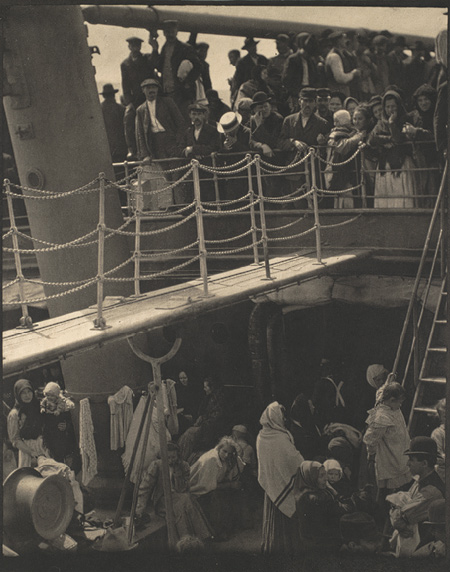
My wife and children, my friends and my brothers… Brahms’s Symphony #4, Beethoven’s Symphony #3, Mahler’s Ich bin der Welt abhanden gekommen, and I’ll Be Seeing You… Judy Collins… Alfred Stieglitz’s photo The Steerage and Van Gogh… The Lives of Others, The Best Years of Our Lives, Lost Horizon, and The Prizoner of Zenda (the last two movies with Ronald Coleman)… getting to know (really know) people…

Anna Karenina, A Tale of Two Cities, and A Prayer for Owen Meany by John Irving… baseball and the Zeolite Scholarship Fund… Shakespeare… Chocolate… Dim Sum, Superdawg (a Chicago area hot dog drive-in), and almost anything cooked by my wife Aleta… Precious and Peanut (family dogs)… listening to and telling stories… the satisfaction of doing something difficult and well… a good cup of coffee and the singing of the birds on a spring morning.

File:The Steerage 1907 Stieglitz.jpg

And if you asked me what would I want in any heaven worth the name?

All that plus my father in middle-age and my mother before life defeated her.

Put another way, I guess I am living in something pretty close to heaven on earth.

Not bad at all.

Since, for most of us, food is one of the joys of living, you might want to take a look at an interesting and recently initiated blog on that subject: Adventures in Food.

The top photo is Brown sisters Melody, Deondra, and Desirae performing on a Steinway grand piano at CBC Radio Studios in Ottawa, Canada as part of the Ottawa International Chamber Music Festival on September 12, 2006. Photo by Mike (Binary Rhyme) Heffernan. The bottom photo is The Steerage taken by Alfred Stieglitz in 1907. Both are sourced from Wikimedia Commons.

Give Me Presence! The Magic of Charisma

No, the third word in the title isn’t a misspelling. I do mean “presence,” not presents.

Just wanted to get your attention.

According to the online “wiktionary,” the word presence can be defined as “a quality of poise and effectiveness that enables a performer to achieve a close relationship with his audience.” It goes on to give an example: “Despite being less than five foot, she filled up the theater with her stage presence.”

It is that almost indefinable quality about which I am writing. An ineffable “something” about a person which draws us to him, focuses our attention, grabs us so that we are “taken” by him to the point of being more easily influenced, touched, or otherwise affected. The kind of characteristic that people refer to when they say that they can’t take their eyes off of someone or are mesmerized by his voice.

It tends to be a thing that one either has or doesn’t have, not a talent that is easily taught or self-created.

Wilhelm Furtwängler had it. Furtwängler was best known as a German symphony and opera conductor who lived from 1886 to 1954. He was a physically unattractive man (see photo above): tall, bald, and socially awkward. Yet remarkable stories are told about him, and his recordings of the great German composers (e.g Beethoven, Brahms, Schubert) are riveting.

The long time timpanist of the Berlin Philharmonic, Furtwängler’s orchestra, recalled a rehearsal at which they were led by a guest conductor. Werner Thärichen, the timpanist, was waiting for his part in the composition and simply following along in the musical score, turning pages as he did so. Then, suddenly, he noticed that the tonal quality of the sound changed dramatically; that is, the intensity, expressiveness, and beauty of sound abruptly increased.

Startled, he looked up.

Furtwängler had simply walked into the hall in order to observe the rehearsal. His physical presence alone, even in the absence of a look or gesture, was enough to alter the way that the musicians played and evoke a different aural characteristic.

Surely you have known people like this. They have big personalities and a magnetism that is hard to resist. It is said by those who have spoken face-to-face with Bill Clinton, even by some of his detractors, that when he talks to you his gaze makes you feel as if you and you alone are the only thing that exists in his universe.

But “presence” is not always benign. Some people, without ever saying a word, have a physical bearing and facial expression that produces intimidation. Others can intimidate not by looking menacing, but by the combination of their intensity, seriousness, and apparent intellect.

One can try to change or soften one’s presence, but it can be difficult. It is said that the dramatic and exciting conductor Sir Georg Solti sometimes implored the members of his orchestra, the Chicago Symphony, to play in a softer, less aggressive way than they characteristically did for him. To his dismay, despite his words, the musicians were compelled to respond to his large, angular gestures and the urgent, kinetic quality of his being. Although they desired to achieve what he wanted, he evoked a different sound than that which he described on these occasions; the players were irresistibly carried along in a way that neither they nor he wanted.

Might you know someone whose basic good humor and shining presence makes you feel good when he enters a room? My youngest daughter, from an early age, would complain that “people are looking at me!” At first my wife and I worried about the possibility of an early developing paranoid state.

But then, we noticed something interesting.

People were looking at her. Carly had an animation and expressive vitality that drew the eyes of strangers and today, make her an excellent performing musician. She “owns” the stage and that quality was there, on its own, from the start.

Confidence and a lack of self-consciousness help to create a big personality, of course, but they are not absolutely essential.

No, this is something quite mysterious. You can be beautiful and not alluring, plain but engaging, unwise but compelling; you can have the right answers to which no one listens; or be a charismatic leader with the wrong answers — indeed, disastrous plans that can sweep a whole nation along with you to its doom. Any time we worship at the altar of charisma we are at risk.

Even so, it is better for each of us to have a strong presence than not and best to know how we are perceived by others and whether we are producing an unwanted impression.

Still, most of us don’t want to be the guy who, when he is in a crowd, makes the crowd stand out. Having some impact is usually better than having none.

But, as relationship consumers, each of us needs to be sure that the person we are with is not simply a great “presence,” but that he has something substantial to offer.

Be careful.

We are all drawn to the sound of the “sizzle” of a steak on a grill, even without the steak actually being there.

Unfortunately, the sizzle without the steak doesn’t make much of a meal.

The top image is of Wilhelm Furtwängler. The bottom image is of Sir Georg Solti.

The Ultimate Comment on Marrying Younger Women

Pablo Casals and his Wife, Martita, 1960 - copyright Lisl Steiner

They used to be called “May/December” romances — a younger woman and an older man. The lady was variously described as a “gold digger” or a “trophy wife,” more often the latter now. Sometimes you see the reverse, a woman senior to the man — a gigolo, if he is “kept” by her.

The relationship involves a kind of social exchange. The aging man trades his status or wealth for the woman’s beauty, fertility, and a return to the springtime of life.

When my daughters, both young women, hear about such things, all they can say is “gross.” The female isn’t the “gross” part.

Other factors do play in. Sometimes the tally of years is irrelevant. The puzzle pieces don’t always fit in age-acceptable matters of romance. Should a rare magic happen, age similarities or differences matter little.

The man who marries a woman of greater years, like the woman who enjoys a seasoned man, might also have unresolved parental issues. Transference is what Freudians would call it. Put another way, the adult child’s unconscious invites a second chance for the kind of love represented by the parental stunt-double — the new, older person; especially where such love was never won from the parent.

Nor should we overlook the attractions of mortality itself: another soul speeding to death’s gate before oneself. For those of us at war with time, the brevity of the rose’s bloom makes it even more appealing than if it were everlasting. We value things and people, in part, because we won’t always have them. The perishable delights of life create urgency and the desire to hold on tight before Cinderella’s clock strike’s midnight — and we all turn into pumpkins.

There is, however, a less dark possibility. Pablo Casals, the famous cellist/conductor of the mid-20th century was 81-years-old when he married his 20-year-old cello student, Marta Montañez Martínez. Robert Baldock, Casals biographer, wrote: “No one who knew them or saw them together during the final years of Casals life could doubt … that they married for love.” Indeed, Casals said his attraction to his wife came, in no small measure, from her physical resemblance to his mother in her youth.

Still, people being people, some wondered about the match. The musician put it this way in 1970, three years before his death:

I was aware … that some people noted a certain discrepancy in our ages — a bridegroom of course is not usually thirty years older than his father-in-law. But Martita and I were not too concerned about what others thought; it was, after all, we who were getting married — not they. If some had misgivings, I can only say our love has deepened in the intervening years.

An apocryphal version of the student/maestro story is amusing. Casals got engaged and then informed his MD of his upcoming nuptials. The physician expressed alarm.

“You’d better think before you do anything — this might be lethal!”

Casals didn’t respond right away, but appeared to consider the doctor’s words. Only then came the answer.

“Well, you know, if she dies, she dies.”

Quite vigorous for most of his remaining years, Casals passed away at age 96 in 1973. The Immortal Beloved lives yet.

The image above is of Pablo Casals and his wife, Martita 1960 by Lisl Steiner, with permission: http://www.lislsteiner.com/

Should Beethoven Have Quit His Day Job? A Few Thoughts on the Complexity of Satisfaction

Ludwig Beethoven Life Mask by Klein c1812

Part of the problem with figuring out whether your life is satisfying is what exactly you expect from life. If you expect close to constant happiness, you haven’t been paying attention to what is going on around you — to what the nature of life is. No one is that happy — life doesn’t permit it with all its routine ups and downs. And, if you compare yourself to people in the media — beautiful or handsome, smiling, rich, famous, and seemingly in control — you will be hard pressed to think that you are doing as well as you should be. Moreover, if you believe that struggle and work frustration are somehow indicative of a life that isn’t satisfying, you just might be misunderstanding what “satisfaction” is.

Take Beethoven, the famous German composer who lived from 1770 to 1827. What is it like to be a genius? Well, for Beethoven it involved lots of struggle and enormous amounts of dedication and hard work. You can learn a bit about this by watching a recently issued DVD set that includes Leonard Bernstein’s Omnibus television programs. One in particular focuses on Beethoven’s process of composing his Symphony #5, the one that begins with the most famous four notes in music history: three Gs and an E-Flat; three eighth-notes and a half-note.

According to Bernstein, Beethoven tried out 14 different versions of the opening of the second movement over a period of eight years. The DVD features Bernstein talking about and conducting the Symphony of the Air in several different passages that were rejected for the first movement, which Beethoven sketched out over a period of three years. Indeed, the composer altered some passages in that movement as many as 20 times. The agony and struggle involved in the composing process can be seen even on the orchestral score of this piece, with numerous write-overs, scratch-outs, and cross-outs.

One might then ask, did Beethoven obtain satisfaction from the process of composing with all its frustration, reworking, effort, reconsideration, revision, contemplation, and strain? The answer apparently is “yes,” he was deeply engaged and committed to the creative process and proud of the results he achieved, however dear the cost. Put another way, “no pain, no gain.”

Happiness isn’t a day at the beach, at least not on a regular basis. Rather, it usually requires that you work for and achieve something — something that isn’t simply given to you. It is not great wealth or a big house in the right neighborhood; it is not power for power’s sake or lofty status simply because you’d like others to look up to you. Rather, it demands that we take on a task that is challenging and engaging — perhaps even creative — master the challenges, and produce a result of value. Having attained that level of accomplishment (not necessarily a material thing or something to which you can assign a dollar value), you can look back with satisfaction on what you have achieved (be it the healthy young life of your child or a great symphony). It is not about work alone, but work is a part of it.

Beethoven wasn’t what we would call a happy man. He was lonely, in part due to his growing deafness, and often frustrated and frustrating in his relationships (and satisfying relationships are normally needed for happiness). But he knew he was a great composer and lived for and through his enormous gifts and an unflagging dedication to producing the greatest music that was in him to create, no matter the length of time and the strain required.

Indeed, it is the strain and struggle within Beethoven’s music itself, and his ultimate triumph over the difficult technical and emotional act of composing, that draws us to him. Beethoven’s “process” is felt in Beethoven’s “product.” The trajectory from travail to triumph mimics the task of composing in such works as the 5th and 9th Symphonies or the Leonore Overture #3. And, in his mastery of the challenge of composing (not to mention the overcoming of his deafness to make great music), he also gives us a model for living.

Should Beethoven have quit his day job and found something easier?

I think you know a rhetorical question when you read one.

(The image above is a life mask of Beethoven done by Franz Klein in 1812 when Beethoven was 41).

By the way, the Chicago Symphony plays all of Beethoven’s Symphonies conducted by Bernard Haitink in June of 2010.