Cosmetic Changes: How Far Will We Go?

http://a4.att.hudong.com/15/66/01300000560404126382666976558_s.jpg

A funny thing happened at this morning’s dental appointment. In the course of a routine cleaning, my lovely dental hygienist mentioned that I might want to consider Invisalign, a clear plastic alternative to metal braces. The reason: to create a greater cosmetic perfection to my lower front teeth.

I had a good laugh when she mentioned this. It’s not that I couldn’t use it, but what I said to her surprised even me: “You know Kristina, rather than do that, I think I probably ought to just replace my entire head!” Why, after all, have a perfect smile and still have the same bald head, the same wrinkles, and the same less than completely even and taut facial contours. “In for a penny, in for a pound,” as the old English saying goes. Don’t just paint the old car, buy a new one!

If you’ve had your car repaired, you will be able to relate. Fixing a damaged vehicle is expensive. The car doesn’t actually have to be beyond repair for it to be considered “totalled.” When the body shop tells you this, they mean that the expense of the parts and labor exceed the current value of the car. In other words, you’d be better off buying a new one. It displeases me to say that my head has reached that point.

Imagine the following conversation with a salesman: “I can offer you a good price on the new head you want, Dr. Stein. But, I’m afraid that there isn’t much I can give for trading in the old one.” God, the humiliation of it!

The picture of me (top, right) is actually pretty realistic. I have some serious mileage on this head and this body. To the good, however, my younger daughter recently commented on my upper body to the effect that (unlike all other middle-aged or older men she has seen) “you don’t have ‘man boobs,’ dad.”

You can only imagine how wonderful this made me feel. But, it is true, my body is pretty fit. Lots of aerobic exercise, a healthy diet, and weight lifting account for it. However, since I didn’t conduct therapy sessions with my shirt off, I didn’t hear much about my physique while I was in practice. Just as well, since I actually wanted to continue practicing. I wouldn’t have enjoyed a professional review board questioning me about the topic of “topless” therapy.

We’ve all seen those TV shows where someone gets a major “makeover.” Teams of surgeons and fashion consultants transform some unfortunate soul who really needs it. He or she never has to pay for this because the services are donated. Retail price would probably be a seven-figure sum. I’m not that vain or that rich.

I would, however, like to look like Jon Hamm or Brad Pitt for just one day. I’d also like to be Beethoven, Shakespeare, Rembrandt, and Willie Mays (a famous baseball player) — each in his prime, also for one day per person. It would be pretty neat to know what it would feel like to inhabit those bodies and brains from sunrise to sunrise, and to receive the world’s approbation for the same 24 hours. I’m not quite evolved enough to say I’d like to be a woman for a day, but I’ll bet it would be even more informative and interesting. None of this will happen, of course.

Yet.

Cosmetic alteration clearly has a future. And, I suspect, all of us who are less than perfect in appearance (in other words, just about everybody) have an appointment with that future. Let me explain.

http://upload.wikimedia.org/wikipedia/commons/thumb/d/dc/Dr_Jekyll_and_Mr_Hyde_1920_poster.jpg/256px-Dr_Jekyll_and_Mr_Hyde_1920_poster.jpg

There will be a time when you won’t have to have a million dollars to make yourself look like a million dollars. I imagine a future in which each person will have the capacity to holographically alter his appearance, even if the actual body hiding behind the holographic image isn’t the world’s most beautiful. Every day would be like Halloween, but with really good — and good-looking — masks. Mail-order catalogues, websites, and brick-and-mortar stores will have a department that lets you pick out the face you’d like to face in the mirror. Computer programs will let you “photo-shop” the image to your precise specifications. Everyone will be stunning! Sounds wonderful, doesn’t it?

How would that change the world, I wonder? Well, yes, there would doubtless be some who still want to stand out at any cost. Lots of perforations and punctures, body art, wild clothing, that sort of thing. But for the most part, just beauty as far as the eye can see. Jaw dropping appearances. Men would look like Jon Hamm or Brad Pitt if they wanted to, women could be as physically attractive as Marilyn Monroe or Beyonce, Jennifer Lopez or Katy Perry. A movie-star level of beauty all around.

The effect would be paradoxical, I think. In a world without disease or death, for example, no one would think about how he feels or worry about getting sick. In a climate that is always mild, sunny, and clear, no one would care much about the weather. And in a future of endless and omnipresent pulchritude — where anyone could become exquisite just by visiting the department store — the value of physical allure would surely diminish. The beautiful girl or guy would become something of a commonplace.

Other things would correspondingly count for more. The trophy spouse would have to be a Nobel Prize winner or an author; or someone of unusual charm or wit, generosity or kindness. A different world, for sure.

Until then? I think I will hold on to my old head. Despite some relatively high mileage, it has served me well. It is not the head of a handsome 25-year-old, but there are some good ideas and interesting experiences contained therein. I wouldn’t want to be without them. I’ve earned the weathering and learned from the lines. With a little buffing and waxing, it still does its job.

See you at the car wash.

The top photo is of Jon Hamm. The bottom image is a poster of John Barrymore as Mr. Hyde in the 1920 Paramount Pictures classic Dr. Jekyll and Mr. Hyde. It is sourced from Wikimedia Commons.

Phishing For a Therapist

In the age of electronic scams, no one is safe, not even a therapist. I have now received three or four very similar queries from potential new patients that fit the same model. And I do mean model, since all of the phishing expeditions involve someone searching for a therapist to treat a swim suit model with anxiety problems.

As you may know, “Phishing is the act of attempting to acquire information such as usernames, passwords, and credit card details (and sometimes, indirectly, money) by masquerading as a trustworthy entity in an electronic communication” according to Wikipedia.

The email messages always follow a pattern similar to this:

Greetings from Transylvania!

My name is Dr. Sucker Fisher. I have been a plastic surgeon since 1993. I do face lifts and breast lifts. I have been looking for a therapist for anxiety for over a week now till I met an old friend yesterday that referred you to me, so I decided to contact you to know if you will be able to work on my client.

My client’s name is Ms. Lana Voluptuous, a swim suit model here in Transylvania who is struggling with anxiety. She will be coming to the U.S in three weeks time for a modeling job and will be residing in your area temporarily until the necessary arrangement for her job has been made before she leaves. She will be needing a one hour anxiety therapy session per day, three sessions per week for six weeks. Ms. Voluptuous asked me to come with her to the States, but I told her that my schedule wouldn’t permit this and also because I do not know much about anxiety therapy sessions, so I promised to help her get a good therapist in your area.

Please tell me a little more about yourself,  how long have you been treating anxiety? And would you be able to provide her with the anxiety therapy sessions requested? I need you to get back to me with the amount you charge per session and also let me know if she can pay you with a certified check drawn from a US bank.

You can view some of Ms. Voluptuous’s pictures from the following link: http://www.lanavoluptuous.com/ 

Thank you,

Dr. S. Fisher

Your Future Patients?

OK, now ask yourself what is happening here and what will happen if you, the therapist, engage in a correspondence with the phisher, Dr. Fisher?

There are several things within the email that suggest that the search for a therapist is not genuine:

1. Isn’t it a little suspicious that (unless you are an internationally famous therapist) someone in Transylvania recommended your services?

2. Why isn’t the patient making the request herself instead of through an intermediary?

3. If the alleged model decided to engage someone to do this search for a therapist, why wouldn’t it be her current therapist? Why would it be someone who professes to know very little about the treatment of anxiety? Given that she wants a very precise number of sessions per week, Ms. Voluptuous (if she is real) is clearly knowledgeable about treatment and is currently in therapy.

4. Why wouldn’t the model wish her present counselor to provide the new counselor precise and detailed information about her background and her needs rather than the very generalized description of her condition (“anxiety”)?

5. Why would any legitimate request for a therapist include a link to photos of the model?

6. Why would the above email include a request for more information about your background and ability to treat anxiety? First, the writer has indicated that he knows little about such treatment, suggesting that he would be unable to evaluate anything you might provide. Moreover, you might (like me) have both a website and a blog site that include information on your background. If he were serious about searching for a qualified therapist, he almost certainly would already have consulted those sites (and in my case, noticed that I am retired).

In the actual emails of this sort, the links to the photos are real. I imagine that the models in question would be surprised to find that someone is using their names and their photos to swindle unsuspecting therapists. The models are always quite beautiful. I imagine that the phisher is assuming that the enticement of working with a sexy young woman will lure some therapists to pursue the email exchange further. Such a therapist might rationalize that since there is the promise of being paid by a certified check there would be no risk of financial loss.

Not so fast. Once the email exchange progresses sufficiently, the “model” typically discovers that her next assignment (after her therapy sessions with you, but before you actually have seen her) will be in another country. You are also told that she is having trouble dealing with the company that is engaging her there and asks you to serve as an intermediary involving a financial transaction. Again, you will be reimbursed by a cashier’s check (which will doubtless be counterfeit).

Do many therapists fall for this? I can’t say for sure, but if they do, here is why:

1. They are being offered the opportunity to obtain a new client who will presumably be paying a hefty fee.

2. The client is very attractive.

3. They are flattered to think that their skill is so great that they are being sought by a minor celebrity from another country.

As P.T. Barnum is alleged to have said, “There is a sucker born every minute.”

In this instance, need I add that we are talking about men?

The top image is called Fishing by Carl Larsson. The photo below it is from the Miss Kandy Kontest, September 13, 2008. It was taken by Toglenn. Both images are sourced from Wikimedia Commons.

“Please be Honest with Me:” Of Sex, Wisdom, and the Danger of Telling the Truth

When someone asks you a question and says, “Please be honest with me,” I have a word of advice: be careful.

Two examples will illustrate the point. One comes from Greek mythology; the other from my own experience in, of all places, kindergarten. Hard lessons were earned and learned in each one. Sometimes telling the truth is a big problem. Sometimes no answer is right.

The Greek myth in question has to do with Teiresias. According to one version of the story, this young man was walking along, minding his own business, when he came upon two snakes having sex. He hit the pair with his walking stick, but displeased the Goddess Hera in the process. Hera punished the young man by turning him into a young woman. Not only did “she” then live as a woman for seven years, but bore children.

Apparently, when she again found snakes mating, she delivered another blow to them, thus releasing her from Hera’s spell and transforming her back into a man. Some sources suggest that Teiresias killed the female reptile in the first instance, thus explaining Hera’s anger, and the male in the second, thereby evening the scales.

Fast forward to a conversation between Hera and her husband Zeus, the chief God. The pair couldn’t agree on the question of which gender enjoys sex more. Zeus claimed it was women, while Hera was certain that males had more sexual pleasure. How to resolve the question? What better way than turn to the only person who had ever been both a man and a woman, our friend Teiresias.

His answer went as follows:

If the pleasures of sex were divided in ten,
there’d be nine parts for women and one part for men.

Oops. Teiresias apparently forgot that he was dealing with Hera once again, the same person who had changed his sex. She now punished him a second time by blinding him permanently. Zeus could do nothing to change this, but did try to compensate Teiresias by giving him the gift of prophecy. Thus, ironically, Teiresias became a blind seer, a man who could “see” into the future despite his inability to see through his eyes.

Skip now even further ahead to a little boy named Gerry Stein.

I was a dashing little person. Resplendent in the Indian (Native American) head-dress my parents gave me or the cowboy holster and six guns that I wore around my waist. Of course, the contradictions among those elements of attire didn’t bother me. Perhaps they were an early indication of my tendency to see both sides of an argument.

I was a six-year-old. I didn’t wear my western outfit to school, but I was still pretty cute: a curly-haired, fresh-faced, sweet little boy, with large hazel eyes. And I had three girlfriends! Count ‘em: three! Way more than any of the other little boys in my kindergarten class. Was it at Avondale School or Jamieson? I don’t remember that.

Little did I know that I was about to meet my Waterloo. Little did I know that the great disasters of life are largely unforeseen; and that fortune can turn in an instant. Teiresias, whose name I wouldn’t encounter for many years, could well have warned me.

The teacher gave us an assignment to draw something. I don’t recall just what it was. But I was good at anything having to do with art and quickly finished off my mini-Picasso masterpiece. That gave me a little time. And so I walked over to the place where two of my girlfriends were hard at work on their own artistic products.

What exactly did it mean that I had three girlfriends? I was six, for God’s sake. I never saw them outside of our kindergarten class. I doubt that I ever held hands with even one of them. Still, there was a sense of security, a point of pride in “having” three pretty little females each of whom also thought that I was her boyfriend, and each of whom was just as clueless as I was about what that might mean.

I can still see myself standing in front of the first two charmers, who were, by the way, best friends. And I can still hear the question that one of them asked me, much like the question posed to Teiresias by Zeus and Hera: “Gerry, whose picture do you like the best?”

Remember, I was six. Maybe even five. No life experience. A piece of unripe fruit, yet to be churned by the cruelties of the human food processor that is daily life. For sure, I was pure and naive. And terribly, terribly honest.

So I answered. I chose one. I don’t remember which one. I only remember the aftermath.

The unchosen female immediately burst into tears. “You made me cry. You aren’t my boyfriend anymore!”

I was stunned. It might even have been her question that prompted the answer she was blaming me for. I considered using the Nuremberg Defense (“I was just following orders).” But before I could say anything, the next hammer dropped.

Her companion, girlfriend #2, looked at me and said: “You made my friend cry. You aren’t my boyfriend any more.”

My stock was falling like the Dow Jones Industrial Average on “Black Friday.” I was down two-thirds on my net girlfriend-worth. I was sweating. I didn’t know what to do. I must have mumbled something about being sorry. But the hard-hearted pair facing me, like Hera x 2, had rendered their unchangeable verdict. The Gerry Stein Fan Club was quickly disbanding.

In my desperation I did what most anyone would do. I ran over to my one remaining girlfriend, the better to secure my position with her. God knows, if she asked me what I thought of her drawing, I was prepared to tell her that not even Rembrandt could have done half as well.

Unfortunately, in my haste I wasn’t especially careful about where my feet were going. And the hard wood floor had recently been polished, making traction tricky and braking balky. I over-ran my target and accidentally stepped on my remaining girlfriend’s foot. This damsel, now in distress, quickly began to cry. And you already know the rest: “You made me cry. You’re not my boyfriend any more.”

Dazed, stunned, disillusioned, and confused, I probably would have walked into traffic if we hadn’t been in a secure environment. Everyone else continued to busy themselves in drawing and conversation. I alone was crushed, alienated from humanity, feeling for the first time in my life the cruel indifference of a world that goes on about its business, ignoring the human road-kill still to be observed in its peripheral vision.

Little did I know that my moment of lifetime peak popularity with the opposite gender had passed, but at least I retained my vision, unlike Teiresias.

As I see it (sorry for the pun, Teiresias,) both Teiresias and I acquired some wisdom under difficult circumstances. His tendency to displease those in charge, Hera in particular, led Zeus to give the newly blinded man the gift of prophecy. With that, one could be sure that he would handle potentially disastrous situations involving snakes and vengeful Gods quite differently in the future. And indeed, he became esteemed for giving good advice and important warnings to other mythic Greeks.

My kindergarten disaster — my childhood tsunami-like encounter with three girlfriends — was also instructive. No, I didn’t become a seer, a visionary, or a prophetic advisor to princes and kings. But I did become a little wiser about the ways of the world; about dealing with women; and about the punishment that sometimes comes by just answering a question scrupulously. I learned the truth in Clarence Darrow’s observation that “There is no such thing as justice, in or out of court.”

Wisdom almost always comes at a high price. Just take it from me and Teiresias.

Thanks to Keith Cleveland, Instructor in the University of Chicago’s Basic Program of Liberal Education for Adults, for relating the portion of the Teiresias myth that I have discussed. All photos are of the author. The first comes from September, 1965, taken by Steve Henikoff. The second is dated August 15, 1948. The third is undated.

Dr. Frankenstein and the Curse of Self-Awareness: Part II (Conclusion)

If you haven’t read the first part of this story, go to:  Dr. Frankenstein and the Curse of Self Awareness. Then return here for the conclusion.

The phantasm was your standard-issue genie, up to a point: skyscraper tall, with a long, twirling mustache and broad shoulders, but his bug eyes were friendly. Once past the imposing size, you realized he offered a welcoming smile. In other words, the sort of genie you wouldn’t mind having a beer with, if you found a bar with a mile-high ceiling.

I am at your service, Master. You may request one wish and one only. I must warn you, however. The maker of this lamp wanted certainty that no one would use it to cause harm. He therefore required me to tell its possessor this: any wish that would damage another will produce the same injury to the person who makes it.

The genie took a deep breath before speaking again:

OK, now you’ve heard what my maker demanded I tell you. But, over my 3000-year career, I’ve had lots of time on my hands when the lamp lay undiscovered. So, you should know — I took a junior college course in psychology and dabbled with becoming a therapist. What I’m trying to communicate is this: I will give you 50-minutes to discuss possible choices before you decide; breakfast included, no extra charge!

With that, the food appeared. “Wow,” said Ralph. “Thank you so much. I never persuaded Fox to go to marital counseling and she almost never cooks, so this is great! I kind of thought I should enter therapy myself, but never had the time.” Ralph didn’t receive consideration often. His, interest in talking was as much for the semi-human contact with a congenial genie, as to help him decide how to use the gift of the lantern.

“So, what’s on your mind?” asked the ancient apparition. The human proceeded to describe his marital life and his wife’s bankrolled journey to glamour, emphasizing her regular side trips to his personal complaint department. The ageless magic creature listened patiently.

Wow, Ralph said to himself. No one interrupted me.

“Well Ralph, have you considered returning your wife’s body to its pre-surgical status? No problem at my end.”

“No, I don’t want to do that to her. She ‘d be depressed and never forgive me.”

“OK, how about if I make you as handsome as she is beautiful?” offered the genie.

“No,” said our hero again, “She’s never been bothered about how I look. My appearance is the only thing she accepts. Besides, she’d adjust to any change.

Ralph looked away. “I don’t think there is a solution.”

Ralph quieted, despairing. The genie, out of ideas, offered nothing more.
 
Then the unlikely Master came alive to his power: “You know, here’s what I want. It would be amazing for Fox to see herself in the mirror. Not the outside, external stuff, but the inside: to fathom how self-involved she is and how she is never satisfied. How much I love her, too.”
 
“One minute of self-awareness, please. I hope to change her forever. Can you do it, genie?”
 

“Sure, Ralph. Bring her here tomorrow before dawn. I’ll need a hand-mirror, as well. Your wish will be granted.”

Ralph spent an anxious day and a sleepless night waiting for the morning. It took some doing to persuade Fox to rise early for the promised beach visit, especially because her eye sensitivity caused avoidance of sunny places. But she was intrigued by her husband’s request. He assured her they would only be there for a short while past sunrise.
 
The next day came, while Sleeping Beauty dreamed of a luxury car or a trip to France, either one a fulfillment of her husband’s enticement.  The couple thus traveled in a state of quiet uncharacteristic of her, preoccupied as she was by her material fantasies.
 

As instructed by the man of the lamp, Ralph carried a small satchel and walked with Fox to the empty beach. The genie reduced his stature to nestle in Ralph’s ear, where he whispered precise instructions.

Our hero laid out a large towel and requested his wife to sit facing the water. The lamp stayed in the handbag, as Ralph removed the glass, asking the beauty to take off her shades, then hold the mirror to her face. “Oh, Ralphie, are you going to put a necklace on me?”
 

Now came the dawn. In an instant Fox saw not her a reflected image of expensively achieved features, but a self-interested personality in its self-unforgiven ugliness. By the fifth second, she realized how vain and narcissistic she was. In the eighth she became aware of the chronic unkindness she visited on her family.

One quarter of the way to the end of time, a shaft of insight displayed the likeness between the neglect Fox suffered as a child and the identical indifference she dispensed to her children. Half-way through she could no longer justify her affair.
 
At 40 ticks a psychic bombshell penetrated her defense against the emptiness of her existence.
 
In the last 10 seconds of her single minute of self-awareness, the once friendless girl no longer dismissed how much she had hurt her husband, who — it occurred to her — loved her more than anyone. At second 60 — crying the non-stop, can’t-catch-your-breath tears of catharsis — Fox’s heart broke and stopped beating. She collapsed in Ralphie’s arms, already dead.
 

For an instant — enough time for a horrified, heart-rending sigh and the formation of a single tear — Ralph stared at the devastation wrought by his attempted salvation of his marriage. His wish was innocent: to make Fox as beautiful inside as her oft admired face and form; a person whose acquired self-awareness would morph her into the compassionate, loving wife and mother Ralph and his children yet ached for.

But his gasp signaled only the dawn of Ralph’s own insight, just as the genie warned earlier, as unexpected by Ralph as his wife’s tortured demise.

In the first second he realized how weak he had been with Fox; by the 10th, how much he failed to provide their children with a strong role-model. Thirty-seconds on, penetration of the word ENABLER knocked him back into the sand.

Though the day was still new, Ralph’s consciousness sensed a curtain lowering on creation. He saw a sign emblazoned on an antique gate: ABANDON ALL HOPE, YE WHO ENTER HERE. In his slow-motion entry to hell, Ralph perceived himself as an indulgent Dr. Frankenstein. He was the creator of a monster, one surgery at a time: the man whose life would have been different if he had learned to say “no.”

At the end of Ralph’s single minute of enlightenment, his heart also stopped. He slumped over his deceased wife, closer than they had been during life.

The last moment of Dr. Frankenstein’s descent, before his heart broke, revealed that he and Fox were not ill-matched at all. In fact, they were perfectly matched, as if made for each other, like a custom measured and cut glove, sewn to fit one’s hand.
 
Fox could not have become “herself” without Ralph, and Ralph could not have fulfilled his potential to be a good-hearted, but beaten dog without her. An evil genius lay within himself, all the same.
 

Like two intimately bound elderly people in a long marriage, the scientist and his creation had to die close in time. One could not live without the other, if indeed they ever lived.

The genie crawled out of Ralph’s right ear. He assumed his full height and stood over the wreckage of the magic lamp’s too illuminating wish-fulfillment.

Gosh, this never happened before, he thought to himself. Criminy. Maybe I need to get out of this business. Three-thousand-years is enough. I don’t want another catastrophe.

Back in the day, I wanted to be a therapist.

Hmm.

The phantasm crawled back into his lamp, lost in his own lostness.

He’d been so focused on the wishes of others, he never created a decent Plan B.

The top image is a poster for the Mel Brooks’ film Young Frankenstein. The Arabian Nights Entertainments by Milo Winter, published in 1914 by Rand McNally and Company is sourced from Wikimedia Commons. The final image is a Magic Lamp.


Dr. Frankenstein and the Curse of Self-Awareness

http://upload.wikimedia.org/wikipedia/commons/thumb/a/af/Megan_Fox_LF.jpg/256px-Megan_Fox_LF.jpg

Does self-awareness bring happiness? Most people seem to believe their portion of self-awareness is sufficient for contentment. Others don’t think about the question. The latter live without much excavation of what is deep in the cavernous underground of their psyche.

I intend to write more about this subject, but will introduce the topic with the story of two people who don’t know themselves well. After reading, you might ask yourself how much self-awareness you possess and whether it improves your life.

My take on the subject may surprise you.

If you watched Ralph for 30 minutes straight and walked away, you would be unable to describe him. He was a man with no distinguishing qualities: not too heavy, not too thin; not too much hair (if there is such a thing), but not bald either; a man of indifferent facial features rendering him unremarkable. Although mega smart, his eyes displayed no light or life. Indeed, his brain’s powerful wattage came as a surprise and then only after you’d gotten to know him.

Nor did withdrawn Ralph have many friends; wait — any friends. Vocation became all. If I gave you the name of what he did, you probably wouldn’t comprehend it. Suffice to say, this brainiac possessed a specialized knowledge of something to do with physics. Still, if one is preoccupied by such arcane, abstract, and technical work — a marginalizing kind of territory — conversation is hard.

What Ralph did have, to the shock of anyone who met his family, was a knock-out wife named Fox. And, funny enough, she resembled Megan Fox: equally sultry, but more curvaceous, with hair so black you wondered if it came from a bottle of dye. Indeed, Fox existed as a woman to die for. Ralph was close to fulfilling the expression’s prediction: dying inside because of her.

The honeymood period had been different. This woman only now devoted her life to turning heads. She observed men to see if they ogled, and so they did. The throng turned toward her, where she once blended unknown and unnoticed into every crowd.

When they married, Fox was as plain as white bread. Much like Ralph, in fact. Maybe I’m being too kind to her. Her nose reminded one of a driver frozen in place at a four-way traffic stop, unable to decide which way to go. Her jaw was too small, so her bottom teeth bunched up, like a classroom of eager students all raising their hands. Her “bum” was absent — one of the many straight, boyish lines on a body screaming for curves.

This young woman’s ear lobes had been marred by a failing intern at a bargain “piercing shop.” The cretin used something like a train conductor’s punch to do the job. Meanwhile, her oversized, protruding ears (as if ready for takeoff) created a human likeness to Disney’s Dumbo. Fox’s feet made grace of motion a challenge, too. Topping everything, the delicate dear-one’s sensitive eyes responded with pain to sunlight, requiring an almost vampire-like avoidance of the summer outdoors. In total, this woman appeared a mess on the outside, while her insides couldn’t help noticing and sent out distress signals.

Given the lady’s neediness, perhaps Ralph’s arrival falls into the “meant to be” category. She struggled to reach for a top shelf grocery item and asked for his aid. When he provided the assistance she started chatting him up, telling him the details of her miserable life. “Oh my God, thank you. I don’t know what I would have done if you hadn’t been here to get the Cheerios. I always have such trouble with these things. No one ever seems to give me the time, so sometimes I go without.”

Fox went on and on. The relationship might have been different, if only lonely Ralph had been a more confident and not so good-hearted. A woman eager for his company should not be ignored, he thought. Soon they were sitting together in the supermarket’s cafe. He still listened and she still filled the conversational carbon dioxide with her ill-fated history. The pattern had been set.

http://upload.wikimedia.org/wikipedia/commons/thumb/3/3d/Girlfriend_and_I.jpg/256px-Girlfriend_and_I.jpg

Ralph couldn’t help but notice two things. First, she enjoyed talking to him. Second, he garnered appreciation despite doing almost nothing. Our fellow’s muteness around women mattered not. Since Fox engaged in endless monologue, he found an uncommon ease in being with her.

A third idea occurred to this Everyman, too: he pitied the injured creature. The recitation of her life disappointments touched him. The masculine heart broke as he auditioned the ugly duckling disses she described, her parents’ neglect, and the absence of outstanding qualities in a world demanding them.

Ralph looked beyond Fox’s outsides to the “poor girl” insides he saw on the newsreel of sorrow she re-ran. They became a couple. At first, Fox was overjoyed for a boyfriend — one who would listen to her! Ralph wanted a girlfriend just as much, so it seemed inconsiderate to begrudge the woman he loved for her uncontrollable regurgitation of life’s raw indignities. Besides, she seemed grateful he’d drop anything for her, and he felt wanted and purposeful in being able to better this woman’s life.

Marriage inevitably followed courting. Children inevitably followed marriage. Challenges inevitably followed children. “Oh, Ralphie, look at what Molly (their two-year-old) did. I’m too totalled-out to clean up the mess. Can you take care of it, Ralphie?” What could the dear man do? He’d come home from work “totalled-out” himself, but Fox needed rest. Their daughter couldn’t be alone to create further disorder, Ralph said to himself.

As time passed Fox came to treat our boy’s devotion as an entitlement, treat Ralph’s patient listening as an entitlement, treat Ralph’s bread-winning and housekeeping and childcare as an entitlement.

The miserable male consoled himself. She’s had such a hard life, he thought. She’ll soon snap out of it. Maybe if I can do more, things between us will be good again. “Good,” meaning back to the time Fox offered gratitude and the kids were distracting her husband from focusing on her. Then, one day, she asked for something new.

“Ralphie, my doctor says he knows a foot specialist who can fix my feet so it’s not so hard to walk. Wouldn’t that be great? We can afford that, right Ralphie? How about it?”

Well, you know Ralph. Refusal of a reasonable request was unthinkable. He achieved an abundant living and knew it. It was the least he could do for the woman he loved and the mother of his children.

Although Fox had to go through a difficult period of recuperation, the surgery made walking the natural, unconscious thing it is for most young people. Once the healing advanced, her surgeon recommended training in ballet. Ralph’s wife became the embodiment of grace, a creature whose movement across space was streaming and seamless — something to behold.

For a brief period the spouse was even grateful to Ralph, but within a few months wretched routine resumed. Customary indifference and lack of approbation were Ralph’s daily bread, duly accepted. Until, of course, the next thing Fox wanted.

“Ralphie, my doctor says he knows a plastic surgeon who can fix my schnoz. Wouldn’t that be great? We can afford that, right Ralphie? How about it?”

Ralph didn’t jump at this suggestion quite as fast as the idea of taking Fox’s feet to the repair shop. Moreover, he’d grown to like the way Fox’s nose couldn’t seem to make up its mind about the best route to take from its bridge to her nostrils.

Still, she was the woman he loved and the mother of his children. Before too long, Fox had a nose to die for. Straight, not too big, not too small; “just right,” as Goldilocks would have said. Fox spent hours staring at her proboscis in the mirror, admiring the surgeon’s craft and her enhanced appearance: what you might call attractive if your standards for beauty weren’t too high.

http://upload.wikimedia.org/wikipedia/commons/thumb/7/75/A_Bela_e_a_Fera_-_The_Beauty_and_the_Beast.jpg/256px-A_Bela_e_a_Fera_-_The_Beauty_and_the_Beast.jpg

Sex, however, didn’t improve. Romance had never sizzled, but Ralph accepted what his companion offered. Since he’d never had intercourse with anyone else, for a long time it satisfied. Now, however, frequency diminished. Fox also made it more “conditional.”

Let me explain.

The wife complained of headaches and exhaustion — both words sometimes uttered when the other is preoccupied with something else, their brain is somewhere else, and they only wish their partner were elsewhere, too. Fox had an ever-changing, ever smaller list of body parts available for touching, and a growing catalogue of forbidden sex acts. These, she claimed, might cause a brain hemmorhage.

“The Mayo Clinic will prove it. Take me there, you’ll see!”

He didn’t. She’d won the point.

For his part, Ralph began to think of Fox’s torso as a terrain undergoing lots of highway and road repair. He imagined her naked physique covered with little CAUTION and DANGER signs: arrows indicating detours, and tiny flagmen waiving him right or left, but always into a dead end. The helpless bloke wished for the radio traffic reports one hears every 10 minutes, desperate for guidance to the least hazardous routes. Alas, no station carried the needed updates on Fox’s body map. All Ralph got was static.

http://upload.wikimedia.org/wikipedia/commons/thumb/b/be/Singapore_Road_Signs_-_Temporary_Sign_-_Detour.svg/256px-Singapore_Road_Signs_-_Temporary_Sign_-_Detour.svg.png

Other than when Ralph kissed Fox on her rear end (which she loved but left him cold), ardor was ever more frustrating for our Mr. R. Indeed, as Fox transformed into a fox, the limitations multiplied and the frustration grew.

Attempts at sex caused a mindset akin to days without food, knowing the closest restaurant took a three-hour drive and remained open for just 15 minutes beginning at 3 AM every other week; and the food was cold and tasteless and they never had what you wanted on the menu; and the wait staff were impatient and complained and banged around with pots and pans while you were trying to eat; and the servers were pestering you to hurry up because they were closing soon.

Well, you won’t be surprised when I tell you the surgical requests kept coming. They took the usual form: “Ralphie, my doctor says he knows a surgeon who can do ‘X.'” Next came a complete reworking of her jaw, mouth, and teeth; later breast implants, buttock rounding, and cheek inserts. Botox injections targeted a variety of places. An “ear job” followed to close up the holes left by the conductor’s punch and pin them back so that they didn’t stick out. Soon Fox requested an alteration of her hairline, in addition to lots of consultations with makeup artists, skin specialists, and hair stylists.

The family’s dull doll became unrecognizable — movie-star beautiful. She also transformed into a one-woman cheerleading squad for the wonderful doctor who picked out the best people to work their magic; with not a word about Ralphie, the guy who paid the surgeons and kept doing everything else he’d always done — ever faithful, ever devoted, ever taken-advantage-of, all-day-sucker Ralphie.

Nor was the new “arm candy” an unalloyed benefit to him. Ralph was told he was a lucky hombre, but overheard strangers wondering about the ill-matched “FR” pair. Someone would take her away from him, they guessed.

By the time Fox reached her early 40s, her physical transformation was complete. She passed for 30, at most, and pursued a life unimaginable during her frumpy, freaky, friendless teens. The kids both attended college out-of-state and Ralph never stood in the way of what she wanted. Ralphie earned a fine salary, she rationalized. In fact, however, he worked overtime to pay for the kids’ tuition, the old doctors’ bills, and Fox’s impulse purchases.

With fewer responsibilities due to the the children’s departure and no more surgeons to consult, the manufactured femme fatale realized she missed her divorced doctor, the man she so idolized: the person who guided her to achieving her new, traffic-stopping, stunning state of being. Their meetings started when she dropped in at his office, unannounced, and said hello. Soon they scheduled lunches. Long ones. Ralph couldn’t help but wonder if something was happening.

http://upload.wikimedia.org/wikipedia/commons/thumb/e/ec/Deep_Sadness.jpg/256px-Deep_Sadness.jpg

One day at sunrise, while Fox slept in and the provider was taking a rare vacation day, he drove to a nearby beach. As a young man, when he was the friendless class nerd, he’d walk along the lake front, let the sun soothe him, and nursed his malaise. Sometimes it worked. The sound of the waves and the warmth of the rays eased his craptastic condition. Perhaps he got lost in a fantasy of winning an adoring girlfriend who would become his wife.

How did things gone so wrong, he wondered? The stillness of the deserted beach provided no comfort. “What can I do? I still love her.” Ralph was talking aloud. “If only I can regain what we had on our first day in the grocery.”

Ralph’s right foot caught on something and he fell on his face, eating a mouthful of sand and pebbles. Disrespect everywhere. Not even the beach likes me, he thought.

As Ralph got up he noticed the object he tripped over. A hard item protruded from the otherwise flat surface. He pulled at it: a golden Middle Eastern style lamp. Scuffed and dented, it nonetheless looked as though it had once been a fine product of the metal artisan’s craft. Ever prepared to do cleaning, the Sad Sack took out his handkerchief and tried to shine it up a bit.

That’s when the genie appeared.

For the conclusion of this story, go to Dr. Frankenstein and the Curse of Self-Awareness: Part II (Conclusion).

The top photo is of Megan Fox, by Luke Ford. Next comes Girlfriend and I by Christian Reusch. That is followed by Beauty and the Beast by Giovana Milanezi, uploaded by Johnny MrNinj and a Singapore Road Sign by Woodennature.  Deep Sadness by Erik Charlton is the fifth image. All are sourced from Wikimedia Commons.

A Humorous Guide to Helping Your Daughter Choose a Mate

"wanna beer?" "it's 7 o clock in the moring." ... "scotch?"

Start by being suspicious — of six-year-old boys! If you really want to protect your little sweetie pie from evil-minded males (in other words, normal guys) you have to get an early start. This will give you some time to develop your profiling skills. Assume a “hell no, he’s not right for you” stance — with every boyfriend she ever has. Since most people date lots of losers before they marry, you will be right virtually all the time and thereby enhance your credibility. Good job, mom! Good job, dad!

Ah, but that is only the first step in assuring that your innocent daughter will not make a mistake. What do I mean by a mistake? Well, first of all, that she will have sex — ever. You know, deep down, that you don’t want this to happen. Not at any age. Not if she lives to be 100. Certainly not in your own lifetime.

Nor do you want someone who will disappoint her, break her heart, or live off her hard-earned wages. No, if she must marry (and this is pretty doubtful in your mind) it should be to someone who can earn a good living and put her on a pedestal.

OK, are you serious about protecting your beautiful child? Are you willing to do anything — anything and everything it takes? Then here is a short list of steps to guarantee, if not perpetual virginity, then at least the chance that she will marry a good man (of whom there are only three on the planet):

  • Start by eliminating any guy with an earring, tattoo, or body puncture of any kind. Too harsh? That is the whole point of this! Remember that I said there are only three acceptable guys on the planet. You can’t expect me to make the qualifications too easy, can you?
  • Greet the young man with a chainsaw in your hand (ideally one that is on) and the grim expression of Michael Keaton above (from Mr. Mom).
  • Ask your potential son-in-law to provide you with the results of an IQ test performed by a licensed psychologist. Me! If he scores below the 98th percentile, he is history.
  • He must be willing to submit a complete medical report before arriving for date #2. Results of genetic testing should be included. You need this information so that your future grandchildren have a good chance of being free of imperfection.
  • Require the suitor to provide you with letters of recommendation from at least one person in each of the following categories: a) past girlfriend b) clergyman or woman, preferably the Dalai Lama or the Pope c) employer d) supreme court justice e) someone he saved from a burning building or a speeding bullet. OK, maybe that is a little extreme. So, let’s say at least four of the five categories.
  • Never smile unless it is in a devilish fashion. Give him “the stare.” Hold eye contact until he breaks it off and leaves the house, whimpers, or begins to weep. Practice in the mirror until you look like this:

Bela Lugosi

  • Ask the young man a series of innocent questions such as:

a) “Have you ever given any thought to what it might be like to be waterboarded?”

b) “Define the word ‘abstinence’ and explain what you think about it.”

c) “Other than eyes or hair, what is your favorite female body part and why?” (If he says “feet,” assume that he is a foot-fetishist and throw him out).

d) “What are your goals in life if you grow up?”

  • Be sure to purchase a military arsenal and install it in a special, locked, dungeon-like room in your home. Make certain that you show this to your daughter’s suitor the very first time he comes to pick her up for a date. Diplomas you earned for marksmanship and martial arts should be prominently displayed, with casual references to “some unfortunate disappearances that happened” to your daughter’s previous boyfriends, and how the police were unable to find them. Newspaper accounts of the “disappearances” should be framed and hung on the dungeon’s walls.

Parents have paid me a small fortune for these tips. The techniques have stood the test of time. They can be used by both parents together or by either mom or dad. For a limited time only, they are yours free of charge. Consider yourself lucky.

And lucky that your son didn’t try to date my daughters!

P.S. Since my children each married great guys, that means there is now only one other decent single man available in the world. You might have to make your screening process even tougher than mine!

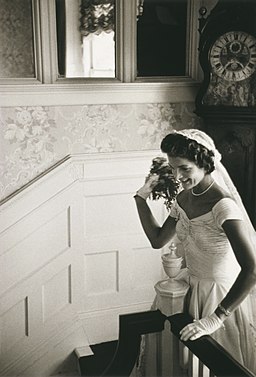
http://upload.wikimedia.org/wikipedia/commons/thumb/1/15/Jacqueline_Bouvier_Kennedy_Onassis2.jpg/256px-Jacqueline_Bouvier_Kennedy_Onassis2.jpg

The bottom photo by Toni Frissell is of Jacqueline Kennedy Throwing the Bouquet at her First Wedding, September 12, 1953. It is sourced from Wikimedia Commons.

Bald is Beautiful? Reflections on Hairlessness

I recently had a brief on-line conversation with my old friend Steve Henikoff (pictured above), whom I met in fifth or sixth grade at Jamieson School in Chicago. I mentioned that I was struck by his father’s baldness as soon as I was introduced to his dad, Armand. I recall thinking to myself that Steve would therefore probably go bald too, and that I would be exempt because my dad had a full head of hair. That shows you how little I knew about genetics — how unaware I was of the fact that Male Pattern Baldness (MPB) wasn’t that simply acquired. Not surprisingly, Steve has a great head of hair to this day and I am — well — just look at the picture on the right.

Steve, however, was not a fan of his father’s nose and claims to have the spitting-image — sneezing-image? – of his dad’s schnozzola. I never noticed anything about his father’s nose that seemed remarkable. But, Steve certainly inherited the best of Armand and Sylvia Henikoff’s brain-power, as he is an internationally recognized researcher at the Fred Hutchinson Cancer Research Center and one of the few folks in the world elected to the National Academy of Sciences (NAS). The NAS is the Hall of Fame of living scientists, comprising approximately 2200 members and 400 foreign associates, of whom about 200 have won the Nobel Prize.

Steve’s hair undoubtedly contributed to his success. Yes, I know he graduated from the University of Chicago and Harvard and is fantastically smart. But I’m here to report that it was his hair that enabled him to become world renown. Doubtless, if not for my own shiny pate, I would be right beside my old buddy on the NAS roster. I tell myself this so that I can sleep at night.

I, unlike Steve, began to lose my hair in college. I noticed a few too many strands on the bathroom sink during a summer that I worked at MIT and shared an apartment with Rich Adelstein and a friend of his. My initial reaction was that those black hairs couldn’t be mine. I looked for name tags attached to the individual hairs, but finding none, didn’t think too much about it. I simply buried the idea of this being some sort of early warning signal. By the beginning of graduate school at Northwestern, however, there was no doubting that something was happening — to me! My roommate then was blond. Ownership was indisputable.

A bald man who has cleverly figured out how to distract you from his baldness.

Passing thoughts occurred to me about the potential speed of my condition’s progress, but since it wasn’t obvious to anyone else I didn’t agonize about it. I suppose that I might have done some calculations. “Let’s see, if I have X number of hairs and I am losing hair at the rate of Y hairs per day, then I will be bald as a coot by — Tuesday!” As I say, I didn’t do this and wouldn’t recommend this exercise in self-abuse.

Talk about vanity. Before long I was trying to figure out whether I would look better if I had longer hair in the area of my temples or if shorter hair would achieve a better disguise. But I still had lots of wavy hair, despite the beginning signs of a bald spot on my crown. I was a poster child for the early stages of Male Pattern Baldness, which, unlike female baldness, tends to be localized at the start, rather than a thinning of the hair over the entire scalp.

By the 1980s a blood pressure medication called Minoxidil (Rogaine) was producing good results for some of the men who used it to deal with their hair loss. I knew friends who vouched for its safety and effectiveness. But somehow I couldn’t get around the idea of taking medicine for something that had more to do with self-image than with health. I’d also seen too many bad hair-pieces by that time, and heard that the care and feeding of those creatures — “Is the animal on your head still alive?” — was time-consuming. They also reportedly generate a good deal of heat on the top of the scalp, not being ventilated the way that real hair is.

Other possibilities presented themselves. For example, some guys look good with their heads shaved. The danger here, I think, is coming off as a little too intimidating; plus, you need the right shaped head. Not for me.

The idea of a serious comb-over seemed worst of all. I always wonder about the romantic partners of these guys. Don’t they have the guts to say “You know dear, I have to tell you that combing the six-foot-long hairs from behind your left ear to cover the top of your head makes you look like CRAP!!!”

Scalp reduction surgery was more intriguing. As I’ve written elsewhere, it is designed to get more coverage out of the hair you have by reducing the territory on top of your head.

I can imagine the following conversation:

Surgeon: ‘Well, Dr. Stein, we’ve studied your head, your hair-line and scalp and we have some good news and some bad news.”

Me: “Tell me more, Doctor.”

Surgeon: “The good news is that we can give you a full head of hair!”

Me: “And the bad news?”

Surgeon: ‘Your head will be the size of a grape.”

According to Wikipedia:

One large-scale study in Maryborough, Victoria, Australia showed the prevalence of mid-frontal baldness increases with age and affects 73.5 percent of men and 57 percent of women aged 80 and over. A rough rule of thumb is that the incidence of baldness in males corresponds to chronological age. For example, according to Medem Medical Library’s website, male pattern baldness (MPB) affects roughly 40 million men in the United States. Approximately 25 percent of men begin balding by age 30; two-thirds begin balding by age 60.

The news that you have (or will have) some company in the hair loss department is cold comfort, especially if you lose too much hair early, which I didn’t. As with money, status, jobs, and just about everything else in life, we are more likely to make comparisons to those who are better-off than those who are lower on the totem-pole than we are.

Question: Does this look more like Steve’s father or me?

A man who is honest with himself will admit that the reason he wants hair on the top of his head is to look good for others. When you are alone reading a book in your room, I doubt that many guys think that the experience would be better if they could run a hand through thick and wavy locks every few minutes and say to themselves: “Boy, you know I liked The Great Gatsby the first time I read it, but it’s really much better now that I have a hair transplant!” No, I don’t think so.

So this is about making a good impression, rather than a bad impression or no impression at all. It is about being sexually attractive even if you have no real interest in having sex with those who might admire you. And, as with many other things, it is emotionally tougher for women, some 30 million of whom have hair loss issues in the USA alone.

Eventually, at least for most guys who don’t try to change the course of nature, you reach the point that your baldness can neither be disguised nor denied. You are a bald guy. Face it. Because, I’ll tell you what, it isn’t the worst thing in the world. Think of some of the advantages:

  1. You will find yourself thinking much less about either hair arrangement or being without hair. It is just who you are.
  2. You will save money on hair spray, hair cuts, and hair-care products.
  3. You will save hours combing your hair and have much more time for re-reading The Great Gatsby.
  4. You can rent out the top of your head as advertising space — “Eat at Joe’s Restaurant” — and make some extra money.
  5. Some woman actually prefer bald men and many value other qualities more highly than hair.

There is one other advantage, but I’m afraid I can’t transfer this to my brothers in baldness. It came in the form of a 2008 handmade Father’s Day card from my daughter Carly. To help you understand the message, you need to know that we have a cabinet-filled room full of CDs which is mostly devoted to my listening to music. If you happen to be in the kitchen, you can see into the room easily, and see me from behind as I am seated on a couch. Here is what Carly wrote on the inside of the card:

Dad,

Your bald head has always had a warm place in my heart. Sounds peculiar, I know. But ever since I was little, I would look at the back of your head sitting in the music room and it comforted me. The image still does. It’s because that picture (below) represents my Dad who is always there to listen, to give ample hugs, to give sound advice, to dole out corny jokes, and when he smiles I know how much he loves me. To someone else it may be just a bald head, but to me it’s the gleaming ray of sunshine that is my Dad!

As perhaps you can imagine, reading that was worth all the hair loss in the world.

The photo of a Bald Eagle was taken by Vlad Butsky and is sourced from Wikimedia Commons.

How Self-Consciousness Misleads Us: The “Rock” Guitar Performance Anxiety Story

http://upload.wikimedia.org/wikipedia/commons/thumb/7/76/Guitarist_girl.jpg/256px-Guitarist_girl.jpg

Everyone will know. You believe everyone will witness your screw-up, how you embarrassed yourself. Friends and strangers, both. They will see the perspiration and hear the stammering. Your face shall transform into a tomato-like ball of redness. It might as well get sold at a fruit market.

Yes, someone will make a video, too, making you an international laughing-stock. Forever.

We fear the worst and fear takes us over. We become hostage to worry. We crawl inside the fear are devoured. Fear surrounds us, breathes into us, and binds us. We are trapped.

Only it’s not true. We’ve all lived moments like the one in the story I’m about relay. Not identical to this event, but just as excruciating and sure to be permanent, we thought. Not so bad after all, I hasten to tell you.

“Rock” was a graduate student at the University of Pennsylvania. Extraordinary — a remarkable scholar in fact; a shining academic star. Black wavy hair already flecked with gray — he made an impression. He was gifted with words on paper and with the words he spoke. “Rock,” a nickname belying a less than chiseled physique, would come to win two awards for teaching at another prestigious university. Rich Adelstein, his real name, remains one of the few people who is eloquent without a script.

Playing the guitar, however, is something else. Always was. And music is what his friends asked him to make at their wedding. “Just for a few minutes; anything you want. You’ll be a star!”

How could Rock say no? He chose a Bach transcription, not more than three minutes long.

http://upload.wikimedia.org/wikipedia/commons/3/37/Amanda_Fran%C3%A7ozo_At_The_Runner_Sports_Fragment.jpg

The day came. A torrid day in a sweltering summer. Rock knew the piece by heart, had played it many times in the privacy of his apartment. There, Bach was effortless, fluent. But at a wedding, in front of lots of people?

You sweat the anticipation. You count the time. The sands of the hourglass push down and the hands of the hooded hangman slip the noose under your head. Tightening, tightening. There is no escape. You’re expected participation is public knowledge. You can’t claim sudden illness without betraying your cowardice, your conscience, and your comrades.

The moment arrived. Rock sat in the chair in front of perhaps 200 wedding-well-wishers. His fingers, unlike his voice, were not the part of himself he trusted.

The perspiration began even before the first note. More notes, more perspiration. Our boy’s arm pits oozed. His winter-weight, flannel suite – the only one he owned – was soaking through. The sweat came in waves, like the kind that sweep you off your feet and carry you out to sea. The guitarist’s mind was overwrought with the terror of public humiliation. His brain buzzed. The shining brilliance of Rock’s head, always full of ideas, was now brilliant and shining for an uncustomary reason. My friend was barely above the water, caught in a whirlpool, capsizing in a feverish river of illuminated perspiration and panic.

Rock’s fingers moved on their own, to the good. They were, however, getting harder to motivate. “A little while longer. If I can go on for a little while longer,” he said to himself. His digits seemed to get larger, like plump sausages; unbendable, heavy. Stiffening. And then, the unimaginable: his fingers went on strike. The unreliable labor force stopped laboring.

True, a single moment of silence was not inappropriate. But a moment is not 15-seconds, or 30-seconds, or a minute. Time transformed, became timeless. Rock stared at the stationary digits.

No vibration. Eternity. Strain. Second upon second upon second. How many? Finally, the music began to sound. By sheer force of will the piece was finished.

The audience applauded. No shouts or cheers. Surely everyone knew. How could they miss a suit jacket doubling as swim wear? Surely they were talking about him, giggling about Rock, feeling sorry. Surely people would remember.

A reception followed. The man of words had no words to describe his mortification. Yet, no one looked at him more than anyone else. No comment on his dampness. A few even told him they enjoyed the performance. Not a soul asked “What happened?” or “Are you OK? We worried about you.”

A woman appeared. Middle-aged. A stranger, well-dressed, with a cultured, intellectual aura.

“Oh, God,” Rock thought.

“I really enjoyed your performance,” she said with enthusiasm. “The dramatic pause, in particular!”

She wasn’t kidding. The disqualifying paralysis – the moment of ruin – was to her the creative highlight.

Life went on: a life of accomplishment, good works, and recognition. An admirable life, untouched by momentary catastrophe. Indeed, a catastrophe in one place alone: the mind.

Most of us have had some version of this experience. And survived. People usually notice less than we think. Most disasters are temporary. Even when the audience does recognize a difficult situation, they tend to forget. The event is replaced by some other, newer story about someone else. We are much more concerned with our own lives than the lives of others. Thus, our daily tasks, relationships, victories, failures, deadlines, and distractions allow little room for concentration on another’s momentary discomfort.

A few rules for the next time you have a “Rock” Guitar experience:

  1. Remember, “this too shall pass.”
  2. Your internal emotions and what others detect are not the same. You probably don’t look or sound as bad as you think.
  3. Don’t proclaim your inexperience, nervousness, or troubled state. Do not cue the audience to search for problems they would otherwise likely miss. Do not apologize afterward.
  4. Remember, however bad the day, you will soon be yesterday’s news, replaced by some other event. More probable still, the crowd’s preoccupation returns to what we all spend most of our time thinking about: ourselves.
  5. Remind yourself that you are not unique. Even professional athletes drop baseballs in front of 50,000 people in the stands and millions watching on TV.

Not convinced you will live to fight another day? That your bad moment will go unnoticed or be forgotten? Then I am forced to tell you about the most inappropriate, politically incorrect, embarrassing experience of my life. This is a story you can’t top. No one ever has: Generosity and Kindness: A Story of Political Incorrectness.

The top image is called  Guitarist Little Girl (Dorothy Takacz) — Budapest, Hungary by Takkk. The second photo is entitled Drops of Sweat by Bibikoff. Both are sourced from Wikimedia Commons.

When Your Doctor Gives You the Finger: Why Men Fear “Digital” Medicine

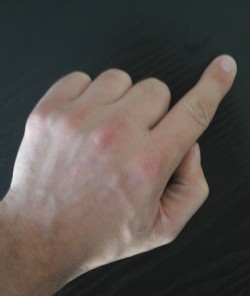
http://upload.wikimedia.org/wikipedia/commons/4/41/Dedoduro.jpg

An early medical rage of this century was the move to electronic medical records (EMR) and the digital practice of medicine. But I’d like to say a few words about some rather different digits. One in particular.

Patients may not fear the doctor touching the computer keyboard to reveal their personal information. Still, many of them certainly are troubled by the docs touching certain personal body parts and telling them something is wrong. To be specific, men are incredibly ticklish about another person putting their hands anywhere near their underwear-absent bottom.

Computer digits are OK, but human digits to perform the routine prostate exam, aka the single-finger digital rectal exam — no thank you. As Shakespeare would say, “There’s the rub.”

A 2011 Esquire Magazine internet survey sheds some light on this dark place in doctor-land. The survey should not be interpreted as gospel since it was taken by 519 internet-connected US males, a sampling technique that would tilt the results toward the young and relatively affluent and more educated individuals than might be found in a more representative selection of the male population. That said, it does support the notion that males are touchy about being touched.

When men were asked which medical tests give them the most anxiety, two were tied for the top spot: the digital prostate exam and a colonoscopy, each chosen by 36% of the sample. By comparison, only 23% found a dental checkup the most upsetting, and just 5% admitted to being threatened by a hernia exam. Consistent with these results, only 30% reported having had the rectal (prostate) exam of those men between ages 41 and 50 who participated in the research.

What might this suggest about the avoidance of doctors by some males?

Conventional wisdom tells medical professionals that stereotypical men identify themselves as “tough” and don’t like appearing vulnerable. They are taught early some version of “the athlete’s creed: “If you are injured, don’t complain, rub some dirt on the wound and get back into the game; don’t be a sissy, a wuss, a wimp, a pussy, a weakling, a girly-man or however else being ‘less than a man’ might be characterized.

By that standard, going to a doctor when you feel relatively fine is a sign of weakness or fear, a source of shame. Indeed, data suggests that many men tend to delay seeing physicians even when they are sick, at least until some time passes and the distress can’t be ignored any longer.

The digital advances brought by computer technology (rather than the MD’s advancing digit) hold no such threat. Immediate access to your medical history no longer depends on your memory or the physician’s. Drug interactions are more easily avoided. Computers may even help suggest diagnoses consistent with your recorded symptom profile. Medical errors should be reduced. All the computerized data also make medical research easier.

However.

Medical apps won’t be able to get you to make an appointment with your doctor if you are afraid of what he might do to you or what he might say about your condition. Many prefer to assume that doctors can be avoided if they feel good. They like to think the medical community is too much like any other business and that what passes for evaluation and treatment is another way to make a buck. Trust is needed if you put yourself in the doctor’s hands.

Literally.

But what would make the digital rectal exam (or its even more invasive cousin, the colonoscopy, terrifying? After all, the former takes just a few seconds; the doctor uses a lubricated glove to do it, and it isn’t painful.

Well, probably a couple of things.

First, men and women generally rate cancer as the disease they most fear. Since possible cancer detection is the usual reason for the routine digital rectal exam in men, it could be one of those things men believe to be better left alone. In other words, don’t look for trouble, and “If it ain’t broke, don’t fix it.”

But there is more. It might be an instinctive fear of assault from the rear.

It is probably scary enough for many men to stand with their private parts exposed to another man, but likely even worse to be positioned with your back to him while his fingers enter you. I’m not talking here only about homophobia, but equally about an instinct for self-preservation causing a kind of automatic terror of being injured.

“Wild Bill” Hickok, the legendary gunfighter of the Old West, is a possible example of this concern. Hickok is said to have always wished to sit with his back to the wall. But on August 2, 1876, he joined a saloon card game, and the only remaining seat placed his back toward the entrance. Twice, he asked others to change seats, but no one did.

He was shot in the back of the head by a man entering from the door, just as he feared.

Lots of my male patients postponed or avoided the kinds of examinations I’ve described here, even quite a number who knew very well that it was a good idea to obtain them. Some were ultimately persuaded by their wives to go to the doctor.

Others might have been influenced if one appealed to the desire to live long enough to care for their family or see their grandchildren grow up. But, part of the dilemma is that men tend not to talk to potential persuaders about private matters. And, if you don’t have a doctor (45% of the Esquire sample did not), she or he cannot advise you to do what is needed.

Clearly, early detection of serious medical problems represents a desperately important area for research into how to motivate terrified folks to do what is best for them. As much as we read about the advances expected from medical research, it might be useful to hear a bit more about what is being done to reduce the fear of medicine done with digits, a fear that remains in the shadows—an “unmanly” quality in some of the very same men who portray themselves as macho.

If, as I’ve suggested, men avoid these tests out of age-old instincts for self-preservation, one can only be struck by the irony that their efforts at such self-defense increase the chance of early and avoidable death.

However, as with all such sensitive and very personal areas of life, there is always room for a joke. My own physician told me the following:

I had a patient who came in for a routine digital rectal exam as a part of his annual physical. After that portion of the evaluation was completed, he asked me a question: “Doc, how many fingers did you use?” “One,” I answered. “Why didn’t you use two?” “Because the exam is done with just one finger,” I said. “Yeah, I know, but I wanted a second opinion!”

For a very funny (but also) serious take on getting a colonoscopy, read Dave Barry’s A Journey into My Colon — and Yours.

==========

The top image is Index Finger by Cherubino, sourced from Wikimedia Commons.

 

“Will You Accept This Rose?” Reactions to Receiving the “Beautiful Blogger” Award

First of all, I will end the suspense, little as it may be: I did accept the “Beautiful Blogger” Award. The writer of Anxiety Adventures was kind enough to nominate me for this, for which I am very grateful. But, if you’ve been following my writing for a bit, you also know that I tend to think about things a good deal. So I’ll offer you a few thoughts prompted by this little bit of recognition.

Before I do that, however, I need to tell you about three other blogs worth your attention. My acceptance of the “Beautiful Blogger” Award actually requires seven such nominations (it is a little like a chain letter), but I’ll give you just three for now, with more to come in the future:

I’m happy to hear from other bloggers who might wish this sort of recognition. My panel of judges is a tough bunch, but you never know whether you might get lucky. Bribes may increase you chances! Now, back to thoughts inspired by the “Beautiful Blogger” Award. Questions, actually:

Question #1: How many bloggers are out there? According to NM Incite, “overall, 6.7 million people publish blogs on blogging websites, and another 12 million write blogs using their social network.” The same source states that they tracked over 181 million different blogs by the end of 2011. WordPress indicates that there are about 500,000 new blog posts each day on its WordPress sponsored sites alone.

Question #2: With so many posts, how does anyone get noticed? Unless you are writing for some outfit like Huntington Post that will promote your work by its very existence, people spread the word via Facebook, tweets, and other social media sites and methods. They use photos to get attention, try to “tag” their posts with key words so that search engines like Google will pick them up, and send their URL (web address) to those individuals who might find their writing interesting. In turn, those contacts are encouraged to pass the posts on to their own friends and acquaintances. Bloggers are also wise to leave comments on other bloggers’ sites as a way of encouraging reciprocal attention to their own blogging activity.

Question #3: What did you do, Dr. S, to get an audience for what you write? I did some of the above, but not as much as you might think. First, since I don’t use any of the usual social media like Facebook or LinkedIn, there was only a limited amount of self-promotion. For the record, I did not tweet, chirp, squawk, or transubstantiate to get the message out. I did not pray for readers or wail. I did not beg or plead with my patients, only with my friends. I did not wear sandwich boards (see the image just below) announcing my new venture. I gave some consideration to traveling from town to town, setting up a tent, and performing miracles, but dismissed the idea when I couldn’t get a good price on a tent.

http://upload.wikimedia.org/wikipedia/commons/thumb/5/57/Bundesarchiv_B_145_Bild-F079081-0018%2C_Bonn%2C_Fu%C3%9Fg%C3%A4ngerzone%2C_Sternstra%C3%9Fe.jpg/256px-Bundesarchiv_B_145_Bild-F079081-0018%2C_Bonn%2C_Fu%C3%9Fg%C3%A4ngerzone%2C_Sternstra%C3%9Fe.jpg

I did, however, put the URL for the blog on my business card and my website. I also told a number of people about what I was doing. I linked my blog site to some online therapy referral services where I was listed. Mostly I just wrote and let the writing do the job. Eventually people read my stuff, but this didn’t happen very quickly — I had only eight “page views” in the month that I began posting, February, 2009. As a few of the posts became popular (see particularly the first two items on the list of Top Posts in the column to the right), more and more people began to pay attention. Last month I had 7,411 “page views.” Clearly, I am not Oprah. OK, I’m not even Oprah’s assistant, but neither am I anonymous. Were I to try to do more to promote my writing, I’d need to read and comment on the blogs of others a good deal more than I do.

Question #4: How has the blog changed over time? I am doing more writing now that I am retired from clinical practice. I’m also freer to share whatever comes to mind, including humor and fiction, than when I had to be somewhat more concerned about the professional impression I was making. Moreover, now that I’m not working for a living I’ve discovered that my imagination is less restrained than when it was more narrowly focused on helping my patients and tending to the business aspects of my corporation. As a consequence, I’ve written humorously about invisibility, masturbation, and nausea. Very soon, I will post something about the male fear of the digital rectal exam! Apparently, I am becoming more shameless in my writing.

Question #5: How are your posts different from those of other bloggers? I’ve ignored the general rule to be brief. I tend to write essays. I try to keep a conversational tone so that you, yes you, will feel that you are engaged with me and that I take you seriously, because I do. I hope that people will think about the topics, not necessarily just turn the page and forget about the issues I raise. I’m older than most bloggers, half of whom are between 18 and 34, again according to NM Incite. And, of course, the last time I checked I’m not a woman, as are more than 50% of bloggers.

Question #6: For whom do you write? I start out with topics that are of interest to me, so I begin by writing for my own satisfaction and enjoyment of the process of putting words on the electronic white board of the Internet. I also try to do a bit of education, touch the heart every so often, and produce an occasional smile. I hope to have done a bit of all three before the end of this post.

I write, in part, for my adult daughters, so that they will have this small piece of me to hold on to, kind of like Jor-El in Superman, who created a hologram of himself so that his son (aka Clark Kent) could interact with and consult his father even though he was long gone. I’m not planning to leave the planet for a while, but the idea of emptying myself of whatever I have learned about life has some appeal, whether for them or those sympathetic and kind souls who find what I have to say has some value.

Question #7: Does any of this make you a “Beautiful Blogger?” The adjective in question — “beautiful” — is probably not the first one that comes to your mind when you look at my picture, but, as the old maxim tells us, “beauty is in the eye of the beholder.”

Seriously though, I will say one more thing: I’m pleased that you are reading my work. If you enjoy what I do I’d be grateful for you to pass it on. And to show my thanks, here is something of beauty that doesn’t require a vote or a nomination — a performance to tug at your heart: Slower Than Slow (La plus que lente) by Debussy; four minutes of music that expresses things that words cannot.

The June, 1988 Bonn, Germany image of people wearing sandwich board advertisements comes from the German Federal Archives by way of Wikimedia Commons. This sort of ad was common during the Great Depression. You even see an occasional sandwich board today, usually during “going out of business” sales.