The Simple Beauty of a Power Outage

Powerless.

They said it would be over by the next day; the Commonwealth Edison recorded message said so, that is, about the power outage that began at about 9 PM Tuesday night, June 21, 2011.

It would be over by Wednesday. An estimate? A guess? A hope? Of course, there was the caveat that it could go on until Friday night or maybe even longer. Storms, tornadoes, fallen trees, and downed power-lines had done it. Nothing to do but wait. And so we did nothing, my wife and I.

http://upload.wikimedia.org/wikipedia/commons/thumb/6/6f/Bright_Darkness.JPG/500px-Bright_Darkness.JPG

The first thing we noticed was the quiet. Quieter than the usual quiet, which, it turns out, isn’t really still. No music, no TV, no radio, no computer (with its “You’ve got mail” greeting), no air conditioning; just the low-frequency chugging of a few distant gasoline powered generators. Everything by candlelight and flashlight. Time to sleep: earlier than usual, more dictated by the sun than by the clock.

—

Wednesday morning. Still no power. It is still still. How dependent are we on electricity? What about the food? The stuff in the refrigerator and the freezer? It is cool out, not to worry — yet. We will get ice, pack it in the freezer and refrigerator if we need to.

Things are slowing down. Listening to bird sound and song — pretty nice. The quiet seems to simplify things. The rooms look different by candlelight. The shadow of a lamp, not the usual light-giving object itself, but the elongated, misshapen outline of the object on the other side of a candle, cast against the wall.

Easier to think. Easier to read: no distractions. And then there is the pleasure of sitting in the dark or in the half-light, just listening to the small squeaks and creaks of the house; the small sound of footsteps, your breath and your heartbeat — all the things so easily missed, so meditative.

http://upload.wikimedia.org/wikipedia/commons/thumb/8/86/Remiz_pendulinus_-Estonia_-singing_by_partly_built_nest-8_cropped.jpg/500px-Remiz_pendulinus_-Estonia_-singing_by_partly_built_nest-8_cropped.jpg

The latest Edison recording said that the power was expected by 10 this Thursday morning. “Check that,” as Cubs announcer Jack Brickhouse used to say — now the prediction is 2 PM. And later a real person at Edison tells me that we should be back to normal by 11 PM tonight, still Thursday. Maybe another trip to get ice will be needed.

—

Bored? Not at all. It is remarkable how interesting little things can be: the perspiration accumulating on your upper lip after you’ve lifted weights; the physical sensation of your feet as they touch the floor; the feedback from muscles and joints simply doing their job, if you are paying attention; the tiny sounds your neck makes when you turn your head; the air around your fingers as your open hands extend beyond the touch of the chair’s arm rests.

In T. S. Elliot’s words from Burnt Norton, I arrived

At the still point of the turning world. Neither flesh nor fleshless;
Neither from nor towards; at the still point, there the dance is…

—

Friday morning, 6:03. The power company’s message now says that they think we will be back in business by 5:30 PM. Over 440,000 “customers” have been without power, meaning that many more people have been affected than originally reported. One-hundred-sixty crews from other states are working on the problem, along with the Illinois contingent of 440 repair groups.

By now I’ve finished Sissela Bok’s Exploring Happiness: From Aristotle to Brain Science and am on the home stretch of Philip Roth’s Sabbath’s Theater. Thank goodness for the Light Wedge battery-powered reading accessories provided by my youngest daughter. Much better than candlelight.

The planned week off from work is stretched, but not by impatience; rather, by the ratcheting down of the slave-driving electronic grid and its attendant, inessential distractions. I have less to do, but more focus in doing it. A bit like an earlier time, I suppose — most of human history, after all, was lived by nature’s tempo, not according to man’s technologically created stopwatch. No electronically calibrated exercycle to use, so I walk more.

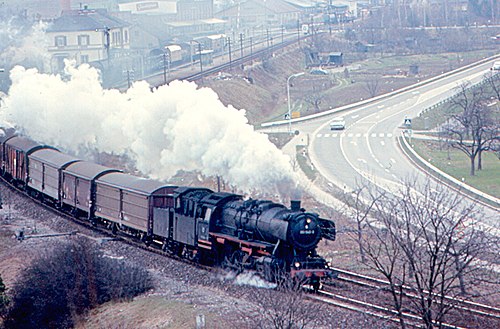
Remember how, when you were a kid in the car with your folks and a train stopped the traffic at the railroad crossing? How neat it was to look at all the different cars going by? How it made your eyes crazy with back-and-forth movement? How if the train was long enough you started to count the cars, all of them or just particular types like box cars or cattle cars? How some of the names on the sides of the cars suggested far away places — different states that you’d never been to? When did being “stuck” at a train crossing become an inconvenience and not a delight, something that slowed you down, something to get angry about?

http://upload.wikimedia.org/wikipedia/commons/thumb/5/53/Gundelsheim_-_Class_50_and_Freight_Train.jpg/500px-Gundelsheim_-_Class_50_and_Freight_Train.jpg

Two-thirteen PM Friday afternoon. The dishwasher is whirring! The lights are flashing! The power is back! Wow, electricity! The dazzle of a working computer, of artificial light, of TV!

That won’t last, of course. It didn’t even literally last because we lost power again one week later, again at night, although only for a few hours.

The long powerless interlude was pretty nice, partly because it wasn’t a flood or a tsunami; partly because we had hot water and motorized transportation; partly because it wasn’t too hot. Happily, as little as it was, it didn’t go on forever. Just long enough to give some perspective.

Take nothing for granted.

—

The photo reproduced at the top is called Old Bottles of Wine Aging by Candle Light, by Steffan Hausmann. The second photo is Sky at Sunset from Brancoli’s Crux on December 26, 2007 by Luccio Torre. Next is A European Penduline Tit in Estonia on June 19, 2010, the work of Alastair Rae. The final image is of a Class 50 steam locomotive near Gundelsheim Station, Germany taken on April 4, 1970 by Roger Wollstadt. All are sourced from Wikimedia Commons.

The Kardashians Meet Jerry Springer: On Watching “The Queen of Versailles”

Would a yearly outlay of a million dollars on clothing be enough for you? The documentary film The Queen of Versailles shows what is possible when you strike the word “enough” from your vocabulary. It introduces you to a couple who give new meaning to the phrase “conspicuous consumption.” They are easy to laugh at, as many audience members at the showing I attended did, but the hilarity is based on an inability to see oneself in David and Jackie Siegel, the Florida husband and wife who set out to build the biggest house in the USA. If that doesn’t sound much like you or me — well — just keep reading.

The story begins before the economic meltdown of 2008 that hammered David Siegel’s time-share real estate empire, Westgate Resorts. It ends in 2011 with him still trying to rescue both that business and the completion of a 90,000 square-foot estate fashioned after the Palace at Versailles. He intended to build it, as he says in the movie, “because I could.” The Siegels envisioned 30 bathrooms, 10 kitchens, stadium-level sports facilities, grand staircases, and a wing — a wing — for the children, who number eight living with them; not to mention the 19 member staff who were already present in the 26,000 square-foot Florida mansion that had become “too small.”

Where did David and Jacqueline come from? Mr. Siegel’s midwestern parents were addicted to gambling and lost everything on their visits to Las Vegas. He recalls that his mother, on a return trip from a gaming disaster, asked her husband if she could have a candy bar. He responded that there was no money left even for that. As a result, every Christmas Day, the 74-year-old Mr. Siegel buys himself a large Hershey bar and eats it in memory of his mom. Perhaps his parents’ failure at the gambling tables of Nevada also was behind the 52-story “vacation ownership resort” he built for his business there, a kind of posthumous triumph at the scene of his parents’ defeat. At least, before David’s empire started to disintegrate.

Mrs. Siegel, his 43-year-old surgically enhanced former beauty queen wife, also came from a humble background. Her college degree allowed her to work in engineering, but she seems uninterested in anything associated with what might be called an intellectual life. Indeed, the Siegel’s eight children (one is actually Jackie’s niece) had apparently not been encouraged to prepare for college until David’s financial distress created doubts about his ability to support them.

Nor do we observe any discussion of religion or values, although one might surmise that “The Golden Calf” is the only object of serious worship. Still, viewers should remember that the family was filmed over a period of three years. We only get to see those few moments that fit the narrative the producer/director, Ms. Greenfield, wants to show us — the story she wants to tell.

That said, Mr. Siegel is pretty much a self-proclaimed workaholic, portrayed as having little intimacy with his children. Indeed, he sees his wife as just another child, but one who compulsively buys things, including a large tin of caviar for herself even as the banks are threatening foreclosure. Yet the film maker Lauren Greenfield is careful to capture Jackie’s generous, warm, and outgoing nature. Indeed, she appears to be fonder of her husband than he is of her, despite the fact that even one of their children recognizes that Jackie was something of a trophy for dad.

Mr. and Mrs. Siegel sitting on what appears to be a throne.

A couple of the most telling moments in this very entertaining but sad story come when Jackie and the kids, unable to fly the private jet that they are accustomed to, have to travel like the rest of us. This prompts mom to ask them “How is it, flying commercial?” When she attempts to rent a car, the young man behind the rental desk is stunned to hear her ask, “What’s the name of my driver?” There is none, of course. Back home, Jackie does have a driver and a limousine, to boot. But the disarray caused by having to lay off 15 of the 19 servants and nannies is something to behold, resulting in a level of filth and dog poop that belies the luxuries that the Siegels still find a way to afford.

It appears that Mr. Siegel was not pleased with the movie and sued Lauren Greenfield for “defamation.” I can only imagine that the story he envisioned when he was on top of the world was very different from the film you will see at the theater. Joe Nocera’s article in the The New York Times reports his claim that his business has bounced back and that his palatial home is being completed after all. For anyone who, like Mr. Siegel, gloried in his success and hoped for another feather in his cap, his big screen setback would have been a bitter pill.

So what does all this have to do with you and me? Most of us have been captured (at least a little) by the empty quest for “stuff” that is “The American Dream.” Are we more modest in our aspirations than the Siegels partially because we don’t have the opportunity that they had to indulge those desires? As a result, we either settle for the big screen TV or two or three that we really don’t need or wish we could buy at least one. What I’m talking about is the worm in the rotten core of the consumption-driven apple that most of us want a bite of.

I write this about a day after having seen the movie. My emotional reaction is interesting, at least to myself. The film produced two feelings in succession that still linger. The first was the sense of emptiness at the heart of the Siegel’s lifestyle. As Wordsworth said, “Getting and spending we lay waste our powers.”

The second reaction, however, was to think of my wife and children, my family and friends, my good health, and realize just how lucky I am. The Siegels can have their private jet and dazzling luxury. More — more is the pity.

Bald is Beautiful? Reflections on Hairlessness

I recently had a brief on-line conversation with my old friend Steve Henikoff (pictured above), whom I met in fifth or sixth grade at Jamieson School in Chicago. I mentioned that I was struck by his father’s baldness as soon as I was introduced to his dad, Armand. I recall thinking to myself that Steve would therefore probably go bald too, and that I would be exempt because my dad had a full head of hair. That shows you how little I knew about genetics — how unaware I was of the fact that Male Pattern Baldness (MPB) wasn’t that simply acquired. Not surprisingly, Steve has a great head of hair to this day and I am — well — just look at the picture on the right.

Steve, however, was not a fan of his father’s nose and claims to have the spitting-image — sneezing-image? – of his dad’s schnozzola. I never noticed anything about his father’s nose that seemed remarkable. But, Steve certainly inherited the best of Armand and Sylvia Henikoff’s brain-power, as he is an internationally recognized researcher at the Fred Hutchinson Cancer Research Center and one of the few folks in the world elected to the National Academy of Sciences (NAS). The NAS is the Hall of Fame of living scientists, comprising approximately 2200 members and 400 foreign associates, of whom about 200 have won the Nobel Prize.

Steve’s hair undoubtedly contributed to his success. Yes, I know he graduated from the University of Chicago and Harvard and is fantastically smart. But I’m here to report that it was his hair that enabled him to become world renown. Doubtless, if not for my own shiny pate, I would be right beside my old buddy on the NAS roster. I tell myself this so that I can sleep at night.

I, unlike Steve, began to lose my hair in college. I noticed a few too many strands on the bathroom sink during a summer that I worked at MIT and shared an apartment with Rich Adelstein and a friend of his. My initial reaction was that those black hairs couldn’t be mine. I looked for name tags attached to the individual hairs, but finding none, didn’t think too much about it. I simply buried the idea of this being some sort of early warning signal. By the beginning of graduate school at Northwestern, however, there was no doubting that something was happening — to me! My roommate then was blond. Ownership was indisputable.

A bald man who has cleverly figured out how to distract you from his baldness.

Passing thoughts occurred to me about the potential speed of my condition’s progress, but since it wasn’t obvious to anyone else I didn’t agonize about it. I suppose that I might have done some calculations. “Let’s see, if I have X number of hairs and I am losing hair at the rate of Y hairs per day, then I will be bald as a coot by — Tuesday!” As I say, I didn’t do this and wouldn’t recommend this exercise in self-abuse.

Talk about vanity. Before long I was trying to figure out whether I would look better if I had longer hair in the area of my temples or if shorter hair would achieve a better disguise. But I still had lots of wavy hair, despite the beginning signs of a bald spot on my crown. I was a poster child for the early stages of Male Pattern Baldness, which, unlike female baldness, tends to be localized at the start, rather than a thinning of the hair over the entire scalp.

By the 1980s a blood pressure medication called Minoxidil (Rogaine) was producing good results for some of the men who used it to deal with their hair loss. I knew friends who vouched for its safety and effectiveness. But somehow I couldn’t get around the idea of taking medicine for something that had more to do with self-image than with health. I’d also seen too many bad hair-pieces by that time, and heard that the care and feeding of those creatures — “Is the animal on your head still alive?” — was time-consuming. They also reportedly generate a good deal of heat on the top of the scalp, not being ventilated the way that real hair is.

Other possibilities presented themselves. For example, some guys look good with their heads shaved. The danger here, I think, is coming off as a little too intimidating; plus, you need the right shaped head. Not for me.

The idea of a serious comb-over seemed worst of all. I always wonder about the romantic partners of these guys. Don’t they have the guts to say “You know dear, I have to tell you that combing the six-foot-long hairs from behind your left ear to cover the top of your head makes you look like CRAP!!!”

Scalp reduction surgery was more intriguing. As I’ve written elsewhere, it is designed to get more coverage out of the hair you have by reducing the territory on top of your head.

I can imagine the following conversation:

Surgeon: ‘Well, Dr. Stein, we’ve studied your head, your hair-line and scalp and we have some good news and some bad news.”

Me: “Tell me more, Doctor.”

Surgeon: “The good news is that we can give you a full head of hair!”

Me: “And the bad news?”

Surgeon: ‘Your head will be the size of a grape.”

According to Wikipedia:

One large-scale study in Maryborough, Victoria, Australia showed the prevalence of mid-frontal baldness increases with age and affects 73.5 percent of men and 57 percent of women aged 80 and over. A rough rule of thumb is that the incidence of baldness in males corresponds to chronological age. For example, according to Medem Medical Library’s website, male pattern baldness (MPB) affects roughly 40 million men in the United States. Approximately 25 percent of men begin balding by age 30; two-thirds begin balding by age 60.

The news that you have (or will have) some company in the hair loss department is cold comfort, especially if you lose too much hair early, which I didn’t. As with money, status, jobs, and just about everything else in life, we are more likely to make comparisons to those who are better-off than those who are lower on the totem-pole than we are.

Question: Does this look more like Steve’s father or me?

A man who is honest with himself will admit that the reason he wants hair on the top of his head is to look good for others. When you are alone reading a book in your room, I doubt that many guys think that the experience would be better if they could run a hand through thick and wavy locks every few minutes and say to themselves: “Boy, you know I liked The Great Gatsby the first time I read it, but it’s really much better now that I have a hair transplant!” No, I don’t think so.

So this is about making a good impression, rather than a bad impression or no impression at all. It is about being sexually attractive even if you have no real interest in having sex with those who might admire you. And, as with many other things, it is emotionally tougher for women, some 30 million of whom have hair loss issues in the USA alone.

Eventually, at least for most guys who don’t try to change the course of nature, you reach the point that your baldness can neither be disguised nor denied. You are a bald guy. Face it. Because, I’ll tell you what, it isn’t the worst thing in the world. Think of some of the advantages:

  1. You will find yourself thinking much less about either hair arrangement or being without hair. It is just who you are.
  2. You will save money on hair spray, hair cuts, and hair-care products.
  3. You will save hours combing your hair and have much more time for re-reading The Great Gatsby.
  4. You can rent out the top of your head as advertising space — “Eat at Joe’s Restaurant” — and make some extra money.
  5. Some woman actually prefer bald men and many value other qualities more highly than hair.

There is one other advantage, but I’m afraid I can’t transfer this to my brothers in baldness. It came in the form of a 2008 handmade Father’s Day card from my daughter Carly. To help you understand the message, you need to know that we have a cabinet-filled room full of CDs which is mostly devoted to my listening to music. If you happen to be in the kitchen, you can see into the room easily, and see me from behind as I am seated on a couch. Here is what Carly wrote on the inside of the card:

Dad,

Your bald head has always had a warm place in my heart. Sounds peculiar, I know. But ever since I was little, I would look at the back of your head sitting in the music room and it comforted me. The image still does. It’s because that picture (below) represents my Dad who is always there to listen, to give ample hugs, to give sound advice, to dole out corny jokes, and when he smiles I know how much he loves me. To someone else it may be just a bald head, but to me it’s the gleaming ray of sunshine that is my Dad!

As perhaps you can imagine, reading that was worth all the hair loss in the world.

—

The photo of a Bald Eagle was taken by Vlad Butsky and is sourced from Wikimedia Commons.

Why Some Patients Shouldn’t be Treated: When Therapy Can Make Things Worse

http://upload.wikimedia.org/wikipedia/commons/thumb/5/57/Stub_surgeons.svg/128px-Stub_surgeons.svg.png

Therapists are programmed to do therapy the way that surgeons are programmed to do surgery. For some of them, it can be the almost automatic elixir for whatever is ailing. But is treatment always a good idea? Here is a cautionary tale, a story of one occasion where I counseled someone to forego therapy with me — and why.

The woman was about 55 years old, still fit and attractive, with bright eyes and an engaging smile. She gave an impression of someone of inner strength and conviction. One imagined that she had her share of male attention over the years. But turning heads was not what she valued, entirely to her credit. No, she meant to make a difference in the world, to get some recognition for her work, to make a name and do something of value with her life. And she knew, by 55, that she probably had a limit on how much could be accomplished in her lifetime. After all, her parents had both died before age 70.

Although she had a loving husband and three children, something was missing. It wasn’t money since her family was well-fixed. She had a few good friends, so she wasn’t lonely, even if few knew the full extent of her complicated inner life. And her husband adored her, despite frustration that he couldn’t remedy her dissatisfaction.

He worried that she seemed to rely on alcohol too much, usually after dinner, never before. Drink was kind of a sedative, something that calmed that unsettled feeling that shadowed her much of the time. Anti-depressant and anti-anxiety medication had failed her; too many side-effects, she felt. You might say that she lived with an itch that couldn’t be scratched.

http://upload.wikimedia.org/wikipedia/commons/thumb/2/21/Back_scratcher.jpg/256px-Back_scratcher.jpg

Mrs. Half-Empty Lovely Life. Let’s call her that, or Mrs. HELL, for short. Because that is what her life was like, some sort of heavenly hell. She knew it was beautiful. She tried to persuade herself that she should be satisfied with it. She realized that she was incredibly lucky compared to nearly everyone else on the planet. People in her church admired her, her husband and children loved her, and everyone was healthy. But still she needed a few drinks at the end of the day — her only respite from the coiled spring of tension and disquiet that lived inside of her. Nothing seemed to scratch that itch I mentioned. And you might ask, where did that itch come from?

I learned about her early life in the course of an initial interview. She had been special, so her father had said. He was a minister who hoped to become a great man in his religious denomination. But he volunteered to be a chaplain in wartime and, however much this was a noble thing to do, it derailed his assent in the church hierarchy. Dad never achieved the exalted level of recognition he sought. Ah, but there was his daughter, born just nine months after he returned from overseas! What might be possible for her? She was his favorite and dad encouraged her to imbibe from the fountain of faith and ambition that sustained him. His church was a liberal one, so the assent of a woman just might be possible. That hope tied them together and his death left the task to her alone, the thing she knew he wanted for her and for himself.

In fact, she did become a clergywoman. But, at some point, her career stalled. Everyone thought she was great, or so they said. Everyone loved her sermons, or so they said. But somehow, when it came to advancement in her denomination, she never got as high as she thought she should. There was a rung on the ladder just out of reach. She remained a big fish in a small pond. She wanted to do something that people would remember. She wanted to be a bishop and, if truth be told, even more. There were important reforms to the church that she believed were desperately needed for the good of all. But her current position didn’t permit that kind of impact and she had her doubts about it ever happening.

Prayer, the thing that you might think would give her comfort, didn’t give enough. Wine actually gave more. The minister was reaching the point where she was pretty sure that the project — her dad’s project for her, but one she believed in fully — would not be achieved. Yet, she continued to plug away, trying to influence others with more power in the church to make some of the changes Mrs. H thought to be essential. She wrote letters advocating her ideas, brilliant and well-reasoned. “Oh, yes, thank you, we will give your suggestions every consideration,” they said. But the ideas never took hold. Perhaps sexism played a part in her frustration, but Mrs. H was mostly concerned with the goal, not the reasons why her conception of a reformed church institution went nowhere.

http://upload.wikimedia.org/wikipedia/commons/thumb/0/07/Pyaar-ke-Side-Effects_Official-Poster.jpg/256px-Pyaar-ke-Side-Effects_Official-Poster.jpg

The frustration brought her to consult me. She’d heard that I treated other ministers and had been helpful. We talked, even though she felt vaguely uncomfortable with the idea of seeking counseling; surely, she thought, her parents had raised her to be tough and God alone should be a sufficient source of reliance.

That reliance led Mrs. H to conclude that even if her ideas didn’t triumph in her lifetime, perhaps someone would eventually act on her vision of what the denomination might become. “I’d like to think maybe someday in heaven, I’ll be able to look down on all this and realize that what I did wasn’t in vain. I’d like to think that my efforts will have made a difference.”

I asked her about the solace that she gave to her flock and the value she put on that part of her life. Indeed, she acknowledged that it was important, but somehow it seemed too individualized, not sweeping enough, not the institutional change she was aiming for. Helping people one-by-one was all very good and important, but…

She could not give up the project. We talked about her alcohol use, the benefit of prayer, the possibility of trying meditation. She mentioned the anti-depressant side-effects and her sensitivity to medication. Her work made sharing her frustrations with people in her church community difficult. She did share them with her husband and a couple of other adults, but that didn’t provide more than temporary assistance.

Mrs. H talked a lot about her dad. How much she loved and respected him. How much he hoped that she would rise in the church hierarchy and make it a different and better place, one more pleasing to both man and God.

Dad’s devoted daughter often wondered what he was making of the antics on earth from his spot in heaven, her own struggles in particular. I asked her if she believed that he would want her to keep trying to advance her vision for the church or perhaps give up on the project that was causing her so much anguish. She knew that he wanted her happiness, she said in response. She was certain he would be chagrined at her frustration, but couldn’t imagine her father ever being comfortable with quitting on something important. Sure, he would tell her to give herself a break, but wouldn’t he really be disappointed? That is the way that Mrs. H thought.

This good woman had a life that some would say was blessed: a husband she loved and who loved her, great grown children and sweet grandchildren; a respected position and as many material things as she cared about. Yet she was gripped by something that defined her entire life, her relationship to her father, and her afterlife (as she envisioned it); something to which she had devoted close to 40 years of training, experience, and effort.

http://upload.wikimedia.org/wikipedia/commons/thumb/5/5c/858MilanoDuomo.JPG/256px-858MilanoDuomo.JPG

In light of all this, what might therapy do for (or to) such a person? And what did I try to do?

I recommended another medication consult with a terrific psychiatrist. I said that we should meet again after that. When Mrs. H returned, however, she said that the psychiatrist could provide nothing that the previous physicians hadn’t already prescribed, those drugs that had produced intolerable side-effects.

When you’ve done psychotherapy for a long time, you get to know who is really open to change and who is not. As I saw it, Mrs. HELL was not open to giving up on the multi-generational efforts of her father and herself; she was not open to accepting defeat whether due to sexism, her own personal limitations, or even the shortness of life. And she was most certainly not open to questioning her religious faith or seeing any unfairness in God’s “plan” for her, even as much as none of it was sufficient to sustain her.

But what if, somehow, I had been able to find a way in — to get her to question one or more beliefs? Weren’t these like the pillars that hold up a building, however shakily? What if she came to see that her father should not have freighted her with the responsibility to carry on his mission? What if she began to recognize unfairness in the behavior of the church hierarchy or sexist discrimination in their treatment of her? Or, what if she came to think that she would never see the posthumous completion of her task from a lofty spot in heaven, either because her ideas would die with her or because heaven didn’t exist?

If Mrs. H came too close to any of that, she probably would have become even more depressed and unsettled than she already was. Therapy would have been too much like pulling on a loose thread in a sweater, only to cause the entire garment to unravel. She might have felt guilt for prematurely giving up on her father’s vision, internally conflicted about him, and doubtful of the fairness of judging someone who had been so good to her. If anything, it’s likely that Mrs. H would have blamed herself for “buying in” to a life that dad hadn’t actually demanded of her. Rage at the church might have contributed to her turmoil, especially the men who didn’t give her ideas due consideration; and made it harder to minister to her flock. And if Mrs. H somehow began to question the possibility of the kind of afterlife she had imagined, the entire edifice of her religious faith could have collapsed.

At some point in treatment she would likely have come to believe that she’d wasted the best years of her life, without a clear future plan or the time required to create and achieve it. Depression would almost certainly then intensify along with an increase in alcohol abuse. Therapy, if it could help, would take years, by which time even more of Mrs. H’s life would be behind her. Indeed, the fact of having to engage in a lengthy and expensive therapeutic process could well add an additional layer of resentment and regret.

I told this woman, lovely and bright, that I didn’t think I could help. Since she didn’t ask why, I wondered if she was hoping that I would say just that. I knew there were two reasons for my decision: I didn’t believe I could get her to look at herself and her situation in a new way; and, even if I could, it would be too destructive for her to do so.

I suggested that she continue to pursue possible psychopharmacological (medication) treatment as a first line of potential healing. I recommended some other therapists who might have a different perspective on her dilemma if she wished to try counseling with someone else. Put simply, I thought the grieving process of getting over the failed family project of reforming her religious denomination would have been worse than simply letting her continue to struggle. The treatment held the risk of drowning her. For now, at least, she was still above water. I suspected that as time passed her reliance on the idea of a heavenly victory would increase and provide more sustenance. I may have been wrong in my evaluation, but that is what it was.

The way I look at it, then and now, is that sometimes a well-intentioned act can cause damage. Take the following example. It is rather extreme, but it makes the point. A concentration camp prisoner tells the story:

I shall never forget how I was roused one night by the groans of a fellow prisoner, who threw himself about in his sleep, obviously having a horrible nightmare. Since I had always been especially sorry for the people who suffered from fearful dreams or deliria, I wanted to wake the poor man. Suddenly I drew back the hand that was ready to shake him, frightened at the thing I was about to do. At that moment I became intensely conscious of the fact that no dream, no matter how horrible, could be as bad as the reality of the camp which surrounded us, and to which I was about to recall him.*

http://upload.wikimedia.org/wikipedia/commons/thumb/f/fe/Bonfire_inferno.jpg/256px-Bonfire_inferno.jpg

As Dante Alighieri knew, hell’s Inferno has many levels of pain — some better, some worse. Viktor Frankl, the writer of the concentration camp story, points to the risk of awakening people to misery that is even greater than the unhappiness they are currently experiencing. Physicians are instructed that they should “first, do no harm.” I always tried to remember that, even though I successfully treated a great many people, and rarely turned anyone away in the manner I’ve just described.

Therapists can be life savers. Literally. But, none of that changes the fact that sometimes the cure really is worse than the disease. Good therapists must know the difference.

—

For those who have tried therapy without good results, you may want to read this: What to do When Therapy Doesn’t Help.

The top image is a Surgeon Icon by Angelus. The second is a Man Scratching Back With a Back Scratcher by en:User: Archos. It is followed by a poster for the movie Side Effects, a production of Pritish Nandy Communications. Next comes, the Facade of the Cathedral of Milan, Italy by MarkusMark. Finally, a Bonfireby Madmatt52. All are sourced from Wikimedia Commons.

*Viktor E. Frankl, Man’s Search For Meaning: Revised and Updated (New York: Washington Square Press, 1984), 48.

Betting on Life: A Psychologist’s Guide to Making Retirement and “Bucket List” Plans

http://upload.wikimedia.org/wikipedia/commons/thumb/d/d8/Card_games_and_game_tokens_01.jpg/256px-Card_games_and_game_tokens_01.jpg

When you reach a certain age (which some of you have not), you might have occasion to fill out a retirement planning questionnaire. It is a sobering experience. It asks all the expected questions, but somehow still unsettles you. How much do you make? How much do you owe? How much have you saved? And then the big one: how long will you need the money after you retire? Or, to put it differently, how long do you expect to live? You know, how long before you “kick the bucket,” from whence the phrase “bucket list” comes?

Even if you are very young, you are probably already making an unconscious bet on your future. You are assuming that some things must be done pretty soon and that others can wait. Implicit in this decision is that you will be alive long enough to do those things you choose to delay. If you are relatively young, you probably will. But, of course, there are no guarantees. If you’d like to find out what the Northwestern Mutual Life Insurance Company thinks your life expectancy might be, you can take an easy and free 13 question test that will take less than five minutes and give you an immediate estimate: Lifespan Calculator.

When you get a bit older, however, the probabilities begin to turn. You might not want to think about this, and some of you could be about to search the net for the latest update on Snooki; in other words, a topic that is less weighty and more amusing. Still with me? Good. You are a brave soul.

—

All of us take risks, including young people, and we usually avoid disaster in spite of that. The sun rises tomorrow despite drinking too much, having unprotected sex, and eating the wrong things. I don’t advise you to do stuff like that, but I can’t imagine having any kind of life worth living if one were so cautious as to avoid all possible risks, always wear a bullet-proof vest, and never give one’s heart away for fear that it might be broken.

But, time does tend to march on, and the odds don’t improve with its passage; specifically, the chance of having enough time to do all the things you might want to do. I bring this up because I retired in December and have had tons of conversations with people in the last two years about their retirement plans. I wanted to learn as much as I could in order to inform myself about what I might be getting myself into.

I talked with a lot of very smart people, some who weren’t retired and couldn’t imagine it, some who were retired involuntarily, and some who made a choice to do it. I tried to find out the ups and downs of it all and, now that I am retired myself, I’ve been asked questions by people who are hoping to learn from my experience; to find out what things are like on this side of the work force.

What have I learned? First, even though I feel good about my personal choice, I know that it fits only the particular circumstances of my life and personality. I can’t promise you that you would be as pleased with the decision to retire as I have been thus far. It might be absolutely wrong for you.

Second, if you are young it might be useful to run through the list below while you have the time to achieve fulfillment in the first half of your life. The eventual retirement decision will be easier if you make good use of the early years and have little regret over misspent time that can no longer be recovered.

Third, I realize that there are risks on both sides of the choice. You can retire when you are at the top of your game or when you are well-past your prime. You can retire when you are still healthy and active enough to enjoy life or when your body and your brain make that impossible. You can retire with enough money to live comfortably or discover that the days of your life have outpaced your ability to pay for lunch.

http://upload.wikimedia.org/wikipedia/commons/thumb/9/97/No_death.svg/256px-No_death.svg.png

What factors, then, do people think about as the try to figure this out? For the sake of this list, I’ve not included those individuals for whom continued work is an absolute necessity because they are without the financial resources to retire even for a short time:

1. Money. Even though some people have enough money to retire for a while, many are afraid to take the risk of retirement for fear of eventual destitution. Others have knocked themselves out to make a high salary and find the idea of walking away from that income to be difficult. This is particularly true for people who have known financial hardship in their lives, those who see their income as a kind of measure of their rank among their peers, or folks who simply put great importance on dollars and cents.

In the absence of financial necessity, the decision to retire pits the value of money vs. the value of time, unless your work itself is engaging enough to be the best possible use of that time. Put differently, ask yourself whether you would continue to do the work you do in the absence of financial compensation. The answer will tell you something about how much you value the job vs. how much you value the money that it provides.

2. Lifestyle Issues. This is certainly correlated with the money concerns I’ve just mentioned. The difference with this item, however, is that some people believe it is essential to live just as they always have, or perhaps even more grandly, in terms of vacations and the other non-essential things that money can buy: fine clothing, expensive dinners, and the like. They plan to continue working so that their level of non-essential expenditures can be maintained.

3. Responsibilities, Obligations, and a Strong Work Ethic. Continued work can be driven by having relatives who are financially dependent or have large medical expenses. But even without such demands, I know individuals who have a strong desire to serve others and believe they have a duty to an organization, a team, or simply their fellow-man or woman. Others, however, have a sense of guilt if they do not “work,” because they were required to do so growing up and evaluated accordingly by their parents. For them, work is driven not so much by its “meaning,” but by some sense of having to do it in order to measure up to an old, internalized standard of what makes them worthy of affection or approval.

4. Hobbies, People, and Interests. If one is to have a decent retirement, it is essential to have interesting things to do. Lying around, watching TV, and observing the grass growing are not weigh-stations on the highway to happiness. For most people, a good retirement requires human contact. Those whose social ties are to be found largely in the office can get pretty lonely after the office is permanently closed to them. For doctors, that can include the absence of social fulfillment derived from seeing patients; for teachers, it can be the sorely missed daily contact with students.

Similarly, productive endeavors are essential. Worry and anxiety are likely to close in without some way of organizing your life and engaging in fulfilling activity, even if that activity is labeling your coke bottle collection. Folks who have developed neither social networks nor hobbies often keep working for fear of what the alternative would be like. The routine of work can be comforting and give you a sense of stability. Without an adequate retirement routine — especially for those prone to worry or anxiety — there is also the risk of reliance on the self-medication of alcohol or recreational drugs. Before you retire, you’d best have an idea of how much you will still need the society that work provided and the routine it required, and how else these might be achieved.

5. Energy. If you still feel enormously energetic most of the time once you reach 65 — well, then you are a better man or woman than I am. Some of us retire, at least in part, because the physical cost is greater than it used to be. Others, because they have less resilience available to deal with the stress of working — the “emotional overhead” of staying in the rat-race. Moreover, if you want to have an active retirement, you do still need to have some gas left in the tank. Wait too long and you will be running on empty. It is one reason why a few of us choose to get off the escalator.

6. The Lure of the “Bucket List.” Most of those who belong to the “mature” or middle-aged set have the idea that they will eventually get to the category of things that I mentioned at the beginning of this essay: those items that have been postponed until there is “enough time” to do them. Thanks to the movie starring Jack Nicholson and Morgan Freeman, the concept of The Bucket List has entered popular consciousness.

The list provides an incentive to flee your day job while you still have the capacity to enjoy the activities you’ve delayed. They don’t have to be elaborate or difficult to achieve. The list can include items as simple as taking a course of study in something you’ve always had an interest in, reading Proust’s magnum opus, or learning how to sail or fly a kite. My friend Ron has a very thoughtful list that is part-way toward completion. He has already done things like working for Habitat For Humanity and going to see a space-shuttle launch. The “great hot dog tour” waits for him. Yours truly will be riding shot-gun alongside of him, hoping that eating our way across the country on a diet of “red-hots” (a kind of sausage on a bun) won’t kill us.

Don’t think, however, that everything can be postponed. Something that sounded good at age 25 might not feel as good if you accomplish it at 65. All work and no play when you are young sets you up to miss the boat on those things that are best done early. Paris in the springtime of the year feels better in the springtime of your life, when you can flirt with a comely young Parisian rather than watch someone else do it and realize that you should have made the trip decades before.

http://upload.wikimedia.org/wikipedia/commons/thumb/3/31/Gr%C3%BCner_Eimer_im_Watt.JPG/256px-Gr%C3%BCner_Eimer_im_Watt.JPG

7. The Joy of Work and Making a Contribution. I am pleased to say that I know a number of people who get great joy and fulfillment out of doing the job that they also do to make a living. Why give something up if it is akin to a “calling?” Symphony conductors are well-know to continue their work well into their 80s, so strong is their passion for making music. I also had a legendary pediatrician, Dr. Albert Stein (no relation), who maintained his medical practice into his 90s. For myself, I found my work as a clinical psychologist very satisfying. But was it a “calling?” Probably not.

8. The Desire for Freedom From the Oppression of the Clock and “Responsibility.” The wear and tear of life can erode your soul. The second-hand of the clock slices you a small sliver of your life, like a piece of pie that you can no longer consume. We are a “time driven,” deadline-driven society. The machines and electronic devices task us to keep up with them. E-mail, voice mail, and text messages seem to demand instant responses in a way that letters and a hand-written message taken by your secretary did not a few years back. Workplaces often expect you to surrender your life to the company, putting your family second, your friends third, and any personal time out of the question.

You might know that the origin of the word “deadline” comes from a line that was drawn in a military prison yard during the Civil War to make sure that the prisoners did not get too close to the prison wall. If you did cross the “deadline,” it was assumed that you intended to escape. You were shot simply for violating it. Today’s work deadlines might just be killing us too. In Japan, they even have a word for working yourself to death. It is called karõshi.

9. The Desire to Spend More Time with Your Spouse, Family, Grandchildren, and Friends. This is not exactly a “bucket list” item, but can be very important, nonetheless. First, however, I should point out that some people postpone retirement for fear of spending more time with their spouse! Others are surprised only after they have left the job that there are complications from more proximity to their partner. Best to know whether you are really compatible with the older version of your companion (and she with you) before the decision to quit work. If not, make plans to do lots of things separately. With respect to others, one of the most often cited benefits of retirement is the ability to be with grandchildren and the opportunity to spend more time with old friends or make some new ones.

10. Status and Its Loss. Many of us define ourselves, at least in part, by our work. For those who take particular pride in what they do and the status that it confers, it is especially difficult to surrender their profession. Loss of identity is a risk. In such cases a satisfying post-work life requires that one be flexible enough to re-define oneself and no longer feel the necessity of being “the big guy” who is indispensable to the organization. The truth is that work will go on without us. Put very darkly, “the cemetery is full of indispensable people.” However much your absence might mean on a personal level, there is probably someone who can do your job as well or better than you can, other than raising your children and grandchildren.

11. The Ability to Appreciate and Accept Things. It is useful at any age to feel gratitude for the things you have. It is equally beneficial to enjoy simple pleasures: a beautiful day, laughter, and the excitement of a game of ball — especially if you are playing in it.

If you are aging well there will be some loss of restlessness and driving ambition over time — a sense of being “in the hunt.” Be grateful for that, too. Unless you have tamed the beast that youthful ambition can be, you will feel more like the pursued than the pursuer when that youth is well behind you. Win the games you can win while you have the grace and speed and drive of a young man. A good retirement usually requires a belief in accomplishment that one can look back on — the feeling of a job well done. If retirement age finds you still maniacally trying to beat the competition, you should either stay working or ask yourself why you remain driven.

—

I think it is pretty easy to fool yourself about the reasons you continue to work, as well as those that might cause you to retire. But, from a psychological viewpoint, the greatest risks in life are usually those that require change. Even though retirement isn’t the same as walking a tightrope over Niagara Falls, to some people it feels that way.

The decision to stop working requires not only that you establish a new kind of life, but some amount of courage in facing the fact that you won’t live forever; and that even if you do live many more years, you might not be in the shape required for the life you imagine. High achieving individuals are generally good at postponing gratification, perhaps too good. Be careful not to fool yourself into thinking that there will always be more “good” time.

That said, neither work nor its absence in retirement ever produce a perfect state of being. Work or no work, all the same daily indignities are available, from people cutting you off in traffic to dealing with insurance companies over a claim. Few people achieve serenity, but acceptance of things “as they are” can occasionally come close. If and when you decide to retire — assuming that you have planned it well, have enough money in the bank, and have a sustaining curiosity about life and people — you just might find it to be lovely.

Whatever your choice, Star Trek’s Mr. Spock (Leonard Nimoy in both the images below) has the best salutation: “Live long and prosper;” to which a fellow Vulcan would respond “Peace and long life.” These extra-terrestrial, science fiction-based humanoids are said to have lifespans that can extend beyond 200 years. Yet, as the above salutations suggest, even they remain mindful of the preciousness of time.


http://upload.wikimedia.org/wikipedia/commons/thumb/4/4a/Leonard_Nimoy%2C_2011%2C_ST_Con-2.jpg/256px-Leonard_Nimoy%2C_2011%2C_ST_Con-2.jpg

—

The top picture is called Card Games and Game Tokens by victor vic. The second image is called No Death (the grim reaper crossed out) by Benjamin Hauber. It is followed by a Green Bucket by 4028mdk09. All are sourced from Wikimedia Commons. Finally, Leonard Nimoy as Mr. Spock in the 1960s and at the 2011 Star Trek Convention, the latter by Beth Madison, sourced from Wikimedia Commons. In each instance he is giving the sign that goes along with the salutation “Live long and prosper.”


Fooling Yourself Into Failing Yourself: The Trap of Anxiety and Avoidance

File:Fear of a blank planet.jpg

“But I just don’t like to do that.”

That is what she told me — the young woman who said she didn’t want to go to a restaurant alone. “Why should I do that? I’d much rather eat with someone and be able to talk at dinner. Eating alone wouldn’t be any fun.”

True. Most of us would prefer a dinner companion. It probably would be more enjoyable to dine with a friend. But there is an important distinction here. It is between being able to do something that you might prefer not to do, and being unable to do the thing because it is uncomfortable for you; maybe even frightening. And, it is between deluding yourself into thinking that the activity might be boring or stupid when the truth is that you are afraid to do it.

Deluding and denying. We do it all the time. “I don’t like to do that. Why would I want to do that? Why do I have to do that?” And so we persuade ourselves that we can live without certain experiences, side-stepping the things we don’t know about or haven’t done — the small and large challenges of life.

But what are we really doing here?

http://upload.wikimedia.org/wikipedia/commons/thumb/4/4a/WeirdTalesv36n1pg068_Shocked_Woman.png/240px-WeirdTalesv36n1pg068_Shocked_Woman.png

For the young woman in question, her repeated need to be accompanied to places — her fear to act alone — caused her to be dependent upon people, especially boyfriends. As a result, she found it difficult to be without a male companion for very long and, when she did find one, discovered that she wanted (and needed) to be with her lover more than he wanted and needed to be with her. Thus, her insecurity about being alone and her avoidance of doing things alone made her dependent upon others.

Eventually, the “clinging” drove her boyfriends away. Then she really was alone. Finding herself abandoned and rejected, she turned her reliance on family or friends; if she had those friends, that is, because she had spent so much time with her boyfriends that she’d neglected making platonic friends, along with the work required to keep them.

Some people who are avoidant don’t realize how anxious they are — how much fear dominates their lives. After all, if you turn down invitations to parties because of underlying social anxiety, you manage to avoid getting nervous as you think about the party, dress for the party, drive to the party, walk in the door, and then try to fit in.

The fact that you don’t feel anxious doesn’t necessarily mean that you don’t have anxiety problems. In fact, sometimes a better way to determine whether you have a life-compromising form of anxiety is to make a list of the things you will not do unless forced to at gun point.

  • Things like giving a public speech, raising your hand in class, traveling to the downtown area of a big city, driving on the expressway, making a phone call, going to a party where you know few people, and eating at a fancy restaurant or any place where you are not familiar with the cuisine.
  • Things like going to a movie, play, lecture, or concert alone; flying, sending a poorly prepared dish back to a restaurant’s kitchen, saying “no,” returning an item at the store, etc.
  • Things like trying some new activity on your own or voicing a strong opinion that just might be criticized by someone else; and not looking for a new job for fear of the interviewing process.

Please notice that I’m not talking about some of the very commonly experienced fears such as spiders, high places, and confined places: the phobias we call arachnophobia, acrophobia, or claustrophobia and the like. Rather, my focus is on the anxieties that make for daily difficulties — that make a life so narrow that it begins to look a little bit like this:

http://upload.wikimedia.org/wikipedia/commons/thumb/f/fa/Toledo_narrow_street.jpg/240px-Toledo_narrow_street.jpg

To the avoidant, anxious person, the narrowly confined life seems safer. It is fraught with fewer frustrations and failures. It demands less. It feels less foreboding.

If you are heavily invested in social media, you can even persuade yourself that your electronic social life of texting, instant messages, blogging, tweeting, role-playing games, and hundreds of Facebook friends is better than the real thing. And what might the real thing be? Dedicated time unmediated and uninterrupted by technology spent with a person who is right in front of you and within the reach of an outstretched hand.

Can you approach social situations without a preliminary drink or joint? Are you certain that the alcohol or marijuana you use to unwind is recreational rather than an effort to self-medicate your anxiety? Yes, we are pretty good at talking ourselves into just about anything rather than seeing ourselves as we really are.

But if we are avoidant, there is a price:

  • The same things done over and over and that can be done only in the same places and in the same way; and sometimes only in the realm of electronically achieved distance and safety.
  • The need to rely on others who provide an emotional security blanket, or substance use upon which one is also reliant.
  • The self-doubt and the worry that accompanies thoughts of leaving our “comfort zone.”
  • Too much time spent looking at a television or a Smart Phone or a computer screen.

Avoidance offers no growth and no “life,” only the illusion of safety and the temporary relief that we all know from our school days when the teacher was sick and the test was postponed. I suppose that you can try to postpone the “tests” that life offers until the end of your days. Believe me, I’ve seen it happen. I’m talking about a life of challenges unmet, mastery unachieved — the narrow life that Thoreau described when he said:

The  mass of men lead lives of quiet desperation. What is called resignation is confirmed desperation.

And, in a companion quote often misattributed to Thoreau:

Alas for those that never sing,
But die with all their music in them.

But he also wrote:

Great God, I ask for no meaner pelf

Than that I may not disappoint myself,

That in my action I may soar as high

As I can now discern with this clear eye.

We live in “The Age of Anxiety” according to W.H. Auden. In any life there is a first time — a clumsy, unsure time — for everyone and every thing. We fear the judgment of others, the embarrassment, and the mortification of taking a chance and stumbling in public. We compare how we feel inside to the apparent (but not always real) serenity, calm, and self-confidence of others as we look at them from the outside. We condemn ourselves for lost time and opportunity, say to ourselves that we are “too late” or “too old” to take on a new challenge, and thereby guarantee that even more time will be lost; perhaps all the time we will ever have.

We tell ourselves that we can’t try a thing until we first feel better, calmer, and more confident; not realizing that “trying” is just what we need to do in order to feel better about the thing; failing to grasp that anxiety is not the biggest part of the problem, but that a failure to act in spite of the anxiety is.

If you are anxious enough or avoidant enough you might well avoid counseling, too. That is a shame, because there are very good treatments available in the realm of Cognitive Behavior Therapy (CBT). For a discussion of therapy for Social Anxiety Disorder, for example, you can look at this: Social Anxiety Disorder and Its Treatment.

Only if you fully realize that your avoidant coping strategies are costing you something of value will you call a therapist. Are you afraid to call? Is it less distressing to email? Did I hear you say, “Maybe tomorrow?” You may not detect the sound, but the clock is ticking.

As Eleanor Roosevelt said, “You must do the thing you think you cannot do.”

Now.

http://upload.wikimedia.org/wikipedia/commons/2/2e/RelojDespertador.jpg

—

The top image is described as Fear of a blank planet, cover by Lasse Hoile Porcupine Tree Band 2005: http://www.porcupinetree.com/ “OTRS Ticket 2006082110002647.” The Illustration of a Shocked or Frightened Woman has been altered by AdamBMorgan from the original that appeared in Wierd Tales (September 1941, Volume 36, Number 1). The next image is One of the narrow streets in the old part of Toledo, Spain by Allessio Damato. Finally, An old style alarm clock captured by Jorge Barrios. All are sourced from Wikimedia Commons.

“Will You Accept This Rose?” Reactions to Receiving the “Beautiful Blogger” Award

First of all, I will end the suspense, little as it may be: I did accept the “Beautiful Blogger” Award. The writer of Anxiety Adventures was kind enough to nominate me for this, for which I am very grateful. But, if you’ve been following my writing for a bit, you also know that I tend to think about things a good deal. So I’ll offer you a few thoughts prompted by this little bit of recognition.

Before I do that, however, I need to tell you about three other blogs worth your attention. My acceptance of the “Beautiful Blogger” Award actually requires seven such nominations (it is a little like a chain letter), but I’ll give you just three for now, with more to come in the future:

I’m happy to hear from other bloggers who might wish this sort of recognition. My panel of judges is a tough bunch, but you never know whether you might get lucky. Bribes may increase you chances! Now, back to thoughts inspired by the “Beautiful Blogger” Award. Questions, actually:

Question #1: How many bloggers are out there? According to NM Incite, “overall, 6.7 million people publish blogs on blogging websites, and another 12 million write blogs using their social network.” The same source states that they tracked over 181 million different blogs by the end of 2011. WordPress indicates that there are about 500,000 new blog posts each day on its WordPress sponsored sites alone.

Question #2: With so many posts, how does anyone get noticed? Unless you are writing for some outfit like Huntington Post that will promote your work by its very existence, people spread the word via Facebook, tweets, and other social media sites and methods. They use photos to get attention, try to “tag” their posts with key words so that search engines like Google will pick them up, and send their URL (web address) to those individuals who might find their writing interesting. In turn, those contacts are encouraged to pass the posts on to their own friends and acquaintances. Bloggers are also wise to leave comments on other bloggers’ sites as a way of encouraging reciprocal attention to their own blogging activity.

Question #3: What did you do, Dr. S, to get an audience for what you write? I did some of the above, but not as much as you might think. First, since I don’t use any of the usual social media like Facebook or LinkedIn, there was only a limited amount of self-promotion. For the record, I did not tweet, chirp, squawk, or transubstantiate to get the message out. I did not pray for readers or wail. I did not beg or plead with my patients, only with my friends. I did not wear sandwich boards (see the image just below) announcing my new venture. I gave some consideration to traveling from town to town, setting up a tent, and performing miracles, but dismissed the idea when I couldn’t get a good price on a tent.

http://upload.wikimedia.org/wikipedia/commons/thumb/5/57/Bundesarchiv_B_145_Bild-F079081-0018%2C_Bonn%2C_Fu%C3%9Fg%C3%A4ngerzone%2C_Sternstra%C3%9Fe.jpg/256px-Bundesarchiv_B_145_Bild-F079081-0018%2C_Bonn%2C_Fu%C3%9Fg%C3%A4ngerzone%2C_Sternstra%C3%9Fe.jpg

I did, however, put the URL for the blog on my business card and my website. I also told a number of people about what I was doing. I linked my blog site to some online therapy referral services where I was listed. Mostly I just wrote and let the writing do the job. Eventually people read my stuff, but this didn’t happen very quickly — I had only eight “page views” in the month that I began posting, February, 2009. As a few of the posts became popular (see particularly the first two items on the list of Top Posts in the column to the right), more and more people began to pay attention. Last month I had 7,411 “page views.” Clearly, I am not Oprah. OK, I’m not even Oprah’s assistant, but neither am I anonymous. Were I to try to do more to promote my writing, I’d need to read and comment on the blogs of others a good deal more than I do.

Question #4: How has the blog changed over time? I am doing more writing now that I am retired from clinical practice. I’m also freer to share whatever comes to mind, including humor and fiction, than when I had to be somewhat more concerned about the professional impression I was making. Moreover, now that I’m not working for a living I’ve discovered that my imagination is less restrained than when it was more narrowly focused on helping my patients and tending to the business aspects of my corporation. As a consequence, I’ve written humorously about invisibility, masturbation, and nausea. Very soon, I will post something about the male fear of the digital rectal exam! Apparently, I am becoming more shameless in my writing.

Question #5: How are your posts different from those of other bloggers? I’ve ignored the general rule to be brief. I tend to write essays. I try to keep a conversational tone so that you, yes you, will feel that you are engaged with me and that I take you seriously, because I do. I hope that people will think about the topics, not necessarily just turn the page and forget about the issues I raise. I’m older than most bloggers, half of whom are between 18 and 34, again according to NM Incite. And, of course, the last time I checked I’m not a woman, as are more than 50% of bloggers.

Question #6: For whom do you write? I start out with topics that are of interest to me, so I begin by writing for my own satisfaction and enjoyment of the process of putting words on the electronic white board of the Internet. I also try to do a bit of education, touch the heart every so often, and produce an occasional smile. I hope to have done a bit of all three before the end of this post.

I write, in part, for my adult daughters, so that they will have this small piece of me to hold on to, kind of like Jor-El in Superman, who created a hologram of himself so that his son (aka Clark Kent) could interact with and consult his father even though he was long gone. I’m not planning to leave the planet for a while, but the idea of emptying myself of whatever I have learned about life has some appeal, whether for them or those sympathetic and kind souls who find what I have to say has some value.

Question #7: Does any of this make you a “Beautiful Blogger?” The adjective in question — “beautiful” — is probably not the first one that comes to your mind when you look at my picture, but, as the old maxim tells us, “beauty is in the eye of the beholder.”

Seriously though, I will say one more thing: I’m pleased that you are reading my work. If you enjoy what I do I’d be grateful for you to pass it on. And to show my thanks, here is something of beauty that doesn’t require a vote or a nomination — a performance to tug at your heart: Slower Than Slow (La plus que lente) by Debussy; four minutes of music that expresses things that words cannot.

—

The June, 1988 Bonn, Germany image of people wearing sandwich board advertisements comes from the German Federal Archives by way of Wikimedia Commons. This sort of ad was common during the Great Depression. You even see an occasional sandwich board today, usually during “going out of business” sales.

A Question of Trust: A Story That Leads Back Home

The old guy was an easy mark. He’d had a stroke a few years before, made a good recovery with no evident physical effects, but certainly wasn’t the bright young man of his youth. And he wasn’t just any old guy. He was my dad.

“Rain or Shine” Milt Stein, an appellation that referred to his reliability and work ethic, was 83, but still active. Early every morning he took a walk of perhaps a mile in the area near the condo he shared with my mother, who was seven years his junior.

It was the very steamy summer of 1995, the hottest in Chicago’s history, topping out at 106 degrees Fahrenheit (41 degrees Celsius). On the day in question the temperature was already in the 90s, although not yet 7 AM. A relatively young couple with a small boy approached him.

“Our car broke down, sir. Do you have any water — water to drink?” It was a Sunday and stores would not open for three hours or so.

Milt Stein was a gentle and decent man. Perhaps he noted that the family wasn’t especially well-dressed — that their clothing was damp with perspiration. Approximately 750 deaths by heat and dehydration had been reported in the news recently. The condo was only a couple of blocks away. He led the family there.

My mom was shocked when dad unlocked the door and the family entered. Much less trusting than my father, Jeanette Stein never would have permitted this if she had been given a choice. Beauty, charm, and a quick wit were my mother’s strong suits. Faith in humanity wasn’t high on the list. She often said that “no good deed goes unpunished.” Mom knew this wasn’t exactly politically correct and wondered what others might think of her lack of trust. She sometimes made a joke of it by saying (always with a twinkle in her eye), “People say I’m kind, but what I want to know is, what kind?”

No time for such comments now. Strangers were inside her home. As she viewed it, the “aliens” had breached the gate. But what could she do? Dad was already on the way to the kitchen to get some glasses and fill them full of water. Meanwhile, the man and woman began to talk excitedly to my mother.

The boy disappeared.

It all happened quickly. Within just a few minutes everyone had been hydrated and the trio departed. But when my parents went into their bedroom, they noticed that a closet door was open and a cardboard box on a shelf there was ajar. The box was empty of the $10,000 in jewelry it had contained only a few minutes before. The little boy had done his crafty worst. He had taken the treasure.

The police were engaged quickly. A report was filed and the officer told my parents that there had been similar episodes in their neighborhood recently. None of this made my dad feel any better. He felt the fool and, unfortunately, my mother’s criticism of his trusting nature didn’t encourage a quick emotional rebound from the event.

Surprisingly, the police actually were able to recover more than half of the jewelry within a few weeks. But Mrs. Stein’s approval wasn’t so quickly retrieved by Mr. Stein. Mother would tell people the story and father would have to admit that, yes indeed, his kindness had not been repaid in kind.

So what we have here is a difference of temperament or personality on questions of trust and compassion — two models of how to live. You probably have a few family stories yourself, the kind that illustrate similar things, get repeated, and eventually become amusing, even if they didn’t begin that way.

As time passed, my always-clever mother found a humorous way to tell this tale. First she would explain the details of the “con.” Next mom would comment about my father’s naivety and mention the recovery of some of the jewelry almost as an afterthought. But you just knew she couldn’t end it there and the twinkle in her eye gave away that she was getting ready for the knock-out punch. Mrs. Stein pointed her index finger at the man to whom she had been married for nearly 45 years, took a deep breath, wound up and delivered:

“People keep telling me that I should change the locks on the condo. But the problem is, he’s got a key!”

—

The image above is my mother as a young woman. This is a revised version of a story I wrote some time ago.

Can You Stop a Person Determined to Commit Suicide? Afterthoughts on Watching “Goodbye Solo”

http://upload.wikimedia.org/wikipedia/commons/thumb/1/1a/Blowing_Rock-27527-2.jpg/512px-Blowing_Rock-27527-2.jpg

Can you save someone who is suicidal? What would you do? If you are like most folks, you’d try to talk him out of it, remind him of what he has to live for, and stay close by to make sure he doesn’t act. You might urge him to get therapy or medication, call 911 or send for an ambulance.

When the patient tells a therapist about his suicidal thoughts, some counselors will ask “Why haven’t you committed suicide?” This is not an attempt to encourage it. Rather, depressed patients will often answer the question by stating what connects them to life. They might refer to religious beliefs, children or family, the hope of a better future, or whatever presently keeps them hanging on. And now the therapist has a sense of whether there is imminent danger and what he has to work with that can keep the patient alive.

Counselors routinely ask new patients about depression and the details of any plan they have to harm themselves. They want to know about a history of such attempts and the person’s tendency to be impulsive. Their concern is heightened if their client is more than usually comfortable with physical pain, a characteristic that can make “the act” easier. They seek information about the individual’s network of friends and family, hoping that he has a web of supportive people.

The healer tries to determine whether the patient believes that he doesn’t count in the world (or worse) that he is a burden on others. Therapists must evaluate the possibility of alcohol or drug use which can create the disinhibition to make the suicide attempt. They ask whether he is suffering from a loss which, if grieved, might provide relief in time.

But sometimes, even an excellent therapist can only do so much. Sometimes medication can do only so much. Sometimes electro-shock therapy fails. And then there are those who will try none of these remedies or, having tried them, stop trying. Which brings us back to the question posed in the title of this essay: can you permanently prevent the suicide of a person committed to it, especially someone whose life is largely behind him?

This query is brought to mind by watching a 2008 American movie of understated eloquence called Goodbye Solo, directed by Ramin Bahrani, and starring Souléymane Sy Savané and Red West. You might recognize Red West, a boyhood friend of Elvis who worked as his body-guard and as a stunt man before he became a character actor.

Seventy-two-years-old at the time the film was released, West has the visage of a man who has lived through everything, paid for each act of recklessness with a line on his face, and suffered more heartache than any 10 of us. He plays a character called William. Solo is his African émigré cab driver in Winston-Salem, North Carolina. The proposition William offers the cabbie is simple: agree to take him to the top of Blowing Rock mountain in several days for $1000. He never states why, but the cabbie and the audience know it is to jump off and kill himself.

cigarettes aren't doing the job, so Red West decides to end his life on his own schedule in 'Goodbye Solo' (that's the taxi driver on the couch)

They are strangers, but Solo comes from a place where human relationships count for a lot. Moreover, he is an optimistic man, set on improving life for himself and his family. He hopes to become a flight attendant. Solo believes that he can alter his circumstances and that life will take-off for him, not come to the crashing end that William, twice solo’s age, envisions for himself. The cab driver does his best to connect with this old man; to engage him socially, to make friends, to have good times, to bring him into his own modest home; to inject William with some of his optimism about life.

We never find out much about William’s background, although he appears to have no significant social contact and no work to fill his time or give it meaning. There are hints of what life has done to him, or what he has done to himself, but Solo cannot discover much more than William wants him to know. It becomes clear that William’s suicidal intention has been well thought-out; that his plan is not impulsive.

William is not unappreciative of Solo’s efforts, not so fully out of touch with life that he has stopped caring about what happens to certain others. Nor does he dismiss the beauty of nature, if one can conclude that fact by his choice of Blowing Rock as the place of his demise: the last thing he will see (if he follows through with his plan) is the staggering magnificence of the vista beyond the mountain (see the top photo). After all, he could instead blow his brains out in his motel room.

In effect, Goodbye Solo puts a question to us: what is one to do when a long life — a rough life — has simply become too much? When one is care-worn, broken-down, and deadened, but not yet dead? When the beauty of nature and a child’s smile no longer compensate? When the kindness of strangers — their caring and concern — either isn’t enough or is too frightening because it portends only more vulnerability and loss if one allows them in?

Data from the American Association of Suicidology suggest that these are not idle concerns. Although the elderly made up only 12.5% of the population as of 2007, they accounted for 15.7% of all suicides. Moreover, men over 65 were more than seven times as likely to kill themselves than were women of the same age, and this difference grew as they aged.

Lest you become too depressed in reading this essay, you might wish to know a remarkable story that describes how a willingness to play out the hand you are dealt can be a far better choice than to “fold” and leave the game too early: “In Defeat Defiance:” Suicide and the Danger of Giving Up Too Soon. Therapists are sworn enemies of suicide and hopelessness, of course. Religion and loved ones try to silence such thoughts, as well.

But, especially for some elderly men, the questions are persistent. Can you stop a person like William — as old as William — determined to commit suicide? Can Solo? Should Solo?

Watch the movie.

—

Special thanks to my friend Bernie for recommending this film. The top image is of Blowing Rock by Ken Thomas, sourced from Wikimedia Commons. The second photo comes from the movie, Goodbye Solo, left to right, Red West and Souléymane Sy Savané.

Are You Destined For a “Destination Wedding?”

The-Kennedys-W-

My wife recently asked me if an acquaintance — someone with a disastrous relationship history — will be having a “destination wedding.” My answer? “Only if the destination is divorce court.”

As you might know, a “destination wedding” is one that requires travel by virtually everyone invited. It doesn’t happen in the home city of the bride or groom, or in the town where their parents live. The “destination” is on a beach, on top of a mountain, or ideally, on a beach that has a mountain top within easy walking distance. The place is glamorous and glorious, like the vacation sites where TV programs such as The Bachelor are filmed. It is “once-in-a-lifetime” dazzling and costs more than most people make in their three most lucrative years of employment — combined. Of course, it also requires the guests to spend a fortune if they wish to attend.

The question is, what must the “interested parties” consider? I’m talking about the engaged couple and their parents. Choice of venue is only one item on the agenda. Among the other decisions, they must determine whom to invite, how many, who will pay for it all, how much (if anything) can parents afford, and whether the people with the “deep pockets” are willing to go over-budget. There are a thousand details about hotel arrangements, music, dancing, menu, the wedding cake, flowers, and party favors. Nor can one forget the religious elements, colors, the wedding dress, the order and scheduling of events. Attention must be paid to booking the perfect honeymoon suite, local transportation for people coming from out-of-town, night-before dinners, and morning-after breakfasts; even table cloths.

Then there are the things that kill your friendships. Who will be the best man/maid of honor? Who will be in the wedding party? How will I tell those who expect to participate that they got squeezed out? My head hurts just thinking about all this and I’m not even involved in such decisions any more.

Since I have two married daughters, I must have put on two weddings. I’m a little fuzzy on this point. To be more precise, my wife and daughters put on the weddings, once my wife and I agreed on how much we’d be willing to spend. I then became blind and deaf to the process and the incredible amount of “wedding talk” that went on until the event was over. Those conversations continued beyond all reason. Less time was spent by the World War II Allied Forces in planning the D-Day invasion of Western Europe. Less time was spent building the Great Wall of China. I shut out as much as I could in order to preserve my sanity, keep my eyes from glazing over, and prevent saliva from dribbling out of my mouth. I would have been rendered insensible had I paid attention. Talk to me about psychology, politics, classical music, baseball, visual art, history, fiction, the economy or just about anything else, but please, please, please allow me to leave the room when you start the “wedding talk.”

http://upload.wikimedia.org/wikipedia/commons/thumb/0/08/Bride_and_Groom.jpg/256px-Bride_and_Groom.jpg

Although the largest amount of time is spent discussing the details I mentioned, there are other less explicit and material considerations. I’m referring to the questions of values and priorities. For example, does it matter more to you that your close friend is at the big event or that the big event is on a big beach in Big Sur, California and your friend is back in Back Bay, Boston, Massachusetts, 3000 miles away, bawling buckets of tears?

Then there is the moral question: how do you deal with the notion that you could retire the National Debt if you made out your check to the federal government rather than the florist? Yes, I get the part about it being your special day, the day you will remember for ever and ever, and that will happen (you hope) only once in your life. Still, as my mother used to say years ago when I didn’t finish eating everything on my plate at dinner, “How can you not eat? People are starving in India!”

It eventually occurred to me that my eating wasn’t going to feed anyone else, and that some of the Indians might have preferred to skip a meal than eat my mom’s concoctions, but I do think that the ridiculous excess of a six-figure wedding is a little unseemly. Have you thought about putting some of the money toward a charity? Really. Today, by the way, Indian mothers probably tell their dinner-disinterested children who are pushing away a plate full of tandoori chicken, “How can you not eat? People are starving in the USA!”

My effort to escape the wedding planning did not, in fact, include every element of the nuptials. There was a single portion of the extravaganza about which I didn’t zone out. It was the sole item I wanted to think about and work on. It was the one thing that was mine alone: the speech by the father of the bride.

Now, I’ve been told that I’m a good public speaker. I work at it. But I have never put as much effort into any other speech preparation as I did for the orations given at each of my daughters’ weddings. Although it didn’t equal the D-Day planners in time spent, it was pretty close. I had the necessary soliloquy ready months before the date, maybe even a year. And I memorized and rehearsed; and rehearsed; and rehearsed. Why? Because it was a wonderfully special day that required just the right words and, in each case, I didn’t know if I could get through the performance without breaking down. For the nuptials of my first-born this was particularly hard. Even when I practiced it on the morning of the day itself, my voice still cracked and tears got in the way. This was not a problem except that the performer is supposed to allow the audience to have the feelings, and this is a whole lot easier if you can actually finish what you’d like to say.

But when the moment came, it all worked. My advice to dads or moms who choose to speak? Spend more time on this than anything else. As for the rest, be as generous as you can without cleaning out your retirement savings. But also realize that the fate of the free world doesn’t hang on spending tons of money. It’s probably long past time that you teach your child and his/her intended the value of a dollar, and that their love for each other is more important than having a Golden Calf in the middle of the banquet hall. Don’t show-off to your family and friends how successful you are by putting Kate Middleton’s wedding to shame. There are lots of people who have great weddings on flat and modest grounds, indoors, in some location that isn’t half-way across the world. Your children’s friends will be grateful and the bride and groom will be happy that they were there.

In my next blog post, I’ll tell you exactly what I said in the speech I gave at my first born’s wedding. For now, you can read the one that I gave on my second child’s big day: A Wedding Toast.

—

The top photo is The Kennedys by Toni Frissell (The Kennedy-Bouvier Wedding), September 12, 1953. The second image is the painting Bride and Groom by Modigliani, 1915/1916. Both are sourced from Wikimedia Commons.