Close Calls and Tough Questions: “Is God a Happy Guy?”

The_gods

Something unexpected happened on a Sunday evening in 2011 on a trip to Chicago. My wife and I were driving east to a Lincoln Avenue restaurant. I missed the left turn I needed to make on Lincoln, a thoroughfare that runs diagonally northwest to southeast.

No biggie, I thought.

I took the next two left turns, planning to circle around so that I could return to the road I wanted. My car was traveling slowly down a dark and slippery side street when, from my right and barely ahead, another vehicle burst from an alley without warning.

I slammed on the brakes and braced for the crash. I couldn’t imagine not hitting the other auto broadside, given the car’s speed and the short distance. Time stretched to slow motion, the moment distending like a rubber band, but coming ever closer to the other vehicle. The alleyway intruder, a very young man, looked at us but never stopped.

I missed him by a millimeter, and I still can’t understand how I could have.

Questions arise from situations like this. Should I have left home a minute earlier, driven more slowly, driven more rapidly, concentrated more and thereby not missed the original left turn on Lincoln? Was the driver intoxicated, just in a rush, or both?

But what if I did leave earlier or later? Might something much worse have happened?

And then the big question that some people ask: did God save us?

More thoughts follow from that one: Should I be grateful to Him? Is there some reason that we weren’t injured? Was one of us — perhaps even the driver of the other car — meant to be alive to accomplish something of importance? Or, was it all just pure luck?

I have written about the “luck” question before (Is There Such a Thing as Bad Luck?) and also about near misses: Near Misses and Near Mrs. Events like this are troubling.

If it is luck, not the Deity, behind all these things, then life gets a little scarier. Or does it?

Life can be terrifying either way. If things “just happen,” like loose bricks falling from tall buildings, we are in a lot of trouble. But if God decides which bricks, which buildings, and the precise wind speed to create a direct hit on your noggin, that doesn’t exactly make us safe either.

God is alleged to be all-good and all-powerful, which means that he can do anything he wants. Now you can say that he has given mankind free will and thereby absolve Him of responsibility for what one man does to another, like what my young driver-nemesis almost did to my wife and me. But that doesn’t explain natural disasters or bricks falling from tall buildings.

In other words, God — if he exists — has some explaining to do.

THE_TURTLE_IS_PROTECTED_FROM_FALLING_OBJECTS._I'M_COVERED_WITH_A_HARD_HAT._-_NARA_-_515670.tif

If he is all good, but not all-powerful, then natural disasters cause no intellectual problem. God is simply a good guy who can’t stop them. Or, if God is all-powerful but not all-good, the unnerving world we live in also seems to make sense. But if he is both omnibenevolent and omnipotent, then the idea of God is no longer consistent with the way the world works and with the fact that “bad things happen to good people.”

Most religious folks don’t spend much time thinking about troubling thoughts like this. They rely on faith and let the rest go. Some rationalize that God knows best and everything bad is for some greater good. But when the loose brick on the tall building hits someone you love, this becomes harder to live with, no pun intended.

It is also one thing to think that your demise might be a random act, but quite another to fix on the notion that God decided the world would be a better place without you. And you thought that the biggest rejection of your life came when your girlfriend Veronica dumped you! A person needs a strong ego to be thrown on God’s discard pile and live long enough to know it.

I’m not going to cover the “question of evil” or “theodicy” (the attempt to justify an all-good and all-powerful God in a world where there is pain and suffering) any more than what I’ve already said. But I do want to raise two perspectives on God’s “nature” that I’d never considered until recently.

The December 20, 2012 issue of the New York Review of Books contains an essay by Lezek Kolakowski with the terrifically intriguing title “Is God Happy?” Unfortunately, it is not based on an interview with the Creator of the Universe or the results of psychological tests, which I’d be first in line to administer, by the way.

Kolakowski assumes that God loves us and believes this is evidence that God has emotions. He also accepts the notion that God is not indifferent to human suffering and therefore concludes:

If He is not indifferent, but subject to emotion like us, He must live in a constant state of sorrow when he witnesses human suffering. He did not cause it or want it, but He is helpless in the face of all the misery, the horrors and atrocities that nature brings down on people or people inflict on each other.

If, on the other hand, He is perfectly immutable (constant and unchanging), He cannot be perturbed by our misery. He must therefore be indifferent.

Either way, God is not a happy guy. Every day for the Supreme Being would be some sort of Hell under the first of these circumstances, and stone-cold detachment under the second, neither condition resembling the way God is described in Sunday sermons. Of course, neither is He a “guy,” you may answer, and therefore is not subject to human rules or understanding by we mortals.

Perhaps God isn’t as we imagine him. To read Kolakowski’s full essay, go to: Is God Happy?

The brilliant writer Julian Barnes, a man closer to the end than to the beginning of things, has thought a good deal about his own mortality and the God question. His book Nothing To Be Frightened Of is very much worth reading, especially if you have your own set of concerns about what might or might not happen after you check out. One idea that Barnes mentions is well known, but he makes something entirely new of it. I’m referring to Pascal’s Wager. 

Nothing To Be Frightened Of

As you will recall, Blaise Pascal was a 17th-century mathematician and philosopher who believed that there was more to gain by betting on the existence of God than by being an atheist. Julian Barnes’s take on it goes this way:

The Pascalian bet sounds simple enough. If you believe, and God turns out to exist, you win. If you believe, and God turns out not to exist, you lose, but not half as badly as you would if you chose not to believe, only to find out after death that God does exist. It is, perhaps, not so much an argument as a piece of self-interested position taking worthy of the French diplomatic corps; though the primary wager, on God’s existence, does depend on a second and simultaneous wager, on God’s nature. What if God is not as imagined? What, for instance, if He disapproves of gamblers…?

Barnes also notes that it might just be possible that God would prefer an “honest doubter” to someone who would take Pascal’s bet. And, of course, there is also the chance that the Almighty might not value “belief” so much as living a “good” life.

All very interesting stuff, at least to me. As I said earlier, I’m in line to interview the Big Guy (assuming he exists) and report back. But I’m not hoping to have that opportunity any time soon.

—

The top image, titled “The Gods,” was downloaded by Otgo. The second picture is “The Turtle is Protected From Falling Objects,” created for the Office of Emergency Management, ca. 1941-45. Both are sourced from Wikimedia Commons. The Julian Barnes book cover, Nothing To Be Frightened Of, comes from Amazon.com.

Youth vs. Experience and Maturity: Who Has the Edge?

What would it be like to couple a youthful body with the wisdom of age? It is largely the subject of movie comedies, partially because a serious look at the question would be difficult. Still, everyone seems to be wishing for that imaginary combination whenever they say “Youth is wasted on the young.”

My short response to that statement? I think not. Youth is exactly where it needs to be; age as well. But, just to make sure, let’s take a look at the advantages and disadvantages of youth and experience and why they can’t easily be combined, even conceptually.

To begin, what benefits attach to youth?

I’d include a fresh, eager perspective on things; enthusiasm and boundless energy; and a great capacity for getting excited (in every sense). Remember the enkindling experience of a new great song or a new love? You are likely to hear more wonderful music over time, and probably have later loves, but they don’t quite feel the same to you if you are mature when they happen.

Add to the period of life’s early gifts an openness to new experience, intellectual flexibility and the relative ease of molding yourself into a new shape; quickness of mind and body; great beauty and strength. Finally, youth is more innocent and finds it easier to trust, not yet having been so fooled by life and the people in it to assume that appearances are always the real thing.

On the down side, there is the self-consciousness that particularly afflicts the young and can make it a painful time. If some Eastern religions are correct, freedom from suffering and peace of mind are found in a state called “nirvana,” certainly not to be experienced while self-consciously finding your path in life. And, no, I’m not referring to the band “Nirvana.”

We tend to learn more from pain than pleasure. Thus, early life — the period in which we learn the most — is a painful time, of necessity. “The School of Hard Knocks” doesn’t award you a diploma, but perhaps it should.

Most of us do not enjoy the youthful stress connected with not knowing a thing and having to learn large quantities of procedures, skills, and information rapidly. It is no fun being behind all the bigger, older, and more learned competitors and authorities. But this gives way to a more gradual — less “all at once” process of learning as one ages. Routines are acquired. Practice makes perfect. One discovers “the tricks of the trade,” even though baseball great Vernon Law warned that “Some people are so busy learning the tricks of the trade that they never learn the trade.”

Still, experience does tend to make lots of things easier, so that each day is not quite so challenging as it was when we were growing up. And with that experience and the knowledge acquired along the way comes, one hopes, fewer of the errors that are a part of any learning process, thus serving to increase one’s feeling of self-confidence and security; and perhaps even allowing for less self-consciousness.

The young usually have a greater sense of “possibility” than the mature. It is easier for them to turn around, retrace steps, and start over. They are usually less encumbered by things like spouses and children, mortgages and other debts. However much one loves the spouse and children, they are also a responsibility that constrain you. As Francis Bacon said, “He that hath wife and children hath given hostages to fortune; for they are impediments to great enterprises, either of virtue or mischief.”

The fresh mind is more comfortable with change than the stodgy and stuck older person, as anyone who has looked at the effect of technological advances on these two groups. Indeed, one danger of aging is to gradually feel more alienated from the world in which you live, partly because it is no longer the world you knew.

Of course, the fuzzy-cheeked have more time ahead of them in most cases, and much less behind them than do the mature. What is more, the “sense” of time passing is different in the novice and the old hand; the latter can feel it passing with a speed that his junior cannot, even though the clock is the same for both.

I don’t wish to suggest that all the best of life is to be found in youth, but the rewards of the mature time of life are certainly different. If you can avoid becoming frozen in your ideas and jaded by having seen (and suffered) too much, you just might appreciate things more when you are older, not take them so much for granted.

My wife tells me that she never saw the moon in the old days, when she slept through every night. A bit older now, we both find that a trip past the skylight “into that good night” reveals the glorious moon shining down on us, the beauty of which is some compensation for sleep that is not as sound as it used to be. Just so, the love a mature person has its own, perhaps less urgent biological necessity, having to do with knowing that nothing lasts forever, a feeling that is often hard for a young person to fully grasp, even though he knows it to be true intellectually.

The more seasoned individual should have become more comfortable in his own skin, even when that skin undergoes its own unwelcome changes; less concerned with what the crowd thinks (although, obviously, this isn’t true for professions like politics)!

In real maturity there is a steadiness and calm: you’ve seen worse before, you’ve lived through a lot; so you know that not everything is a matter of life and death. Or to quote a famous basketball coach’s advice to his young players: “If every game is a matter of life and death, you’re going to have a problem. You’re going to die a lot.” And so the mature person “dies” less often than his youthful counterpart and is at least a little better at taking on difficult challenges. The man with seniority no longer sweats so much of the small stuff.

If he is more than just chronologically mature and has actually learned from time and experience, he has begun to accept some things — doesn’t rage so often and so easily at the unfairness that is a part of any life. Not surprising, then, that revolutions are usually for the young. Not that they aren’t worth fighting even by those who are older, but somehow the older man is no longer “that person” who is capable of the kind of energy and passion and idealism that fuel most revolutionaries. Life finds him less intense, not so easily worked up. Just look at the way young orchestra members sit on the edge of their seats, while seasoned musicians look more “laid back” and you will know what I mean.

—

Reflecting on my career as a therapist, I think that a few of my patients might have done better with the older than with the younger version of me: the seasoned psychologist who had “seen it all before” and could therefore make faster and more accurate diagnoses and more apt therapeutic interventions; the man who was more secure and more able to keep an appropriate psychological distance from the patient: not too close and not too far away.

But, it is possible that some of my patients would have benefited more from my younger self, one with more energy and a need to prove himself. That less experienced version of me, of course, sometimes had a hard time keeping the right therapeutic balance because he was prone to caring too much. But, sometimes enthusiasm and energy carry the day despite other shortcomings. “Swings and roundabouts” (offsetting gains and losses), as the British like to say. You are who you are at whatever age you are and you try to better yourself. A good therapist and, I should say, a good person should be forever looking to improve.

You would not want it otherwise if you were, as you will be inevitably, the patient of some medical or therapeutic practitioner. Experience does count. You wouldn’t want a surgeon, no matter how talented and bright, who has done the operation you are about to submit to only once before. On the other hand, you wouldn’t want a once great specialist who was worn down by routine and time.

Ideally, whether it is a therapist or a physician, what I think you’d want is someone with a good deal of experience but who approaches you with a fresh attitude; trying to recapture, if possible, that awareness and enthusiasm for the job that we usually associate with “the first time.” The very greatest scientists and lovers, teachers and musicians, friends and therapists “make it new.”

Victor Mature, a famous movie actor of the mid-twentieth century. Was he mature? He was married five times.

Back to the question of whether youth is wasted on the young, can you imagine going back to your childhood or teen years with the knowledge and experience of someone 30 or 50 or 70? How could you possibly fit in? And look at those middle-aged, well-seasoned folks who behave and dress like twenty-somethings. Same problem.

We are stuck with who we are, but there is a lesson in this, I think. No, it is not to spend the rest of your time regretting what you had and lost; or never had and wishing you could go back and try again, armed with all that time has taught you. Rather, the lesson is in living life fully at whatever age you are, because, in part, you will never be that particular version of yourself again. We need to stumble to learn, as we do particularly in our youth; and we need the losses that come with experience in order to appreciate what we have.

As much as change is frightening, it does make the experience of living more interesting. As Heraclitus, the Greek philosopher, said 2500 years ago, “You cannot step into the same river twice, for other waters are ever flowing on to you.”

Embrace the new river and the new version of yourself, at whatever age.

—

On the subject of maturity, you may find this of related interest: Signs of Maturity: What Does It Mean to Grow Up?

—

The top image is called Old and Young by Mbjerke. The second one is a New Zealand OFLC Poster. Both of these are sourced from Wikimedia Commons. The Dave Barry ad photo comes from Amazon.com

Last Words: Be Sure to Choose Wisely

The elderly Lady Nancy Astor, the first female member of the British House of Commons, awoke during her last illness to find that her family was assembled around her bed. Clever to the end, she said, “Am I dying or is this my birthday?”

Most of us associate the idea of last words with the solemn and quotable pronouncements of great men and women, not the sassy commentary of the once beautiful English politician pictured above. Here is something more typical: John Adams, our second President, alternately rival and friend of Thomas Jefferson, found some relief and gratitude in uttering “Thomas Jefferson still survives” as he (Adams) lay dying.

What he did not know in the pre-electronic year of 1826, was that Jefferson had predeceased him by a few hours. Nor did either of them appear to reflect on the irony that these founding fathers both expired on July 4th, precisely 50 years after the Declaration of Independence that they both signed and Jefferson wrote.

On a less ironic note, those of us in Chicago might have heard of Giuseppe Zangara, an anarchist, who took aim at President-elect Franklin D. Roosevelt as he and the Mayor of Chicago shook hands in Miami’s Bayfront Park on February 15, 1933. The bullet hit Mayor Anton Cermak, who reportedly said to FDR, “I’m glad it was me instead of you.” Cermak died soon after and is memorialized to this day by a Chicago street that bears his name.

There are other kinds of last words, of course. And though most of us probably won’t plan out what to say in advance, I think you will agree that you could do worse than follow the example of Ernesto Giulini, an Italian timber salesman born in the 19th century. He gathered his family around his death-bed, including musician-son Carlo Maria, to remind them that the word “love” — “amore” — should guide their thought and conduct throughout their lives. And one can only imagine how many times the words “love” and “I love you,” have been on the lips of both the dying and their survivors at the very end of earthly things. The religiously faithful have been heard to add, “See you on the other side.”

A rather more wry approach to imminent mortality is attributed to Voltaire. Asked by a priest to renounce Satan, he reportedly uttered: “Now, now my good man — this is not the time for making enemies.”

As Voltaire’s comments suggest, timing is everything and it is best to consider carefully what you want to be remembered for — and by whom. Last words from or to our parents tend to linger in the memory of those who survive, sometimes because of what was said, sometimes because of what wasn’t. Too many people — including some of my ex-patients — lament never having heard the words “I love you” from a parent at the time of his death or any time before.

We are often cautioned to part from loved ones on a high note, not a dissonant one, lest someone be left with the recollection and pain of a final disagreement, or the regret of causing an injury in what proves to be the last possible moment. Nearly all of us would avoid cruelty if we only knew when that would be. Usually we don’t. The dead may not care, but those surviving surely do.

Two unfortunate examples from my clinical practice come to mind in this regard. One woman, whose mother had died many years before, had difficulty in shaking her mom’s last minute assertion, “You’re an ass, Jenny (not her real name).” It is not the only such example I can recall hearing from one or another of my patients. But the all-time cake-taker, the grand prize winner in an imaginary “Hall of Shame” of ill-timed and venomously expressed invective, are the words of a rebellious teenager to his severely taxed father.

A long history of mutual destructiveness typified their relationship. It seems that the pater familias was inept and self-interested in raising his son, and the son repaid his parent’s cruelty and clumsiness with as much drug use and petty crime as he could muster. Nor did it help that the family was under financial pressure and that the two adults of the home were a badly matched, fractious pair.

The father had only recently sustained a heart attack when the school reported to him and his wife that the son had once again been suspended. The “mother-of-all” shouting matches ensued between the middle-aged man and his first-born disappointment. And then, the last words: “You’re going to kill me.” And the reply, “I don’t care.”

Not 24 hours later the words were realized. Deserved or not, the father was dead of a second cardiac arrest. And despite the fact that one could easily make a convincing argument that his death would have happened very soon even without the argument as a trigger, it is easy to imagine a lasting sense of guilt in the son.

That said, I’m not opposed to standing up to people who have injured you, including parents, well before they check out of this mortal coil. Choosing to say, “I know what you did (even if you deny it or justify it) and I won’t let you do it any more” is sometimes perfectly appropriate. That act of self-assertion can be therapeutic, even though it is usually not essential.

You can also recover from childhood mistreatment without confronting the offender. Witness those individuals who do so when their abusive parents are already dead and therefore unavailable for real-life discussion. What is essential, however, is to make certain that any continuing mistreatment stops. This usually means that you, the by-now adult child, have to stop it: walk away, say “no,” or hang up the phone — whatever is required.

If, instead, you aim to change the offender, be prepared to be disappointed. Most won’t change or even admit that they did anything wrong. But if you wish to overcome your fear and master the situation, that mastery, at least, is possible. Nor should you usually hesitate for fear of “killing” your parent, as in the example I’ve given, especially if health issues aren’t present. That is the only story of its kind I’ve ever been told.

Better, though — so much better — to live among friends and relatives who live as Giulini’s family lived, with love at the center of their being. That way, even if there is no time for a formal goodbye, nothing will have been left unsaid: respect and affection will be well-known long before the end because of the way each treated the other. I’m told that the old Italian expression for this is “volersi bene” or “voler bene:” an untranslatable sentiment indicating that you cannot be happy without the happiness of the other. Yes, much better this way.

Perhaps it is no mistake that in English and German the words for life and love are so close. Change the word “live” by one letter and you have “love.” In German, change the word “leben” (to live) by adding one letter and you have “lieben” (to love). Not just last words or Ernesto Giulini’s last words, but words to live (and love) by.

—

Lady Astor (1909) by John Singer Sargent, is sourced from Wikipedia Commons. The photo of Carlo Maria Giulini comes from the front cover of the superb biography by Thomas Saler, published by University of Illinois Press. The present essay is a revised version of an earlier blog post from 2009: “Last Words: Be Careful What You Say.”

What Does Music Tell You About Someone New?

When you meet someone new, you probably don’t begin the conversation by asking “What is the meaning of life?” Nor is it likely that you will inquire about anything “personal” or probe for skeletons in his family’s closet.

Instead, you are more likely to talk about things like music.

We get to know each other by testing the waters and discovering whether we share interests, a sense of humor, a style of living. Usually, it is only later that questions of values are raised. Until then, if the new person seems attractive, intelligent, funny; and roots for our sports team and likes our music, that is enough.

We make assumptions. In effect, we say to ourselves, “If you’re a Cubs fan, then your heart must be in the same place as mine because I’m a Cubs fan. If you like the same music I do, then you must share the same sentiments — the same taste.” From data such as this we predict our potential friend or lover to have an acceptable “sense and sensibility” — one that is close enough to match our own.

But, we don’t always get this right, do we? It turns out that just because Person X likes the same music and roots for the same team, he might not be a good match for us at all.

Here is a very dramatic example that illustrates the point.

Let’s say you like the “Ode to Joy” from Beethoven’s 9th Symphony. And, even if your new friend hasn’t heard it, he probably would agree with its vision of a world in which “alle Menschen werden Brüder,” which means “all men become brothers.” Better still if he actually has heard it and enjoys both the music and the sentiment of universal brotherhood. The shared affinity between you and this person might suggest that you will get along well together.

Not so fast. The video link will take you to a performance of the closing four minutes of that symphony that will teach you otherwise: Beethoven’s 9th Symphony.

Hieronymus Bosch: “The Garden of Earthly Delights” (right panel)

The place is Berlin. The date is April 19, 1942. And the audience is filled with Nazis (the film will show you this), all listening intently to the words “all men become brothers.” OK, they aren’t uniformly crazy about Beethoven. The concert, after all, is celebrating Hitler’s birthday (which would occur the next day), so some listeners are there for the celebration if not the symphony. But, I doubt that many of the Nazi Party Beethoven fans were troubled by the contradiction between those words and their day job: murdering people, including the groups they considered “Untermenschen” (subhumans), comprised of Jews, Gypsies, Slavs, and Homosexuals.

Just in case you are wondering how anyone in the audience could actually applaud the idea that “alle Menschen werden Brüder,” the answer is to be found in the peculiar Nazi conscience. Simply put, since the Nazis had defined the groups I mentioned as less than human, those who believed in Nazi ideology saw themselves as doing a positive good for Germany by eradicating those same groups. And, since the “Untermenschen” were not thought to be “human,” they couldn’t be the “brothers” to any of those people in the audience who thought of themselves as the very best of the human race. Thus, the words of the poet Schiller which Beethoven used in his 9th Symphony seemed to them perfectly consistent with the Nazi view of the world.

No, I don’t think you will soon run into a Nazi who likes Beethoven or whatever other music might be your favorite. But, if you are looking for internal consistency in people, you are likely to be disappointed. Some “great men” cheat on their wives. Some brilliant writers are terribly troubled. Some good-looking and delightful people don’t know how to handle money.

The moral to the story is this: the next time you meet someone new, don’t assume that superficial things tell you everything you need to know. The way he dresses, the place he lives, or the car he drives might actually be irrelevant. And don’t assume that his love for the same music that you love tells you anything about his generosity, his kindness, or his morality.

Even the beautifully harmonized syllables “alle Menschen werden Brüder” are, after all, just words.

—

The top image is called Female Musicians at Aurangzeb’s Wedding, 1636, posted to Wikimedia Commons, as was the Bosch painting.

Phishing For a Therapist

In the age of electronic scams, no one is safe, not even a therapist. I have now received three or four very similar queries from potential new patients that fit the same model. And I do mean model, since all of the phishing expeditions involve someone searching for a therapist to treat a swim suit model with anxiety problems.

As you may know, “Phishing is the act of attempting to acquire information such as usernames, passwords, and credit card details (and sometimes, indirectly, money) by masquerading as a trustworthy entity in an electronic communication” according to Wikipedia.

The email messages always follow a pattern similar to this:

Greetings from Transylvania!

My name is Dr. Sucker Fisher. I have been a plastic surgeon since 1993. I do face lifts and breast lifts. I have been looking for a therapist for anxiety for over a week now till I met an old friend yesterday that referred you to me, so I decided to contact you to know if you will be able to work on my client.

My client’s name is Ms. Lana Voluptuous, a swim suit model here in Transylvania who is struggling with anxiety. She will be coming to the U.S in three weeks time for a modeling job and will be residing in your area temporarily until the necessary arrangement for her job has been made before she leaves. She will be needing a one hour anxiety therapy session per day, three sessions per week for six weeks. Ms. Voluptuous asked me to come with her to the States, but I told her that my schedule wouldn’t permit this and also because I do not know much about anxiety therapy sessions, so I promised to help her get a good therapist in your area.

Please tell me a little more about yourself,  how long have you been treating anxiety? And would you be able to provide her with the anxiety therapy sessions requested? I need you to get back to me with the amount you charge per session and also let me know if she can pay you with a certified check drawn from a US bank.

You can view some of Ms. Voluptuous’s pictures from the following link: http://www.lanavoluptuous.com/ 

Thank you,

Dr. S. Fisher

Your Future Patients?

OK, now ask yourself what is happening here and what will happen if you, the therapist, engage in a correspondence with the phisher, Dr. Fisher?

There are several things within the email that suggest that the search for a therapist is not genuine:

1. Isn’t it a little suspicious that (unless you are an internationally famous therapist) someone in Transylvania recommended your services?

2. Why isn’t the patient making the request herself instead of through an intermediary?

3. If the alleged model decided to engage someone to do this search for a therapist, why wouldn’t it be her current therapist? Why would it be someone who professes to know very little about the treatment of anxiety? Given that she wants a very precise number of sessions per week, Ms. Voluptuous (if she is real) is clearly knowledgeable about treatment and is currently in therapy.

4. Why wouldn’t the model wish her present counselor to provide the new counselor precise and detailed information about her background and her needs rather than the very generalized description of her condition (“anxiety”)?

5. Why would any legitimate request for a therapist include a link to photos of the model?

6. Why would the above email include a request for more information about your background and ability to treat anxiety? First, the writer has indicated that he knows little about such treatment, suggesting that he would be unable to evaluate anything you might provide. Moreover, you might (like me) have both a website and a blog site that include information on your background. If he were serious about searching for a qualified therapist, he almost certainly would already have consulted those sites (and in my case, noticed that I am retired).

In the actual emails of this sort, the links to the photos are real. I imagine that the models in question would be surprised to find that someone is using their names and their photos to swindle unsuspecting therapists. The models are always quite beautiful. I imagine that the phisher is assuming that the enticement of working with a sexy young woman will lure some therapists to pursue the email exchange further. Such a therapist might rationalize that since there is the promise of being paid by a certified check there would be no risk of financial loss.

Not so fast. Once the email exchange progresses sufficiently, the “model” typically discovers that her next assignment (after her therapy sessions with you, but before you actually have seen her) will be in another country. You are also told that she is having trouble dealing with the company that is engaging her there and asks you to serve as an intermediary involving a financial transaction. Again, you will be reimbursed by a cashier’s check (which will doubtless be counterfeit).

Do many therapists fall for this? I can’t say for sure, but if they do, here is why:

1. They are being offered the opportunity to obtain a new client who will presumably be paying a hefty fee.

2. The client is very attractive.

3. They are flattered to think that their skill is so great that they are being sought by a minor celebrity from another country.

As P.T. Barnum is alleged to have said, “There is a sucker born every minute.”

In this instance, need I add that we are talking about men?

—

The top image is called Fishing by Carl Larsson. The photo below it is from the Miss Kandy Kontest, September 13, 2008. It was taken by Toglenn. Both images are sourced from Wikimedia Commons.

A Step Toward Happiness: Learning How to Lose Without Being a “Loser”

Imagine a beautiful, wealthy young woman. She falls in love with a man named Compeyson, who cares only to make off with some of her money. On her wedding day she discovers the fraud and is left at the altar. From that day forward, she lives in a state of mourning, continuing to wear her wedding dress as a badge of her perpetual sense of victimization. The cake is left on her dining room table uneaten.

Perhaps you recognize that I’ve just described Miss Havisham, an important character in Great Expectations by Charles Dickens. A wasted life, I expect you would say. A mistake never to get over the lost love and the humiliation. Surely people aren’t like that, are they?

Yes, I’m afraid, some are. Their dysfunction is less obvious without the yellowed wedding dress and the uneaten cake, but it is still there.

Another example: imagine a man who wants a career in high finance, a tough and competitive road to travel successfully. He’d trained for it and worked hard to get to the top. For a time he was making his way up the administrative ladder within an important bank in a big city. Then an economic downturn and a change in management caused a corporate reshuffling. His career never recovered and he never again worked in his chosen field. While he made an acceptable living, his mind always returned to “what might have been.” It remained hard to feel satisfied with the remainder of his work or his life.

The unfortunate path I’ve just described is real enough, but it rests on some shaky assumptions:

  1. That life would have been great if only the man could have achieved success in his chosen profession.
  2. That life cannot be satisfying for him in any other field of endeavor or by any other means.

Psychologists who do research on what makes for happiness might disagree. And, in fact, that research tends to support the idea that the flush of excitement and happiness that comes with winning the race, new romance, or a major achievement doesn’t last nearly as long as people expect it to.

We humans tend to be pretty poor at estimating the accuracy and durability of what will make us happy. For example, Daniel Kahneman and David Schkade took a look at what effect living in a nice climate might have on life satisfaction. Students living in California and the Midwest were recruited for this experiment. In general, regardless of where they were going to school, the college students tended to think people would be happier living in California. But, in fact, there was no difference in the life satisfaction of those who lived in the harder climate conditions of the Midwest than in the milder ones associated with the West Coast.

In part, it would appear, we are prone to focus on items like climate that we will become accustomed to as time passes. Similarly, you might be delighted over the terrific new car or new house you just bought, but it is likely to recede into the background of your life as you get some distance from the moment you acquired it. Put differently, going out with Brad Pitt or Marilyn Monroe might be terrific for a while, but in a few years the dazzle and novelty tend to wear off.

It turns out that life satisfaction and the happiness we experience along the way are strongly influenced by our inherited temperament. You can be fantastically wealthy and unhappy — or relatively modest in your level of success and affluence and be happy. Of course, this issue is much more complex than I am suggesting. But, if I were to prescribe a brief recipe for happiness, it would have to do with making a decent enough living at labor you deem worthwhile to live modestly but well (research says that a household income of $75,000 is usually enough) and having people in your life who you love and who love you back, both friends and relatives.

One other thing: to some extent, happiness depends on what you are paying attention to. Kahneman suggests that misery can often be traced to having goals that are especially hard to achieve. A laser focus on obtaining great success in a performing art like music or dance or theater is almost a guarantee of continuing disappointment (since so few make it to the top). The danger is that those who aim for triumph in fields such as these tend to unconsciously make their entire happiness dependent on their level of achievement, to the exclusion of other factors that might contribute to a satisfying life.

Of course, it needn’t be just an attempted career in the arts that frustrates a person. Athletic accomplishment at the highest level is only attained by the few. Nor are Nobel Prizes given out at the bingo parlor. If you pin your happiness on writing the “Great American Novel,” becoming the next Steve Jobs, or being a scientist whose name will still be in bold relief in the next century’s text books, you have almost certainly guaranteed a significant level of displeasure.

What then does this say about all the rest of us? Especially in our attempt to get over the failures and rejections by employers and lovers that are the commonplace experiences of life?

The disappointed banker I mentioned earlier would have to reorient his thinking, get over his defeat, and “invest” himself in some new line of work or another facet of his life — like family, community, friends or hobbies. The same might be said of the baseball player who never becomes a Major League star or a physics professor who never produces the scientific breakthrough he was hoping for and continues to work at it into his old age, never giving up or accepting that he didn’t become the man he hoped to be; never satisfied by the work itself as opposed to the glory he hopes will come from it.

Chemutai Rionotukei Running in the 2007 St. Silvestre Road Race in Sao Paulo, Brazil

What is preventing these men from feeling happier about their lives? Perhaps it is their belief that a satisfactory life amounts to winning a figurative pot of gold at the rainbow’s end of their career, as in the top image; not necessarily money, but a kind of vocational or social jackpot. In part, this self-imposed requirement makes it harder to grieve their losses. They continue to focus on what might have been or what might still be. The failed banker is looking back on the career he wished he had and re-running the same old movie of his life with the same old unhappy ending, even before that life is over. The physics professor is still trying to produce the next major scientific discovery, not willing to accept that his colleagues have already rendered their verdict on his work.

The former individual replays the lost ballgame of his life 10 years or more after it ended, while the scientist continues to play the game into extra innings without progress, even after the fans have left the stadium and the lights have been turned off. The tyranny of “what might have been” can be the equal of “what might yet be” in its capacity to diminish those lives that might be good in every other way. The mistake of giving up too late or not at all on a fruitless pursuit is just as costly as “giving up too soon” on one that would have been profitable with more persistence.

You needn’t be a great man or woman in order to have a satisfying life. If you must become a financial wizard or a Nobel Prize winning scientist, then you have probably overestimated the importance of these endeavors and undervalued the other possibilities in your life, including the things you might already have:  interesting work, health, love, and some amount of admiration by others, even if the latter quality isn’t as much as you wanted.

Miss Havisham, the failed banker, and the perpetually striving scientist have all made the mistake of believing that their happiness depended upon a particular thing; and by failing to grieve when that thing wasn’t achieved. They have idealized what a life with that thing would be like (be it a particular spouse, money and status, or scientific achievement and glory). Each one remains stuck in a state of bitterness (Miss Havisham), disappointment (the banker), or longing and frustration (the scientist). Others, with less fixed goals and more intellectual and emotional flexibility, would  be unhappy only temporarily, eventually withdrawing their emotional investment in what they never had; moving on to find some other focus of their attention and effort.

As the title of this essay suggests, it is important in life to learn how to lose; how to give things up and set them aside. In fact, I’d argue that this is more important to life satisfaction than victory in the game of romance or your chosen profession, which, unless you are Einstein, will probably be pretty modest. I suppose that my suggestions here would result in fewer scientific breakthroughs and fewer great violinists. On the other hand, there would be more happy people.

Even on the day after you take home the Nobel Prize, should you be a genuinely great man and a lucky winner, you must deal with the fact that there is still the laundry to do. Even after winning the fair maiden, there are still bills to pay, children to raise, and differences over which movie to attend (and worse). Most of us frequently misunderstand that the object we are chasing usually doesn’t make that much difference to the rest of your life, even if it seems desperately important at the moment. Unless of course, you think it really does make all the difference; which means that the problem resides in how you think about it.

If you must be a big-deal banker or a Nobel Prize winner, then I guess you will keep gnawing on the meatless bone of your failure or pursuing the miniscule possibility of a late success. No, you shouldn’t be a bum and automatically give up some admirable goal, especially if you are young. But, I am here to tell you that the goal you have believed all your life to be essential to achieve, just might take you off course and your chance of satisfaction with it.

Sometimes only by accepting your losses can you make your life into a winning proposition.

The End of the Norfolk Relay 2006 at the Athletics Track, Lynnsport.

—

The top image is called Pot of Gold in Arkengarthdale by Andy Waddington. Next comes a photo of Men Running in a Chariot Race at the Piha Surf Club Carnival in New Zealand, ca. 1938 sourced from the National Library, NZ. The picture of Chemutai Rionotukei is the work of Ricard from Sao Paulo, Brazil. Finally, the relay race photo was taken by Katy Walters. All are sourced from Wikimedia Commons.

“Modern Times” and “The Grapes of Wrath:” Films For the 99%

Their issues are simple. Equity. Fairness. Adequate food and decent shelter. A job with a living wage. Who am I talking about? I could be describing “The 99%,” the folks in the “Occupy” movement who have protested against the monied class of late. But movies that embody all of their concerns were created over 70 years ago. The first of the three I will discuss, Modern Times, ranks 78th on the American Film Institute’s list of the best American films ever made. And most of it is silent.

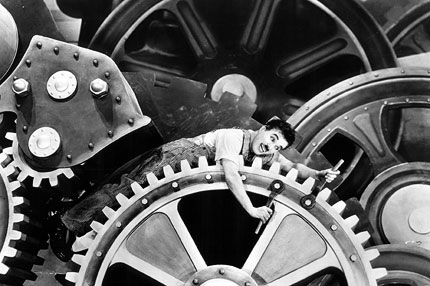
Charlie Chaplin’s comedy character, “The Little Tramp” — still said to be the most famous human figure in movie history — is a working man put-upon by a bottom-line-oriented, self-interested management. He works at an assembly-line on a mind and body-numbing job. He is the donkey upon whose back the higher-ups ride their way to great wealth. When they want more productivity, he is put in a machine that will reduce his lunch hour and force-feed him his food, until the machine goes awry.

It sounds grim, I know. But that scene is hilariously funny, because Chaplin’s object is to mock the rich men and women who believe that everything is fine so long as they remain on top of the world — the world of the 1930s Great Depression, in which 25% of the U.S. population is unemployed and 25% underemployed.

Soon Chaplin’s comic everyman character is driven over the edge and literally into the gears of a giant machine of which he becomes a moving part. It is one of the most famous and inventive scenes in movie history.

Although you might not notice it, a good part of the film has to do with food, getting it and eating it, an unfortunate daily preoccupation in a time of bread-lines; a society that lacked a social safety net. And there is a good deal of haughtiness displayed by the upper-class, who treat the unlucky with considerable disdain, as if they all deserve their sorry state. Sound familiar?

Chaplin’s co-star is his wife, the beautiful Paulette Goddard, who plays a young woman forced to steal to get a bite to eat for herself and her sisters. Her efforts to make her way through to a better time inspire the tramp’s own.

This movie gave the audience for Chaplin’s graceful pantomime a first opportunity to hear “The Little Tramp” speak, or actually, sing. The nonsense song he creates is a masterpiece of movement, facial animation, and shy humor.

Chaplin’s tramp appeals to us because of our identification with the good-natured underdog, his desire to help others no matter how downtrodden he is himself, and to share whatever he has. He often outsmarts those more powerful than he is, something nearly everyone wishes he could do. And, without words, he makes us laugh and conveys a human tenderness well beyond the capacity speech.

Chaplin wrote the music for this film, including the wonderful tune “Smile.” Despite the difficulty that the two stars have in finding jobs and a place to live, they strive to maintain an upbeat, can-do attitude toward their woes. In the end, though their future still is not clear, they have both their optimism and their relationship intact. A better day is surely ahead as Goddard and Chaplin, arm in arm, walk toward the horizon to the strains of  Chaplin’s famous tune. Modern Times is a  movie that treats grave social and economic problems, but somehow manages to make us smile.

Henry Fonda in “The Grapes of Wrath”

Another great film, but much darker in every sense, is The Grapes of Wrath, a 1940 movie directed by John Ford and starring Henry Fonda. It is based on the best-selling John Steinbeck novel of the same name. The political message is much like that of Modern Times, as are the parallels to today. The story recounts the journey to California of the Joad family following the loss of their “Dustbowl” home in drought-stricken Oklahoma. They find that the economic life of a migrant farm worker is no less desperate than the Depression-era poverty back home.

While the Joads receive help from kind souls along the way, they also encounter those who will take economic advantage of them. The family members inhabit a world where they are told that “A red (a communist) is any son-of-a-bitch that wants thirty cents an hour when we’re paying twenty-five.” Although most captains of industry might not use those words today, some of them can be every bit as ruthless in their attitude toward employee wages.  This movie ranks 23rd on the American Film Institute’s list of best American films.

A terrific book on the history of the 1930s “Dustbowl” is The Worst Hard Time by Timothy Egan. It describes the environmentally tragic decision to cultivate the grassland in large parts of America’s Great Plains, ultimately stripping the earth of its top soil and causing dust storms that were felt as far away as Chicago and New York City. Those conditions led families like the fictional Joads to look for work in California. Again, the much milder drought conditions of today recall events of our parents’ and grandparents’ and great grandparents’ lifetimes.

A particularly sobering 1932 quotation comes from Hugh Bennett: “Of all the countries in the world, we Americans have been the greatest destroyers of land of any race of people barbaric or civilized.” Bennett would eventually take over the federal government’s attempt to stabilize the blowing soil.

Finally, you can view a 25-minute late 1930s documentary film about the “Dustbowl” by Pare Lorentz called The Plow That Broke the Plains. The music is by an important American composer and music journalist, Virgil Thompson. Even better I expect, will be Ken Burns’s four hour, two part documentary, The Dust Bowl, which will premiere on PBS on November 18 and 19.

About Grieving, About Friendship… About My Friend Bob Calsyn

When you lose someone you care about, for a while you walk around in a daze. Of course, there is the sadness. But less often mentioned are the sense of disorientation and the random memories; the moments your eyes fill with tears and the fatigue you can’t seem to shake. For a while you are scattered and off-balance until, finally, the jumble of things settles down and life returns to “normal.”

I am writing this in the midst of the jumble. My friend Bob Calsyn died on Friday, September 21st. His wife Maria called from St. Louis with the news. I let a couple of my old friends know. They are Bob’s old friends too, from our days in grad school at Northwestern. And I heard independently from Dave Kenny, another NU alum. If Dave isn’t — I should say wasn’t — Bob’s best friend, then surely he was tied with the other contenders for first place.

I told Dave I was thinking of writing something about Bob and asked if he might offer some of his own thoughts. His remarks below are adapted from those he read at the memorial he attended in St. Louis on September 25th. (In each case that I quote him, his comments are set off from the rest of the text and begin with his name in BOLD CAPITAL LETTERS).

What I’d like to do here is to tell you why Bob mattered to all of us. But the truth is, I need to tell you. I need to get this out to honor Bob — to honor the loss suffered by Maria and Bob’s children and siblings and all those who were closest to Bob. And, not least, to help myself with the jumble I mentioned at the start.

What follows is a series of recollections of a wonderful man and great friend, much of it in Dave Kenny’s voice; along with some of my own memories, a little of my own philosophizing about the nature of friendship and loss, and some things just about me. Someday, you too will be in the midst of the jumble. Maybe it will help.

DAVE KENNY:

I knew Bob for 44 years. When we met at Northwestern we had a lot in common: both oldest child of a large family, both lapsed Catholics, both of us had mothers who wanted us to be priests, and both of us had a strong commitment to social justice. We very quickly became friends. What Bob accomplished in four years at Northwestern was truly remarkable: earning his Ph.D., serving two years as a Conscientious Objector to the Vietnam War, doing a one year clinical psychology internship, and becoming a father, much of the time commuting 14 miles from Hyde Park to Evanston. The later incredible academic success of his sons Dylan and Chris was foreshadowed by Bob’s.

Bob, unlike me, continued in his commitment to social justice throughout his entire lifetime. He was passionate about ending homelessness and he worked diligently in this effort. I never told Bob how grateful I was that he let me play a small role in his work.

For the record, Robert Joseph Calsyn was a product of Rock Island, Illinois and Alleman High School; the child of working class parents. He graduated from Loyola University in Chicago before attending grad school. Bob served as the Chairman of the Psychology Department at the University of Missouri, St. Louis, as well as being Director of its Gerontology Program.

There is something about schoolmates. At Northwestern, our group of graduate students was more than usually close. The Psychology Department was small, so we had lots of classes together, the way you do when you are 10 years old. We ate together, socialized together, went on double-dates; some of us roomed together. We passed through the same moment in history and the same stage in our lives in the same place. It was hard not to bond.

The men in the group played lots of softball and football and basketball against other Northwestern departmental conscripts. Bob usually played second base for our softball enterprise, which we called the Psyclones — a play on words since we were all studying to be psychologists. He played hard, but that particular game was tough for Bob, especially making accurate throws to first base. Still, Bob was an essential part of a pretty good team. Even if we’d have been slightly more perfect without him, we wouldn’t have had nearly as much fun or had the benefit of his “heart.”

In sports like touch-football Bob was fierce, taking particular pride in the devastating, bone-rattling blocks he delivered to opponents who couldn’t imagine them coming from a man who was no more than 5’8″ (173 cm) on a good day. Bob was no plaster saint. He knew the full range of four letter words and used them when necessary, as they tend to be in sports, especially in games played with the sweaty tenacity that Bob brought to them.

DAVE KENNY:

Our friendship endured and we saw each other in eight different states. Many of those visits were near water which Bob loved: the coast of Maine, Cape Cod, Long Island Sound, and of course, his beloved Anna Maria Island (where Bob and Maria had a vacation home). Bob was strange about water. He loved to watch and hear it, but he was not a fan of being in it. However, don’t forget that Bob grew up and spent most of his adult life near the Mississippi River. Maybe not going in the water made good sense.

I didn’t see Bob a lot after grad school. We’d visit occasionally, at first when I was teaching in New Jersey and he came to nearby New York City, later in Chicago, and a few times in St. Louis. Our relationship took the form of letters, then email and occasional phone calls. I got to read and critique some of his short stories; he helped with career issues for one of my children.

And yet, for me at least, a person like Bob lives inside of you in a continuous way even when there is no continuity in actual contact. He was always on an imaginary list of people who I thought of as my friends. Bob was someone who you were sure would be dependable, helpful, and unfailingly honest. He told you what he thought, not what he believed he “should” say or what he thought you wanted to hear.

We “knew” each other, could talk about anything. We knew where each of us was coming from — came from — in both a literal and figurative sense. He didn’t keep score. Bob was always there when you needed him, someone who was compassionate, gave sound advice, and was incredibly funny.

DAVE KENNY:

Bob had his own view of nutrition. He introduced me to Dairy Queen Blizzards. I remember him cooking donuts and beignets in his kitchen. We always had a 3PM cookie break when working together. For breakfast he would ignore his wife Maria — his Argentine bombshell — and sneak off to eat at Waffle House or Denny’s, not the healthy breakfast she suggested.

Bob and Maria (ca. 1994)

My friend retired from his faculty position in 2009. Not long after he was diagnosed with cancer. This made our contacts more frequent. Somehow Bob remained optimistic in spite of multiple tumor sites that never fully disappeared.

Bob continued to play tennis, the game he loved best, even though the treatment compromised his breathing. Singles were now out, so he played doubles. I didn’t see the down moments and I’m sure that there were more than a few. But his resilience, his ability to live life and to keep really “living it” and enjoying himself was astonishing. And he could still be there for me, as when I had a long conversation with him about retirement: whether to do it, when to do it, what it was like for him, and what it might be like for me. We had plans to see each other on the first weekend in October in St. Louis.

People find it difficult to talk with someone who is battling “Death,” a bigger than “Life” opponent with an undefeated record. It is, indeed, hard to know what to say. Mostly you listen, even if most of us think we must have some sort of magic words to deliver when, in fact, no such words exist. Bob made it as easy as possible.

The day after Bob died I heard John Adams’s musical composition, On the Transmigration of Souls, presented by the Milwaukee Symphony and Chorus. Bob liked classical music, so it seemed a nice coincidence; more than that, the composition is a commemoration of those lives lost in the terrorist attack on the World Trade Center on September 11, 2001. An interview with the composer on the New York Philharmonic website includes the following:

… I’d probably call the piece a ‘memory space.’ It’s a place where you can go and be alone with your thoughts and emotions. The link to a particular historical place — in this case 9/11 — is there if you want to contemplate it. But I hope that the piece will summon human experience that goes well beyond this particular event.

‘Transmigration’ means ‘the movement from one place to another’ or ‘the transition from one state of being to another.’ … And I don’t just mean the transition from living to dead, but also the change that takes place within the souls of those that stay behind, of those who suffer pain and loss and then themselves come away from an experience transformed.

I guess you hear what you want to, what you need to, what you can’t escape. Of course, I couldn’t help but think about Bob during the performance…

Bob managed to write a novel, all the while dealing with his illness. It is called Primal Man and you can buy it on Amazon. You won’t be disappointed. The story is a murder mystery that takes place in a university setting. This comes from a brief interview of Bob in the St. Louis Post-Dispatch on September 4, 2011:

Q: Had you written fiction before?

Bob: No. but I’ve always read mysteries.

Q: This primal man is apparently an exhibitionist?

Bob: Primal man exposes himself to female students and throws them an index card that says, ‘Men are hunters, women are gatherers. Gather yourself home.’

Q: How does psychology figure in?

Bob: It helps you explore character. I was an administrator for many years. I thought writing a mystery was a more socially acceptable outlet than strangling my colleagues.

Bob was a confident man, but not arrogant. For all the scholarly articles he produced and all his advocacy for homeless, mentally ill people, he told me one day at the St. Louis Zoo that he thought of himself as a “journeyman.” Indeed, he considered each one of us who got Northwestern psychology doctorates in 1972 in the same light, with one exception. Dave Kenny was and is that exception, an internationally known academic who has changed the way people think about social psychology research, its design, and its analysis. But, I don’t believe Bob meant to disparage any of us, and certainly not himself. He simply knew that there was a pretty big difference between being Bob Calsyn or Gerry Stein and being Beethoven.

Bob didn’t care about or aim to be a great man. He was too busy living his life, loving his wife, doing his work. He was too busy delighting in his kids and grandchildren, playing tennis, and having a beer (but not at the same time)! The irony, of course, is that the way that Bob lived was a kind of un-self-conscious, rough-hewn work of art, something to be admired and emulated. As Marc Anthony said over the body of Julius Caesar in the Shakespeare play, “When comes such another?”

DAVE KENNY:

In thinking over my friendship with Bob, it occurred to me that Bob and I never argued and Bob never got mad at me. We disagreed all the time, but our disagreements did not result in arguments. Bob regularly told me that I was wrong, but he never did so in a way that said, “I’m better than you” or “You are a bad person.” He sincerely wished, as I did, that I was a better person. Bob did have lots of reasons to be angry at me: missing deadlines, drinking too much, not staying in contact… Bob would get angry at Republicans, at demagogues, and perhaps even his colleagues. But he channeled his anger against his colleagues by writing short stories and killing them off there.

Bob always was one step ahead of me. He left a high-powered college to go to a more low-key institution. He got married and had children, ended his difficult marriage, and remarried; he had grandchildren and retired — all before me. Now Bob, you have done it again and you have died before me.

Upon reflection, Bob was more of an older brother to me than a friend. He was doing things before me and giving me advice on how to do them. My big brother Bob helped me cope with all of the major transitions in my life, especially my divorce. We know that Bob faced a terminal disease and death courageously and remarkably. Again I will be following Bob, and I hope I can muster 10% of his courage, but I hope that mustering does not happen too soon.

Dave Kenny

We cannot know what others are feeling except by analogy to our own emotions. Those of us who have lost a friend may think we are hurting and we are, but surely the intensity and nature of the feelings experienced by those closest to Bob can’t be known, at least not by me. Everyone’s grief is different, formed by the tapestry of experiences they had with the departed — all the memories and struggles, the laughter, the kindness, and the human imperfections that are inevitable on both sides of any relationship.

For those closest, their lives will now be marked with the idea of “before and after;” before and after Bob died and how much that difference made. To all those who were closest to Dr. Calsyn, and to those (like me) who were a step or two back, my condolences.

That said, from the outside and some distance, it looks to me like Bob had a wonderful life. Too short, for sure, but wonderful. Not without pain or disappointment or hard times, but full of compensating joy, success, and love. He gave life and the people in his life everything he had. He traveled, competed, and he knew when to rest and take a walk on the beach. Bob didn’t “phone it in.” He lived more in 66 years than most of us would do in twice that time. Like the ballplayer who tries to stretch a triple into a home run and is thrown out at the plate, he was a thing to behold.

On the subject of baseball, I’m reminded of an old story about Babe Ruth, the most famous baseball player ever. Actually, it is about the Babe’s funeral, which happened on a particularly hot day in New York City. It seems that two of his old teammates, Joe Dugan and Waite Hoyt, couldn’t help but comment on the weather, especially since they’d served as their friend’s pallbearers and the heat hadn’t made that easier:

Joe Dugan: I’d give a hundred dollars for a beer.

Waite Hoyt: So would the Babe.

Here’s to you, Bob. How lucky I was to know you.

——–

The top image is the Calsyn Family (ca. 2001). From left to right: Bob’s son Dylan and Dylan’s wife Beth and their daughter Zoe; Maria, Bob, Soledad Van Emden (Maria’s daughter and Bob’s stepdaughter), Bob’s son Chris, Margaret van Emden; and John van Emden, Soledad’s husband. Since this picture was taken, three more grandchildren have arrived: Abigail, Ella, and Max.

The photos are courtesy of Dave Kenny. My very special thanks to Dave for his contribution to this essay, especially given the enormous difficulty he had returning home to Connecticut from Bob’s memorial in St. Louis. Thanks, also, to Judy Goodman, Steve Hanan, Angela Shancer, and Diane Tyrell for their helpful and speedy comments about an earlier draft; and for their friendship.


What Do Patients Think About Their Therapist? What a Counselor Does About “Transference”

http://upload.wikimedia.org/wikipedia/commons/6/6e/Fussball_und_Freud.jpg

Patients wonder what their therapist is thinking. Therapists wonder what their patients are thinking. It is not much different from what happens between husbands and wives, parents and children, bosses and employees — or is it?

I’ve written about what doctors think about their patients before: What is Your Therapist Thinking? But today I’ll focus on what the patients are thinking about their counselor and how therapists are “supposed to” handle that. I say supposed to, because we don’t always do it well. It is one of the trickiest parts of a counselor’s job.

Patients have feelings and expectations about a counselor, in part, because he resembles someone else. This is called transference. In other words, the client’s sense of this new person is transferred from someone else who is important to him, simply because the new acquaintance resembles the old one. It happens automatically and without thinking; a kind of mistaken identity.

No, you don’t think your therapist has red hair if his hair isn’t actually red. But you do see him through the lens of your past experiences, and react to him because of certain real or imagined similarities to others. All of us do this in all sorts of relationships. It occurs whenever we have unconscious feelings and assumptions about someone who reminds us of someone else; which is a lot, even if we don’t know it. The feelings toward the old person (be it a parent, a sibling, a boss, or a lover) can become quite mixed up with the real human qualities of any new individual, including a new therapist.

Indeed, this is made easier by the fact that the therapist limits how much the patient knows about his personal life. In effect, the shrink is a kind of blank slate upon which the client “fills in the blanks” left empty by a lack of real information. Not surprisingly, all of us are prone to repeating old behavior patterns in new relationships; and, to the extent that a new person evokes old feelings about what the relationship is and what it can become, the transference can play out the patient’s repeated relationship difficulties right in the therapist’s office.

Take a hypothetical situation. Let’s say that your dad was a hard guy. He was critical of you, didn’t give you enough attention, and seemed to favor your siblings. Now, many years later, you meet your new therapist. Is he any of these things? To some extent it doesn’t matter. For example, the fact that your shrink only sees you once a week can reopen the tender wound of your neediness — your failure to win your father’s time and attention. You might feel that your doctor isn’t as available as you’d like him to be, in person or on the phone. You might interpret some of his statements as being disinterested, even when they are not so intended.

The counselor can be more important to you than he would otherwise be because of your unresolved, unconscious desire to get the affection and approval of this admired authority figure, who, like all authority figures, can easily remind you of dad. The hurt and/or anger that you feel when the shrink does not fill your need for a “good” father is almost inevitable. You might want to leave therapy because of it.

http://upload.wikimedia.org/wikipedia/commons/thumb/9/97/FIESA_7_Freud_276.jpg/256px-FIESA_7_Freud_276.jpg

What is a therapist supposed to do when this happens? If he reacts defensively to the patient’s demands or disappointments, he is unlikely to do him any good. In fact, the counselor who responds angrily can create one more injury of the same kind that was inflicted by the patient’s father, thereby adding to the client’s mistrust and misery. Even if the healer tries hard to give him what only a father can give, the patient will still not be satisfied. After all, the therapist cannot literally fulfill the childhood yearnings that come from anyone’s vanished youth. The hunger of a 10-year-old for good parenting can no more be satisfied when he is 30 than can a literal hunger for a good meal at age 10 by a delicious dinner 20 years later.

What the therapist can do is the following. First, he can be compassionate and understanding. He often anticipates that the patient’s old losses and resentments (his past disappointments concerning his dad) are likely to play out in the therapeutic relationship. When they do, the psychologist will try to gently assist the client to see that the feelings bubbling up are not fully appropriate, but come from the historical emotions attached to the father that have been superimposed onto the shrink. If the patient is open to exploring this, he will gradually be able to purge his internally complicated connection to his parent. This is a grieving process, a cathartic expression and understanding of the sadness and/or anger that continue to live inside of him, even if the parent is dead.
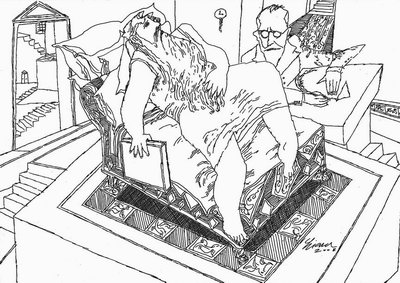
If all goes well in therapy, the therapist will eventually no longer evoke the transferential emotions; no longer remind the patient of the parent. And not only will his relationship with the therapist be less complicated, but so will all those other interactions with lovers, bosses, or friends which used to unconsciously trigger the same feelings. Finally, the old injuries will be healed sufficiently to be set aside, clearing the way to better social interactions in the future.

I am certainly not saying that all of the feelings that patients have about their doctors are mistaken. Therapists have the same potential flaws as everyone else. They can be good or bad, attentive or unreliable, too easily hurt or too distant. Some want your admiration and some don’t much care. They have feelings about the patient that grow out of their own relationship history. This is called a countertransference. Regardless, the potential for the transferential issues I’ve described is always there, just as the therapist’s countertransference toward the patient must be carefully watched to prevent the damage that it can do.

Do you find all of the above some sort of psychobabble that doesn’t apply to you? Trust me, transference is real. The more that you believe your relationships are “logical” and that your past doesn’t reach into your present, the more that it probably does, unless of course you have dealt adequately with it in some sort of therapeutic process, whether in treatment with a professional or in your own self-analysis.

http://upload.wikimedia.org/wikipedia/commons/5/5a/Moses_hos_Freud.jpg

Therapy and transference are much more complicated than I’ve described. What you’ve read is a simplification based on a hypothetical relationship between a father and his adult child who is in therapy. If you are not in therapy, even if your relationships are going quite well, it still may benefit you to take a look at patterns of connection you make with friends or lovers: the kind of people you are drawn to and the types of individuals who usually “push your buttons,” get you angry, or disappoint you in some way. We can all learn a lot by just connecting-the-dots of our life history, seeing the resemblances among the people who keep returning, even if their names are different the second or twenty-second time around.

It is easy to blame others when relationships fail. Relationships aren’t easy. But, the more unsatisfactory and repetitious your social life is, the more likely that something in you needs attention.

—

The top painting is called Therapy by Gerhard Gepp. Apparently, the patient (a soccer ball or football) is thinking about being kicked around. Might he have transferential feelings toward the therapist and feel badly treated by him, as well? The second image is a photograph of Sigmund Freud in Session with a Patient, from the Seventh International Sand Sculpture Festival in Portugal. The artist is RHaworth. Finally, a cartoon of Freud Treating Moses by Moa1. All are sourced from Wikimedia Commons.

Do You Have a Bad Attitude?

Life is difficult enough without making yourself miserable. Those who begin with a negative, “can’t do” point of view often justify themselves by saying that they don’t want to get their hopes up; that the world is unfair and one should be prepared for it. But in so doing they can create their own misery and bring down the mood of those who are close by.

I’ll discuss below a few variations on this theme — different forms of “bad attitude” along with some potential solutions:

1. Focusing on the past. While I am a firm believer in learning from the past, one must remember that it is yesterday’s news. Short of daydreaming about a happier time in your life or doing the essential work of grieving, it can fuel sadness without compensating benefits. The past holds too many unfulfilled hopes, failures, and broken romances. It is the storehouse of betrayals — about “what might have been.” It is the place where things that went wrong can fill your mind and heart with regret. It is a wasteland of missed opportunities, lost beauty, and a nostalgia that is no more satisfying than trying to fill your stomach with the photo of a past meal. Visit the past, but don’t live there.

2. Living in a frightening future. An exclusive focus on the future can be as deadly as a preoccupation with the past. The twin dangers of living in the future are worry/anxiety and make-believe daydreaming. Most who live in the future usually live a life of dread, overpredicting catastrophe and underestimating their ability to survive misfortune.

The only thing we have in life with any certainty is the present. Any chance of happiness depends upon one’s ability to find a way to live in the moment and find satisfaction there, experiencing it and whatever it brings, accepting life on its terms. Plan for the future but be careful not to live in that future any more than you live in the past.

The goal ahead might be very worthwhile, but try to enjoy the journey to get there. Mindfulness meditation, Stoic philosophy, the Zen tradition, and ACT (Acceptance and Commitment Therapy) can help reorient you to determining what is important in life; setting aside what is inessential, distracting, or worrisome; and living according to those principles in the present moment.

3. Pessimism or the self-fulfilling prophecy. Pessimism is a close cousin to worry and anxiety over events that may never happen. It smothers spontaneity, joy, and drains energy. It renders defeat in the game of life even before the game has begun. It anticipates a guilty verdict from the jury that causes one not even to show up for the trial. Pessimism destroys motivation and generates avoidance of challenges or half-hearted effort, at best. Depression and pessimism drink from the same poisoned well.

4. Throwing a wet blanket on the happiness of others. Don’t be a buzz-killer, a kill-joy, or a party pooper. Avoid raining on someone else’s parade. Don’t be an emotional suicide bomber, someone who brings down oneself and all those around you. A bad attitude can consist of always seeing the single dark cloud on a glorious sun-lit day, especially if the sun is shining on someone else. It is the “yes, but” response to the other’s good fortune, her excitement, and her dreams. It attempts to make others suffer as much as you are. This attitude masquerades as attempting to “be helpful” or “realistic” or trying to prevent the friend or child “from being hurt.” Perhaps. But it is a cautionary or negative/critical message at the wrong time, in the wrong place, to the wrong person.

5. Rejecting the encouragement or helpfulness of others. Most people want to ease your suffering, to offer you some encouragement or hope or solace. But if you have a bad attitude, you will reject all of this. You will say “I’ve thought of that already” when you are offered a suggestion or “I’ve already tried that” or “That won’t work because…” Instead, your bad attitude may isolate you from those who only wish to offer their presence and show their affection for you; their simple desire to hold your hand in a difficult moment. In the worst case you will drive such people away, thereby increasing your sense of separation from the world and guaranteeing a solitary misfortune.

6. Perfectionism or the belief that things can always be better. Some of us can’t accept a grade of 99% on the test, simply because we could have done better. Short of performing brain surgery, it is useful to be able to accept the imperfect nature of life and ourselves. Do your best, prepare for the race, study hard; but realize that perfection (if it is to be found at all) resides only in the works of Mozart, Rembrandt, Shakespeare, and a few others. If you punish yourself for falling short of that ideal, you have misunderstood the nature of life on earth and guaranteed that you will be joyless.

7. Whining and complaining. Worse than those who see only the dark side of life are those who not only see it, but won’t let you get away from them before they tell you about it in malcontented detail. They tend not to focus on abstractions. Rather, their concern is not the unfairness of life, but the unfairness of their life. There is no surer way of driving people away than to adopt this particular version of a bad attitude.

8. Fighting every battle. Some people seem perpetually aggrieved and angry. They live with a chip on each shoulder, daring life to knock the wood off. Life will knock it off, but not in the way that they expect. Their anger will breed anger in others. And in fighting perpetually, they will miss any sense of contentment or joy.

No one can take on all the battles worth joining, let alone those that will produce nothing of value. As an antidote to rage, gratitude for the things in life too easily taken for granted can be coupled with acceptance of the things that you can’t change. Ideally, these two abilities will usually counterbalance the frustrations and resentments of life without robbing you of the capacity to fight the good fight when necessary. Telling the difference between those skirmishes that need you and those you should pass is crucial. If you are too angry too often, seek counseling.

9. Refusing to take life seriously. If you’ve been paying attention, there is a relatively new popular expression among teens and a few others. It is called YOLO or “you only live once.” It justifies mindless foolishness; not just ill-considered behavior, but action that is not considered at all. It can be an excuse for doing whatever you want or refusing to do whatever someone else might advise. YOLO suggests that you are not living in the future, not living in the past, and not living in any really mindful present. If you were, the thought of driving 60 miles an hour down a side street in a school zone would never be translated into actually doing it. We seem to make enough mistakes in life without adopting a philosophy of life that virtually guarantees it.

10. Too much realism. While it helps to see the world as it is, there is the risk of it being too much of a good thing. The world as it is today (or most any day) includes poverty, genocide, and betrayal; infirmity, disease, and heartbreak; stress, cruelty, and the big one: death. Everyone you know will die and that also includes you. Focus on all of this just enough to make the most of your precious and too short life. Focus on it just a little more and you will be so depressed that you won’t want to get out of bed.

—

If you have any of the bad attitudes I’ve described, your first response will usually be to justify it; perhaps even to see it as a strength. But I would ask you if you are satisfied with your life as it is? If not, then you may need to investigate that same attitude, especially those aspects that actually could be making the problem worse. Ask friends and family what they see in you that needs to change — if they have enough courage and love of you to tell you the truth (and you have the guts to take it). Looking in the mirror — seeing yourself as others see you — is brutally hard, but can be a first step to enlightenment and a better life.

Read Czikszentmihalyi about “flow” and those wonderous moments when one is so involved in a productive/creative action that one loses all sense of time and self. Read Daniel Gilbert’s Stumbling on Happiness, Martin Seligman, Daniel Kahneman (Thinking Fast and Slow) and other “positive” (hedonic) psychologists about what makes for happiness and how to get there.

It can be helpful to make a list of those things for which you are grateful. Indeed, it may be of assistance to look back at the day to find what it can teach you or what was good (even on a bad day). Yes, I know that plenty that is bad does happen and has happened and will happen. But we humans must not live in these moments of misery for too long without grieving our losses and moving on, learning to accept the nature of life, and learning that the very best times are unreflecting, unself-conscious, utterly spontaneous experiences that we don’t think about, we simply are living them.

In part, our job is to pull our head out of its backward look, out of its forward glance, and play the game that is exactly where we are — right here, right now. That ultimately means more action, more experiment, more risk and less thought — swimming in the pool of life without regard to getting wet. It matters not if you start in the shallow end of the pool because most of us do — just don’t stay there.

Rear Admiral Grace Murray Harper knew more than a little about the water and about the voyage. She put the idea of living your life with a good (rather than a bad) attitude very well:

A ship in port is safe; but that is not what ships are built for. Sail out to sea and do new things.

—

The top image is Emotions X by Franz Xaver Messerschmidt (1736-1783) downloaded by access. The second is Messerschmidt’s The Constipated, dowloaded by Sailko. Both are sourced from Wikimedia Commons.