When Something Goes Wrong: Projection and Rationalization

512px-dust_bowl_oklahoma

Something goes wrong. That’s where it begins. Life turns, often in small ways, not as hoped for or expected.

As a child, you lose a game you hoped to win. The paper you handed in to your teacher received a poor grade. And then–oh no–you bombed a test.

Blame the game winner and say that he cheated? Tell yourself the instructor was a hard grader? Go home and curse the other guy under your breath? Claim the election was stolen?

There is some value to this. It makes you feel better and think better of yourself. If you tell your friends and your parents, perhaps they buy into your victimization.

Of course, sometimes life is unfair.

However, adults who cannot accept responsibility are not uncommon. They blame the other fellow, project their own flaws on him, and point to the man’s color or customs.

Those who encourage such feelings can stir another’s sense of unfairness to a boil:

At last someone understands me. He knows the problem is not mine; it’s those other guys.”

Great literature sometimes allows us to learn more about such defense mechanisms and transports us into the lives of others, while informing us about our own.

Take The Grapes of Wrath by John Steinbeck. Tom Joad, the story’s hero, reframes cowardice into practicality, moves from fight to flight, and converts hesitation into wisdom; all with the help of a man who has already rationalized his own diminished life.

We rationalize because we must — to live comfortably with our motives and our choices.

We all do it sometimes, and some do it all the time.

Steinbeck’s novel is set in the Dust Bowl era of 1930s Oklahoma. Newly available machines enabled rapid, widespread plowing and cultivation of the native grass: an act of misguided surgery.

The grass was essential to bind the earth to the land. When drought came, not only were conditions insufferable, but crops died for lack of moisture. The earth became unmoored and blew away.

In some areas this “worst hard time” persisted for eight years.

Dust storms blackened the sky. The fine dark particles invaded farmhouses, killed animals, and impaired breathing. Visibility could be reduced to a few feet on a given day. The dust-occluded air produced occasional darkness as far away as New York City.

Tom Joad was a young man just released on parole after four years in McAlester prison. He killed a neighbor who attacked him in a bar fight. Tom and two acquaintances are on the land that once belonged to his family.

The Joads were evicted in a bank foreclosure. The men notice a police car coming to investigate.

Muley, one of Tom’s acquaintances, is an older man who experienced the merciless attitude of the bankers, their agents, and law enforcement officers as they evicted most everyone in the area while Tom was in prison.

The bankers and the police rationalize as well.

He and Tom talk about the vehicle heading in their direction:

TOM: We ain’t doin’ no harm. We’ll jus’ set here. We ain’t doin, nothin’.

MULEY: We’re doin’ somepin jus’ bein’ here. We’re tresspassin’. We can’t stay. They been tryin’ to catch me for two months. Now you look. If that’s a car comin’ we go out in the cotton an’ lay down.

TOM: What’s come over you, Muley. You was’nt never no run-an’-hide fella. You was mean.

Muley agrees with Tom that he is not the same man he was. Changing conditions changed him. He knows Tom’s nature is to fight, especially on the land where Tom grew up. Muley also reminds Tom of his parole. Any “trouble” and he will be sent back to prison.

TOM: You’re talkin’ sense. Ever’ word you say is sense. But, Jesus, I hate to get pushed around! I lots rather take a sock at Willy.

MULEY: He got a gun. … He’ll use it cause he’s a deputy. Then he either got to kill you or you got to get his gun away an’ kill him. Come on Tommy. You can easy tell yourself you’re foolin’ them lyin’ out (in the cotton) like that. An’ it all just amounts to what you tell yourself.

Landscape

Indeed. Tom follows Muley’s advice to hide from the police rather than confront anyone.

As with other (mostly unconscious) life strategies, the way we explain our behavior to ourselves can help or harm. Some of us automatically rationalize so many choices we lose touch with who we are and how we hurt ourselves and our fellow man.

Others reflexively come to unnecessary and unflattering conclusions about their deeds. They blame themselves and interpret events in a self-deprecating fashion.

In effect, each of us has our own internal “make-up” artist. It is the part of us who tries to put a “good face” on the reasons we do what we do, the better to look at ourselves in a friendly mirror: one not too revealing of uncomfortable defects.

Think of a situation in which you fail to achieve your goal. Many explanations are available:

  • I’m a loser. (Here you’ve taken a single disappointment and indicted your entire being and character).
  • It was his fault. He was unfair. (In this example, right or not, someone else is blamed).
  • This is a temporary setback.
  • Perhaps I need to approach situations like this differently. (Possible adaptation and learning come into play with this explanation).
  • I did the best I could. (Defeat is acknowledged, but there is also a self-comforting understanding of the event).
  • “Every knock is a boost.” (This was one of my dad’s expressions. He reinterpreted his defeats as exercises in strengthening his character.)

Many other examples might be offered. Cognitive-behavioral therapists help patients reframe their beliefs and assumptions about themselves and the world. They hope to free clients from self-damaging “self-talk.” CBT counselors encourage a reality-based yet adaptive approach to thinking about and explaining our behavior to ourselves.

You and I are left with the question that Muley raised in his conversation with Tom: what do we tell ourselves?

Something to think about.

—

The top photo is titled Dust Bowl, Oklahoma. It shows a “father and sons walking in the face of a Dust Bowl storm in Cimarron County, OK,” April 1936. The picture was taken by Arthur Rothstein. The second image is Dust Storm Near Beaver, Oklahoma; July, 14, 1935. Both are sourced from Wikimedia Commons. If the Dust Bowl is of interest, you might want to watch The Grapes of Wrath, the 1940 movie adaptation of the Steinbeck novel. Henry Fonda stars as Tom Joad. The film is widely considered one of the 100 greatest American films. The Worst Hard Time: The Untold Story of Those Who Survived the Great American Dust Bowl is a terrific oral history of the period written by Timothy Egan. Finally, don’t miss Ken Burns’s documentary, The Dust Bowl.

Why Therapists Leave

256px-goodbye_grenada_goodbye_karibik_-_panoramio

Any beginning predicts an ending. Permanent relationships can become impermanent with time’s passage. That knowledge unsettles those in long-term treatment. Abandoned before, they wonder not “if,” but “When?”

Why do therapists leave?

An example: the man and woman had been married for six years. In mid-life, however, he was afflicted with a rapid and permanent hearing loss. In the midst of the crisis, his mother-in-law was diagnosed with cancer. She lived 1000 miles away. What was the wife to do? She chose to spend the last six weeks of her mother’s life with mom. She’d have done the same thing if she’d been your therapist.

Granted the departure was temporary, but such disruptions happen and are sometimes more lasting. A lovely psychologist of my acquaintance, a being so calming as to make quiet moments with her almost holy, fought illness off and on for years. Her resilience seemed infinite. In her ninth decade she banged against infinity’s wall and retired abruptly, having met physical problems even she could not shake off.

The choice is usually not so harrowing. My own retirement was the consequence of the increasing depletion I felt from doing my work. The weight of the problems of others pressed heavily, even though my clients were less troubled as a group than they’d been earlier in my career. Then too, books called out to be read, courses of study beckoned, and new wonders of the world awaited.

Therapists are notorious for burning out, though not all do. Unfamiliar places trigger our wanderlust. Everyone seems to believe California or some warm spot would be nicer, at least if you live in the Midwest. Grandchildren need attention while they are small. You cannot place their youth in a safe deposit box for later use any more than you can your own.

Life intervenes in unexpected ways. I do not mean to minimize the pain when a therapist departs before a patient expects the end of the relationship. I helped clients grieve such losses when they came to me afterwards. I also caused unhappiness myself by deciding to leave practice. Unexpected finishes, however, cannot be allowed to finish us off.

When I was about to embark on the capstone or giant-killer to a graduate education, the dissertation, my advisor disappeared, vanished. I found out he was going through a messy divorce. Fair enough, but to another state? Without telling me? I adjusted. I lined up a new dissertation committee chairman and was ready to proceed when my initial advisor returned, as unexpectedly as he departed. Granted, he was not my therapist, but still …

Therapists also, on occasion, change as people. Funny, one wants a transformative counselor, not a transforming one. The patient expects to be the only person to make substantial self-alterations, setting aside any desire for a reduction in boundaries allowing more intimacy with the doctor.

A young therapist/colleague became a carpenter in his ’30s. I met a lawyer with a towering income who opted out of his partnership to opt into a seminary. Charles Krauthammer, a syndicated conservative columnist, was a psychiatrist. Granted, not many established counselors change careers, but an occasional dropout happens.

long_boy_goodbye_ma_goodbye_pa_goodbye_mule_with_yer_old_hee-haw

Close to the end of my career I’d hear the question from a patient, “Do you expect to retire soon.” I think I answered, “I have no plans.” Until, of course, I eventually did and then announced my future unprompted.

We (and by “we” I mean you and me) have no crystal ball, no bewitched mirror on the wall. We don’t expect to divorce when we marry, don’t enter careers anticipating they will end soon, don’t fall into friendship with a vision of its erosion or collapse. I can only tell you — only tell myself — the things I know for sure. And sometimes what we think we know we don’t know. Fate’s hand spins the top of our lives in directions never imagined and, when the spinning stops, a new idea forms and informs us.

Therapists leave and it’s not personal, except it is. When you don’t think you are “enough,” a therapist’s departure (at least not one caused by a lightening-strike) says “You’re not enough to cause my staying at the job.” I get it and I also get the absence of an intention to harm.

So yes, your therapist might leave you, but your departure is more probable. The latter is best, for sure, if you’ve gotten what you came for. The good news is we have encouraging career-longevity data on doctoral level psychologists. The American Psychological Association’s Center for Workshop Studies reports that among those already “retired” in 2013, 42% were still working. The median age of retirement was 61, meaning half retired before 61 and half after. The sample included all doctoral level psychologists in the year of the study, not only clinical or counseling psychologists in practice.

Therapists, like most of the rest of us, are living longer and need to make a living. They have multiple incentives to continue. The satisfaction of meaningful work, the intimate contact with good people, and the words of thanks are enriching. The work is interesting and research offers us new tools. It’s an exciting time to be in the field, in the lab, and in the office.

We cannot guarantee our lives, any of us. The retirement or side-lining of a therapist probably won’t happen while you are in treatment. The answer to the “What will I do if it does?” question is that you will do what is required. In the meantime, avoid living the infinite variety of doom-laden scenarios available to imagination: a “thought-error” called catastrophization which can be treated with cognitive-behavior therapy (CBT).

Good advice comes from John Steinbeck’s The Grapes of Wrath and his character “Ma” Joad, the rock of a migrant family almost out of chances. She is the lady responsible for their emotional and physical sustenance, including cooking the salt-pork packed for the clan’s trip to an uncertain life in California. Her 16-year-old son Al asks:

Ain’t you thinkin’ what it’s gonna be like when we get there? Ain’t you scared it won’t be nice like we thought?

No. No I ain’t. You can’t do that. I can’t do that. It’s too much — livin’ too many lives. Up ahead they’s a thousan’ lives we might live, but when it comes, it’ll ony’ be one. If I go ahead on all of ’em it’s too much. … An’ (what I concentrate on is) jus’ how soon (the family) gonna wanta eat some more pork bones. That’s all I can do. I can’t do no more. All the rest’d get upset if I done any more’n that. They all depen’ on me jus’ thinkin’ about that.

—

The top photo is entitled Goodbye Grenada, Goodbye Karabik by giggle. The cover art for the sheet music for Long Boy (I imagine this means “So Long, Boy”) was drawn by Gar Williams. Both images are sourced from Wikimedia Commons.

“Modern Times” and “The Grapes of Wrath:” Films For the 99%

Their issues are simple. Equity. Fairness. Adequate food and decent shelter. A job with a living wage. Who am I talking about? I could be describing “The 99%,” the folks in the “Occupy” movement who have protested against the monied class of late. But movies that embody all of their concerns were created over 70 years ago. The first of the three I will discuss, Modern Times, ranks 78th on the American Film Institute’s list of the best American films ever made. And most of it is silent.

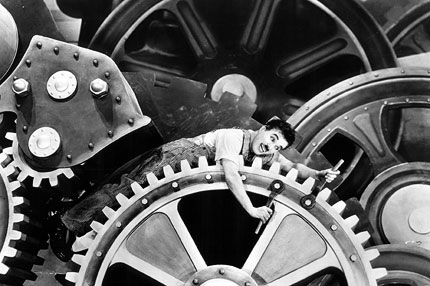
Charlie Chaplin’s comedy character, “The Little Tramp” — still said to be the most famous human figure in movie history — is a working man put-upon by a bottom-line-oriented, self-interested management. He works at an assembly-line on a mind and body-numbing job. He is the donkey upon whose back the higher-ups ride their way to great wealth. When they want more productivity, he is put in a machine that will reduce his lunch hour and force-feed him his food, until the machine goes awry.

It sounds grim, I know. But that scene is hilariously funny, because Chaplin’s object is to mock the rich men and women who believe that everything is fine so long as they remain on top of the world — the world of the 1930s Great Depression, in which 25% of the U.S. population is unemployed and 25% underemployed.

Soon Chaplin’s comic everyman character is driven over the edge and literally into the gears of a giant machine of which he becomes a moving part. It is one of the most famous and inventive scenes in movie history.

Although you might not notice it, a good part of the film has to do with food, getting it and eating it, an unfortunate daily preoccupation in a time of bread-lines; a society that lacked a social safety net. And there is a good deal of haughtiness displayed by the upper-class, who treat the unlucky with considerable disdain, as if they all deserve their sorry state. Sound familiar?

Chaplin’s co-star is his wife, the beautiful Paulette Goddard, who plays a young woman forced to steal to get a bite to eat for herself and her sisters. Her efforts to make her way through to a better time inspire the tramp’s own.

This movie gave the audience for Chaplin’s graceful pantomime a first opportunity to hear “The Little Tramp” speak, or actually, sing. The nonsense song he creates is a masterpiece of movement, facial animation, and shy humor.

Chaplin’s tramp appeals to us because of our identification with the good-natured underdog, his desire to help others no matter how downtrodden he is himself, and to share whatever he has. He often outsmarts those more powerful than he is, something nearly everyone wishes he could do. And, without words, he makes us laugh and conveys a human tenderness well beyond the capacity speech.

Chaplin wrote the music for this film, including the wonderful tune “Smile.” Despite the difficulty that the two stars have in finding jobs and a place to live, they strive to maintain an upbeat, can-do attitude toward their woes. In the end, though their future still is not clear, they have both their optimism and their relationship intact. A better day is surely ahead as Goddard and Chaplin, arm in arm, walk toward the horizon to the strains of  Chaplin’s famous tune. Modern Times is a  movie that treats grave social and economic problems, but somehow manages to make us smile.

Henry Fonda in “The Grapes of Wrath”

Another great film, but much darker in every sense, is The Grapes of Wrath, a 1940 movie directed by John Ford and starring Henry Fonda. It is based on the best-selling John Steinbeck novel of the same name. The political message is much like that of Modern Times, as are the parallels to today. The story recounts the journey to California of the Joad family following the loss of their “Dustbowl” home in drought-stricken Oklahoma. They find that the economic life of a migrant farm worker is no less desperate than the Depression-era poverty back home.

While the Joads receive help from kind souls along the way, they also encounter those who will take economic advantage of them. The family members inhabit a world where they are told that “A red (a communist) is any son-of-a-bitch that wants thirty cents an hour when we’re paying twenty-five.” Although most captains of industry might not use those words today, some of them can be every bit as ruthless in their attitude toward employee wages.  This movie ranks 23rd on the American Film Institute’s list of best American films.

A terrific book on the history of the 1930s “Dustbowl” is The Worst Hard Time by Timothy Egan. It describes the environmentally tragic decision to cultivate the grassland in large parts of America’s Great Plains, ultimately stripping the earth of its top soil and causing dust storms that were felt as far away as Chicago and New York City. Those conditions led families like the fictional Joads to look for work in California. Again, the much milder drought conditions of today recall events of our parents’ and grandparents’ and great grandparents’ lifetimes.

A particularly sobering 1932 quotation comes from Hugh Bennett: “Of all the countries in the world, we Americans have been the greatest destroyers of land of any race of people barbaric or civilized.” Bennett would eventually take over the federal government’s attempt to stabilize the blowing soil.

Finally, you can view a 25-minute late 1930s documentary film about the “Dustbowl” by Pare Lorentz called The Plow That Broke the Plains. The music is by an important American composer and music journalist, Virgil Thompson. Even better I expect, will be Ken Burns’s four hour, two part documentary, The Dust Bowl, which will premiere on PBS on November 18 and 19.