How to Grieve, How to Live

grieving-parents-side-view

You might think that grieving is not an uplifting topic. But there are ways in which that is precisely what it is.

We start with the pain of loss, specifically a loss of something of value. If you lose a penny, you won’t much care. But if the loss is of something of great importance to you, you will care greatly. The pain of loss points to the value of the thing that you have lost; and the value you place on a thing points, at least potentially, to the pain to which you are vulnerable.

What are the things we value? A job, a relationship, friends and family, a promotion; our physical-self, which can be defaced or damaged… many things: money, status, a good name, a pet, and power, too. Take your pick. You decide what is important and whatever is inside the basket in which you put your emotional pain or your vulnerability to such pain — that item has value.

Grieving involves opening yourself to the pain. Now, you might think, “It must be only a recent loss that causes the hurt.” But the heart has no clock attached to it, no timer reading off the digits of distance between you and the loss; so, if you had a difficult childhood, you might still be holding the pain inside even though it is decades old.

Not only must you open yourself to the pain, but you must do it with a witness, a listener, someone who cares and who is present, who is “there for you.” This is necessary to reattach you to human contact — to life, to intimacy — rather than closing off and pulling away from people. And in this sharing — this openness, this talk and tears and gnashing of teeth — the pain eventually subsides. It’s a little bit like kneading dough — you continue to work it until it changes. The story of your feelings will be repeated by you, if necessary, dozens of times in different ways, until the emotions are changed and the excruciating intensity of the loss passes.

How long does this process take? Six months to a year would not be unusual, although it can be longer. The first anniversary of the loss is often especially hard; so are birthdays and holidays in the first year and sometimes beyond. But if you do not do the grieving “work,” the process can be extended and a sense of melancholy or a lack of vitality can follow you relentlessly.

To grieve doesn’t mean you will forget what you have lost. And, indeed, if it is a loved one, certainly you will never forget and you will never be untouched by the memory. There is a dignity in this. We honor the loved ones who are lost in this way and perhaps they live, metaphorically speaking, inside of us. As the Danes say, “to live in the hearts that you leave behind is not to die.”

But “how” to do this grieving — that is the problem. If you have lived your life trying to be tough, you will find that the toughness might prevent you from doing the emotional work that will allow the grief to end. If you maintain that “toughness,” you might find yourself living as if you are numb, or displaying a sunny disposition totally at odds with what is felt deep inside, in the place where you have buried your hurt. And if you have deadened yourself enough, you will have a hard time “living,” since you will be closed-off to feelings. Joy, abandon, and spontaneity will be harder to achieve. Instead, the time ahead of you would be better called “existence” than “life.”

But perhaps you are afraid that if you allow all the pain to come out, you will be overwhelmed to the point of being unable to function. And, indeed, this can happen, at least temporarily. Or perhaps you are afraid of what others might think of you if they see you without your typical emotional control, and you are afraid of their negative judgments.

And so, grieving involves having the emotions without the emotions having you; accepting them and not struggling with them; metaphorically speaking, it is like driving a car with the radio on, but not so loudly that you are overcome by it. In other words, you will have the emotions but still be able to drive — still be able to lead your life.

To do this you must open the pain in a place that is safe and in a way that it is neither deadened or perpetually out-of-control. You must hold the hurt not too tightly and not too loosely, but gently, since it is precious; not walling the emotions off or letting them carry you away from active life for days at a time. Part of this is simply allowing yourself to be human, to honor the injury, not judging or trying to change what you feel (the change will happen by itself if you allow it), but permitting yourself to do what our mammal relatives do — to lick your wounds (metaphorically speaking) and accept the support of others, whether they are friends, lovers, relatives, or therapists.

And, in the end, if you have grieved and have the courage, good luck, and time to continue the human project that we all have been given, you are likely to heal enough to venture forth into the world, again putting yourself into the things and people you hold dear, risking injury once more, not hiding from the dangers that life brings, but also experiencing what is good in life — all the things you still value.

You will be alive again, and the grieving process will have led you there.

The above image is The Grieving Parents, Kathe Kollwitz’s 1932 memorial to her son Peter, who died in World War I.

Are You Too Emotional?

http://upload.wikimedia.org/wikipedia/commons/thumb/7/7d/Frenchmanweeps1940.jpg/512px-Frenchmanweeps1940.jpg

You’ve heard it before — “You are too emotional!” Surely you heard it as a child, at least once. But, what does it mean? How do you know if it is true? What is the proper place of emotions in any life? And, if you are “too emotional,” what should you do about it?

First let us establish some ground rules. Emotion is necessary. Imagine a life without it. No  love, no families based on that love, no compassion, no empathy, no righteous anger. What would be left? A life of relating to others as objects, like chairs or tables, their only value in utility — the function that they perform; only reason would be left — cold computation of what to do and how to do it. No laughter, no tears, no gratitude, no passion.

If you agree with what I’ve just said, then it is clear that emotion has a place. It binds us to others, plays a part in letting us know when we have been injured, allows for the possibility of good relationships and a joy in living. It also creates an energy that is necessary for self-defense and for the pursuit of causes. Emotion motivates us and permits the creation of communities.

But, when you are called “too emotional,” the accuser usually isn’t referring to love or happiness or even anger. No, usually he means that you are too easily hurt. And, when you are young, especially if you are male, you are encouraged to “be a man” and live by the “athlete’s creed;” if you are hurt, in other words, rub some dirt on the injury and get back into the game. Don’t complain; that is for whiners and wimps and little kids.

Well, if you are an athlete, that is what you have to do. Think too much about the injury and you won’t be able  to perform. Moreover, if you even think too much about your past failure in the game, you won’t have the confidence and focus to be able to succeed in the remainder of the contest. So, under those circumstances, being “emotional” does, indeed, get in the way. Similarly, emotion interferes with necessary behavior in war-time or in other crises that require focus, indifference to pain, and steadfast action.

But how about situations that are less demanding and fraught with danger or competition?

For me at least, emotion has become, for the most part, a friend. I can be moved by the sadness of my patients and those in my life who I love. I do not consider it a weakness. It is simply a part of being the responsive, sensitive person I aspire to be. And I can be moved by music or drama, again to the point of a tear. Life seems richer, warmer, more eventful and worthwhile that way. I don’t feel the need to keep up a brave front, an appearance of having tamed my emotions.

No, I’m not often whipsawed by my feelings, but, in part, that is because I give them their place in things and don’t keep them all bottled-up, looking for a way to burst out of the container that I would otherwise have put them in. And, when it is required, I am prepared to seek solace from a few of those closest to me, just as I give solace to my patients and those I love.

True, being emotionally vulnerable means that you can be injured. But, don’t fool yourself, life will have its way with you whether you are deadened to feelings or not. By killing your emotions, you are probably only succeeding in limiting the fullness of your life while attempting to create an illusion of strength.

Put another way, it is only human to have emotions and best if you are comfortable with that fact almost all the time.

But, beware when the emotions have you!

At the extreme is a condition called Borderline Personality Disorder (BPD).

The Diagnostic and Statistical Manual of Mental Disorders, Fourth Edition, states that “the essential feature of BPD is a pervasive pattern of instability of interpersonal relationships, self-image, and affects (emotions), and marked impulsivity that begins by early adulthood and is present in a variety of contexts.” These folks are, unfortunately prone to “frantic efforts to avoid real or imagined abandonment,” instability, recklessness, suicidal behavior, rapid and intense mood changes, emptiness, and anger. They are the flesh-and-blood definition of what it means to be “too emotional.” And, not surprisingly, they are difficult to treat, although Dialectical Behavior Therapy is a treatment specifically designed to do so, and has demonstrated great promise with this patient group.

For those who are not categorized with this diagnostic label, how do you know if you are too emotional? Here are a few questions you might ask yourself:

1. Do people, not only family members, often tell you that you are too emotional?

2. In an over-heated moment do you tend to make impulsive decisions that you later regret?

3. Do you have many arguments and blow up easily?

4. Do friends and relatives have to handle you with kid gloves?

5. Do your emotions suck the life out of you, change easily and quickly, and generally whip you around?

6. Do you weep easily and often in the absence of major set-backs or great losses (I’m not talking about having a tear come to your eye here, but something more gut-wrenching)?

7. If you are in mid-life, are you no less emotional than you were in your teens? (Most of us become less volatile, more in-balance, over time).

If you’ve answered too many of these in the affirmative, you may want to seek counseling.

A last word or two. Life is challenging. We need to permit ourselves feelings and we need to express them, within limits, and to have a sympathetic soul there to bear witness and listen to us. Balance is the key most of the time. It may help to remember a portion of the “serenity prayer:”

God grant me the serenity

to accept things I cannot change;

courage to change the things I can;

and wisdom to know the difference.

If you do not “know the difference,” often enough and go to emotional extremes over the routine ups and downs of life, if even the small things seem too big, then it might be time to seek professional help. Not to kill your feelings, but to make sure that they don’t destroy your ability to have a good life.

You may find the following post of related interest: Vampires and Buried Feelings: The Therapy of Getting Over Your Hurt.

The above scene, Frenchman Weeps 1940, was used in the 1943 US Army propaganda film Divide and Conquer (Why We Fight #3) directed by Frank Capra. The photo shows “French people staring and waving at remaining troops of the French Army leaving metropolitan France at Toulon Harbour, 1940, to reach the French colonies in Africa where they will be organized as Free French Forces fighting on the Allied side, while France is taken over by the Nazis and the Petain regime collaborating with them.”

Wikimedia Source: Records of the Office of War Information, NARA. *Date: June 14, 1940 *L.

Surely, under the circumstances, this man’s emotions were quite appropriate.

Letting Go of Your Children

One of the hardest things a parent has to do for his child’s well-being is “letting go.” The attachment between a parent and child, at its best, is profoundly intense and rewarding to both parties. But, at some point, earlier than most parents think, the tie must be loosened. There are at least two reasons for this.

The first involves the danger of overprotection. While the world is a harsh place at times, children who are not seriously disabled need to begin to obtain some mastery of that world. They will not do so if the parent hovers too closely, watches every move, makes every decision, and doesn’t permit the child to get a sense of accomplishment and independence, that is, to get a sense of their own mastery of the world.

Secondly, if the child is ultimately to break-free, the parent must prepare him and encourage him. Kids will make bad decisions; they will get hurt by life. All that is a part of growing up and, in fact, a part of life as an adult, too. If they are to succeed in life, attach to others outside the family (mate), produce children, and develop a personality that is different from that of either parent, they will profit from the permission and encouragement to do so.

There is no perfect guidebook for how to disengage–how to, little-by-little, give your child more freedom, less oversight. It is easier, of course, if the young one is reasonably outgoing, a good student, and doesn’t get into much trouble with authorities. But even with kids who are having difficulty, micro-management can create resentment and rebellion, while constant criticism can be depressing and efface the child’s shaky self-esteem. A parent needs to know which children need a heavy hand, which a light touch, when to praise, when to correct, and when to punish. No one can provide  precise direction to this in the abstract, because each child is different and each parent is different. That said, here are a few pitfalls to watch out for:

1. Don’t try to raise each of your children the same way. While this should be obvious, it rarely is. Some parents even brag: “I treated all my kids the same.” This is preposterous, but, even if you came close, you probably shouldn’t have. All children aren’t the same and therefore require the kind of individually tailored attention that works for them. Why would it make sense to raise an active child in the same way as a passive one, or an outgoing offspring just like an introspective little person? One size doesn’t fit all.

2. Don’t “own” your child’s life. He isn’t you. He needs to have his own ideas, not some Xeroxed version of what you think he should be. He ultimately needs to “own” his direction in life, meaning that the desire to do well in school and in other things needs to be his. If he only does his school work because he is required to, even when he is in high school, somehow the transfer of responsibility from you to him hasn’t been made. You’ve got about 15 years to accomplish that hand-off; after that, demands from parents to “do better” usually generate diminishing returns.

3. Don’t set unreasonable expectations. Most middle-class folks see their children, at least a little, as a reflection of themselves; someone to carry the family banner into the future. But, you can make yourself a little crazy by wanting great fortune and fame for your kids, and letting them know you will settle for nothing less. Harvard isn’t for everyone and there is no guarantee of a good life that comes with admission to Princeton, Northwestern, Yale, etc. If your child can make a living, find love in his life, behave honorably, and experience some measure of fulfillment, that just might be quite enough.

4. Don’t make your child feel guilty over leading his own life, not providing you with grandchildren, and not being as close to you as he was when he was little. He needs to break-free and take care of himself. He should (and probably will) want to have you in his life, but don’t be an anchor around his ankle.

5. Don’t live and die with every success and failure on your son or daughter’s path. Easier said than done, by the way. Learn to accept things as they are. Get some distance. Meditate. Get a life of your own. As a famous basketball coach once said, “If every game is a matter of life and death, you’re going to have a problem. You are going to die a lot.”

6. As your kids move into adulthood, don’t preach and do be careful about giving advice, especially if it hasn’t been requested. Let your children know that you are proud of them. Not because they became captains of industry, but because they are good, decent, and loving people. Give your grown kids support and encouragement. Enjoy them, don’t manage them.

7. Remember that they aren’t you, they won’t always do what you would do, what you think wise, believe what you believe to be true. They might belong to a different political party, root for a different baseball team (God forbid!), change religion or give up religion. They might marry someone you don’t completely fit with. Remind yourself that what is important is your child’s happiness and fulfillment and decency.

8. Take good care of yourself. Find a meaning in life that is not 100% about your adult children. Try to get there gradually, not on his or her 21st birthday.

If you are lucky, your children will turn out well, and be grateful for all you did, and for your wisdom in not “doing it all” for them forever. It’s quite an adventure for the concerned parent, and you will never stop being concerned. As Sir Francis Bacon wrote, “He that hath wife and children, hath given hostages to fortune…” But, with practice, you will sleep at night even on many of the nights that your adult child is having some bumps in the road.

When you look at her, fast asleep in her crib, all of that seems impossible and impossibly far away. But it can happen.

I’ve been there.

What Happens in Psychotherapy?

What does psychotherapy do and how does it do that? Good questions, and even some therapists might have a hard time answering them. Of course, some of the goals are obvious: reduce depression, have better relationships, eliminate anxiety, enjoy your life more, and stop worrying. But what are the elements that get you there? I’ll give you a sense of some of the factors that permit those goals to be achieved.

1. Trust. Many people entering treatment have trust issues: they trust too easily or not at all, usually the latter. Trust will start with the relationship between you and the therapist. Simple things: does he listen? Does he understand? Does he seem interested and dedicated? Is he dependable? Does he care? If the answers to these questions are “yes,” then it will be a bit easier to begin to trust others. The experience of a benign relationship with one person can open you to the possibility that this experience can be achieved elsewhere in your life.

2. Validation. Many people coming into psychotherapy having been told that they should “get over it,” that they “shouldn’t feel that way,” that they shouldn’t complain or “whine;” or having been ignored, dismissed, or criticized too often when trying to express themselves. Some folks believe feelings are unimportant; others might state that it is not “masculine” to feel too much, and so forth. As a result, many new patients have so buried their feelings that they are alienated from themselves and don’t know whether it is appropriate to think or feel as they do. A good therapist creates a safe place for talking about such things (trust again), and gives the person a sense that there is value in what they feel and think. Over time, this action, by itself, can help improve self esteem and reduce sadness and alienation.

3. Grieving. If one has not had supportive relationships (with people who are both trustworthy and validating), the sense of loss or absence contributes to sadness, and sometimes to depression. The relationship with the therapist allows you to express the emotions related to loss (both sadness and anger) to someone who listens patiently and shows concern. As you process those feelings of loss, your sadness should gradually diminish. The therapist serves as a witness and again, as someone who validates your pain. Grieving in isolation too often contributes to the feeling of disconnection and alienation from the world. Grieving with someone who cares reconnects you to one of the things that can be good in life: human contact.

4. Learning new things. Any good therapist needs to provide some guidance and tools that enable change. This might come in the form of helping you learn and practice new social skills (including acting these skills out with the therapist), assisting you in changing how you think (cognitive restructuring) that helps you reduce self-defeating thoughts, training in how to be assertive (again with role playing in the therapy session), or meditation.

5. A change in perspective. A good therapist will provide you with new ways of thinking about the world and about your life. Since he can see you from the outside, he is more likely to see you in a way that you cannot see yourself.

6. Facing things, not avoiding things. We all practice avoidance some of the time, and some of the time it is a useful thing. Unfortunately, many of us practice it all too much. We distract ourselves from pain and avoid challenging situations. We can use food, TV, shopping, sex, drugs, alcohol, the internet, and computer games to get us away from whatever it is we can’t handle. We worry about problems rather than coming up with a plan of action and taking them on. We don’t ask out the pretty girl for fear of rejection, or say “no” to people who want to befriend us for the same reason. We stay at a “dead-end” job because of our insecurities. And, of course, unhappiness is the result.

A therapist can assist you in identifying the patterns of avoidance, help you to gradually become able to tolerate anxiety (by use of such things as cognitive restructuring, role playing or meditation) and give you tasks that gradually increase in difficulty so that you reduce avoidance and begin to take action that works.

7. Acceptance. By acceptance I am referring to acceptance of the nature of life and the discomfort that comes with living; acceptance of the fact that being open to life allows you to experience satisfaction and joy, but also opens you to pain; and awareness of the temporary nature of most of that discomfort. The more that you take life on its terms, the less you will be trapped by it.

Remember playing with the Chinese Finger Puzzle as a kid, the cylindrical woven structure made of bamboo, open at both ends? You put your two index fingers into it, but when you pulled hard to get your fingers out, you became more stuck. Only by releasing the tension and moving your fingers toward the center of the device, did it collapse and no longer held you tight. Life is a lot like that to the extent that we must stop engaging in behaviors that only make us more “stuck.”Acceptance allows you to free yourself, at least somewhat, from what is distressing about life.

8. Valued Action. If you are caught in the struggle with your emotions, or focused on avoidance of pain, what is good in life will be hard to achieve. Therapy can help you to think about the life you would like to lead, the life that is consistent with your values, and help to relieve you of the habits that keep you so wound-up that you don’t have time to think about what it is you would really like to do, and what it is that would lead you to a sense of satisfaction and accomplishment. What is your true self? Therapy can help you find out and encourage that person to exist in the world.

The description I’ve given you is based, in part, on my experience in life and training, especially training in such therapeutic approaches as cognitive behavior therapy (CBT), mindfulness-based behavior therapy, Acceptance and Commitment Therapy (ACT), and psychodynamic psychotherapy. Other therapists may have a different view of what is important and how to help you get to the point that your life is more satisfying and less fraught with depression, anxiety, or chronic relationship problems. But here, at least, I hope that I have given you some sense of direction and some reason to be hopeful about the possibility of change in your life.

Father’s Day

Father’s Day can be complicated.

Like any day of honor, some tributes are deserved more than others, or not at all.

Some obligations are carried out with joy, while others are a matter of dutiful routine.

And sometimes there is pain, where once there was (or should have been) pleasure.

But, for myself, Father’s Day is pretty simple.

While I miss my dad (who died 11 years ago), the sense of loss is no longer great. He was 88 when he stroked-out in July 2000, soon to be followed by my mother in February 2001, and our family dog in November 2001: a tough 16 months.

The experience taught me what Hamlet’s uncle Claudius knew when he said to his wife (Hamlet’s mother), “O Gertrude, Gertrude, when sorrows come, they come not single spies, but in battalions.”

“When will dad be OK again?” my children asked my own wife. It took a little while, but eventually time and the loving support of family and friends did the job of healing.

But being healed isn’t the same as being indifferent and, as I said earlier, I still miss my father.

If you saw the movie “Peggy Sue Got Married” with Kathleen Turner and Nicholas Cage, think back to the scene of her time-travel from middle age to age 16; specifically, to the moment when she talked to her deceased grandmother on the phone, now suddenly back to life.

I’d give a lot to have a moment like that with my dad.


My father was a good story-teller. One of his favorites was about his time as a star Chicago Cubs pitcher.

He wasn’t, of course.

Somehow, all the records of his “career” in the major leagues had been “lost,” or so he told us. He also informed me and my brothers that he’d been able to pitch nearly every day, and was so reliable and dependable that his teammates called him “Rain or Shine” Milt Stein (able to pitch, “rain or shine”). We all came to value this funny tale and, in fact, had my wife and I had a male child, the boy’s middle name would have been “Rainer,” as in “rain or shine,” in honor of the newborn’s grandfather.

Another story he told frequently was based in fact rather than imagination.

Twenty year old Milt Stein had a tough time in 1932, the depth of the Great Depression. He could find little steady work, though he had enough to eat thanks to living with his parents. Finally, he landed a full-time job at the opening of the 1933 Chicago World’s Fair. His boss told him that he could work every day if he wished (although he didn’t have to), but work and money were so dear that he did — 170 consecutive days from May 27th into November.

http://upload.wikimedia.org/wikipedia/commons/thumb/a/ab/Chicago_world%27s_fair%2C_a_century_of_progress%2C_expo_poster%2C_1933.jpg/240px-Chicago_world%27s_fair%2C_a_century_of_progress%2C_expo_poster%2C_1933.jpg

It was a few years after my dad died when I first realized that these two stories were actually different ways of telling the same morality tale: my dad was “Rain or Shine” Milt Stein, reliable and hard-working, both on the imaginary playing field of his “major league” career and at the World’s Fair performing a real job.

I don’t even know if my father was aware of the connection between these stories.

Dad was an intelligent, but uncomplicated man. If he had lived in a more prosperous time he’d certainly have graduated college. But, as things turned out he worked as a postal supervisor, raised three boys, and was married to the same woman for almost 60 years.

When I was very little, my father played a game of make-believe with me. In those days before everyone had some sort of recording device, he used our floor model vacuum cleaner extension as a pretend microphone for a radio show he fashioned out of his imagination. We would take turns speaking into the nozzle as he interviewed me.

I guess my career in interviewing people goes pretty far back.

http://upload.wikimedia.org/wikipedia/commons/thumb/2/2f/Blue_vacuum_cleaner.svg/200px-Blue_vacuum_cleaner.svg.png

I owe my love of baseball, a sense of fair play, and a strong work ethic to my father; and the fact that years later, each night at bedtime, I would reach into my own imagination as he did with me during our “radio show,” to tell my young daughters a story; a different one nearly every night, especially with my first-born.

Dad was not a perfect man or a perfect father. His three sons all saw too little of him because of his dedication to work and the shadow of the Great Depression on his view of matters financial. He deferred to my mother too much for our well-being.

But it is Father’s Day, not the day to get into his shortcomings.

In 1985 Milton Stein’s youngest brother, my Uncle Harry, died suddenly. I’d not been very close to my uncle, so that loss didn’t much affect me except for the fact that it made my dad’s mortality palpable to me: if Harry, my father’s youngest brother could die, then surely my father would, possibly soon. The family history of heart disease had killed Harry, and my dad had narrowly escaped alive from his own heart attack at age 47, over 25 years before.

In the wake of Harry’s death, I asked my “old man” (now genuinely old) if he’d be open to doing a videotaped history of his life, with me as the interviewer — the “radio show” with the roles reversed. He complied readily.

I still have the four hours of video that my father and I created together. Much of it is filled with the detail of his life, but at a few points my normally controlled dad let down his guard.

Most moving of all was his recollection of returning to the USA from WWII service in Europe. He hadn’t seen my mom for about two years. He called her as soon as he was situated on American soil.

As I’ve detailed elsewhere (Love Letters), the catch in Milton Stein’s voice and the tears in his eyes as he recalled hearing the woman he ached for — the love of his life — would have been unforgettable even without the video evidence.

I’m sure that you can tell I have a soft spot for my dad.

And, lucky me, I have two wonderful daughters who will make me feel like the most important person in the world on Father’s Day.

But, I’m even luckier than that.

They make me feel like it is Father’s Day every day.

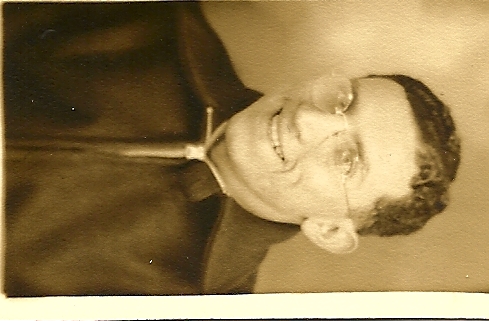
The photos above are all of my father, with the obvious exception of the vacuum cleaner, made available from the Open Clip Art Library; and the poster from the 1933 Chicago World’s Fair, created by Weimer Pursell, silkscreen print by Neely Printing Co., Chicago; both sourced from Wikimedia Commons.

The first picture of my dad is probably from some time in the early to mid-1930s. The second photo looks as though he was a teenager when it was taken.

The night time snap-shot probably took my dad by surprise while he was on a date, before he met his wife-to-be (my mother). It was likely shot by a street photographer, who would have handed my father a numbered envelope that identified the negative. Dad would have had to mail the envelope to the company with payment in order to get developed copies of the picture.

I recall seeing such photographers in downtown Chicago at least as late as the 1960s. Now, of course, just about everyone carries his own camera/phone.

The final image is of the young Stein family in late 1959: my mom and dad and, left to right, Jack, myself, and Eddie.

Coming to Terms with What Cannot be Changed

http://upload.wikimedia.org/wikipedia/commons/d/dd/Hand_drawn_ghost.png

A beautiful, but not always wise friend once told me a story of infinite wisdom. She married a widower with children when she was in her mid-30s. The kids had fond memories of their departed mother, so the house was filled with art objects, furniture and photographic reminders of the deceased.

Additionally, the widower maintained relationships with many people who knew his late wife. The maternal grandparents, of course, wanted to spend time with their daughter’s children. The husband’s parents did as well, and lived close by. Everyone held the departed in high esteem and affection. She had been an extraordinary person, now achieving a kind of virtual sainthood due to her early death.

When my friend (who I hadn’t seen in years) told me all this, I asked what it was like to reside among the living reminders of her predecessor; in the midst of the physical mementos of her husband’s previous wife.

It’s like living with a ghost.

How do you do that?” I replied.

First, you make friends with the ghost.

the-ghost-of-vermeer-van-delft-jpgpinterestlarge

Indeed, what else was possible? How could the almost palpable presence of this woman be denied? To ignore or discourage discussion of her or suppress her memory — put away the photos and other objects — would be a disservice to the children and risk their alienation.

Surely, the only way forward was to “make friends” with someone she never met, a ghost guaranteed to defeat her if my friend chose to create a competition.

Special days like Mother’s Day remained difficult. On such occasions she suffered the reminder of never giving birth to a child, but also that she was not the “real” mother to her husband’s offspring. Still, the best solution required honoring this woman’s memory; and the part of her living in her offspring and in their father’s memory.

Sometimes life offers limited choices. Those situations must be accepted even if one wouldn’t have chosen them freely. My friend decided to recognize the woman who came before her: see her in the good qualities the children displayed — their beauty, their kindness, and their intellect — just as she came to think of her husband’s first wife as having encouraged a loving side of him she now enjoyed as his second wife.

As I said, in all of this my “not always wise” friend was very wise indeed.

The top image is a Hand Drawn Ghost by Milonicia, sourced from Wikimedia Commons. The second painting is The Ghost of Vermeer van Delft by Salvador Dali. It came from WikiArt.org.