How to Grieve, How to Live

grieving-parents-side-view

You might think that grieving is not an uplifting topic. But there are ways in which that is precisely what it is.

We start with the pain of loss, specifically a loss of something of value. If you lose a penny, you won’t much care. But if the loss is of something of great importance to you, you will care greatly. The pain of loss points to the value of the thing that you have lost; and the value you place on a thing points, at least potentially, to the pain to which you are vulnerable.

What are the things we value? A job, a relationship, friends and family, a promotion; our physical-self, which can be defaced or damaged… many things: money, status, a good name, a pet, and power, too. Take your pick. You decide what is important and whatever is inside the basket in which you put your emotional pain or your vulnerability to such pain — that item has value.

Grieving involves opening yourself to the pain. Now, you might think, “It must be only a recent loss that causes the hurt.” But the heart has no clock attached to it, no timer reading off the digits of distance between you and the loss; so, if you had a difficult childhood, you might still be holding the pain inside even though it is decades old.

Not only must you open yourself to the pain, but you must do it with a witness, a listener, someone who cares and who is present, who is “there for you.” This is necessary to reattach you to human contact — to life, to intimacy — rather than closing off and pulling away from people. And in this sharing — this openness, this talk and tears and gnashing of teeth — the pain eventually subsides. It’s a little bit like kneading dough — you continue to work it until it changes. The story of your feelings will be repeated by you, if necessary, dozens of times in different ways, until the emotions are changed and the excruciating intensity of the loss passes.

How long does this process take? Six months to a year would not be unusual, although it can be longer. The first anniversary of the loss is often especially hard; so are birthdays and holidays in the first year and sometimes beyond. But if you do not do the grieving “work,” the process can be extended and a sense of melancholy or a lack of vitality can follow you relentlessly.

To grieve doesn’t mean you will forget what you have lost. And, indeed, if it is a loved one, certainly you will never forget and you will never be untouched by the memory. There is a dignity in this. We honor the loved ones who are lost in this way and perhaps they live, metaphorically speaking, inside of us. As the Danes say, “to live in the hearts that you leave behind is not to die.”

But “how” to do this grieving — that is the problem. If you have lived your life trying to be tough, you will find that the toughness might prevent you from doing the emotional work that will allow the grief to end. If you maintain that “toughness,” you might find yourself living as if you are numb, or displaying a sunny disposition totally at odds with what is felt deep inside, in the place where you have buried your hurt. And if you have deadened yourself enough, you will have a hard time “living,” since you will be closed-off to feelings. Joy, abandon, and spontaneity will be harder to achieve. Instead, the time ahead of you would be better called “existence” than “life.”

But perhaps you are afraid that if you allow all the pain to come out, you will be overwhelmed to the point of being unable to function. And, indeed, this can happen, at least temporarily. Or perhaps you are afraid of what others might think of you if they see you without your typical emotional control, and you are afraid of their negative judgments.

And so, grieving involves having the emotions without the emotions having you; accepting them and not struggling with them; metaphorically speaking, it is like driving a car with the radio on, but not so loudly that you are overcome by it. In other words, you will have the emotions but still be able to drive — still be able to lead your life.

To do this you must open the pain in a place that is safe and in a way that it is neither deadened or perpetually out-of-control. You must hold the hurt not too tightly and not too loosely, but gently, since it is precious; not walling the emotions off or letting them carry you away from active life for days at a time. Part of this is simply allowing yourself to be human, to honor the injury, not judging or trying to change what you feel (the change will happen by itself if you allow it), but permitting yourself to do what our mammal relatives do — to lick your wounds (metaphorically speaking) and accept the support of others, whether they are friends, lovers, relatives, or therapists.

And, in the end, if you have grieved and have the courage, good luck, and time to continue the human project that we all have been given, you are likely to heal enough to venture forth into the world, again putting yourself into the things and people you hold dear, risking injury once more, not hiding from the dangers that life brings, but also experiencing what is good in life — all the things you still value.

You will be alive again, and the grieving process will have led you there.

The above image is The Grieving Parents, Kathe Kollwitz’s 1932 memorial to her son Peter, who died in World War I.

What To Expect From Your Partner When Your Baby Arrives

Sometimes the idea of a baby is a little different from the reality of a baby. Ask a parent. But the reality doesn’t comprise only the feeding and care of the little one. It also involves changes in the relationship to the spouse–the person who contributed half of the genes that make up your tiny new person.

Mostly I’m talking about a first child here, since the newness of the event and a number of other parts of it are things for which one cannot  prepare.

Let’s start with the sheer exhaustion you will feel. Babies are demanding creatures and will disrupt your sleep and test your stamina. Whatever schedule you had now must be altered to fit your child’s needs. How will you and your partner divide the new responsibilities?

Everything must now be planned out, so if you were a spontaneous, in-the-moment sort of person before, you will be thrown off your game. Do you want to go to the movies? Who will watch the baby? Are you breast-feeding? Will you leave some milk behind while you are out? Do you feel good about the person who is watching the infant? Is he/she conscientious and responsible?

The job of going out with the baby is not less demanding. Packing all his/her stuff, bundling him up, carrying or pushing him around, and trying to concentrate on driving or shopping or friends or your spouse at the same time.

Then there is the question of your parents and your in-laws. Do they want to be very involved with your new-born? How will you and your spouse feel if they are around more often? Will they be supportive or critical of you as new parents?

Of course, in order to go out, you must have a few dollars in your pocket. Most new parents have only a few–the mother (yes, its still usually the mother) has, at least temporarily taken time off from work. And now there is baby furniture and clothing and food to buy and baby sitters to pay for. Fewer dollars tends to mean more tension in the marriage and more decisions to be made about how to use those dollars.

New parents also face an increased sense of responsibility. After all, you have a little one who is entirely dependent upon you for everything–his life, safety, financial well-being, his clothes, food, and not least, his emotional health. Are you doing it right? Are you harming him/her? These concerns are enough to make nearly anyone insecure.

And, with the demands and responsibilities of this new life, you will necessarily have less time for each other and less time for yourself and your friends. Not surprisingly, especially among insecure men, jealousy can come into play. In an unexpected turn of events, the adoring sex-bomb he married just might have eyes for someone else–his own child! And, the needs of that kiddie will tend to come first. Moreover, if you have parents staying with you, your sexual spontaneity can be further diminished by their proximity. Later, you might also hear the phrase, “Not now–wait until the baby is asleep,” or later still “Not now, the kids might hear.” And one or both of you might occasionally find yourself thinking, to your surprise, that a nap sounds a lot better than sex.

In the time following the birth, the wife often feels less attractive, especially if her weight doesn’t come down to her pre-pregnancy number and the bags under her eyes reflect the sleeplessness of her new duties. Will the husband be understanding about this?

Heard enough? I haven’t even mentioned the differences in child-rearing styles that you will likely discover when your baby gets older.

Now that I’ve made the case against springing for a new off-spring, I will say something else: it can be one of the most wonderful times of your life. A time when you and your spouse pull together, find out new things about each other and about life, and glow with the love that only a child can evoke from you. If you are not dazzled by this new life, a life that you and your partner created out of nothing, a life that is different from any other one that exists now or ever existed, then you are missing one of the most wonderful experiences possible; it is a kind of falling in love, just as overwhelming as the romantic kind, but different.

Sure its a challenge, but what worthwhile tasks are not? It can be intense, delightful, joyous, worrying, demanding, and frustrating all at once.

But if you do it close to right and have a little luck, you will look back on your time on the planet knowing that it was the most important and rewarding thing you ever experienced.

Hope For the New Year: Old Words After a Tough Twelve Months

Its been a tough year, but not the first in human history. These old words from the great nineteenth-century Scottish writer Robert Louis Stevenson seem just right:

“Give us grace and strength to forbear and to persevere. Give us courage and gaiety and the quiet mind. Spare us to our friends and soften us to our enemies. Give us strength to encounter that which is to come, that we may be brave in peril, constant in tribulation, temperate in wrath and in all changes of fortune, and down to the gates of death loyal and loving to one another.”

When the Lover is Ready the Soul Mate Will Appear

Mel Nudelman and Sally

I’ve read or heard two different meanings attributed to the Buddhist saying, “When the student is ready the master will appear.” The first suggests the universe is ordered in such a way that things happen when they are supposed to:  knowledge will be offered by events in the universe (or God) at the right time. If I am allowed to amplify the meaning slightly, the saying would also refer to the idea that when you are ready, the right person for you might also appear, not just a teacher, but your future love.

I prefer, however, another, more psychological way of thinking about this aphorism: there are always available “masters” or other persons who might be important in your life, but the “student” doesn’t notice the presence of those persons until he is ready. Or, to look at a different aspect of this notion, important knowledge is always or almost always available to us, if only we are open to it, prepared by experience or mind-set to receive it.

In other words, we must be ready to learn, to think and feel differently than we have before in order to recognize there is something important to be learned.

Those in life who have all the answers — certain of everything — will never learn anything new. Those afraid to do new things are unlikely to learn, since in order for the “master to appear” one must have one’s eyes open and actually get out of the house — the master being unlikely to call you to make an appointment, unsolicited.

But if you are humble about what you know, humble in the knowledge there is always more to learn, you might just learn something. Branch Rickey, the baseball executive, said “luck is the residue of design.” I’d add to that, so is learning the residue of design. And part of the “design” or preparation is to put yourself into situations where it is possible to be enlightened, whether by people or events or your actions; by books or theater, music or child-rearing or romance.

A good therapist is enlightened by his patients. He experiences a whole world, the world of the patient, seen through the patient’s eyes. His patients also inform him, directly or by their response to him and to the therapy, what works and what doesn’t.

People in less formal relationships than therapist and client teach us too, and enrich our lives. For example, some people believe there is only one person who represents our romantic destiny. When the person comes along they might say, by the first definition I gave you at the top of this essay, the universe or God put this person in our lives at just the right time. There is a Yiddish word that captures this notion nicely: “bashert” or “beshert.” In other words, to be “fated.” It is used when someone tries to say an event was “meant to be,” and is often employed with respect to a reference in the Jewish Talmud that God has chosen your soul mate.

My own opinion, however, is that most of us might have met, fallen in love with, and married any number of good people and had equally good lives as we have with the person whom we did marry; different, certainly, but just as good, more or less. That we didn’t marry someone else might have been due to a lack of maturity when the “other” person appeared, poor judgment about the value of the qualities in a person, or fear of rejection and heartbreak, to name just a few possible reasons.

If you protect your heart against the poisonous arrows that can harm it, you also might prevent Cupid’s arrow from reaching it.

One must be open, then, for the right person, for the master, for whatever knowledge or experience might enrich us. Vincent Van Gogh wrote the following to his brother Theo in 1880:

Many a man has a bonfire in his heart and nobody comes to warm himself at it. The passers-by notice only a little smoke from the chimney, and go their way… I am drawn more and more to the conclusion that to love much is the best means of approaching God. Love a friend, anyone, or anything you like, and I tell you, you will be on the right road to learn more. You must love with a high and intense determination, with your will and your intellect, and seek always to deepen, expand, and improve your knowledge. …”

Which makes me think of my late friend, Mel Nudelman. Mel was an old friend in both senses of the phrase — I’d known him since the ’70s and at age 87 he lost his wife of 50 years and was devastated. But, to his credit he fought through and grieved his broken heart to the point of making a new girlfriend! (A lovely woman, by the way). And so, Mel lived as he always did, learning, taking classes, counseling others, being with his children and grandchildren, making friends young and old; ever curious about politics, music, sports, medicine, and the world. All this until near the end of his days in his 90s.

Put differently, Mel was open to life and whatever it would reveal to him.

My advice then, to you and to myself, is to keep learning and keep being open to “possibility,” including the possibility there are things yet unseen, unexpected, or unacknowledged to enlighten us if only we keep our eyes open and look.

We are all students of the greatest teacher of all: life.

The photo above shows Mel and Sally Nudelman.

Unloading Your Therapist: Breaking Up is Hard to Do

Ending a relationship is difficult. Most of us have been on the receiving end of a relationship “break up” of some kind. We know that it doesn’t feel good. Indeed, we know that it can be taken as a rejection (and often that is exactly what it is). Nonetheless, that doesn’t stop some of the same people who decry the insensitivity of those who unceremoniously “dumped them” from doing the very same thing, in the very same way, when they wish to be free of seeing someone else ever again.

With that in mind, here are a few guidelines for thought and action, and some examples of what people do, when and if it comes time to end a relationship with a therapist. Today, I won’t be talking about the sense of loss or sadness that sometimes accompanies therapy’s end. I’ll leave that weighty topic to another time.

1. The “I’ll call you” strategy. Usually, this is delivered by phone message. The patient probably has an appointment with the therapist and cancels it, adding that he will call to reschedule. Experienced therapists know that many people will attempt to end the therapeutic relationship in this way. It avoids a face-to-face conversation which the patient might imagine as uncomfortable, and it avoids actually giving any reason for terminating therapy. It leaves the therapist a bit in the dark, not knowing whether the predicted call will ever come, and probably not knowing what the reason is for the decision to end treatment.

2. The “end of session” termination. Patients often wait until the end of the therapy session to say something of importance, in part because it is uncomfortable or they don’t want to discuss it in any detail, at least not yet. This method of termination has the advantage of being done face-to-face; what it doesn’t do is to allow the two parties to process the reasons for that decision and discuss any concerns. Without some time to talk, the therapist cannot be helpful to the soon-to-be-departed patient, or find out much about the client’s reasons for his decision. Without knowing what those reasons are, its hard for the therapist to learn from any mistakes he might have made, anything he did (or didn’t do) that made the patient uncomfortable, etc.

3. The “no-show” departure. Some individuals who are receiving counseling decide to end therapy by simply being absent from their next scheduled appointment. This is rude, of course, and also risks that the therapist will charge you for the time even though you didn’t come to his office (most therapists expect 24-48 hours notice of cancellation in order to relieve you of the obligation of payment).

4. The “nasty phone call” ending. While this is a rare event, sometimes people want to hurt the therapist because they believe that they have been hurt or neglected by him. They leave an angry phone message and avoid any chance for the therapist to find out why they are hurting, just as they make it impossible to come to a more amicable resolution of the issues at hand.

5. The “I need a break” message. It is, indeed, sometimes appropriate for patients to take a break from treatment. It can get too intense for some, who realize that taking a breather might be helpful. On other occasions, the complications of life outside of the counselor’s office make continued therapy difficult for the moment. However, when giving the message that you “need a break” is simply a way of leaving therapy, with no intention of return, it doesn’t allow for any closure to the relationship, or any of the benefits that such closure provides (which are described below).

6. The “best” way. Whether you have been seeing the therapist for a long time or a short one, the issue of termination is an important one. It is appropriate for you, even from the start of treatment, to ask how long it is expected to last. If you are finding counseling unsettling or unproductive at any point, it is best if you discuss your concerns with the therapist as they happen. Since many people who enter therapy have a hard time with being assertive and direct, it might well be tempting not to talk much about anything that you believe the therapist doesn’t want to hear, and simply to end the relationship unilaterally. Unfortunately, you and the therapist are short-changed if you do this.

Ideally, your concerns should be expressed early in a session, when there is sufficient time to talk about them. Be prepared for your therapist to ask you why you are thinking of ending treatment. You might be surprised that the therapist agrees with you. Alternatively, you might be persuaded if he makes a good case to continue for a while. But if you are certain that it is time to end things, be sure to hold your ground. A good counselor should accept this without trying to make you feel bad about your decision.

Once an understanding is reached about ending treatment, that doesn’t necessarily mean that it must end at precisely that moment. You and the therapist might decide to taper-off sessions or to have at least one additional session to sum up the history of your work together and to say “goodbye.”

There are several reasons for having just such a final session. First, it should allow the two of you to review what you have accomplished, how your life has changed, and what you have learned. Equally, if nothing or little of value has occurred, it can give you the chance to inform the therapist where treatment went wrong. Therapists should be grateful for this information since it allows them to learn, adapt, and improve so that they can help those patients who will follow you into their offices. And, a last session gives the therapist time to point out treatment alternatives or refer you to other available therapists who you might wish to consult.

Finally, a good therapist who has known you for a bit of time usually has some very nice things to say about you, about your courage, wit, grace, intelligence, and the guts it took to look your problems in the face and try to change your life. The last session also gives you a chance to say “thank you,” if that is something that you believe appropriate. The counselor will usually let you know that he would be grateful to hear from you again, just to know how you are doing. And, the door is almost always open if a return to therapy is required.

So, therapy, even when it wasn’t as helpful as you had hoped, can and should end with an expression of respect and good wishes for your future well-being. You will usually feel good about being direct in doing what you believe is in your interest, and having the self-confidence and respect to tell it to the therapist face-to-face. Your therapist will be grateful too, in almost all cases.

No losers here. Only winners.

Are You Too Emotional?

http://upload.wikimedia.org/wikipedia/commons/thumb/7/7d/Frenchmanweeps1940.jpg/512px-Frenchmanweeps1940.jpg

You’ve heard it before — “You are too emotional!” Surely you heard it as a child, at least once. But, what does it mean? How do you know if it is true? What is the proper place of emotions in any life? And, if you are “too emotional,” what should you do about it?

First let us establish some ground rules. Emotion is necessary. Imagine a life without it. No  love, no families based on that love, no compassion, no empathy, no righteous anger. What would be left? A life of relating to others as objects, like chairs or tables, their only value in utility — the function that they perform; only reason would be left — cold computation of what to do and how to do it. No laughter, no tears, no gratitude, no passion.

If you agree with what I’ve just said, then it is clear that emotion has a place. It binds us to others, plays a part in letting us know when we have been injured, allows for the possibility of good relationships and a joy in living. It also creates an energy that is necessary for self-defense and for the pursuit of causes. Emotion motivates us and permits the creation of communities.

But, when you are called “too emotional,” the accuser usually isn’t referring to love or happiness or even anger. No, usually he means that you are too easily hurt. And, when you are young, especially if you are male, you are encouraged to “be a man” and live by the “athlete’s creed;” if you are hurt, in other words, rub some dirt on the injury and get back into the game. Don’t complain; that is for whiners and wimps and little kids.

Well, if you are an athlete, that is what you have to do. Think too much about the injury and you won’t be able  to perform. Moreover, if you even think too much about your past failure in the game, you won’t have the confidence and focus to be able to succeed in the remainder of the contest. So, under those circumstances, being “emotional” does, indeed, get in the way. Similarly, emotion interferes with necessary behavior in war-time or in other crises that require focus, indifference to pain, and steadfast action.

But how about situations that are less demanding and fraught with danger or competition?

For me at least, emotion has become, for the most part, a friend. I can be moved by the sadness of my patients and those in my life who I love. I do not consider it a weakness. It is simply a part of being the responsive, sensitive person I aspire to be. And I can be moved by music or drama, again to the point of a tear. Life seems richer, warmer, more eventful and worthwhile that way. I don’t feel the need to keep up a brave front, an appearance of having tamed my emotions.

No, I’m not often whipsawed by my feelings, but, in part, that is because I give them their place in things and don’t keep them all bottled-up, looking for a way to burst out of the container that I would otherwise have put them in. And, when it is required, I am prepared to seek solace from a few of those closest to me, just as I give solace to my patients and those I love.

True, being emotionally vulnerable means that you can be injured. But, don’t fool yourself, life will have its way with you whether you are deadened to feelings or not. By killing your emotions, you are probably only succeeding in limiting the fullness of your life while attempting to create an illusion of strength.

Put another way, it is only human to have emotions and best if you are comfortable with that fact almost all the time.

But, beware when the emotions have you!

At the extreme is a condition called Borderline Personality Disorder (BPD).

The Diagnostic and Statistical Manual of Mental Disorders, Fourth Edition, states that “the essential feature of BPD is a pervasive pattern of instability of interpersonal relationships, self-image, and affects (emotions), and marked impulsivity that begins by early adulthood and is present in a variety of contexts.” These folks are, unfortunately prone to “frantic efforts to avoid real or imagined abandonment,” instability, recklessness, suicidal behavior, rapid and intense mood changes, emptiness, and anger. They are the flesh-and-blood definition of what it means to be “too emotional.” And, not surprisingly, they are difficult to treat, although Dialectical Behavior Therapy is a treatment specifically designed to do so, and has demonstrated great promise with this patient group.

For those who are not categorized with this diagnostic label, how do you know if you are too emotional? Here are a few questions you might ask yourself:

1. Do people, not only family members, often tell you that you are too emotional?

2. In an over-heated moment do you tend to make impulsive decisions that you later regret?

3. Do you have many arguments and blow up easily?

4. Do friends and relatives have to handle you with kid gloves?

5. Do your emotions suck the life out of you, change easily and quickly, and generally whip you around?

6. Do you weep easily and often in the absence of major set-backs or great losses (I’m not talking about having a tear come to your eye here, but something more gut-wrenching)?

7. If you are in mid-life, are you no less emotional than you were in your teens? (Most of us become less volatile, more in-balance, over time).

If you’ve answered too many of these in the affirmative, you may want to seek counseling.

A last word or two. Life is challenging. We need to permit ourselves feelings and we need to express them, within limits, and to have a sympathetic soul there to bear witness and listen to us. Balance is the key most of the time. It may help to remember a portion of the “serenity prayer:”

God grant me the serenity

to accept things I cannot change;

courage to change the things I can;

and wisdom to know the difference.

If you do not “know the difference,” often enough and go to emotional extremes over the routine ups and downs of life, if even the small things seem too big, then it might be time to seek professional help. Not to kill your feelings, but to make sure that they don’t destroy your ability to have a good life.

You may find the following post of related interest: Vampires and Buried Feelings: The Therapy of Getting Over Your Hurt.

The above scene, Frenchman Weeps 1940, was used in the 1943 US Army propaganda film Divide and Conquer (Why We Fight #3) directed by Frank Capra. The photo shows “French people staring and waving at remaining troops of the French Army leaving metropolitan France at Toulon Harbour, 1940, to reach the French colonies in Africa where they will be organized as Free French Forces fighting on the Allied side, while France is taken over by the Nazis and the Petain regime collaborating with them.”

Wikimedia Source: Records of the Office of War Information, NARA. *Date: June 14, 1940 *L.

Surely, under the circumstances, this man’s emotions were quite appropriate.

Letting Go of Your Children

One of the hardest things a parent has to do for his child’s well-being is “letting go.” The attachment between a parent and child, at its best, is profoundly intense and rewarding to both parties. But, at some point, earlier than most parents think, the tie must be loosened. There are at least two reasons for this.

The first involves the danger of overprotection. While the world is a harsh place at times, children who are not seriously disabled need to begin to obtain some mastery of that world. They will not do so if the parent hovers too closely, watches every move, makes every decision, and doesn’t permit the child to get a sense of accomplishment and independence, that is, to get a sense of their own mastery of the world.

Secondly, if the child is ultimately to break-free, the parent must prepare him and encourage him. Kids will make bad decisions; they will get hurt by life. All that is a part of growing up and, in fact, a part of life as an adult, too. If they are to succeed in life, attach to others outside the family (mate), produce children, and develop a personality that is different from that of either parent, they will profit from the permission and encouragement to do so.

There is no perfect guidebook for how to disengage–how to, little-by-little, give your child more freedom, less oversight. It is easier, of course, if the young one is reasonably outgoing, a good student, and doesn’t get into much trouble with authorities. But even with kids who are having difficulty, micro-management can create resentment and rebellion, while constant criticism can be depressing and efface the child’s shaky self-esteem. A parent needs to know which children need a heavy hand, which a light touch, when to praise, when to correct, and when to punish. No one can provide  precise direction to this in the abstract, because each child is different and each parent is different. That said, here are a few pitfalls to watch out for:

1. Don’t try to raise each of your children the same way. While this should be obvious, it rarely is. Some parents even brag: “I treated all my kids the same.” This is preposterous, but, even if you came close, you probably shouldn’t have. All children aren’t the same and therefore require the kind of individually tailored attention that works for them. Why would it make sense to raise an active child in the same way as a passive one, or an outgoing offspring just like an introspective little person? One size doesn’t fit all.

2. Don’t “own” your child’s life. He isn’t you. He needs to have his own ideas, not some Xeroxed version of what you think he should be. He ultimately needs to “own” his direction in life, meaning that the desire to do well in school and in other things needs to be his. If he only does his school work because he is required to, even when he is in high school, somehow the transfer of responsibility from you to him hasn’t been made. You’ve got about 15 years to accomplish that hand-off; after that, demands from parents to “do better” usually generate diminishing returns.

3. Don’t set unreasonable expectations. Most middle-class folks see their children, at least a little, as a reflection of themselves; someone to carry the family banner into the future. But, you can make yourself a little crazy by wanting great fortune and fame for your kids, and letting them know you will settle for nothing less. Harvard isn’t for everyone and there is no guarantee of a good life that comes with admission to Princeton, Northwestern, Yale, etc. If your child can make a living, find love in his life, behave honorably, and experience some measure of fulfillment, that just might be quite enough.

4. Don’t make your child feel guilty over leading his own life, not providing you with grandchildren, and not being as close to you as he was when he was little. He needs to break-free and take care of himself. He should (and probably will) want to have you in his life, but don’t be an anchor around his ankle.

5. Don’t live and die with every success and failure on your son or daughter’s path. Easier said than done, by the way. Learn to accept things as they are. Get some distance. Meditate. Get a life of your own. As a famous basketball coach once said, “If every game is a matter of life and death, you’re going to have a problem. You are going to die a lot.”

6. As your kids move into adulthood, don’t preach and do be careful about giving advice, especially if it hasn’t been requested. Let your children know that you are proud of them. Not because they became captains of industry, but because they are good, decent, and loving people. Give your grown kids support and encouragement. Enjoy them, don’t manage them.

7. Remember that they aren’t you, they won’t always do what you would do, what you think wise, believe what you believe to be true. They might belong to a different political party, root for a different baseball team (God forbid!), change religion or give up religion. They might marry someone you don’t completely fit with. Remind yourself that what is important is your child’s happiness and fulfillment and decency.

8. Take good care of yourself. Find a meaning in life that is not 100% about your adult children. Try to get there gradually, not on his or her 21st birthday.

If you are lucky, your children will turn out well, and be grateful for all you did, and for your wisdom in not “doing it all” for them forever. It’s quite an adventure for the concerned parent, and you will never stop being concerned. As Sir Francis Bacon wrote, “He that hath wife and children, hath given hostages to fortune…” But, with practice, you will sleep at night even on many of the nights that your adult child is having some bumps in the road.

When you look at her, fast asleep in her crib, all of that seems impossible and impossibly far away. But it can happen.

I’ve been there.

He Who Hesitates is (Sometimes) Lost

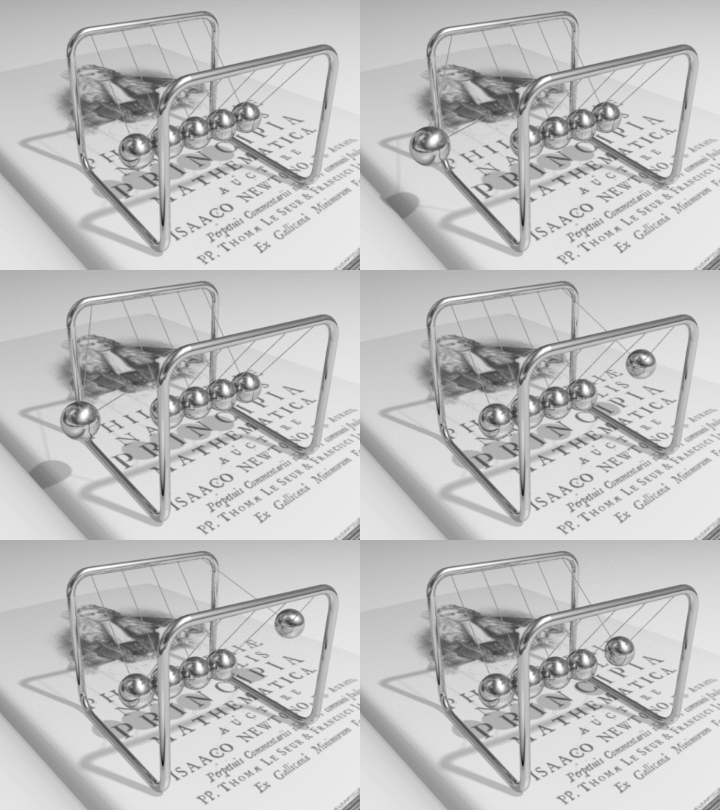
http://upload.wikimedia.org/wikipedia/commons/0/02/Newtons_cradle_animation_smooth.gif

Fear and hesitation go hand in hand. They hold you back, creating a slow motion to your progress (see above) and sometimes no progress at all. The trick is to separate the two, to recognize that you needn’t wait until you are free of fear in order to act. Indeed, if that were the case, most of the people whom we consider brave would still be waiting for the moment of bold action that earned them the appellation “hero.”

Years ago I heard a panel discussion on the subject of Wagner’s opera cycle The Ring of the Nibelung that actually touched on the issue of courage and decisive action. The experts focused on the character Siegfried, who is described as someone who has never known an instant of fear in his life. Should we therefore consider Siegfried’s fearless behavior to be indicative of heroism and bravery? The panel in question concluded it did not. After all, they reasoned, how can one be a hero without fear to overcome? Only a fool would rush to action without being aware of the attendant dangers. But a brave and courageous man would know the perils facing him and choose to act in any case.

Most of us won’t face dragons or fire, of course, but we still will all have numerous chances to act decisively or to hold back. Here is a trivial, but instructive example from my own life. In college, I was fulfilling a PE requirement by taking fencing. Now, I wasn’t a very good fencer, despite being a reasonably good athlete. And, my heavy academic course load didn’t permit me the luxury of spending time outside of class to practice fencing. Thus, in the first seven matches I had against my classmates, I won only three, a pretty mediocre showing.

Nonetheless, I was competitive enough to want to win more often, so I reasoned that there just might be a way that wouldn’t take time away from my other studies. I realized that I was a relatively tentative fencer, and so I decided to become more aggressive. I set myself the task of getting in the first “touch” as soon as each new match began. The strategy worked. Of the next 17 matches, I won 14. I was almost always able to get a 1 to 0 lead within a few seconds of the start of the competition by catching my adversaries off-guard. Yet, despite my new found success, I was really no better at fencing than I’d been when my record was three wins and four losses. I was simply less hesitant, more aggressive.

I once had a biology professor named Hudson who conducted the “Quiz” portion of his classes in a way to encourage behavior similar to my fencing experience. You were graded on the number of questions you answered correctly and lost points if you answered the interrogatories wrong. Hudson asked the questions aloud and it was a race to get your hand up first and have him call on you to answer. Naturally, you had to make a quick decision as to whether you had the right answer. Very fast indeed. Those who hesitated were, as the saying goes, “lost.”

But how does this all apply to daily life, the life outside of the university. You might say that “normal” life is less competitive than my examples suggest, but is it? To answer that question, ask yourself how often you hesitate to do things, take chances, give public voice to concerns that might engender disapproval, avoid tasks that are difficult or challenging? Do you ask out the beautiful woman, or do you wait until you feel “ready,” only to watch someone else beat your time in getting her attention? Do you, at least sometimes, see a crisis as an opportunity? Or do you hold back, put things off, wait and hope that another or better time for action will come? Sometimes it will, but sometimes it won’t.

If your “default” strategy, your habitual tendency, is to wait, you have a similar problem to those whose standard operating procedure is to act impulsively, without thinking. It may be the case that “fools rush in where angels fear to tread,” but it is also true that you are an equal fool if you forever hold back, hesitate, and watch the moment pass or see someone else “seize the day (carpe diem).”

What I am talking about is fear and the uncertainty that fuels it. When we are fearful and decide not to take action, most of us feel an immediate sense of relief. That relief reinforces our hesitation, while simultaneously depriving us of the opportunity to succeed in the endeavor. Soon enough the relief will pass, but not the self-doubt and lack of personal esteem and confidence that might have been won by an effective action.

The danger in allowing too many chances to pass by is a life of “quiet desperation,” a life on the sidelines, watching others play the game, but not playing it ourselves. And, at the end of life, regret for the opportunities passed and the chances not taken is more likely to be troubling than the failed efforts made. Beware the heartache of the words “what if?” True, acting boldly often fails; but, it also sometimes succeeds.

No wonder, then, that musicians spend relatively little time passively listening to music. They are too busy making it.

Make music of your life, then. Let the trumpet announce (or remind) the world of your presence. Sing your song. And if you cannot, find a therapist who will give you the tools to beat back your fear and help encourage you.

The above image is an Animation of Newton’s Cradle created on August 8, 2006 by Demon Deluxe and sourced from Wikimedia Commons.

The Things We All Need to Learn

The things we need to learn wait for us. They are very patient.

I think you know what I mean. At least, you have seen it in others: the angry person who never learns how to control his anger or perhaps isn’t even aware of the need to control it.

Then there is the passive person, who cannot stand up for himself easily, defers to others, and gets taken advantage of pretty routinely. And, despite this, it hasn’t changed over the years.

Some of us choose the wrong friends, lovers, or business associates, making the same mistakes repeatedly. Others continue to use failed methods in raising children. Some of us never face our fears fully (see Albert Brook’s film Defending Your Life for a funny take on this problem). And then there are the people who are impulsive and act without thinking, over and over; or the ones who are sloppy at tasks, not careful enough; or those who are too compulsive, too detail-oriented, trapped by their obsessive attention to small things.

I could go on, but instead, it’s time to ask you a question. What challenges in your life have you yet to master, the ways of thinking or behaving that don’t work for you but which you repeat? Most of us have a pretty easy time spotting the errors in others, but how about your own?

There is an old joke about how we learn:

A man walks down a road and falls into a hole. He doesn’t see it, and it takes some time to get out because it is deep.

The next day, the man walks down the same road and falls into the same hole. He still doesn’t see it, but he might just get out of it more rapidly this time.

The day after, the man walks down the same road, sees the hole, and falls into it anyway.

The following morning, the man walks down the same road, sees the hole, and this time walks around it.

And what does our hero do after the next sunrise? He walks down a different road.

Holes, like unsolved problems, have all the time in the world. They wait for us to recognize them, see the danger they pose, and change our behavior to avoid the danger. As the saying goes, “If you do what you’ve done, you’ll get what you’ve got.” Others have said that one definition of insanity is continuing to use the same failed strategy, all the while expecting different and better results.

How long will you wait to change? Your problems can last a lifetime. They have no train to catch or meetings to attend; they take their time, not troubled by waiting. Or, should I say, they take your time. All of your time.

Do you really want to wait that long?

Fifty Positive Steps to Change Your Life

Australian State Route Shield

You might think it an odd place to begin changing your life, but consider this: write your own obituary. What is it that you’d like someone to say about you after you are gone?

One of the tricks to changing your life is to widen your imagination, break your routine, and see and think about things differently. Here are 49 more small steps that you might consider in the process of reconfiguring yourself:

If you are a city dweller, drive far enough away from the city to see the stars on a clear night. There are lots more than you think.

Think of someone you dislike and make a list of all of their positive qualities.

Volunteer to do something that might be described as “community service.”

Start to write your autobiography.

Write a short story.

Eat a raisin slowly, as if you’d never tasted one before.

Go to a fancy restaurant and eat a meal alone; or go to a concert, play, or movie alone.

Make a list of all the things you are grateful for.

Apologize to someone who deserves your apology, including a “no excuses” statement of regret and some method of attempting to make-it-up to them.

Re-contact an old elementary school friend.

If your physician allows it, begin a weight-lifting program.

Wake up early to see the sun rise.

Make two lists, one of your strengths and another of your faults.

Create a “bucket list:” all the things you’d like to do before you “kick the bucket.” Make plans to do one of them within the next year.

Tell someone how much you appreciate him and why.

Write a letter. Hand write it.

Do some routine task (eating for example) with your non-dominant hand.

Build something, even if it is only a model airplane.

Grow something.

With adequate supervision so that you don’t get hurt, spend some time blindfolded.

Take an academic course.

Meditate.

Take a yoga class.

If you aren’t a dancer, learn to dance.

Remember all of the difficult life challenges that you’ve overcome and identify the qualities in you (strengths) that allowed you to overcome them.

Imagine a different and more rewarding life than the one you currently lead. What do you need to do to create it?

Create a five-minute comedy monologue and deliver it to a group of friends.

Learn to sing or play a musical instrument.

Play chess.

Give up something for a month (for example, TV, a favorite food, alcohol, caffeine, or listening to music).

If you have no children, consider becoming a “Big Brother” or a “Big Sister.”

Learn a foreign language.

Participate in a team sport.

Start a philanthropic project with some friends, no matter how small it might have to be.

Visit a public high school in the inner-city and think about the future of this country and what you can do to make it better.

Clean out your closet.

Imagine that you are to be stranded on a desert island and can only take five non-essential items with you. What would they be?

If your memory was going to be erased, what would be the single memory that you would ask to be spared? Why that one?

Go on a retreat.

Teach someone something. Show them “how it is done.”

Give some money (even if its only a dollar) to some needy person you know; and do it anonymously!

Buy a hard copy of one of the few remaining great newspapers in the USA (for example, the New York Times, Washington Post, or Wall Street Journal) and read every word. Then think about the fact that a Bell Labs study reportedly estimated that the average sixteenth century man had less information to process in a lifetime than can be found in a single daily edition of the New York Times.

If you wear a tie, tie the knot in a new way (most men tie a Four-in-Hand knot, but there are some others that actually look better).

Paint, draw, sketch, or sculpt something.

If you haven’t done so already, read Becker’s The Denial of Death.

Walk to some destination that you usually reach by car or pubic transportation.

Make a list of all that you have learned about life since finishing your formal education.

If you don’t have a tatoo, get a temporary tatoo (if there are no health risks to you) and observe how people look at you differently; if you have a prominent tatoo and can cover it up, walk around and notice the way that people look at you now.

Send me a suggestion on one more step to change your life.

The image of the Australian State Route Shield is sourced from Wikimedia Common.