What I Have Learned so Far: Life Lessons, Part II

study-for-inner-improvement-1977

Here is a second round of ideas about the process of living accumulated in a lifetime of observation and action — success, error, and reflection. My profession allowed me access to the thoughts and stumbles, ascensions and tumbles of thousands of folks. Some of my learning is crafted into the bits below. I published an essay on January 8 with the same title, labeled Part I. Perhaps there will be a third set after a while. Here goes the second one:

  • “Not everything that counts can be counted and not everything that can be counted counts.” Einstein most often gets credit for saying so, but the real author is William Bruce Cameron. So much for justice.
  • “Buddies don’t count,” as my friend John Kain says. He meant we should not keep score or expect perfect equity in any relationship. Close attention to a balance sheet will make us (and our soon-to-be former friend) miserable.
  • “Know thyself” is inscribed at the Temple of Apollo. I never met anyone who understood himself completely, myself included. Self-awareness is a “more or less” commodity. We consume too much time preoccupied with what others think of us, analyzing why they did what they did, said what they said. One might more profitably endeavor to know oneself and do good in the world.
  • The ability to start over is essential. I counseled people who made dramatic career changes (from powerhouse attorney to clergyman, for example). I had to evaluate patients afresh to see if I was missing something or misunderstanding their makeup. We must occasionally wipe clean the mirror of our thinking and let ourselves be shocked or enlightened by our unphotoshopped image. As Max Weber suggested, whether we wish to or not, our lives will be influenced by how much truth about ourselves and the world we can bear.
  • To understand yourself you need to know your roots. Our ancestors survived, chose mates, and produced children. We inherited their genes and therefore possess the same urges. These forebears also had to detect who was like them and might be friendly, and who was different and might be dangerous. Fruit enabled survival, so we were handed their love of sweets. The creation of tools further enhanced the chance of staying alive. The ability to form cooperative groups helped, as well. Since they didn’t live long, the genes they delivered to us gave us instincts that worked for what we now think of as the first half of life.
  • A troubling aspect of evolution is that it enabled survival, not happiness. Happiness became the bi-product of human actions only if the emotion helped make sure the kids were born, survived, and thrived. The joy produced by love, for instance, bonded families and increased the likelihood the children would come to generate offspring of their own in time.

even-if-happiness-forgets-you-occasionally-never-forget-it-completely

  • We tend to think in terms of before and after: before and after school, before and after you left home; a first job, the death of someone you loved, a first sexual encounter, etc.
  • We don’t need permission from very many people. Asking “to be allowed” means you will hear “no” more than the guy who doesn’t. Such requests make you the hostage of waiters, your children, and people you will never meet again. Often it is OK to just do what you want. No one will stop or question you. The world, within limits, tends to adjust. A wonderful sense of liberation awaits.
  • We need to evaluate our default (automatic) tendencies. Some of us take action, others wait. Some routinely approach, others reflexively avoid. Our strengths can also be our weaknesses when applied to the wrong situations. Best to apply as needed, rather than by default.
  • Personality disorders cause us to rerun mistakes, like an old episode of a poor TV show. One is well-advised to recognize flawed life strategies — recurring behavior patterns contributing to our disappointments. We otherwise risk familiar and fruitless searches for the wrong people; too many or too few chances taken and, either ignoring tomorrow for pleasure today or focusing so much on tomorrow we miss the glory and opportunity offered by the new sunrise.
  • “In the land of the blind, the one eyed man is king.” Within a group of unremarkable people, you can stand out without being extraordinary. Becoming a big fish in a small pond is easy because the pond is tiny, with little competition, and the other fish are not so fine as you are.
  • There are fewer small ponds these days. Over our history, especially when villages and small towns predominated, we could achieve high status without difficulty. Now we must compete with people all over the globe.
  • The only thing you control is what you do, what you think. The attempt to change other adults is a fool’s errand unless they want to be altered, like an article of clothing needing to be resized. Remember the old psychotherapy joke:

Question: How many therapists does it take to change a light bulb?

Answer: One, but the light bulb must want to be changed.

untitled-1993

  • Most selfish people don’t experience much guilt. Those who fear their own selfishness tend to overstate the danger. Even then a self-sacrificing person must care for his own needs. Please recall the airline safety instructions:

If the oxygen mask comes down and you are traveling with someone who is dependent on you, put the mask on yourself first. (Otherwise you’d be of little help to your companion or child).

  • Many folks don’t buy into the belief their choices are as genetically determined as they are. Example:

Maybe you say, “I dress the way I do to look nice.” Well, an evolutionary scholar would tell you ancestors who made a good appearance were more likely to have their choice of healthy, faithful mates and thereby ensure they would create fit offspring. That tendency is “built-in,” so we incline toward concern about appearances well after our biological clocks stop.

  • The average 16th-century man had less information to process in his short lifetime than can be found in a single, daily edition of The New York Times. We must narrow our focus or drown in a sea of real news, fake news, and drivel. Too many of us attend to things of no lasting value.
  • Change can be unsettling. The effort to keep our world exactly as it is, however, can lead us to reduce the size of our lives, resist unfamiliar experiences, and fail to incorporate new people in our circle. Flexibility is a key to life satisfaction. Change is an opportunity to reinvent oneself.
  • Don’t expect sincere apologies any time soon. In 1942 West Coast Japanese Americans were forcibly relocated to internment camps by the federal government, which alleged potential disloyalty during the ongoing war. World War II ended in 1945. Not until 1988 did the USA formally apologize, citing the real reasons for this disgraceful act against a group which included 62% U.S. citizens:

Race prejudice, war hysteria, and the failure of political leadership.

  • Inaction, stillness, and patience are powerful tools. Passive-resistance has been a major and successful method of changing the world, one practiced by Gandhi and Martin Luther King. Here is a modest illustration of how passivity can work for you:

When my wife and I bought our current home, we dealt directly with the owner. He proposed a price. I was silent. As the seconds passed he lowered the number a few times. The man assumed my failure to respond meant he’d not reached a figure acceptable to us. The truth was, however, he went below what we were prepared to pay.

evening-magic-2000-jpglarge

  • If you chase people they are inclined to flee. Stop chasing and they may turn toward you or even walk in your direction. Consider this with respect to your romantic life.
  • I had the pleasure of a friendship with a Japanese businessman residing in the USA. His favorite teacher advised him to choose a career that was his second love, not the thing he loved best. Why?

If you do what you love best as your vocation you will discover it becomes a thing you must do, not an activity you choose to do. You may kill the thing you love.

  • Luck is most often defined by happy accidents and near misses: finding a dollar on the street, winning the lottery, that sort of thing. A bigger scale exists. My wife’s maternal grandmother was an indentured servant in Poland. She served on a farm before indoor plumbing was common. When using the outhouse in wintertime she jumped from one cow patty to another to keep her bare feet warm.

In my mother-in-law’s childhood, she and her young friends picked up lumps of coal that fell off passing freight trains to help heat their homes. I can remember washboards and clothes lines in my youth, a day of few washing machines and dryers. In graduate school we used mechanical calculators to compute research results until giant computers became available. The point?

Be grateful for what you have.

  • Think about random events for a moment. The most unlikely event in your life is that you exist at all. Had my grandparents not left Europe at the beginning of the 20th-century, I could have been murdered by the Nazis some time later. Moreover, for each of us to exist as the unique person we are, every ancestor had to meet and procreate with just the mate with whom they did. Had only one made a different choice or perhaps had intercourse on another day, we wouldn’t be here. Others would.
  • I worked for a quirky psychiatrist at a now defunct psychiatric institution. MJ was enormously bright and also quite full of himself. One day he asked me to sub for him at a meeting. I reported back the criticism I heard aimed at him. He was unperturbed. MJ’s only comment was, “A big tree casts a long shadow.” In other words, MJ viewed himself as a big, imposing tree and therefore believed some people were going to take shots at him, be jealous, etc. I thought to myself, “You really are full of yourself.” A second later I realized he was right:

If you are going to do anything significant in life and hold opinions not universally agreed upon, you need to let the bullets bounce off. There will be bullets.

  • In his Politics, Aristotle writes about those who “proceed on the supposition that they should either preserve or increase without limit their holdings of money. The cause of this condition is that they are serious about living, but not about living well.”
  • Aristotle was born over 2400 years ago. Lucky for us, some of the best advice has been around for a while.

—

The first image is called Study for Inner Improvement by Helen Almeida, dating from 1977. The next one is Even if Happiness Forgets You Occasionally, Never Forget It Completely, a year 2000 work of Hasson Massoudy, followed by an Untitled 1993 painting of Albert Oehlen. Finally comes Evening Magic created in 2000 by Eyvind Earle. All are sourced from Wikiart.org.

A Dozen Ways to Avoid Regret (and a Warning about Endless Therapy)

512px-claude_monet_impression_soleil_levant_1872

When we suffer regret we are, by definition, occupied with the past. We lament things we did or didn’t do, time lost, vanished opportunities. Perhaps, however, it would be useful thinking about how to avoid regret going forward. Here are a few guidelines:

  • Recognize life’s limitations, learn from failure, and don’t stop trying. Anyone with imagination can think of several possible lives to lead, places to go, experiences to pursue. If  you are honest you can even envision a different spouse or children, no matter your great good fortune in those you have. Thus, the world is like a candy store in which only so much consumption of sweets is possible, to borrow a metaphor from Haruki Murakami and Forrest Gump. The earlier you recognize this the more you are forced to refine and narrow your choices. Moreover, you must reach for some of those candies without ever having tasted them and before obtaining experience in how to grasp each one artfully, a guarantee of mistakes.
  • We can only learn from disappointments and try again. Live your values as best you can: dive deep into those few candied heaps of life you deem worth the effort in the short time permitted. Don’t end your days saying, “I should have” or  “Why did I waste my time on … ” Or, worst of all, “Why didn’t I?” Michael Jordan, basketball hero, said:

I’ve missed over 9,000 shots in my career. I’ve lost almost 300 games.Twenty-six times I’ve been trusted to take the game-winning shot and missed. I’ve failed over and over and over again in my life. And that is why I succeed.

  • Improve your choices. Moving through life, take stock, reflect. Write down your analysis, perhaps every five or 10 years. Look where you’ve been, where you are, and where you would like to go. I’m talking about what career you might still pursue, what you’d like to learn about, how much of yourself you hope to devote to relationships, what personal characteristics you still wish to alter, where you’d like to live, what you’d like to see, and the legacy you might leave behind. No one can do everything, be everything. Too much candy, too little time, too much indigestion.
  • Since we can’t invent more hours, we are left to determine how best to spend our allotment. If you hope to become World Champion in the art of perusing and responding to tweets, stop reading this now. You are wasting minutes you could devote to your curious focus on 280 characters or less. For myself, I watch TV/video less than an hour a day on most days, except for those in the baseball season! Why? Because I value the time spent in the company of fine novelists, historians, and ancient philosophers more than what is on the tube. Some of this might strike you as elitist, but no.
  • Literature isn’t automatically “superior” to TV, film, or theater. I’ve simply made a choice: my personal preference. You can find superb TV shows if that is what you believe is a good use of your day. I’m suggesting you think through choices. Assuming you are mature, the most satisfying life possible for you will be a life designed by you — not a consequence of habit or the persuasion of advertising, the boss, or friends. Quiet consideration of how you spend your waking hours is essential to the success of your plan, especially if you are not happy.
  • Be active, take risks, always seek to grow. Some of these endeavors will assume the form of self-disclosure and vulnerability, some the shape of honest self-reflection, some the act of trying new things. The courage to know yourself and then be yourself is never easy. The ground is shifting under all of us. Move, don’t sit still. Reinvent yourself, at least a bit. Proceed, don’t rush, but live with intensity. Walter Pater wrote:

To burn always with this hard gem-like flame, to maintain this ecstasy, is success in life.

256px-soleil_couchant_sur_le_vercors

  • Be wary of bucket lists. I’m referring to the postponement of activities until late in life, the things you want to do before you begin residence below ground. Several problems come with delay: a) you might not live long enough. b) if you are forever looking forward you won’t live in the moment and experience joy in the now. c) bucket lists assume excellence at predicting what will bring fulfillment in 10, 20, or 40 years. We are poor at this. Research on “affective forecasting” (being able to predict how life events will influence our emotions) affirms the weakness. Richard Posner, in his book Aging and Old Age, puts the dilemma of anticipating our future self this way. Say we sentence a 20-year-old to life in prison. Are we punishing the same person when he is 65? That is, does a man change over time? Possibly deepen, mature, give up old hobbies and take on new ones, learn more; become enriched and transformed by love or literature or experience, turn grateful or embittered, for or against life?
  • Unless we can predict the manner in which events and people will work on us and how we will work on ourselves, we might realize a long postponed trip to Paris would have been better in life’s springtime; or, in my case, a Chicago Cubs World Series victory would have meant more to me at 20, when I lived and died by the team’s fortunes, than it did in 2016. By the way, I didn’t plan on morphing into a less avid fan. I simply changed.
  • Regret can be a result of idealization. As Janet Landman observes in her book, Regret: The Persistence of the Possible, this emotional state is akin to the aftermath of a decision made at a fork in the road. We reach the divide and must choose. Proceeding down the chosen path, past the time of easily retracing our steps, we think: “I was mistaken. The other way was better.” But really, do we know?  We only understand the lived experience of the choice we made. The other avenue is easy to idealize because it exists in imagination, because we didn’t encounter the imperfections one can only suffer by a different choosing. Do you wish to spend a lifetime lamenting a mirage?
  • Ask whether there is another side to losses, mistakes, and missed opportunities. I am not Pollyanna. Few who read my writing regularly would think so, I suspect. I will say, however, that I have learned far more from the “slings and arrows of outrageous fortune” than from any other source.
  • Not every mistake can be rationalized, not every loss offers even close to equal compensation in some other form. But before you devote the rest of your days to regret, take a few moments to seek what can be learned from life’s hard and unequal distribution of pain. Perhaps you can create some good out of your awareness of those things you did or didn’t do, the words you said or didn’t say, the chances missed and the poorly chosen roads endured — if not for yourself, then for someone else.
  • Remember that research says you will be happier if you take newfound money and buy a cup of coffee for a stranger than if you use the gift for yourself. King Midas wasn’t a happy guy, was he? Take a hard look at your desire to gain triumphant, towering status and wealth.

256px-sonnenaufgang_schilf_im_winter

  • Be careful how much time you spend looking back. I am on thin ice in saying so. A good therapist begins with history. The untying of binding emotional knots is essential, often requiring discovery of how they came to be, where they remain, and more. Danger exists, however, in believing every knot requires attention, every cognitive or behavioral change demands agonizing soul-searching. Some will loosen with the passage of time, others aren’t too important. CBT (Cognitive Behavior Therapy) is able to master many without endless and wrenching historical probing. Meanwhile, weigh the time spent on a backward focus versus possible gains from attention to the now via action. Curtail whatever retrospective view isn’t essential to making a satisfying life.
  • Is this avoidance, cowardice? Only sometimes. Psychotherapy in-depth encourages a seemingly perpetual return to the bottomless gorge of your memory-distressed soul until you dredge up every dark thing at its floor. Sometimes we must put an end to reruns and begin a new season in the installment series of our lives. Your therapist might urge digging deeper. He may be correct. I’m here to say — on reflection — my patients sometimes knew when to stop when I didn’t.
  • Is there room for gratitude? Such a sentiment is hard to summon in the midst of despair, maybe impossible. The practice of routinely reminding yourself what is good can, nonetheless, diminish sadness much of the time.
  • Time is always moving forward and doesn’t permit time-travel for do-overs. Those facts set the stage for regret. Not because you made horrible mistakes, but because you are human and were thrown into a set of unalterable physical laws (as are all of us). The best way we can deal with what nature offers is to make good use of the present and plan for the future, even though the person for whom we are planning (our future self) may not be as thrilled as we hope with the baton we pass him.
  • Regret is inevitable because our genetic inheritance keeps us unsatisfied, always seeking more and better. Those early humans without such ambitions — those who were easily satisfied — didn’t survive, nor did their offspring become our ancestors. Evolution enabled the perpetuation of our forefathers’ genes in the form of their progeny, but offered no guarantee of joy in our status, our mate, or our job. Regret, therefore, is built into who we are: restless creatures still driven by the biological imperative to behave in a way that increases the chances of our genes surviving, even past our reproductive years.
  • Learn to forgive yourself. You cannot do everything, you will never be perfect, you will disappoint and injure others, your imprint on the planet will (unless your last name is Will Shakespeare or Hawking or Beethoven) be small. We are always learning and forever changing course. Do your best, try to do better, and leave it at that. Life is punishing enough for most of us without volunteering for the cross and offering to hammer in the nails, to boot. As a Christian colleague occasionally told her patients, “Get off the cross, we need the wood.”

You need the wood, too. Take the timber and carve a sculpture or draw a lovely image or build a house; or burn it to keep yourself and another good human warm. Leave the job of summing up your life to history, assuming history cares.

In my book that is enough.

—

The top painting is Impression, Sunrise by Claude Monet. The second photo is Sunset Over the Vercors Mountains, Seen From Grenoble by Guillaume Piolle. Finally, Sunrise with Reeds in Winter is the work of Benjamin Gimmel. All are sourced from Wikimedia Commons.

A Therapist Tells You a Secret. Do You Really Want to Know Everything?

mirror-on-the-wall

In the search for information and closeness to your therapist you can’t predict what you might discover. I will use the subject of race to illustrate. Two subjects, then: racial bias and yours truly, a retired psychologist who was not always admirable as a stand-in for your counselor. The question of self-knowledge, too, is on my agenda, absent in most of our prejudices, replaced by the ability to rationalize our thoughts and actions.

Ugh, I hear you say: what can one offer about race that hasn’t been uttered to the point of numbness. I’ve groaned myself. More often I’ve grumbled about unfairness to minorities, blamed the big bigots, or written a check to a noble cause. My buddies from Mather High School even established a college scholarship program for disadvantaged teens of all races, ethnicities, nationalities, and religions.

Sounds admirable, right? Read on if you dare. You might find something out you don’t like, something to knock me off any pedestal given me by your generosity, a coin flip, or my own effort to climb on top.

We come by vulnerability to racial bias as part of our evolutionary inheritance. Humans who didn’t notice differences became someone else’s lunch. The tribe next door was quickly identified as “other.” Otherness made both sides wary. Those who were too welcoming too fast suffered a bad end. They are not our ancestors. Yes, cooperation was essential to survival, but care had to be taken about anything signaling danger.

We also want to think of ourselves as “better than” someone, more in control, deserving a more advantaged life than they. The “other” comes in handy here, too, for the sake of drawing contrasts. Read Ernest Becker’s The Denial of Death to investigate this light subject.

Still more of us seek simple advantage by becoming a top dog over the Untermenschen, which has typically included benefits like money, power, status, and mating opportunities.

The trickle-down theory of prejudice applies as well. The one who is mistreated — the one who is hated — becomes the hater. And not necessarily aiming his animus at those who inflicted the injury. But sometimes racial resentment derives simply from emulating the deeds and words of the ones you love or the culture in which you live. Then, in bad times, the fire is fueled, whatever its first cause.

Such tendencies do not make anyone evil. But they do require that we catch ourselves leaning.

At least in my generation — the leading edge of the post-war baby boom — most of the white folk were not untouched by racist messages and, more significantly, many absorbed some of the bias. I was one such.

Maybe the most shameful day of my life happened early in graduate school. My roommate and I had a one-year lease on an apartment in residential Evanston, IL. He soon was swept away in romance and wished to move in with his girlfriend. Jim, a quiet, mysterious, handsome fellow — his new fiancé was a beauty too (and they both had terrific abs, having met in a fitness center) — was also a man of honor: he agreed to pay half the rent until I could find someone to take his space. He and I understood, “the sooner the better.” Neither of us was wealthy.

I advertised, of course. The first person to call sounded perfect on the phone, another student at Northwestern. He came with a companion to see my digs. We agreed on the timing for his move-in. Within a couple of days I backed out of the arrangement. Why?

s-l1600

Though he was born in the USA, his skin suggested an Indian subcontinent origin. Do understand, what I’d learned about race never referred to people who lived in Pakistan or India, other than they might be starving. Such references were common among parents of the time. They wanted their children to “clean the plate,” encouraging us to benefit from the bounty that the unfortunates on the world’s far side lacked.

I had no additional opinions about people from the spot on the map from which this NU student’s ancestors launched themselves. Moreover, he wasn’t starving — he could have been the guy next to Jim in the weight-lifting room. This young man, just a bit more green than myself, was clearly intelligent, displayed good manners, and dressed in the fashion of college students of the day. Well, obviously, he was not green in every sense, the clear point of my prejudice.

By now I had another roommate in line who would replace my replacement for Jim. Larry, the newer guy, was whiter than white. Blond. No better or worse, probably not as smart, different only in individual peculiarities I did not yet know, except — a big exception — for the fairness of his skin tone. I make zero excuses. My act was reprehensible, prejudiced. I looked in the mirror (eventually) and learned from it, too late for the man I discriminated against.

Most of us don’t think of ourselves as racist. The group in denial includes those who behave in a way consistent with bigotry, tell jokes dependent upon stereotypes, and vote for candidates who intend to disadvantage minorities while wrapping themselves in their country’s flag. The last of these adopt a faux patriotism that Samuel Johnson called “the last refuge of a scoundrel.” We are, almost all of us, pretty well-rationalized. Our sleep is undisturbed, our friends shake our hands, and we receive applause for acts of public generosity. But there are secrets, too, and now you know one about me.

I offer you no grand take-away here. I cannot tell you the meaning of life or even whether one is waiting to be found. But I believe part of my guidance for myself is to do better, learn more, be more understanding — enlarge my humanity and add some little good to the world. Hard to do any of that unless you begin the endless and ancient task of knowing yourself.

The friendly social scientists at Harvard have made it easier. They offer a free psychological instrument designed to help you understand your implicit, unconscious preferences or beliefs: to be more precise, a tendency to prefer “white” over “black.” It’s called the  Implicit Association Test (IAT). Consider the measure akin to the mirror of the evil queen in Snow White.

There are actually a great many tasks you can undertake on the site, but the one I’m talking about is the one labeled Race IAT in blue.

512px-dostoevsky_1872

The Harvard creators take the time to quote Fyodor Dostoyevsky:

“Every man has reminiscences which he would not tell to everyone but only his friends. He has other matters in his mind which he would not reveal even to his friends, but only to himself, and that in secret. But there are other things which a man is afraid to tell even to himself, and every decent man has a number of such things stored away in his mind.”

These lines from Dostoyevsky capture two concepts that the IAT helps us examine. First, we might not always be willing to share our private attitudes with others. Second, we may not be aware of some of our own attitudes. Your results on the IAT may include both components of control and awareness.

Now, you are likely to ask whether there is a connection between preferring “white” over “black” (or the reverse) and acts of discrimination/racism. The answer is in the FAQ (Frequently Asked Questions) section of the site. In general, they inform us, “not necessarily.”

Of course, I don’t know how you, dear reader, will score. Are you, to quote Dostoyevsky once more, a hostage to “those things which a man is afraid to tell even to himself?”

Do you have the courage to find out?

Again, here is where you can: Implicit Association Test.

Now, say, after me: “Mirror, mirror, on the wall … ”

For sure, this psychologist is not the fairest of them all. In any sense.

—

Following the Disney images of the evil queen and her mirror (from Snow White and the Seven Dwarfs) comes Vasily Perov’s 1872 portrait of Dostoyevsky, sourced from Wikimedia Commons.

Part III: So You Say You Want to Know Yourself? Thoughts on Examining Your Life

512px-The_Body_of_Abel_Found_by_Adam_and_Eve_by_William_Blake_c1826_Tate

In the last two posts I offered a set of questions — hypothetical choices — designed to help you think about your values. The first piece of writing was devoted to the complete list of 13. The second one offered you my personal answers to the initial seven of these, with no suggestion that my responses were better than yours might be. So, if you are familiar with the previous publications I suggest you scroll down to #8 on this one, where I will give you my thoughts on those I didn’t get to a few days ago. Those who haven’t read first seven answers, however, might wish to start with #1 here:

1. Someone asks for a year off your life — a transfer of 365 days from you to him in return for money. Would you accept? How much money seems sufficient? The old Twilight Zone TV series presented an interesting story involving such an offer: The Self-Improvement of Salvatore Ross. I can imagine circumstances in which I would take the offer. If I needed money to save the life of someone I loved, for example. Otherwise, probably not. But then, I am financially comfortable. Were I not, perhaps I’d be more inclined to accept. I’d not care to get a bigger house, win status, or travel the world. Nor would I give the year for any charity short of enough dollars to change thousands of lives. There are limits to my altruism.

2. If you could trade one extra year of good health and youth for one less year of longevity, would you make the exchange? Everything else being equal (which is never the case) this is attractive. Pain can be instructive if you are young enough and the suffering is defeated. Living longer, at least into an old age suffused with agony, has no appeal for me. Leon Kass, physician and philosopher, however, argues that discomfort and gradual loss of our abilities combine to make us less resistant and more grateful for the release provided by death. Note that my answers to all of these questions are personal. You might well offer ideas at least as worthy and persuasive, perhaps more faith-based.

3. What would you die for? My post What Would You Kill For? includes many thoughtful responses I received from friends and acquaintances.

4. What would you kill for? The same essay deals with answers to this query as well.

5. Imagine you are given the opportunity to improve your physical beauty by 25% or your intelligence by a similar percentage. One or the other, just by saying so. Please discuss your decision and justify it. Were I a deformed young man, enhanced beauty would be difficult to resist. The importance of what meets the eye, of course, depends on the individual’s self-image and how much else recommends him to others in the mating game. The hand of time steals pulchritude from us all, a dime’s worth here, a nickel’s worth there, until at last those who once possessed surpassing beauty often sustain the most damaging psychological losses. We witness what some will buy from surgeons to fight the clock. The world pressures women more than men with regard to appearance, another consideration. At this point in my life, however, I’d take 25% more intelligence, being without an outsized vanity regarding how my externals are judged. Yet I wonder if the added cognitive burst might then separate me from friends and loved ones, literally change my thinking, our mutuality, and increase their discomfort in my presence. The value of relationships means more to me than becoming Einstein. Had I been given the offer of a bigger brain in my school years, however, I’d likely have accepted. We tend to think of ourselves as a kind of unitary everlasting whole, despite the changes we go through outside and inside. For a number of the questions in this essay, consider whether you would answer the same way when youthful, in middle-age, and in old age.

6. You are offered the chance to live one day over again. A “do-over.” Which 24-hours would you choose, if any? Describe what led you to this determination. My first thoughts here were focused on my youth, when confidence and self-assertion were wanting. On the other hand, life worked out before long. Moreover, any edge won with increased bravado would have been temporary, or (as Rosaliene Bacchus commented in response to the original post) might have altered the course of events in ways I didn’t predict. For example, had I been more masterly with some young woman in my single days, perhaps I wouldn’t have met and married my wonderful wife, produced our two great daughters, etc. No, I’d let the opportunity for a “do-over” for the chance of self-advancement pass by, but take advantage of it with respect to someone I hurt. My answer to question #10, based on regret, offers the details.

7. A genie will give you the ability to relive one day of your life just as it happened, without change. Which would you choose? Explain. My post What Memory Would You Take To Eternity? describes a heavenly reward consisting of living forever in a single, precious, blissful moment. I chose the instant I treasured most and treasure still, described therein. However, if I had 24-hours to live over again, I’d probably conjure up my father when I was a small boy, maybe three. He created a pretend radio show for me using the nozzle of our vacuum cleaner (hose attached) as a mock microphone. We played different parts, at least as the story was related to me much later. Though I lived it, I own no memory of the event. I’d like to visit him again in the fizzing sparkle of his relative youth, when his heart fairly burst with love and pride in his first born. The pictures of my dad with me show how overwhelmingly happy he was, beside himself with joy. I remember my own experience of this dad role with my children and watch it duplicated today whenever I go over to the home of my youngest daughter and son-in-law Keith with their wonderful boy — my grandson, of course.

512px-Blake_Cain_Fleeing_from_the_Wrath_of_God_(The_Body_of_Abel_Found_by_Adam_and_Eve)_c1805-1809

8. The gift of immortality on earth is yours — to live forever, never aging beyond your current age. Do you want it? Check out this post: the downside of immortality as seen by a werewolf. Put simply, eternal existence changes everything you think you know about your values and the way you are inclined to live. Much that is precious is given worth because it is either in short supply or temporary. Never-ending life makes choices less important since there is always more time try another path. I’ll take this life, thanks. I want a life where my decisions have meaning.

9. In your travels you come upon a fountain of youth enabling eternal earthly life at whatever chronological age you choose, with only the knowledge and experience you possessed at that time. To what moment would you return? Might you decide not to drink from the fountain? Tell me more. If you believe in “necessity” — that events happen and actions are taken in a predictable and unalterable way — then you’d be returning to a life identical to the one you had, like a TV rerun. Moreover, as an immortal you’d also have to deal with the problems of a never-ending life mentioned in the downside of immortality. Perhaps a more interesting question is whether you’d like to start over from an early age with the only guarantee being that your life course would be different, not a repetition of what you lived. I find this intriguing. I can imagine other careers, reconsidered decisions, a changed set of relationships and chance meetings — perhaps dozens of alternative ways to reach a life worth living. This isn’t meant to suggest dissatisfaction with my history — rather, curiosity. But you know what they say about curiosity and cats!

10. Who is the one person living to whom you most owe an apology? Why haven’t you expressed your regret? An old girlfriend with the initials MC is the person. Really, a sweet young woman when I knew her. I dated MC for several weeks in graduate school (she was not a schoolmate) and I left the relationship angry, not because of any betrayal by her, but due to my own immaturity and selfishness. Curiously, I didn’t think I needed to apologize until years later and recognized my fault. I suppose this is a commentary on how one’s view of events alters with time, circumstance, and self-evaluation. By then there was little chance of finding her short of hiring a detective. We often don’t know whether our impact on someone else is lasting unless we are told. The rear view mirror fails to inform you of how a lover’s future turned out. Sometimes he or she doesn’t remember the event at all. I hope MC was either less hurt than I believed or healed quickly and completely; and that her memory of me vanished with the wound.

11. Imagine you can live the fantasy of succeeding in everything you try and being continuously satisfied by the progress of your life. It will be experienced as absolutely real, even though you will be in a chair connected to a machine keeping you healthy, supplying you with food, and fooling you into believing you are elsewhere. Alternatively, you can try to make your way in the real world as you do today. Which would you opt for? This hypothetical machine and the “pleasure-button” I will describe in question #12 are “thought experiments” derived from the three sources: 1. The “Experience Machine” imagined by philosopher Robert Nozick. 2. The examples present in the novel Infinite Jest by David Foster Wallace, and 3. The Matrix. The real question here is what choice you will make when given the opportunity, not after being plugged into the machine or starting to press the seductive “pleasure button” in item #12. Once you choose either of these experiences you are hooked. In the first example, you immediately believe it is real and therefore don’t even think of returning to real life. In response to question #12, you become addicted to the ecstasy within your reach (pun intended), better than any drug. Underlying these queries are others: How much do you value genuine achievement (as opposed to the false belief of successful accomplishment, like getting an A on a test because you cheated)? Are you responsible to make the real world better, even if only in small ways? Would you rather strive for actual (imperfect) relationships or interact with fantasy friends and partners? Do you believe life allows us to achieve a sustained stratospheric level of happiness or that pleasure and satisfaction only come in inconsistent bits? Those of you familiar with my writing can guess my answers.

12. You are offered a risk-free, brief surgery permitting you to give yourself ecstatic pleasure by pressing a button whenever you want: the most powerful mood-changer ever invented. The marvelous joy beyond joy lasts only 10 minutes, so if you want more you have to press repeatedly. Do you accept this “gift?” See my answer to #11.

13. You are given a trip on a time machine, enabling you to go back to the moment in history in which you’d prefer to live, in whatever place you’d like, though you’d remain your current age. The journey is one-way — no coming back. Moreover, you can bring only one other person with you. Would you do so and with whom? To what historical place and time? Elaborate your deliberation process. My first concern is whether I’d be open to losing all the relationships I have, but one. The answer is no. If I were willing, however, the question then becomes which moment in time would be superior in fascination to the current one? A different way to view this is to see the choice as a kind of test, where the qualities needed to have a satisfying life might be more necessary in one historical epoch than another. Finally, consider this comment made by Al to the previous blog:

I think my soul belongs to the depression era. My soul feels comfort in hardship. My mind wants a simpler life with less advancement and technology. I need people and to connect. So, even though life would be hard, I believe my tortured soul would feel comfortable. I enjoy working hard and reaping the benefits. This would force me to not sit tight and work. People were the entertainment. I would like that. I’d be forced to live in reality. No work, no pay.

I hope this set of uncommon questions has been amusing and perhaps, personally informative. They’ve touched on the value of time, the question of whether you can create a scale to weigh time and experience in terms of dollars, what you think about money, the importance of memory, the place of regret in any life, the danger of addiction, the benefit of relationships, whether you’d prefer reality or an escape to fantasy, the role of apology, the way we change over time, the difficulty of predicting what will be important to us in the future, etc.

As I said in the first part of this three-part series, no grading, no right or wrong answers. You alone are the judge of your own responses. It is your life.

—

The top painting is The Body of Abel Found by Adam and Eve. The second is called Cain Fleeing From the Wrath of God. Both are by William Blake and sourced from Wikimedia Commons.

Part II: So You Say You Want to Know Yourself? Thoughts on Examining Your Life

512px-Vladimir-Grig-Who-Am-I

In my last post I promised to give you my thoughts on the questions I posed about knowing yourself and examining your life. There were 13 in total, (superstitious anyone?). Here are the responses they prompted in me.

  1. Someone asks for a year off your life — a transfer of 365 days from you to him in return for money. Would you accept? How much money seems sufficient? The old Twilight Zone TV series presented an interesting story involving such an offer: The Self-Improvement of Salvatore Ross. I can imagine circumstances in which I would take the offer. If I needed money to save the life of someone I loved, for example. Otherwise, probably not. But then, I am financially comfortable. Were I not, perhaps I’d be more inclined to accept. I’d not care to get a bigger house, win status, or travel the world. Nor would I give the year for any charity short of enough dollars to change thousands of lives. There are limits to my altruism.
  2. If you could trade one extra year of good health and youth for one less year of longevity, would you make the exchange? Everything else being equal (which is never the case) this is attractive. Pain can be instructive if you are young enough and the suffering is defeated. Living longer, at least into an old age suffused with agony has no appeal for me. Leon Kass, physician and philosopher, however, argues that discomfort and gradual loss of our abilities combine to make us less resistant and more grateful for the release provided by death. Note that my answers to all of these questions are personal. You might well offer ideas at least as worthy and persuasive, perhaps more faith-based.
  3. What would you die for? My post What Would You Kill For? includes many thoughtful responses I received from friends and acquaintances.
  4. What would you kill for? The same essay deals with answers to this query as well.
  5. Imagine you are given the opportunity to improve your physical beauty by 25% or your intelligence by a similar percentage. One or the other, just by saying so. Please discuss your decision and justify it. Were I a deformed young man, enhanced beauty would be difficult to resist. The importance of what meets the eye, of course, depends on the individual’s self-image and how much else recommends him to others in the mating game. The hand of time steals pulchritude from us all, a dime’s worth here, a nickel’s worth there, until at last those who once possessed surpassing beauty often sustain the most damaging psychological losses. We witness what some pursue from surgeons to fight the clock. The world pressures women more than men with regard to appearance, another consideration. At this point in my life, however, I’d take 25% more intelligence, being without an outsized vanity regarding how my externals are judged. Yet I wonder if the added cognitive burst might then separate me from friends and loved ones, literally change my thinking, our mutuality, and increase their discomfort in my presence. The value of relationships means more to me than becoming Einstein. Had I been given the offer of a bigger brain in my school years, however, I’d likely have accepted. We tend to think of ourselves as a kind of unitary whole, despite the changes we go through outside and inside. For a number of the questions in this essay, consider whether you would answer the same way when youthful, in middle-age, and in old age.
  6. You are offered the chance to live one day over again. A “do-over.” Which 24-hours would you choose, if any? Describe what led you to this determination. My first thoughts here were focused on my youth, when confidence and self-assertion were wanting. On the other hand, life worked out before long. Moreover, any edge won with increased bravado would have been temporary, or (as Rosaliene Bacchus commented in response to the original post) might have altered the course of events in ways I didn’t predict. For example, had I been more masterly with some young woman in my single days, perhaps I wouldn’t have met and married my wonderful wife, produced our two great daughters, etc. No, I’d let the opportunity for a “do-over” pass by for the chance of self-advancement, but take advantage of it with respect to someone I hurt. My answer to question #10, based on regret, offers the details.
  7. A genie will give you the ability to relive one day of your life just as it happened, without change. Which would you choose? Explain. My post What Memory Would You Take To Eternity? describes a heavenly reward consisting of living forever in a single, precious, blissful moment. I chose the instant I treasured most and treasure still, described therein. However, if I had 24-hours to live over again, I’d probably conjure up my father when I was a small boy, maybe three. He created a pretend radio show for me using the nozzle of our vacuum cleaner (hose attached) as a mock microphone. We played different parts, at least as the story was related to me much later. Though I lived it, I own no memory of the event. I’d like to visit him again in the fizzing sparkle of his relative youth, when his heart fairly burst with love and pride in his first born. The pictures of my dad with me show how overwhelmingly happy he was, beside himself with joy. I remember my own experience of this dad role with my children and watch it duplicated today whenever I go over to the home of my youngest daughter and son-in-law Keith with their wonderful boy — my grandson, of course.

That’s enough to ponder for now. Stay tuned, as my dad might have said in our imaginary radio days, for my take on questions eight through 13.

—

The top image is a work of Vladmir Grig called Who am I as sourced from Wikimedia Commons.

So You Say You Want to Know Yourself? Thoughts on Examining Your Life

256px-La_Fontaine_de_Jouvence_Paul_Gervais_m

Our choices tell us who we are. In hypothetical situations it is easy to be heroic or generous, but no one can be sure what he would do until tested in real life. Since we prefer to believe the best of ourselves, if faced with a genuinely costly decision we might act differently than we think. You already know your history in life choices familiar to most of us: electing more time at work or at home, determining what to spend your money on, choosing a life partner, etc. What of those you haven’t experienced?

With all that in mind, I offer you several imaginary scenarios designed to reveal your values. You might find out something new about yourself if you take any of them seriously. After all, the words “know thyself” were inscribed in the forecourt of the Temple of Apollo. I’d be grateful if you comment and share your thoughts as you consider the outlined scenes, even if you mention only one. I suggest you consider just one at a time. In a future post, I’ll give you my own ideas about the dilemmas listed below:

  1. Someone asks you for a year off your life — a transfer of 365 days from you to him in return for money. Would you accept? How much money seems sufficient? The old Twilight Zone TV series presented an interesting story involving such an offer: The Self-Improvement of Salvadore Ross.
  2. If you could trade one extra year of good health and youth for one less year of longevity, would you make the exchange?
  3. What would you die for?
  4. What would you kill for?
  5. Imagine you are given the opportunity to improve your physical beauty by 25% or your intelligence by a similar percentage. One or the other, just by saying so. Please discuss your decision and justify it.
  6. You are offered the chance to live one day over again. A “do-over.” Which 24-hours would you choose, if any? Describe what led you to this determination.
  7. A genie will give you the ability to relive one day of your life just as it happened, without change. Which would you choose? Explain.
  8. The gift of immortality on earth is yours — to live forever, never aging beyond your current age. Do you want it? Why or why not?
  9. In your travels you come upon a fountain of youth enabling eternal earthly life at whatever chronological age you choose, with only the knowledge and experience you possessed at that time. To what moment would you return? Might you decide not to drink from the fountain? Tell me more.
  10. Who is the one person living to whom you most owe an apology? Why haven’t you expressed your regret?
  11. Imagine you can live the fantasy of succeeding in everything you try and being continuously satisfied by the progress of your life. It will be experienced as absolutely real, even though you will be in a chair connected to a machine keeping you healthy, supplying you with food, and fooling you into believing you are elsewhere. Alternatively, you can try to make your way in the real world you and I live in, as you do today. Which would you opt for?
  12. You are offered a risk-free, brief surgery permitting you to give yourself ecstatic pleasure by pressing a button whenever you want: the most powerful mood-changer ever invented. The marvelous joy beyond joy lasts only 10 minutes, so if you want more you have to press repeatedly. Do you accept this “gift”? Explain.
  13. You are given a trip in a time machine, enabling you to go back to the moment in history you’d prefer to live in, in whatever place you’d like to live, though you’d remain your current age. The journey is one-way — no coming back. Moreover, you can bring only one other person with you. Would you do so and with whom? To what historical moment and place? Elaborate your deliberation process.

No right or wrong answers here. Have at it!

—

The painting is The Fountain of Youth, 1908, by Paul Jean Gervais. It comes from Wikimedia Commons.

Graduation: How I Found My Way Back to School and Realized I Was There for the First Time

When I was young I thought reading the right authors and listening to Beethoven and Mozart might make everyone a better person. No longer young, I realize being “good” isn’t so simple. But, even if education is insufficient by itself, I still believe in the effort to ennoble oneself, to try hard to be guided by virtue. Socrates provided instruction: “The unexamined life is not worth living.”

All this sounds like a frightful amount of work and who has the time? Actually, I do. Thus, after retirement, one of the first things my wife and I did was to enroll in the Basic Program of Liberal Education for Adults at the Graham School of the University of Chicago.

It was one of the best decisions we’ve ever made. Now I realize you might find this incredible. Moreover, if you’d asked me when I was 18 to predict whether I’d do such a thing voluntarily, I’d have said, “More school? No way!”

What happened between then and now?

I dutifully plowed through college and graduate school. True, I enjoyed many of my classes, but I always had the sense of “having to” more than “wanting to.” I needed to learn, not for its own sake, but for the sake of getting somewhere: namely, achieving the credentials and knowledge required to make a decent and interesting living — the letters after my name needed to do some good in the world. The shadow of the Great Depression my parents barely survived compelled my work ethic and success.

Then, of course, there were tests to take, papers to write, presentations to give (which I hated until, much later, I decided to master the art of public speaking), and oral exams for my advanced degrees. ACTs, SATs, and GREs, too. Obligation and pressure were what I experienced, what I lived. Looking back, I was a prisoner of my goals and the joy of learning was not even on the list of priorities. School was a grind. I made school into a grind.

Now, 50 years on, I’m a different man on a different mission. Over the past half-century I learned the process is sometimes as important as the product. I learned that when the instructor calls my name I will benefit more if the question is difficult than if it is easy. I am therefore grateful for such questions. I learned that all those old white European males like Socrates, Lucretius, and Kant (and ladies like Jane Austen and Virginia Wolff) knew more about my 18-year-old life than I did when I was 18.

Above all, I learned that learning can be stimulating, thought provoking and exciting. I learned to learn for the love of it.

We live in a time when, more than ever, students are encouraged to be practical and attend university to be trained in technique as a means to a material end. They try to imagine their entire employment future (an impossible task), take classes designed to match their vocational choice, and hope society will be willing to pay them if they guess right. Some people sneer at the idea of taking liberal arts courses, and universities are purging them. Recently, for example, Western Illinois University decided to eliminate four degree programs, including Philosophy and Religion. Poor enrollment and low graduation rates were blamed — saving money, in other words.

With reasoning like this we will be left with a population of people who know how to make a living, but don’t know how to live.

I’ve had the good luck to be able to attend the only program of adult classical education of its kind in the country. The “Basic Program” offers many texts someone like Thomas Jefferson would have read and owned in a library he eventually sold to the Library of Congress, to make up for those burned in the War of 1812. Other “lifelong learning” or senior education programs exist, but none aim to teach those already well-educated to practice a new way to read and reason, based on an integrated program of classics designed to “speak to each other:” to look at the big questions found in life, philosophy, and magnificent fiction, providing a set of different perspectives on the same important issues. Should you be interested, the four-year reading list is here: Basic Program Curriculum. There are no lectures, only the Socratic Method of the instructors — exploring questions by asking questions — and the author’s voice to guide us.

I must explain, too, the Basic Program requires no papers to be written, no speeches to be given, no exams to be taken. Yet, as some of our instructors note, we students devour the material and come prepared to class, often more thoroughly than those who are 50 years our juniors in degree programs around the city. No disrespect is meant to our younger counterparts. Perhaps another half-century of life is sometimes required to prepare the human soil for the seeds of lofty thoughts, to approach the writing with respect, to set aside preconceived notions and be open to the enlightenment a careful reading provides. As T.S. Eliot wrote:

We shall not cease from exploration
And the end of all our exploring
Will be to arrive where we started
And know the place for the first time.

I was honored to be asked to give a speech at the June 4th commencement held at the Graham School. The video is posted above. Please turn up the volume and watch. The view you will see from the Gleacher Center is southeast across the Chicago River. Thanks go to the university, my classmates, and the gifted group of instructors who led us into the joyful intellectual thicket of “the best which has been thought and said in the world,” as Matthew Arnold put it: a journey without end.

How Well Do You Know Yourself? An Answer in Ten Minutes or Less

self-reflection

We spend more time trying to understand the motivations of others than our own. Not that we aren’t focused on ourselves, but our internal machinery is more likely to ask “How shall I handle this problem?” than why you did or didn’t do something.

“What caused me to do what I just did?” is not at the top of our self-examination question list.

If we are already sure of our motives, as most of us are, self-analysis doesn’t occur. The reasons for our actions seem obvious.

For example, Donald Trump recently said, “When Mexico sends its people, they’re not sending their best. They’re sending people that have lots of problems. And they’re bringing those problems with us (sic). They’re bringing drugs, they’re bringing crime. They’re rapists.”

In response to criticism over his remarks, Trump countered, “I don’t have a racist bone in my body.”  Mr. Trump is certain of his motives without even a bone scan to prove it, but I am much less confident than he is. Is his belief about himself correct? We might ask the same question of ourselves. Ergo, my title: How Well Do You Know Yourself?

I will give you a chance to find out shortly.

I raise the topic because we aren’t as insightful about ourselves as we might be. For example, in matters like politics and religion, we arrive at our opinions intuitively, but think we reasoned them out. In fact, according to Jonathan Haidt, our attitudes are driven by instinct and bubble up from our unconscious. Only later does our logical brain kick-in and generate reasons for those predetermined opinions. The thinking cerebral cortex therefore takes the job of defense lawyer or public relations advocate to justify attitudes and make them palatable to ourselves.

Haidt says we are like monkeys riding elephants. The emotional elephant is 90% in charge of leading the way, but the monkey logician on his back thinks he is in control. I imagine you believe this about some of the people you know — the ones who fool themselves. Perhaps not yourself, however.

You might consider Mr. Trump to be like a friend who doesn’t understand himself — isn’t honest with himself. “The Donald” denies any kind of dominant, irrational, and instinctive prejudice, despite his recent comments disparaging Mexican immigrants. If you believe you are more self-aware than Mr. Trump, his example won’t cause you to question your own psychological self-rationalizing process.

Nearly everyone believes himself to be thoughtful — careful not to jump to conclusions. Indeed, you might believe the two of us are like the majority of those who answered the following Gallup telephone survey with a “yes,” saying they’d vote for a woman, a black, or a Hispanic for President.

The Gallop poll results are below. The question asked of participants comes first, then their responses:

6bdstjdogu2cb2zu35rrmw

I don’t believe the data, at least in the top few categories. Why?

First, most of us recognize the political incorrectness of saying we wouldn’t vote for a woman, black, or Hispanic. Even to someone on the phone who promised not to share the information. Second, we are hesitant to admit our bigotry to ourselves.

Finally, look at the question again. The second sentence reads (with my italics): “If your party nominated a generally well-qualified person for president who happened to be ____, would you vote for that person?” If you are prejudiced, you could well rule out most any woman, black, or Hispanic instinctively. At the same time, however, you might say to yourself, “but if (hypothetically) he has the right stuff, then he’d get my vote.” It wouldn’t take long before you pat yourself on the back for being enlightened. In effect, you have persuaded yourself, “the person’s gender, race, or nationality isn’t important, but only the ability to do the job.” The poll, in the example just described, would produce an inaccurate result.

Now is your chance to find out who you are. The good folks at Harvard developed something called The Implicit Association Test.  Their creation is not like Gallup’s poll. They don’t ask only about your beliefs, but measure your reactions to pictures and words to uncover what your implicit (unconscious) attitude is.

You might be sure you lack bias, but the test is capable of surprising you. No guarantees either way. Perhaps you are as color blind as you think you are.

Take the 10-minute measurement: Implicit Association Test. Click on “Social Attitudes.” Then you will have at least a partial answer to the question: how well do I know myself?

There are a great many tests on the site. They deal with our imbedded reactions to race, age, overweight, sexual preference, mental illness, etc. Don’t expect, if, say, you are black, to automatically have a more favorable implicit association to blacks than to whites on the test particular to such responses.

Another point. You are likely to ask yourself whether a connection exists between preferring “white” over “black” (for example) and your chance of discriminating against someone who triggers an implicit prejudice. Not necessarily. You will find a more detailed answer imbedded within the site after you decide to take a test.

Of course, I don’t know how you, dear reader, will score. Are you, as Dostoevsky wrote, a hostage to those “things which a man is afraid to tell even to himself?”

Do you have the courage to find out?

Turning Points

256px-Korean_Traffic_sign_(U-Turn).svg

A few weeks ago I was with two friends, one of whom very abruptly became angry with the other over something that seemed to me quite small. A difference of opinion, as it turned out, about a political matter. Very angry and very small, at least in the sense that the issue wasn’t important to their well-being or anything that was in their control. It was triggered by an everyday observation about the behavior of one particular politician. You’ve probably heard or made similar comments yourself.

To me, however, it was stunning. Why? Because, in that moment, I saw something that I sometimes do: make a fuss with my wife over a subject of no real consequence, even though it tends not to be about politics. And, I’ll tell you what, what I saw wasn’t pretty. I’m sure it is every bit as unfortunate when I do it as when it happens between these two friends. For me it was a turning point. I have been much different since that day. More than once I’ve replayed in my head what I saw happening in front of me. I’m hoping that the change in me lasts and am writing this to keep myself on target.

I imagine that when most of us think of the idea of a personal turning point, we conjure up a more operatic circumstance. Something about death or winning (or losing) the presidency or falling in love, to name just a few possibilities. But, sometimes a turning point can be as unremarkable as the very personal one I just described. The kind of event that is inwardly dramatic, but not outwardly dramatic. The kind that has to do with an “aha” moment, the self-knowledge it brings, and a change in behavior because of it.

Put differently, turning points involve both what you experience and how you reflect on that experience. Moreover, that self-reflection must lead to a permanent change in conduct. Yet the trigger needn’t be theatrical. The event I just mentioned was compelling only because of the meaning I gave it. To anyone else watching, it would have been soon forgotten.

Here is a rather different kind of turning point, quite a contrast to the one I just portrayed. It is outwardly dramatic as well as inwardly dramatic. It changed how a teenager led the remaining 55 years of his life. Just reading this brief account might change yours: Turning Point.

—

The image above is a Korean Traffic “U-turn” Sign by P.Ctnt, sourced from Wikimedia Commons.

On the Elusiveness of Vindication (and How Special It is When It Happens)

http://upload.wikimedia.org/wikipedia/commons/thumb/8/86/Rembrandt_Harmensz._van_Rijn_013.jpg/256px-Rembrandt_Harmensz._van_Rijn_013.jpg

I suspect there is hardly anyone among us who has not hoped that the person who broke our heart would come back to us, see the light, apologize, and say:

You know what? I was wrong. I didn’t give you a chance. I should have. You deserved better treatment than you received from me. It was unfair of me to blame you as I did, not to see how good you are.  I hope that you will forgive me and we can start over.

Vindication can take a number of forms. It might involve being reinstated to a position you lost unfairly, being exonerated of a crime you were alleged to have (or convicted of having) committed, receiving a belated medal for acts of courage performed in combat, or having a parent apologize for abusive or neglectful mistreatment.

There is only one problem.

When the injury is great, these things almost never happen. Or, if they do, they come much too late. Think about the occasional news story that documents the exoneration of someone who had been wrongly imprisoned after years behind bars, now finally permitted to return to civilian life. Or the long-denied medal for heroic service to one’s country in an almost forgotten war, awarded to a man now aged or perhaps deceased, and therefore only a posthumous recipient of the honor.

Perhaps even rarer is the parent who apologizes for child abuse. First, such people rarely acknowledge the extent of what they have done. And, to the degree that there is any recognition or admission of  mistreatment of their child, it is nearly always minimized on the one hand, and justified on the other; justified, usually by the child’s alleged misbehavior or provocation.

By the time the parents in question are senior citizens, the fog of time and self-deception has clouded and distorted their memory. Moreover, were they to admit (even to themselves) what they had done, they would almost certainly be shattered and humbled by that self-awareness; and left with the fact that there would be no way to make up for the lost time and the pain they inflicted – not enough of a future available to redeem the sorry state of the past and remove the stain on their conscience.

Perhaps it is therefore not surprising that they do not admit their errors even when confronted – in effect cannot do so psychologically without jeopardizing their ability to live with any measure of equanimity.

My wife likes to say that her favorite punishment for such people would be one minute of self-awareness. Unfortunately, they are the least likely among us to achieve this kind of insight.

A useful book to read on the subject is Frauen by Alison Owings. Owings interviewed numerous German women who had lived through the period of the Third Reich. She observed the extent to which self-deception, rationalization, and denial were present as they looked back upon what they claimed they knew or witnessed (or didn’t know), and what they did or didn’t do in response to the mistreatment and murder of their Jewish neighbors by the Nazis.

Beyond the individual level, even nations have a problem admitting that wrong has been done in their name. Turkey continues to deny the Armenian genocide of the twentieth century’s second decade, while Austria and France have historically skirted their participation in the Holocaust, preferring to be considered co-victims with other sufferers of Germany’s misdeeds.

And, it was not until 1988, that the United States formally apologized for the 1942 forced internment of Pacific Coast residents of the USA, solely because they were of Japanese decent, in the aftermath of the attack on Pearl Harbor. Of those people, 62% were US citizens.

While none of what I’ve described thus far permits a very optimistic take on human nature, I do want to relate one very beautiful story I heard from a former patient on this subject. It stands out because it demonstrates that obtaining personal vindication does happen every so often, and can produce any enormously healing experience for both parties involved. I’ve changed the circumstances of the story to disguise the identity of my patient, but I think you will get the idea.

The young woman in question was a high school volley ball player, a member of the school’s team. She was a junior and had played, usually as a starter, for most of the season. Her coach was a young woman as well, that is to say, a relatively new teacher, just shortly out of training.

Toward the end of the season, the student’s mother was to receive a special award from her workplace. Mom and dad both wanted their daughter to be at the dinner honoring the mom, and the young athlete wanted to be there as well. Unfortunately, the award ceremony conflicted with an important game for her team. She explained in advance to her coach that she would not be able to play in that game, but the coach was furious. Thereafter the coach repaid her absence by keeping her on the bench for most of the remainder of the season and treating her with disdain.

Although she liked volleyball, my future patient chose not to try-out for the team as a senior, expecting either to fail to make the roster chosen by the same coach; or, if permitted to be on the team, anticipating the same sort of mistreatment from her for another year. And so, the athlete’s high school athletic career ended prematurely.

This turn of events did not, however, destroy her love for the game. She continued to play in various park district leagues for many years. But the memory of being humiliated by the coach did not go away, nor of the lost senior year of competition that she might otherwise have enjoyed, playing a game she loved.

Perhaps 10 years after the incidents I’ve described, this woman was now my patient. And one day she told me that just the day before she had found herself in another volley ball contest against a new team. And, wouldn’t you know it, she saw that one of the opposing players was her old coach, now in her early to mid-thirties.

My patient recognized the coach, but hoped the recognition was not mutual. As the game progressed they soon enough were face-to-face across the net from each other. The coach said “hello,” calling her by name, and my patient replied in kind. Perhaps, she thought, that would be the end of their interaction.

At the end of the game, however, the coach came over to my patient. She asked if she could speak with her privately. They moved away from the other volleyball players to a place where they would not be overheard.

What the young woman’s ex-coach said went something like this:

I’ve thought about you for many years. I realize that what I did to you was very unfair. I took your decision not to play that game too personally. Of course, there was nothing wrong with your attending a dinner recognizing your mother. Who wouldn’t have? I was very young, but I should have known better than to treat you as badly as I did. I have felt guilty for years that I caused you pain and that I made it almost impossible for you to even think of trying-out for the senior team. I have been hoping to run into you all this time, so that I could say this. I’m so sorry.

As my patient related this story to me she was in tears, enormously touched by what the coach had said. The coach had given her closure for a painful part of her history and had done it with grace, courage, and integrity; taking full responsibility for injuring my patient. In so doing, I suspect the coach found relief too, because her former charge was an enormously likeable, decent, and forgiving person.

Everyone here was a winner.

As I said, the tale stands out for me because this kind of ending occurs so rarely. I suspect many of us have been the victims of similar hurts.

But, perhaps more importantly, some of us have probably inflicted comparable injuries on others.

Sometimes its worth reflecting on that — on one’s own failures and mistreatment of others.

You just might discover that like the coach, there is still an opportunity to put things right.

Of course, that is up to you.

—

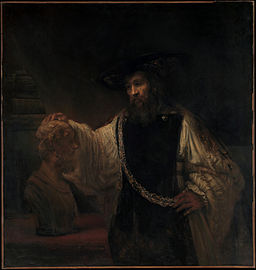
The image above is Aristotle Contemplating a Bust of Homer by Rembrandt, sourced from Wikimedia Commons.