What I Have Learned so Far: Life Lessons, Part II

study-for-inner-improvement-1977

Here is a second round of ideas about the process of living accumulated in a lifetime of observation and action — success, error, and reflection. My profession allowed me access to the thoughts and stumbles, ascensions and tumbles of thousands of folks. Some of my learning is crafted into the bits below. I published an essay on January 8 with the same title, labeled Part I. Perhaps there will be a third set after a while. Here goes the second one:

  • “Not everything that counts can be counted and not everything that can be counted counts.” Einstein most often gets credit for saying so, but the real author is William Bruce Cameron. So much for justice.
  • “Buddies don’t count,” as my friend John Kain says. He meant we should not keep score or expect perfect equity in any relationship. Close attention to a balance sheet will make us (and our soon-to-be former friend) miserable.
  • Know thyself” is inscribed at the Temple of Apollo. I never met anyone who understood himself completely, myself included. Self-awareness is a “more or less” commodity. We consume too much time preoccupied with what others think of us, analyzing why they did what they did, said what they said. One might more profitably endeavor to know oneself and do good in the world.
  • The ability to start over is essential. I counseled people who made dramatic career changes (from powerhouse attorney to clergyman, for example). I had to evaluate patients afresh to see if I was missing something or misunderstanding their makeup. We must occasionally wipe clean the mirror of our thinking and let ourselves be shocked or enlightened by our unphotoshopped image. As Max Weber suggested, whether we wish to or not, our lives will be influenced by how much truth about ourselves and the world we can bear.
  • To understand yourself you need to know your roots. Our ancestors survived, chose mates, and produced children. We inherited their genes and therefore possess the same urges. These forebears also had to detect who was like them and might be friendly, and who was different and might be dangerous. Fruit enabled survival, so we were handed their love of sweets. The creation of tools further enhanced the chance of staying alive. The ability to form cooperative groups helped, as well. Since they didn’t live long, the genes they delivered to us gave us instincts that worked for what we now think of as the first half of life.
  • A troubling aspect of evolution is that it enabled survival, not happiness. Happiness became the bi-product of human actions only if the emotion helped make sure the kids were born, survived, and thrived. The joy produced by love, for instance, bonded families and increased the likelihood the children would come to generate offspring of their own in time.

even-if-happiness-forgets-you-occasionally-never-forget-it-completely

  • We tend to think in terms of before and after: before and after school, before and after you left home; a first job, the death of someone you loved, a first sexual encounter, etc.
  • We don’t need permission from very many people. Asking “to be allowed” means you will hear “no” more than the guy who doesn’t. Such requests make you the hostage of waiters, your children, and people you will never meet again. Often it is OK to just do what you want. No one will stop or question you. The world, within limits, tends to adjust. A wonderful sense of liberation awaits.
  • We need to evaluate our default (automatic) tendencies. Some of us take action, others wait. Some routinely approach, others reflexively avoid. Our strengths can also be our weaknesses when applied to the wrong situations. Best to apply as needed, rather than by default.
  • Personality disorders cause us to rerun mistakes, like an old episode of a poor TV show. One is well-advised to recognize flawed life strategies — recurring behavior patterns contributing to our disappointments. We otherwise risk familiar and fruitless searches for the wrong people; too many or too few chances taken and, either ignoring tomorrow for pleasure today or focusing so much on tomorrow we miss the glory and opportunity offered by the new sunrise.
  • “In the land of the blind, the one eyed man is king.” Within a group of unremarkable people, you can stand out without being extraordinary. Becoming a big fish in a small pond is easy because the pond is tiny, with little competition, and the other fish are not so fine as you are.
  • There are fewer small ponds these days. Over our history, especially when villages and small towns predominated, we could achieve high status without difficulty. Now we must compete with people all over the globe.
  • The only thing you control is what you do, what you think. The attempt to change other adults is a fool’s errand unless they want to be altered, like an article of clothing needing to be resized. Remember the old psychotherapy joke:

Question: How many therapists does it take to change a light bulb?

Answer: One, but the light bulb must want to be changed.

untitled-1993

  • Most selfish people don’t experience much guilt. Those who fear their own selfishness tend to overstate the danger. Even then a self-sacrificing person must care for his own needs. Please recall the airline safety instructions:

If the oxygen mask comes down and you are traveling with someone who is dependent on you, put the mask on yourself first. (Otherwise you’d be of little help to your companion or child).

  • Many folks don’t buy into the belief their choices are as genetically determined as they are. Example:

Maybe you say, “I dress the way I do to look nice.” Well, an evolutionary scholar would tell you ancestors who made a good appearance were more likely to have their choice of healthy, faithful mates and thereby ensure they would create fit offspring. That tendency is “built-in,” so we incline toward concern about appearances well after our biological clocks stop.

  • The average 16th-century man had less information to process in his short lifetime than can be found in a single, daily edition of The New York Times. We must narrow our focus or drown in a sea of real news, fake news, and drivel. Too many of us attend to things of no lasting value.
  • Change can be unsettling. The effort to keep our world exactly as it is, however, can lead us to reduce the size of our lives, resist unfamiliar experiences, and fail to incorporate new people in our circle. Flexibility is a key to life satisfaction. Change is an opportunity to reinvent oneself.
  • Don’t expect sincere apologies any time soon. In 1942 West Coast Japanese Americans were forcibly relocated to internment camps by the federal government, which alleged potential disloyalty during the ongoing war. World War II ended in 1945. Not until 1988 did the USA formally apologize, citing the real reasons for this disgraceful act against a group which included 62% U.S. citizens:

Race prejudice, war hysteria, and the failure of political leadership.

  • Inaction, stillness, and patience are powerful tools. Passive-resistance has been a major and successful method of changing the world, one practiced by Gandhi and Martin Luther King. Here is a modest illustration of how passivity can work for you:

When my wife and I bought our current home, we dealt directly with the owner. He proposed a price. I was silent. As the seconds passed he lowered the number a few times. The man assumed my failure to respond meant he’d not reached a figure acceptable to us. The truth was, however, he went below what we were prepared to pay.

evening-magic-2000-jpglarge

  • If you chase people they are inclined to flee. Stop chasing and they may turn toward you or even walk in your direction. Consider this with respect to your romantic life.
  • I had the pleasure of a friendship with a Japanese businessman residing in the USA. His favorite teacher advised him to choose a career that was his second love, not the thing he loved best. Why?

If you do what you love best as your vocation you will discover it becomes a thing you must do, not an activity you choose to do. You may kill the thing you love.

  • Luck is most often defined by happy accidents and near misses: finding a dollar on the street, winning the lottery, that sort of thing. A bigger scale exists. My wife’s maternal grandmother was an indentured servant in Poland. She served on a farm before indoor plumbing was common. When using the outhouse in wintertime she jumped from one cow patty to another to keep her bare feet warm.

In my mother-in-law’s childhood, she and her young friends picked up lumps of coal that fell off passing freight trains to help heat their homes. I can remember washboards and clothes lines in my youth, a day of few washing machines and dryers. In graduate school we used mechanical calculators to compute research results until giant computers became available. The point?

Be grateful for what you have.

  • Think about random events for a moment. The most unlikely event in your life is that you exist at all. Had my grandparents not left Europe at the beginning of the 20th-century, I could have been murdered by the Nazis some time later. Moreover, for each of us to exist as the unique person we are, every ancestor had to meet and procreate with just the mate with whom they did. Had only one made a different choice or perhaps had intercourse on another day, we wouldn’t be here. Others would.
  • I worked for a quirky psychiatrist at a now defunct psychiatric institution. MJ was enormously bright and also quite full of himself. One day he asked me to sub for him at a meeting. I reported back the criticism I heard aimed at him. He was unperturbed. MJ’s only comment was, “A big tree casts a long shadow.” In other words, MJ viewed himself as a big, imposing tree and therefore believed some people were going to take shots at him, be jealous, etc. I thought to myself, “You really are full of yourself.” A second later I realized he was right:

If you are going to do anything significant in life and hold opinions not universally agreed upon, you need to let the bullets bounce off. There will be bullets.

  • In his Politics, Aristotle writes about those who “proceed on the supposition that they should either preserve or increase without limit their holdings of money. The cause of this condition is that they are serious about living, but not about living well.”
  • Aristotle was born over 2400 years ago. Lucky for us, some of the best advice has been around for a while.

The first image is called Study for Inner Improvement by Helen Almeida, dating from 1977. The next one is Even if Happiness Forgets You Occasionally, Never Forget It Completely, a year 2000 work of Hasson Massoudy, followed by an Untitled 1993 painting of Albert Oehlen. Finally comes Evening Magic created in 2000 by Eyvind Earle. All are sourced from Wikiart.org.

What I Have Learned So Far: Life Lessons, Part I

512px-alfred_stieglitz_american_-_the_steerage_-_google_art_project

Long ago my maternal grandfather told me he missed the boat on his 1912 journey to the USA, trying to sail from England to America. He was late for the Titanic. My mom heard this in her own childhood, decades before movies like Titanic made such stories more common.

Grandpa was a warm, dashing, multilingual man; originally from Romania: the loving and lovable grandfather of one’s dreams. Leo Fabian was easy to look up to; and not only because he was over 6′ tall, slender, straight-backed, and imposing in an era of men of more modest presence. Grandpa owned a wonderful, rascally smile and enough charm to enchant a small village, a bit like Harold Hill in The Music Man. He was the life of the party.

Soon enough I learned that alcohol had been a nemesis never defeated, ruining him in the eyes of his son and much of the world. By the time I was a teen I saw my grandfather hungover, chagrined, and shrunken. My last memory of him is when he offered a weakened, but still welcoming smile for me, his oldest grandchild, from his hospital bed.

Of course, he was a story-teller. No surprise, the Titanic tale was unverifiable.

I think my informal education began with observations of Grandpa, who unintentionally provided me with lessons he never intended to teach. I learned that people with admirable qualities, even those full of love and humanity, can be grievously flawed. Moreover, I realized you can’t believe everything you are told, no matter how much you admire the teller. These were necessary lessons, cruel lessons.

We are carried through life in a flood of such instructions, some needful of learning, some wrong; some unlearned, never learned, or learned badly. All of us are lifelong students enrolled in the school of experiences, a university whose classes are taught in the midst of a vast river: now calmly flowing, now surging. Drop out and avoid experiences at your peril: little learning is found below deck, where the beautiful, sunny, glorious days on the water will also be missed. No perfect grades, either, even for those of us who man the sails and survive the episodes of seasickness.

galgal_hatsala

Since I’ve been on the voyage for a while I thought it might be useful to pass along some ideas not expressly taught, not usually written, and not often offered as sage advice. This is not exhaustive and not everything you will read here can be proven. Still, I began this blog with the idea of presenting ideas about life for my children and I now have a grandson who might profit from them (or run screaming into the night believing elders are best ignored). Here, then, for whatever value you assign, are off-beat bits of what I think I know:

  • I have met no one I thought to be completely evil, evil 24/7. We’d have an easier time identifying them if they were. Indeed, some of the least trustworthy folks were quite charming and generous. The world is full of gray tones. Still, dark gray is to be avoided.
  • Life lessons are often age-dependent. The lessons of youth apply to that time, the lessons of age to another time. Just as the customs of one country differ from another and must be used in the right place and moment, one should acquire the knowledge applicable to the period of life in which you live and use it in a timely way. Perhaps our learning ought to come with a “use by” date. Beware of employing old, once effective strategies which now fail with some regularity. We cannot “freeze dry” our lives. We must continue to adapt.
  • “Some people are so busy learning the tricks of the trade that they never learn the trade.” So said Vernon Law, the best pitcher in baseball in 1960 and a member of the World Series Champion 1960 Pittsburgh Pirates.
  • Fame, that is to say “celebrity,” is fleeting. Ask Vernon Law, still alive at 86. I’ll bet you don’t know his name unless you were a baseball fan 50 years ago or live in Pittsburgh. Nonetheless, I’d have loved to spend one day in Willie Mays’s skin in his prime, a contemporary of Mr. Law. I’m sure I’d immediately have become addicted to the excitement and adulation.

13 Oct 1960, Pittsburgh, Pennsylvania, USA --- 10/13/1960-Pittsburgh, PA: Photo shows the seventh game of the World Series between the New York Yankees and the Pittsburgh Pirates. Vernon Law, Pittsburgh Pirates pitcher, is shown in mid-pitch action. --- Image by © Bettmann/CORBIS

  • “It is what you read when you don’t have to that determines what you will be when you can’t help it.” And just think, Oscar Wilde wrote this before Kim Kardashian was born.
  • If you believe everybody should be able to reason his way out of a paper bag, remember that half of the population has an IQ score below 100.
  • “If you want revenge, be sure to dig two graves.” An old Italian expression about the cost of undiminished anger.
  • The older you get the more time you spend on maintenance. Your body requests nothing when young, quietly obeying your every command, but recording your debt to it. The bill comes due later. By 29 I had to stretch before softball games. As I approached the age at which my dad had a heart attack (47) I began regular aerobic exercise to stay in shape. Stretching by now was a time-consuming daily event. Doctor visits, instances of physical rehabilitation, and occasional surgery enter the picture for many of us, jamming up the schedule. All of this happens gradually, little things accumulate. The change is both astonishing (because you didn’t think it would happen to you) and unremarkable (because you adjust to most of the nicks, scratches, and dents). Things wear out, something you knew abstractly, but hadn’t yet lived. Then you begin to have regular conversations with your friends frontloaded with physical concerns. You hear yourself making comments like this:

“The funniest thing happened yesterday, Steve. I was relaxing in front of the TV and — in the middle of everything — my nose fell off. Lucky for me, I caught it on the way down. A little glue and it looks like new, right?”

Of course, what is Steve going to say? That is, if he is able to speak. I wish I could pinpoint the exact date I turned into this person — like, perhaps, Tuesday, March 8 — but I can’t.

  • Even so, you will still think of yourself as about 20% younger than your real age (assuming you are over 40), perhaps explaining the frequent mismatch between the way people dress or wear their hair and what might be considered “age-appropriate.”
  • We are poor at affective forecasting: predicting our future feelings. An example: “When I make $10,000 more I’ll be happy.” Ask those who have won the lottery for the answer.
  • We are also bad at affective forecasting when it comes to negative events. Given enough time we tend to get over things. However, you might not want to wait months or years. The profession of psychotherapy depends on this, in part. There are also countless exceptions when no amount of waiting will lift you to a higher altitude. Psychotherapy is available for this, as well.
  • Some people, almost always men, succeed in life because they are like blunt objects with eyes, who see a door and keep banging on it until the door finally collapses. A number of women marry such a man thinking he will protect them. They admire his persistence or give in to his unrelenting will, though they aren’t emotionally drawn to him. You will also notice many of his kind on the political stage.

1912__080814

  • Look around you. If you think we humans are rational at all times you haven’t been paying attention. By the way, you are human, therefore …
  • On the other hand, if we were absolutely rational we would be machines: I’d rather have love, even at the cost of heartbreak; joy, even at the cost of disappointment; pleasure at the cost of pain.
  • Time will change you or at least it should. More even than learning from experience, the body and brain do their own shape-shifting and gradually alter who you are. Some of what passes for wisdom is simply getting older, inhabiting a different physique with an altered mix of chemicals running around.
  • No matter how intelligent or physically attractive you are, a number of people won’t want to spend time with you. You will likely believe this is your fault. “Maybe I’m not funny enough, smart enough, well-proportioned enough,” you think to yourself. More often than you imagine, however, it is just because you part your hair the way their father did, a factor of which even they are unaware. Transference is everywhere, not only in the therapist’s office.
  • We all need some amount of compartmentalization and denial. Otherwise life is simply too much. Within limits, the ability to lose yourself in an activity as simple as reading a book or having fun at a party is a great gift. Self-consciousness, being preoccupied with your thoughts about yourself, demands an escape.
  • Sunny days can turn cloudy. I learned to look back and figure out when exactly my mood changed and thus determine what bummed me out. Unravel your discontent early enough in the day and you will sleep better.
  • If you provide friends with too much truth about themselves you are in danger of losing them. Provide them with too little, however, and they aren’t worth having and you aren’t being a good friend.
  • I discovered the generation gap around age 26. Lecturing at Rutgers University I mentioned Adlai Stevenson II. The statesman had died only about eight years before. Stevenson was twice the Democratic Party’s nominee for President and remained a prominent international figure at the time of his death. No one in the large lecture hall of undergraduates knew who he was. These days I find myself spending more time explaining what I’m talking about when I refer to the past.
  • A Bulgarian patient once said, “In the United States people live to work. In Bulgaria we work to live.”
  • I’m still learning. A Thursday night PBS interview of Vice President Joe Biden offered the following anecdote. Judy Woodruff asked him about his plans after leaving public service. Biden referred to issues about which he was still passionate and for which he intended to continue his work:

My dad had an expression: ‘A lucky person (is someone who) gets up in the morning, puts both feet on the floor, knows what he is about to do, and thinks it still matters.’

Biden remains, despite enormous life losses and setbacks, a happy man. By his father’s standard, he is lucky, indeed.

The top photo is The Steerage by Alfred Stieglitz. Taken in 1907, it is among the most famous photographs in history. The lowest class accommodation was literally the lowest on the ship and those who were “upper class” did, literally, look down on you. My grandfather likely took his voyage on such a ship, but I have no idea where he was situated on the boat. The second image is called Life Buoy, the work of Shirley. Both were sourced from Wikimedia Commons.


Pondering Gratitude and the Admirable, Imperfect Life of Morris Abram

512px-heart_of_my_heart_2529992211

A boost to the spirits can come from an unexpected place, even an obituary. The March 17, 2000 account of Morris Abram’s life, as written by William Honan in The New York Times, included this:

Mr. Abram was a young lawyer in Atlanta specializing in railroad cases in 1949 when he began a 14-year struggle to overturn a Georgia electoral rule that gave disproportionate weight in primary elections to ballots cast in predominantly white rural areas at the expense of those cast by urban blacks. The rule perpetuated segregation in Georgia.

Mr. Abram felt the sting of the rule in 1953 when he sought the Democratic nomination for Congress from the Fifth District. He ran on a platform that urged the desegregation of schools and carried populous Fulton County, which includes Atlanta. But he lost two smaller rural counties that had disproportionate weight under the rule and lost the election.

Over the years Mr. Abram helped bring cases against the rule to the United States Supreme Court. On March 18, 1963, Attorney General Robert F. Kennedy, who had been briefed by Mr. Abram, argued the case before the Supreme Court. In a historic ruling, the court declared the rule unconstitutional because ”within a given constituency there can be room for but one constitutional rule — one voter, one vote.”

A remarkable story, then, both for the achievement and the time and persistence it took. Abram advantaged not only those who heard of him in his lifetime, but those who did not. Countless others benefit today. Abram’s name fades, but his work remains. Thanks to him we are closer to a country where “all men are created equal,” even if not yet close enough. As a friend of mine, Rich Adelstein, likes to say, we are all the beneficiaries of people we never met whose names we do not know.

Life, however, rarely stops in the moment you achieve something of genuine greatness or personal importance. Glory is fleeting, the river flows on. Abram faced many ups and downs in his future, professional and relational: failed jobs, marital problems, and more.

In 1973, Mr. Abram was told he had acute myelocytic leukemia. His fight against the disease impelled him to write an autobiography, The Day is Short, in 1982.

Abram lived another 18 years after publication of his story and died of something else. He was 81.

At the conclusion of The Day is Short, Abram offers this:

I have never been a cautious man, and in a good cause, I would be more willing than ever to take risks. As my remission continues, I notice that I am more inclined to consider the long-term consequences of my actions. But I know that time is limited, and I tend to be in a hurry. I am daily reminded of an ancient Hebrew text that says, ‘The day is short, the work is great … It is not thy duty to complete the work, but neither art thou free to desist from it.’

The work to repair yourself also repairs the world. Those who find therapy self-indulgent misunderstand. In making ourselves better we impact the life around us. Perhaps in not so grand a way as this small-town Jewish man’s 14-year struggle to right injustice, but a contribution still. Even Abram’s battle to defeat disease provides an example; as does his sense of urgency in doing his work because, as he reminds us, “the day is short.”

abram_cropped

Morris Abram was grateful for his usefulness to others, offering us still another lesson in how to live. Therapists benefit from their usefulness, too. All of you have my thanks for spending time with my words. I am heartened that you do.

I have been told there are those who look to me for answers, some for encouragement, some to enter one therapist’s mind. Perhaps you are drawn by an unaccustomed frankness about difficult and complicated topics. I hope you enjoy my peculiar slant on a variety of matters or my effortful attempt to achieve an artful turn of phrase. I am aware more than a few find comfort here and I am pleased to provide it when I can. Then too, I try to entertain.

I know my essays are sometimes unsettling. I would apologize, but I am indeed doing so knowingly, though not always with perfect tact. My intention is to get you to think in a new way. I hope I succeed from time to time. This virtual cubby-hole is designed as a safe and civil place in a world not always so. If my provocations do not shatter your trust in me — well — then I’ve accomplished my goal. I am on your side.

To those who feel dismissed in life, know that I and others like myself take you seriously. I think of you as I write. My effort is to speak to you as if we were face-to-face, eye-to-eye, without condescension. A handful of you are friends, some ex-patients, some fellow-bloggers. All of your comments are appreciated and frequently enlightening or touching. I’ve been lucky to make online friendships along the way because of them. All of you — silent or not, known to me or not — are welcome here.

Without people who pay attention to us there would be no therapists.

So thanks for taking me seriously, too.

The best of good wishes for the best possible New Year.

The top photo is called Heart of My Heart. It is the work of Koshy Koshy as unloaded by Jkadavoor to Wikimedia Commons.

A Dozen Ways to Avoid Regret (and a Warning about Endless Therapy)

512px-claude_monet_impression_soleil_levant_1872

When we suffer regret we are, by definition, occupied with the past. We lament things we did or didn’t do, time lost, vanished opportunities. Perhaps, however, it would be useful thinking about how to avoid regret going forward. Here are a few guidelines:

  • Recognize life’s limitations, learn from failure, and don’t stop trying. Anyone with imagination can think of several possible lives to lead, places to go, experiences to pursue. If  you are honest you can even envision a different spouse or children, no matter your great good fortune in those you have. Thus, the world is like a candy store in which only so much consumption of sweets is possible, to borrow a metaphor from Haruki Murakami and Forrest Gump. The earlier you recognize this the more you are forced to refine and narrow your choices. Moreover, you must reach for some of those candies without ever having tasted them and before obtaining experience in how to grasp each one artfully, a guarantee of mistakes.
  • We can only learn from disappointments and try again. Live your values as best you can: dive deep into those few candied heaps of life you deem worth the effort in the short time permitted. Don’t end your days saying, “I should have” or  “Why did I waste my time on … ” Or, worst of all, “Why didn’t I?” Michael Jordan, basketball hero, said:

I’ve missed over 9,000 shots in my career. I’ve lost almost 300 games.Twenty-six times I’ve been trusted to take the game-winning shot and missed. I’ve failed over and over and over again in my life. And that is why I succeed.

  • Improve your choices. Moving through life, take stock, reflect. Write down your analysis, perhaps every five or 10 years. Look where you’ve been, where you are, and where you would like to go. I’m talking about what career you might still pursue, what you’d like to learn about, how much of yourself you hope to devote to relationships, what personal characteristics you still wish to alter, where you’d like to live, what you’d like to see, and the legacy you might leave behind. No one can do everything, be everything. Too much candy, too little time, too much indigestion.
  • Since we can’t invent more hours, we are left to determine how best to spend our allotment. If you hope to become World Champion in the art of perusing and responding to tweets, stop reading this now. You are wasting minutes you could devote to your curious focus on 280 characters or less. For myself, I watch TV/video less than an hour a day on most days, except for those in the baseball season! Why? Because I value the time spent in the company of fine novelists, historians, and ancient philosophers more than what is on the tube. Some of this might strike you as elitist, but no.
  • Literature isn’t automatically “superior” to TV, film, or theater. I’ve simply made a choice: my personal preference. You can find superb TV shows if that is what you believe is a good use of your day. I’m suggesting you think through choices. Assuming you are mature, the most satisfying life possible for you will be a life designed by you — not a consequence of habit or the persuasion of advertising, the boss, or friends. Quiet consideration of how you spend your waking hours is essential to the success of your plan, especially if you are not happy.
  • Be active, take risks, always seek to grow. Some of these endeavors will assume the form of self-disclosure and vulnerability, some the shape of honest self-reflection, some the act of trying new things. The courage to know yourself and then be yourself is never easy. The ground is shifting under all of us. Move, don’t sit still. Reinvent yourself, at least a bit. Proceed, don’t rush, but live with intensity. Walter Pater wrote:

To burn always with this hard gem-like flame, to maintain this ecstasy, is success in life.

256px-soleil_couchant_sur_le_vercors

  • Be wary of bucket lists. I’m referring to the postponement of activities until late in life, the things you want to do before you begin residence below ground. Several problems come with delay: a) you might not live long enough. b) if you are forever looking forward you won’t live in the moment and experience joy in the now. c) bucket lists assume excellence at predicting what will bring fulfillment in 10, 20, or 40 years. We are poor at this. Research on “affective forecasting” (being able to predict how life events will influence our emotions) affirms the weakness. Richard Posner, in his book Aging and Old Age, puts the dilemma of anticipating our future self this way. Say we sentence a 20-year-old to life in prison. Are we punishing the same person when he is 65? That is, does a man change over time? Possibly deepen, mature, give up old hobbies and take on new ones, learn more; become enriched and transformed by love or literature or experience, turn grateful or embittered, for or against life?
  • Unless we can predict the manner in which events and people will work on us and how we will work on ourselves, we might realize a long postponed trip to Paris would have been better in life’s springtime; or, in my case, a Chicago Cubs World Series victory would have meant more to me at 20, when I lived and died by the team’s fortunes, than it did in 2016. By the way, I didn’t plan on morphing into a less avid fan. I simply changed.
  • Regret can be a result of idealization. As Janet Landman observes in her book, Regret: The Persistence of the Possible, this emotional state is akin to the aftermath of a decision made at a fork in the road. We reach the divide and must choose. Proceeding down the chosen path, past the time of easily retracing our steps, we think: “I was mistaken. The other way was better.” But really, do we know?  We only understand the lived experience of the choice we made. The other avenue is easy to idealize because it exists in imagination, because we didn’t encounter the imperfections one can only suffer by a different choosing. Do you wish to spend a lifetime lamenting a mirage?
  • Ask whether there is another side to losses, mistakes, and missed opportunities. I am not Pollyanna. Few who read my writing regularly would think so, I suspect. I will say, however, that I have learned far more from the “slings and arrows of outrageous fortune” than from any other source.
  • Not every mistake can be rationalized, not every loss offers even close to equal compensation in some other form. But before you devote the rest of your days to regret, take a few moments to seek what can be learned from life’s hard and unequal distribution of pain. Perhaps you can create some good out of your awareness of those things you did or didn’t do, the words you said or didn’t say, the chances missed and the poorly chosen roads endured — if not for yourself, then for someone else.
  • Remember that research says you will be happier if you take newfound money and buy a cup of coffee for a stranger than if you use the gift for yourself. King Midas wasn’t a happy guy, was he? Take a hard look at your desire to gain triumphant, towering status and wealth.

256px-sonnenaufgang_schilf_im_winter

  • Be careful how much time you spend looking back. I am on thin ice in saying so. A good therapist begins with history. The untying of binding emotional knots is essential, often requiring discovery of how they came to be, where they remain, and more. Danger exists, however, in believing every knot requires attention, every cognitive or behavioral change demands agonizing soul-searching. Some will loosen with the passage of time, others aren’t too important. CBT (Cognitive Behavior Therapy) is able to master many without endless and wrenching historical probing. Meanwhile, weigh the time spent on a backward focus versus possible gains from attention to the now via action. Curtail whatever retrospective view isn’t essential to making a satisfying life.
  • Is this avoidance, cowardice? Only sometimes. Psychotherapy in-depth encourages a seemingly perpetual return to the bottomless gorge of your memory-distressed soul until you dredge up every dark thing at its floor. Sometimes we must put an end to reruns and begin a new season in the installment series of our lives. Your therapist might urge digging deeper. He may be correct. I’m here to say — on reflection — my patients sometimes knew when to stop when I didn’t.
  • Is there room for gratitude? Such a sentiment is hard to summon in the midst of despair, maybe impossible. The practice of routinely reminding yourself what is good can, nonetheless, diminish sadness much of the time.
  • Time is always moving forward and doesn’t permit time-travel for do-overs. Those facts set the stage for regret. Not because you made horrible mistakes, but because you are human and were thrown into a set of unalterable physical laws (as are all of us). The best way we can deal with what nature offers is to make good use of the present and plan for the future, even though the person for whom we are planning (our future self) may not be as thrilled as we hope with the baton we pass him.
  • Regret is inevitable because our genetic inheritance keeps us unsatisfied, always seeking more and better. Those early humans without such ambitions — those who were easily satisfied — didn’t survive, nor did their offspring become our ancestors. Evolution enabled the perpetuation of our forefathers’ genes in the form of their progeny, but offered no guarantee of joy in our status, our mate, or our job. Regret, therefore, is built into who we are: restless creatures still driven by the biological imperative to behave in a way that increases the chances of our genes surviving, even past our reproductive years.
  • Learn to forgive yourself. You cannot do everything, you will never be perfect, you will disappoint and injure others, your imprint on the planet will (unless your last name is Will Shakespeare or Hawking or Beethoven) be small. We are always learning and forever changing course. Do your best, try to do better, and leave it at that. Life is punishing enough for most of us without volunteering for the cross and offering to hammer in the nails, to boot. As a Christian colleague occasionally told her patients, “Get off the cross, we need the wood.”

You need the wood, too. Take the timber and carve a sculpture or draw a lovely image or build a house; or burn it to keep yourself and another good human warm. Leave the job of summing up your life to history, assuming history cares.

In my book that is enough.

The top painting is Impression, Sunrise by Claude Monet. The second photo is Sunset Over the Vercors Mountains, Seen From Grenoble by Guillaume Piolle. Finally, Sunrise with Reeds in Winter is the work of Benjamin Gimmel. All are sourced from Wikimedia Commons.

Thoughts about Dependence on My Grandson’s First Independence Day

This morning I found myself thinking about my grandson’s first Independence Day: how he is growing, keen to learn and master the world, but also how he will react to the dazzle and display of fireworks. Thrilled, I’m sure, whenever he can stay up late enough to watch. And, I couldn’t help but wonder about an implicit trade-off as children begin to master the world, but perhaps lose some of its magic in the process.

My free association took me to a 1956 nighttime baseball game my uncle promised to take me to — take me to watch the great center fielder Mickey Mantle. I fairly burst with anticipation to monitor Mantle in a contest under the lights, the latter still a novelty for the adults and a first-time experience for me. I continue to enjoy baseball and have traveled to nearly 20 cities for games in ballparks old and new. But I’m not anymore the nine-year-old boy blown away by the idea — the impatient, invisible, excited expectation of attendance — or the youngster of a similar age on another occasion who was stunned by the color green and the expansive daytime beauty of Wrigley Field as I walked up to the concourse from the shadowy underworld of the old stadium, feeling as if I were in a better place — as if the gates of heaven opened for me.

We become more experienced, more confident, and wiser while losing a bit of the thrill of accomplishment. You notice the growing security in any small child and the tenacity and curiosity driving it, but he can’t yet imagine his adult self who will be more used to things, less overwhelmed; a person who, having “seen it all,” won’t get as excited, stimulated, and intoxicated. Perhaps, in part, that’s why we drink or drug to mimic the feelings of a world from which the cellophane wrapper has just been removed.

The little one is so desperate to get away. Yes, he checks over his shoulder to assure himself that the parent has his back, but eventually no longer checking and no longer wanting to be checked, supervised, reigned in. Freedom and competence and recklessness rule. Later come maturity and jadedness, too. We are like toothpaste out of the tube, pristine for a moment, then losing something hard to define. The rewards of the life of one who has broken free are different, more dependable and therefore more essential, but less remarkable and joyous. The colors are duller.

Perhaps, as adults, some of us go places not seen and seek the thrill of a fresh relationship with a younger body to recapture the old intensity: an unconscious effort to touch an uninnocent-innocent in the hope her relative newness will rub off.

Our mature challenge is to make the day new, a bigger effort than for the 10-month-old for whom it simply is new.

But, little boy, I’m sure you wouldn’t be happy as a forever dependent oldster, even for all the moments of untarnished delight joined to your present dependency. Yours is the wonder of a life of constant enlightenment and unfolding, but there is no profit in perpetual incapacity, of reliance on your parents. You must know this deep down because you work so hard to escape it and enter an existence full of mastery achieved at the expense of routine.

One of the happiest memories of my life took place after being taken to a drive-in movie by my parents. It was not only the first film I’d ever seen and the first outdoor movie I’d ever attended, but 3-D to boot! You had to wear special glasses to get the effect, of course. (The trailer above displays an over-the-top promotion of said entertainment: The House of Wax).

I possess little memory of the video. What I do recall is the ride home in the family Chevrolet. The horizontal, seven-year-old version of myself drifted into that Neverland between waking and sleep on the pre-seat-belted bench behind my parents. I was as content as I have ever been, fully confident of having mom and dad to myself (since my two little brothers were back home with a sitter) in the days when I still thought of my elders as Zeus and Hera, god and goddess of the universe. I was sure of being taken care of: safe, serene, and inexpressibly happy, as though a fairy god-mother had touched me with her wand.

I have no advice for the little guy who will visit our home today: it would make no impact on his not-yet-perfected word processor-mind. But if my experience would make a difference, I’d say this:

Don’t grow up too fast, tiny man. Your parents will never again be so young, handsome, and wonderful. You will never be loved with more self-sacrificing intensity. The sparklers on this still dependent Independence Day will never so astonish you.

Seize the day, now and forever.

Whatever Became of Julius Rosenwald and William Schuman?

Have you ever opened the old photo album of a parent or grandparent and wondered, “Who are these people?” So many smiling faces lost to the passage of time.

We spend lots of effort at the job of being remembered. No one wants to be forgotten, unless, like the old-time actress Greta Garbo, you “want to be alone.”

Indeed, one of the chief reasons people skip high school reunions is the fear of not being recalled.

Look around you at the buildings. Once gone, the person whose name appears on the edifice loses control. Buildings get torn down, names get changed.

Take Dyche Stadium, Northwestern University’s football field in Evanston, Illinois. The edifice opened in 1926, named after William Dyche, an NU grad in the Class of 1882, who later became the Mayor of Evanston and oversaw the venue’s creation. To the dismay of the Dyche family, NU sold the rights to the name in 1997 to Pat Ryan, then the Chairman of Northwestern’s Board of Trustees. For eight-million dollars, Dyche Stadium became Ryan Field.

256px-Ryan_Field

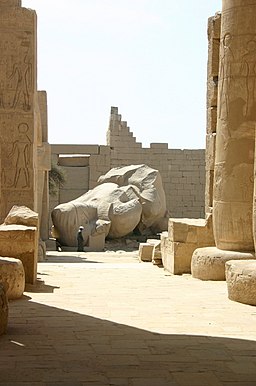
Percy Bysshe Shelley would have understood. His poem Ozymandias tells a similar story about the collapse and destruction of an ancient monument to a once formidable and arrogant ruler. An inscribed pedestal is the only thing left:

“My name is Ozymandias, king of kings:
Look on my works, ye Mighty, and despair!”
Nothing beside remains. Round the decay
Of that colossal wreck, boundless and bare
The lone and level sands stretch far away.

http://upload.wikimedia.org/wikipedia/commons/thumb/a/af/S_F-E-CAMERON_EGYPT_2005_RAMASEUM_01319.JPG/256px-S_F-E-CAMERON_EGYPT_2005_RAMASEUM_01319.JPG

If the exception proves the rule, then we should talk about Julius Rosenwald. You probably don’t know his name and Rosenwald wouldn’t have cared.

Julius Rosenwald (pictured at the top) was President of Sears, Roebuck, and Company from 1908 to 1924, and the Chairman of its Board until his death in 1932. In 1917 he established the Rosenwald Fund, a charitable enterprise designed to have no endowment, i.e. an untouchable bankroll to be invested for the purpose of the charity’s survival. Rather, Rosenwald intended the Fund to disperse grants “for the well-being of mankind” until there was nothing left. The money was gone by 1948; and with it, any chance we might hear about it in our time. Only a 2015 documentary on the philanthropist’s life has (for the moment) reintroduced his name to the public.

During its existence Rosenwald’s fund distributed about $70 million, with much money going to the establishment of over 5000 schools in the South, aimed at educating black youth. Rosenwald was also a principal founder of Chicago’s Museum of Science and Industry, seeding it with five-million dollars and serving as its president from 1927 to 1932. At the time, people in Chicago were as likely to refer to the structure as the “Rosenwald Museum” as they were the Museum of Science and Industry.

http://upload.wikimedia.org/wikipedia/commons/thumb/4/4e/Museum_of_Science_and_Industry.jpg/512px-Museum_of_Science_and_Industry.jpg

William Schuman’s name, on the other hand, was never a household word. But in his day (1910-1992), only Aaron Copland was a more prominent living American composer in the classical world. Moreover, as president of the Juilliard School and then of the emerging Lincoln Center, no one had a greater influence on serious music in the middle portion of the last century. Schuman also wrote 10 symphonies among other works, and won the first Pulitzer Prize ever given for musical composition. His Symphony #3 is arguably the greatest such piece written by an American.

William Schuman: Symphony No. 3

Yet, the centenary of his birth in 2010 was hardly noticed by performing groups and the major US orchestras pay him little attention. I asked an orchestral executive why, with few exceptions, deceased 20th century Americans like Schuman are not performed. His wry answer: once dead “it is easier to say ‘no’ to them.” All the friends in high places who programmed Schuman’s music are now gone, along with his music, except for occasional performances and recordings. The musicians and executives of our own time don’t know his work and don’t care, or so it seems.

Schuman would have agreed, I suspect, with the notion that a composer’s life is like trying to create art on a block of ice on a hot day in July, to paraphrase Arthur Miller. In other words, you hope those notes will last and be played, but the odds are against you.

Shakespeare treated the fleeting memory of our existence more gently in the words he gave to Prospero, the sorcerer, in The Tempest. Prospero’s comment comes as he ends a brief staged performance — a play within a play. What he says refers not only to the matter of creating illusions in the theater, but also to the insubstantial and temporary nature of life itself, not just our names:

Our revels now are ended. These our actors,
As I foretold you, were all spirits, and

Are melted into air, into thin air…

We are such stuff
As dreams are made on; and our little life
Is rounded with a sleep.

The irony implicit in Shelley’s and Shakespeare’s words is that while they talk of the transience of things, their names and works live on. Though it’s not called Dyche Stadium any more, the place Dyche built still stands along with the “Rosenwald Museum.”

Got to run. A recording of Schuman’s Symphony #3 is coming on the radio. Perhaps his music, like that of Gustav Mahler, will be revived 50-years after his death.

The future is full of surprises.

Who knows. Somebody at the reunion might remember you after all.

The top video is the trailer for the 2015 documentary, Rosenwald. The 1970 photo of Ryan Field (formerly Dyche Stadium) comes from Greenstrat. Steve F-E-Cameron is the author of the Temple of Ramses II, Luxor, Egypt. The photo of the Museum of Science and Industry is courtesy of Knarfol. All of these are sourced from Wikimedia Commons. The final image is the Columbia LP (long playing record) cover of William Schuman’s Symphony #3 with the smiling Schuman facing the photographer.

Anticipation and Realization: Can Expecting Disappointment Reduce Your Pain?

409px-In-Erwartung_Keller

My mother used to say, “Anticipation is greater than realization.” She uttered the phrase more than once, always unprompted. It was as if she were giving me a warning about the disappointments of life, the hoped-for moments that wouldn’t fulfill my expectation of them. Certainly, she was speaking of her own pain-filled history. Her strategy was not to predict too much good from events and especially from people, for fear of adding to the list of letdowns. In doing therapy I heard many others tell me they adopted a similar defense, the better to buttress themselves against the world’s assaults. Simply put, don’t get your hopes up, they would say. Otherwise you will be ripe for dismay.

I am no blind optimist, but I think mom was wrong. First, I’m not sure you can effectively steel yourself against all the blows of life. If Death is an opponent with an undefeated record, Life is sometimes your best friend and at others your worst enemy. He will lift you up and tear you down. Even in a lucky life like mine “there will be blood.” But since I like the heady experience of those times life lifts you off your feet, I must pay the cost of admission to the airport. These are the terms of the contract we accept by taking our first breath. We do well, if we can, to bounce back when defeated, since the future may hold more glorious and unexpected flights.

Secondly, many of the injuries we suffer are impossible to anticipate except in an abstract way: we know people will leave, we expect occasional betrayal, we recognize nobody wins every game, on and on. Only a fortune-teller knows exactly how and when. Thus, in a moment of pain, we are taken by surprise despite our preparation. Moreover, we risk wasting our days in a state of general worry or dullness, bypassing every chance for love, kindness, and accomplishment. Expecting disappointment rarely reduces the hurt, but the strategy guarantees little possibility of joy.

My most memorable experiences were impossible to fully forecast. A trivial example: as a kid I looked forward to attending a NY Yankees baseball night game against the Chicago White Sox on May 18, 1956. I couldn’t wait until my Uncle Sam took me. The thrill I imagined weeks in advance was amplified a thousand fold when the mighty Mickey Mantle hit one home run batting right-handed and another left-handed, a feat rarer than pitching a no-hit game. I can still picture the port side clout, as if carried by a rising tide, the ball aglow in the arc lights until the spheroid struck the right field upper deck of old Comiskey Park. But for the impediment of the rafters I thought it would reach the moon.

I have been moved to tears by music, by the birth of my children, and amazed that I could move many of my high school classmates to tears by a speech given at one of our class reunions. A crackling physical electricity of athletic performance passed through my body on one occasion — a sensation I never knew possible. I’ve enjoyed luck in love and friendship as well as heartbreak and betrayal. A business partner and friend stole tens of thousands of dollars from our enterprise. My parents are both long dead. A lifetime of movies, books, conversations and observations did not prepare me for these sensations and emotions when the moment arrived. Life is about taking action and being surprised and being grateful despite the fact there is no free lunch.

Some hunker down in their shelter of straw thinking the big bad wolves will thereby be held off. I’m here to tell you I know of no fool-proof defense against injury and no Teflon-infused clothing to deflect the “slings and arrows of outrageous fortune.” What we are offered is a life of imagination and fear and effortfully summoned courage and friendship and tears and laughter and loss and taking chances: in other words, of winning and losing. If you think otherwise, well, you haven’t been paying attention.

Sample the menu of life. Not all the dishes are tasty, but even some of those you don’t like are informative, and knowledge is usually desirable. Don’t make the highlights of your life the things you buy for yourself. Do make some of those highlights the gifts (of all kinds) you give to others.

The best events cannot be anticipated. And don’t glut yourself: a gourmet meal should be a special treat, not a routine pattern of diminishing novelty. The greatest art, music, and literature become old if revisited daily. I wouldn’t want to attend a performance of Beethoven’s 9th Symphony even once in three years. Celebrate the rare occasion. Become an enemy of routine. Do look forward to some things, be they goals worth working for, a date with your sweetie, a trip, or a once a year get-together with old friends. Anticipation has magic, as we note in the lives of children every Christmas. Don’t become like the worker in a candy factory who grows tired of chocolate by eating too much.

The world is not your oyster, but there are some good bites. No one gets out alive, yet brave souls seize the day. On a fine afternoon your bite will feel like more than enough. You might even uncover a pearl.

The top image is called In Anticipation by Albert von Keller. It was sourced from Wikimedia Commons.

Insecurity and Our Preoccupation with Appearances

512px-Peter_Paul_Rubens_-_The_toilet_of_Venus

We try so hard to make a good impression, don’t we? No one enjoys a disapproving audience. We dress well, hide our inner turmoil, and smile. We comb our hair, clean our clothes, and wash pretty often. Why do we care so much about the opinion of onlookers?

The simple answer: because it was historically dangerous to be unattractive, unsuccessful, and unliked; dangerous to survival and damaging to our chances of finding a mate. Most importantly, those historical facts continue to influence how we live today. They have major implications for the type of person we seek in a partner; why we compete in business and games; why loneliness feels so terrible and why personal insecurities are widespread. Let me explain.

Evolutionary psychologists think about us in terms of the qualities that enabled our survival through thousands of years. Of course, our long process of descent from prehistoric ancestors required them to complete two missions: staying alive until sexual maturity and making babies who lived beyond them. Whatever innate preoccupations and skills enabled early humans to meet these two criteria were passed down in their genes as part of the never-ending chain of life, like a relay race in which the baton has now been given to us. The inborn talents or defects of those who didn’t survive didn’t get handed off. Those folks aren’t our ancestors.

Now, you may be saying, OK, but I’m pretty smart and I make my own decisions. I don’t need to be like people who lived in caves and wore animal skins.

Not so fast. Think about anger. It helped our forefathers defend against attack by enemies and hungry carnivores. You live with their capacity to defend yourself. And some of us blow-up at those we love, commit murder, and make war.

Or let’s say you are a guy. Remember back to your childhood when girls were yucky? Then one day you had an erection. I doubt this was a well-reasoned and much-desired gift you put on your Christmas list — unless your parents were more liberal than mine, that is. Not everything you do is a matter of thoughtful choice, unmotivated by Mother Nature.

We are wired to survive and to mate with a member of the opposite sex who is capable of producing and supporting a new life. So whom do we choose? A woman at the dawn of human existence had to be especially concerned with finding a man who could defend her and provide for her when she was pregnant and vulnerable. Evolutionary researchers believe several qualities signaled such ability: physical strength, intelligence, stamina, the capacity to work in groups, leadership, etc. Thus, when a woman is in the market for a man rather than a fling, she is influenced by her ancestors’ inherited tendency to find one who can make a living and create a safe residence. Yes, I know women are no longer uniformly dependent on men, but the ladies’ genes didn’t receive the memo.

512px-Federico_Andreotti_-_The_Persistent_Suitor

What about physical appearance? Women notice handsome men as much as men recognize the beauty of the fair sex. Unlike men, however, who place physical appearance at the top of their wish list, attractiveness is further down her tally of desired attributes in a permanent sexual partner. Why? Again, because of the historic vulnerability of women carrying and bearing their children. A female can only afford to be picky about noble features and hot bodies if she has a choice among men who first can accomplish the things she and her future children will need. Thus, a lady cannot allow the luxury of opting for surface qualities over those more essential to her safety and her child’s well-being.

Men are more likely to be motivated by just one thing: a healthy and fertile appearance (which is correlated with youth and beauty). Nature permits them to indulge themselves because the physical cost of producing a child will be borne by their partner. As the famous trial lawyer Clarence Darrow said, “There is no such thing as justice — in or out of court.”

Of course, few of us think about these things when we are on the prowl. Remember, too, I am simplifying the story for the sake of brevity.

Now, on to the origins of insecurity. Competition is built into the system. Should you want the most attractive female (the best potential mom in evolutionary terms or the hottest mama in your feverish dreams) you must stand out from the crowd of other men in some way suggestive of your superior ability to be a provider. Thus, men have historically tried to make lots of money (even more than necessary to live), achieve high status, display their excellence in the performance of an activity (business or sports) and impress with their intellect and cleverness. Men size up the competition to get the best of them. Insecurity — the preoccupation with where you stand in the pecking order — necessarily follows.

Females compete for males as well. The cosmetics and fashion industries thrive on the genetically fixed desire to catch the eye of a husband. Again, however, when out shopping you aren’t likely to think, “those jeans will improve my chances of getting my genes into the next generation.” Instead, you say to yourself, “Wow, those jeans look good on me.” Only people like me think of genes, not jeans. And, if you repeat similar questions often enough — what looks good on me, what doesn’t, how do I compare with the others — the insecure background of one’s thought becomes the norm.

Earlier I said it has been historically dangerous to be unattractive, unsuccessful, and unliked. If humans of antique times couldn’t find a sufficiently enterprising and healthy sex partner, that person’s genetic line would end. Those who didn’t make friends found their chances of survival on their own were poor. Thus, whether looking for a mate or a group affiliation to increase their odds (against other tribes, animals, and nature) they needed sensitivity to any word, expression, element of body language, or deed signaling another person’s disinterest, dislike, or disaffection from them; in addition to those indicators communicating they were welcome or pleasing to the crowd. Unfortunately, the ability to determine how they were coming across to others required a preoccupation with other people’s opinions: a recipe for insecurity and self-consciousness. Those who didn’t care how they were being received didn’t hand down their genes successfully.

Lonely_guy,_shadow_as_friend

How does loneliness fit in? A soul contented in his isolation didn’t mate. Women and men satisfied just with the company of their sexual partner reduced their chances of survival compared to couples who had alliances with others. Individuals who were happy when alone, therefore, didn’t pitch their genes forward into the next generation. Men and women discontented when by themselves, however, would have wanted to join up with other creatures. Since group participation increased the chance of surviving, procreating, and raising a child, their unhappiness when separated from humans is a quality we now have: it motivated them to take an action useful to staying alive.

There are other factors beyond evolution influencing you today. Your upbringing, your own life experiences, and the individual set of incidental personality traits nature handed to you. But, back there somewhere is the long reach of the instincts that survived the evolutionary relay race. The ways in which we react, think, and act are more determined by the successful tendencies of our ancestors than (I suspect) most of us consider or believe.

In short, having a mind drawn to thoughts of both friends and strangers comes naturally. Our preoccupation with status and money, even though it can create misery, is a quality that long ago began to improve the chance of survival and is still in us. We operate according to a program written by nature on the men and women who lived here an eternity before we jumped out of mom’s womb.

The aim of evolution was never to make us happy. We can only challenge ourselves to deal with the insecurities and preoccupations it deposited in our genes. Those instincts don’t always work well in a world that, for the most part, is much different and safer than the natural state of man’s life, described by Thomas Hobbes as “nasty, brutish, and short.”

In our search for satisfaction we must grapple with a biology that often makes us discontented and wary, replicating what our ancestors did to live. Understanding this gives us a better chance of remaking ourselves the best we can to suit not their time — but ours.

The top image is Toilette der Venus by Peter Paul Rubens. The second painting is The Persistent Suitor by Frederico Andreotti. The cartoon was created by Welleman and is called Lonely Guy, Shadow as Friend. All come from Wikimedia Commons.

The Lists We Keep and the Meaning of Life

51E68PBGVEL

“Everyone has a list and everyone is on someone’s list.” I heard this from a musician, speaking of himself and his 100 orchestral colleagues. The statement reminded me of the 1971 “Enemies List” kept by President Richard Nixon’s assistant Charles Colson, naming Nixon’s biggest political and public opponents. He even included the movie actor Paul Newman. I suspect, however, those of us who make lists like this don’t actually intend to meddle and damage other lives, as Nixon did by means of Internal Revenue Service audits and the like. Fortunately, the IRS Commissioner Donald C. Alexander refused to do the President’s dirty-work.

Our catalogues of people and things are usually more benign. Here are a few:

  • Shopping lists.
  • To-do lists.
  • Bucket lists. I always wonder about this one. Postponing gratification is useful to get ahead in life, but assumes there will be life ahead, and the kind of health permitting joy in the delayed experiences. Anyone over 50 will tell you not to postpone too many activities. The things of youth belong to their time. Any athlete past his prime can affirm this. Down the road, the bucket springs some leaks and will not hold the treats we put in it.
  • Lists of lovers. I recall a conversation with an old friend and somehow it came up that he’d slept with about 50 women in his long life. He wasn’t bragging, but his production of a number suggests he counted them. In fact, in the opera Don Giovanni (Don Juan) by Mozart, the composer gave us something called “The Catalogue Aria,” sung by his servant Leporello. Here is how it begins:

My dear lady, this is the list
Of the beauties my master has loved,
A list which I have compiled.
Observe, read along with me.

In Italy, six hundred and forty;
In Germany, two hundred and thirty-one;
A hundred in France; in Turkey, ninety-one;
But in Spain already one thousand and three …

I leave it to the reader to come up with the proper (?) response to this.

  • Lists of medications. The tally is created by older people, of necessity, because new specialist physicians need to avoid prescribing drugs likely to produce a dangerous interaction with those already in the system.
  • Lists of jobs (a résumé).
  • Lists of publications. Academics are judged by their number of writings, the excellence of the journals or books in which they appear, and the extent to which their work generates further scholarship from other authors and researchers.
  • “Ten best” lists. News and entertainment media enjoy ranking athletes, movie stars, and places to go. Of course, you can make your own.
  • Lists of employees, those who sign up for a course, etc.
  • A catalogue of life unfairness and injury. Those who routinely recite these (we all know at least one such friend) is someone whose presence can only occasionally be tolerated.
  • A similar list of grudges.
  • A short list of regrets — the big ones. Some of us keep circling our thoughts back to a handful of actions we ought to have done or not done. Interestingly, research suggests men are more likely to kick themselves about the chances they didn’t take with the fair sex (the woman not pursued, the opportunities bypassed), while the ladies reflect on relationships they chose with the wrong men.
  • Lists of things for which we are grateful. Not everyone has a list of this kind, but the benefits can be considerable if you review and remember the items.
  • Mental lists of subjects to talk about on a date. Young men often create these for fear of running out of topics of conversation.
  • The things you can’t do anymore and the parts that hurt. Older folks, without much pressure, can tell you and tell you — and tell you.

Lists tend to fall into categories. Those that are practical and helpful (to-do and grocery), achievement (publications and lovers, the latter if you are a braggart), tales of woe (the times you’ve been dumped and jobs lost), etc.

We probably are better off with fewer lists, other than those involving gratitude or producing a sense of fulfillment. List making, beyond what is necessary, doesn’t get you too engaged in the world in front of you, unless it includes actions you intend and a plan to carry them out. You need a method for your new year’s resolution madness, for sure.

Holding grudges doesn’t make you feel better, while creating a list of conversations topics for a date might. Remember, past a certain indeterminate age, we tend to enjoy telling stories about good old days. The best advice, perhaps, is to experience as many of those days as you can, not only to enjoy them in the moment, but bank them for fond remembrance later.

We often look for a cognitive lightning bolt, an epiphany, or a turning point to change our lives: “If only I do this or try that, then I will be transformed and fulfilled.” Or maybe you say, “These five things are what I need,” as if the check-offs on your list are both necessary and sufficient — a guarantee of happiness. Ah, but perhaps you will think of one more to achieve and then one more still when the last one is done. There is no end to the number of awards to attain, money to bank, and places to see.

I wonder if sometimes we miss the simplest things, forgetting to put them on the paper with the tangible wish list. Our feverish pursuit of goals — intent upon grasping and holding each one we touch — suggests a permanence not present in life. We believe once we grab them they will assuage all discontent. Are we like dazed and thirsty souls in the desert who see an oasis ahead, not recognizing it is a mirage instead?

Meanwhile, those simplest things cost us nothing and bestow what we all want: to live well. Yet they are easily lost in the overheated tumult of life and the mind-numbing routine of the day.

As Jack Palance said to Billy Crystal in the 1991 movie City Slickers, the secret of happiness (if there is one) all comes down to “one thing.”

What is that “one thing?” Watch:

How Life is Like an MRI

User-FastFission-brain

Compacted into 30-minutes, having an MRI is an analogue for living. It took only one half hour in the machine to get a visual impression of my knee. There were no life threatening conditions. Just possible surgery due to wear and tear. Both words, literally.

I lay myself down on a movable platform. Imagine me as a cigar on my back, electronically slid into and out of a narrow, cylindrical enclosure. The magnets, on at all times, made a metallic, heartbeat-like racket; louder and arrhythmic when the machine got excited attempting to get a proper picture of the crucial body part: the kind of sound to make a person believe he was being fed into a meat grinder. I was given ear plugs which never fully killed the noise. The technician reminded me to be still, lest the exercise become worthless.

In the magnetic resonance imaging machine you enter a world of “booming, buzzing confusion,” as William James said. Is that any different from the world outside the hospital? You are on a very short assembly line. On it. Now you know something new: not what a factory worker knows, but the piece of metal or plastic on which he works before the product moves on to the next employee on the line. I had become a thing, objectified, like people we pass every day, unknown to us except by a few details. Just as we are unknown to them.

The cigar was left to mark the time. Nothing to read or notice. I’d been offered headphones and a choice of music, but experience informed me tunes couldn’t compete with the creature swallowing me. If one is a catastrophizing sort, here is a major opportunity to think the worst: “I won’t be able to be still, I’ll screw up the picture and therefore screw up the surgery and therefore screw up my life!” “I’ll sneeze or need to pee.” “One of the technicians will mess up.”

Or, if you prefer, you can take the 30-minutes and contemplate everything else wrong with your life or capable of going wrong. You are in any case, at the mercy of circumstances beyond controlling. Like life, again.

I did, in fact, have a foot cramp while on my back. The right foot, not the one in need of stasis. A few flexes calmed it down.

My left hand held a “panic button.” MRIs sometimes require the patient to live in the tube head-to-toe. I’ve had that done too and if your claustrophobic (I’m not) you need the panic button. The machine mimics how fate acts upon us. There are some things to which one can only submit. Fortunately, I took the event as an opportunity to meditate. Until, at least, I got the idea for this essay and thought about what to write. Make lemonade out of lemons, another life lesson.

Had I been upset, instead of panicking I could have reminded myself the hospital visit would soon be over. This too shall pass. My first time in the tube I remember thinking it might be an experience from which I’d learn something new and interesting. “This isn’t a misfortune, but a part of life.” If I lived a while back I’d have no remedies such as the knee surgery ahead. Psychologists call this “reframing.” Taking a new perspective on your situation.

In the big picture we are kind of like the cigar. On a conveyor belt that sometimes moves forward, sometimes in reverse, and makes no progress much of the time. We are dependent on the kindness of strangers — people like the two competent and kind ladies who took care of me. We move and are moved, not only as a matter of inches, feet, or miles, but in the emotional sense. The experience in the tube, like all experience, is time-limited.

The key, if you can find it in the “booming, buzzing confusion” of the world inside and outside your brain, is sometimes to relax. Control what you can, give in to the rest. Take the people around you for who they are, not objects, but folks made of the same stuff you are. We laugh, we cry, we struggle, and — if paying attention to what is important — we give some love, get some love, and do a little good.

Two out of three is a passing grade.

Enjoy the ride. However long, it is brief. So you better, in the words of Woody Guthrie, “take it easy, but take it.”

The top image is explained by the man whose brain was imaged, FastFission: “Made from an fMRI scan I had done. Goes from the top of my brain straight through to the bottom. That little dot that appears for a second on the upper-left hand side is a vitamin E pill they taped to the side of my head to make sure they didn’t accidentally swap the L-R orientation.” It comes from Wikimedia Commons.