What Children Need From Parents III: Beware the Extinction Burst!

http://upload.wikimedia.org/wikipedia/commons/1/1d/Albino_Rat.jpg

Popular culture gives us just enough information to be confused.

Not surprisingly, many parents who have never taken a psychology course know it is important to set limits on their children and to be consistent in enforcing those limits. Despite this, a good many parents don’t have the strength of will to withstand the repeated pleading of their kids, or the energy to do so.

If your child wants you to buy him a candy bar or a toy while you are in the store, many parents believe it is simply easier to give in than to listen to the endless entreaties of their offspring.

In some cases it can be too exhausting or overwhelming to have to deal with a persistent child, in other instances the parent might fear losing the child’s affection if the desired treat isn’t forthcoming, and in still other situations the parent feels guilty if he or she deprives the youngster of something.

For all the reasons I’ve just mentioned, I always tell parents before they intend to change their style from one that inconsistently reinforces their child’s misbehavior, they have to be strong enough and knowledgeable enough to be prepared for what comes next.

And what comes next is something pretty powerful.

Its called an “extinction burst.”

First, what is “extinction?” Extinction occurs when a behavior that has been previously “reinforced” (some would use the word “rewarded”), no longer receives reinforcement. Eventually, the organism (animal or person) will stop performing the behavior. Put differently, the undesirable behavior is “extinguished.”

Take, for example, a laboratory rat. You can teach these creatures to press a bar in order to get a food pellet. Rats are good at this. But, if you no longer give the rat food pellets for pressing the bar, the critter will eventually stop doing the bar press. But there is a catch here and it relates to the word eventually. And the catch is what is called an “extinction burst.”

Let us assume your child, like the lab rat, has learned something about how you deliver reinforcers. The reinforcer could be the aforementioned candy bar or toy; it could be money; it could be your attention; it could be staying home from school; it could be a lot of things.

And, let’s further assume that you no  longer want the child to keep pestering you for whatever it is that he wants. Now, remember he hasn’t gotten what he wanted every time, but often enough to learn to be persistent and keep at it until you “break” under the assault.

The “extinction burst” consists of the young-one doing even more of the behavior you want to eliminate at the point you stop reinforcing him.

That might mean he will be louder, or pursue you longer, or repeat more often whatever has worked before. It can go on for a very long time until, finally, the child learns the lesson you want to teach him; in other words, learns he will no longer receive what he wants for his inappropriate actions.

But if you finally do break down and reinforce the child with what he wants during the “extinction burst,” he will have learned an awful truth: “Well, maybe I just have to do this behavior longer or more or louder in order to get what I want.” Indeed, the child doesn’t even have to be able to think or say this to himself.

Even laboratory rats operate according to the same rules of learning, and no one I know has had a very deep conversation with a rat lately.

At least, not the four-legged kind.

Parents sometimes tell therapists they have tried to be consistent and it failed. In other words, that the science regarding “extinction” and setting limits is inaccurate.

But what has really happened in this kind of case is the parent wasn’t ready to deal with the extinction burst. Their inability to tolerate the “burst” of seemingly relentless pestering or complaining eventually led them to reinforce the child once again for the undesirable behavior; and, in so doing, made it harder to extinguish the behavior than when they started.

Had the mom or dad only be able to stay-the-course and resist the child a bit longer, the “extinction burst” would have ended.

The moral of the story is to prepare yourself before changing your parenting-style in an effort to become more consistent. If you aren’t absolutely sure you have the organization, energy, strength, patience, and self-confidence to withstand the “extinction burst,” don’t even try. You will only make things worse.

And don’t expect your child to really believe you when you say “this is the last time I will let you do this” while you once again reinforce troublesome behavior.

Talk is cheap and, like those same lab rats who can’t understand your language, your child will pay attention to what you do and not what you say.

But, if you do have the requisite qualities that any good parent needs and you are fully prepared to hold your ground with your child, you might be quite pleased at how you have reasserted yourself and gotten control over the home situation.

To do that, the earlier you start in your child’s life, the better.

You may be interested in the following post on the topic of consistency: What Children Need From Parents II: On Slot Machines and Candy Machines.

The photo of an Albino Rat was sourced from Wikimedia Commons.

What Children Need From Parents II: On Slot Machines and Candy Machines

http://upload.wikimedia.org/wikipedia/commons/thumb/b/bd/Slot_machine.jpg/500px-Slot_machine.jpg

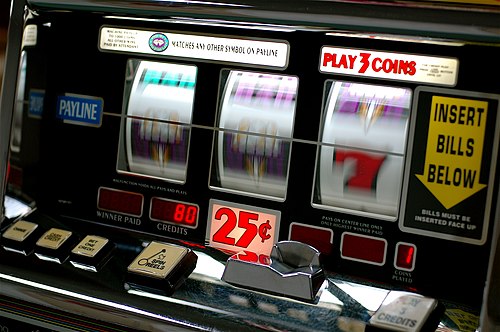
Do your kids see you as more like a candy machine or a slot machine?

It’s not a silly question.

The two machines are rather alike. Both require you to insert some money. Both then demand that you engage the machine, set it in motion. In the case of the candy machine, you press a button or pull a lever to make your choice. The slot machine waits for your follow-through on its lever or “arm,” hence the name, “one-armed bandit.”

That is where the similarity ends and the answer to the question becomes essential: do your kids see you as more like a candy machine or a slot machine?

The reason is as simple as it is important. The candy machine is dependable, reliable, and consistent. Every time you insert your coins and make  the selection, it provides you with the item you have chosen. If, by chance, it should not, you would quickly stop inserting coins because your knowledge and experience tell you that no matter how many more coins you deposit, the machine will not do what you want. It is broken.

The slot machine, however,  is another story. Your knowledge and experience tell you that the machine’s failure to provide you with winnings on one occasion doesn’t necessarily mean that you won’t be a winner the next time, or the time after that. It might take you a very long period of failure and much expenditure of hard-earned silver dollars before you would come to the conclusion that the machine is broken. The machine, when its working correctly delivers winnings on an intermittent (or inconsistent) reinforcement schedule.

Getting the picture? If your children see you as consistent and reliable (like the candy machine) in responding to their requests and their pleadings, they will know that asking for what they want more than once will do them no good: the answer will be the same on the 10th request as it is on the first. And once they have learned this, they will make very few additional requests of you beyond the first one.

But if they see you as similar to the slot machine, boy are you in trouble! They will keep at you, over and over, because they know that one failure at winning doesn’t mean the game is lost. Perhaps the second try will work, or the fifth, or the fiftieth. They will know you better than you know yourself. Simply put, they will know that they have a good chance of wearing you down so that they can have the toy, the TV show, the attention, or the food they want; they will know that the punishment you are trying to enforce also can be changed, maybe not by pleading their case only once, but by repeated appeals to you. Your goose will be cooked.

Kids, of course, have more energy for this sort of “back and forth” than most parents do, so time is not on your side. And the longer they have experienced your inconsistency, the longer it will take for them to “unlearn” what you have taught them about yourself.

The message is simple. Say what you mean and mean what you say. Do what you say that you will do. It will easier on you and better for your children. But before you get started, be prepared for the “extinction burst.”

What is that, you say? I’ll cover that topic in my next blog.

The above image is a Slot Machine by Jeff Kubina from the milky way galaxy, sourced from Wikimedia Commons.

The Upside of Depression and the Downside of Medication

http://upload.wikimedia.org/wikipedia/commons/thumb/d/dc/Depression.jpg/500px-Depression.jpg

Are there advantages to being depressed? Something good about something we think of as so bad? A recent New York Times Magazine article by Jonah Lehrer makes just that case: Depression’s Upside.

The essence of the argument is that some episodes of depression allow for and encourage a kind of analytic rumination that is productive. Put another way, the tendency in depression to focus on a problem, mulling it over to the exclusion of other thoughts, permits the sad person to find a solution to his difficulty and change his life in a positive way.

The counter-argument, however, is that the ruminative process is both painful and unproductive — that it often creates a kind of self-flagellating preoccupation with one’s trouble rather than a process that leads to something good; that unhappiness and focusing on pain and its concomitants simply feed on themselves to no helpful end.

In my clinical experience, therapy with people who are depressed over loss or injury often breaks down into two phases. The first of these is a grieving process, where the person expresses and processes (or sometimes purges) the feelings of anger, sadness, emptiness, desolation, and hopelessness that come with the loss of something of value — a love, a job, high social status, a capability, a fortune, etc.

The second phase involves learning from one’s painful experience about how to live differently, make different decisions, associate with different people, become more assertive, overcome fear; value things differently in life such as money, material things, status, accomplishment, friendship, and love.

Naturally, neither of these two phases is absolutely discrete — they blend into each other and overlap each other. As a practical example, someone who has had a series of bad relationships will typically need to grieve the unhappy end of the most recent one and, in the process, learn how he happened to choose a person or persons who made him so miserable; then changing whatever needs to be changed internally and externally so that different and more satisfying choices occur in the future.

People who are like the hypothetical individual just cited usually come into therapy in emotional pain and seek relief of that pain as promptly as possible. This desire is entirely reasonable — who wouldn’t want this? Some of them request medication, which is often the fastest way to “feel better.”

But many are leery of psychotropic drugs and see them as artificial, hoping that therapy will produce a more lasting fix without dependency upon a foreign substance. Indeed, while a good therapist will strongly encourage the use of medication for someone who is seriously depressed, i.e. suicidal, unable to work, sleeping away the day away (or almost unable to sleep); that same therapist will also know that medication sometimes serves to “de-motivate” the patient, giving him or her a relatively quick solution that allows that person to tolerate an intolerable situation. In the New York Times Magazine article mentioned above, Dr. Andy Thomson describes this problem eloquently:

I remember one patient who came in and said she needed to reduce her dosage. I asked her if the antidepressants were working, and she said something I’ll never forget. ‘Yes, they’re working great. I feel so much better. But I’m still married to the same alcoholic son of a bitch. It’s just now he’s tolerable.’

Clearly, this woman was aware that she needed to be in some amount of discomfort in her relationship with her husband in order to be motivated to get out of it. The drug made her feel better, but, it also reduced her incentive to change herself and her life. It was, in effect, a kind of band-aid, rather than a real cure. It anesthetized her and, in so doing, robbed her of something that was essential for new learning and behavior change to occur.

Unfortunately, most people who come to therapy are neither as courageous or insightful as the woman just described. Once they feel significantly better, whether due to therapy or medication, it is common for them to be less interested in continuing treatment. They have recovered from the event that precipitated their entry into therapy, but they might not yet have learned enough to avoid making the same mistakes that contributed to the problem in the first place.

Such a person can reason that the cost of therapy (both financially and in terms of time, effort, and the difficulty that comes with changing one self) is now greater than emotional pain from which they might still be suffering. Put another way, at this point, doing therapy “causes” more difficulty and pain than not doing therapy, just the reverse of what seemed true when they started the treatment process.

At this stage, those who continue in therapy have something that an old mentor of mine, Truman Esau, used to call “therapeutic integrity.” What he saw in some of his patients was an almost heroic desire to make themselves better regardless of how much the actual process of doing so was difficult, uncomfortable, or painful.

These patients didn’t shy away from problematic truths about themselves or others. They worked hard to stretch and challenge themselves, knowing that it was crucial to improve. They didn’t simply want a quick fix. Like the woman in Dr. Thomson’s example, they recognized that some pain was essential to being motivated. They knew that there was no such thing as “a free lunch,” and were willing to do whatever it took to repair and better their lives.

If you are in therapy now, it will be important for you to be sensitive to this shift from the often intense distress that brought you into therapy, to the point when the therapy itself might seem distressful. This can mean that the therapist is not skillful or that he is pushing you too much, but it just might also signal that some of the most difficult life changes you need to make are still ahead of you, even if the cost of making those changes seems greater than when you started treatment.

If you leave therapy because it is hard and unpleasant work, the problems you have won’t care. They will simply continue to reside in you, work on you, and trip you up. It is not enough to get over your last disappointment or unhappiness, but to change yourself enough to avoid future problems.

Few things that are worthwhile come to us for free.

The above image titled Depression is the work of Hendrike, sourced from Wikimedia Commons.

Are You Narcissistic?

http://upload.wikimedia.org/wikipedia/commons/thumb/b/b0/Fran%C3%A7ois_Lemoyne_001.jpg/500px-Fran%C3%A7ois_Lemoyne_001.jpg

Have you ever been called a narcissist? What does that mean? Let me offer you an image that might help you understand it.

Imagine that you are standing in front of a mirror, but at some distance from it. You can see yourself, but you can also see a great many other things around and behind you. Now envision yourself walking toward the mirror.

If you get close enough, you will see only one thing: yourself. It is not necessarily that you are indifferent to whatever else might be behind and around you; rather, you are so taken with your own likeness, that you become unaware of other people nearby and how they might be faring.

That is narcissism: a fascination with and almost exclusive focus on yourself. The word comes from the Greek myth about an unusually attractive young man named Narcissus, who falls in love with his reflection in a pool, not aware that he is looking at his own image. Inevitably he perishes because he cannot get over this preoccupation.

At the extreme, too much narcissism becomes a Personality Disorder. That means it is a pattern of behavior and internal self-involvement that is rigidly pervasive and leads to problems in relating to others. People who suffer from Narcissistic Personality Disorder tend to lack empathy for others; they are grandiose in their inclination to overestimate their worth. They usually assume that others will not only share in this high appraisal of their value, but treat them accordingly. Indeed, they expect to be admired and take that admiration as an entitlement.

The word insufferable comes to mind.

http://upload.wikimedia.org/wikipedia/commons/thumb/d/de/Michelangelo_Caravaggio_065.jpg/240px-Michelangelo_Caravaggio_065.jpg

Such people believe that the rules that apply to most others might not apply to them because of their special qualities. Nor do they clearly see the injuries that they inflict on others; or show empathy even when such injuries are brought to their attention. If you are useful to a narcissist, able to help him advance his agenda, then he will probably want you around.

At the moment that you are no longer of value, however, or have been replaced by someone deemed better or more useful, you are in danger of being set aside or discarded.

The narcissist tends to have fantasies of great achievement or idealized love and exploits others. And when his behavior fails to lead to the result that he believes is his due, it is rare for him to fully recognize and take responsibility for that failure. Without that awareness, circumstances and other people are blamed, and he is likely to continue on the same unfortunate path indefinitely.

And to answer the question posed in the title, given the blind spot just mentioned, if you are narcissistic, it is unlikely that you will so identify yourself.

Initially, you might find such a person dashing, enormously self-confident, and appealing, perhaps even a visionary — definitely a big personality. Closer and more frequent contact, however, begins to reveal the dark side. Loving someone else is difficult for the narcissist, who is already in love with himself.

Do you need an example?

At least as he has been represented in the press, the Governor of South Carolina will serve that purpose. Obviously, one cannot diagnose him or anyone else on the basis of news accounts, but they suggest that he might fill the bill.

He is said to be taken with himself, preoccupied with his achievement and appearance, and fancies himself (and his South American lover) as sharing some sort of idealized, almost mythic love. Meanwhile, in the course of his affair, the wife and kiddies back in the States were set aside; even his responsibilities to his constituents were ignored, as he took secret trips to visit his girlfriend, leaving South Carolina without anyone in charge while he was away.

I suspect that you know some people who are pretty full of themselves and might have some of the other characteristics I’ve mentioned.

Want to change them?

Good luck.

Personality Disorders of this kind are not easily altered. Indeed, such people rarely see the need for treatment — their reflection in the mirror looks more than good enough to them. Self-awareness is not one of the narcissist’s strengths.

No, change won’t come easily.

A better question to ask yourself would be the following: why would you WANT to be with him?

The painting at the top of this essay is Narcissus by Francois Lemoyne, from 1728, sourced from Wikimedia Commons. The second image is Caravaggio’s take on the same subject (1594-1596), from the same source.


What I Learned About Therapy From Frankie Avalon

http://upload.wikimedia.org/wikipedia/commons/thumb/3/3a/Gluehlampe_01_KMJ.jpg/240px-Gluehlampe_01_KMJ.jpg

Now, you might not think about Frankie Avalon in connection with psychotherapy. But, in a peculiar way, he taught me a bit about treatment many years ago.

Frankie Avalon was performing in Chicago and appeared on a late night local program on Chicago’s ABC affiliate TV station; as did I and two other mental health professionals. Avalon was talking about his career as a singer and one-time pop-idol of the 1960s. The rest of us were speaking about hypnosis. Frankie Avalon was to appear on the first half of the program, while the mental health section was scheduled second.

The program was taped on Thursday for broadcast the next day. And, as things worked out, both the legendary singer and the shrinks all spent a few minutes together in “the Green Room” before the taping began. Avalon asked us a bit about ourselves.  When he discovered that we would be talking about hypnosis, he posed the following question: “Hey, can you guys stop me from smoking?”

One of my fellow-therapists responded, “Do you want to stop?”

“No,” Avalon replied.

We all laughed, but in truth, the singer had demonstrated something very important about therapy. To wit, not everyone who comes to therapy wants to change. Or, at least, they might not want to change the particular thing about themselves that is causing their unhappiness, or suffer the pain of making that change, or explore the unsettling emotions that sometimes surface in treatment.

This often happens in marital therapy too, when one member of the couple doesn’t think he or she is doing anything that bad, and so has no reason to adjust.

Therapists often can help those who recognize that their problems are severe enough to require “whatever it takes” to change. But, we are not much good when working with someone who, like Frankie Avalon, really doesn’t want to do anything different.

Those adults who are forced into therapy, pressured into treatment, or who go because they think that they ought to, are usually setting themselves up for failure. A wise therapist will usually identify this quickly and ask those individuals if they really want to be there — or point out that they don’t seem ready, and that premature therapy would be a waste of their time and money.

As the old joke goes, “How many therapists does it take to change a light bulb?”

One, but the light bulb has to want to be changed.

The above image is an Electric Light Bulb From Neolux in Studio by KMJ, sourced from Wikimedia Commons.

How to Grieve, How to Live

grieving-parents-side-view

You might think that grieving is not an uplifting topic. But there are ways in which that is precisely what it is.

We start with the pain of loss, specifically a loss of something of value. If you lose a penny, you won’t much care. But if the loss is of something of great importance to you, you will care greatly. The pain of loss points to the value of the thing that you have lost; and the value you place on a thing points, at least potentially, to the pain to which you are vulnerable.

What are the things we value? A job, a relationship, friends and family, a promotion; our physical-self, which can be defaced or damaged… many things: money, status, a good name, a pet, and power, too. Take your pick. You decide what is important and whatever is inside the basket in which you put your emotional pain or your vulnerability to such pain — that item has value.

Grieving involves opening yourself to the pain. Now, you might think, “It must be only a recent loss that causes the hurt.” But the heart has no clock attached to it, no timer reading off the digits of distance between you and the loss; so, if you had a difficult childhood, you might still be holding the pain inside even though it is decades old.

Not only must you open yourself to the pain, but you must do it with a witness, a listener, someone who cares and who is present, who is “there for you.” This is necessary to reattach you to human contact — to life, to intimacy — rather than closing off and pulling away from people. And in this sharing — this openness, this talk and tears and gnashing of teeth — the pain eventually subsides. It’s a little bit like kneading dough — you continue to work it until it changes. The story of your feelings will be repeated by you, if necessary, dozens of times in different ways, until the emotions are changed and the excruciating intensity of the loss passes.

How long does this process take? Six months to a year would not be unusual, although it can be longer. The first anniversary of the loss is often especially hard; so are birthdays and holidays in the first year and sometimes beyond. But if you do not do the grieving “work,” the process can be extended and a sense of melancholy or a lack of vitality can follow you relentlessly.

To grieve doesn’t mean you will forget what you have lost. And, indeed, if it is a loved one, certainly you will never forget and you will never be untouched by the memory. There is a dignity in this. We honor the loved ones who are lost in this way and perhaps they live, metaphorically speaking, inside of us. As the Danes say, “to live in the hearts that you leave behind is not to die.”

But “how” to do this grieving — that is the problem. If you have lived your life trying to be tough, you will find that the toughness might prevent you from doing the emotional work that will allow the grief to end. If you maintain that “toughness,” you might find yourself living as if you are numb, or displaying a sunny disposition totally at odds with what is felt deep inside, in the place where you have buried your hurt. And if you have deadened yourself enough, you will have a hard time “living,” since you will be closed-off to feelings. Joy, abandon, and spontaneity will be harder to achieve. Instead, the time ahead of you would be better called “existence” than “life.”

But perhaps you are afraid that if you allow all the pain to come out, you will be overwhelmed to the point of being unable to function. And, indeed, this can happen, at least temporarily. Or perhaps you are afraid of what others might think of you if they see you without your typical emotional control, and you are afraid of their negative judgments.

And so, grieving involves having the emotions without the emotions having you; accepting them and not struggling with them; metaphorically speaking, it is like driving a car with the radio on, but not so loudly that you are overcome by it. In other words, you will have the emotions but still be able to drive — still be able to lead your life.

To do this you must open the pain in a place that is safe and in a way that it is neither deadened or perpetually out-of-control. You must hold the hurt not too tightly and not too loosely, but gently, since it is precious; not walling the emotions off or letting them carry you away from active life for days at a time. Part of this is simply allowing yourself to be human, to honor the injury, not judging or trying to change what you feel (the change will happen by itself if you allow it), but permitting yourself to do what our mammal relatives do — to lick your wounds (metaphorically speaking) and accept the support of others, whether they are friends, lovers, relatives, or therapists.

And, in the end, if you have grieved and have the courage, good luck, and time to continue the human project that we all have been given, you are likely to heal enough to venture forth into the world, again putting yourself into the things and people you hold dear, risking injury once more, not hiding from the dangers that life brings, but also experiencing what is good in life — all the things you still value.

You will be alive again, and the grieving process will have led you there.

The above image is The Grieving Parents, Kathe Kollwitz’s 1932 memorial to her son Peter, who died in World War I.

What Do Antidepressants Really Do?

I believe that the oldest reference to an antidepressant medicine comes in Homer’s Odyssey, which “could not have been completed much before the end of the eighth century B.C” according to Richmond Lattimore. The reference occurs when Menelaos (brother of Agamemnon),  Telemachos (son of Odysseus), and others are grieving the loss of friends and relatives in the Trojan War. Helen, the wife of Menelaos, is also present. It was her departure to the walled city of Troy with Paris that triggered the assault on that fortress to retrieve her. Having since returned to her husband, she wishes to salve the emotional pain of the men who are gathered at her home. The passage reads as follows in Lattimore’s translation:

“Into the wine of which they were drinking she cast a medicine of heartease, free of gall, to make one forget all sorrows, and whoever had drunk it down once it had been mixed in the wine bowl, for the day that he drank it would have no tear role down his face, not if his mother died and his father died, not if men murdered a brother or a beloved son in his presence, with the bronze, and he with his own eyes saw it.”

That would be a potent brew indeed. But the idea of it prompts me to say a few words about what an antidepressant can and cannot do, for there is much misunderstanding on this point. And, by the way, the first real antidepressants only became available in the 1950s.

An antidepressant does not make you giddy about your life or impervious to emotional pain; it doesn’t make you forget bad things. In other words, it is not what Helen of Troy administered. If an antidepressant is working well, it helps put a floor under you. That is to say, many people with depression feel as though there is nothing holding them up (metaphorically speaking), no bottom to their suffering.

An effective medication creates that bottom, relieving them of the sense that they are without any support underneath them. It reduces their suffering too, makes them less prone to crying, less exhausted, and less subject either to over-eating or having no appetite, and usually able to sleep better. In other words, the medicine helps you tolerate life and helps normalize that life.

Some people, including quite a number who shy away from psychiatric medications or medication or any kind, actually are attempting to “doctor” themselves with drugs or alcohol.

There is danger here, naturally.

You probably know some of the dangers, but one I want to mention in particular is the depressant-effect of alcohol. It might make you feel better in the short-run, but in the long-run it is likely to fuel your depression, not to mention create a dependency.

As the old Chinese expression goes, “First the man takes the drink, then the drink takes the man.”

I suspect that you know someone who believes that psychotropic medication (and perhaps psychotherapy too) is a crutch. There is no denying that being treated for emotional problems can produce negative judgments and a stigma. Moreover, historically speaking, insurance companies have paid less well for therapy and psychotropic medication than for “physical” illnesses. That has just changed in 2010, but the stigma won’t be legislatively erased by the US congress, as was achieved by “parity” legislation that now requires equal insurance coverage of both physical and “mental or nervous” conditions.

Yet some categories of depression are certainly just as “physical” as an imperfect gall bladder is, for instance. Specifically, Bipolar Disorder, also called Manic-Depressive Disorder, is one such biologically-based psychiatric category where medical intervention is often enormously helpful, if not essential.

Would you want your severely diabetic loved-one to avoid the “crutch” of necessary medication? If your answer is “no,” then you shouldn’t be put-off by treating a biologically-based depression with a proper medication to stabilize his mood.

Nonetheless, it is true that many depressed individuals do not have any biological flaw or chemical imbalance, but rather are reacting emotionally to difficult life circumstances such as repeated losses (e.g. divorce, job loss), unfinished grief, or abuse of one kind or another. Very often psychotherapy is able  to successfully treat these people without the benefit of medication. Indeed, sometimes patients are too quick to obtain antidepressant prescriptions which take the edge off their feelings enough to reduce their motivation to address difficult life circumstances, including repetitive patterns of behavior that lead to unhappiness.  In that event, they will risk having to stay on antidepressants lest they fall back into depression.

For those patients, on the other hand, who successfully address their issues in psychotherapy, antidepressants may never be needed or, if they are used, might be required only temporarily.

If you are seeing a therapist for depression, talk with him about medicine for your condition, especially if you feel that you need immediate relief or are having suicidal thoughts. Beware equally of therapists who never want their patients to go on medication, as well as those who always do.

I should mention that while many depressed people obtain medication from their family or primary-care physician or general practitioner (GP), this isn’t always the best source of psychotropic mood-altering substances. While some GPs are both comfortable with and experienced in prescribing such medication, some are hesitant or unsure. The latter group may be less adept at identifying the precise antidepressant which is best for you given your particular symptoms; moreover, their hesitation can cause them to give you too low a dose to obtain a therapeutic benefit.

A good psychiatrist, by contrast, is absolutely up-to-date on everything about the medications available to treat you, adept at identifying which of the available antidepressants is the best fit for your particular situation, and knows how to get you to a therapeutic level of the medicine as quickly as possible. Since those in pain so often feel as if there will be no end to their suffering, and since antidepressants often take a several weeks to produce relief, getting the medicine right as quickly as possible is very important.

If you do choose to obtain medication, be sure to educate yourself about your condition and the possible side-effects of the medication being suggested. Not all physicians are good about describing those side-effects before-hand, even including the sexual side-effects produced by some antidepressants. Be your own advocate. Don’t be passive in treatment. It is your body, it is your life.

Last I heard, you only get one of each.

Are You Too Emotional?

http://upload.wikimedia.org/wikipedia/commons/thumb/7/7d/Frenchmanweeps1940.jpg/512px-Frenchmanweeps1940.jpg

You’ve heard it before — “You are too emotional!” Surely you heard it as a child, at least once. But, what does it mean? How do you know if it is true? What is the proper place of emotions in any life? And, if you are “too emotional,” what should you do about it?

First let us establish some ground rules. Emotion is necessary. Imagine a life without it. No  love, no families based on that love, no compassion, no empathy, no righteous anger. What would be left? A life of relating to others as objects, like chairs or tables, their only value in utility — the function that they perform; only reason would be left — cold computation of what to do and how to do it. No laughter, no tears, no gratitude, no passion.

If you agree with what I’ve just said, then it is clear that emotion has a place. It binds us to others, plays a part in letting us know when we have been injured, allows for the possibility of good relationships and a joy in living. It also creates an energy that is necessary for self-defense and for the pursuit of causes. Emotion motivates us and permits the creation of communities.

But, when you are called “too emotional,” the accuser usually isn’t referring to love or happiness or even anger. No, usually he means that you are too easily hurt. And, when you are young, especially if you are male, you are encouraged to “be a man” and live by the “athlete’s creed;” if you are hurt, in other words, rub some dirt on the injury and get back into the game. Don’t complain; that is for whiners and wimps and little kids.

Well, if you are an athlete, that is what you have to do. Think too much about the injury and you won’t be able  to perform. Moreover, if you even think too much about your past failure in the game, you won’t have the confidence and focus to be able to succeed in the remainder of the contest. So, under those circumstances, being “emotional” does, indeed, get in the way. Similarly, emotion interferes with necessary behavior in war-time or in other crises that require focus, indifference to pain, and steadfast action.

But how about situations that are less demanding and fraught with danger or competition?

For me at least, emotion has become, for the most part, a friend. I can be moved by the sadness of my patients and those in my life who I love. I do not consider it a weakness. It is simply a part of being the responsive, sensitive person I aspire to be. And I can be moved by music or drama, again to the point of a tear. Life seems richer, warmer, more eventful and worthwhile that way. I don’t feel the need to keep up a brave front, an appearance of having tamed my emotions.

No, I’m not often whipsawed by my feelings, but, in part, that is because I give them their place in things and don’t keep them all bottled-up, looking for a way to burst out of the container that I would otherwise have put them in. And, when it is required, I am prepared to seek solace from a few of those closest to me, just as I give solace to my patients and those I love.

True, being emotionally vulnerable means that you can be injured. But, don’t fool yourself, life will have its way with you whether you are deadened to feelings or not. By killing your emotions, you are probably only succeeding in limiting the fullness of your life while attempting to create an illusion of strength.

Put another way, it is only human to have emotions and best if you are comfortable with that fact almost all the time.

But, beware when the emotions have you!

At the extreme is a condition called Borderline Personality Disorder (BPD).

The Diagnostic and Statistical Manual of Mental Disorders, Fourth Edition, states that “the essential feature of BPD is a pervasive pattern of instability of interpersonal relationships, self-image, and affects (emotions), and marked impulsivity that begins by early adulthood and is present in a variety of contexts.” These folks are, unfortunately prone to “frantic efforts to avoid real or imagined abandonment,” instability, recklessness, suicidal behavior, rapid and intense mood changes, emptiness, and anger. They are the flesh-and-blood definition of what it means to be “too emotional.” And, not surprisingly, they are difficult to treat, although Dialectical Behavior Therapy is a treatment specifically designed to do so, and has demonstrated great promise with this patient group.

For those who are not categorized with this diagnostic label, how do you know if you are too emotional? Here are a few questions you might ask yourself:

1. Do people, not only family members, often tell you that you are too emotional?

2. In an over-heated moment do you tend to make impulsive decisions that you later regret?

3. Do you have many arguments and blow up easily?

4. Do friends and relatives have to handle you with kid gloves?

5. Do your emotions suck the life out of you, change easily and quickly, and generally whip you around?

6. Do you weep easily and often in the absence of major set-backs or great losses (I’m not talking about having a tear come to your eye here, but something more gut-wrenching)?

7. If you are in mid-life, are you no less emotional than you were in your teens? (Most of us become less volatile, more in-balance, over time).

If you’ve answered too many of these in the affirmative, you may want to seek counseling.

A last word or two. Life is challenging. We need to permit ourselves feelings and we need to express them, within limits, and to have a sympathetic soul there to bear witness and listen to us. Balance is the key most of the time. It may help to remember a portion of the “serenity prayer:”

God grant me the serenity

to accept things I cannot change;

courage to change the things I can;

and wisdom to know the difference.

If you do not “know the difference,” often enough and go to emotional extremes over the routine ups and downs of life, if even the small things seem too big, then it might be time to seek professional help. Not to kill your feelings, but to make sure that they don’t destroy your ability to have a good life.

You may find the following post of related interest: Vampires and Buried Feelings: The Therapy of Getting Over Your Hurt.

The above scene, Frenchman Weeps 1940, was used in the 1943 US Army propaganda film Divide and Conquer (Why We Fight #3) directed by Frank Capra. The photo shows “French people staring and waving at remaining troops of the French Army leaving metropolitan France at Toulon Harbour, 1940, to reach the French colonies in Africa where they will be organized as Free French Forces fighting on the Allied side, while France is taken over by the Nazis and the Petain regime collaborating with them.”

Wikimedia Source: Records of the Office of War Information, NARA. *Date: June 14, 1940 *L.

Surely, under the circumstances, this man’s emotions were quite appropriate.

He Who Hesitates is (Sometimes) Lost

http://upload.wikimedia.org/wikipedia/commons/0/02/Newtons_cradle_animation_smooth.gif

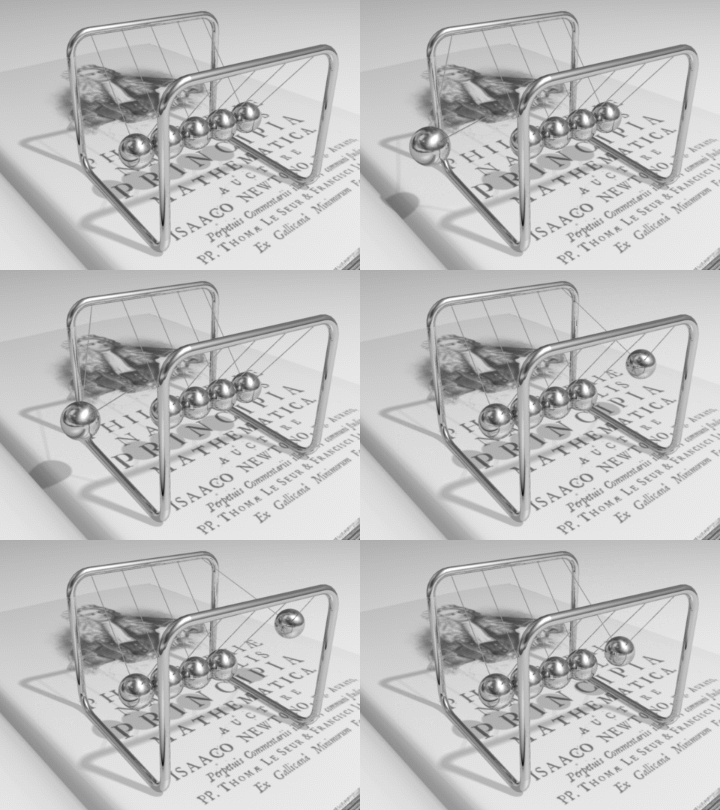
Fear and hesitation go hand in hand. They hold you back, creating a slow motion to your progress (see above) and sometimes no progress at all. The trick is to separate the two, to recognize that you needn’t wait until you are free of fear in order to act. Indeed, if that were the case, most of the people whom we consider brave would still be waiting for the moment of bold action that earned them the appellation “hero.”

Years ago I heard a panel discussion on the subject of Wagner’s opera cycle The Ring of the Nibelung that actually touched on the issue of courage and decisive action. The experts focused on the character Siegfried, who is described as someone who has never known an instant of fear in his life. Should we therefore consider Siegfried’s fearless behavior to be indicative of heroism and bravery? The panel in question concluded it did not. After all, they reasoned, how can one be a hero without fear to overcome? Only a fool would rush to action without being aware of the attendant dangers. But a brave and courageous man would know the perils facing him and choose to act in any case.

Most of us won’t face dragons or fire, of course, but we still will all have numerous chances to act decisively or to hold back. Here is a trivial, but instructive example from my own life. In college, I was fulfilling a PE requirement by taking fencing. Now, I wasn’t a very good fencer, despite being a reasonably good athlete. And, my heavy academic course load didn’t permit me the luxury of spending time outside of class to practice fencing. Thus, in the first seven matches I had against my classmates, I won only three, a pretty mediocre showing.

Nonetheless, I was competitive enough to want to win more often, so I reasoned that there just might be a way that wouldn’t take time away from my other studies. I realized that I was a relatively tentative fencer, and so I decided to become more aggressive. I set myself the task of getting in the first “touch” as soon as each new match began. The strategy worked. Of the next 17 matches, I won 14. I was almost always able to get a 1 to 0 lead within a few seconds of the start of the competition by catching my adversaries off-guard. Yet, despite my new found success, I was really no better at fencing than I’d been when my record was three wins and four losses. I was simply less hesitant, more aggressive.

I once had a biology professor named Hudson who conducted the “Quiz” portion of his classes in a way to encourage behavior similar to my fencing experience. You were graded on the number of questions you answered correctly and lost points if you answered the interrogatories wrong. Hudson asked the questions aloud and it was a race to get your hand up first and have him call on you to answer. Naturally, you had to make a quick decision as to whether you had the right answer. Very fast indeed. Those who hesitated were, as the saying goes, “lost.”

But how does this all apply to daily life, the life outside of the university. You might say that “normal” life is less competitive than my examples suggest, but is it? To answer that question, ask yourself how often you hesitate to do things, take chances, give public voice to concerns that might engender disapproval, avoid tasks that are difficult or challenging? Do you ask out the beautiful woman, or do you wait until you feel “ready,” only to watch someone else beat your time in getting her attention? Do you, at least sometimes, see a crisis as an opportunity? Or do you hold back, put things off, wait and hope that another or better time for action will come? Sometimes it will, but sometimes it won’t.

If your “default” strategy, your habitual tendency, is to wait, you have a similar problem to those whose standard operating procedure is to act impulsively, without thinking. It may be the case that “fools rush in where angels fear to tread,” but it is also true that you are an equal fool if you forever hold back, hesitate, and watch the moment pass or see someone else “seize the day (carpe diem).”

What I am talking about is fear and the uncertainty that fuels it. When we are fearful and decide not to take action, most of us feel an immediate sense of relief. That relief reinforces our hesitation, while simultaneously depriving us of the opportunity to succeed in the endeavor. Soon enough the relief will pass, but not the self-doubt and lack of personal esteem and confidence that might have been won by an effective action.

The danger in allowing too many chances to pass by is a life of “quiet desperation,” a life on the sidelines, watching others play the game, but not playing it ourselves. And, at the end of life, regret for the opportunities passed and the chances not taken is more likely to be troubling than the failed efforts made. Beware the heartache of the words “what if?” True, acting boldly often fails; but, it also sometimes succeeds.

No wonder, then, that musicians spend relatively little time passively listening to music. They are too busy making it.

Make music of your life, then. Let the trumpet announce (or remind) the world of your presence. Sing your song. And if you cannot, find a therapist who will give you the tools to beat back your fear and help encourage you.

The above image is an Animation of Newton’s Cradle created on August 8, 2006 by Demon Deluxe and sourced from Wikimedia Commons.

The Things We All Need to Learn

The things we need to learn wait for us. They are very patient.

I think you know what I mean. At least, you have seen it in others: the angry person who never learns how to control his anger or perhaps isn’t even aware of the need to control it.

Then there is the passive person, who cannot stand up for himself easily, defers to others, and gets taken advantage of pretty routinely. And, despite this, it hasn’t changed over the years.

Some of us choose the wrong friends, lovers, or business associates, making the same mistakes repeatedly. Others continue to use failed methods in raising children. Some of us never face our fears fully (see Albert Brook’s film Defending Your Life for a funny take on this problem). And then there are the people who are impulsive and act without thinking, over and over; or the ones who are sloppy at tasks, not careful enough; or those who are too compulsive, too detail-oriented, trapped by their obsessive attention to small things.

I could go on, but instead, it’s time to ask you a question. What challenges in your life have you yet to master, the ways of thinking or behaving that don’t work for you but which you repeat? Most of us have a pretty easy time spotting the errors in others, but how about your own?

There is an old joke about how we learn:

A man walks down a road and falls into a hole. He doesn’t see it, and it takes some time to get out because it is deep.

The next day, the man walks down the same road and falls into the same hole. He still doesn’t see it, but he might just get out of it more rapidly this time.

The day after, the man walks down the same road, sees the hole, and falls into it anyway.

The following morning, the man walks down the same road, sees the hole, and this time walks around it.

And what does our hero do after the next sunrise? He walks down a different road.

Holes, like unsolved problems, have all the time in the world. They wait for us to recognize them, see the danger they pose, and change our behavior to avoid the danger. As the saying goes, “If you do what you’ve done, you’ll get what you’ve got.” Others have said that one definition of insanity is continuing to use the same failed strategy, all the while expecting different and better results.

How long will you wait to change? Your problems can last a lifetime. They have no train to catch or meetings to attend; they take their time, not troubled by waiting. Or, should I say, they take your time. All of your time.

Do you really want to wait that long?