What Do Women Want in Men? Three Different Answers

Freud asked the title question, “What do women want?” even though men had been asking it long before Sigmund’s time. It is not that women are so inscrutable. Rather, if you ask women, men are rather notorious for missing the obvious. And so we, the male of the species, repeat Freud’s question to ourselves: “What do women want?”

To some men, asking “What is the meaning of life?” would be an easier interrogatory.

Keeping in mind that “fools rush in where angels fear to tread,” this male will try to answer Freud’s question.

But, cheating just a bit, I will divide the challenge into three parts. First, I’ll offer some hints as to what young women want, then those not-quite-so-young, and finally, those who are mature. You can place yourself or your partner in the appropriate age category. Fool though I may be, I’m not so foolish as to demarcate the groups myself.

In each section I’ll also include a bit of advice to men on what to do (or not to do) or some commentary on the category in question.

I should also say that while my comments are based on lots and lots of conversations with men and women, many women will not fit into the broad categories I’m describing.

I. A young woman usually wants someone who is cute, if not handsome and sexy. He should be bold, take the lead, and ideally have a bit of an edge; a man who is exciting and confident. If at all possible, its good for him to be smarter and have a higher social status than his female counterpart or, at least, the ambition to achieve a higher station. He should not be timid or afraid, but more than capable of holding his own ground. Nor will neediness make him more appealing.

Young women are less likely to look at long-term compatibility (values and mutual interests) than the immediate excitement the man provides. These females often want little more than a good time, at least initially. If a man can take them places that they haven’t been to, know things about which they might not be knowledgeable — teach them or dazzle them with something new — all the better.

  • Yes, young man, do go up to the attractive woman and strike up a conversation. No, not with some worn out “line.” Just make contact. You never know.
  • Don’t immediately become slavishly devoted, putting the woman on a pedestal. Many women will view this as pathetic and run away. Why? Because it is pathetic. On the other hand, Woody Allen used to say that the problem with his first marriage was that he tended to put his wife “underneath a pedestal.”
  • It has been said that a man marries a woman hoping that she will never change, while a woman marries a man in the hope that he will. If the relationship requires serious change, it is usually too optimistic to expect that it can be achieved after the wedding day if you have not been successful in obtaining it during courtship. As to men expecting women always to be young, on fire, and totally focused on the man, they need to be both more realistic and more in touch with the fact that long-term compatibility requires sympathetic alteration on both sides.
  • One more word of advice to the young man: sometimes, persistence does pay off.

II. Not-quite-so-young women are usually looking for qualities and relationships that are more lasting. They are less inclined than young women to trade substance for surface, durability for excitement, or maturity for boyish charm. Unlike more youthful females, they do not “short” the value of the long-term — the things that last. Many of the same qualities that attract a less mature female remain appealing to the not-quite-so-young woman, but other factors now come into play more forcefully.

Can the man make a good living? Is he financially secure? Is he funny and easy to be with? Does he listen and understand rather than offering an impatient, abrupt solution to a woman’s problems? Is he egalitarian? That is to say, does he treat women respectfully and as equals? Will he be an involved and caring father? Is he comfortable with himself? Is he good — decent in a moral sense? Can he express affection? Does he share the same values and at least some of the same interests? Will he be faithful? (It should be said that it is not that young women ignore this question, but rather, that if they are attractive enough, they needn’t fear younger women because there aren’t any).

A certain realism usually enters into a not-quite-so-young woman’s thoughts as she considers potential suitors. She might realize that she is “not quite” the woman she used to be (some of this is entirely to the good), that she has some baggage (and perhaps some children), and that her “shelf-life” in the marriage-market will not last forever. (I apologize for saying this, but, it is something that cannot be ignored, however unfortunate or unfair it might be).

  • The 1988 movie Crossing Delancey touches on the issue of social status and intellectual/cultural background. Many a woman in the not-quite-so-young category struggles with this. She might meet a very nice man, attractive and decent, funny and dedicated, but someone not as accomplished as she is; from a different (lower) cultural, financial, and educational milieu. It can be enormously difficult for the woman to accept such a man despite the fact that he is a good match in every other way. In the movie, Amy Irving (who works in the New York literary world) is faced with just such a dilemma as she contemplates a relationship with Peter Riegert (who specializes in selling pickles).

III. For mature women, reality usually intrudes more dramatically. They may wish to be left alone or with their female friends, and might well disdain the idea of seeking male companionship. But, if they are still interested, the answer to the question, “What do women want?” has been simplified. A kind, interesting, and companionable man in reasonably good health with his wits about him can be quite appealing, even more if he has some energy and vitality. Sexual magnetism or prowess are not usually high on the list of requirements. Superior status or financial stability are often less important than before, or no longer of any concern.

The numbers game favors the man — the law of supply and demand applies to this as much as to soybeans and corn — his competitors are dying off faster than available women of the same age.

  • The following story is true. A long-married man’s wife died after an extensive period of declining health. The widower, about 70 but physically fit and active, continued to stay in his home for some time. After a while, however, he decided that maintainance of his property was more than he wanted to do. Nor did he need so large a living space just for himself now that his wife was deceased and his children long since out of the house. So, he purchased a unit in a retirement facility — one of those senior-living communities where females usually outnumber males; the residents are still quite independent and each one has his or her own place. The seniors also have access to a central dining room, an activity director, maid-service, shuttle-bus availability, and so forth. The man had placed his house on the market, but it remained unsold as he moved to his new abode. Months passed. But eventually, the man returned to his home, leaving the retirement facility behind. “Why are you back here?” The man’s answer was simple: “They wouldn’t leave me alone!”

To close, nothing much in life is so generically unfair as the domain of love; or, to put it differently, the fact that “All’s fair in love and war,” means that nothing in those situations is fair. The best and brightest, the most kind and decent people, do not always come out well. But, the good news is that there is more than one possible mate for each of us, more than one person with whom we might share a good life. Since both the male and the female are looking for each other, there is every reason to believe that a happy outcome is possible.

Hang in there.

The Limits of Reason: How to Think about Your Date, Your Boss, Your Mom, etc.

http://www.southdacola.com/blog/wp-content/uploads/2009/04/rodin20thinker.jpg

As a therapist, I hear a lot of concerns from my patients about parents, bosses, romantic partners, and so forth. The thoughts often take the form of “Why did he do that?” or “What was he thinking?”

Some of this is worth questioning. In life it is useful to take the role of the other person, to look at things from his or her perspective, to try to “understand” that individual’s motivations and reasoning process.

But, there are limits. Here are just a few that make understanding difficult:

1. People don’t always carefully weigh their decisions before making them. We humans frequently think and act impulsively or emotionally. It can be a bit harder to fathom an ill-considered act than one that is carefully reasoned.

2. The person whose mind you wish to enter may not know himself well at all. When you recall what he says are the reasons for his actions, you need to be aware that he may be fooling himself. Alternatively, he might be dishonest with you, giving you less than a full set of data, trying to prevent himself from looking bad in your eyes, or attempting to protect you from being hurt by the truth.

3. We all act in self-serving ways much of the time. The same person who says that he hates it when someone ends a relationship without explaining why — not even making contact or returning phone calls — might well avoid the discomfort of a final farewell or confrontation himself when he decides that a relationship should end, thereby doing the very thing that has been done to him.

4. Most people, in or out of therapy, are often indirect in expressing their unhappiness with you or their disappointments about your behavior. (Marital conflicts and parents talking to children can be noteworthy exceptions to this general rule). But, in the absence of direct communication, it is difficult to be a good mind reader. Indeed, crystal balls are in short supply whenever I go shopping.

5. When trying to understand others, we look for some form of logic. To seek something that is often missing within the person is a pretty big misunderstanding of how people think and act.

6. You may not have enough history and background information to make an accurate analysis of what drives this individual to do what he does.

7. Do you really know the person well “under the skin?” There is often a mismatch between what is happening on the inside and what is occurring on the outside. Put differently, the contradiction between surface appearances and internal truth often affirms the old saying, “Don’t judge a book by its cover.”

Too much time trying to figure out another person is unproductive. For this reason and those cited above, I encourage my patients to set some limits on the amount of time they spend attempting to get into someone else’s head. At bottom, I think, what most of us are looking for is the understanding that will allow us to return to the relationship and put it right, now that we have found the “answer” to what transpired. Or, something that will console us or produce the closure that we are hoping for at the relationship’s end. By attempting to “understand,” we are frequently seeking a sense of intellectual control, partially to acquire information that will prevent future disappointments, but also to compensate us for our loss and to silence the nagging internal voice that asks “What happened?” and “Did I do something wrong?”

It is better, beyond a certain point, to consider several things about oneself:

a. Why did I choose that person to be with? (Obviously this doesn’t apply to your parents; nor does it always apply to bosses or co-workers).

b. How did it happen that I missed the early warning signs of trouble? Oh, I know that you might think that such signs didn’t exist, but it could be that you ignored them, minimized them, or had a blind-spot for them.

c. Why didn’t I set some limits on the relationship in order to prevent the other person from injuring me? And, if I tried, why did my efforts fail?

d. Why didn’t I leave the relationship earlier?

e. What, if anything, did I contribute to the problems that occurred between my friend/partner/lover/boss and myself?

f. Have I grieved the loss or disappointment fully (including attention to both my sadness and my anger)?

g. What do I have to do differently in order to minimize or avoid problems like this in the future?

Instead of addressing the situation in these ways, with these questions, most of us spend no small amount of time ruminating, and then looking for something we can say to the other person to get them to behave as we wish. With some individuals that is possible, but not with everyone.

Jackie Robinson’s breaking of the baseball color-line is instructive in this regard. As you might know, Robinson and his boss, Branch Rickey, agreed that he would not respond to the abuse from fans, players, and coaches that both expected he would receive when he became the first black man in the 20th century to play in the Major Leagues. But, despite two years of taking every racially demeaning insult known to mid-century white males, he succeeded in playing well. Moreover, by this time there were other blacks in the Major Leagues and a great experiment in civil rights had succeeded.

If the story I’ve heard is true, Robinson and Branch Rickey had a conversation at the beginning of Spring Training at the start of Robinson’s third year with the Brooklyn Dodgers. They agreed that Robinson could now be himself, and fight back with words or fists, if necessary. Soon after, the Dodgers played the Philadelphia Phillies, who did not know that Robinson was no longer on a leash. The middle-aged man from the deep south who coached third base therefore once again began the verbal onslaught that he had performed with impunity for the two previous seasons. Robinson called time and walked over to the third base coaching box.

Remember that Robinson had lettered in four sports at UCLA, including football (as a running back). More than most, he radiated intensity, strength, courage, and intelligence. So it was that Robinson moved within inches of the bigot, looked straight into his eyes, and said: “If you ever say anything to me like that again, I’ll kill you.”

Now, I bring this up not to recommend death threats, but rather to point out that Robinson knew exactly who he was dealing with. He knew this man was not going to be persuaded to behave himself by high-flown verbal eloquence; he knew that spending much time thinking about this man’s character was a waste. What Robinson knew for certain was that there was only one thing he needed to understand about his nemesis (his intolerance) and only one approach that would work:

  • I’m bigger and stronger than you are, so if you don’t stop, I will beat the crap out of you.

Everything changed that day as others quickly realized that Jackie Robinson was not a man who could be insulted any more.

Of course, we all need to spend some time thinking about others and why they do what they do. But, endless rumination on the subject rarely is enlightening or successful in making us feel better.

Some people are like boulders. They are big, hard, insensate, obdurate, and potentially damaging objects. It is essential to see their potential to injure and realize that when you are downhill from such a human bolder, you are in danger.

If you understand how gravity works and get out-of-the-way, that is all you need to know and do — all you can do.

A shame, but true.

The image above is The Thinker by Auguste Rodin.

Lost and Forgotten Loves

Do you remember, perhaps wistfully, someone who has long been out of your life? The person might be a first love or a romantic interest who came along at a vulnerable moment. That individual provided something timely and touching, perhaps a feeling that you thought you would never have. Usually it was the possibility of love — the possibility of being loved and feeling loveable — something that hadn’t been experienced recently if at all; something that seemed hopelessly out of reach. And so, this person who opened the door to embracing that feeling — to a sense of being worthwhile and valuable — acquired a special value herself. She brought the “music” into your life and might continue to hold a special place in your heart.

Perhaps you felt that the lost love was too good for you — at least so you thought. The interest she had in you seemed a bit astonishing to you. And you were enormously grateful for her interest and the pleasure that she seemed to take in your company. If you were lucky, the relationship lasted long enough to change you for the better. And even though it ended with your heart breaking, you still carry inside of you a sense of gratitude and an enduring soft-spot for this person who you’ve likely not seen for many years.

There are ironies here, at least two I can think of. First, that your gratitude just might be a bit misplaced. You probably thought too little of yourself and too much of the object of your affection. Perhaps you placed her on a pedestal. You might have dismissed what you brought to the relationship: your good nature, your wit, your humor or kindness, or  your own physical attractiveness. And so, whatever affection or interest you experienced that felt to be more than you deserved, might in fact have been just what you were entitled to: you were better than you thought.

Another irony is that, as much as you might still think of this individual from time to time, it is entirely possible that she almost never thinks of you. You did not change her life, even if she changed yours. Your role was more peripheral, less important. To her, you are another relationship in a history of such contacts, not the one that made an enormous difference in her life, as she did in yours. It seems a bit unfair, doesn’t it? Yet that is the way life works.

But I think that the ultimate irony in these unequal pairings is that there is probably someone out there whose life you did alter, to whom you meant everything, and who you now hardly ever think about. In other words, the roles described at the start of this essay are reversed. And you may not even know (or remember) just how profound your impact was on that lover of the moment. For him or for her, that time together with you was much more special, decisive, and profound than it was for you.

It helps to see both sides of this. Both the over-valuing of another and the impact we make on people without really trying — just by showing up in their lives at the right moment and being ourselves. The most dramatic impact outside of a romantic relationship (and indeed one that has more influence) is surely that between a parent and a child, but bosses and friends can sometimes approach the importance of a romantic partner.

Therapists and teachers need to be mindful of this too, in their relationships with patients and students, respectively. Whether you help or you hurt another can be of enormous importance. And, if you’ve done your job especially well or especially poorly, you will probably be recalled long after the relationship has ended.

My high school friends and I take part in something called the Zeolite Scholarship Fund, about which a search of this blog’s archives will reveal more. One of the things we have done in addition to giving scholarships at our alma mater is to honor our old Mather High School teachers. We let them know how much they meant to us, at least those who made an important difference in our lives and are still living. Even decades later and long since they might have recalled any of our names, we remember them and their influence.

I suppose that the most appropriate metaphor for the way in which we unknowingly impact others negatively (and this can apply to teachers who were particularly poor or nasty) is one of walking down the street, being unaware and unconcerned (as we all are) of the very little creatures (bugs) that we might be treading upon. I know that this is an exaggerated comparison to the way that we are affected by others. But the point is that we are all pretty fragile, easily hurt by those who care less about us than we do about them.

Just something to be mindful of in any relationship, whichever end of it you are on. Like throwing a stone into a pool of water, the ripples can go on for a very long time.

Be nice.

gustav-klimt-the-kiss-c-1907-detail

A cropped version of the painting at the top of this page: The Kiss by Gustav Klimt

Sex and (S)ex-pectations

Sexual performance.

There, I said it. Of all the things men hate to talk about in any realistic detail, this is it, with the possible exception of colonoscopies. Oh, young men in the cloistered confines of a locker room will talk about their prodigious sexual performance; occasionally, those self-proclaimed exploits even bear some resemblance to the truth. But, too often, the male of the species wants his male acquaintances to believe that he is some sort of super-hero, capable of great feats of stamina, if not strength, that are well-beyond his actual capacity.

In reality, the fact that the sexual organ of the man can be observed by his partner contributes to the performance anxiety of many men. Even those males who are relatively secure might wonder how they compare to other men.

My purpose here is to provide a bit of grounding, just a little bit of the truth, so that you or your lover do not need to feel inadequate. To wit:

1. It is infrequent for any couple to be able to sustain intercourse for more than 12 to 15 minutes.

2. More typically, the intercourse lasts from two to seven minutes.

3. The entire sexual encounter typically takes from 15 to 45 minutes.

4. Even among sexually content and well-matched couples, less than 50% of the sexual encounters are optimal.

5. There is a great deal of variability here, and things like timing, affection for one another, alcohol or drug abuse, age, time of day, stress, and physical problems all play their part and influence what happens.

There. I hope you don’t feel so bad.

If you’d like to know more, you might want to consult various of the publications of Metz and McCarthy including Coping with Premature Ejaculation and Coping with Erectile Dysfunction.

The image comes from the Dancehouse Theatre’s “Kiss Bike Kiss” at the Manchester Bike Culture Festival of 2008.The author is Echomrg and it is sourced from Wikimedia Commons.

Jerry, Raya, and the Shadow

http://upload.wikimedia.org/wikipedia/commons/1/14/Russia_stamp_no._583_-_In_memory_of_the_Holocaust_victims.jpg

Do you ever find yourself thinking of an old childhood friend? Someone you haven’t seen in an age?

My friend Jerry lived across the alley from me in Chicago’s West Rogers Park neighborhood.

If you grew up in the suburbs, you probably don’t know much about alleys. I met some of my best friends there, playing lots of softball in the narrow confines of cement bordered by an endless row of garages on each side. I learned to climb roofs to retrieve softballs that landed there and (like my friends) occasionally beat a hasty retreat when a line-drive shattered a garage door window.

Jerry wasn’t much of a softball player. He had dark brown hair combed straight back, handsome features, and a smile of devastating charm. His eyes could be impish and alive as he stood there in the shadow of one of the garages on a summer evening taking a drag on his cigarette, especially when he talked about something slightly naughty for a 12-year-old, like sex.

Or they could be sad and mournful, as if he knew something that none of the rest of us knew about.

His parents were Holocaust survivors.

He lived with them on the first floor of a two-flat building. He had a sister, I seem to recall. His aunt and her husband owned the upstairs flat. Jerry’s mom, a sweet woman who had likely once been very pretty, was always kind to me; but worn out, faded in appearance, weary, looking older than my mom, although they were probably about the same age.

Jerry’s father was short, with a bristly, full head of salt-and-pepper, almost angry hair. He was never mean, but there was a grim severity about him, a desperate seriousness. I never once saw him smile.

Jerry told me that his dad disapproved of him. Jerry’s relatively poor school work was the reason. I could never understand why Jerry didn’t do better at his studies. He could be witty and clever — he was certainly bright enough. But, he didn’t have much interest or heart for it, seemed not to try very hard, even was held back by a half-year, winding up in my eighth grade class despite the fact that he should already have been in high school.

I remember one conversation. Something about money. Jerry told me that his parents were pretty careful with their money and didn’t want him to spend it unwisely. But, he said, there was one exception. “They say that for food I can have as much money as I want — so I can buy it anytime I want.” Peculiar, I thought. Nice of them, I guessed. But, it stuck there in my mind, not fitting somehow, an inconsistency that I couldn’t fully understand.

My friendship with Jerry dropped away in high school. He continued to struggle in school and we both gravitated toward other people. I don’t think he graduated, but I heard that he eventually got his GED (high school equivalency degree).

When I was in college or graduate school I ran into him on the bus. We had one of those semi-awkward reunions, catching up on our lives, not having much more than that to say. Jerry was then a hair dresser. And, I suspect, a good one, since he always had an artistic flair.

I met Raya in college. She was tall and very pretty, with wavy, long brown hair. Her form was willowy, and she moved with the grace of a dancer, as if trying, in her fluid motion, not to disturb the air. Raya spoke with an accented English, having come to this country with her parents from Israel only a few years before.

It was hard not to find Raya attractive, but she was very quiet and conversations were always a struggle. I find that curious in looking back, because you’d think that I would have asked her tons of questions about her life in Israel and how it was different than Chicago.

Maybe I did.

Nonetheless, Raya and I went on two or three dates. I remember the first one, driving to her home to pick her up and meeting her father there. He reminded me of Jerry’s dad: a very strong and dark presence, grave, serious, not to be trifled with.

At the time, I probably wrote that off to the protective relationship between a father and a daughter. As I said at my youngest’s wedding, the job of being a father to a beautiful daughter is not an easy one. You spend a lot of time thinking unkind thoughts about little boys, wondering what plots they might be hatching to ensnare your female child!

In any case, Raya and I went to a movie that evening, the highly rated The Pawn Broker starring Rod Steiger. I didn’t know anything about it, just that it was the movie on everyone’s lips. I don’t think Raya knew much about it either.

It turned out to concern a man, played by Steiger, who lost his family in the Holocaust, later becoming a pawn broker in Spanish Harlem, and especially about his relationship with a young Hispanic man who works for him, and a social worker who attempts to draw him back into the world from the dark, shadowy place into which he retreated after his wartime experience.

It was not long into the film before I noticed that Raya was quietly weeping. I asked her if she was OK, but she tried to minimize her upset. And when the movie was over, she told me that her parents were concentration camp survivors.

Now, you’d think I would have been more careful about this, about what exactly the movie was about and who exactly was this pretty girl underneath her surface beauty and grace.

But, to my discredit, I hadn’t been.

Apparently, Raya didn’t hold this against me particularly, because we went out one or two other times. But, as I said, it was difficult to generate conversation, and we parted in a not-unfriendly way. Perhaps there were things too deep for words, things that one simply couldn’t talk about on a “date” with someone you hardly knew.

It might be of interest to you to know that the word “Holocaust” was not immediately applied to the genocidal murder of six million Jews by the Nazis during World War II. In fact, if you watch the old 1959 Alfred Hitchcock movie North by Northwest, you will see in the scene just following Cary Grant’s narrow escape in a corn field, a prominent newspaper headline using the word “holocaust” to describe the explosion of an oil truck when it collided with a low-flying airplane.

These days, that word is rarely applied to anything except the European Jewish experience of the 1930s and 1940s.

Today, April 12, 2010, is Holocaust Remembrance Day.

Back in the time that I was in high school, the 1960s, virtually no reference was made to these events. One simply did not talk about them in any great depth and it was not the subject of special study or attention in class. In fact, this failure to mention it was particularly true of the homes of most of the survivors. But, the children of these unfortunate people, mostly about my age, came to know enough about what happened to their parents to give them special consideration, and to try to protect them and compensate them for what they lost in the European tragedy.

It was a heavy burden for the generation just behind the survivors, one written about for the first time by Helen Epstein in the classic book, Children of the Holocaust. For everyone else among Jewish children of the time, the shadow of the event was there, even without a name. Simply the idea that but for the accident of time and place — had you been born just a few years earlier in Europe — you would have almost certainly been a human target in a deadly game, along with everyone else you loved.

Long after my relationships with Jerry and Raya ended, I was reading a book by a French Holocaust survivor who described his return to Paris. It was within a few months of his homecoming. The man was on the subway, near two teenage girls who were talking. He heard one say how hungry she was; “I’m starving,” she said.

The survivor knew the words, understood the meaning, and thought to himself, “I have no idea what she is talking about.” Put another way, this man knew “starvation” to mean the severe malnourishment that he experienced in a concentration camp, not the colloquial, everyday meaning that the girl was giving it, an expression he might have used himself in the time before the war.

When I read that passage, I flashed back to my conversation with Jerry, the one when he told me a bit about his parents’ exception to their usual cautiousness with money: “They say that for food I can have as much money as I want — so I can buy it anytime I want.”

And then, I understood just a little bit what they must have meant.

I wonder where they are now, Jerry and Raya.

I wonder who they are now.

It would be nice to know.

The image above is Russian Stamp No. 583 created by Russian Post, Beylin V., painter. It is sourced from Wikimedia Commons.

Relationship Warning Signs: Fighting the Last War

http://upload.wikimedia.org/wikipedia/commons/thumb/e/e6/Oscar_Wilde_portrait_by_Napoleon_Sarony_-_albumen.jpg/240px-Oscar_Wilde_portrait_by_Napoleon_Sarony_-_albumen.jpg

Relationship choices are a little bit like the old military saying that generals are always preparing to fight the last war. Military men are apt to focus closely on past mistakes, without realizing the dangers of a new strategy, perhaps inadequate for whatever lies ahead.

In the same way, we try to avoid past relationship mistakes, without being aware our strategy might produce new, unfortunate problems in the future.

Let’s take an example. Suppose your last relationship was with an authoritarian, demanding, insensitive, maybe even somewhat abusive man. Now you want a lover who won’t be like him. Now you want someone who won’t push you around in any sense of the word — a companion less threatening and more accommodating. This might work well – for a while.

But, perhaps gradually, you will notice the same person who gives-in to you is also giving-in to others; not standing up for himself or for you; spending too much time away from you, instead doing favors for his parents or his friends. Perhaps you will conclude he is too passive and, that while he won’t often say “no” to you, you must push him to do the things you want.

Or maybe your last boyfriend wasn’t ambitious and industrious. You had to lend him money or serve as his source of financial support. You got tired of this of course. Now, you only choose to date someone who is hard-working and successful. You pick a workaholic mate and hardly ever see him, and you must do the job of raising the children pretty much on your own, even if the joint bank account is substantial

Or the discarded mate was easy with money and piled up debt. So now you select somebody with a dead-bolt lock on his wallet, cheap in the extreme, frugal to the point of wanting an accounting of every dollar spent by you, and nearly every small purchase the two of you make is treated with the gravity of buying a house.

Or your last companion didn’t pay much attention to you, seemed more interested in being with friends, playing football and computer games. So you target someone who wants to be with you nearly every minute and gets jealous when you even look at another man – a mate who requires an itinerary of your daily activities and seems interested in controlling you more than loving you.

Last but not least, the boring, by-the-book, ever-cautious man who you trade-in for a dashing, spontaneous, risk-taking, unpredictable, funny, charming, devil-may-care partner; later discovering he is reckless, unreliable, and inconsiderate.

The list goes on. The point is, as with so many of life’s offerings, the opposite of what you have is often as bad or worse, only in a different way.

Best to consider all sides of the human mating grab bag and not pick someone at either extreme of most any dimension.

Just like King Midas, who wished for the power to turn everything into gold, sometimes you must be careful about getting too much of what you thought would be a good thing.

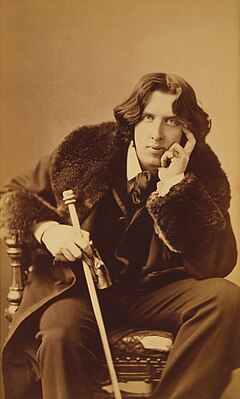
Or, as Oscar Wilde said, “there are only two tragedies in life: one is not getting what one wants, and the other is getting it.”

The image above is Oscar Wilde in a photographic portrait by Napolean Sarony from about 1882, sourced from Wikimedia Commons.

When the Lover is Ready the Soul Mate Will Appear

Mel Nudelman and Sally

I’ve read or heard two different meanings attributed to the Buddhist saying, “When the student is ready the master will appear.” The first suggests the universe is ordered in such a way that things happen when they are supposed to:  knowledge will be offered by events in the universe (or God) at the right time. If I am allowed to amplify the meaning slightly, the saying would also refer to the idea that when you are ready, the right person for you might also appear, not just a teacher, but your future love.

I prefer, however, another, more psychological way of thinking about this aphorism: there are always available “masters” or other persons who might be important in your life, but the “student” doesn’t notice the presence of those persons until he is ready. Or, to look at a different aspect of this notion, important knowledge is always or almost always available to us, if only we are open to it, prepared by experience or mind-set to receive it.

In other words, we must be ready to learn, to think and feel differently than we have before in order to recognize there is something important to be learned.

Those in life who have all the answers — certain of everything — will never learn anything new. Those afraid to do new things are unlikely to learn, since in order for the “master to appear” one must have one’s eyes open and actually get out of the house — the master being unlikely to call you to make an appointment, unsolicited.

But if you are humble about what you know, humble in the knowledge there is always more to learn, you might just learn something. Branch Rickey, the baseball executive, said “luck is the residue of design.” I’d add to that, so is learning the residue of design. And part of the “design” or preparation is to put yourself into situations where it is possible to be enlightened, whether by people or events or your actions; by books or theater, music or child-rearing or romance.

A good therapist is enlightened by his patients. He experiences a whole world, the world of the patient, seen through the patient’s eyes. His patients also inform him, directly or by their response to him and to the therapy, what works and what doesn’t.

People in less formal relationships than therapist and client teach us too, and enrich our lives. For example, some people believe there is only one person who represents our romantic destiny. When the person comes along they might say, by the first definition I gave you at the top of this essay, the universe or God put this person in our lives at just the right time. There is a Yiddish word that captures this notion nicely: “bashert” or “beshert.” In other words, to be “fated.” It is used when someone tries to say an event was “meant to be,” and is often employed with respect to a reference in the Jewish Talmud that God has chosen your soul mate.

My own opinion, however, is that most of us might have met, fallen in love with, and married any number of good people and had equally good lives as we have with the person whom we did marry; different, certainly, but just as good, more or less. That we didn’t marry someone else might have been due to a lack of maturity when the “other” person appeared, poor judgment about the value of the qualities in a person, or fear of rejection and heartbreak, to name just a few possible reasons.

If you protect your heart against the poisonous arrows that can harm it, you also might prevent Cupid’s arrow from reaching it.

One must be open, then, for the right person, for the master, for whatever knowledge or experience might enrich us. Vincent Van Gogh wrote the following to his brother Theo in 1880:

Many a man has a bonfire in his heart and nobody comes to warm himself at it. The passers-by notice only a little smoke from the chimney, and go their way… I am drawn more and more to the conclusion that to love much is the best means of approaching God. Love a friend, anyone, or anything you like, and I tell you, you will be on the right road to learn more. You must love with a high and intense determination, with your will and your intellect, and seek always to deepen, expand, and improve your knowledge. …”

Which makes me think of my late friend, Mel Nudelman. Mel was an old friend in both senses of the phrase — I’d known him since the ’70s and at age 87 he lost his wife of 50 years and was devastated. But, to his credit he fought through and grieved his broken heart to the point of making a new girlfriend! (A lovely woman, by the way). And so, Mel lived as he always did, learning, taking classes, counseling others, being with his children and grandchildren, making friends young and old; ever curious about politics, music, sports, medicine, and the world. All this until near the end of his days in his 90s.

Put differently, Mel was open to life and whatever it would reveal to him.

My advice then, to you and to myself, is to keep learning and keep being open to “possibility,” including the possibility there are things yet unseen, unexpected, or unacknowledged to enlighten us if only we keep our eyes open and look.

We are all students of the greatest teacher of all: life.

The photo above shows Mel and Sally Nudelman.

Self-Defeating Behavior and the Path to Loneliness

http://upload.wikimedia.org/wikipedia/commons/thumb/0/0b/Africa_lonely_kids.jpg/240px-Africa_lonely_kids.jpg

What price would you be willing to pay to feel that you are special? I will tell you a story of one young woman who has paid that price and then some. She is an example of how we sometimes defend our self-image at the cost of our happiness.

The patient of another psychologist, I knew this woman for about 20 years, filling-in for her therapist when he was on vacation. Gloria (not her real name) had a tragic early life. She was victimized by her parents’ verbal and physical abuse and neglect, and became an easy target for schoolmates. Gloria was unlucky, too, in that she was born with slightly less than average intelligence. Making things even worse, her body was naturally graceless and her facial features were less than attractive. But, Gloria could be sweet and socially engaging, willing and able to approach strangers and make conversation despite a long history of rejection.

Even with all her disadvantages and misfortunes, Gloria, now a middle-aged woman, might still be able to have a good and pleasing social life except for one thing: she believes that she is the world’s unluckiest person, the record-setter for having received the greatest misfortune in the history of the planet. Moreover, she feels compelled to report her tale of woe to those people she begins to get to know, very early in her relationship to them. This has the predictable result — they shy away from her, leaving her feeling rejected once more, and adding to her claim that she has been the most ill-treated human in recorded history.

I am not being facetious here; I once asked her to compare herself to various victims of misfortune including those who had been tortured, suffered in natural disasters, lived in concentration camps, or been plagued with disfiguring and painful illnesses. She assured me that her lot in life was far worse than any of them; and, that it was only fair and reasonable to expect people to be sympathetic to her and give her some of the understanding, sympathy, and support she had always been lacking.

Thus, Gloria pursues with a vengeance the comfort and affection that she believes she has coming to her. Her sense of entitlement to this, her insistence that her fellow-man should and must provide this, drives people away from her in her striving for the love she has never had. Of course, her therapist points out to her the self-defeating nature of this strategy, the need first to establish relationships based on something other than the other person’s willingness to listen to her sadness and anger. Gloria doesn’t accept this, unfortunately. The world and the rest of the human race owe her this hearing (so it seems to her), the sooner the better, and it is only fair and just to expect them to deliver what she wants.

Gloria is smart enough to understand that people she hardly knows might not have much patience or interest in accepting her premature self-disclosure. And so, you might well ask, why does she continue to do the same thing over and over with the same bad result? Why doesn’t she try something different?

After much consideration of that question, here is the best answer I can provide. First, Gloria is so desperate and needy, so starved for affection, that it is difficult for her to restrain herself from lunging at the thing she desires whenever she first sights it. But, more importantly, I think the one thing that Gloria values above everything in her life is her self-appointed status as The Most Unfortunate Person in World History.

Now, you might say that you wouldn’t want to hold that particular title. But, think about it. I suspect that this designation gives Gloria the only form of distinction she could every expect to achieve in life. Without it, she is simply a sad, angry, lonely, unattractive, unaccomplished, anonymous person; but with it, she is something special, someone who stands out from the crowd, a noteworthy individual, one in six billion, the leader in her class. And the self-nourishment she receives from licking the wounds attendant to this awful position in life almost certainly provides her with some amount of solace.

I’m sure Gloria would deny the psychological explanation I’ve just provided for her self-defeating behavior and I cannot promise you that it is accurate. But I would ask you this. Do you know people who persist in self-defeating behavior despite all the advice, therapy, or wise counsel offered by friends, relatives, and therapists? Have you sometimes wondered why they do so?

Often the answer isn’t “logical” in that it doesn’t “make sense” intellectually. But, it just might make sense emotionally, as I believe it does for Gloria. If, somewhere deep inside, she doesn’t really believe that she can achieve the life she wants, her behavior suggests that she has found a method, however self-defeating it is, to give herself some of the sense of status and recognition that life hasn’t and probably won’t provide to her.

Gloria was dealt a bad hand in life. Her response to that deal of the cards is instructive. She seems to have chosen a sort of fantasy, a story about herself that compensates her for her misfortune, just as it simultaneously fuels her continued loneliness. But be careful should you wish to dismiss her behavior as “crazy” too quickly. We all do self-defeating things in life.

Before you condemn her, check yourself out in the mirror.

The drawing above is called Africa Lonely Kids by Myfacebook. It is sourced from Wikimedia Commons.

Unfaithful and Feeling Guilty: Now What?

http://upload.wikimedia.org/wikipedia/commons/thumb/5/56/Pashtun_Couple.jpg/256px-Pashtun_Couple.jpg

Infidelity happens. I’m not condoning it, but humans are known for mistakes, and this is simply another example of our fallibility. Still, what should you do if you have realized the error and broken off the affair? Assuming that your spouse or significant other doesn’t already know what happened, should you confess?

Let’s add two more conditions to the hypothetical situation that I’m describing: first, that you feel guilty; and second, that you have no intention of ever violating your partner’s trust again. Let us further assume that it is unlikely that your spouse will find out about the affair from someone else.

This, in other words, is one of those moments between you and your conscience. I’ve counseled people who felt so guilty that they believed they had no choice but to confess. I’ve also treated people who didn’t tell, believing that they would injure the spouse unnecessarily.

Sometimes these affairs are very old. I remember the first patient who reported a situation such as this to me. The infidelity had actually happened years before. It had gone on for a few months, then ended. The man had been faithful ever since and, it was clear, had every intention of being faithful from then until the end of time. But he felt terrible about what he had done and couldn’t shake the feeling despite the passage of time.

One consideration that such a person needs to take into account is that, for the spouse, the event is new when it is uncovered, even if it happened years ago. The wound happens at the moment of discovery or confession and doesn’t exist until that time (assuming that no STD has been communicated). But once the indiscretion is revealed, the emotions of anger and sadness are triggered, as is the sense of betrayal, and the lack of trust. Even if the infidelity is 100 years old, it typically feels to the injured party as if it happened today. And the long climb back to marital accord now begins, with no guarantee that the summit will be reached and good relations will be reestablished.

So, what if you don’t tell your spouse? Will your guilt last forever, undiminished? That depends on an enormous number of factors, including your religion (if any), your anxiety that your husband or wife will eventually find out (no matter how unlikely that might be in reality), your need for forgiveness/absolution, your ability to rationalize mistakes, your own capacity to forgive yourself, and so forth. If you need absolution and have a religious background, confessing to a priest, or fasting and prayer on the Jewish “Day of Atonement” might be helpful, depending on your particular faith. Therapists sometimes also serve the role of unofficial confessor.

If you were hoping that I would give you a clear answer, a “right” way to handle this situation, I undoubtedly have disappointed you. I frankly don’t think there is a right or wrong way in this type of case, at least not in the abstract. There are only ways that work better or worse; well, less well, or poorly; and it will depend not only on your own psychology, but the psychological makeup of your spouse. Thus, a solution that might be effective or useful for one couple, might be awful for another and lead to the end of the marriage.

Best, of course, not ever to be unfaithful. But, as I said at the start, these things do happen and, when they do, can have an overwhelming emotional wallop on all concerned. How you handle it shouldn’t be automatic. Much depends on your decision.

Choose wisely. As carpenters like to say, “Measure twice, cut once.” And know that the news will “cut.”

The above image is called Pashtun Couple by Arsalan Khan, sourced from Wikimedia Commons.

Beautiful and Smart, But Unlucky in Love: The Reasons Why

gentlemen_prefer_blondes_movie_trailer_screenshot_16-1

I have treated many beautiful women who reported a history of bad relationships: unfaithful boyfriends or husbands, frank physical or verbal abuse by their partners, or a loss of interest by the men from whom they most wanted that interest. There are lots of reasons for this. Here are a few:

1. If you came from a home where you were neglected, criticized, or abused, your self-worth is likely to be less than what it should be. Recall Marilyn Monroe: famous, beautiful, and talented, but insecure and unlucky in love. A woman with the background I’ve described often looks for approval from someone who unconsciously reminds her of the person who failed to love her as a child. It is as if the unconscious mind is still looking for the thing never achieved before (love or approval), and it only has value if it comes from a similar person. Since the parent in question was neglectful or critical, the chosen substitute will likely be that way as well, providing the woman with another chance to win loving attention. Given her poor choice of a partner, the sought-for affection and approval are no more likely than they were in childhood.

2. Whether male or female, if you moved too often as a youngster, the insecurity of being the new kid on the block is hard to shake. You may also feel the never-ending need to prove yourself. Once again, insecurity can lead to choosing someone less good and kind than you deserve.

3. Are you too needy? Are you dependent upon your boyfriend or husband to make decisions for you? Are you unable to support yourself financially? Can you bear to be without a boyfriend for very long? Do you need regular reassurance you are “the one and only?” This gets old. While that reassurance will temporarily calm your fears, your lover will almost surely tire of it, leaving you insecure if you don’t ask repeatedly for confirmation of his devotion (or him feeling put-upon if you do). As with a number of the concerns mentioned above, therapy is suggested if your self-worth requires an ever-present escort who constantly bolsters you; and a tendency to lose your sense of self in the relationship, forget about your friends when with a romantic partner, and give-in to the new love-interest for fear he will otherwise leave you.

4. Is your beauty (or sex) all you believe you have to offer? There are tons of gorgeous, sexy women out there and, unlike you, they won’t age! (Or at least it will seem so, since, as you get older there will be a new cohort of young females who eventually will look preferable in purely physical terms). Although men can be pretty primitive in their response to the physical characteristics of women, qualities like wit, kindness, intelligence, good humor, and integrity grow in their value to all but the most unenlightened men. As someone once said, “Beauty fades, but stupid is forever.”

5. If a man shows interest in you too early, are you turned off? It’s true that there is an element of gamesmanship in dating and mating, but don’t choose the intrigue of a man who is hard to get and miss the devotion and decency of another.


http://upload.wikimedia.org/wikipedia/commons/thumb/5/5b/Du_Caju_%28miss_Belgian_Beauty_2006%29.jpg/500px-Du_Caju_%28miss_Belgian_Beauty_2006%29.jpg

6. Are you entitled? Do you believe your boyfriend or husband should keep you on a pedestal, shower you with gifts, and buy the best house in just the right neighborhood? Do you value money, status, and material things too much? If you do, a well-grounded man will tire of you or avoid you. One who is less secure or less enlightened may simply become weary of your demands for “more,” and instead seek a woman who is less self-involved and shallow.

7. Are you a good listener? I hope so, because relationships demand this. If you aren’t, your partner will not feel understood. Unless you respect the differences between yourself and your lover (which very likely were initially attractive), you will find the relationship works poorly or not at all.

8. As I’ve said before on my blog, sexual interest and enthusiasm are necessary parts of a good relationship. Abandon them at your own risk. However, this is not to suggest you should have sex simply because your partner wants (or worse) demands it.

9. Do you allow yourself to be demeaned in public by the man you are with? I always ask marital couples seeking therapy what attracted them to each other. One male I recall said, “She ‘shows’ well,” about his beautiful wife. The words and tone were demeaning, in no way a compliment. Indeed, the man might have said the same thing about a show dog or show horse. The lovely lady remained silent. A more self-respecting woman might have walked out of the room.

10. Do you have a drinking or drug problem? Does your male friend? How do you know you don’t? Just because friends and acquaintances drink as much as you doesn’t mean you can avoid the alcohol or drug-driven downside of heartache, arguments, and a bad end to the relationship. Read up on alcohol abuse to get a sense of where you stand: http://www.alcoholscreening.org/

11. Do you wind up with men you feel sorry for? Not a good choice. Do you give in to men who pursue you relentlessly, even though you aren’t enormously attracted to them? Again, this is not destined to lead to a successful match.

12. Do you believe you can change the man you are with? A miraculous transformation is unlikely to occur. Meaningful alternations in any of us take their own time and much painful effort. As the old therapy joke goes, “How many therapists does it take to change a light bulb?” Answer: “One, but the light bulb has to want to be changed.” Take a measure of who you are with while you are still capable of being objective, which means your evaluation needs to be done early in the relationship. Once your heart takes over, rational judgments are either too late or altogether impossible.

13. As a father two two career-minded, married daughters, I applaud independent women who forge careers. But just as a man needs to remember his wife and children require attention, so do women in high-powered careers need to live by the same rules. If you are neglectful of your partner, mentally or physically exhausted by the work you do between 9 and 5, and consumed by issues related to your vocation, the relationship is at risk.

14. Are you too critical? If you experienced or observed a fair amount of criticism growing up, it is easy to become like the person who did this. Indeed, we are often at risk of becoming the thing we hate, or of normalizing the unfortunate characteristics we observed in our parents because we had no other family to compare them to. Compassion, understanding, forgiveness, and acceptance are needed in any good relationship, and in large quantities.

15. Do you expect your boyfriend or husband to fulfill your life and make you happy? No one can really do that for you, although having a companion can be worthwhile and important. But a relationship will not solve all problems or make life perfect. Don’t expect it to. The weight of that expectation is more than most lovers can bear.

16. One final point, and a sad one. If you are smart and beautiful, and especially if you are professionally accomplished, there are men out there who will be intimidated by your competence, intelligence, authority, and attractiveness. As a result, you might have to generate more than the usual amount of effort to find a good match. Unfair, but true.

In closing, I should say that making a good choice of mate, regardless of whether you are a man or a woman, is challenging. But there are a lot of good people out there (albeit fewer men than women), so if your history shows a pattern of failed choices, its best to look in the mirror and ask why. And, if you can’t come up with an answer or change your pattern even though you are aware of repeating the same mistakes, therapy often helps.

This post has generated one very heated and critical comment. You might want to read it and see what you think: Dealing with Online Criticism of that “Bald, Ugly, Old” Man: Me.

The top photo is of Marilyn Monroe, a cropped frame from her 1953 movie, Gentlemen Prefer Blonds. The second image is of Céline Du Caju, Miss Belgian Beauty 2006, taken by Eddy Van 3000 and sourced from Wikimedia Commons.