Telling Your Children Too Much: The Danger of Role Reversals

“My children are the most important thing in my life.” I know you have heard that before. You might well have said it yourself, believe it, feel it, and it might be true.

But are you injuring them anyway?

What I’m talking about here is the tendency to confide in children; to tell them things that they shouldn’t have to hear.

Such as?

Feelings of depression and loneliness, criticism of your spouse, and details of your sex life (whether good or bad).

Questions to them about how you should handle your relatives and friends. Disclosures of insecurity about your abilities or your appearance.

Why not talk about these things?

First, you are the parent, not a friend. Even when we are older, we want to see our parents as people who are capable, strong, reliable, confident, and who will always be there. As children of whatever age, we want to know we can, in a pinch, go to our parents — count on their wisdom, and depend on their honor. We really don’t want parents to be friends, although it is good if they are friendly. We shouldn’t have to “take care” of the parent’s emotional life, serve as a confessor or a therapist; or function as a go-between for one parent in order for one alleged adult to get along better with the other nominal authority figure in the house.

Our children shouldn’t come to feel we are an emotional burden on them, the one who needs parenting rather than the other way around.

If our progeny are to separate from us, become independent, create healthy families of their own, take good care of themselves, and navigate the white water of twenty-first century life, it does not help them to take on the parenting role of their own parents.

I have known children who were required by one parent to retrieve the other from a neighborhood saloon. I have known children who were expected to accompany one parent on her detective work in an attempt to discover whether her spouse was cheating on her. I’ve known kids who were told to ask for the child support (much too common), expected to mix the parent’s favorite alcoholic beverage, smoke pot with mom, lie to the other parent, or cover dad’s money mismanagement; and when older, double-date with a divorced parent and take over the job of being the isolated parent’s social life.

It is usually the mom, not the dad, who cries on the child’s shoulder, gives too much information, and creates the emotional burden for the child. Dads are less likely, even today, to talk about their emotions and their weaknesses and insecurities. A father’s stoicism can be a problem for a child, but not usually in this particular way. Nor are fathers as likely to compete with mothers for a child’s attention, interest, and camaraderie.

Instead, when dads become a burden it is usually a consequence of their misbehavior, addiction,  or life failures. Regardless, neither parent should communicate that the child must “choose sides” or take over the psychological role of a spouse, because one parent is estranged from the other and needs support. While such parent-child relationships are not frankly incestual in a physical sense, they can be emotionally incestual and contaminating, fraught with a sense of something not right and a feeling of complicity in the usurpation and betrayal of a much-loved guardian.

Even after childhood is over, we still prefer our parents to be bigger than life, ideal models capable of solving any problem, all deriving from the same instincts that caused us to say “My dad is better than your dad” when we were little. Of course, as adults we know it isn’t true.

A funny story: my dad told his three sons (when all of us were still small) he’d been a famous Chicago Cubs pitcher, but somehow, quite mysteriously, all record of this time in the Major Leagues had been lost! Moreover, he’d been so reliable, hard-working, and constant that he could pitch nearly every day. And so, his teammates came to call him “Rain or Shine Milt Stein.”

Soon enough we realize stories like this are not true. Soon enough we become aware our parents do not embody the perfect mix of human qualities. Eventually, we see that our elders have failures of judgment, imperfections of mood, and suffer from doubts and worries just like everyone else. We realize even our parents cannot protect us from heartbreak, failure, and injury. Soon enough we see them aging and grasp they will not be around forever, and might even come to a point when they cannot fully care for themselves. Life reduces everything to size sooner or later.

If you are a parent, don’t accelerate this process; know that your children need protection not just from the outside world, but from you — from your intimacies and personal problems and sleepless nights just as much as they need their own privacy and the permission to fail, to learn, and to grow on their own — to come into their own and own their lives, not to be hostage to your judgment, your worries about them, or worries about you due to an invitation or requirement to know you too well.

A parent is a guardian and a custodian, not an owner; a loving authority, not a buddy. A child is not on the planet for the purpose of fulfilling your life, but rather, to fulfill his own.

Your life is your job, not that of your offspring.

One of the greatest favors a parent can do for a child is to take good care of himself or herself both physically and emotionally, not expecting anyone else to achieve that result for him (or worry about the fact it is not being adequately accomplished). And yes, this means even such things as eating well, following medical advice, and making oneself as physically fit as possible.

How important are your children to you? Not in words, but in deeds — in the way you relate to them and the care you take of yourself?

If you haven’t put your words into action, might it be time to start?

(The reproduction at the top of this page is Rembrandt’s Young Woman Sleeping)

Earning Your Life: Teaching Kids the Value of Work, Not Entitlement

http://st4tic.files.wordpress.com/2008/01/workers.jpg

Most of my teenage friends worked in the summer, but I might have been the only one to work every day after class during the last two years of high school.

It wasn’t by choice. My dad, a child of the Great Depression, required it. I protested that it would affect my school work and I think it probably did, but not so much that I didn’t do well.

I accepted my dad’s work dictum, but generally felt put-upon that I, in the minority among the lower-middle class kids I hung around with, had to do this. In the end, it taught me a good deal, as I shall relate to you.

I’d catch the Lincoln Avenue bus and transfer to the Ravenswood elevated train at Western Avenue. This would take me into the “Loop,” that place where the elevated tracks encircle a good part of what is also called “Downtown Chicago.” During my junior year of  high school I was employed at Chicago Band Repair/Ace Crystal Service, my Uncle Sam’s business.

There, I learned to make simple repairs on expansion watch bands, pack and ship glass watch crystals that had been ground to size on a lathe (this was in the days before plastic watch crystals), dispatch those repaired expansion bands, and run errands. The next year I was an “office boy” at David Altman Law Offices on La Salle Street (still in the Loop) doing filing, errands, and running a Multilith machine, the offset duplicating equipment that was used to copy and print large quantities of legal documents.

Those jobs were interesting enough. There were always lots of things to do, little “down time,” and some entertaining people whose life experience was entirely different from my own. At my Uncle’s place at 5 S. Wabash in the Mallers Building I worked with an almost entirely black and mostly female staff in the days just before the major civil rights legislation was passed. At the law office, it was lawyers and secretaries — all white and all white-collar. In both places I fit in pretty well and got treated pretty well.

But it was the summer work at one job that I hated. I was a college student by then, just having finished my junior year. The place was an un-air conditioned metal stamping factory. I had two mind-deadening tasks. One was bending the backs of metal bucket seats using a simple machine. The other was assembling a small gasket. Each job took a matter of seconds. Once you learned how to do it, you never got better at it, and the assignment never changed. You just did the same thing over and over and over. For eight hours, five days a week, while swimming in a river of sweat.

I started by punching in at 7:00 AM, which meant that I had to get up at around 5:00 AM in order to get to work on time. If I stayed out at all late the night before, I paid for it dearly the next day with the extra-strenuous effort that was required to stay awake while performing my deadly dull duties. You know the feeling — each eye lid seems to weigh 400 pounds and sleep beckons more enticingly than the most beautiful woman and more insistently than the most demanding boss.

I recall one day in particular. The summer was a hot one and the factory retained heat. Water was essential to avoid dehydration. Even so, it felt peculiar to be drenched in sweat at my work station at 7:00 AM in a building where the thermometer already registered over 100º Fahrenheit. Dutiful as ever, I did my best that day to keep alert and be productive. Three hours must have passed before I looked at the clock on the wall. It said 7:15 AM! It seemed impossible, but only 15 minutes had elapsed since the moment of my clocking in. Like a bad science fiction film, time had come close to stopping and eternity seemed nearer than the end of the work day.

I so-hated the job that I found another one that summer in order to get out of the factory, where both the duties and the temperature were liquefying my brain. But it was an experience I never forgot, nor the fact that there were men there who did work only slightly more sophisticated and challenging than I did, and continued to do it for the rest of their working lives.

Earlier, during the summer before my second year in college, I worked in the mail room at Edward H. Weiss Advertising Agency. I made about $1.25 per hour. I had a girlfriend named Beverly that summer and she fancied the idea of going horse back riding. One Saturday afternoon we did just that in Lincoln Park. But, to my dismay, I discovered that the horses cost $3.00 per hour. I knew something was wrong if an equine commanded a better wage than I did!

So what exactly did I learn from experiences such as that?

First, that honest labor at whatever level is nothing to look down upon. There are many worse jobs than those I did, but some of mine were bad enough to make me appreciate the men and women who make a living at tasks that provide little room for growth, excitement, or creativity. My hat is off to them and to what they do for their families and their children.

Second, those jobs taught me how to get along with people whose backgrounds were different from mine, in some cases individuals of a different color, sometimes of a different social status (both higher and lower), including people whose parents and grandparents had gone to college (as mine had not) and those who only could hope that their kids might some day be able to obtain more than a high school degree. I came to see the nobility in simple labor; the complexity and skill required to work precisely with your hands; the meaning of craftsmanship, duty, and dedication. I also learned respect for authority even when the authority wasn’t always fair, and the value of being able to make the best of a situation that wasn’t ideal.

I realized, too, that if one had some good fortune — in my case the opportunity to go to college along with parents who encouraged me to become educated and scholarships and fellowships that enabled me to obtain graduate degrees — one should take advantage of it. I saw, up close, that life could be different from what I hoped my life would be, and that the “different” path was one that I did not want to traverse.

And, I have come to appreciate, every day of my life, how lucky I am to do the work that I do. Work that is interesting, mostly in my control (since I am my own boss), and that has allowed me to make a good life for my children; labor that does not always feel like labor, that I do not dread, and that is challenging, enriching, and satisfying to myself and those I serve.

My friend Jeff Carren, who is an attorney, tells me that he has encountered new hires into legal practice (that is, new lawyers) who had never held a full-time job until they became associates at a law firm. And, that they were stunned at the amount of effort that “work” — a new job, any job — requires.

Perhaps then, in light of my experience, you will not be surprised to know that my kids, despite heavy academic and extra-curricular loads, both were gainfully employed part-time during high school. My oldest, Jorie, did her regular stint as a barista at Star Bucks, while Carly did lots of baby sitting. And, both performed full-time summer jobs when school wasn’t in session. They too, have learned the value of hard work and the worth of a dollar earned from that labor; that is, they have learned the one additional lesson of my early life experience — that money does not grow on trees. They discovered, early enough, what it feels like to “earn” a thing — quite a different sensation from having it given to you. And they have, thankfully, grown up without the sense of “entitlement” that is so pervasive in American youth.

JFK put the entitlement issue in quite a different context when he said, “Ask not what your country can do for you, ask what you can do for your country.”

Similarly, Captain Miller (Tom Hanks) in the movie Saving Private Ryan tells Ryan to “Earn It” as the latter faces the fact that men have given their lives to save him. That is, “earn” your life by making something of it, so that those who gave their lives for you will not have died in vain.

There is great value in “earning” your life. And, the way it starts is by doing work, “making” a living — in effect, doing what is required to sustain yourself and others.

Parents need to remember that we can let our children down just as much by expecting too little of them, as by expecting too much; as much by overprotection as neglect.

We are not entitled to anything — not you, not me, not our kids. Life can be a gift of opportunity, but there is no free lunch.

It is work, hard and honest labor, that helps to teach this lesson.

Thanks, Dad.

The Power of “No”

File:No sign.svg

Most people don’t realize how much power they have. Or how easily they give it away.

The key is to be able to say “no.” And to hold to that position without alteration.

I learned how easily I could give it away in graduate school.

A door-to-door salesman rang the bell of my apartment. He had a list of magazines. Did I want to subscribe to any of these?

The simple and direct answer was “no.” Had I said this and held to it steadfastly, his time wouldn’t have been wasted and my money, of which I had very little, would have been saved. Instead, I felt that I had to give him a reason, an excuse. I didn’t of course.

But, I chose to say, “Gee, its too bad you don’t have Sports Illustrated on your list.”

“Oh, but I can get that for you!”

I was sunk. I didn’t really want to buy anything. But I’d given the young man, probably no older than I was, an opening. And now I was committed to purchase a thing I didn’t need.

Well, I suppose I was young, inexperienced, and immature. All true. I allowed myself to be held hostage to my insecurity, a feeling of guilt, a need to explain myself, even though it wasn’t required.

If you must have the approval of others, if you believe that you are duty-bound to give them a reason for your actions, then these situations present you with a problem. So too, if you fear confrontation. If you think someone will only provide approval if you consent to their wishes, then you will leave the interaction as the other’s thrall. In effect, the keys to your life and the certificate of ownership will be the property of someone else.

But if you don’t let them or their opinion of you count for so much — if you can live with their unhappiness and don’t feel the need to convince them of the rightness of your position — you will come out of the interaction still in possession of yourself, as opposed to being the possession of your counterpart.

Remember, in many situations you don’t have to persuade the person across the table of your position. You just have to hold to it.

Short of pulling a weapon on you, there is usually very little that people can do to require you to do something that you don’t want to do.

Unfortunately, there are quite a number of people, especially female, who are able to say “no” in defense of their children, but not as an advocate for themselves; all the more, they are prepared to go on attack if they believe that those same little ones have been ill-served by someone else. And yet, when it comes to defending themselves, these moms have trouble. Put simply, it comes down to the fact that they don’t value themselves very highly and therefore can’t easily assert themselves. But for a person they do value, especially their flesh and blood, they are transformed.

If you can’t yet do it for yourself — say “no,” stand your ground — you’ve got some work to do. Your life will be much more the life that you want it to be, if you prevent others from taking you in their direction against your wishes. Think of all the favors you’ve done that you wanted to avoid, the responsibilities you took on at work that really shouldn’t have been yours to take, and (for some women only) the men whose attention you suffered unnecessarily.

If you can’t prevent these things on your own, psychotherapy can help you to learn to employ the word “no” to great effect. It allows you to examine the reasons for your inability to be assertive and gives you tools (and practice) in how to live in a new way.

The ability to say “no” is extraordinarily empowering.

This is one thing you shouldn’t say “no” to.

The above image is by Fibonacci from Wikimedia Commons.

The Stress of Everyday Life

http://upload.wikimedia.org/wikipedia/commons/thumb/b/b8/Tension_belt.jpg/500px-Tension_belt.jpg

Much ink and electronically generated language have been expended commenting on the oppressive and stressful nature of everyday life. We are expected to move too fast, produce instant answers to complex problems, and respond with a fax or an e-mail or a text on the spot.

Many of us travel long distances just to get to work. We hardly know our neighbors and, even if we do, don’t have the time to talk to them. Each of us has his own individualized shipping container (called a car), further separating us from each other. We relate to gadgets more than to people — voice mail and snail mail need answering, internet sites demand surfing, our phones are always on and in our pockets — even vacations don’t place us out of reach of urgent demands and obligations.

Teacher conferences require our attendance, our children plead for our time and homework help. The house needs minding, the lawn needs mowing — there is never any rest.

Witness this commentary:

I cannot help but regret that I did not live fifty or a hundred years sooner. Life is too full in these times to be comprehensible. We know too many cities to be able to grow into any of them, and our arrivals and departures are no longer matters for emotional debauches — they are too common. Similarly, we have too many friends to have any friendships, too many books to know any of them well; and the quality of our impressions gives way to the quantity, so that life begins to seem like a movie, with hundreds of kaleidoscopic scenes flashing on and off our field of perception — gone before we have time to consider them.

I should like to have lived in the days when a visit was a matter of months, when political and social problems were regarded from simple standpoints called “liberal” and “conservative,” when foreign countries were still foreign, when a vast part of the world always bore the glamour of the great unknown, when there were still wars worth fighting and gods worth worshipping.

These words were written by George Kennan, a Pulitzer Prize winning author, diplomat, and scholar.

Yesterday, you ask?

No.

They were written 83 years ago in his journal, on December 20, 1927 when he was 23.

They can be found in his book, Sketches From a Life, published by Pantheon.

The above image is Tension Belt by LeonWeber, sourced from Wikimedia Commons.

Jackie Robinson, Ford Frick, and the National Health Reform Debate

http://blogs.dallasobserver.com/sportatorium/Jackie%20Robinson.jpg

With even one eye shut and one ear covered it would have been hard to miss all of the acrimony expressed by and toward our elected representatives in recent days. And, some are saying, that this is unprecedented—this loss of civility, this frank hatred, including acts of vandalism and threats of murder.

Many are decrying the failure of some Republican politicians to rebuke the hate-mongers in an unconditional and decisive fashion, as Republican Representative John Boehner has: “I know many Americans are angry over this health insurance bill, and that Washington Democrats just aren’t listening. But, as I’ve said, violence and threats are unacceptable. That’s not the American way. We need to take that anger and channel it into positive change.”

Well, unfortunately, angry words and angry actions are really nothing new in “The Land of the Free and the Home of the Brave.” You will find them on both the political left and the political right within living memory: the violent “Weather Underground” of the Vietnam War era, The Black Panthers, the lynchings of blacks in the period between the end of the Civil War and the passage of Civil Rights legislation, the hate crimes against gays, the gauntlet of verbal abuse shouted at black children trying to integrate the schools of Mississippi and Alabama in the mid-20th century, the bombing of abortion clinics; the Oklahoma City bombing; the assassinations of JFK, Martin Luther King, and Robert Kennedy; and on and on.

But, every so often in the midst of all this angst—this stuff that makes one despair about the human condition—someone stands up and does something remarkable; something that makes you proud to be an American, and hopeful about the future of the human race.

Turn the page of your history book back to 1947 and to Jackie Robinson of the Brooklyn Dodgers, the first black man permitted to play in the Major Leagues in the 20th century. What follows is heavily dependent upon (and quotes from) Jules Tygiel’s Baseball’s Great Experiment: Jackie Robinson and His Legacy.

Robinson faced a revolt by some of his own teammates who attempted to organize a petition against him. Kentucky-born Pee Wee Reese, who was to become a great friend and supporter of Robinson, later remembered, “In the park that I grew up in, there were no blacks allowed. Blacks got in the back of the buses, they had a special fountain to drink from. I don’t guess that I ever shook the hand of a black person.” Reese expected Robinson to fail because white people in his part of the country always believed that Negroes had no guts.

“You hear this all your life, you believe it.”

The petition died aborning because most of the players would have no part of it, and because of threats from management. But the bigoted sentiments were still there for Robinson to deal with. His teammate Kirby Higbe was asked on a radio interview how he’d come by such a strong arm. His answer? From pelting Negroes with rocks.

Dodger manager Leo Durocher laid down the law: “I don’t care if a guy is yellow or black, of if he has stripes like a f___in’ zebra. I’m the manager of this team and I say he plays.”

The Philadelphia Phillies were the worst of the race-baiters. Led by Alabaman Ben Chapman, the Phillies showered unspeakable derision on Robinson in their first series with the Dodgers early in the 1947 season.

According to Harold Parrott, “At no time in my life have I heard racial venom and dugout abuse to match the abuse that Ben sprayed on Robinson that night. Chapman mentioned everything from thick lips to the supposed extra-thick Negro skull…(and) the repulsive sores and diseases he said Robinson’s teammates would become infected with if they touched the towels or combs he used.”

Chapman knew that Robinson couldn’t fight back because of the disruption that would cause, the very thing that many predicted and used as an excuse to defend the segregation of the Major Leagues. Everyone soon came to know that Robinson, who received varsity letters in four sports at UCLA, was a sitting duck. “Plenty of times I wanted to haul off when somebody insulted me for the color of my skin,” Robinson later said. “But I had to hold to myself. I knew I was kind of an experiment…The whole thing was bigger than me.”

One teammate thought that Robinson, the sole black on the field, was the loneliest man he had ever seen. Red Barber, the Dodger’s radio announcer, said that Robinson was the only man he had ever seen who could actually play better when he was angry.

The death threats flooded in—the people who wrote that they would be carrying a rifle into the ball park to kill him. Opponents tried to spike him, pitchers threw at his head and body. Even his Southern teammates received hate-mail for allowing themselves to take the field with a “n____r.”

But Robinson’s teammates stood up to Ben Chapman and the Phillies. Fellow Alabaman Eddie Stanky called Chapman a coward. Meanwhile the St. Louis Cardinals baseball team plotted a May strike against Robinson and the Dodgers. Ford Frick, the National Baseball League President, quashed the strike and faced down the Cardinals:

If you do this you will be suspended from the League. You will find that the friends you think you have in the press box will not support you, that you will be outcasts. I do not care if half the league strikes. Those who do it will encounter strict retribution. They will be suspended, and I don’t care if it wrecks the National League for five years. This is the United States of America, and one citizen has as much right to play as another.

The National League will go down the line with Robinson whatever the consequence. You will find that if you go through with your intention that you will have been guilty of madness.

As I said earlier, we have been here before, in this dark place in America that seems to surface especially in difficult economic times or in times of change, of which we have both just now. America is changing today, just as it was changing in 1947, and that metamorphosis brings out the worst in some of us. But the courage of people like Jackie Robinson, and the decisive confrontation of unfairness by people like Ford Frick, are heartening.

At the 1948 Democratic National Convention, Senator Hubert H. Humphrey made an impassioned speech in advocacy of a strong civil rights plank that failed to become a part of the Democratic Party’s platform in that year’s election. His words are worth remembering, as he recalled the founding of the nation in 1776:

To those who say, ‘we are rushing this issue of civil rights,’ I say we are 172 years late. To those who say, ‘this issue of civil rights is an infringement on states rights,’ I say that the time has arrived for the Democratic party to get out of the shadow of state’s rights and walk forthrightly into the bright sunshine of human rights.

Eventually most of Robinson’s skeptical teammates and competitors came to think differently and act differently than they had, at least to the point of accepting that blacks had as much right to play the “Great American Pastime” as they did. Still, the animosity did not end immediately.

As noted by Stuart Miller in the April 25, 2010 New York Times, Robinson continued to be the target of pitched balls in those days before batting helmets. In his first eights seasons he was lower than third in HBP (Hit By Pitches) only once. Moreover, the handful of blacks then in the National League—people like Monte Irvin, Sam Jethroe, George Crowe, Billy Bruton, Ernie Banks, and Hank Thompson—were similarly treated. In the American League, Larry Doby, Luke Easter, and Minnie Minoso found it no different.

Time passed, the hard-line bigots left the game, and others who were more open and less shocked and offended by integration took over the field of play. When Ernie Banks joined the Chicago Cubs in 1953, management saw to it that he join the club at the same time as (and roomed with) Gene Baker, so as to avoid the issue of having one black man and one white man live together.

It took 10 years from the time of Robinson’s debut for the Philadelphia Phillies to allow a black man into a Major League uniform, with the Detroit Tigers behind them. The last to integrate was the Boston Red Sox squad in mid-1959.

Along the way America changed too, for the better. And one must believe that the voices of the fulminating, frustrated few on the political landscape today will eventually be replaced by those who are less self-righteous and more in control of their emotions.

As a therapist it is impossible to do my work without believing that people can change.

It doesn’t always happen, of course.

But it happens more than enough to keep pitching.

What It Means To Be a Man: Reflections on the Ides of March

http://upload.wikimedia.org/wikipedia/commons/thumb/f/fc/Jules_cesar.jpg/500px-Jules_cesar.jpg

We hear the expression frequently—“Be a man!” Usually when we are small and usually directed to males. In the context of an admonishment, it typically means to “be tough,” show little emotion, be stoic, have courage, avoid whining.

But, when you are a little older and more thoughtful you might come up with a different definition. The German word “Mensch” (“man” or “human being”) provides us with a starting point.

You will recall that Friedrich Nietsche gave us the idea of an “Übermensch” or “superman.” Not someone who “leaps tall buildings in a single bound,” but a superior creature to whom a new set of life rules applies. Indeed, the Übermensch creates a set of values, discarding those that belong to a world that he rejects and a god that he thinks to be dead.

Goethe, the great German poet, scientist, and philosopher of an earlier time, had something quite different to say about man in his poem The Divine:

Let man be noble,
merciful and good;
For that alone
Distinguishes him
From all the living
Beings we know…

In Yiddish, a language that has German roots, to be a “mensch” means to be decent, forthright, strong, honorable, and dependable. Someone to be leaned on and counted on. A person of principle, with both a good heart and a good head. A fellow to be reckoned with; a companionable individual of integrity, unafraid of self-assertion.

But there is a different version of “being a man” in the popular culture. In my mind, it is associated with the likes of Clint Eastwood and John Wayne, as portrayed in the numerous “Western” movie roles they took on; on the political front, George W. Bush probably is a rough equivalent.

This “man’s man” is a tough, intimidating, austere, cocky, unrepentant, decisive, and unflinching he-man who never complains or cries out in pain. A guy like this doesn’t look back. He is the opposite of the “Alan Alda,” version of what it means to be a man, which emphasizes a kind, empathic, more sensitive side of human possibility.

The popular vision of a man is someone who is more into solving problems than dealing with feelings, someone who is “logical,” someone more in touch with his head than his heart. When a woman opens herself to him with an injury, he is prone to offering a solution or trying to “fix” things rather than patiently listening and holding her hand.

This rock-solid, heroic figure is the strong-silent type, uncomfortable with public (and sometimes event private) emotion, and a person of few words; certainly not one given to eloquent speech. He is much more inclined toward action than talk. The “John Wayne” version of a man is well described in the closing lines of Shelley’s Prometheus Unbound:

To suffer woes which Hope thinks infinite;
To forgive wrongs darker than death or night;
To defy Power, which seems omnipotent;
To love, and bear; to hope till Hope creates
From its own wreck the thing it contemplates;
Neither to change, nor falter, nor repent;
This, like thy glory, Titan, is to be
Good, great and joyous, beautiful and free;
This is alone Life, Joy, Empire, and Victory.

In any discussion of manhood, one must also inevitably give a nod to “manhood” as it is understood in every day speech; that is, male sexuality. It takes a few forms.

One is simply the ability to be commanding and sexually appealing, to be an experienced and confident lover. Another is the capacity to perform sexually. The problem that follows from this, of course, has to do with the pressure to perform, the anticipated evaluation of that performance, and sometimes the failure to perform.

In old age, both the capacity and interest in such activity have been known to fall away, leaving it to the man and any companion or spouse to determine whether manhood should still be subject to judgment about anything to do with sex. Medicine is perhaps making such considerations irrelevant with the easy availability of Viagra, Cialis, and the like.

On the other hand, a failure of potency, that is, the ability to perform sexually coupled with an inability to foster children, remains a problem in the minds of most such men and one that still lacks a scientific work-around other than adoption or artificial insemination of the man’s wife by someone else, a solution that most males find decidedly abhorrent.

Finally, if you’d like a more Shakespearean commentary on the subject of being a man,  you must read Julius Caesar. Those of you who know the play are aware that Caesar is not the main character, even if he is the title character.

Rather, the story is about Brutus, Caesar’s friend and admirer, who is persuaded to believe that Caesar has become a tyrant and will visit evils upon the Roman people. Others among the conspirators have their own axes to grind against Caesar and seek personal gain by his overthrow. But Brutus agrees to the plot despite the fact that it is against his nature, only because he concludes that the assassination of Caesar is in the best interests of his fellow countrymen, in order to free the Republic from Caesar’s control.

As so often occurs in classical tragedy, the conflict between one’s public obligations and private loyalties is the undoing of the hero, in this case Brutus. And so, the famous murder happens in the Roman Senate on March 15th, 44 BC, 2054 years ago this week, after Caesar ignores the warning “Beware the Ides of March!” There is a fantastic movie rendition of the play starring James Mason as Brutus and a young Marlon Brandon as Marc Anthony, Caesar’s ally.

After Caesar’s death, Anthony is targeted for death by Brutus’s fellow conspirators, but Brutus stops them, allowing Anthony to speak to the people and eulogize the fallen Caesar, only to rally the Romans against the conspirators and ultimately, to defeat them in the ensuing civil war. It is Brutus’s essential humanity, decency, and sense of fairness (all qualities that contribute to “being a man”) that call him to let Anthony speak.

You will recall the words “Friends, Romans, countrymen, lend me your ears…,” so persuasively rendered by Brando in the aforementioned film, that stir the Roman crowd against the conspirators. Had Brutus been less honorable, he would have avoided the risk that Anthony’s words might incite the rabble against them and perhaps even agreed with his co-conspirators to kill Anthony. And, as portrayed by Shakespeare, it is the decision to allow Marc Anthony to live, not the murder of Caesar, that is the proximate cause of Brutus’s downfall.

The play ends with Brutus dead, and Anthony reflecting on who Brutus was and why he was worthy. And, it is Anthony’s words that provide us with a final comment on what Shakespeare has already told us in the play about what it means to be a man.

Please note that the word “gentle,” as used by Shakespeare, means something approximating “true, cultured, and affable:”

This was the noblest Roman of them all:

All the conspirators save only he

Did that they did in envy of great Caesar;

He only, in a general honest thought

And common good to all, made one of them.

His life was gentle, and the elements

So mix’d in him that Nature might stand up

And say to all the world ‘This was a man!’

The bust of Julius Caesar above is to be found in the Musée Arles Antique. The image was created by Mcleclat and sourced from Wikimedia Commons.

Moral Choices

http://upload.wikimedia.org/wikipedia/commons/thumb/8/80/Choices%2C_choices..._-_geograph.org.uk_-_465212.jpg/500px-Choices%2C_choices..._-_geograph.org.uk_-_465212.jpg

It is easy to judge others, but are not without blind spots in judging ourselves. In the domain of moral choices, this becomes particularly problematic. How many times have you heard or thought to yourself, “If I were he, I would have done that differently.” Or perhaps, “If I were he, I wouldn’t have done what he did.” But how many times have you said to yourself, “If I’m honest, if I were in the same situation, I really don’t know what I would have done.”

I’ve listed below a few such moral dilemmas, some drawn from real life accounts. I hope you will put yourself in each one and ask yourself three questions:

1. What is the right thing to do?

2. Would I do the right thing?

3. Am I absolutely sure what the right thing is?

A. If you have seen the 1957 movie Abandon Ship, you know the moral quandary in which Alec Holmes (Tyrone Power) finds himself. Holmes is second in command of a luxury ocean liner which strikes a mine. He takes charge of a life boat when the captain (Lloyd Nolan) dies from injuries sustained in the explosion. The small vessel is seriously overcrowded (including numerous people who are hanging on from ocean-side), has limited supplies of food and medicine, and is in shark-infested waters with only small amounts of  shark repellent in hand. Those hoping to survive include the young and old of both genders, some of whom have been grievously injured as the ship went down.

Soon they become aware that no SOS was sent, because the explosion destroyed the radio. Concluding that no rescue ship will be looking for them, Holmes determines the infirm and weakest must be ordered off the so that the remaining individuals can have a chance at survival by rowing the very great distance to the nearest land mass, with enough food to sustain them until they reach it. What would you do if you were in charge?

B. This comes from the oral history of a Holocaust survivor as described in Holocaust Testimonies: The Ruins of Memory by Lawrence Langer. Imagine that you are one among many Jews swept up in the Shoah (the Hebrew word for the Holocaust). You have been separated from your parents. You aren’t certain whether they are alive or dead. In fact, the Nazis have taken a large group of Jews, including your mother, to a place in the forest. They have required these people, at gun point, to dig a long, deep trench. While doing this, the soldiers are joking, smoking, and drinking. Once the trench has been dug to an adequate depth, a handful of the soldiers shoot their machine guns at the diggers along the line of the trench. Some are killed instantly, some dive into the trench to escape the gun fire, and others are wounded to various degrees of severity.

Meanwhile, you are far from this action. Perhaps you heard the gun fire in the distance. But once it is finished, the Nazis assemble a group of Jews to fill in the trench, to cover over their dirty work, quite literally. You are in this group, assigned to this grisly task. The soldiers have their guns on you and your co-workers, reminding you to work quickly or else. Much moaning and screams of pain are heard from this place. And one more thing: From the trench in front of you, a familiar voice is also heard, quite distinctly. It is your mother’s voice. She is telling you that she is not wounded and pleads for your help. What should you do? What would you do?

C. You are Agamemnon, the leader of the Greek expedition to Troy, provoked to war by the abduction of Helen of Troy, the wife of your brother Menelaeus. Before you and your 1000 ships can reach Troy, however, your fleet is stuck in place, stopped by the intercession of a god named Artemis. Time passes. Your supplies of food and water are dissipating. In addition to your family responsibility to defend the honor of your younger brother and help him retrieve his wife, you are aware that Zeus, the most powerful and important of the gods, has demanded that you sail to Troy. A seer is consulted to determine what might be done to appease the god Artemis and enable the fleet to be launched. You are told that you must sacrifice your virgin daughter, who is not far away. What should you do? What would you do?

D. The economy is tough. You have been out of work for some time. You don’t want to lose your home or apartment, and you are afraid that if you can’t find work soon, that might eventually happen. But, you’ve been networking, and it finally pays off. You are offered a job selling AK-47s, assault weapons that fire 600 rounds per minute, whose principal use is to kill people. While you would only be expected to sell these arms to “legitimate” buyers, you are also aware that the AK-47 is one of the world’s most frequently smuggled weapons and the rifles you sell are likely to get into the hands of criminals and drug lords. Should you take the job? What would you do?

E. An elderly aunt dies, one you have not seen in many years. She has named you the sole beneficiary of her estate, a total of $600,000. You are doing well financially, so the money is not a necessity for you, but you can certainly imagine an enormous number of uses for it (including charitable giving), not to mention the fact that it would allow you some peace of mind, knowing that you will be even more financially secure. You also have two siblings and two cousins, none of whom were more or less close to your aunt than you were. You are under no legal obligation to share the money with them, but you wonder whether you should. What would you do?

F. You are politically “pro-life.” You have campaigned for candidates who believe, as you do, in the sanctity of life from the moment of conception. You believe that abortion is murder, without qualification. Financially stable, you have donated money to prevent abortion. A young woman approaches you, someone you know, and who knows and respects the aforementioned beliefs. She is pregnant out-of-wedlock. She would like you to adopt her child. She knows that your two children, who you had when you were quite young, are grown, and believes you would be just the right parents for the new life she carries inside of her, in part because of your moral stance against abortion. She is terrified to give up her child to someone she doesn’t know and who might not provide the kind of home that she believes you and your spouse can provide. But the two of you had decided some time ago that you only wanted two children and, in fact, you have been looking forward to any empty nest and to the freedom it would permit you while you are still in your 40s. What should you do? What would you do?

G. The Holocaust again. This time you are a German gentile. You have a spouse and children. You are not wealthy, but you are getting by. You are not sympathetic to Hitler, but well aware of how the Gestapo works, and that anything seen by them as disloyal to Hitler and the Reich would likely cause you to be interrogated, perhaps sent to a concentration camp, or worse. Your family depends on you for their livelihood. A Jew comes to your door after dark. You know him, but only very casually. He asks you to hide him. You have heard rumors about what is happening to the Jews once they are sent away and, in fact, have been told by a witness that they are being murdered. What should you do? What would you do?

I am not here to give you answers to these questions, assuming that I would be able to come up with just one acceptable moral choice; or that I am some sort of moral authority, which I am not. It can be argued that some of these situations do not allow for a “right” action; not all situations in life offer absolute clarity. Life can be complicated, as these examples demonstrate.

To be sure, none of us are as good as we could be, but that does not mean what is good is always apparent. Indeed, in Aeschylus’s telling of Agamemnon’s story, the title character utters the words “(Which) of these things (choices) goes without disaster?” in describing the the conflict between his public responsibilities as leader of his troops, head of his (and his brother’s family), and the demands of the gods Zeus and Artemis versus his private responsibility as the father of young Iphigenia. The heart break is readily apparent in this man’s dilemma of whether to honor all the aforementioned interests except the one closest to his heart in “such sacrifice of (the) innocent blood…(of) the beauty of my house.”

On a daily basis, we can only do our best to lead moral, principled lives. Not just to talk about it, or formally worship a deity on a holy day, or even to donate some money, but to weave those beliefs into the fabric of daily, commonplace interactions, and try not to fool ourselves when we fall short; to minimize the everyday fibs, moral compromises, and inconsiderations; to show kindness, be forthright, go out of our way for others. To do what is right when no one is looking.

On the other hand, if we want to find out if our morality goes the distance, then we have to be tested — confronted with something difficult and costly, if not dangerous, if not horrible in its implications, as in the examples I’ve given you above; and until then, be humble, not knowing exactly what we would do.

Being a “nice person” is easy enough … until the chips are down.

Most of us won’t ever know the answers to the kinds of questions I have posed, that is, what we would do if actually faced with them.

Best not to know, I think.

The photo above called Choices, choices… is the work of Duncan Lilly, originally sourced from geograph.org.uk, sourced for this blog from Wikimedia Commons.

Teenagers, Chicago Parking Meters, and Left Fielders

http://upload.wikimedia.org/wikipedia/commons/thumb/6/68/Alfonso_Soriano.jpg/500px-Alfonso_Soriano.jpg

The “Windy City” — the “City of Big Shoulders” — has a way of making some big mistakes.

Recently, they’ve come in the form of some fiscal short-sightedness affecting both baseball and government. Just over four years ago, the Chicago Cubs signed Alfonso Soriano to an eight year contract, all for the measly sum of $136 million dollars. Alfonso was 31 before he ever played for the team. They will “own” his contract (although the words “owe” and “ouch” come to mind) for three more seasons beyond this one.

After only the first three, he demonstrated that his sunny personality, million dollar smile, and ability to hit home runs when no one is on base don’t make up for declining offensive production and an attitude toward playing left field that suggests, according to Baseball Prospectus 2010, that Soriano believes the outfield wall at Wrigley is actually covered with poison ivy.

Not to be outdone, the local city fathers decided to lease every last parking meter in the city for a term of 75 years to an independent company that agreed to pay 1.15 billion in up-front dollars for the privilege. They doubtless wished to out-do the Cubs in boondoggles, since it is reported that the money is already spent. It has also been said that the city could have negotiated a better deal, and certainly one that didn’t so offend the parking populace by the inflation of parking fees to multiples of their previous size.

In both instances, there is more to come — more parking fee increases and further productivity decline from the Cubs left-fielder. And, long before the end of either contracted term, we will be saddled, metaphorically speaking, with the back-end of an animal that didn’t even look too great from the front-end.

When I think about this sort of short-sightedness in clinical terms, the behavior of teenagers inevitably comes to mind. Teenagers are stereotyped for taking risks, acting on impulse, and using poor judgment. Some of them tend to allow tomorrow to take care of itself, not fully grasping that tomorrow will indeed arrive soon enough and claim payment for the errors of today.

Now, I’m not talking about all teenagers, but rather those prone to vices like smoking, drinking and drugging to excess, blowing off academics, etc. And, it is not as if adults are free from this “live for today” approach, even adults not employed in management by the City of Chicago and the Cubs.

In a just world, all such folks would pay for their indiscretions somewhere down the line.

But, of course, the world isn’t just. And sometimes this works out quite well for the impulsive and heedless joy-seekers in our midst.

I recall one woman who ate and smoked and drank and had unprotected sex as if there would be no tomorrow. When I reminded her that tomorrow would likely come, she assured me that she would be dead by then, and so it didn’t matter. Even as she entered middle-age, she ignored the pain in her joints and her diabetes, continuing to indulge herself well beyond the bounds of medical advice and good sense. This lady believed in the motto uttered by John Derek in the old Humphrey Bogart film, Knock On Any Door:  “Live fast, die young, and leave a good-looking corpse.”

I doubted the wisdom of this, but she turned out to be right, dying of a cancer unrelated to her excesses in her late-40s. I guess if you know with certainty that your time is relatively short, then indulgence might become the preferred path, although it can also create a self-fulfilling prophecy.

Of course, most of us don’t know the appointed day of our departure with the prescience that characterized my acquaintance. Many decisions depend upon just such an estimate of the future: whether to go to college, how much to save for retirement, the care and feeding of your body, the need to exercise, and so forth. In a way, we all are gamblers, those of us who imbibe and those who abstain, those who are profligate and those who save for a rainy day.

We place our bets on what “feels” right now, how we expect to feel in the future, and how long that future might last, if there is one.

Let’s just hope that our bets are wiser than those practiced by the City of Chicago and the Cubs.

The photo above taken by Scott Ableman at RFK Stadium on May 5, 2006 is of Alfonso Soriano in his days as a Washington National. It was sourced from Wikimedia Commons.

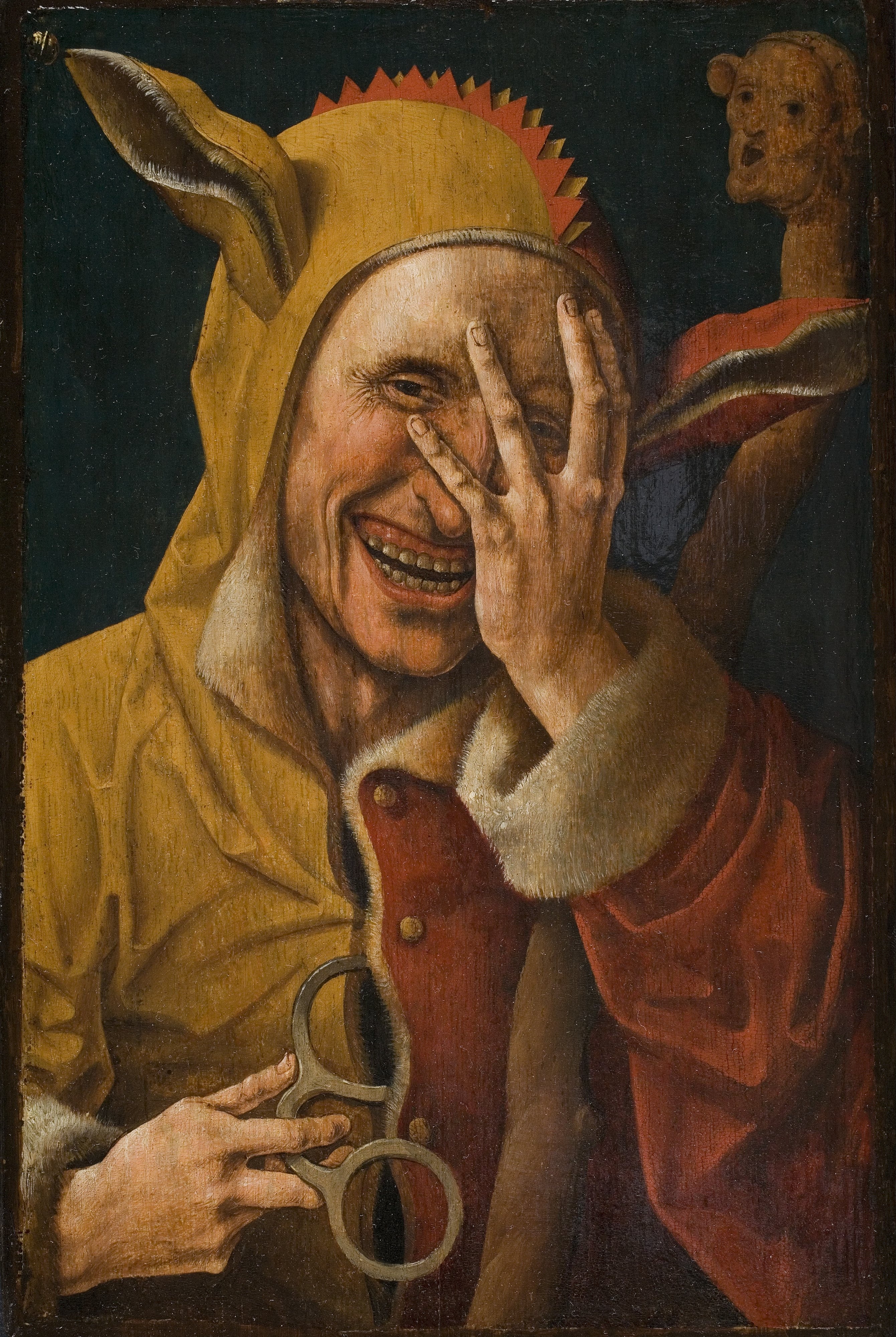
“I Was Only Joking”

http://upload.wikimedia.org/wikipedia/commons/1/1a/Laughing_Fool.jpg

I’ll give you an example of an ill-timed joke. It happened during the oral examination for my Masters thesis at Northwestern. Oral exams tend to generate a good deal of anxiety in the examinee, and I was no exception to this. The protocol is that the examining committee first meets together and then calls you into the room to join them. After exchanging greetings, the chairman of the committee, your thesis advisor, opens the gathering to questions from the other committee members. And so it was that Philip Brickman asked me the first question, beginning just this way:

There is a very serious problem with this thesis.

Dead silence ensued. My anxiety level went up 400%. I began to imagine my future taking a very wrong turn into four lanes of on-coming traffic. And then, after a pause that seemed to last for ages, he turned to the “Acknowledgements” section of the thesis and said:

Philip is spelled with one “L.”

Philip was calling attention to the fact that I had spelled his name “Phillip,” with two “Ls.” I have no memory of exactly what happened immediately after, although I can imagine that everyone laughed. I certainly was relieved; maybe that was Phil’s intent. But, however funny or well-intentioned, it was also a bad joke, one totally at my expense and possible only because of the vulnerability of anyone sitting for an oral exam, and Phil’s authority as one of the examiners. I had no residual resentment toward Phil, who was otherwise always more than pleasant toward me and, I should add, quite a significant research psychologist. But, I give you this example to point out that humor at another’s expense is a problematic undertaking.

I am sure that there are very few of us who haven’t ever taken advantage of the insecurity, vulnerability, or anxiety of someone, to make just such a remark as Phil made. I’ve certainly done it. It is a very human thing to do. And worse if it is done in front of an audience than one-on-one. I’m raising the point only because sometimes people who are sarcastic or mean-spirited do this with regularity and glee. And often, if the target of the humor complains, the jokester will blame the alleged “over-sensitivity” of the person who is the butt of his comment with admonishing words like, “you can’t take a joke,” “I was only kidding,” or “you are too sensitive.”

Maybe, maybe not.

But, once done, we owe the person who we toyed with the courtesy to respect his wishes and whatever sensitivities he does have, whether “over” sensitive or not. To do so is the civil and polite thing to do. Children are especially easy targets for barbs of the kind I’m describing and need particular respect, I think. Life is tough enough for the little guys and girls without adults taking advantage of their unshielded tenderness. That, at least, is my 2 cents on the subject.

And, if you are curious, I did pass the oral exam!

The image above is that of a Laughing Fool (ca. 1500) sourced from Wikimedia Commons.

What I Learned About Therapy From Frankie Avalon

http://upload.wikimedia.org/wikipedia/commons/thumb/3/3a/Gluehlampe_01_KMJ.jpg/240px-Gluehlampe_01_KMJ.jpg

Now, you might not think about Frankie Avalon in connection with psychotherapy. But, in a peculiar way, he taught me a bit about treatment many years ago.

Frankie Avalon was performing in Chicago and appeared on a late night local program on Chicago’s ABC affiliate TV station; as did I and two other mental health professionals. Avalon was talking about his career as a singer and one-time pop-idol of the 1960s. The rest of us were speaking about hypnosis. Frankie Avalon was to appear on the first half of the program, while the mental health section was scheduled second.

The program was taped on Thursday for broadcast the next day. And, as things worked out, both the legendary singer and the shrinks all spent a few minutes together in “the Green Room” before the taping began. Avalon asked us a bit about ourselves.  When he discovered that we would be talking about hypnosis, he posed the following question: “Hey, can you guys stop me from smoking?”

One of my fellow-therapists responded, “Do you want to stop?”

“No,” Avalon replied.

We all laughed, but in truth, the singer had demonstrated something very important about therapy. To wit, not everyone who comes to therapy wants to change. Or, at least, they might not want to change the particular thing about themselves that is causing their unhappiness, or suffer the pain of making that change, or explore the unsettling emotions that sometimes surface in treatment.

This often happens in marital therapy too, when one member of the couple doesn’t think he or she is doing anything that bad, and so has no reason to adjust.

Therapists often can help those who recognize that their problems are severe enough to require “whatever it takes” to change. But, we are not much good when working with someone who, like Frankie Avalon, really doesn’t want to do anything different.

Those adults who are forced into therapy, pressured into treatment, or who go because they think that they ought to, are usually setting themselves up for failure. A wise therapist will usually identify this quickly and ask those individuals if they really want to be there — or point out that they don’t seem ready, and that premature therapy would be a waste of their time and money.

As the old joke goes, “How many therapists does it take to change a light bulb?”

One, but the light bulb has to want to be changed.

The above image is an Electric Light Bulb From Neolux in Studio by KMJ, sourced from Wikimedia Commons.