I am a Boomer born at the front end of the post-war population explosion. My mom, Jeanette, was delighted that Milt Stein returned alive from the killing fields of Europe, crossing the ocean to create me–the soon-to-bloom child they would plant in the world.
Dad was overjoyed to reunite with the beauty he married in 1940, and proud of his newborn son. I’m told it was a joyous scene, and the photos agree.
In the past, old age, which I have acquired by accepting the honesty of the clocks, calendars, and mirrors, required formal respect. The Ten Commandments insist on honoring your father and mother.
Something has changed.
Setting aside the mess Boomers handed humanity, I’d like to answer a critical question: What else accounts for the tendency to dismiss the accumulated experience, knowledge, and guidance of many of the “ancient ones” still around?
Let’s consider six causes of the dismissal of oldster members of the psychedelic era and eight reasons why paying attention to those oldies might be helpful.
1. It is difficult, if not impossible, for a vigorous and vital human of recent vintage to think he will achieve decrepitude. I recall my mother, looking into the mirror in midlife, saying out loud, “When did this happen?” The shape of those who resemble creatures from another planet contributes to believing their opinions pertain to life on Mars.
2. The unfashionable dress, forgotten hairstyles, and limited movement of the now-aged “peace and love” crowd don’t fit well in a world spinning like a top. Since some of us care less about technological trends than is customary, our disinterest reinforces the notion that we are missing the point. Nor do the still-breathing antiques sport earbuds, a practice that will enrich audiologists for years to come.
We are perceived as creatures from outer space or as being born before smart phones, passenger jet planes, computer games, AI, and super cool sneakers.
Yup.

3. We lived before the words “authenticity” and “my truth,” as well as freedom from pretense became mandatory. Indeed, pretense and opportunity were most of what we had going for us. We tried to “fake it to make it.” A student named Jack Weinberg at the University of California, Berkeley, coined the phrase “Don’t trust anyone over 30” during the Free Speech Movement of the 1960s. The sixties generation was a skeptical bunch, except when getting high.
4. Relative youth (let’s say before 40) brings a robust and necessary sense of competence and flexibility. Work now demands more time and expects more self-created ways to make money.
By contrast, the retired crowd lived a slower and less demanding life, and some had lifelong employment in the same place. The University of Illinois, my state college, charged about $100 per quarter. Yes, we emerged in a better moment, but only if our color was white.
5. At a young age, people tend to think they are smart enough to avoid the mistakes made by their elders. Older adults have erred and have the memories to prove it. Their juniors believe they are smarter and claim Elvis is dead to persuade the disbelievers.
Hmm.
The whippersnappers do not think our accumulated knowledge fits the current century. They might be right.
6. My generation includes several blowhards I could name. They never listen but talk from atop a pedestal made for a king.
Now for the rebuttal. Here are eight reasons to listen to what a thoughtful older individual might say:
1. The wise of any age realize that much of life’s significance is a permanent part of the human condition, rather than true of one epoch or another. Think of the need to survive, the pursuit of status, the wish for happiness, the advantage of developing courage, the desire for love, the emptiness of greed, the danger of moral compromise, and the inevitability of aging, loss, change, and death.
Many things cannot be learned without living them. Still, those who survived the ladder up offer awareness of the trip to those who find themselves a few rungs down.
2. Much of what passes for essential reading these days focuses on advancing oneself in the vocational sector, finding love, or psychological self-healing. Ancient philosophers and writers of classic literature can assist those imprisoned by the algorithm-driven, simple answers a newsfeed offers.
With the decline of the humanities in some of the finest universities, the young have missed studying what many of history’s towering and most admired figures learned from such sources. Homer, Immanuel Kant, Plato, and George Eliot (a woman) live in books one does well to discover.

3. Hearing about your parents’ lives is essential to understanding them. What did they live through? They won’t always be around to tell you.
4. A wise person past his prime will listen and ask questions to help you find your answers. A talented therapist does this. And yes, I have revealed some self-flattery here, and some truth.
5. You will live several lives. If you grow, your perspective on yourself, the world, relationships, youth, love, age, money, values, and more will shift by age 50. What is in store for you is the domain of those ahead of you in this process.
6. A lucky soul does not encounter Fate’s hand early in life and believes he is the captain of his unsinkable ship: self-made and invulnerable.
Scholars once spoke, wrote, and thought of destiny as something outside themselves. They believed Fate and the gods had control they lacked, permitting man only the necessity of adapting to it.
Older individuals sustained encounters between themselves and overwhelming, inexplicable forces. There is value in talking to those who have battled such powers.
7. Most of us, of whatever age, live without realizing “The roof that keeps out the rain also blocks out the sun.”* A man is well-served the sooner he grapples with the tendency to avert his eyes from what is uncomfortable to ponder. This, too, reveals itself in uncovering the choices made in a well-lived and long life.
8. Recognizing the speed of time and feeling (not just knowing) one’s mortal condition will enable you to use your time better. The old have lost friends and loved ones, and cannot deny the acceleration of these blows.
If you doubt you are in transit, peer at the old. They hear the clock, but also remember the early, quieter, more patient procession of the hours. Their awareness has increased, and some will tell you they have regrets you would do well to avoid.
You can take the last section as depressing or recognize its truth and the opportunity it offers to help one lead the fullest, most satisfying life possible.
Here’s hoping you do. Here’s hoping we all do.
==========
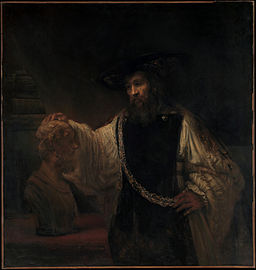
The top image is Marina Karaevangelou’s Megabalanus Coccopoma, the titan acorn barnacle, a tropical species first described by Charles Darwin in 1854. It is followed by the Dalai Lama, as photographed by Christopher in 2010. Finally, Oedipus Questioning the Seer Tiresias, the 1580 painting of Alexander Allori. All of these are sourced from Wikimedia Commons.
*The quotation is from André Gide’s Paludes.