The African Dip: Thoughts on Passive-Aggressiveness, Powerlessness, and Acceptance

The  Flying Turns

My dad occasionally took me to a legendary Chicago amusement park called Riverview when I was a little boy. I was dazzled by the roller coasters, the “Waterbug” ride, and something called the “Rotor.” The latter required you to enter a circular room which spun on a central axis until the velocity and centrifugal force were sufficient to pin you against the wall, just as the floor dropped away.

But, as small as I was, it is a sideshow called The Dip that I remember most vividly. Today I’d like to use this politically incorrect carnival attraction as a spring-board to a few thoughts on the expression of indirect anger that sometimes is called “passive-aggressive,” as well as a therapeutic approach to setting aside the temporary upsets that are a part of any life.

Black men in cages. That is what “The Dip” involved.

Unbelievable, perhaps, as we think about it in 2010. Each man sat on a stool inside the cage. In front of the cage, off to the side a bit,  stood a small circular metal target that was attached in some fashion to the stool, perhaps electronically, but more likely mechanically.

For less than a dollar, you could purchase three balls to throw at the target, one at a time. If you struck the target solidly, the stool on which the man sat collapsed, and he dropped into a pool of water underneath the cage. You might have seen similar “dunk tanks” at various fund-raising events, often giving students the chance to dunk their teachers.

Harmless fun? Not so in the case of a black man doing the sitting and a white man trying to knock him off his seat.

This sideshow was once reportedly called, “Dunk the N****r,” later “The African Dip,” and finally “The Dip.” It was eventually shut down by a combination of Negro outrage and the increasing disgust of white people to the offensiveness of its implicit racism.

The black men were in a relatively powerless situation — almost literally, “sitting ducks.” But, they did what the situation allowed them to do so as to unsettle, tease, and otherwise disrupt the white pitcher’s aim. The Negroes were careful not to say anything too frankly insulting, lest they stir up the racism (and potential for less veiled violence) that was at the heart of the event.

But they would and could get away with belittling their adversaries athletic skill or throwing ability in a way that was amusing. If their comments distracted the opposition at all — got them to laugh (or the crowd to laugh at them) — or caused a break in the hurler’s concentration, the chance of staying on the seat improved a bit.

According to Chuck Wlodarczyk in his book Riverview: Gone But Not Forgotten, the caged men’s banter could include comments about one’s appearance: “If you were heavy, they’d call you ‘meatball.’ If you were thin, they might have called you ‘toothpick.’ If you were with a girl, they might have said ‘Hey fella, that ain’t the same girl you were with yesterday!'”

You don’t have to be a black man in a cage to have some experience of expressing anger indirectly. We’ve all done it. It takes many forms: talking behind someone’s back and mocking that person, being sarcastic, complaining to a co-worker’s superior rather than to the offender’s face, neglecting tasks you have been assigned unfairly, and procrastinating. These passive-aggressive words or acts are rarely very satisfying. The anger doesn’t dissipate; the grudging discontent usually continues; nothing positive happens.

The sense of powerlessness and lack of control that the passive-aggressive individual experiences can come to dominate that person’s emotional life, rather than allowing him to put effort into changing the power dynamic or to remove himself from a position of weakness.

Unfortunately, for some of those who feel powerless and injured, even a passive-aggressive action seems impossible. Consequently, they take a more uniformly passive role. They defer to others, try to avoid giving offense, act meekly, and position themselves under the radar. All that does, however, is give them second class status, just as it informs bullies that they are easy targets.

Someone in this situation, who repeatedly feels mistreated but isn’t able to take on those who inflict the injuries directly, needs to ask himself a few questions. Why do I put up with it? What am I afraid of? Am I really as powerless as I feel? Am I perhaps overreacting? What would happen if I were more direct? Is there any way to get out of the situation I am in?

Cognitive Behavior Therapy (CBT), which aims to quell and counter irrational thoughts, is often helpful in dealing with a lack of self-assertion and the fear that is usually associated with it. Equally, it gives you practice (sometimes using role-playing within the therapy session) in a gradually ascending hierarchy of challenging situations that require an assertive response.

Some CBT therapists, much like ancient Stoic philosophers, employ an “acceptance-based” psychotherapy and integrate this Zen-like element into their treatment. Why, they might ask you, do you so value the minor indignities of daily life and of opinions and behavior of boorish persons? Is it really a good idea to spend the limited time of your life being upset over rudeness from a tardy repairman or a fender-bender accident you didn’t cause — things that will be of no significance in a week, a month, a year?

Put differently, there will always be injustice, and some of it must simply be accepted as the nature of life and of living. Not every fight is worth fighting about, not every slight is intended. If your skin is so thin that you are regularly being upset by people, perhaps you are valuing the approval and opinions of others too much.

For those who ask “Why me?” those same therapists might say, “Why not you — you are alive, aren’t you, so you are subject to all the same things that can affect any other person.” And, as the Stoic philosophers and Zen practitioners would tell us, if we can accept this vulnerability as part and parcel of living, thereby assigning it less meaning and taking it less personally, our lives will be more satisfying — less fraught with anguish, anger, and hurt.

This is not to say society should have tolerated the indignity and racism of “The Dip.” There are times when the indirect, but pointed wit of the caged men is the best course of action; and, many occasions when the force of your personality must be brought to bear by confronting injustice. But some combination of directness in taking on unfairness and forbearance in accepting things — in allowing oneself not to sweat the small stuff — tends to produce as good a result as life will allow.

Of course, you have to figure out what the small stuff is and what other things really do matter to you.

Meditation is usually a part of the treatment enabling you to stay in the moment, and let go of your attachment to passing feelings and thoughts, worries and regrets, and anticipations and fears. To be preoccupied with just such temporary upsets causes you not to be able to fully experience what is going on in the present and determine what is really of importance in your life.

By encouraging and training you in meditation, the counselor  is attempting to give you a method to achieve a state of psychological enlightenment that (without using words) helps you to distinguish the transitory aggravations, disappointments, worries and anxieties of life from whatever matters the most to you, so you can put your effort into the things of greatest value in your life.

Some final questions:

  1. Do you often find yourself fighting over things others consider to be small?
  2. Do you frequently feel put-upon but are capable only of a passive-aggressive response?
  3. Do you (too easily and too often) assume a fetal position with others (metaphorically speaking), who come to think of you as an easy target and treat you badly (in part) because they know you will not stand up for yourself?

If you have answered any of these questions in the affirmative, you might benefit from asking a couple of other questions:

  1. What does this mode of living cost me?
  2. Am I willing to do the work necessary to change?

If the cost is substantial and you are eager to change, then a therapist can be of assistance. Only then will you be ready to get out of the cage, real or not, in which you find yourself.

The image above is the Flying Turns, a toboggan-style ride that was one of the many attractions that made Riverview Park famous.

Fear of Change: the Therapeutic Implications of Japanese Holdouts

Onoda-young.jpg

Things change. The question is, do we change with them? Or, do we instead, continue to operate by the same outdated rules of conduct.

I often said to my patients that they seemed to be behaving as if the conditions of their early life still existed. They had long since fashioned solutions to problems that they faced many years ago, and continued to use the same solutions, even though those methods of living didn’t fit with their current life situation. It is as if one were born in Alaska, learned to wear multiple layers of heavy clothing and then moved to the tropics without a change of attire. The warm clothes were helpful up North, but are a disaster down South.

What does this have to do with the “Japanese Holdouts of World War II? The answer is that these men lived by an outdated set of rules with heartbreaking consequences.

If you recall your history lessons, you will remember that the Japanese soldiers of that period were trained according to the principles of Bushido, a feudal fighting code that derived from the period of Samurai warriors. Above all else, weakness was condemned and surrender was disgraceful. Death by one’s own hand was seen as preferable to permitting oneself to be captured, so as to avoid both personal disgrace and family shame.

The Allied approach to the war against these very soldiers in the Pacific was one that involved “island hopping.” The strategy passed over certain islands, both to save men and ensure that the Allies would be able  to capture those islands that were of the greatest strategic value. When the Japanese surrender came in 1945, numerous Japanese troops found themselves stranded on out-of-the-way Pacific islands, cut-off from their command, and without the capacity for communicating back home. These men neither knew the war was over nor could imagine that any honorable soldier, let alone their entire nation, would surrender. Some were in small groups who gradually died from disease or starvation; others were, at least eventually, alone.

While many never surrendered and died still waiting for reinforcements that never came, it was not uncommon in the late 1940s and 1950s to read news accounts of isolated Japanese combatants giving themselves up. The photo at the top of this page is of Second Lieutenant Hiroo Onada, who finally surrendered in 1974, and would not do so until his former commanding officer, by then a bookseller, personally ordered him to lay down his arms.  At that point, World War II had been over for nearly 30 years.

Thirty years. Yes, 30 years dedicated to a war that was over and a life of desperation that was no longer required.

But how many years, if any, have you given up to a thread-bare, bankrupt strategy of living that has long since outlived its usefulness?. And, more to the point, how many more will you endure? When will you realize that your “solution” has now become the problem?

In my psychotherapy practice I saw numerous variations on this theme. People who were abused or neglected  or criticized as children and who continued to live in terror of disappointing others. Those who found substance abuse the only available way of treating the depression or anxiety they experienced when they were young, and who continued to do so. People who avoided challenges because they were scared of failure, having failed many times in the past. Individuals who wore a chip on their shoulder, forever sensitive to insults and injuries that reminded them of long ago attacks, but now were only injurious in their imagination. And those poor souls who expected rejection because of past rejection. Like the Japanese holdouts, the years pass but the fear doesn’t, and the possibility of satisfying relationships and happiness slips away.

If you still are responding to the present as if it were the past, with solutions that solve little (even if they were once necessary), then it is time to change your life. The barricade of your life’s defenses might be protecting you only from the phantom of an enemy who lives within you, not on the other side of the fortification.

A good therapist is likely to be able to help you develop a new way of living, one more appropriate to the world as it is, not the world as it was; to set aside and heal old wounds.

Is it time?

What is the continuation of your old way of living costing you?

The war, your personal war, might just be over and you don’t know it.

The Power of “No”

File:No sign.svg

Most people don’t realize how much power they have. Or how easily they give it away.

The key is to be able to say “no.” And to hold to that position without alteration.

I learned how easily I could give it away in graduate school.

A door-to-door salesman rang the bell of my apartment. He had a list of magazines. Did I want to subscribe to any of these?

The simple and direct answer was “no.” Had I said this and held to it steadfastly, his time wouldn’t have been wasted and my money, of which I had very little, would have been saved. Instead, I felt that I had to give him a reason, an excuse. I didn’t of course.

But, I chose to say, “Gee, its too bad you don’t have Sports Illustrated on your list.”

“Oh, but I can get that for you!”

I was sunk. I didn’t really want to buy anything. But I’d given the young man, probably no older than I was, an opening. And now I was committed to purchase a thing I didn’t need.

Well, I suppose I was young, inexperienced, and immature. All true. I allowed myself to be held hostage to my insecurity, a feeling of guilt, a need to explain myself, even though it wasn’t required.

If you must have the approval of others, if you believe that you are duty-bound to give them a reason for your actions, then these situations present you with a problem. So too, if you fear confrontation. If you think someone will only provide approval if you consent to their wishes, then you will leave the interaction as the other’s thrall. In effect, the keys to your life and the certificate of ownership will be the property of someone else.

But if you don’t let them or their opinion of you count for so much — if you can live with their unhappiness and don’t feel the need to convince them of the rightness of your position — you will come out of the interaction still in possession of yourself, as opposed to being the possession of your counterpart.

Remember, in many situations you don’t have to persuade the person across the table of your position. You just have to hold to it.

Short of pulling a weapon on you, there is usually very little that people can do to require you to do something that you don’t want to do.

Unfortunately, there are quite a number of people, especially female, who are able to say “no” in defense of their children, but not as an advocate for themselves; all the more, they are prepared to go on attack if they believe that those same little ones have been ill-served by someone else. And yet, when it comes to defending themselves, these moms have trouble. Put simply, it comes down to the fact that they don’t value themselves very highly and therefore can’t easily assert themselves. But for a person they do value, especially their flesh and blood, they are transformed.

If you can’t yet do it for yourself — say “no,” stand your ground — you’ve got some work to do. Your life will be much more the life that you want it to be, if you prevent others from taking you in their direction against your wishes. Think of all the favors you’ve done that you wanted to avoid, the responsibilities you took on at work that really shouldn’t have been yours to take, and (for some women only) the men whose attention you suffered unnecessarily.

If you can’t prevent these things on your own, psychotherapy can help you to learn to employ the word “no” to great effect. It allows you to examine the reasons for your inability to be assertive and gives you tools (and practice) in how to live in a new way.

The ability to say “no” is extraordinarily empowering.

This is one thing you shouldn’t say “no” to.

The above image is by Fibonacci from Wikimedia Commons.

The Upside of Depression and the Downside of Medication

http://upload.wikimedia.org/wikipedia/commons/thumb/d/dc/Depression.jpg/500px-Depression.jpg

Are there advantages to being depressed? Something good about something we think of as so bad? A recent New York Times Magazine article by Jonah Lehrer makes just that case: Depression’s Upside.

The essence of the argument is that some episodes of depression allow for and encourage a kind of analytic rumination that is productive. Put another way, the tendency in depression to focus on a problem, mulling it over to the exclusion of other thoughts, permits the sad person to find a solution to his difficulty and change his life in a positive way.

The counter-argument, however, is that the ruminative process is both painful and unproductive — that it often creates a kind of self-flagellating preoccupation with one’s trouble rather than a process that leads to something good; that unhappiness and focusing on pain and its concomitants simply feed on themselves to no helpful end.

In my clinical experience, therapy with people who are depressed over loss or injury often breaks down into two phases. The first of these is a grieving process, where the person expresses and processes (or sometimes purges) the feelings of anger, sadness, emptiness, desolation, and hopelessness that come with the loss of something of value — a love, a job, high social status, a capability, a fortune, etc.

The second phase involves learning from one’s painful experience about how to live differently, make different decisions, associate with different people, become more assertive, overcome fear; value things differently in life such as money, material things, status, accomplishment, friendship, and love.

Naturally, neither of these two phases is absolutely discrete — they blend into each other and overlap each other. As a practical example, someone who has had a series of bad relationships will typically need to grieve the unhappy end of the most recent one and, in the process, learn how he happened to choose a person or persons who made him so miserable; then changing whatever needs to be changed internally and externally so that different and more satisfying choices occur in the future.

People who are like the hypothetical individual just cited usually come into therapy in emotional pain and seek relief of that pain as promptly as possible. This desire is entirely reasonable — who wouldn’t want this? Some of them request medication, which is often the fastest way to “feel better.”

But many are leery of psychotropic drugs and see them as artificial, hoping that therapy will produce a more lasting fix without dependency upon a foreign substance. Indeed, while a good therapist will strongly encourage the use of medication for someone who is seriously depressed, i.e. suicidal, unable to work, sleeping away the day away (or almost unable to sleep); that same therapist will also know that medication sometimes serves to “de-motivate” the patient, giving him or her a relatively quick solution that allows that person to tolerate an intolerable situation. In the New York Times Magazine article mentioned above, Dr. Andy Thomson describes this problem eloquently:

I remember one patient who came in and said she needed to reduce her dosage. I asked her if the antidepressants were working, and she said something I’ll never forget. ‘Yes, they’re working great. I feel so much better. But I’m still married to the same alcoholic son of a bitch. It’s just now he’s tolerable.’

Clearly, this woman was aware that she needed to be in some amount of discomfort in her relationship with her husband in order to be motivated to get out of it. The drug made her feel better, but, it also reduced her incentive to change herself and her life. It was, in effect, a kind of band-aid, rather than a real cure. It anesthetized her and, in so doing, robbed her of something that was essential for new learning and behavior change to occur.

Unfortunately, most people who come to therapy are neither as courageous or insightful as the woman just described. Once they feel significantly better, whether due to therapy or medication, it is common for them to be less interested in continuing treatment. They have recovered from the event that precipitated their entry into therapy, but they might not yet have learned enough to avoid making the same mistakes that contributed to the problem in the first place.

Such a person can reason that the cost of therapy (both financially and in terms of time, effort, and the difficulty that comes with changing one self) is now greater than emotional pain from which they might still be suffering. Put another way, at this point, doing therapy “causes” more difficulty and pain than not doing therapy, just the reverse of what seemed true when they started the treatment process.

At this stage, those who continue in therapy have something that an old mentor of mine, Truman Esau, used to call “therapeutic integrity.” What he saw in some of his patients was an almost heroic desire to make themselves better regardless of how much the actual process of doing so was difficult, uncomfortable, or painful.

These patients didn’t shy away from problematic truths about themselves or others. They worked hard to stretch and challenge themselves, knowing that it was crucial to improve. They didn’t simply want a quick fix. Like the woman in Dr. Thomson’s example, they recognized that some pain was essential to being motivated. They knew that there was no such thing as “a free lunch,” and were willing to do whatever it took to repair and better their lives.

If you are in therapy now, it will be important for you to be sensitive to this shift from the often intense distress that brought you into therapy, to the point when the therapy itself might seem distressful. This can mean that the therapist is not skillful or that he is pushing you too much, but it just might also signal that some of the most difficult life changes you need to make are still ahead of you, even if the cost of making those changes seems greater than when you started treatment.

If you leave therapy because it is hard and unpleasant work, the problems you have won’t care. They will simply continue to reside in you, work on you, and trip you up. It is not enough to get over your last disappointment or unhappiness, but to change yourself enough to avoid future problems.

Few things that are worthwhile come to us for free.

The above image titled Depression is the work of Hendrike, sourced from Wikimedia Commons.

What I Learned About Therapy From Frankie Avalon

http://upload.wikimedia.org/wikipedia/commons/thumb/3/3a/Gluehlampe_01_KMJ.jpg/240px-Gluehlampe_01_KMJ.jpg

Now, you might not think about Frankie Avalon in connection with psychotherapy. But, in a peculiar way, he taught me a bit about treatment many years ago.

Frankie Avalon was performing in Chicago and appeared on a late night local program on Chicago’s ABC affiliate TV station; as did I and two other mental health professionals. Avalon was talking about his career as a singer and one-time pop-idol of the 1960s. The rest of us were speaking about hypnosis. Frankie Avalon was to appear on the first half of the program, while the mental health section was scheduled second.

The program was taped on Thursday for broadcast the next day. And, as things worked out, both the legendary singer and the shrinks all spent a few minutes together in “the Green Room” before the taping began. Avalon asked us a bit about ourselves.  When he discovered that we would be talking about hypnosis, he posed the following question: “Hey, can you guys stop me from smoking?”

One of my fellow-therapists responded, “Do you want to stop?”

“No,” Avalon replied.

We all laughed, but in truth, the singer had demonstrated something very important about therapy. To wit, not everyone who comes to therapy wants to change. Or, at least, they might not want to change the particular thing about themselves that is causing their unhappiness, or suffer the pain of making that change, or explore the unsettling emotions that sometimes surface in treatment.

This often happens in marital therapy too, when one member of the couple doesn’t think he or she is doing anything that bad, and so has no reason to adjust.

Therapists often can help those who recognize that their problems are severe enough to require “whatever it takes” to change. But, we are not much good when working with someone who, like Frankie Avalon, really doesn’t want to do anything different.

Those adults who are forced into therapy, pressured into treatment, or who go because they think that they ought to, are usually setting themselves up for failure. A wise therapist will usually identify this quickly and ask those individuals if they really want to be there — or point out that they don’t seem ready, and that premature therapy would be a waste of their time and money.

As the old joke goes, “How many therapists does it take to change a light bulb?”

One, but the light bulb has to want to be changed.

The above image is an Electric Light Bulb From Neolux in Studio by KMJ, sourced from Wikimedia Commons.

Unloading Your Therapist: Breaking Up is Hard to Do

Ending a relationship is difficult. Most of us have been on the receiving end of a relationship “break up” of some kind. We know that it doesn’t feel good. Indeed, we know that it can be taken as a rejection (and often that is exactly what it is). Nonetheless, that doesn’t stop some of the same people who decry the insensitivity of those who unceremoniously “dumped them” from doing the very same thing, in the very same way, when they wish to be free of seeing someone else ever again.

With that in mind, here are a few guidelines for thought and action, and some examples of what people do, when and if it comes time to end a relationship with a therapist. Today, I won’t be talking about the sense of loss or sadness that sometimes accompanies therapy’s end. I’ll leave that weighty topic to another time.

1. The “I’ll call you” strategy. Usually, this is delivered by phone message. The patient probably has an appointment with the therapist and cancels it, adding that he will call to reschedule. Experienced therapists know that many people will attempt to end the therapeutic relationship in this way. It avoids a face-to-face conversation which the patient might imagine as uncomfortable, and it avoids actually giving any reason for terminating therapy. It leaves the therapist a bit in the dark, not knowing whether the predicted call will ever come, and probably not knowing what the reason is for the decision to end treatment.

2. The “end of session” termination. Patients often wait until the end of the therapy session to say something of importance, in part because it is uncomfortable or they don’t want to discuss it in any detail, at least not yet. This method of termination has the advantage of being done face-to-face; what it doesn’t do is to allow the two parties to process the reasons for that decision and discuss any concerns. Without some time to talk, the therapist cannot be helpful to the soon-to-be-departed patient, or find out much about the client’s reasons for his decision. Without knowing what those reasons are, its hard for the therapist to learn from any mistakes he might have made, anything he did (or didn’t do) that made the patient uncomfortable, etc.

3. The “no-show” departure. Some individuals who are receiving counseling decide to end therapy by simply being absent from their next scheduled appointment. This is rude, of course, and also risks that the therapist will charge you for the time even though you didn’t come to his office (most therapists expect 24-48 hours notice of cancellation in order to relieve you of the obligation of payment).

4. The “nasty phone call” ending. While this is a rare event, sometimes people want to hurt the therapist because they believe that they have been hurt or neglected by him. They leave an angry phone message and avoid any chance for the therapist to find out why they are hurting, just as they make it impossible to come to a more amicable resolution of the issues at hand.

5. The “I need a break” message. It is, indeed, sometimes appropriate for patients to take a break from treatment. It can get too intense for some, who realize that taking a breather might be helpful. On other occasions, the complications of life outside of the counselor’s office make continued therapy difficult for the moment. However, when giving the message that you “need a break” is simply a way of leaving therapy, with no intention of return, it doesn’t allow for any closure to the relationship, or any of the benefits that such closure provides (which are described below).

6. The “best” way. Whether you have been seeing the therapist for a long time or a short one, the issue of termination is an important one. It is appropriate for you, even from the start of treatment, to ask how long it is expected to last. If you are finding counseling unsettling or unproductive at any point, it is best if you discuss your concerns with the therapist as they happen. Since many people who enter therapy have a hard time with being assertive and direct, it might well be tempting not to talk much about anything that you believe the therapist doesn’t want to hear, and simply to end the relationship unilaterally. Unfortunately, you and the therapist are short-changed if you do this.

Ideally, your concerns should be expressed early in a session, when there is sufficient time to talk about them. Be prepared for your therapist to ask you why you are thinking of ending treatment. You might be surprised that the therapist agrees with you. Alternatively, you might be persuaded if he makes a good case to continue for a while. But if you are certain that it is time to end things, be sure to hold your ground. A good counselor should accept this without trying to make you feel bad about your decision.

Once an understanding is reached about ending treatment, that doesn’t necessarily mean that it must end at precisely that moment. You and the therapist might decide to taper-off sessions or to have at least one additional session to sum up the history of your work together and to say “goodbye.”

There are several reasons for having just such a final session. First, it should allow the two of you to review what you have accomplished, how your life has changed, and what you have learned. Equally, if nothing or little of value has occurred, it can give you the chance to inform the therapist where treatment went wrong. Therapists should be grateful for this information since it allows them to learn, adapt, and improve so that they can help those patients who will follow you into their offices. And, a last session gives the therapist time to point out treatment alternatives or refer you to other available therapists who you might wish to consult.

Finally, a good therapist who has known you for a bit of time usually has some very nice things to say about you, about your courage, wit, grace, intelligence, and the guts it took to look your problems in the face and try to change your life. The last session also gives you a chance to say “thank you,” if that is something that you believe appropriate. The counselor will usually let you know that he would be grateful to hear from you again, just to know how you are doing. And, the door is almost always open if a return to therapy is required.

So, therapy, even when it wasn’t as helpful as you had hoped, can and should end with an expression of respect and good wishes for your future well-being. You will usually feel good about being direct in doing what you believe is in your interest, and having the self-confidence and respect to tell it to the therapist face-to-face. Your therapist will be grateful too, in almost all cases.

No losers here. Only winners.

He Who Hesitates is (Sometimes) Lost

http://upload.wikimedia.org/wikipedia/commons/0/02/Newtons_cradle_animation_smooth.gif

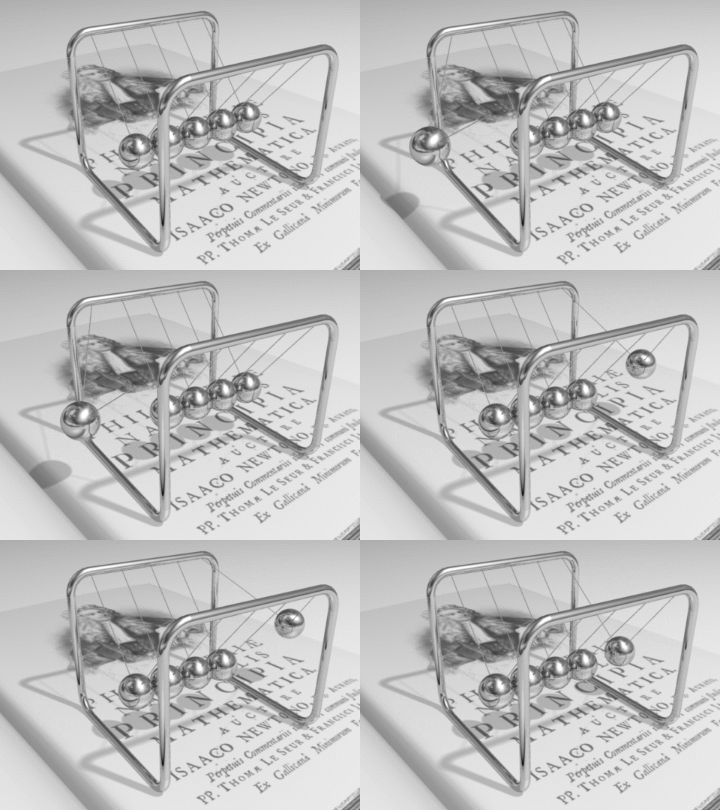
Fear and hesitation go hand in hand. They hold you back, creating a slow motion to your progress (see above) and sometimes no progress at all. The trick is to separate the two, to recognize that you needn’t wait until you are free of fear in order to act. Indeed, if that were the case, most of the people whom we consider brave would still be waiting for the moment of bold action that earned them the appellation “hero.”

Years ago I heard a panel discussion on the subject of Wagner’s opera cycle The Ring of the Nibelung that actually touched on the issue of courage and decisive action. The experts focused on the character Siegfried, who is described as someone who has never known an instant of fear in his life. Should we therefore consider Siegfried’s fearless behavior to be indicative of heroism and bravery? The panel in question concluded it did not. After all, they reasoned, how can one be a hero without fear to overcome? Only a fool would rush to action without being aware of the attendant dangers. But a brave and courageous man would know the perils facing him and choose to act in any case.

Most of us won’t face dragons or fire, of course, but we still will all have numerous chances to act decisively or to hold back. Here is a trivial, but instructive example from my own life. In college, I was fulfilling a PE requirement by taking fencing. Now, I wasn’t a very good fencer, despite being a reasonably good athlete. And, my heavy academic course load didn’t permit me the luxury of spending time outside of class to practice fencing. Thus, in the first seven matches I had against my classmates, I won only three, a pretty mediocre showing.

Nonetheless, I was competitive enough to want to win more often, so I reasoned that there just might be a way that wouldn’t take time away from my other studies. I realized that I was a relatively tentative fencer, and so I decided to become more aggressive. I set myself the task of getting in the first “touch” as soon as each new match began. The strategy worked. Of the next 17 matches, I won 14. I was almost always able to get a 1 to 0 lead within a few seconds of the start of the competition by catching my adversaries off-guard. Yet, despite my new found success, I was really no better at fencing than I’d been when my record was three wins and four losses. I was simply less hesitant, more aggressive.

I once had a biology professor named Hudson who conducted the “Quiz” portion of his classes in a way to encourage behavior similar to my fencing experience. You were graded on the number of questions you answered correctly and lost points if you answered the interrogatories wrong. Hudson asked the questions aloud and it was a race to get your hand up first and have him call on you to answer. Naturally, you had to make a quick decision as to whether you had the right answer. Very fast indeed. Those who hesitated were, as the saying goes, “lost.”

But how does this all apply to daily life, the life outside of the university. You might say that “normal” life is less competitive than my examples suggest, but is it? To answer that question, ask yourself how often you hesitate to do things, take chances, give public voice to concerns that might engender disapproval, avoid tasks that are difficult or challenging? Do you ask out the beautiful woman, or do you wait until you feel “ready,” only to watch someone else beat your time in getting her attention? Do you, at least sometimes, see a crisis as an opportunity? Or do you hold back, put things off, wait and hope that another or better time for action will come? Sometimes it will, but sometimes it won’t.

If your “default” strategy, your habitual tendency, is to wait, you have a similar problem to those whose standard operating procedure is to act impulsively, without thinking. It may be the case that “fools rush in where angels fear to tread,” but it is also true that you are an equal fool if you forever hold back, hesitate, and watch the moment pass or see someone else “seize the day (carpe diem).”

What I am talking about is fear and the uncertainty that fuels it. When we are fearful and decide not to take action, most of us feel an immediate sense of relief. That relief reinforces our hesitation, while simultaneously depriving us of the opportunity to succeed in the endeavor. Soon enough the relief will pass, but not the self-doubt and lack of personal esteem and confidence that might have been won by an effective action.

The danger in allowing too many chances to pass by is a life of “quiet desperation,” a life on the sidelines, watching others play the game, but not playing it ourselves. And, at the end of life, regret for the opportunities passed and the chances not taken is more likely to be troubling than the failed efforts made. Beware the heartache of the words “what if?” True, acting boldly often fails; but, it also sometimes succeeds.

No wonder, then, that musicians spend relatively little time passively listening to music. They are too busy making it.

Make music of your life, then. Let the trumpet announce (or remind) the world of your presence. Sing your song. And if you cannot, find a therapist who will give you the tools to beat back your fear and help encourage you.

The above image is an Animation of Newton’s Cradle created on August 8, 2006 by Demon Deluxe and sourced from Wikimedia Commons.

The Things We All Need to Learn

The things we need to learn wait for us. They are very patient.

I think you know what I mean. At least, you have seen it in others: the angry person who never learns how to control his anger or perhaps isn’t even aware of the need to control it.

Then there is the passive person, who cannot stand up for himself easily, defers to others, and gets taken advantage of pretty routinely. And, despite this, it hasn’t changed over the years.

Some of us choose the wrong friends, lovers, or business associates, making the same mistakes repeatedly. Others continue to use failed methods in raising children. Some of us never face our fears fully (see Albert Brook’s film Defending Your Life for a funny take on this problem). And then there are the people who are impulsive and act without thinking, over and over; or the ones who are sloppy at tasks, not careful enough; or those who are too compulsive, too detail-oriented, trapped by their obsessive attention to small things.

I could go on, but instead, it’s time to ask you a question. What challenges in your life have you yet to master, the ways of thinking or behaving that don’t work for you but which you repeat? Most of us have a pretty easy time spotting the errors in others, but how about your own?

There is an old joke about how we learn:

A man walks down a road and falls into a hole. He doesn’t see it, and it takes some time to get out because it is deep.

The next day, the man walks down the same road and falls into the same hole. He still doesn’t see it, but he might just get out of it more rapidly this time.

The day after, the man walks down the same road, sees the hole, and falls into it anyway.

The following morning, the man walks down the same road, sees the hole, and this time walks around it.

And what does our hero do after the next sunrise? He walks down a different road.

Holes, like unsolved problems, have all the time in the world. They wait for us to recognize them, see the danger they pose, and change our behavior to avoid the danger. As the saying goes, “If you do what you’ve done, you’ll get what you’ve got.” Others have said that one definition of insanity is continuing to use the same failed strategy, all the while expecting different and better results.

How long will you wait to change? Your problems can last a lifetime. They have no train to catch or meetings to attend; they take their time, not troubled by waiting. Or, should I say, they take your time. All of your time.

Do you really want to wait that long?

Making the Same Mistakes Over and Over: How to Learn From Childhood

There are few perfect childhoods out there. Indeed, it’s the nature of childhood to have some tough times. You are small, you don’t know anything, everything has to be learned for the first time. No wonder its a challenge! The adults tower over you and the big kids can belittle you, push you around, and trip you up. Literally.

So what do we do to survive childhood? Well, we figure out some strategies to deal with the problems that we face. For example, if you have an angry parent, you might learn to be sensitive to signs of upset in someone else, know when to keep your head down, try not to ruffle feathers. On the other hand, if you had a parent who only gave you attention when you were helpful and solicitous, doing things like looking after your younger siblings, you could have learned how to take care of others and seen that quality as, perhaps, one of your only virtues.

Often, the solutions that were necessary early in your life don’t work very well in the “older” (which is to say “current”) version of you. Being sensitive to possible anger in friends, lovers, and coworkers could well find you cowering unnecessarily, accepting half-a-loaf because your are afraid that if you speak up, you will get none. Being a care-taker as an adult might get you some initial approval, but it can prove unsatisfying when the person you are with expects that you will do all the caring and give all the help in the relationship, but doesn’t think to give much back to you.

It’s a little bit like this: Imagine that you were born in Alaska, learned to wear heavy clothes and multiple layers. It was a solution that was necessary and one that worked. If you continue to live in Alaska, you will find success if you use the same solution forever. But, should you move to South Florida and operate by the same set of internalized rules, now you will have quite a problem!

Childhood solutions only are useful to adults if you continue to live in circumstances similar to your childhood. But, by definition, most of us live in different circumstances. We are not any longer so small and defenseless, so unworldly and innocent. We now have much more capability to change the world around us. Unfortunately, some of us don’t know it.

Are you doing the same things that you did as a kid, using solutions that haven’t solved anything for a while? Are you suppressing emotions because that  was a good strategy in an uncaring childhood home? Are you still afraid of situations that resemble your early life challenges? Do you still avoid difficulties, never having figured out how to face them?

It’s worth taking an inventory of your early life and, even more importantly, your current life.  Look frankly at what did or didn’t work as a kid (and what does or doesn’t work now), asking yourself whether youthful difficulties produced a way of being that isn’t helpful. If you keep using failed solutions, you will likely continue to experience failure. Most of our problems are patient. They wait for us to recognize them and then to solve them. They can wait a lifetime.

Is that how you want to spend the rest of your life, making the same mistakes, accepting less than what might be possible and good for you? If you are willing to wait in that way, don’t call a therapist; you are too patient and not sufficiently motivated to change. But if you are beginning to be aware of how unsatisfying your way of living is and have the courage to face that fact, do call. That’s what therapists are there for.

The Problems with On-Line Therapy

It is tempting to think that therapy might be done on-line with the same effect that it can be done face to face. Unfortunately, most of the time, this probably isn’t true.

Some people are certainly more comfortable with the computer and that can be part of the problem. The face-to-face contact, in a supportive environment, is something that is beneficial. By pursuing therapy without direct human contact they may be avoiding something about which they are afraid. If that is the case, the therapy will, by definition, miss dealing with the very thing that the patient needs to tackle and confront.

Then, too, part of the therapy process involves having the courage to be with the therapist, alone in the same room with one other person and the words and feelings that are the substance of your life; to make the effort to come to his or her office; to be on time and value the human contact together in a setting where one learns that it is safe to discuss the most intimate, personal things in one’s life.

If you have been to an extremely moving or exciting concert you probably known what direct contact with the event means. Music that can overwhelm in the concert hall is likely to be less powerful when heard in a recording of that concert in your living room. Something inexplicable but precious and unreproducible can happen in the few moments of connection between the human beings who are musicians and the human beings who are the audience. Just so, between the therapist and the patient, something remarkable and fragile is too often missed when the medium that carries the message is electronic.

Even with the aid of video communication between the therapist and client, it is too easy for the counselor to miss the subtle signs of discomfort or sadness, the body language, the perspiration, the incompletely formed tears in your eyes, the ever so slight furrow of your brow; the subtle vibrations, tremors, and eye movements; the nervous bouncing of a leg, or sometimes the disinterest or boredom that it is crucial for the therapist to observe. Equally, the patient cannot see the intensity and concern and dedication of the therapist, or, more appropriately, cannot so easily “feel” them as when he is seated only a few feet away looking directly into his eyes.

A famous musician once described the difference between a “live” performance and a recording as like the difference between “sleeping with Bridget Bardot (a famously beautiful movie star of 1950s and 1960s) or sleeping with her picture.” A crude comparison, perhaps, but it does get to the human contact that happens between two people when they are face-to-face, versus the more artificial quality of that interaction when they might be separated by thousands of miles and living in different time zones.

Of course, one might add that medical insurance may not pay for such an electronically mediated encounter as on-line therapy, but that is not the essential point. The essential point is that the best of life and healing occur in the context of a caring professional who you get to know in a personal way and who gets to know you in the same way. However advanced technology becomes, at least until it allows a convincing hologram of you to be in the same room as the therapist, something will be missing and lost in media-mediated encounters.

That said, if you live at a significant distance from a good therapist, therapy over the phone or on-line might be your only alternative. Still, it is important to recognize that there will almost certainly be something lost. And, depending upon what you need, what is lost may well be the crucial element in your healing.