Are You a Good Judge of Character?

512px-are_you_playing_square-_-_nara_-_513626

Just as most people with cars will tell you they are better than average drivers, I suspect most of us believe we are pretty good at knowing others: estimating their worth, determining their reliability, pegging their level of integrity.

Not so fast. Some of those confident in their capacity to size-up friends and strangers are poor at it, in my estimation. Here are a few of their (and our) possible errors:

  • Believing people are motivated in the identical way we are. This amounts to the expectation that you can judge another’s intentions and actions by asking the question, “What would I do in his shoes?”
  • The tendency to discard important evidence about personality. I wish I had a million dollars for every time a female patient uttered, “Oh, he wouldn’t do that to ME.” The action they referred to was a betrayal, almost always sexual. The man, of course, had already revealed a history of infidelity. Call this willful blindness by the unlucky lady.
  • Sticking with a wrong opinion. Some of us are slow to revise a long-standing error. Even if our original measure of an individual is right, we are in danger of failing to register subtle changes morphing him into something less honorable. One might also miss the ripening of a condemned personality into someone sweeter. It is as if, once done labeling, we are free to put our brains asleep. Richard Posner, a public intellectual and judge, rightly asks the question, “If we sentence a 21-year-old man to life in prison, are we still punishing the same man when he is 71?”
  • The difficulty of thinking psychologically, Part I. Most of us base our understanding on surface impressions. A plausible explanation of a person’s behavior “makes sense.” Freud knew better. Actions can be determined by multiple motivations. Many of those are unconscious. A quick acceptance of a single reason to explain the world risks simplifying the complex.
  • The difficulty of thinking psychologically, Part II. In observing others we tend to assume a personality is something objective, like pulse or blood pressure or height. Might it be more accurate to think of mental makeup as a creation of our perception, a combination of what we encounter in the other and how we interpret what we encounter? To a significant extent we translate our experience of a man, his words and actions, filling in the many blanks with our history of similar persons and a few educated guesses. Much is lost in translation. This is usually done without careful study, no training, by instinct. How else might you account for the neighbor of an ax-murderer telling the TV reporter he appeared to be a good guy?
  • We tend to believe the best of members of our in-group and those we are attracted to.
  • We tend to believe the worst of those we dislike, members of an out-group, and people against whom we compete. They become stereotypes.
  • The influence of the opinions communicated by friends, relatives, and co-workers. Research demonstrates we are influenced by group opinions even if asked to estimate which of several straight lines is the longest, discounting what our senses tell us if the rest of those present offer different answers. We do not form judgments in a vacuum. Millions of advertising dollars are spent on attempts to modify thought and action — yours and mine.

512px-w-_wisdom

  • We believe people will behave in the same way regardless of the situation. Few of us observe even our best friends in a variety of circumstances. We don’t watch them preparing their tax forms, at work, or facing a moral dilemma.  Courage is in short supply. Not everyone can resist taking a surreptitious unfair advantage. Self-interest is a powerful motivator and easily rationalized. Evidence for this opinion is to be found in the large number of political candidates who throw in their lot with a yahoo-like scoundrel and justify it by loyalty to their party.
  • Expecting others to be consistent and whole, all good or all bad. Again, public office-seekers provide the example. They are flawed, as are we. Yet there is the tendency to understand people globally, as undifferentiated and organically whole: honest or dishonest, virtuous or criminal, black or white. The best person on earth has secrets, has made mistakes, and will make more. No man deserves a halo, but many benefit from a halo effect or are harmed by its opposite.
  • Our limited perspective. We experience everyone from a unique view point: through our eyes and our buzzing brains. The reason pollsters sample large groups is because any one person doesn’t reflect everyone’s opinion. We bring to our understanding of life a very particular set of experiences and beliefs that shade and transform all we think and observe.
  • A tendency to judge others more harshly than ourselves. “I wouldn’t have done what he did” is easy enough to say (and thus condemn) because we are not in the identical situation as the one being judged. “He should have known she was no good” is an opinion lacking knowledge of all the history, emotion, and experience which might explain a failure to “know.” Meanwhile, automatic psychological defenses blind us to our own foibles.
  • The shifting perspective created by aging. How can a 20-year-old fully understand a 40-year-old? How can a sixty-year-old understand a 20-year-old? Not only do these people have the advantage or disadvantage of years, but of times. Life today is not what it was in the ’50s or ’60s or ’90s. Time machines cannot take you forward and back with appropriate adjustments of your age.
  • Transference. Transference is not limited to the counselor’s consulting room. It is like a mistaken identity. While we might have feelings for the therapist derived from our relationship to a parent, we can also react this way to a stranger or friend, a lover or a boss. They too may remind us unconsciously of some other past human contact and reproduce many of the sensations and emotions evoked by the original person.
  • The intentionally misleading quality of public faces. Humans try to make themselves “presentable,” just as a gift, an award, or an object of art is better looking when dusted off, retouched, and nicely framed — now suitable for viewing. X-ray vision through and beyond the public face is unavailable, Superman excepted.
  • The influence of our off-kilter emotions. Here is an example of how feelings can distort our estimation of another. An insecure person prone to injury by a word or a look is more likely to believe the other harbors a negative attitude toward him, thus overestimating his neighbor’s dark side.

Though subject to the foibles just described, I nonetheless possess considerable experience (personal and professional) in trying to understand others. If I am better than most in making those judgments, I am far from perfect. To whatever extent I can demonstrate success, it is because I benefited from large data sets for thousands of patients with whom I spent many hours. They offered information often not provided to those closest to them. I received instruction in the manner of asking questions, analyzing the answers, administering and interpreting psychological tests, formal education, and supervision. And still I am not perfect.

We do our best, therapists or not, to hone the observational knife to the point of precise dissection of another personality. Or we do it casually — all too confident — and don’t look back. No one, however, gets a complete grasp of the social world. To do that we would have to be both inside the other and outside of him, combining the perspectives of those who know him best and those who are more distant — like a baseball game viewed from different angles by multiple cameras.

A 24/7 off-the-field videographer might help too, making his visual record during all the hours before and after the contest, even when our subject is asleep. We would also need to speak with our subject’s lover, children, business partners, garbage man, and valet, if he has one. Not to mention the person who does his laundry.

And there is the rub, my friend. Not even your therapist wishes to know everything about you.

Are YOU Playing Square? is a World War II poster of the Office for Emergency Management (Office of War Information). It requires a bit of explanation. During World War II the US government created rationing  and price controls on certain commodities. This was done to ensure that the people at home faced no shortages, while the armed forces were themselves well-supplied. Nonetheless, a black market existed in which one could get more than one’s proper share of a rationed commodity by paying an inflated price. Thus, “playing (fair) and square” meant respecting the rules, not participating in the black market. The poster is meant to suggest that cheating undermined the war effort and thereby endangered the soldier pictured. The second image of Wisdom is the work of Matt Lawler. Both of these pictures were sourced from Wikimedia Commons.

Can Therapists be Fooled? What Therapists Miss

71Ihq8ngHZL._SL1200_

At a recent gathering my wife had an unexpected encounter with a woman who had done us wrong. When my beloved met her eyes and said hello without emotion, the shadowy figure broke eye contact. She looked surprised — taken aback. Ashamed? Shame doesn’t connote self-awareness or guilt, so much as being caught with your hand in the cookie jar.

Who is she? As a teen she’d been a rebellious, angry hell-raiser, the product of a broken home: not divorced parents, but shattered and shattering, sham adults. Time passed and this dark lady appeared to become sociable, energetic, and funny  — an academic failure, but a business success. Failed marriages and friendships revealed that intimacy was a challenge. For all her charm, depression was a life-long battle never surmounted, loneliness her closest companion. A sad story and, I admit, I fell for it. No, that’s unfair. The tale was real enough, but failed to include a description of the shabby baggage she carried.

Madam X is a person for whom truth is only a convenience, like a garment to be discarded when out-of-fashion, not the internal necessity of a more principled life. Honesty is tossed aside like a burned out cigarette. To get what she wants she is unrestrained and unrestrainable.

I am reminded of Oscar Wilde’s character Dorian Gray as I think about Madam X. Wilde’s novella describes the protagonist as a beautiful, upper class Englishman whose bloom of youth and stunning features are captured in a commissioned portrait, upon which he makes a wish: to remain forever young while his canvas likeness ages. But the painting becomes a scold, reflecting and reproving his increasing corruption. The art deforms itself to the point that he must place the thing in an attic. Meanwhile, Dorian Gray’s face and stature honor the wish he made by retaining their handsome allure — the internal rot disguised.

Might life be better if we were required to wear a meter displaying a measure of our integrity? Color coded, perhaps. White would signal a godlike character, black its opposite, with all of us somewhere in between, depending. Then we wouldn’t need to study others, play the back and forth game of risking disclosures, judging facial expressions and body language, and taking the small but tentative steps of early intimacy.

Relationships are about what we will risk and with whom. Part of the dance depends on our own security, part on our ability to judge the trustworthiness of others. None of us is either perfectly secure or gifted with x-ray perception and an internal lie detector to evaluate the soul of another. Some just stop trusting altogether.

Acceptance of human frailty is the therapist’s Achilles heel. We must think the best of our patients, be optimistic, free ourselves from judgment. We have seen people change and so believe in “possibility.”

Having never seen or felt the bite of the potential masked viper sitting before us, we sit disarmed. He offers us no rap sheet of past iniquity. In a certain sense we are wise innocents who intentionally obscure our own vision: an occupational risk we take on knowingly.

512px-Reading-jester-q75-760x753

Therapists also have experience (though not so much as criminal law attorneys and police) with those who don’t play fair, to the point of becoming inured to the usual warning signs. We are prone to be a little stupid or very generous and forgiving (take your pick),  unguarded both inside and outside the office. Not fully, but just at the margin. With time, if the evidence pours in on who the individual really is, we adjust our opinion as necessary, just as you do.

A small number of our clients believe in their own innocence regardless of their history of turpitude. They don’t know the truth of things and are so defended and well-rationalized that even their mirror offers a false reflection. No inward inspection is permitted. The woman in question had been in plenty of therapy, but reported no benefit.

The scary thing is, you’d find her charming, funny, and bright. She might even be generous to you until and unless you found yourself in a situation where her self-interest kicked in and revealed a self unchanged for decades. You might say she lost herself. I’d say, however, Madam X never had a self to lose, only one to disguise. A street fighting sixteen-year-old’s identity was hidden, just waiting for an excuse to emerge and mess with people.

Perhaps you are asking, do I carry continuing resentment? No, though I would not again associate with her. She is too dangerous.

As to retribution, Madam X has been punished enough. Her sentence? To live the life she is living:  a person on the outside of true companionship, capable only of sham friendship. Unlike Dorian Gray, she takes the round shape of a human wrecking ball. Wrecking balls possess no lasting friends. They languish in a junk yard of their own creation, surrounded by the things they have broken and the broken thing they made of themselves.

My knowledge of her sadness lingers. I know the heartbreak at her core and do not wish her worse. Indeed, how nice it might be to chance upon information of something better, more hopeful about Madam X than the closeted life she lives, on the outside of love, honoring only a perpetual undercover assignment of her own making. She was a beautiful child and has her moments still. A dear person is somewhere in there, if only she could find her.

The Jester (or Fool) image comes from a turn of the last century book: Bill Nye’s History of England. It was sourced from Wikimedia Commons.

Normalizing the Abnormal: Making Excuses for Toxic People

256px-Caltrans_CAUTION_PEOPLE_CROSSING.svg

Why do we associate with people who aren’t good for us? Why do we stick with them? Here are a few of the reasons:

  • FAMILIARITY: If you were raised in a dysfunctional family, you are used to acquaintances who injure others. Their behavior is routine. To some degree you become habituated to it.
  • THE DIFFICULTY OF LEAVING: The end of relationships can be complicated and painful. Should you wish to avoid conflict or are afraid the toxic individual will lash out, all the more reason to endure the situation.
  • INSECURITY AND FEAR OF LOSS: A person with low self-esteem and few friends might accept a poor relationship despite its limitations. He does not believe he will be better off without it or capable of finding a new buddy.
  • OPPORTUNISM: Alliances can be a simple matter of taking advantage of a situation and serving your own interest. Senator Marco Rubio is being encouraged to run again for the Senate by senior Republican Party (GOP) members. Thus, he has decided to make friends with an enemy, Donald Trump, the presumed Republican nominee for President. A former supporter of Rubio, Cecilia Durgin in the conservative National Review, states: “Rubio hadn’t just disagreed with Trump on policy but had labeled him a ‘con artist’ who threatened the GOP and was too dangerous to be entrusted with the nuclear codes. Now Rubio has gone from reluctantly upholding his pledge to support the nominee, to saying he’d attend the (Republican National) convention and would be ‘honored’ to help Trump.” Durgin finds Rubio’s shift opportunistic.
  • FEAR OF THOSE UPON WHOM YOU DEPEND: A child who perceives the potential for repetitive angry and hurtful responses from a parent can learn to bury his feelings and blame himself for generating the parental danger. He has little choice. Retaliation will only bring on more injury. Unfortunately, he may accept the parent’s verdict as just. By diminishing himself, he unconsciously attempts to make his situation more acceptable. Moreover, his life then becomes less hopeless: he comes to believe that if only he can change himself, the parent will show him love. Without eventual escape from the elder and processing his own misfortune, he is liable to accept mistreatment throughout his life.
  • RATIONALIZATION: The process of growing up is disillusioning. We discover mom and dad aren’t perfect and no one is morally pure. That includes ourselves, at least if we are honest (a contradiction in terms, I know). Many of us are not and excuse the gradual erosion and transformation of our sense of right and wrong. Thus, we might note no problem in those whose misbehavior isn’t much different from our own. People salve their conscience by thinking they will be heroic and principled when faced with a major moral crisis, no matter their small indiscretions in more routine situations. Without being tested, however, you don’t know. In my experience, morality is lost by inches. Those who are not careful gradually become something they would have rejected at an earlier time of life. When the big moral test arrives, they have long since given up whatever idealism they once had.
  • BECOMING POLLYANNA: By nature or experience, it is possible to be optimistic about individuals and look at the bright side of life. This can be a good strategy for a routine sense of happiness, despite the mistakes of judgment it leads to. If you see only the best in people then it doesn’t matter too much with whom you spend your time or, within limits, how they treat you.
  • HISTORY AND INERTIA: Relationships of long-standing are hard to give up. You share a history and a body of memories with someone special. A recent friend doesn’t replace that shared experience. A new person who appears toxic will be avoided much sooner than an old buddy or family member.
  • GUILT: Society reinforces loyalty. You risk not only admonishment if you end a relationship, but violating your own internalized sense of what is proper.
  • MISGUIDED HOPE OF GETTING THE LOVE YOU WANT: When your beloved or best friend reminds you of a parent who did not love you enough, you may endure his mistreatment in the hope he will change. You are still chasing the dream of getting the kind of affection you hoped for from the parent. This is a case of unconscious mistaken identity or — as therapists call it when they are taken for someone else (metaphorically speaking) — transference. One can almost never persuade a parent or parent’s doppelgänger to be who you want. We can only work through the transference, grieve our failure to obtain the desired love, and find healthier affections.
  • NECESSITY: In a down economy one stays in jobs with abusive bosses far longer than one otherwise would. Financial dependence on a spouse (or the inability to work) creates the same constraints. Escape becomes difficult; though, over time and with preparation, effort, and courage, a toxin-free situation is possible.
  • HOPELESSNESS: Some of us are so bruised by human contact as to assume we might as well stay put, since no one better is thought to exist. It is a false, but powerful belief and likely to be associated with depression. Treat the mood disorder. Hope (and a more objective view of the future) may then return.

One key to a good life is adapting, learning from experience, and knowing how to start over. There are millions of new people you might get to know who would enrich you. Unhappy relationships need not be maintained. We are often freer than we think.

The top Caltrans Sign is the work of Mliu92 and sourced from Wikimedia Commons.

Passive or Active? Choosing Your Life

512px-GuidoReni_MichaelDefeatsSatan

Simple words are not so simple. Rather, we forget their meaning. We forget how much they should provoke a reevaluation of our lives. Consider the words “take” and “make.” I’ll try to “make” something of their importance in describing the lives we choose.

Here is a common sentence: “I must make a decision.” It sounds more passive than it is. I have heard the same phrase from non-native English-speakers, slightly altered: “I must take a decision.” As in grab or capture. Even in “making” a decision, at least in its most active form, we “build” or “construct.”

Take stock. Take over. Take responsibility. Make a choice. Make something of yourself.

Do you see where I’m taking you? What kind of life do you want? One you take or one left over because you did not capture a place in line?

We all know not choosing is a choice. If you don’t make a decision someone else will; or, perhaps the opportunity to intervene on your own behalf will pass. Many times an active decision is right even when wrong. You grab hold of the wheel of your life and try to steer. Value resides in ownership of yourself: self possession.

Many of the newer therapeutic models are not as contemplative, reflective, and retrospective as Freudian therapy, but add conceptual, emotional, and behavioral change — action — in the present. True, Freud warned about making personal decisions early in the treatment process, when still burdened by unresolved issues. There is recklessness in acting without thought, but finally one must roll the dice of life or stay on the sidelines, part of the audience. Indeed, one persuasive therapy model goes by the name of ACT (the word, not the initials): Acceptance and Commitment Therapy. ACT leads you to a point of decision about what is important to you, commitment to those revealed values, and an eventual behavioral enactment of your commitment.

You have doubtless noticed women whose companions are men of action, whether thespians, builders, or “makers and shakers.” Indeed, a man pursuing a woman is described as “being on the make.” Some of those “gentlemen” are less than uniformly admirable, but their grasp of initiative is. Many other males (and females) lead lives of “quiet desperation.”

Please don’t misunderstand me. You needn’t be a leader to take charge of your life. Each of us has problems. Our inner life can be like a room filled with shelves of challenges we avoid. One must clear the shelves. We either sweep them clean or avert our eyes and lock the room wherein they reside. We then avoid any part of life reminding us of the courage we lack. Our failure might even be rationalized as good judgment — as an avoidance of danger.

How many people can’t eat out alone, try to make a new friend, or phone a stranger (choosing email instead)? How many of us can’t speak in a group or attend a class out of fear? How many adults can’t say no, ask for things, or look someone in the eye while uttering a necessary truth? If you are 16 and you don’t tackle such challenges, OK. At 56, if you still can’t, what then?

A graduating high school senior tells a younger, awe-struck young man why she couldn’t be with him:

“Charlie, I told you not to think of me that way nine months ago because of what I’m saying now. Not because of Craig (her then boyfriend). Not because I didn’t think you were great. It’s just that I didn’t want to be somebody’s crush. If somebody likes me, I want them to like the real me, not what they think I am. And I don’t want them to carry it around inside. I want them to show me, so I can feel it, too. I want them to be able to do whatever they want around me. And if they do something I don’t like, I’ll tell them.”*

Life in a fetal position is not a life in full. Trying always to please others is a life given away to people who won’t value you because you set your price tag too low. Such an existence is the opposite of “being a man,” a phrase that applies to any mature, confident adult, regardless of gender. Some of us persuade ourselves that the things we don’t do (because we don’t try) aren’t important. A kind of self-delusion. Others live in regret, consumed by “what might have been,” shadowed by the effort they did not “make.”

Regret is the only six-letter word equivalent of a four-letter swear. Unless you do an irreparable injury to another, perpetual regret is like a judge you have assigned the job of looking down on you, pointing an accusing finger eternally.

We all must stretch ourselves to our limit, especially in the first half of life, and learn to hold our head high always. Ironically, in the act of lengthening the spine by standing upright we feel better, and tend to overcome whatever sense of shame lives inside. Few of us, after all, wish to appear spineless.

Passivity isn’t the opposite of activity as much as it is the adversary of “living.”

Make the best of your life. You will die whether you do or not, so you might as well die trying.

*Chbosky, Stephen. The Perks of Being a Wallflower. New York: Pocket Books, 1999: 201.

The painting of The Archangel Michael Tramples Satan by Guido Reni is sourced from Wikimedia Commons.

It’s Not Going to Happen to Me

Smug_santa_(3105864835)

It’s not going to happen to me.

“Why?”

Well, because I’m young. Sure I smoke, but so did my grandfather and he lived to be 97. Sure I eat a lot and I’m overweight, but so does my mom, and she can still do cartwheels. Besides, I’m a good person — bad things don’t happen to really good people. And, I have a strong relationship to God. He wouldn’t let anything bad happen. He’s on my side.

OK, I don’t know if it is a He or She, but I’m goddamn sure about God being on my side. I’m a spiritual guy. No, not the kind that has to go to church all the time, but God knows my heart is in the right place. I even gave 50 cents to a homeless guy a couple of years ago. Besides, I’ve been lucky all my life. And I’m careful, I have very good judgment. I look both ways before I cross the street. I plan in advance. Not to  mention, I’m really smart. I always got good grades in school. And before anything bad happens, I’ll see it coming and get out-of-the-way.

OK, sometimes I lie to the boss, sometimes I do a side job for cash so I can avoid paying taxes, but who doesn’t do that? The government would waste it anyway. I’m clever. I’ll never get caught.

Sure, there are some things I haven’t taken care of yet, some stuff I need to start, some projects I need to finish. But, crap, I’ve got time, plenty of time. There’s always tomorrow or next week. What’s the rush?

If I really wanted to stop smoking I could stop, but I enjoy it. And even if I do trip myself up somehow or some way, there will always be other chances. What’s more, I’ve got people looking out for me. If I were in trouble, they’d warn me and I’d change course.

The bad things that have happened to me have been someone else’s fault. I’ve recovered. See! I’m as good as new!

What’d you say? You said I drive too fast? Heck, I’ve got terrific reflexes, great hand-eye coordination. I’ve never had an accident, not even a traffic violation. I know what I’m doing.

Yeah, I drink, sometimes too much, but I never drive when I’m tipsy. How do I know? Well, I can just tell. I know myself. I don’t make dumb choices. OK, sometimes I have unprotected sex with people I have just met, but I don’t have sex with those kinds of people who would have AIDS or herpes or something. I guess I wasn’t always faithful to my last girlfriend either, but, I mean, who is? Jeez, I’m a man, I have needs, I have urges. I just do what other men do. What’s wrong with that?

I’m smart. I’m good. Don’t worry about me. I’ll be OK.

It’s not going to happen to me.

What you’ve just read is an imaginary conversation, not intended to resemble the words or attitudes of anyone living or dead, and certainly not the gentleman pictured. The top image is called Smug Santa, taken in 2008 at the New York Santacon by istolethetv and uploaded to Wikimedia Commons by Princess Merida.

How a Dangerous Patient Got That Way

Brave Merida

When I first saw “Mr. X” in my waiting room, I thought his head was on fire. Striking, spiked red hair aflame. My mistake. It was his heart.

Before long, he would be on the verge of doing harm. Or, as he saw it, putting things right; being something like an avenging angel on the side of all that he believed to be just and good; a kind of holy warrior.

This is the story of how he went from being depressed and disgruntled to someone who might kill. But it is also a story about what happens when hearts are inflamed with rage.

Until only a short time before the “X-Man” consulted me, he was the sort of guy who, when you saw him in a crowd, the crowd stood out. Hardly a mutant superhero. His physical stature and undistinguished facial features made him appear to be an average man in every way: average nose, average mouth, average height — you get the picture. Back then his hair was conservatively fashioned, not spiked, and my patient colored it a less startling shade.

Mr. X did not welcome attention, you see. Attention in his life had never signaled kindness.

His parents were unkind. His teachers had been unkind. His first wife was unkind. And his kids wanted no part of him other than financial support. They believed his first wife, who said that he was a scoundrel. Thus, we have a man who was abused and neglected, bullied by school mates, and badly treated by wife #1. The divorce had been financially ruinous and somehow that woman had managed to win his children’s favor.

The X-Person was reasonably bright and worked in a technical field of endeavor. He’d made a decent living, but watched as others surpassed him. Some of them were minorities, and rather than looking at possible short-comings in himself (his relatively clumsy social skills, for example), he thought that they were getting unfair promotion. In short, he became a bigot.

x-men-legends-2-characters-4

Then the final blow: a financial downturn and the loss of his job. He came to me after several months of a futile job search. He was both depressed and embittered. My patient had tried to play by the rules and, it seemed to him, the referee was always penalizing him. Having no close friends, the only things he could count on were his second wife’s support and that of his religious faith, which he relied on more and more. It was not the religion of his parents, but one that he’d chosen some time after his divorce.

Therapy was aimed at keeping him afloat emotionally so that he could succeed in finding a proper job. To the extent that he opened himself to looking at his life of travail, the treatment attempted to help him grieve his losses. But, let’s just say that the goal of keeping him from curling into a ball was working, while relieving him of his back-pack of unresolved grief was not.

Several months in, however, it was clear that he was beginning to think about violence. Acting out. Targeting others. And he increasingly saw the religious texts that he faithfully read as indicating that wrong was being done in the world and that it was his job to right that wrong. Indeed, he felt that it would be irresponsible and sacrilegious not to.

Interestingly, Mr. X was untroubled by war and wished to have no part in supporting it or protesting it. Nor was he concerned with children who were abandoned or starving. No, his concern was for the unborn, but his anger was against those who conspired to prevent their birth. Specifically, physicians who performed abortions.

X_men_1

This X-Man was uncomfortable after telling me this. He was more than smart enough to recognize that, if he talked about a plan of action or specified a target, I was required to report him to those authorities who might prevent the worst. When I questioned him about the inconsistency between valuing the lives of the unborn and the likelihood of destroying lives of innocent bystanders in addition to the “murderers” he hated, he brushed-off the thought. When I mentioned the commandment “Thou shalt not kill,” he was unfazed. Yet it came from the book he called “holy.”

To my patient, there was no problem in killing the MDs, and anyone else who might die in addition to the doctors would be “collateral damage,” worth the accomplishment of his goal. He did not expect to be punished by the god he worshipped and didn’t care what civil authorities might do to him.

It was clear to him and to me that my concern about potential carnage (he denied “yet” having a plan and claimed he hadn’t definitely decided to do anything) was getting in the way of his treatment. Within a few weeks he indicated that he could no longer trust me because I seemed too concerned about “the others” who, he believed, were beneath contempt. He wasn’t sure if he wanted another therapist when I offered to help him find one, because, he said, “They’d have to report me, too.” Assuming, of course, that he went further with his thinking and actually did come up with a plan and a specific target.

When he terminated therapy I was worried. I continued to try to keep phone contact, calling him every few weeks. And, before long, there was a change. The X-Man landed a job. He sounded buoyant, no longer angry, and free of the obsessive preoccupation with going out of this world in a glorious bloodbath, along with the evil soul or souls whose existence he wanted to erase. This frustrated man was frustrated no more, throwing himself into a job that felt fulfilling and interesting. And I breathed a sigh of relief.

As I look back on that man and that time, I sometimes think about what it takes to go over the line. Would this X-Man, lacking X-Men-like super powers that might have made him feel better about himself, have killed if he hadn’t found work just then? I think he might have. Would he have killed only because his religion saw his targets as sinning? No. With a different religion or no religion, he still could have justified his action. Righteous anger is always self-justifying.

Most, if not all religious documents are like a Rorschach Inkblot: one person looks at the picture and sees a butterfly, while another looks at the same picture and sees a vampire bat. The Bible recommends stoning as the punishment for adultery, but we haven’t heard of too many Jews or Christians taking that point seriously lately. In religion, interpretation is everything. No, this man could have been almost any isolated soul who had a sorry history of disappointment, heartbreak, and failed attempts to make his life better; and a bunch of anger ready to blossom into a mushroom cloud.

Nagasaki, 20 Minutes After the Atomic Bomb Explosion in 1945

Nagasaki, 20 Minutes After the Atomic Bomb Explosion in 1945

We humans look for justification for our actions, sometimes before we act, but always after. And we tend to find it. “They’ve got weapons of mass destruction,” said the government, “so let’s invade Iraq before they kill us.” “Slavery is in the Bible (and is not there rebuked) so God intended for us to keep slaves,” as the slave-holding Southern States used to argue. Even the god described in the first book of the Bible, the Book of Genesis, is the intelligent designer of the first-ever genocide, which we conveniently think of as the benign story of Noah and the Ark. God’s reasons?

The LORD saw that the wickedness of humankind was great in the earth, and that every inclination of the thoughts of their hearts was only evil continually.  And the LORD was sorry that he had made humankind on the earth, and it grieved him to his heart. (Genesis 6.5 and 6.6).

As Blaise Pascal said, “The heart has its reasons of which reason knows nothing.”

The top image comes from the movie Brave. Some details of this story have been changed to protect the identity of the patient.

Beware of Therapy Past Mid-life: Reflections on Reading “The Sense of an Ending”

http://upload.wikimedia.org/wikipedia/commons/thumb/e/e3/Hamo_Thornycroft-Lot%27s_Wife.jpg/240px-Hamo_Thornycroft-Lot%27s_Wife.jpg

“Don’t look back, something might be gaining on you.” Satchel Paige’s words suggest that life should be lived “full steam ahead,” not weighed down by regular retrospection. Most people take the advice to heart, at least to some extent, even if having never read it or heard it.

And, past age 60, my experience as a therapist suggests that such reconsideration of one’s own history becomes less and less likely. Unless tragedy strikes, a senior citizen who is a therapy virgin is not likely to seek the counselor’s services. No, the story that we tell ourselves about our life usually becomes fixed and — one must say it — self-serving, so that one does not become overwhelmed by remorse and the things that “should have” (or should not have) been done: the failed persistence, poor choices, and chances not taken; the damage done to others, including our children, our lovers, and our friends.

It is as if our old brain knows what our young brain couldn’t imagine: that there will come a time when there is not enough of a future to redeem the past.

We are, most of us, pretty well rationalized.

Yet this is what Julian Barnes’s prize-winning book The Sense of an Ending is about: the reflection upon and reevaluation of a life of 60-some years, by the author of that life, Barnes’s fictional narrator Tony Webster. And, if you are inclined to such self-analysis or even the common speculation about why people in your life do what they do, you might just find it the best work of fiction that you’ve read in a long time.

On the face of it, the story appears to be a simple one: a tale about pre-college friends including Tony, and his relationship with his first serious girlfriend; then losing touch with all those people, one of whom suffers tragedy. Finally, a jump of 40 years and the reinterpretation of that tragedy and those relationships, as well as his second-thoughts about himself. All of this occurs because of an apparently inexplicable event that disrupts Webster’s “peaceable” way of being.

Until that new monkey-wrench is thrown into the works, Tony thought he’d “wanted life not to bother me too much, and had succeeded.” Somehow he’d trod a course that set aside youthful ambitions and hope for excitement, settling for things (and women) that were predictable and straight-lined. Eventually, he will realize that “We thought we were being mature when we were only being safe. We imagined we were being responsible but were only being cowardly. What we called realism turned out to be a way of avoiding things rather than facing them.”

What he must now face — the way in which long-ago actions have continued to have consequences — is the mystery that Tony (and the reader along with him) will soon come to know.

The book raises a number of issues:

  • How much can you trust your own memory?
  • How much of your memory is selective and comforting?
  • How much are you responsible for what happens to you in your life?
  • How much are your actions responsible for what happens to others?
  • Past what point is self-reflection destructive or, to paraphrase a Jack Nicholson character, “Can you handle the truth?” assuming that it is knowable?
  • How much damage to others do even the most careful of us cause?
  • Is it possible to be completely honest with oneself?

Most of the time one does want to — need to — think that “I am the master of my fate: I am the captain of my soul.” The world would be too scary otherwise.

A simple example illustrates the complexity here:

In graduate school a friend requested me to help his girlfriend move some things from one apartment to another. Although I owned a car, I took the rapid transit and got off at the wrong subway stop, one station away from where I should have been. I didn’t realize until I walked a bit that it was in a terrible neighborhood. In the event, I arrived at my destination safely on foot.

But instead, you could have read this story on the next day’s front page:

Northwestern Graduate Student Murdered Near Cabrini-Green Housing Project

That no one did has always seemed to me a matter of pure luck.

What if I hadn’t been so lucky? Others would ask themselves, how did this happen? Doubtless, my friend would have found out; his girlfriend, too. Would they have felt guilty? Neither intended to set the chain of events in motion, yet both were a part of that chain.

As Tony Webster would say, “There is accumulation.” One thing leads to another.

Why didn’t I drive? Even I can no longer answer this question; I simply have no recollection of how I came to the decision to take the subway. Was it to save money? Was it because I thought it would be difficult to find parking? Was my car in the repair shop?

And why didn’t I walk back to the subway stop soon after I got off the train, the better to go to the next station? Shouldn’t I have been more aware of my surroundings and a little more terrified? Was I too cheap to pay another fare? And if I was, to what extent was that based on how I’d been raised, lessons learned at home about the dearness of the dollar? And if that is so, do my parents have some responsibility in the chain of events?

The example I’ve just given you might seem a bit silly, but I assure you that Barnes’s protagonist confronts a set of events that are much more compelling, involving real events and relationship complications, not things that didn’t happen, as in my illustration. But in both instances, one can ask oneself many questions: Why did I do that? What if I’d not done that? What if I’d done something different?

On the answers to these questions — really, on the actions themselves — lives can depend; at least the quality of a life.

http://upload.wikimedia.org/wikipedia/commons/thumb/c/ce/Flickr_-_don_macauley_-_Hamo_Thornycroft-Lots_Wife.jpg/500px-Flickr_-_don_macauley_-_Hamo_Thornycroft-Lots_Wife.jpg

The Sense of an Ending reminded me a bit of John Irving’s A Prayer for Owen Meany. In each novel the author gives you enough information to put you in the position of an important character in the book, forcing you to live with the same incomplete knowledge that the character has of how things will end up. In Barnes’s work, this will likely cause you to want to reread the book, just as Tony Webster attempts to reread his life through letters and photos, the incomplete testimony of others, and his own imperfect and self-justifying memory. But at 163 pages, the rereading is just as engrossing as the first read-through (for me, just one day earlier).

If you believe that, in Kafka’s words, “a book should be an ax to break the frozen sea within us,” then know that this is such a book.

All of us are, or could be, like Tony or Lot’s wife, from the tale of Sodom and Gomorrah. Lot is the nephew of Abraham in the biblical Book of Genesis. Lot and his wife are permitted to leave before God’s destruction of the two famously iniquitous cities, but there is a catch. They are instructed by angels not to look back. When Lot’s wife does, she is turned into a pillar of salt.

Yet we must look back, mustn’t we? At least some of the time? Isn’t that how we learn? As a therapist, I would certainly say so.

But the biblical rejoinder comes to mind from Ecclesiastes 1:18:

For in much wisdom is much vexation, and he who increases knowledge increases sorrow.

Or in the words of Tony at the book’s end:

There is accumulation. There is responsibility. And beyond these, there is unrest. There is great unrest.

————————————————————————————————————————————————————————————————————————————————————————————————

The positive aspect of looking back can be found here: The Handwriting on the Wall.

The two images are photos of Hamo Thornycroft’s sculpture Lot’s Wife. The first is the work of Yair Haklai. The second is the uploaded photo of Donald Macauley by Amada 44. Both are sourced from Wikimedia Commons.

“Being There” for Children and Others: On the Elusiveness of a Moral Life

http://upload.wikimedia.org/wikipedia/commons/thumb/b/bd/Freedom_From_Fear.jpg/500px-Freedom_From_Fear.jpg

Important life choices don’t always announce themselves.

No brass band stands at-the-ready, playing a fanfare to let you know that you are about to do something right or wrong.

That is, perhaps, why most of us believe we are “good people” regardless of the evidence. After Auschwitz, it’s pretty easy for us to rationalize or minimize our participation in anything less awful than that.

We rarely lose the best of ourselves in a moment of operatic drama, but in the thousands of little things that go unmarked and unnoticed in the course of every day.

Morality and decency are worn away an inch at a time; and gained in just the same painstaking way.

Let me tell you about a good man.

The father of a little girl.

He is divorced and cherishes every moment with his daughter. But, his work is demanding, sometimes requires travel, and he has significant payments to his ex-wife specified by his divorce settlement; so money must be made.

A business trip had been scheduled for some time, but two days before it he was told that his child would be one of the kids receiving some special attention at a grade school evening event; one of many such events that a parent is asked to attend, whether it be a band concert, an orchestra performance, a play, or a small honor of some kind.

A few are terrific and wonderful, but most are a matter of “being there,” despite what often amounts to the dreadful boredom of  50 squeaky violins and the butt-breaking, back-breaking pain of hard-wood gym risers as you listen and watch, already exhausted from your day at work.

This man does everything he can to support his little girl. And, mindful that his “ex” is more than a little self-involved, he tries to make up for what she cannot or does not know to give.

Still, money must be made.

As he sat alone in his hotel room on the trip’s first night, he realized — perhaps a bit late — that he was in the wrong place.

That his clients could wait.

That his daughter was more important.

That it mattered more to be with her than away from her.

He reorganized everything, cancelled meetings for the next two days, and changed his flight plans.

It cost him money and time.

A happy ending?

Not exactly.

The next day’s weather was bad, he spent hours in the airport, and he didn’t get back into his home town until just after his daughter’s event occurred.

It was frustrating, but he was able to take her out for an ice cream cone and a small celebration of her recognition when the assembly ended.

No proclamation came his way, certainly no acknowledgement from his divorced partner, and probably not even an indelible memory for his child, since our protagonist didn’t mention what he had to do in order to try to attend.

Of course, money does have to be made.

And, martyring yourself for your child’s welfare isn’t healthy either.

Life is like the work of a seamstress: the fabric we stitch of small moments, rarely acknowledged, soon forgotten, but leaving a pattern behind.

Things like whether we hold a door open for someone else, give the homeless person some change, use the word “we” instead of “I,” and the like.

Things like hand-writing a “thank you,” bending down to pick up someone’s fallen package, or giving up a seat on the subway to a senior citizen.

Things like being there for your children, your friends, and even those tourists who look confused.

In 2002, on a street corner in a moderate-sized German town, my wife, youngest daughter, and I were those people; who were aided by a man driving in his car who could see our perplexity, spontaneously parked the vehicle, and walked up and down a couple of blocks over a period of 20 minutes to help us locate a very hard-to-find address.

If it doesn’t cost you something it might be just a little too easy.

The “Three Stooges” used to say, “one for all, all for one, and every man for himself!”

Let’s hope not.

Today is another day. Lots of chances to live by the Golden Rule.

Twenty-four hours of opportunities to put your humanity and integrity over your convenience and advantage.

Will you see those chances? Will you rationalize those opportunities away? Will you be a better person at the end of the day than when the day begins?

No revelations, just the thousands of tiny events that make up a life.

Make a life worth living, not just a living.

The above poster was issued by the United States Government Printing Office during World War II. The image is called Freedom From Fear and originally appeared in the March 13, 1943 issue of the Saturday Evening Post. The painter is Normal Rockwell. It is sourced from Wikimedia Commons.

The oil painting is one of four that Rockwell based on the “four freedoms” mentioned by President Franklin Roosevelt in his January 6, 1941 State of the Union Address: freedom of speech, freedom of worship, freedom from want, and freedom from fear. The posters that used Rockwell’s images were intended to remind the country of what it was fighting for in the war against the Axis powers. The same four freedoms were to become part of the charter for the United Nations.

How to Make Yourself and Those You Love Miserable

http://upload.wikimedia.org/wikipedia/commons/thumb/a/ae/Bertram_Mackennal_-_Grief.jpg/500px-Bertram_Mackennal_-_Grief.jpg

It is easy to find on-line guidance to a better life. But the recommendations contained on those self-help web sites (and in books that aim at the same audience) have become almost too commonplace to make any impact.

The remedy? Something that is just the opposite: a list of suggestions on how to make yourself and others miserable. Of course, I’m not wishing that you follow these directions. Rather, I’m hoping that some of you who might yawn at still another list of “things to do” to improve your life, will be struck by the things you already do that make it much worse.

Here goes:

  • Regularly compare your material and financial circumstances to others, especially to those who are doing better than you are.
  • Make a list of all the people who have wronged you over the years and try to remember exactly how awful they made you feel. Think about those who owe you an apology. Forgive no one. Let no slight be too small to dwell on it.
  • Carry on a vendetta. Stay up late at night planning and plotting how you might get back at people. Stay angry. Let all your hatred out in blistering, profane, and cowardly “flames” behind the mask of the Internet.
  • Give your children gifts rather than your time. Set no limits on them. Then wait until they are teenagers and wonder why they are depressed or rebellious.
  • Curse the darkness, the winter, the cold, the rain, the frailty of the human condition, and all the other things that you can’t change.
  • Get impatient with the people who are walking in front of you at a snail’s pace, the couples whose bodies and shopping carts block the entire grocery aisle, and the slow progress of the check-out line at the store.

http://upload.wikimedia.org/wikipedia/commons/thumb/7/74/John_F._Kennedy_Inauguration_Speech.ogv/mid-John_F._Kennedy_Inauguration_Speech.ogv.jpg

  • Make no contribution to the betterment of humanity. Assume an attitude of entitlement. Figure out how to avoid work. Idle away your time. Ask “what your country can do for you,” not “what you can do for your country” in opposition to JFK’s 1960 inaugural address admonition.
  • Forever rationalize your dishonorable or questionable behavior or deny it altogether, even to yourself.
  • Persuade yourself that you need to wait until you feel better before you do the difficult thing that you have been postponing. Keep waiting, even if the time never comes when you believe that you can take action.
  • Do not let conversation with your spouse or children get in the way of watching TV. Keep the TV on most of the time, most importantly at family dinners. If possible have a television in every room.
  • Ignore the beauty of a spring or summer day, the newly fallen snow, and the cheerful laugh of small child. Stay in-doors as much as possible, year round.

http://upload.wikimedia.org/wikipedia/commons/thumb/d/d8/Sommerblumen01.JPG/240px-Sommerblumen01.JPG

  • Allow yourself to be upset by overpaid, under-performing athletes who doom the home team to continued failure. Yes, Cubs fans, this means you!
  • Treat emotions of sadness, tenderness, and hurt as your enemy. Push them away and thereby alienate yourself from yourself. Curtail grieving and try to deaden your feelings to the point of numbness.
  • Work up as much hatred as possible toward opposition political parties. Listen to every talking head who wants to whip you into a frenzy.
  • Expect justice and fairness in all things.
  • Drink too much, drug too much, and spend every extra minute on the web or playing computer games instead of having direct human contact with someone who is in the same room with you. Further distract yourself from your problems by watching TV and listening to music. Escape reality.

http://upload.wikimedia.org/wikipedia/commons/thumb/4/4b/Jack_rose.jpg/120px-Jack_rose.jpg

  • Keep using failed solutions to your problems even though they haven’t worked in years, if ever.
  • Behave in mid-life the way you did as a young person; or, if you are a young person, behave the way you did as a child. Do not reflect on or learn from experience which might teach you something new.
  • Use others instrumentally. That is, value them only in terms of what they can do for you. Lie, cheat, betray, and steal from them if that serves your interests. Then wonder why people mistrust you.
  • Spend as much time as possible worrying about the future and regretting the past, rather than living in the irreplaceable moment.
  • Aim low. Avoid the disappointment that comes with high expectations. When the going gets tough, quit.
  • Train yourself to be a miser. Practice selfishness. Hold on to your money as if you expect to live forever and will need every last cent. Make Scrooge from A Christmas Carol your hero.

File:Chicklet-currency.jpg

  • Judge others less fortunate than you are by using the phrases “he should have known better,” “he didn’t try hard enough,” and the like. Assume that all people deserve whatever misfortune befalls them. Disdain compassion, but remain puzzled when others call you heartless.
  • Indulge in every available excess: unprotected sex, food, spending, smoking, caffeine, etc. Don’t exercise. Ignore medical advice and, even better, avoid going to your doctor. Treat your body badly and then wonder why it betrays you.
  • Be sarcastic, passive-aggressive, and indirect whenever you are injured rather than looking someone in the eye and expressing your displeasure in a straight-forward fashion.
  • Avoid facing things. Give in to your fears, anxieties, and phobias.

http://upload.wikimedia.org/wikipedia/commons/thumb/5/5b/Children_in_Sonargaon.jpg/240px-Children_in_Sonargaon.jpg

  • Don’t let anyone know you well. Believe that your vulnerabilities will always be used against you. Keep social interactions on the surface. Eschew intimacy and maintain your distance, thinking that this is the best way to avoid personal injury. Trust no one!
  • Assume that the normal social rules regarding fidelity to friends and lovers don’t apply to you. Hold on to a double-standard that favors you.
  • Insist on having your way. Don’t compromise. Don’t consider others’ needs or wants. Assume a position of moral superiority, self-righteousness, and arrogance in things religious, political, and personal.
  • Do everything others ask of you. Rarely say “no.”
  • Try to control people and events as much as you can. Don’t go with the flow. Micromanage. Hover over others. Repeat complaints to them incessantly. Remind subordinates, friends, spouses, and children of small errors, even if they are ancient history.
  • Make no significant effort to better your life. Depend on others to take care of you and make all significant decisions for you. Be a burden.
  • Raise all your children exactly the same way even though it is obvious that they are not all the same.
  • Imitate vampires (who have no reflection in the mirror and therefore keep their mirrors shrouded) by never really looking hard at your own reflection in the looking-glass. That is, never take a frank inventory of your strengths and weaknesses or the mistakes you’ve made. Be like the evil queen in Snow White, whose only desire was that the mirror would tell her that she was “the fairest of them all.”
  • Whenever you talk with someone, wonder what they really mean, pondering the possibility that they find you boring, stupid or physically unattractive.
  • Feed yourself on gossip more than food. Delight in talking about others behind their backs.
  • Value beauty, appearance, reputation, and material success over integrity, knowledge, kindness, hard work, and love.
  • Try to change others, but do not try to change yourself. Take no responsibility for your life circumstances, instead blaming those who have stymied you.
  • Stay just as you are regardless of changing life conditions. For example, if wearing warm clothes worked for you when you lived in Alaska, continue to wear them when you move to Arizona in July.

http://upload.wikimedia.org/wikipedia/commons/thumb/3/37/Enrico_Caruso_VI.png/240px-Enrico_Caruso_VI.png

  • Don’t forgive yourself. Maintain the most perfectionistic and demanding moral and performance standard even if you are not a brain surgeon. Stay up at night castigating yourself over every imperfection, no matter how small.
  • Make a list of all the things that are wrong with your life, all the opportunities lost, every heartbreak, and the physical features and bodily changes that you don’t like. Stew in your own juices. Salt your wounds. Pick at your scabs.
  • Take everything personally.
  • Permit friends, family, and co-workers to walk all over you. Do not stand up to them for fear of causing offense and disapproval.
  • Discount your blessings. Concentrate on the dark side of life.
  • Never even consider going into psychotherapy. Assume that this is something only for those who are weak and that anyone who needs to grapple with emotional issues in counseling demonstrates a failure of will power and logic.

With thanks for the inspiration for this essay to Dan Greenberg and Marcia Jacobs, co-authors of a very funny, but ironic book entitled How to Make Yourself Miserable.

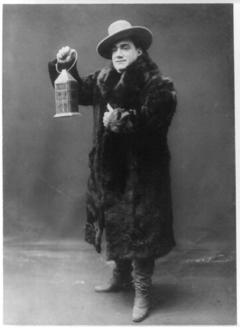
The top image is Grief by Edgar Bertram Mackenna. The video frame that follows is from John F. Kennedy’s 1960 inaugural speech. The next image is Sommerblumenstrauss by A. Gundelach. The following photo by Andygoodell is A Jack Rose Cocktail. The fifth picture is of two children in Bangladesh by Nafis Kamal, while the sixth is called Chicklet-Currency courtesy of the U.S. Department of the Treasury. After the image from Disney’s Snow White, is a 1911 photo of Enrico Caruso, the great Italian tenor. All but the Snow White frame are sourced from Wikimedia Commons.

On the Elusiveness of Vindication (and How Special It is When It Happens)

http://upload.wikimedia.org/wikipedia/commons/thumb/8/86/Rembrandt_Harmensz._van_Rijn_013.jpg/256px-Rembrandt_Harmensz._van_Rijn_013.jpg

I suspect there is hardly anyone among us who has not hoped that the person who broke our heart would come back to us, see the light, apologize, and say:

You know what? I was wrong. I didn’t give you a chance. I should have. You deserved better treatment than you received from me. It was unfair of me to blame you as I did, not to see how good you are.  I hope that you will forgive me and we can start over.

Vindication can take a number of forms. It might involve being reinstated to a position you lost unfairly, being exonerated of a crime you were alleged to have (or convicted of having) committed, receiving a belated medal for acts of courage performed in combat, or having a parent apologize for abusive or neglectful mistreatment.

There is only one problem.

When the injury is great, these things almost never happen. Or, if they do, they come much too late. Think about the occasional news story that documents the exoneration of someone who had been wrongly imprisoned after years behind bars, now finally permitted to return to civilian life. Or the long-denied medal for heroic service to one’s country in an almost forgotten war, awarded to a man now aged or perhaps deceased, and therefore only a posthumous recipient of the honor.

Perhaps even rarer is the parent who apologizes for child abuse. First, such people rarely acknowledge the extent of what they have done. And, to the degree that there is any recognition or admission of  mistreatment of their child, it is nearly always minimized on the one hand, and justified on the other; justified, usually by the child’s alleged misbehavior or provocation.

By the time the parents in question are senior citizens, the fog of time and self-deception has clouded and distorted their memory. Moreover, were they to admit (even to themselves) what they had done, they would almost certainly be shattered and humbled by that self-awareness; and left with the fact that there would be no way to make up for the lost time and the pain they inflicted – not enough of a future available to redeem the sorry state of the past and remove the stain on their conscience.

Perhaps it is therefore not surprising that they do not admit their errors even when confronted – in effect cannot do so psychologically without jeopardizing their ability to live with any measure of equanimity.

My wife likes to say that her favorite punishment for such people would be one minute of self-awareness. Unfortunately, they are the least likely among us to achieve this kind of insight.

A useful book to read on the subject is Frauen by Alison Owings. Owings interviewed numerous German women who had lived through the period of the Third Reich. She observed the extent to which self-deception, rationalization, and denial were present as they looked back upon what they claimed they knew or witnessed (or didn’t know), and what they did or didn’t do in response to the mistreatment and murder of their Jewish neighbors by the Nazis.

Beyond the individual level, even nations have a problem admitting that wrong has been done in their name. Turkey continues to deny the Armenian genocide of the twentieth century’s second decade, while Austria and France have historically skirted their participation in the Holocaust, preferring to be considered co-victims with other sufferers of Germany’s misdeeds.

And, it was not until 1988, that the United States formally apologized for the 1942 forced internment of Pacific Coast residents of the USA, solely because they were of Japanese decent, in the aftermath of the attack on Pearl Harbor. Of those people, 62% were US citizens.

While none of what I’ve described thus far permits a very optimistic take on human nature, I do want to relate one very beautiful story I heard from a former patient on this subject. It stands out because it demonstrates that obtaining personal vindication does happen every so often, and can produce any enormously healing experience for both parties involved. I’ve changed the circumstances of the story to disguise the identity of my patient, but I think you will get the idea.

The young woman in question was a high school volley ball player, a member of the school’s team. She was a junior and had played, usually as a starter, for most of the season. Her coach was a young woman as well, that is to say, a relatively new teacher, just shortly out of training.

Toward the end of the season, the student’s mother was to receive a special award from her workplace. Mom and dad both wanted their daughter to be at the dinner honoring the mom, and the young athlete wanted to be there as well. Unfortunately, the award ceremony conflicted with an important game for her team. She explained in advance to her coach that she would not be able to play in that game, but the coach was furious. Thereafter the coach repaid her absence by keeping her on the bench for most of the remainder of the season and treating her with disdain.

Although she liked volleyball, my future patient chose not to try-out for the team as a senior, expecting either to fail to make the roster chosen by the same coach; or, if permitted to be on the team, anticipating the same sort of mistreatment from her for another year. And so, the athlete’s high school athletic career ended prematurely.

This turn of events did not, however, destroy her love for the game. She continued to play in various park district leagues for many years. But the memory of being humiliated by the coach did not go away, nor of the lost senior year of competition that she might otherwise have enjoyed, playing a game she loved.

Perhaps 10 years after the incidents I’ve described, this woman was now my patient. And one day she told me that just the day before she had found herself in another volley ball contest against a new team. And, wouldn’t you know it, she saw that one of the opposing players was her old coach, now in her early to mid-thirties.

My patient recognized the coach, but hoped the recognition was not mutual. As the game progressed they soon enough were face-to-face across the net from each other. The coach said “hello,” calling her by name, and my patient replied in kind. Perhaps, she thought, that would be the end of their interaction.

At the end of the game, however, the coach came over to my patient. She asked if she could speak with her privately. They moved away from the other volleyball players to a place where they would not be overheard.

What the young woman’s ex-coach said went something like this:

I’ve thought about you for many years. I realize that what I did to you was very unfair. I took your decision not to play that game too personally. Of course, there was nothing wrong with your attending a dinner recognizing your mother. Who wouldn’t have? I was very young, but I should have known better than to treat you as badly as I did. I have felt guilty for years that I caused you pain and that I made it almost impossible for you to even think of trying-out for the senior team. I have been hoping to run into you all this time, so that I could say this. I’m so sorry.

As my patient related this story to me she was in tears, enormously touched by what the coach had said. The coach had given her closure for a painful part of her history and had done it with grace, courage, and integrity; taking full responsibility for injuring my patient. In so doing, I suspect the coach found relief too, because her former charge was an enormously likeable, decent, and forgiving person.

Everyone here was a winner.

As I said, the tale stands out for me because this kind of ending occurs so rarely. I suspect many of us have been the victims of similar hurts.

But, perhaps more importantly, some of us have probably inflicted comparable injuries on others.

Sometimes its worth reflecting on that — on one’s own failures and mistreatment of others.

You just might discover that like the coach, there is still an opportunity to put things right.

Of course, that is up to you.

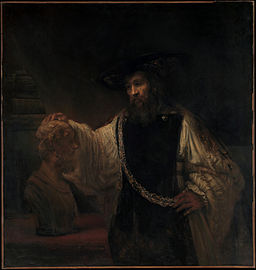
The image above is Aristotle Contemplating a Bust of Homer by Rembrandt, sourced from Wikimedia Commons.