Old But Useful Thoughts: a Stoic Guide to Life

The Stoic philosophers have gotten a bad rap. I know, this problem isn’t exactly as pressing as the unemployment rate, the deficit, and our military involvement in the Middle East.

I therefore beg your indulgence and hope you will read further. It just might influence how you think about life. The BP oil contamination can wait — and you can’t do anything about it anyway —  so don’t let it get the best of you, a point the Stoics would surely make.

The “bad rap” is largely the result of how we understand the word “stoic.” We define that word to refer to someone who is indifferent to emotion, deadened to pain, hardened and impassive; someone who has “killed” his feelings. But this is not what Zeno, a third century B.C. Greek philosopher had in mind when he founded his school of philosophy.

Rather, the Stoics saw that emotion could become extreme and destructive. They therefore looked to find some balance between head and heart, with the passions held in check.

More importantly, however, Stoics turned their attention to the importance of a person’s own behavior and inner life, seeking to help the individual find equanimity and satisfaction in life (in part) by not overvaluing the inessential, external things and events that crowd in on him. According to their line of reasoning, it is important to distinguish what is virtuous and important that is controllable from what is trivial and outside of one’s control. Then, by giving a paramount position to clarity of thought and self-reflection, one may achieve freedom from the excesses of anger, self-pity, jealousy, suffering, and anguish, as well as an overall sense that life hasn’t “played fair” with us.

Professor Luke Timothy Johnson has said the following about the contrast between the world view of a man like Marcus Aurelius, the Stoic “philosopher/king” of second century Rome, and our own way of thinking about “the good life:”

Marcus Aurelius was obsessed by the transitory character of all existent things. We (by contrast) take our institutions for granted. We think that life is long. We assume that we should be healthy. Marcus Aurelius spurned pleasure and sought duty. We are driven by the notions of feeling good, and the pursuit of happiness is often identified with the pursuit of pleasure. Marcus Aurelius identified freedom as a call to virtue and duty, whereas in present day America, we often think of freedom as the most radical form of individualism and doing what we like.

The Stoics would say that most of us are not free. Rather, we are slaves to making money, accumulating objects, and creating or defending a reputation. For them, “living well” didn’t mean living in the lap of luxury, but living simply, concerned with improving oneself and one’s conduct toward other men.

For these philosophers and like-minded people of today, the ups and downs of life, the illnesses, the job frustrations and relationships disappointments, and the calumnies of the jealous, not to mention death itself, are all seen as simply “in the nature of things.” Acceptance of what is “natural” and what is a normal part of the human condition is key to a Stoic’s way of taking the world as it is, not as one might wish it to be. If a Stoic is approached by someone who has suffered a reversal of fortune and is asking “Why me?” he would likely answer, “Why not you.” (Or anyone else, for that matter).

Stoics such as Seneca and Epictetus believed that by leading a virtuous life one could achieve happiness, regardless of what external misfortunes (including death) happened. This is surely farther than most of us would go, but that way of thinking does tend to normalize and minimize certain events that we consider to be “tragic.”

Those of us who live in Western Civilization run the risk of thinking that our happiness depends on how well our kids do in school (and whether they attend the “right” school), our next promotion or job title, the approval of our “betters,” making a certain amount of money or achieving an advanced social rank, and a gorgeous house in a fine neighborhood. The Stoics would say we are much too concerned with external things (rather than focusing on trying to lead a virtuous life). And, interestingly enough, contemporary psychological research tends to support the Stoics: those with tons of money are only somewhat more satisfied with life than those with just enough for the basic necessities.  Put another way, it is the striving for things outside of ourselves, the struggle to defeat or avoid the inevitable disappointments of life, that robs one of peace of mind.

In effect, the Stoics are saying that we pay too much attention to external things of little “real” value, and that in so doing we create our unhappiness, having chosen beliefs which lead us into the pain we seek to avoid.

Take an example. A parent wants his child to obtain a graduate school level education from a “good” school. The child, however, may not be of an academic bent, and doesn’t seem destined to achieve this goal, although he is otherwise a decent young man. And so the parent frets, feeling disappointment and frustration. Meanwhile, another parent, who has a similar child, doesn’t place so much value on this particular direction and doesn’t see it as an essential path for his child to follow. The first man is unhappy, the second is happy. The unhappiness is the creation of the first man’s opinion about things, it does not reside in the thing itself.  The parent is troubled because of his attachment to an idea, something that is external to him and is inessential for his contentment or the well-being of his son, however much he might think otherwise.

Now, you might think that the Stoic is unambitious and that he doesn’t try hard enough (or encourage his kids to try). Regarding the latter, I suspect that a real Stoic would value knowledge and learning and encourage the same in his child, but not make it a cause for desperation and the wringing of his hands. So, while not completely “hands off” the practical things of life, he achieves some distance from pain by thinking things through.

The Stoics desire to live in harmony with the way the world is, rather than to struggle against it. And, here again, they strive to improve themselves — their moral and intellectual state — rather than the state of their bank account or their rank in the pecking order of social and business life. In the words of Epictetus “…as the (working) material of the carpenter is wood, and that of (a sculptor is) bronze, so the subject-matter of the art of living is each person’s own life.” Thus, the philosopher attempts to attain a state of courage, justice, temperance, and wisdom; and always turns back to such thoughts in a constant effort to improve himself and practice what he preaches.

Interestingly, Stoics were also way ahead of everyone else in matters of social justice. For them, slaves were seen as the equal of other men, and women were thought to have just as much capacity for rationality as men, views that were unheard of in the ancient world.

And, as you might have noticed, the Stoics were not so far off from the mindset of Zen philosophy. In particular, both recommend living “in the moment,” being aware of the transitory nature of most things that make us unhappy, and the fruitlessness of spending too much time looking back (usually with regret or nostalgia) or looking forward (often in anxiety or the uncertain hope of a better future) while the unrepeatable present moment passes by.

Here are a few quotations from three of the great Stoic philosophers. Best to read them individually and think about each one, rather than to blow through them quickly. Who knows, one or another might change your life.

“But what says Socrates? ‘One man finds pleasure in improving his land, another his horses. My pleasure lies in seeing that I myself grow better day by day.'” (Epictetus, CLIII)

“If you are told that…one speaks ill of you, make no defense against what was said, but answer, ‘He surely (didn’t know) my other faults, (or) else he would have mentioned (those as well)!” (Epictetus, CLXIX)

“What wouldst thou be found doing when overtaken by Death? If I might choose, I would be found doing some deed of true humanity, of wide import, beneficent and noble. But if I (am) not be found engaged in (anything) so lofty, let me hope at least for this…that I may be found raising up in myself that (quality) which has fallen; learning to deal more wisely with the things of sense; working out my own tranquility…” (Epictetus, CLXXXIX)

“(I learned) from Alexander the Platonic, not frequently to say to anyone that I have no leisure; nor continually to excuse (my) neglect of duties…by alleging urgent occupations.” (Marcus Aurelius, I.12)

“Every moment think steadily…to do what thou hast in hand with perfect and simple dignity, and feeling of affection, and freedom, and justice; and to give thyself relief from all other thoughts. And thou wilt give thyself relief, if thou doest every act of life as if it were the last, laying aside all carelessness and passionate aversion from the commands of reason, and all hypocrisy, and all self-love, and discontent with the portion which has been given to thee. Thou seest how few… things are (required), …which if a man (has in hand), he is able to live a life which flows in quiet, and is like the existence of the gods; for the gods on their part will require nothing more from him who observes these things.” (Marcus Aurelius, II.5)

“Do the things external which fall upon thee distract thee? Give (yourself) time to learn something new and good, and cease to be whirled around (by external events).” Marcus Aurelius, II.7.

“Or is it your reputation that’s bothering you? But look at how soon we’re all forgotten. (It is) the abyss of endless time that swallows it all. The emptiness of those applauding hands.” (Marcus Aurelius, IV.3)

“Do not waste the remainder of thy life in thoughts about others…For thou losest the opportunity of doing something else when thou hast such thoughts as these: ‘What is such a person doing, and why, and what is he saying, and what is he thinking of, and what is he contriving,’ and whatever else of the kind makes us wander away from our own ruling power.” (Marcus Aurelius, IV.4)

“…By all means bear this in mind, that within a very short time both thou and he will be dead and soon not even your names will be left behind.” (Marcus Aurelius, IV.6)

—“In the morning when thous risest unwillingly, let this thought be present — I am rising to the work of a human being. Why then am I dissatisfied if I am going to do the things for which I exist and for which I was brought into the world.” Marcus Aurelius, V.1)

“Let it make no difference to thee whether thou art cold or warm, if thou art doing thy duty; and whether thou art drowsy or satisfied with sleep; and whether ill-spoken of or praised; and whether dying or doing something else. For it is one of the acts of this life; it is sufficient then in this act…to do well (with) what we have in hand.” (Marcus Aurelius, VI,1)

“The best way of avenging thyself is not to become like (the wrong-doer).” Marcus Aurelius, VI,6)

“…Keep thyself simple, good, pure, serious, free from affectation, a friend of justice, a worshiper of the gods, kind, affectionate, strenuous in all proper acts. Strive to continue to be such as philosophy wished to make thee. Reverence the gods and help men. Short is life. There is only one fruit of…this life — a pious disposition and social acts. Do everything as a disciple of Antoninus. Remember his constancy in every act which was conformable to reason, and his evenness in all things, and his piety, and the serenity of his countenance, and his sweetness, and his disregard of empty fame, and his efforts to understand things…and how he bore with those who blamed him unjustly without blaming them in return…” (Marcus Aurelius, VI, 30)

“Let not future things disturb thee, for (you will) come to them, if it shall be necessary, having…the same reason which now thou usest for present things.” Marcus Aurelius, VII,8)

“Is any man afraid of change? Why? What can take place without change?…Can anything that is useful be accomplished without change?…” (Marcus Aurelius, VII,18)

“The art of life is more like the wrestler’s art than the dancer’s, in respect of this, that it should stand ready and firm to meet onsets which are sudden and unexpected.” (Marcus Aurelius, VII, 61)

“No longer talk at all about the kind of man who a good man ought to be, but be such.” (Marcus Aurelius, VIII, 16)

“I have often wondered how it is that every man loves himself more than all the rest of men, but yet sets less value on his own opinion of himself than on the opinion of others…” (Marcus Aurelius, XII,4)

“How ridiculous and how strange to be surprised at anything which happens in life!” (XII,13)

“If it is not right, do not do it. If it is not true, do not say it.” (Marcus Aurelius, XII,17)

“(Good men) should not be afraid to face hardships and difficulties, or complain of fate; whatever happens, good men should take it in good part, and turn it to a good end. It is not what you endure that matters, but how you endure it. (Seneca, On Providence)

“Among the many splendid sayings of our friend Demetrius there is this one…’Nothing,’ he said, seems to me more unhappy than the man who has no experience of adversity.’ For he has not been allowed to put himself to the test.” (Seneca, On Providence).

“You are wrong if you think anyone has been exempted from ill; the man who has known happiness for many a year will receive his share someday; whoever seems to have been set free from this has only been granted a delay.” (Seneca, On Providence).

“What is the duty of a good man? To offer himself to fate…The soul that is earthbound and sluggish will follow the safe course; virtue takes to the heights.” (Seneca, On Providence).

“Inside (of yourself the universe has) given you every good; your good fortune is in not needing good fortune (to be happy).” (Seneca, On Providence).

“Revenge is an admission of pain; a mind that is bowed by injury is not a great mind. The man who has done the injury is either stronger than you or weaker; if he is weaker, spare him, if stronger, spare yourself.” (Seneca, On Anger).

“All of us are inconsiderate and imprudent, all unreliable, dissatisfied, ambitious…all of us are corrupt. Therefore, whatever fault he censures in another man, every man will find residing in his own heart….So let us show greater kindness to one another.” (Seneca, On Anger).

“No man will ever be happy if tortured by the greater happiness of another.” (Seneca, On Anger).

“The greatest outcry surrounds money: this is what brings exhaustion to the courts, sets fathers against children, concocts poisons, hands out swords to assassins and the legions alike; this is what wears the stain of our blood; this that makes the nights of wives and husbands noisy with quarrelling, and the crowd surge against the benches where the magistrates arbitrate; because of money, again, kings grow savage and engage in plunder, overthrowing states built by the long toil of centuries so they can rummage for gold and silver among the ashes of cities.” (Seneca, On Anger).

“…in the future have regard not only for the truth of what you say but for the question (of) whether the man you are addressing can accept the truth.” (Seneca, On Anger).

“…so long as each one of us prefers to trust someone else’s judgment rather than relying on his own, we never exercise judgment in our lives but constantly resort to trust, and a mistake that has been passed down from one hand to another takes us over and spins our ruin.” (Seneca, On the Happy Life).

“Human concerns are not so happily arranged that the majority favors the better things: evidence of the worst choice is the crowd.” (Seneca, On the Happy Life).

“For as far as pleasure is concerned, though it pours itself all around us and flows in through every channel, charming our minds with its blandishments, and applying one means after another to captivate us wholly or partly, who on earth, who has any trace of humanity left in him, would wish to have his senses tickled day and night and, abandoning the mind, to devote himself to the body?” (Seneca, On the Happy Life).

“For if a man has put himself beyond the reach of all desires, what can he lack? What need does he have of anything external, if he has concentrated all that he possesses in himself?” (Seneca, On the Happy Life).

“In my case, if wealth slips away, it will deprive me only of itself, but you (who value wealth too highly), will be stuck dumb, you will think you have been deserted by your own self if it leaves you; in my eyes wealth has a certain place, in yours it is center-stage; to sum up, my wealth belongs to me, you belong to yours.” (Seneca, On the Happy Life).

“I say that wealth is not a good as it is, since something that is found among wicked men cannot be called a good; for if it was it would make men good; as it is, since something that is found among wicked men cannot be called a good, I deny it this name. But that it is desirable, that (it) is useful and confers great benefits in life, I do admit.” (Seneca, On the Happy Life.)

“It is truly said…by Curius Dentatus, that he would rather be a dead man than a live one dead; it is the worst of evils to depart from the world of the living before you die.” (Seneca, On the Tranquility of the Mind).

“Nothing, however, delights the mind as much as a loving and loyal friendship.” (Seneca, On the Tranquility of the Mind).

“Small is the part of life that we really live. All that remains of our existence is not actually life but merely time.” (Seneca, On the Shortness of Life).

“…the greatest waste of life exists in postponement: that is what takes away each day as it comes, that is what snatches away the present while promising something to follow. The greatest obstacle to living is expectation, which depends on tomorrow and wastes today. What lies in the hands of Fortune you deal with, what lies in your own hands you let slip. Where are you looking? Where are you bending your aim? All that is still to come lies in doubt: live here and now!” (Seneca, On the Shortness of Life)

“But those who forget the past, ignore the present, and fear for the future have a life that is very brief and filled with anxiety…Their very pleasures are fearful and troubled by alarms of different kinds; at the very moment of rejoicing, the anxious thought occurs to them: ‘How long will this last?'” (Seneca, On the Shortness of Life)

“No man is crushed by misfortune unless he has first been deceived by prosperity. Those who love her gifts as if they are theirs to enjoy forever, who wish to be highly regarded because of them, lie prostrate in mourning whenever these false and fickle delights abandon their vacuous and childish minds that know nothing of any lasting pleasure: but the man who has not become puffed up by happy fortune does not collapse when there is a reversal.” (Seneca, On the Shortness of Life)

“When you have lost one who is most dear, it is stupid indulgence to grieve endlessly, but inhuman hardness not to grieve at all.” (Seneca, On the Shortness of Life).

The above image is of Marcus Aurelius.

Dr. Jerry Katz: A Lesson From the Greatest Generation

The_British_Army_in_the_United_Kingdom_1939-45_H2917

Sometimes the memory of a few minutes lingers for the rest of your life. And teaches you a profound truth about life.

Jerome (Jerry) Katz was a psychiatrist in the Chicago area some years back. Jerry died in his 70s after a very long career practicing in Chicago’s northern suburbs and in the city itself.

He was a big man with a gentle soul, despite his days as a high school football player. Someone who, at least professionally, always seemed to be at ease — an inviting smile on his face, a soothing voice, and a twinkle in his eyes — as if he knew something that the rest of us hadn’t figured out quite yet.

I didn’t know Jerry very well. It was the kind of relationship that is cordial, saying hello, passing a few words here and there, telling a joke as Jerry often did, but never much of anything more. From time to time Jerry would consult me for my diagnostic opinion about a hospitalized patient. Beyond that, I suspect we never had a conversation that lasted more than five minutes.

Except for one day.

We were sitting alone in the doctors’ cafeteria at Forest Hospital, at the time, a private psychiatric facility in Des Plaines, IL. It must have been more than 20 years ago. Uncharacteristically, no one else was around and we were undisturbed for the entire period of our lunch.

The conversation turned to Jerry’s youthful service in World War II, “the good war.” I don’t remember whether Jerry said that he was underage when he enlisted. But, like many young men of the time, he felt service was his duty and he made his way through basic training to the killing fields of France after D-Day, the Allied Invasion of Europe on June 6, 1944.

Jerry could not have been more than 17 or 18 when his view of life changed because of a single German soldier.

Katz and his unit were “dug in” that day. They’d taken a position with relatively little cover, perhaps behind some rocks, dead trees, and some hastily created earth works. It did not sound like the conventional trench of World War I, but something more ad hoc.

A German force attacked: in effect, an infantry charge. And Jerry, a strapping young man of perhaps 6’2″ did what he had been trained to do. He held his ground and fired into the oncoming assault.

Soldiers fell at a distance, but a few continued their onrush. One in particular — a towering giant of a young German — bigger even than Katz, built like a mobile fortress, and seemingly indestructible.

Jerry and his comrades kept firing, and no amount of speeding metal seemed to deter the attacker. He just kept racing toward them.

Jerry remembered the surreal nature of the event. He and his comrades had fired enough bullets to kill 20 men. But somehow they must have missed this soldier. He was now almost on top of their position and on top of Jerry.

Finally, the man lunged at Jerry with his bayonet — and collapsed, close enough for Jerry to touch the enemy and the blade intended for his flesh. Had the giant German only one more second of life, the future psychiatrist would have lost his own.

In a very real sense, Katz was touched by this combatant, because he thought this soldier would be his executioner. The man who wanted to end Jerry’s life, had instead transformed it.

“Since that day,” Jerry told me, “everything in my life — every day of my life — has been a ‘lagniappe.'”

It was a word I had not heard before. “What does that mean?” I asked.

“It’s a French expression,” he said. “It means ‘something extra.’ Like when you go into a bakery and they give you a 13th roll because you bought a dozen. A kind of gift.”

The conversation ended not long after Jerome Katz told me that story.

Like most of us, Jerry had his ups and downs in life. Heart disease was one of his challenges; a loving wife and family one of his boons.

But, when I think of Dr. Jerome Katz, I’ll always think of that story. I’ll recall how every day of his post-war life was “something extra.”

And I’ll remember how the ever-present twinkle in his eyes got there.

The image above is The British Army in the U.K. 1939-1945, which comes from the Imperial War Museum and is sourced from Wikimedia Commons. This is a staged bayonet-charge as part of a training exercise that took place on the Isle of Wight, August 10, 1940.

On Sacrifice

http://upload.wikimedia.org/wikipedia/commons/thumb/2/2b/Rembrandt_-_Sacrifice_of_Isaac_-_WGA19096.jpg/500px-Rembrandt_-_Sacrifice_of_Isaac_-_WGA19096.jpg

Would you like to know who you are? Then it is essential to know what is of real value to you. One way of finding that out is by asking the question, “What would I be willing to give up for something that I claim is important to me? What would I be willing to sacrifice for love, or great wealth, or power, or honor, or for my child’s well-being?”

What we are willing to sacrifice defines us, both as individuals and as a society. But first, let’s look at what the word sacrifice means:

The on-line Merriam-Webster’s dictionary gives the following definition of the noun sacrifice:

1 : an act of offering to a deity something precious; especially : the killing of a victim on an altar
2 : something offered in sacrifice
3 a : destruction or surrender of something for the sake of something else b : something given up or lost <the sacrifices made by parents>
4 : loss <goods sold at a sacrifice>

Thus sacrifice involves loss and giving something up.

In primitive societies, it often included murder.

Human sacrifice was intended most often to appease a God, win the God’s favor, or avoid the God’s wrath. Igor Stravinsky wrote a famous ballet about this, The Rite of Spring.

More recent depictions of this sort of behavior have included Friedrich Dürrenmatt’s 1956 novel, The Visit. In this story a wealthy woman (Claire Zachanassian) returns for a visit to her home town, a place that has fallen on hard times. She departed in disgrace many years before when she was impregnated by her young lover. This person denied the charge of paternity and bribed two people to support his case by claiming that they had been intimate with her. Shamed by the townsfolk, Claire eventually turned to prostitution.

Her return home is noteworthy for a “proposition” she has for the town where her former lover continues to live as a respected businessman. She will bequeath an enormous sum to the hamlet if it will do one simple thing: put to death the man who caused her disgrace. In effect, the book asks the question of what this woman is willing to sacrifice for revenge (her money, her morality) and what the town’s people are willing to give up for money. The movie of the same name starred Ingrid Bergman and Anthony Quinn.

http://upload.wikimedia.org/wikipedia/commons/thumb/b/b3/Adi_Holzer_Werksverzeichnis_835_Abrahams_Opfer.jpg/500px-Adi_Holzer_Werksverzeichnis_835_Abrahams_Opfer.jpg

More recently, a very different sort of sacrifice is depicted in a 1967 episode of the original Star Trek TV series, The City on the Edge of Forever. While in an irrational state, the ship’s physician enters a time portal on an alien planet, one that takes him back to 20th century USA in the midst of the Great Depression.

At the instant that this happens, the Enterprise starship disappears from its orbit of the world on which the time portal exists. Captain Kirk and Mr. Spock, already on the planet in pursuit of Dr. McCoy, recognize that he must have altered history in such a way as to result in a universe in which their space vehicle never existed.  Kirk and Spock therefore enter the time portal themselves at a moment in history slightly before they believe that McCoy reached 20th century earth, in order to prevent whatever action he took that changed subsequent events.

While back in time, Kirk and Spock meet a social worker named Edith Keeler, who runs a soup kitchen for the down-and-out victims of the Depression. Soon, Mr. Spock uses his technological prowess to discover that Dr. McCoy will eventually have something to do with Edith Keeler herself.

In one possible historical thread, Spock finds a newspaper obituary for her. In another, however, he discovers that she will lead a pacifist movement that delays the USA’s entry into World War II, resulting in Hitler’s victory and the very alteration of events that prevented creation of the star fleet of which the Enterprise starship is a part. Thus, in order to create the more benign future known to the three officers, Edith Keeler must die.

There is only one complication. Captain Kirk and Edith Keeler (played by Joan Collins) have fallen in love.

The climatic moment comes when Dr. McCoy and Captain Kirk see each other across the street for the first time on 20th century earth. As they rush to reunite, Edith Keeler (on a date with Kirk), attempts to cross the street to join them, heedless of the fact that a fast-moving truck is headed toward her. The doctor attempts to rescue Kirk’s love, but is restrained by Kirk from doing so. Edith Keeler is killed.

The heartbreak is heightened by the incredulous McCoy’s indictment of his captain and friend: “I could have saved her…do you know what you just did?.” Unable to speak, Kirk turns away while Mr. Spock says quietly, “He knows, Doctor. He knows.” Thus, Kirk has sacrificed Edith Keeler’s life and his own happiness, to prevent her from actions that would have led to world enslavement by the Third Reich.

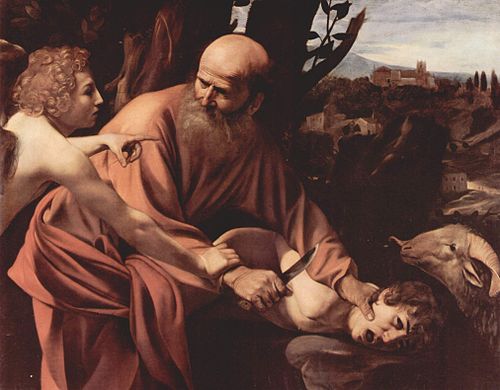
I have always been troubled that two of the most important biblical stories involve human sacrifice. The tale of Abraham and Isaac finds the former, the founder of the Jewish faith and monotheism, asked to sacrifice his son Isaac in order to prove his devotion to God. As he prepares to do this, an angel appears and stays his hand. A lamb is slaughtered instead. Rembrandt depicted this beautifully in the painting reproduced above.

Remember now, that I’m a psychologist. I cannot look at this painting without wondering what the child Isaac might be thinking and feeling in the aftermath of this moment. How will his relationship with his father be changed? Might there have been other possible ways of testing Abraham without permanently scarring his son?

The foundation story of Christianity poses a virtually identical dilemma, with the sacrifice of Jesus to pay for the sins of humanity. I fear that we are so used to abstracted representations of these events, that we have become inoculated against the trauma depicted by them and the human, societal, and theological implications of such horrors, reportedly authorized by God.

http://upload.wikimedia.org/wikipedia/commons/thumb/4/45/Michelangelo_Caravaggio_022.jpg/500px-Michelangelo_Caravaggio_022.jpg

Of course, most of our sacrifices are much less dramatic. Do we give up eating what we might want in order to be fit and live a longer and healthier life? Do we brush off the attractive member of the opposite sex who “comes on” to us, in order to maintain our marital fidelity, avoid injuring our spouse and children, and keep whole our integrity? Do we sacrifice time having fun or attempting to climb the career ladder in order to go to our child’s boring orchestral recital and enduring hours of “Twinkle, Twinkle, Little Star” played by tiny violinists, all of whom are out of tune?

I’m sure you can imagine many more such choices and sacrifices of your own.

We make decisions, all of us, about the question of national sacrifices too. Jobs vs. clean air, tax cuts vs. social services, giving to charity vs. keeping the money for ourselves, liberty vs. the promise of security, and most poignant of all, the decision of when war is necessary despite the sacrifice of the unlived lives of our young adult children.

Just as an exercise, you might want to make a list of all those things you spend time on that are inessential, all the things that you could live without if it came to something really important.

Or, still another exercise: if you could only take 10 things or 10 people with you to a desert island, who or what would they be and who or what would you leave behind? And what cause would be great enough for you to agree to go to a desert island in the first place?

Who are we as a nation? Who are you as a person?

We might know more about our country and ourselves if we first ask what we are willing (and unwilling) to sacrifice.

The top image is the Sacrifice of Isaac by Rembrandt. The second picture, taken by Michael Gäbler, is of Adi Holzer’s hand colored etching Abrahams Opfer from 1997. Finally, Caravaggio’s version of the same scene Die Opferung Isaaks from 1594-96, sourced via the Yorck Project. All of the above come from Wikimedia Commons.

Signs of Insecurity: Behavior That Reveals a Lack of Confidence

http://drgeraldstein.blog/wp-content/uploads/2010/07/insecurity.jpg?w=225

Insecure people often reveal their self-doubt without being aware of it. Indeed, a wise observer can “read” another individual. For example, members of the Chicago Symphony Orchestra have told me they can tell whether a new conductor is competent and talented within 10 minutes of the beginning of their first rehearsal with him. What follows is a short list of behaviors that suggest insecurity:

  • 1. Are you able to give a compliment? Even more important, can you graciously accept one? The latter behavior tends to be difficult for someone who is unsure of himself. He might blush or become flustered. Alternatively, he is prone to dismiss the validity of the praise, instead telling you why it isn’t true. What should one do if complimented? Smile and say “Thank you.” Nothing more.
  • 2. The ability to maintain eye contact is hard for many individuals who lack confidence. They will turn away or look down, but rarely hold the gaze of the other by looking into his or her eyes.
  • 3. The self-doubting person tends to apologize when no apology is necessary. It is as if she expects to be reproached or is afraid to give offense; so, she prophylactically tries to excuse any possible mistake to avoid such a response.
  • 4. Answering a question with an upward inflection of the voice has been done by everyone. The person being questioned doesn’t have certainty about his answer, so he replies with a tone betraying his insecurity. Since I originally wrote this piece, a name has been given to the practice: upspeak.
  • 5. Men and women who are uncomfortable with sharing personal information for fear of being judged will oft-times turn the conversation to a different topic, away from anything that might make them vulnerable or reveal too much. This is also called “changing the subject.”
  • 6. One way of inoculating yourself against criticism is to joke at your own expense. Do this often and others may conclude you believe you are flawed.
  • 7. Do you have trouble making a decision? The comedy team “Cheech and Chong” (I’m not sure which one) said: “Taking responsibility is a lot of responsibility.” If you automatically let others choose the restaurant, movie, and other activity, you are either easy-going and good-natured or don’t want to be held accountable for making the wrong choice.
  • 8. Do you state strong opinions? Those who avoid doing so might maintain the peace — often a good thing — but some fear drawing fire and unwanted attention.

Before I give you nine more signs of insecurity, I’ll say what might cause the condition. Many possibilities. Critical or neglectful parents, poor academic skills, frequent moves making you “the new kid” (especially if you are introverted by nature), learning disabilities and ADHD, being “different” in some fashion (size, shape, color, religion), thinking of yourself as the “poor” kid in a community of the affluent, sensing you are the average child in a school filled with bright youngsters, feeling ashamed of your parents or residence, frequent rejections, getting fired (whether deserved or not), clumsiness, a history of abuse or bullying; physical unattractiveness, deformity, or injury, etc. For a more thorough discussion of these causes, click here: The Causes of Insecurity. Now back to the list of signs of insecurity:

  • 9. Do you laugh nervously in social situations? It is another behavior betraying self-consciousness.
  • 10. People will appraise you harshly if they see you bite your nails or they appear bitten.
  • 11. Are you self-effacing, placing yourself at a disadvantage — letting others go first, speak first — reluctant to raise your hand? Do you hesitate to take your turn? Do you sacrifice your interests as a matter of course? Insecurity can make you wait until the opportunity before you is lost. Excessive deference displays little regard for yourself, even if some amount can be a sign of good breeding and consideration.
  • 12. Are you nervous eating in front of others? Do you fear dropping something, displaying poor table manners, or making a mess? You probably won’t, at least not more than the rest of us.
  • 13. Can you make phone calls without trepidation; especially those in which you need to introduce yourself, correct a problem, or speak to an authority? Too much discomfort in anticipation of these actions can reveal your sense of uncertainty.
  • 14. Might you make too many excuses? Those who are unsure give explanations where none are required. Imagine you order an entrée at an elegant restaurant and the waiter asks whether you want an appetizer to start. You explain why you don’t. Some folks offer multiple excuses for what they do, anticipating criticism. If you must give a reason, limit yourself to one. The more you give, the more uncertain (or dishonest) you sound. For  example, “I can’t come to the party because I have a stomach ache and my car broke and I need to study.” One reason will be more convincing. You needn’t explain yourself as often as you think.
  • 15. Insecurity can be suggested by hesitation to ask for a favor or an inability to say “no.” Anticipation of rejection or disapproval is the motivator for both of these problems with self-assertion. By contrast, a self-assured person will not believe the relationship (or his own value) is dependent upon going along with someone else’s wishes or fulfilling the desires of others as a matter of routine.
  • 16. Do you make frequent requests for reassurance? A few examples: “Does that make sense?” “What do you think?” “What would you do?” “Do you think that is a good idea?” “Do I look OK?” Must you have sex to prove your partner remains interested in you? If you are self-assured, you won’t implore your lover to calm your doubts and remind you, over and over, in words and deeds, of your desirability or intelligence.
  • 17. Last one. Here insecurity takes a different form. This person wants the spotlight at all times, the better to be told “You are the fairest of them all!” She or he pushes for recognition, strutting about the stage we call life; checking to see where he stands and what others think of him. Bragging and display become a full-time job. Perhaps he was the class clown in grade school, but now he drops names to prove his importance and get your attention. His inner emptiness must be filled and refilled, like a bucket with a hole in it. Such people are plagued by narcissism as well as insecurity, a troublesome combination. There is hell to pay for those who expose the pretender’s flaws: lacerating attacks against any critics. If you are this variety of insecure person, I doubt you will admit it even to yourself. If you meet such an individual, run!

I suspect you get the idea. Please add an item if you like. You can use the list in one of two ways: to consider whether you are insecure or evaluate the confidence of those around you. Of course, you are the only one whose self-confidence you can change.

You may find the following related post of interest: Signs of Self Consciousness: When the Mirror Isn’t Your Friend. Also, you might want to read  The Upside of Insecurity or, this very recent post: Insecurity and Our Preoccupation with Appearances/

The image above is Insecurity by Lacey Lewis: http://www.lacey-lewis.com/ With permission.

The African Dip: Thoughts on Passive-Aggressiveness, Powerlessness, and Acceptance

The  Flying Turns

My dad occasionally took me to a legendary Chicago amusement park called Riverview when I was a little boy. I was dazzled by the roller coasters, the “Waterbug” ride, and something called the “Rotor.” The latter required you to enter a circular room which spun on a central axis until the velocity and centrifugal force were sufficient to pin you against the wall, just as the floor dropped away.

But, as small as I was, it is a sideshow called The Dip that I remember most vividly. Today I’d like to use this politically incorrect carnival attraction as a spring-board to a few thoughts on the expression of indirect anger that sometimes is called “passive-aggressive,” as well as a therapeutic approach to setting aside the temporary upsets that are a part of any life.

Black men in cages. That is what “The Dip” involved.

Unbelievable, perhaps, as we think about it in 2010. Each man sat on a stool inside the cage. In front of the cage, off to the side a bit,  stood a small circular metal target that was attached in some fashion to the stool, perhaps electronically, but more likely mechanically.

For less than a dollar, you could purchase three balls to throw at the target, one at a time. If you struck the target solidly, the stool on which the man sat collapsed, and he dropped into a pool of water underneath the cage. You might have seen similar “dunk tanks” at various fund-raising events, often giving students the chance to dunk their teachers.

Harmless fun? Not so in the case of a black man doing the sitting and a white man trying to knock him off his seat.

This sideshow was once reportedly called, “Dunk the N****r,” later “The African Dip,” and finally “The Dip.” It was eventually shut down by a combination of Negro outrage and the increasing disgust of white people to the offensiveness of its implicit racism.

The black men were in a relatively powerless situation — almost literally, “sitting ducks.” But, they did what the situation allowed them to do so as to unsettle, tease, and otherwise disrupt the white pitcher’s aim. The Negroes were careful not to say anything too frankly insulting, lest they stir up the racism (and potential for less veiled violence) that was at the heart of the event.

But they would and could get away with belittling their adversaries athletic skill or throwing ability in a way that was amusing. If their comments distracted the opposition at all — got them to laugh (or the crowd to laugh at them) — or caused a break in the hurler’s concentration, the chance of staying on the seat improved a bit.

According to Chuck Wlodarczyk in his book Riverview: Gone But Not Forgotten, the caged men’s banter could include comments about one’s appearance: “If you were heavy, they’d call you ‘meatball.’ If you were thin, they might have called you ‘toothpick.’ If you were with a girl, they might have said ‘Hey fella, that ain’t the same girl you were with yesterday!'”

You don’t have to be a black man in a cage to have some experience of expressing anger indirectly. We’ve all done it. It takes many forms: talking behind someone’s back and mocking that person, being sarcastic, complaining to a co-worker’s superior rather than to the offender’s face, neglecting tasks you have been assigned unfairly, and procrastinating. These passive-aggressive words or acts are rarely very satisfying. The anger doesn’t dissipate; the grudging discontent usually continues; nothing positive happens.

The sense of powerlessness and lack of control that the passive-aggressive individual experiences can come to dominate that person’s emotional life, rather than allowing him to put effort into changing the power dynamic or to remove himself from a position of weakness.

Unfortunately, for some of those who feel powerless and injured, even a passive-aggressive action seems impossible. Consequently, they take a more uniformly passive role. They defer to others, try to avoid giving offense, act meekly, and position themselves under the radar. All that does, however, is give them second class status, just as it informs bullies that they are easy targets.

Someone in this situation, who repeatedly feels mistreated but isn’t able to take on those who inflict the injuries directly, needs to ask himself a few questions. Why do I put up with it? What am I afraid of? Am I really as powerless as I feel? Am I perhaps overreacting? What would happen if I were more direct? Is there any way to get out of the situation I am in?

Cognitive Behavior Therapy (CBT), which aims to quell and counter irrational thoughts, is often helpful in dealing with a lack of self-assertion and the fear that is usually associated with it. Equally, it gives you practice (sometimes using role-playing within the therapy session) in a gradually ascending hierarchy of challenging situations that require an assertive response.

Some CBT therapists, much like ancient Stoic philosophers, employ an “acceptance-based” psychotherapy and integrate this Zen-like element into their treatment. Why, they might ask you, do you so value the minor indignities of daily life and of opinions and behavior of boorish persons? Is it really a good idea to spend the limited time of your life being upset over rudeness from a tardy repairman or a fender-bender accident you didn’t cause — things that will be of no significance in a week, a month, a year?

Put differently, there will always be injustice, and some of it must simply be accepted as the nature of life and of living. Not every fight is worth fighting about, not every slight is intended. If your skin is so thin that you are regularly being upset by people, perhaps you are valuing the approval and opinions of others too much.

For those who ask “Why me?” those same therapists might say, “Why not you — you are alive, aren’t you, so you are subject to all the same things that can affect any other person.” And, as the Stoic philosophers and Zen practitioners would tell us, if we can accept this vulnerability as part and parcel of living, thereby assigning it less meaning and taking it less personally, our lives will be more satisfying — less fraught with anguish, anger, and hurt.

This is not to say society should have tolerated the indignity and racism of “The Dip.” There are times when the indirect, but pointed wit of the caged men is the best course of action; and, many occasions when the force of your personality must be brought to bear by confronting injustice. But some combination of directness in taking on unfairness and forbearance in accepting things — in allowing oneself not to sweat the small stuff — tends to produce as good a result as life will allow.

Of course, you have to figure out what the small stuff is and what other things really do matter to you.

Meditation is usually a part of the treatment enabling you to stay in the moment, and let go of your attachment to passing feelings and thoughts, worries and regrets, and anticipations and fears. To be preoccupied with just such temporary upsets causes you not to be able to fully experience what is going on in the present and determine what is really of importance in your life.

By encouraging and training you in meditation, the counselor  is attempting to give you a method to achieve a state of psychological enlightenment that (without using words) helps you to distinguish the transitory aggravations, disappointments, worries and anxieties of life from whatever matters the most to you, so you can put your effort into the things of greatest value in your life.

Some final questions:

  1. Do you often find yourself fighting over things others consider to be small?
  2. Do you frequently feel put-upon but are capable only of a passive-aggressive response?
  3. Do you (too easily and too often) assume a fetal position with others (metaphorically speaking), who come to think of you as an easy target and treat you badly (in part) because they know you will not stand up for yourself?

If you have answered any of these questions in the affirmative, you might benefit from asking a couple of other questions:

  1. What does this mode of living cost me?
  2. Am I willing to do the work necessary to change?

If the cost is substantial and you are eager to change, then a therapist can be of assistance. Only then will you be ready to get out of the cage, real or not, in which you find yourself.

The image above is the Flying Turns, a toboggan-style ride that was one of the many attractions that made Riverview Park famous.

Denial, BP, and You

Denial isn’t a river in Egypt. It apparently is, however, related to a river of oil in the deep water of the Gulf of Mexico

But there is more to denial than British Petroleum’s failure to consider the possibility that a disaster might happen.

No. Denial is something we all do, at least some of the time.

Still, let us start with BP. Major environmental accidents involving oil have not caused this company and others like it to spend significant money on safety considerations and the prevention of ecological calamity. Clean-up technology remains much the same as it was 40 years ago.

What were the oil executives thinking? Perhaps, that such things wouldn’t happen to them or on their watch. And if it wasn’t going to happen, why reduce profits to take “unnecessary” safety measures. This, despite repeated oil spills over the years.

An example, might illustrate how “denial” such as this is possible, starting at a tender age.

Back when I was a very little boy, I did something similar. I remember walking to Jamieson School on a very foggy day. Indeed, the fog was so thick that one couldn’t see more than perhaps a half-block ahead. Somehow I got it into my head that if I couldn’t see my school, perhaps it no longer existed!

Jamieson School, an enormous building, occupied most of a square city block on Chicago’s North Side.

But maybe, just maybe, it had disappeared!

I didn’t think about the details of how such a thing might have happened overnight. I didn’t imagine what effort it would have taken to disassemble the structure brick-by-brick or consider that I would have heard any explosion that razed it. No, for me, the disappearance of the building would have been a result of magic. Here one minute, gone the next.

Unfortunately, or so I thought, it finally came into view. And with it, another day of school; not the day of fun I had fantasized about on my journey from home. I couldn’t have been more than six or seven at the time.

The point being, that if grown men act like seven-year-olds, we have a problem. And problem is called denial — a failure to reckon with reality — at least at the extreme.

I’m sure you can think of lots of examples. The cigarette-smoker who never thinks about heart disease, emphysema, or lung cancer happening to him; the person texting and driving, who can’t imagine the possibility of an auto accident; the 350 pound man who has two-quarter pounders with cheese, fries, and a diet-cola, and somehow persuades himself that he is being careful about what he is eating because his meal includes a low-calorie soft drink.

More examples: the man who fancies a partner with a history of infidelity, but doesn’t grasp that he could be victim to the same fate as his predecessors in dating her; the morally upright and self-righteous citizen who cheats on his taxes; the parent who persuades himself that his lack of time for his children will be no problem for them; or the family that normalizes and minimizes the drinking of the household’s head, rather than facing his alcoholism.

Not to mention the biggest denial of all — that we are all mortal, all going to die, and that it could happen at any time — not just to the other guy, but to me! Instead, we treat it as unusual and remarkable when someone expires before, say, 70, when it is actually a fairly commonplace event (however, sad it might be). Indeed, I’ve known more than one therapist who avoided thinking about the topic. See Ernest Becker’s Pulitzer Prize winning book The Denial of Death for more on this subject.

In fact, it is our mortality, the very jeopardy of living and the tenuousness of life, that makes denial necessary and healthy for us to do some of the time, even if a number of folks use it altogether too often. Without some amount of denial (coupled with a little courage) it would be hard to get up in the morning and walk out of the house, fearful as we would be of accident or injury on the streets or highways. How could my parents have permitted me to walk to Jamieson School as a little boy unless they put aside the possibility that I might be abducted or harmed? Would you be able to fly to New York City unless you “strapped-on” intellectual blinders to the danger of your plane crashing or another terrorist attack?

At another level, denial simplifies our lives, removing potentially uncomfortable inconsistencies between who we are and who we think we are. It allows us to engage in life and take action without the burden of too much troublesome data that might interfere with pursuing often necessary self-interest.

As I hope you can see, we need some amount of denial just to get through the day. So, while you rage against BP (and they certainly have earned your enmity), do realize that they were simply doing something we all do frequently, but they were using that psychological defense on a much more grand and dangerous scale than most anyone else.

The truth is, no one can look life squarely in the face all the time, lest he be perpetually distressed by his vulnerability to misfortune on the one hand, and an overbearing conscience on the other. Denial is almost as necessary as the air we breathe and the water we drink. Of course, if we deny the dangers of pollution as did BP, we just might foul up that needed air and water, quite literally.

Life is complicated, isn’t it?

The image above is of the author, at a time before he had any thoughts about disappearing schools.

War Requiem

http://news.bbc.co.uk/nol/shared/spl/hi/picture_gallery/07/magazine_faces_of_battle/img/3.jpg

War — the cost of war — seems worth consideration on the occasion of Memorial Day 2010. Perhaps you have seen the movie Brothers. It will be in the same spirit, I hope, that I reflect a bit on the cost that any war brings, however necessary it might be. I will do this by quoting two poems and directing you to some wonderful music using poetry as text.

World War I,  “a war to end all wars” according to President Woodrow Wilson, generated lots of verse. British poets, in particular, found the pity in wartime, and as Wilfred Owen wrote, “the poetry is in the pity.” Owen fought and wrote about fighting, as in a letter to his mother just after his arrival in France:

“I can see no excuse for deceiving you about these 4 days. I have suffered seventh hell.

I have not been at the front.

I have been in front of it.”

The 25 year-old Owen was to die in battle just one week before the armistice on November 11, 1918.

When Benjamin Britten, the pacifist English composer, was commissioned to write music in honor of the reconsecration of Coventry Cathedral in 1962 (which had been destroyed in World War II), it was Owen’s World War I poetry and the Latin Mass for the Dead to which he turned. The piece, for large orchestra (with the addition of a chamber orchestra), three vocal soloists, and chorus, alternately rages against and laments the ravages of wartime.

The War Requiem ends with the Owen poem Strange Meeting, sung at the première by an English tenor and a German baritone, no coincidence as England and Germany fought against each other in both World Wars.

In this poem (excerpted below), the narrator finds himself in the bomb shelter and sleeping quarters below the trenches of the enemy, “down some profound dull tunnel,” as part of a night raid where he encounters dead and dying soldiers. There, he and his enemy recognize their shared human bond:

…Then, as I probed them, one sprang up, and stared
With piteous recognition in fixed eyes,
Lifting distressful hands as if to bless.
And by his smile, I knew that sullen hall
By his dead smile I knew we stood in Hell

“Strange friend, ” I said, “here is no cause to mourn.”
“None,” said the other, “save the undone years, the hopelessness.
Whatever hope is yours, was my life also…
For by my glee might many men have laughed,
And of my weeping something had been left,
Which must die now. I mean the truth untold,
The pity of war, the pity war distilled.
Now men will go content with what we spoiled,
Or, discontent, boil bloody, and be spilled…

I am the enemy you killed, my friend.
I knew you in this dark: for so you frowned
Yesterday through me as you jabbed and killed.
I parried; but my hands were loath and cold.
Let us sleep now…”

The English language changed because of World War I. Phrases and references to the word “trench” became part of common parlance, as in the phrase “in the trenches” which still refers to working at a hard, grinding task; and even the phrase “trench foot,” which led back to a type of frost bite common in the muddy, cold, wet, and verminous condition of those dark places inhabited by the warriors.

Or, how about “trench fever,” a bacterial infection associated with the lice that bred there. The expression “No Man’s Land,” plays back to the space between the trenches — between you and the enemy trench — which could be a few hundred yards. It was the place belonging to “no man” or side in the conflict, and it was the place where no man could easily survive. So too, when one army decided to launch an attack on the other, they had to go “over the top” of the trench and into hostile fire.

But it was to a much earlier use of the trench in warfare that the poet Patrick Shaw-Stewart would refer.

Patrick Shaw-Stewart was born on 17 August 1888 in Wales, and fought as part of the British Expeditionary Force at Gallipoli on the Chersonese peninsula during World War I, not far from the site of the Trojan War.

Gallipoli was a disaster for the British. Shaw-Stewart was on three days leave from the front on the island of Imbros when he wrote the untitled poem that follows. It refers to the Trojan War as represented in The Iliad, so a little background is required to better understand it.

The war began soon after the Trojan prince Paris abducted Helen, the most beautiful woman in the world, but the wife of one of the Greek kings (Menelaus). The Greeks organized their own expeditionary force and followed Helen to Troy so they might retrieve her.

Many years into the conflict, Achilles, the greatest of the Greek warriors, stopped fighting because the leader of the Greeks (Agamemnon) had taken away Achilles’ concubine. Achilles’ rage and his decision not to fight is called “The Wrath of Achilles.” In addition, Achilles knew if he returned to battle he would not survive the war. Despite this, he resumed the fight and turned its tide, with the goddess Athena beside him, both shouting in a trumpet-like, horror-inducing scream to make the Trojans flee.

Achilles and Athena stood at the ditch in front of the wall built by the Greeks to protect their ships. Achilles’ head was surrounded by an aura of flame created by the goddess (to which the poet refers in the heart breaking last stanza), so better to terrify the Trojans, who panicked and ran away.

Shaw-Stewart tells his own Illiad-like war story from the standpoint of his temporary leave from fighting:

I saw a man this morning
Who did not wish to die
I ask, and cannot answer,
If otherwise wish I.

Fair broke the day this morning
Against the Dardanelles ;
The breeze blew soft, the morn’s cheeks
Were cold as cold sea-shells

But other shells are waiting
Across the Aegean sea,
Shrapnel and high explosive,
Shells and hells for me.

O hell of ships and cities,
Hell of men like me,
Fatal second Helen,
Why must I follow thee?

Achilles came to Troyland
And I to Chersonese :
He turned from wrath to battle,
And I from three days’ peace.

Was it so hard, Achilles,
So very hard to die?
Thou knewest and I know not-
So much the happier I.

I will go back this morning
From Imbros over the sea;
Stand in the trench, Achilles,
Flame-capped, and shout for me.

Much like Achilles, Patrick Shaw-Stewart survived the Gallipoli campaign, but not the war.

He was 29 at the time of his death.

Fear of Change: the Therapeutic Implications of Japanese Holdouts

Onoda-young.jpg

Things change. The question is, do we change with them? Or, do we instead, continue to operate by the same outdated rules of conduct.

I often said to my patients that they seemed to be behaving as if the conditions of their early life still existed. They had long since fashioned solutions to problems that they faced many years ago, and continued to use the same solutions, even though those methods of living didn’t fit with their current life situation. It is as if one were born in Alaska, learned to wear multiple layers of heavy clothing and then moved to the tropics without a change of attire. The warm clothes were helpful up North, but are a disaster down South.

What does this have to do with the “Japanese Holdouts of World War II? The answer is that these men lived by an outdated set of rules with heartbreaking consequences.

If you recall your history lessons, you will remember that the Japanese soldiers of that period were trained according to the principles of Bushido, a feudal fighting code that derived from the period of Samurai warriors. Above all else, weakness was condemned and surrender was disgraceful. Death by one’s own hand was seen as preferable to permitting oneself to be captured, so as to avoid both personal disgrace and family shame.

The Allied approach to the war against these very soldiers in the Pacific was one that involved “island hopping.” The strategy passed over certain islands, both to save men and ensure that the Allies would be able  to capture those islands that were of the greatest strategic value. When the Japanese surrender came in 1945, numerous Japanese troops found themselves stranded on out-of-the-way Pacific islands, cut-off from their command, and without the capacity for communicating back home. These men neither knew the war was over nor could imagine that any honorable soldier, let alone their entire nation, would surrender. Some were in small groups who gradually died from disease or starvation; others were, at least eventually, alone.

While many never surrendered and died still waiting for reinforcements that never came, it was not uncommon in the late 1940s and 1950s to read news accounts of isolated Japanese combatants giving themselves up. The photo at the top of this page is of Second Lieutenant Hiroo Onada, who finally surrendered in 1974, and would not do so until his former commanding officer, by then a bookseller, personally ordered him to lay down his arms.  At that point, World War II had been over for nearly 30 years.

Thirty years. Yes, 30 years dedicated to a war that was over and a life of desperation that was no longer required.

But how many years, if any, have you given up to a thread-bare, bankrupt strategy of living that has long since outlived its usefulness?. And, more to the point, how many more will you endure? When will you realize that your “solution” has now become the problem?

In my psychotherapy practice I saw numerous variations on this theme. People who were abused or neglected  or criticized as children and who continued to live in terror of disappointing others. Those who found substance abuse the only available way of treating the depression or anxiety they experienced when they were young, and who continued to do so. People who avoided challenges because they were scared of failure, having failed many times in the past. Individuals who wore a chip on their shoulder, forever sensitive to insults and injuries that reminded them of long ago attacks, but now were only injurious in their imagination. And those poor souls who expected rejection because of past rejection. Like the Japanese holdouts, the years pass but the fear doesn’t, and the possibility of satisfying relationships and happiness slips away.

If you still are responding to the present as if it were the past, with solutions that solve little (even if they were once necessary), then it is time to change your life. The barricade of your life’s defenses might be protecting you only from the phantom of an enemy who lives within you, not on the other side of the fortification.

A good therapist is likely to be able to help you develop a new way of living, one more appropriate to the world as it is, not the world as it was; to set aside and heal old wounds.

Is it time?

What is the continuation of your old way of living costing you?

The war, your personal war, might just be over and you don’t know it.

Two Americas, But Not the Two You Think

http://upload.wikimedia.org/wikipedia/commons/thumb/6/6c/H1N1_USA_Map_by_confirmed_cases.svg/240px-H1N1_USA_Map_by_confirmed_cases.svg.pnghttp://upload.wikimedia.org/wikipedia/commons/thumb/c/ca/H1N1_USA_Map.svg/240px-H1N1_USA_Map.svg.png

Before his marital infidelity discredited him, John Edwards spoke eloquently about “two Americas.” He talked of differences between the health care, financial stability, education and housing available to these two different parts of our society.

But there is another American divide that has created two other Americas: on one side the fighting men and women in our armed services (along with their families) and the rest of us on the other.

If you are unhappy about the polarization of our society, look no further than the differences that have been institutionalized by the volunteer army. However much good was achieved by the decision to eliminate the military draft, surely the absence of shared sacrifice has contributed to the ease with which we take opposing positions to our fellow-citizens on matters that have to do with national security.

No longer does the USA pull together for the long haul in the way that was possible during World War II. In part, “the Good War” was good because enough people believed in the values for which the USA fought, knowing that their children, husbands, and brothers would defend those same values with their lives; and it was good because the people of this country (regardless of class) shared in the rationing of goods and the sheer terror of having their loved ones abroad and in harm’s way.

If a war is worth fighting, it should not have merit only because the children of other people are fighting it, even if they do so voluntarily.

These thoughts occurred to me as I listened (on CD) to the book Final Salute by Pulitzer Prize winning author Jim Sheeler. This book is about the officers who inform families that they have lost a loved one, and of the families who suffer the unspeakable pain of the death of a son, a husband, a wife, a brother, or a sister; a dad or a mom.

The book takes no sides on the question of the War in Iraq. Yes, you will hear occasional comments in support or opposition, but you will not think as much about these policy questions as about the human beings you meet along the way. Several families will become your acquaintances as well as the warriors — the Marines — who died serving our country. And you will also get to know Major Steve Beck, a Marine tasked to inform the families of their loss, the man who delivers a message nearly as shattering as the projectile that killed their loved one.

Major Beck and the Marines live by the creed that they shall leave no comrade behind. And, consistent with this value, Major Beck leaves no family behind, providing comfort and support long after the knock on their door that changes everything, that creates a “before and after” without end.

I wish I had the words to convey what is in this book. I don’t. But I can say that it is plainly written, eloquent in its simplicity, aching in its beauty, profound in its impact. It does not work to make melodrama of what is already poignant enough. Rest assured that you will think about war, any war, differently after reading or listening to Final Salute; unless, of course, you are a member of the “other America,” the one that fights the wars and sends its loved ones into conflict. If you belong to the bereft group within that group, then there is nothing contained in this book that you do not already know at a level too deep for words.

If you have lost just such a one as the young men portrayed in Final Salute, I can only give my condolences to you and your loved ones. It is thanks to the willingness of the few to serve on behalf of the many that the rest of us are safe.

We — those of us in the non-fighting America, those of us for whom the wars in Afghanistan and Iraq are abstractions — perhaps remain too comfortable, too detached from something of desperate importance: the work done far from home in our name by the children of other people. And too removed and distant from how these “best and brightest” of their families risk and sometimes give up everything they hold dear.

We need to remember that, for these families, the human cost never fully goes away.

They are out there, these inhabitants of “the other America.”

We walk by them unaware every day…

Kafka said that “a book is like an ax, to break the frozen sea within us.”

This is such a book.

The maps above are the work of Allstrak, courtesy of Wikimedia Commons.

The Power of “No”

File:No sign.svg

Most people don’t realize how much power they have. Or how easily they give it away.

The key is to be able to say “no.” And to hold to that position without alteration.

I learned how easily I could give it away in graduate school.

A door-to-door salesman rang the bell of my apartment. He had a list of magazines. Did I want to subscribe to any of these?

The simple and direct answer was “no.” Had I said this and held to it steadfastly, his time wouldn’t have been wasted and my money, of which I had very little, would have been saved. Instead, I felt that I had to give him a reason, an excuse. I didn’t of course.

But, I chose to say, “Gee, its too bad you don’t have Sports Illustrated on your list.”

“Oh, but I can get that for you!”

I was sunk. I didn’t really want to buy anything. But I’d given the young man, probably no older than I was, an opening. And now I was committed to purchase a thing I didn’t need.

Well, I suppose I was young, inexperienced, and immature. All true. I allowed myself to be held hostage to my insecurity, a feeling of guilt, a need to explain myself, even though it wasn’t required.

If you must have the approval of others, if you believe that you are duty-bound to give them a reason for your actions, then these situations present you with a problem. So too, if you fear confrontation. If you think someone will only provide approval if you consent to their wishes, then you will leave the interaction as the other’s thrall. In effect, the keys to your life and the certificate of ownership will be the property of someone else.

But if you don’t let them or their opinion of you count for so much — if you can live with their unhappiness and don’t feel the need to convince them of the rightness of your position — you will come out of the interaction still in possession of yourself, as opposed to being the possession of your counterpart.

Remember, in many situations you don’t have to persuade the person across the table of your position. You just have to hold to it.

Short of pulling a weapon on you, there is usually very little that people can do to require you to do something that you don’t want to do.

Unfortunately, there are quite a number of people, especially female, who are able to say “no” in defense of their children, but not as an advocate for themselves; all the more, they are prepared to go on attack if they believe that those same little ones have been ill-served by someone else. And yet, when it comes to defending themselves, these moms have trouble. Put simply, it comes down to the fact that they don’t value themselves very highly and therefore can’t easily assert themselves. But for a person they do value, especially their flesh and blood, they are transformed.

If you can’t yet do it for yourself — say “no,” stand your ground — you’ve got some work to do. Your life will be much more the life that you want it to be, if you prevent others from taking you in their direction against your wishes. Think of all the favors you’ve done that you wanted to avoid, the responsibilities you took on at work that really shouldn’t have been yours to take, and (for some women only) the men whose attention you suffered unnecessarily.

If you can’t prevent these things on your own, psychotherapy can help you to learn to employ the word “no” to great effect. It allows you to examine the reasons for your inability to be assertive and gives you tools (and practice) in how to live in a new way.

The ability to say “no” is extraordinarily empowering.

This is one thing you shouldn’t say “no” to.

The above image is by Fibonacci from Wikimedia Commons.